2022
This test has the first 120 of the 228 questions that match.
Question 1 of 120
2026 Practice Test A English, question 50Question
Which sentence in the paragraph contains an error in construction?
(1) The blobfish, a creature that certainly resembles its name, is an unusual fish whose body is mostly composed of pink, gelatinous flesh. (2) Because it has very few muscles and its density is close to that of water, the blobfish spends its life floating slightly above the ocean floor. (3) It must wait patiently for whatever edible matter might float by its mouth. (4) The blobfish’s downturned mouth, slimy skin, and pale coloring caused them to be voted the World’s Ugliest Animal in 2013.
Move the answer to the box. There is only one error in construction.
Contains an error in construction
On the test you drag one of the tiles into the box; here, choose it.
- ASentence 1
- BSentence 2
- CSentence 3
- DSentence 4
Show the answer
Correct answer: D
The question asks for identification of the one sentence in the paragraph that contains an error in construction.
Sentence 1: Construction is correct. The singular pronoun “its” matches the number of the word it refers to, the singular noun “blobfish.” Additionally, the appositive phrase “a creature that certainly resembles its name” is correctly set off by commas to provide an extra, but not essential, detail about the blobfish. The comma separating “pink” and “gelatinous” is correct because these are coordinate adjectives. There are no errors in sentence 1.
Sentence 2: Construction is correct. The singular pronouns “it” and “its” match the number of the word they refer to, the singular noun “blobfish.” Additionally, the structure of the sentence correctly shows that the clause “Because it has very few muscles and its density is close to that of water” explains why “the blobfish” spends its life floating. There are no errors in sentence 2.
Sentence 3: Construction is correct. The “it” and “its” in the sentence refer to “the blobfish” mentioned in the previous sentence. The use of singular pronouns in sentence 3 is consistent with the rest of the paragraph. There are no errors in sentence 3.
Sentence 4: Contains an error in construction. Sentence 4 erroneously uses the plural pronoun “them” to refer to the blobfish, when the singular “it” should have been used. Although sentence 4 starts by correctly referring to the blobfish in the singular (“the blobfish’s”), it erroneously switches to plural usage midway through: “caused them to be voted.” This is an error because the rest of the paragraph refers to the blobfish in the singular. The singular construction of the paragraph starts with “a creature” and “an unusual fish” in sentence 1 and continues throughout sentence 2 (“it has,” “its density,” “the blobfish,” and “its life”), sentence 3 (“It must” and “its mouth”), and the first half of sentence 4 (“the blobfish’s”). Proper construction requires sentence 4 to maintain the paragraph’s consistent use of singular references. To fix the construction error in sentence 4, the plural pronoun “them” should be changed to the singular pronoun “it” (i.e., “The blobfish’s downturned mouth, slimy skin, and pale coloring caused it to be voted the World’s Ugliest Animal in 2013.”).
Question analysis
This editing question gives a four-sentence paragraph describing the blobfish, a pink, jelly-like fish that floats just above the ocean floor, and asks which sentence contains an error in construction. On the test students move a sentence tile into a box; the kind of error is not named, so every sentence, with its commas, describing phrases and pronouns, must be checked.
- NYS standards
- 7L1 grammar and usage conventions
- Grade level
- Grade 7 reading and task
- Compared with grade 7
- At grade 7 The grammar here is taught by grade 6, but the question does not say what kind of error to look for, and the correct sentences carry commas, describing phrases and pronouns of their own, which is typical of grade 7 editing.
- Estimated difficulty
- Moderate: several steps, or a close reading with one strong distractor.
- Thinking it demands
- Depth of knowledge 2, skills and concepts · mainly analyze
- What makes it hard
- A rule that doesn't sound wrong moderate
- Every choice must be checked moderate
- Evidence
- Answered from one paragraph or stanza
- Reading level
- Question and choices: about grade 6, 112 words.
- Corrected from the DOE handbook
- Two grammar terms in the explanation were wrong; both sentences were corrected.
- Students, last 30 days
- Not enough answers yet to show (it takes 10).
Why it is hard, traps and wrong answers (shows the answer)
Why it is hard
The faulty pronoun is camouflaged by the list right before it, which makes a plural sound natural, so students who read by ear pass the last sentence and flag a correct one. The likeliest victim is sentence 2, where “it” comes before the noun it stands for, which some students wrongly believe is not allowed. The question rewards asking, for each pronoun, what noun it stands for and whether the number matches.
A rule that doesn't sound wrong moderate Working it out
“Them” in sentence 4 follows the plural list “downturned mouth, slimy skin, and pale coloring,” so it sounds right, though what was voted ugliest is the singular blobfish. (Connors & Lunsford, 1988)
Every choice must be checked moderate Choosing the answer
The stem names no kind of error, and every sentence has a pronoun or a set-off phrase that could be suspect, from the opening appositive to the “Because it has” clause, so all four must be checked. (Embretson & Wetzel, 1987)
Strategy: Check each sentence in turn: the subject and verb, what every pronoun refers to, and what each describing phrase attaches to, without trusting how smoothly the sentence sounds.
Traps
- Fixes what isn't broken: Changes a part of the sentence that was already correct, while the real error stays; or, where the question asks which sentence has an error or should go, picks one that is correct and belongs.
The wrong answers, classified
A Fixes what isn't broken (Connors & Lunsford, 1988)
Suspects the long interruption “a creature that certainly resembles its name” or the comma in “pink, gelatinous,” though both are correct and the sentence is complete.
B Fixes what isn't broken (Connors & Lunsford, 1988)
Believes a pronoun cannot come before its noun, so flags “Because it has very few muscles,” though “it” correctly looks ahead to “the blobfish” in the main clause.
C Fixes what isn't broken (Connors & Lunsford, 1988)
Assumes “It” must point to the nearest noun, “the ocean floor,” and calls it unclear, though only the blobfish could wait for food to float by.
What was corrected from the DOE handbook, and why
- Explanation: The handbook's explanation of sentence 1 calls “a creature that certainly resembles its name” a clause; it is an appositive phrase, a noun phrase that renames “the blobfish”, and now says so. Its explanation of sentence 2 says the “Because…” clause “modifies the words ‘the blobfish’”; an introductory “because” clause tells why something happens, so it modifies the verb, and the sentence now says it explains why the blobfish spends its life floating. The answer, sentence 4, is unchanged.
Working it out, step by step
Figure out what the question asks
You need the one sentence with an error in construction, a mistake in how the sentence is built. The question doesn’t say what kind of error. So check each sentence’s commas, phrases and pronouns. A pronoun is a word like it or them that stands in for a noun.
Check sentence 1
“A creature that certainly resembles its name” is an extra phrase that renames the blobfish. Commas around an extra phrase are correct: Max, my brother, plays drums. In “pink, gelatinous,” a comma sits between two describing words of equal weight. Gelatinous means jelly-like. You could say pink and gelatinous, so the comma is right.
Check sentences 2 and 3
Sentence 2 starts, “Because it has very few muscles.” This part tells why the blobfish floats. Here “it” comes before “the blobfish.” That is allowed when the noun follows soon after: Because she was tired, Maya went to bed. In sentence 3, “It” can only mean the blobfish. Only the fish could wait for food to float by its mouth. Both sentences are correct.
Watch out: Some students think a pronoun can never come before its noun. That makes sentence 2 look wrong, which leads to B.
Find the error in sentence 4
Sentence 4 says the fish’s features “caused them to be voted the World’s Ugliest Animal in 2013.” What was voted the ugliest animal? The blobfish, one animal. A pronoun must match its noun in number. So it should be it, not them. The rest of the paragraph calls the blobfish it every time.
Watch out: The list just before, “downturned mouth, slimy skin, and pale coloring,” is plural. That makes them sound right. But a mouth, skin and coloring can’t be voted an animal.
Show the fix
Fixed, the sentence reads: The blobfish’s downturned mouth, slimy skin, and pale coloring caused it to be voted the World’s Ugliest Animal in 2013. Now the pronoun matches the one blobfish.
Choose the answer
Sentences 1, 2 and 3 are built correctly. Only sentence 4 has a pronoun that doesn’t match its noun. So the answer is D: move the tile “Sentence 4” into the box labeled “Contains an error in construction.”
Why this answer and not the closest wrong one
Sentence 2 is the closest wrong answer, because “it” comes before the word “blobfish.” That is allowed, since the noun follows right away. In sentence 4, though, “them” is plural but stands for one blobfish. That mismatch is the real error.
More questions like this
The original DOE question
Question 2 of 120
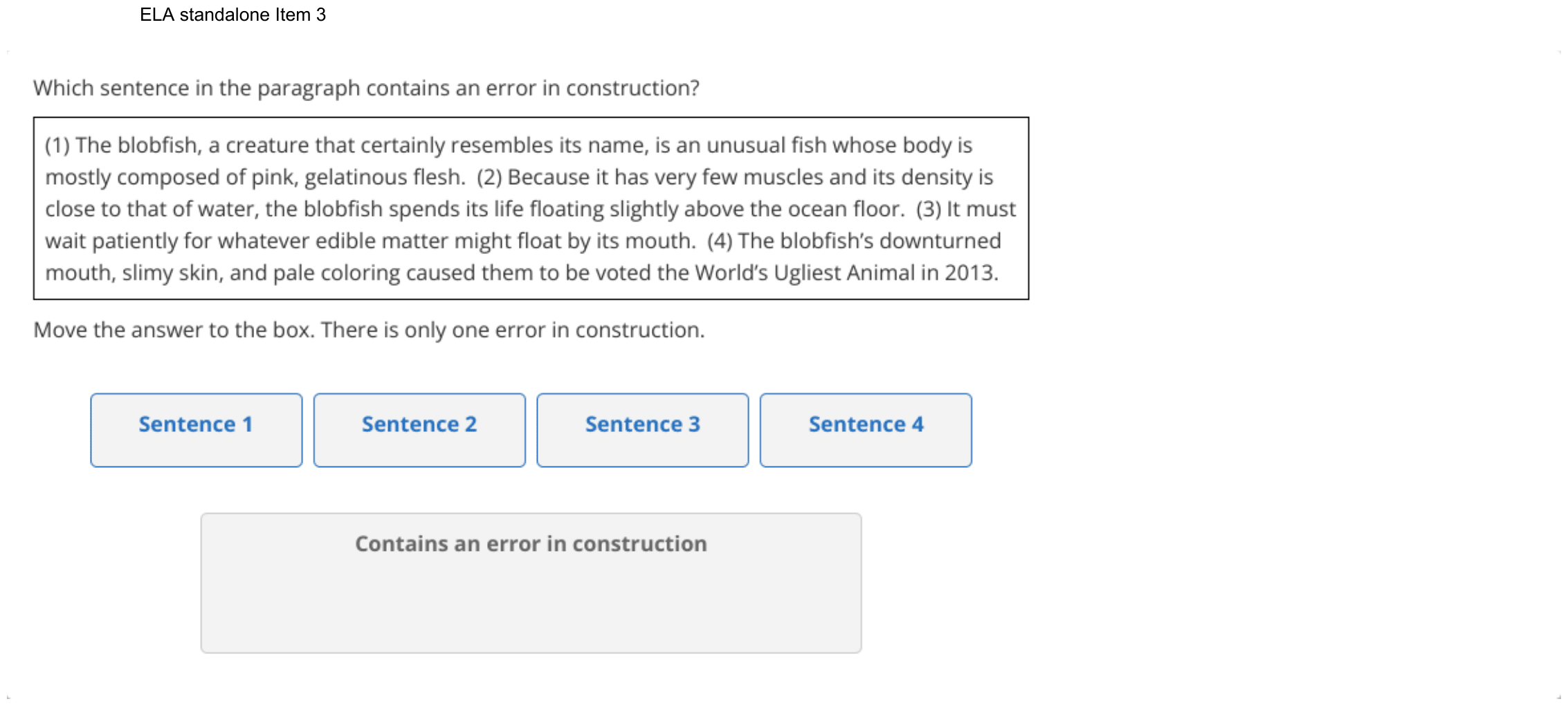
2026 Practice Test B English, question 23Passage Looking for the Smallest Spark of Everything
Looking for the Smallest Spark of Everything
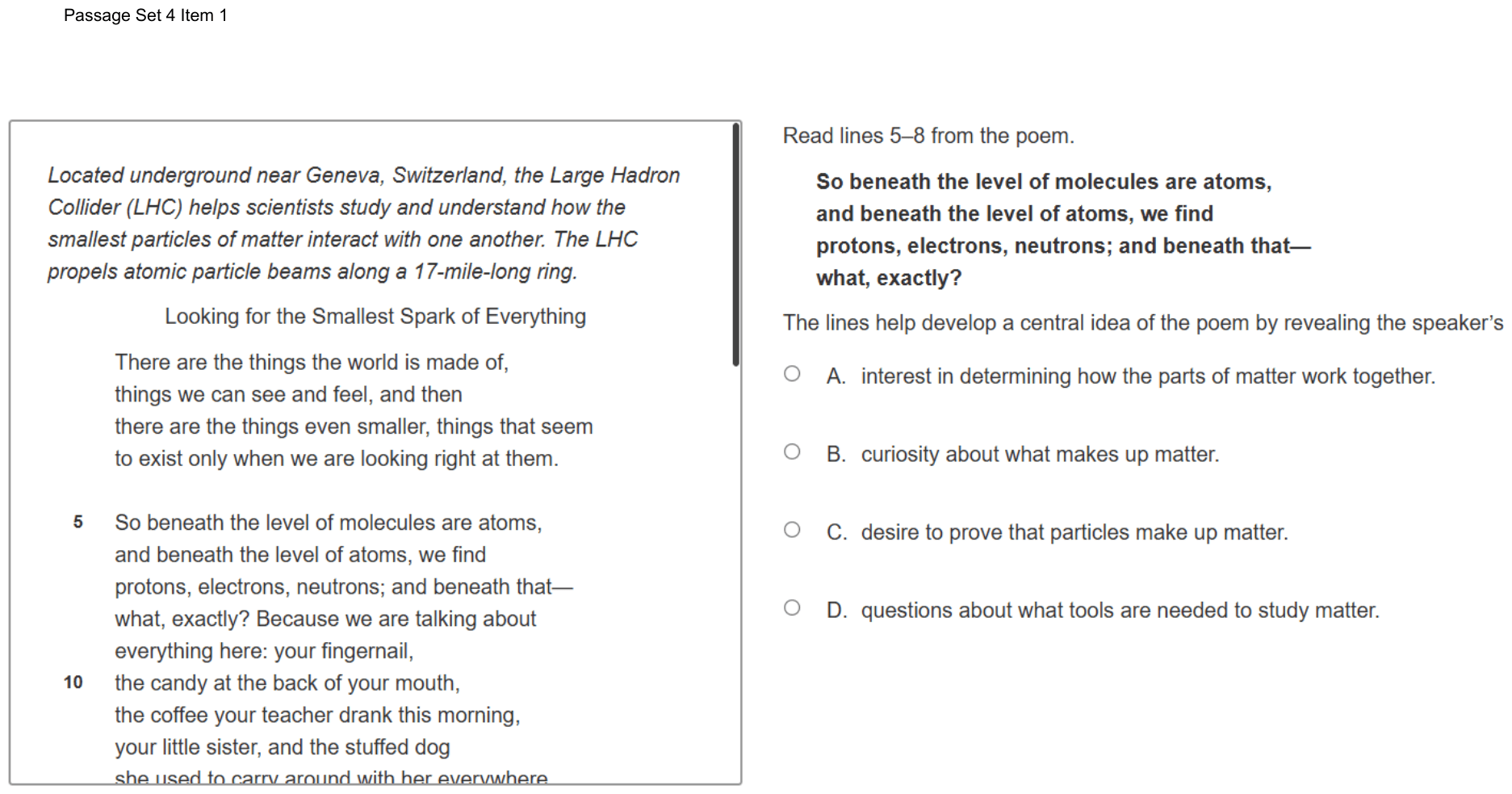
Located underground near Geneva, Switzerland, the Large Hadron Collider (LHC) helps scientists study and understand how the smallest particles of matter interact with one another. The LHC propels atomic particle beams along a 17-mile-long ring.
There are the things the world is made of,
things we can see and feel, and then
there are the things even smaller, things that seem
to exist only when we are looking right at them.
So beneath the level of molecules are atoms,
and beneath the level of atoms, we find
protons, electrons, neutrons; and beneath that—
what, exactly? Because we are talking about
everything here: your fingernail,
the candy at the back of your mouth,
the coffee your teacher drank this morning,
your little sister, and the stuffed dog
she used to carry around with her everywhere.
And everywhere.
Everything and everywhere
are made up of the same stuff, whatever
it is. How do we find it? We can listen for it
in the wavelengths from deep space,
talking back to us from unimaginable
distances. Or we can build long,
deep circular tunnels beneath the surface
of this Earth and race particles
(like racing cars, only very tiny cars
flashing along at close to the speed of light)
until everything we think we know
bangs against everything else we know.
And there, in the explosion, in the darkness,
briefly incandescent, they appear:
the quarks, the leptons, and the bosons;
the baryons and the mesons. Their names
sound like dinosaurs or maybe bands
playing terrible music in someone’s garage.
The one thing we know for sure
is that they spin. This is how gravity
enters our world, how our world is held
both together and apart, what keeps
together the pencil in your hand right now
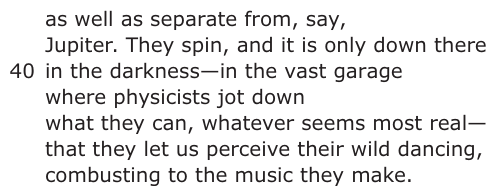
as well as separate from, say,
Jupiter. They spin, and it is only down there
in the darkness—in the vast garage
where physicists jot down
what they can, whatever seems most real—
that they let us perceive their wild dancing,
combusting to the music they make.
Question
Read lines 5–8 from the poem.
So beneath the level of molecules are atoms,
and beneath the level of atoms, we find
protons, electrons, neutrons; and beneath that—
what, exactly?
The lines help develop a central idea of the poem by revealing the speaker’s
- Ainterest in determining how the parts of matter work together.
- Bcuriosity about what makes up matter.
- Cdesire to prove that particles make up matter.
- Dquestions about what tools are needed to study matter.
Show the answer
Correct answer: B
The question asks what lines 5–8 reveal about the speaker to help develop a central idea of the poem.
A. Incorrect. In lines 5–8, the speaker is demonstrating knowledge about the structure of matter, not demonstrating interest in how matter’s parts work together; for example, “beneath the level of molecules are atoms, / and beneath the level of atoms, we find / protons, electrons, neutrons” (lines 5–7).
B. CORRECT. Lines 5–8 show the connection between the particles by using the words “beneath the level” repeatedly. The progression of particles of matter, from atoms to subatomic particles, “protons, electrons, neutrons” (line 7), ends with a question. By asking, “what, exactly?” (line 8), the speaker questions the mysteries that are still unsolved about the nature of matter, which is a central idea of the poem.
C. Incorrect. The speaker expresses curiosity in line 8 (“what, exactly?”) but does not use language in lines 5–8 that expresses a desire to prove a point. The poem does not show any conflict, either from within or from other scientists, about the concept that particles make up matter.
D. Incorrect. While the poem is about the Large Hadron Collider, which, according to the introductory text before the poem, is a tool that “helps scientists study and understand how the smallest particles of matter interact with one another,” lines 5–8 do not suggest the use of tools but rather question what comes after the “protons, electrons, neutrons” (line 7).
Question analysis
This question on the poem “Looking for the Smallest Spark of Everything,” about the Large Hadron Collider, quotes lines 5–8, which move from molecules down to atoms and smaller particles. Students decide what the lines reveal about the speaker and how that develops a central idea of the poem. The choices name related attitudes toward matter and science, so precise reading matters.
- Grade level
- Grade 6 reading and task
- Compared with grade 7
- Below grade 7 Below typical grade 7 demand: the four lines are quoted in the question and use everyday words, so a single step of interpretation links them to the speaker’s attitude and to the poem’s larger subject.
- Estimated difficulty
- Straightforward: two steps or one careful reading.
- Thinking it demands
- Depth of knowledge 2, skills and concepts · mainly analyze
- What makes it hard
- Evidence
- Answered from one paragraph or stanza
- Reading level
- Passage: 346 words (a poem; reading level not measured); question and choices: about grade 7, 76 words.
- Students, last 30 days
- Not enough answers yet to show (it takes 10).
Why it is hard, traps and wrong answers (shows the answer)
Why it is hard
The lines move down level by level, molecules, atoms, protons, and then stop at a question, so the speaker’s curiosity is close to the surface. The choice about how the parts work together comes nearest to the right one, helped by the head-note, which says the collider studies how particles “interact.” Students who notice that the lines list what lies beneath what, and never how things interact, settle on curiosity about what matter is made of.
Reading between the lines minor Working it out
The speaker never names a feeling; the curiosity shows in the dash and the question “what, exactly?” that cut off a confident list of layers. (Graesser, Singer & Trabasso, 1994; Kintsch, 1998)
A very close wrong answer minor Choosing the answer
The choice about how the parts of matter work together and the right one both give the speaker an interest in matter; they part on its object, how parts interact or what matter is made of. (Embretson & Wetzel, 1987; Gorin & Embretson, 2006; Ascalon et al., 2007)
Strategy: Read lines 5–8 as one sentence, describe in a word or two what the speaker is doing in them, and pick the choice that matches those exact lines.
Traps
- Twists what the text says: Uses the text's topic and ideas but changes what it says: who did it, how much, when, or why.
- Wrong part of the text: A choice is true of another paragraph, stanza or speaker than the one asked about.
- Reads too much in: A reasonable-sounding conclusion that goes further than the text allows.
The wrong answers, classified
A Twists what the text says (King et al., 2004)
Keeps the speaker’s interest in matter but shifts it from what lies beneath atoms to how parts interact, the subject the head-note gives the collider, not these lines.
C Reads too much in (Graesser, Singer & Trabasso, 1994)
Reads the confident list of layers as a case being argued, though the speaker treats them as known and ends on a question, seeking rather than proving.
D Wrong part of the text (Kirsch & Mosenthal, 1990)
Jumps ahead to stanza 3, where the speaker asks “How do we find it?” and describes tunnels, but lines 5–8 say nothing about tools or ways of studying matter.
Working it out, step by step
Figure out what the question asks
This asks what lines 5–8 show about the speaker, the voice talking in the poem. It also asks how that fits a central idea, a main point of the whole poem. Decide what the speaker is doing in these lines.
Read lines 5–8
The lines say “So beneath the level of molecules are atoms, / and beneath the level of atoms, we find / protons, electrons, neutrons; and beneath that— / what, exactly?” Matter is the stuff everything is made of. A molecule is a tiny group of atoms joined together. Protons, electrons and neutrons are the even tinier parts of an atom.
See what the speaker is doing
The speaker goes down layer by layer: molecules, then atoms, then the parts of atoms. Then the list stops with a dash and a question: “what, exactly?” The speaker does not know what lies beneath, and wants to know. That is curiosity. The whole poem keeps asking what everything is made of.
Check each choice
- A does not fit. The lines ask what is underneath, not how the parts work together.
- B fits. The speaker wonders what matter is made of at its smallest.
- C does not fit. The speaker is not trying to prove a point. The lines end with a question.
- D does not fit. Ways to search, like tunnels, come later, in lines 17–22. Lines 5–8 do not mention them.
Watch out: A is tempting because the note before the poem says scientists study how particles “interact,” or act on one another. But lines 5–8 are only about what lies beneath.
Choose the answer
The question “what, exactly?” shows a speaker who wants to know what matter is made of. So the answer is B, “curiosity about what makes up matter.”
Why this answer and not the closest wrong one
A is the closest wrong choice, since it also shows interest in matter. But A is about how the parts work together. Lines 5–8 never talk about that. They go down layer by layer and end with “what, exactly?” That question asks what matter is made of, so B fits.
More questions like this
The original DOE question
The passage “Looking for the Smallest Spark of Everything” as printed (pages 32–33)
Question 3 of 120
2026 Practice Test B English, question 24Uses the passage above: “Looking for the Smallest Spark of Everything”.
Question
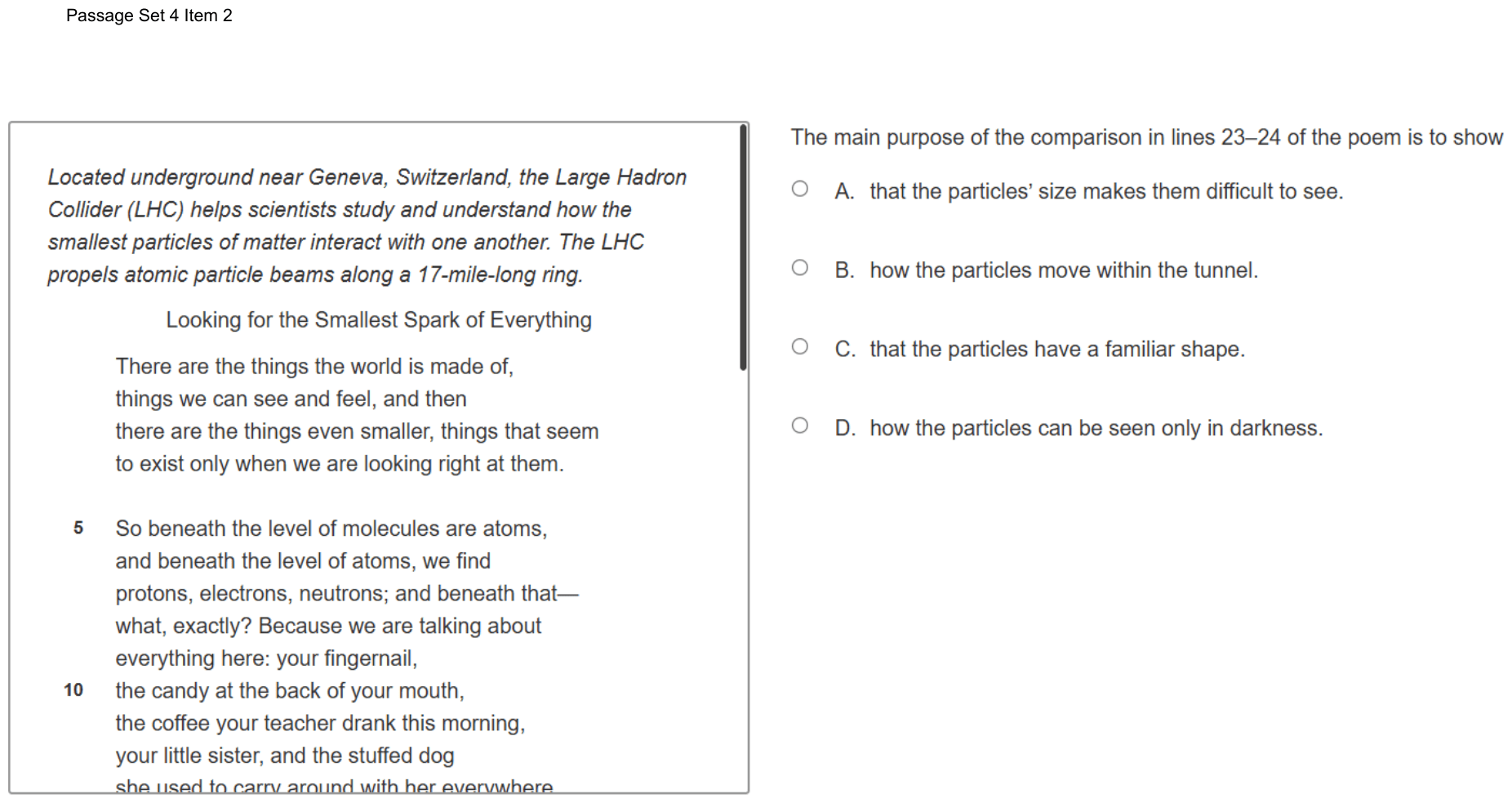
The main purpose of the comparison in lines 23–24 of the poem is to show
- Athat the particles’ size makes them difficult to see.
- Bhow the particles move within the tunnel.
- Cthat the particles have a familiar shape.
- Dhow the particles can be seen only in darkness.
Show the answer
Correct answer: B
The question asks what the comparison in lines 23–24 of the poem is mainly meant to show.
A. Incorrect. While the particles are moving “close to the speed of light” (line 24), which would make them difficult to see, the comparison in lines 23–24 focuses on the movement of the particles, not how visible they are.
B. CORRECT. Lines 23–24 describe “tiny cars / flashing along at close to the speed of light,” which describes how the particles move.
C. Incorrect. Lines 23–24 do not describe the shape of the particles but rather their movement, which is “flashing along at close to the speed of light” (line 24).
D. Incorrect. The word “flashing” in line 24 does not refer to light in darkness but rather to speed, and the word “light” is used to reference a measurement of speed, not brightness in darkness.
Question analysis
This figurative language question asks for the main purpose of a comparison in lines 23–24 of the poem “Looking for the Smallest Spark of Everything,” where particles in an underground tunnel are likened to tiny racing cars. Students must work out what the image is mainly meant to show about the particles, judging the comparison as a whole rather than word by word.
- Grade level
- Grade 6 reading and task
- Compared with grade 7
- Below grade 7 Explaining what a simple comparison shows is grade 6 work, and this one likens particles to racing cars in two short lines of familiar words, so a single step of interpretation is enough.
- Estimated difficulty
- Routine: one familiar step, little to misread.
- Thinking it demands
- Depth of knowledge 2, skills and concepts · mainly understand
- What makes it hard
- Evidence
- Answered from one sentence or line
- Reading level
- Passage: 346 words (a poem; reading level not measured); question and choices: about grade 5, 46 words.
- Students, last 30 days
- Not enough answers yet to show (it takes 10).
Why it is hard, traps and wrong answers (shows the answer)
Why it is hard
The image is built from words about motion, racing cars “flashing along at close to the speed of light,” so most students see its purpose quickly. Each wrong choice seizes one piece of the picture, the cars’ tininess, their shape or the word “light,” and makes it the point. Students who ask what the whole comparison makes them picture, rather than what one word suggests, avoid all three.
Figurative or literary language minor Understanding the question
The comparison sits in parentheses, “like racing cars, only very tiny cars / flashing along at close to the speed of light,” and students must see that racing cars stand for speed. (Graesser, Singer & Trabasso, 1994; Kintsch, 1998)
Strategy: Name the two things being compared in lines 23–24 and ask what a reader is meant to picture, then choose the purpose that the comparison’s own words support.
Traps
- Taking figurative language literally: A choice reads a figure of speech or image at face value.
- Word match: Repeats striking words or phrases from the text, so it looks supported, but its meaning does not fit the question.
- Dictionary meaning, not meaning here: A common meaning of the word that does not fit its use in this text.
The wrong answers, classified
A Word match (Freedle & Kostin, 1993)
Fixes on “very tiny cars” and decides the point is that the particles are too small to see, though racing cars are chosen for their speed, not their size.
C Taking figurative language literally (Graesser, Singer & Trabasso, 1994)
Takes the comparison at face value, as if particles looked like little cars, when the speaker uses racing to picture how they move, not what shape they have.
D Dictionary meaning, not meaning here (Perfetti, 2007)
Reads “flashing” and “light” as a glow, like the one in the darkness of lines 27–28, but “the speed of light” measures how fast the particles travel.
Working it out, step by step
Figure out what the question asks
This asks why the poet makes a comparison in lines 23–24. A comparison shows how two different things are alike. First find the two things. Then ask what the reader is meant to picture.
Read the lines around it
Lines 20–22 describe building “deep circular tunnels beneath the surface / of this Earth” to race particles. Then lines 23–24 add “(like racing cars, only very tiny cars / flashing along at close to the speed of light)”. The speed of light is the fastest speed there is.
Work out the comparison
The particles are compared to racing cars. Racing cars zoom around a track, lap after lap, very fast. The particles zoom around the round tunnel the same way. “Flashing along” means moving so fast they are a blur. So the comparison helps you picture how the particles move.
Check each choice
- A does not fit. The cars are “very tiny,” but the point is racing, not being hard to see.
- B fits. Like racing cars, the particles speed around the tunnel.
- C does not fit. The particles do not look like cars. The comparison is about motion, not shape.
- D does not fit. “Light” here measures speed. It is not about glowing in the dark.
Watch out: A is tempting because of the word “tiny.” But a poet picks racing cars to show speed, not size.
Choose the answer
The racing cars help you picture particles speeding around the tunnel. So the answer is B, “how the particles move within the tunnel.”
Why this answer and not the closest wrong one
A is the closest wrong choice, since the poem does call them “very tiny cars.” But the comparison is to racing cars “flashing along at close to the speed of light.” Every word there is about speed and motion. So B, how the particles move, fits better.
More questions like this
The original DOE question
Question 4 of 120
2026 Practice Test B English, question 25Uses the passage above: “Looking for the Smallest Spark of Everything”.
Question
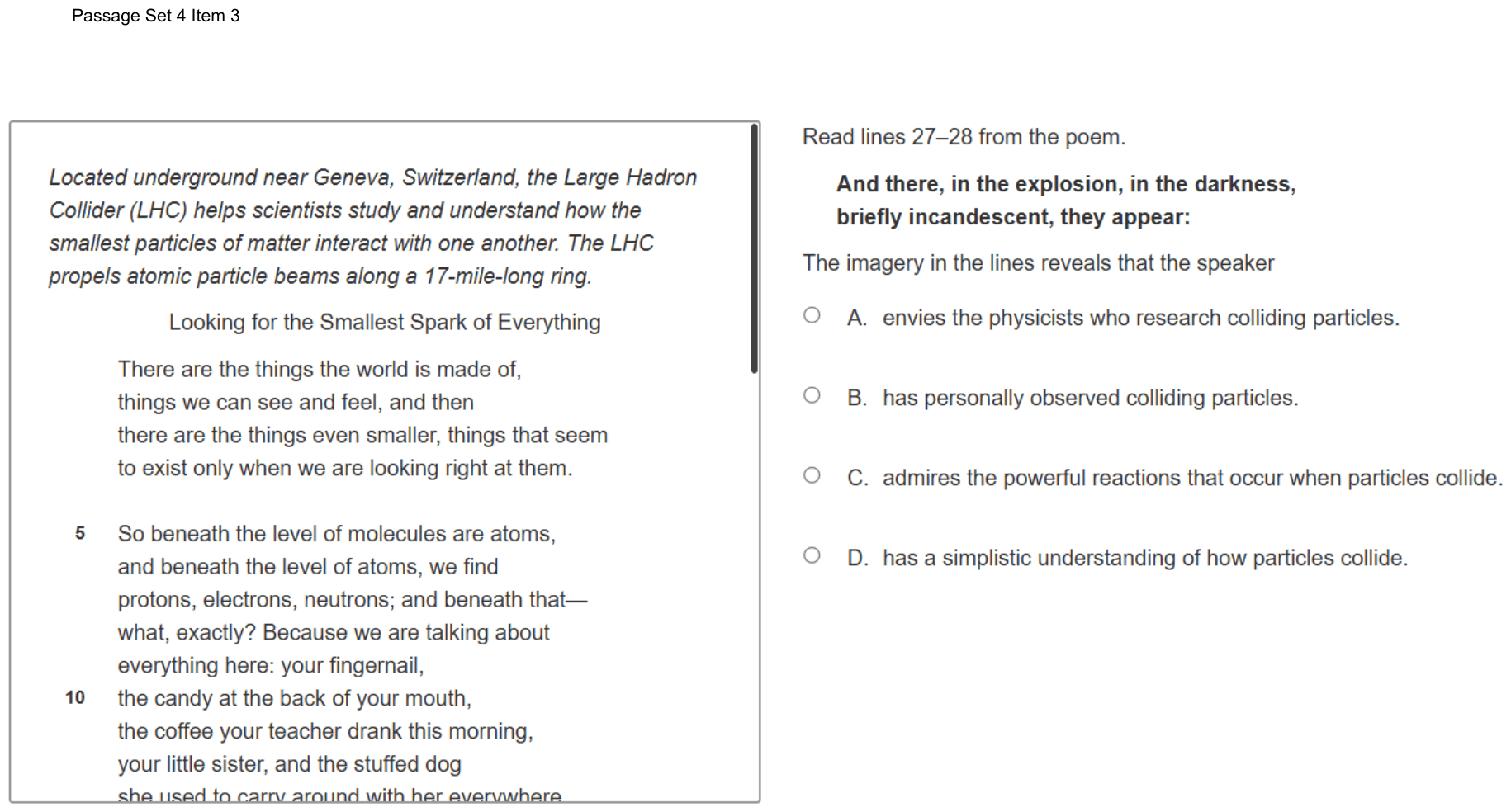
Read lines 27–28 from the poem.
And there, in the explosion, in the darkness,
briefly incandescent, they appear:
The imagery in the lines reveals that the speaker
- Aenvies the physicists who research colliding particles.
- Bhas personally observed colliding particles.
- Cadmires the powerful reactions that occur when particles collide.
- Dhas a simplistic understanding of how particles collide.
Show the answer
Correct answer: C
The question asks what the imagery in lines 27–28 reveals about the speaker.
A. Incorrect. The physicists mentioned in the fifth stanza (lines 33–44) are described as mere observers: they “jot down / what they can” (lines 41–42). In lines 27–28, the speaker is focused on the reaction between the colliding particles, not on the physicists who study them.
B. Incorrect. The speaker describes the particle collision in detail, but the text does not imply that the speaker has personally witnessed a collision. The speaker implies that his or her understanding of the collision is based on the experiences of the physicists observing the phenomenon (“They spin, and it is only down there / in the darkness—in the vast garage / where physicists jot down / what they can, whatever seems most real— / that they let us perceive their wild dancing” [lines 39–43]).
C. CORRECT. The word “explosion” and the phrase “briefly incandescent” create a picture of rapid changes and short bursts of bright light, revealing how powerful the new particles are. The language the speaker uses is positive, revealing that the speaker admires the power of the reaction and stands in awe of the new particles.
D. Incorrect. The poem reveals the speaker’s deep knowledge about subatomic particles. For example, the speaker is able to name the new particles discovered—“the quarks, the leptons, and the bosons; / the baryons and the mesons” (lines 29–30)—and is able to use imagery to create a powerful picture that reveals the complexity of a scientific process that humans have never been able to see.
Question analysis
This imagery question asks what lines 27–28 of “Looking for the Smallest Spark of Everything” reveal about the poem’s speaker, as particles appear “briefly incandescent” in an explosion inside a particle collider. Students must infer what a vivid image says about the person describing it. The word “incandescent” may be unfamiliar, and the choices are about very different things.
- Grade level
- Grade 8 reading and task
- Compared with grade 7
- Above grade 7 Grade 7 students infer a speaker’s attitude from imagery, but these two lines turn on the uncommon word “incandescent,” state nothing about the speaker outright, and the choices range over the speaker’s knowledge, experience and feelings, which is harder than typical grade 7 work.
- Estimated difficulty
- Hard: combines ideas, needs a plan, and has more than one tempting wrong answer.
- Thinking it demands
- Depth of knowledge 2, skills and concepts · mainly analyze
- What makes it hard
- Reading between the lines major
- Hard words moderate
- Figurative or literary language minor
- Evidence
- Answered from one paragraph or stanza
- Reading level
- Passage: 346 words (a poem; reading level not measured); question and choices: about grade 9, 55 words.
- Students, last 30 days
- Not enough answers yet to show (it takes 10).
Why it is hard, traps and wrong answers (shows the answer)
Why it is hard
Nothing in the two lines names a feeling, so students must judge the speaker’s attitude from the image alone, and its key word is uncommon. The vividness is itself a trap: a scene described this sharply can seem to be one the speaker watched, though the poem says the particles are perceived only through the physicists’ work. The choices range over envy, experience, admiration and understanding, so each must be tested against the lines rather than against an overall impression.
Reading between the lines major Working it out
The lines describe particles, not the speaker, and contain no word of feeling; admiration has to be inferred from the drama of “the explosion” and the glow of “briefly incandescent.” (Graesser, Singer & Trabasso, 1994; Kintsch, 1998)
Hard words moderate Understanding the question
“Incandescent,” glowing with heat and light, is the word that makes the image dazzling, and a student who does not know it sees only an explosion in the dark. (Perfetti, 2007; Freedle & Kostin, 1993)
Figurative or literary language minor Understanding the question
The two lines are pure imagery, a burst of light in darkness as the particles “appear,” and the question asks what that picture reveals about the person painting it. (Graesser, Singer & Trabasso, 1994; Kintsch, 1998)
Strategy: Picture the scene in lines 27–28, including what “incandescent” means, decide what the description suggests about the speaker, and test each choice against these two lines.
Traps
- Taking figurative language literally: A choice reads a figure of speech or image at face value.
- Reads too much in: A reasonable-sounding conclusion that goes further than the text allows.
The wrong answers, classified
A Reads too much in (Graesser, Singer & Trabasso, 1994)
Reasons that someone so drawn to the scene must envy the physicists who study it, though the physicists appear only in lines 39–44 and nothing in the poem hints at envy.
B Taking figurative language literally (Graesser, Singer & Trabasso, 1994)
Takes the vivid scene of particles that “appear” in a glow as something the speaker witnessed, though lines 39–43 place that sight “down there,” where physicists record what they can.
D Reads too much in (Graesser, Singer & Trabasso, 1994)
Treats the poem’s playful comparisons, racing cars and garage bands, as a sign of shallow knowledge, though the next lines have the speaker naming quarks, leptons, bosons, baryons and mesons.
Working it out, step by step
Figure out what the question asks
This asks what the imagery in lines 27–28 shows about the speaker. Imagery is language that helps you see, hear or feel a scene. The lines describe particles, not the speaker. So you must infer, or figure out from clues, how the speaker feels.
Read lines 27–28
The lines say “And there, in the explosion, in the darkness, / briefly incandescent, they appear:” Briefly means for a short time. Incandescent means glowing with heat and light. So picture a burst of bright light flashing in the dark. The particles have just crashed into each other, or collided. In that flash, the tiny particles appear.
Decide how the speaker feels
The words are bold and bright: “explosion,” “incandescent,” “appear.” The speaker makes the moment sound dramatic and amazing. People describe something this way when they are in awe of it. So the speaker admires, or looks up to, the power of the crash.
Check each choice
- A does not fit. Physicists come up only later, in line 41. Nothing shows envy, or wanting what they have.
- B does not fit. Nothing says the speaker was there. Lines 39–42 place the sight “down there,” where “physicists jot down / what they can.”
- C fits. The glowing burst in the dark shows the speaker’s wonder.
- D does not fit. Right after, the speaker names quarks, leptons, bosons, baryons and mesons. That is not a simple understanding.
Watch out: B is tempting because the scene is so vivid. But a writer can picture something without seeing it in person.
Choose the answer
The bright, explosive picture shows a speaker who is amazed by the crash. So the answer is C, “admires the powerful reactions that occur when particles collide.”
Why this answer and not the closest wrong one
B is the closest wrong choice, because the scene feels like an eyewitness report. But the lines never say the speaker was in the tunnel. What they do show is a feeling. Words like “explosion” and “briefly incandescent” make the moment thrilling. That is admiration, so C fits.
More questions like this
The original DOE question
Question 5 of 120
2026 Practice Test B English, question 26Uses the passage above: “Looking for the Smallest Spark of Everything”.
Question
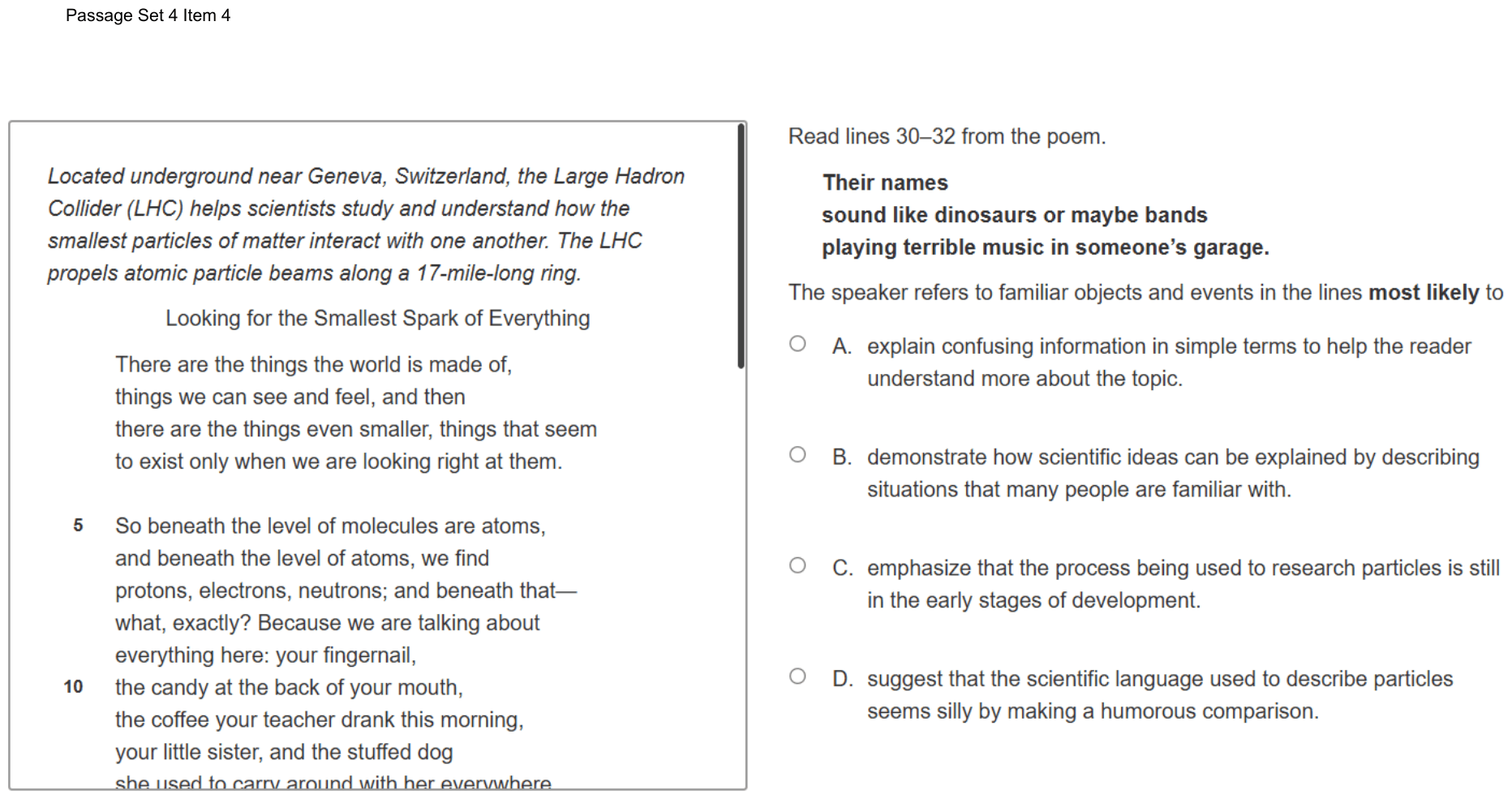
Read lines 30–32 from the poem.
Their names
sound like dinosaurs or maybe bands
playing terrible music in someone’s garage.
The speaker refers to familiar objects and events in the lines most likely to
- Aexplain confusing information in simple terms to help the reader understand more about the topic.
- Bdemonstrate how scientific ideas can be explained by describing situations that many people are familiar with.
- Cemphasize that the process being used to research particles is still in the early stages of development.
- Dsuggest that the scientific language used to describe particles seems silly by making a humorous comparison.
Show the answer
Correct answer: D
The question asks why the speaker refers to familiar objects and events in lines 30–32.
A. Incorrect. In lines 30–32, the speaker only gives an opinion about what the names sound like and does not simplify confusing information about how these newly discovered particles function or exist.
B. Incorrect. In lines 30–32, the speaker is only describing what the names of the particles sound like: “dinosaurs or maybe bands” (line 31). These descriptions illustrate the speaker’s opinion but do not explain specific scientific ideas.
C. Incorrect. In lines 30–32, the mention of the names of the particles sounding like “dinosaurs or maybe bands” (line 31) reveals the speaker’s opinion about the names but does not explain the process of researching the particles.
D. CORRECT. The phrase “their names” (line 30) refers to the scientific names of the particles: “the quarks, the leptons, and the bosons; / the baryons and the mesons” (lines 29–30). In lines 30–32, the speaker expresses the opinion that these scientific terms sound nonsensical, much like the strange scientific names of dinosaurs or silly band names.
Question analysis
In “Looking for the Smallest Spark of Everything,” the speaker says the names of particles sound like dinosaurs or bands playing in someone’s garage. This question asks why the speaker refers to such familiar things in lines 30–32. Students must read the comparison’s tone and purpose, and the choices offer several reasons poets compare science with everyday life.
- Grade level
- Grade 7 reading and task
- Compared with grade 7
- At grade 7 Explaining why a speaker includes a comparison is typical grade 7 work on word choice and tone. The three lines are quoted and their images are everyday ones, but the choices state purposes that differ in subtle ways.
- Estimated difficulty
- Moderate: several steps, or a close reading with one strong distractor.
- Thinking it demands
- Depth of knowledge 2, skills and concepts · mainly analyze
- What makes it hard
- How, not what moderate
- Figurative or literary language moderate
- Reading between the lines minor
- Evidence
- Answered from one paragraph or stanza
- Reading level
- Passage: 346 words (a poem; reading level not measured); question and choices: about grade 10, 97 words.
- Students, last 30 days
- Not enough answers yet to show (it takes 10).
Why it is hard, traps and wrong answers (shows the answer)
Why it is hard
Two choices give the textbook reason for an everyday comparison, to make hard science easier, and they draw students who answer from what comparisons usually do. These lines explain nothing; they say how the particles’ names sound, and “terrible music in someone’s garage” is a joke at the expense of the jargon. Students who trace “Their names” back to the list before it and hear the teasing tone reach the right purpose.
How, not what moderate Working it out
The question asks why the speaker makes the comparison, and two choices offer the usual reason for likening science to everyday things, making it easier to grasp, which these lines do not do. (Anderson & Krathwohl, 2001)
Figurative or literary language moderate Understanding the question
The humor has to be heard: names that sound like dinosaurs or like bands “playing terrible music in someone’s garage” are being teased, which signals a joke, not an explanation. (Graesser, Singer & Trabasso, 1994; Kintsch, 1998)
Reading between the lines minor Working it out
“Their names” points back to the list in lines 29–30, quarks, leptons, bosons, baryons and mesons, and students must see that the lines judge those words, not the particles. (Graesser, Singer & Trabasso, 1994; Kintsch, 1998)
Strategy: Find what “Their names” refers to in the lines just before, then ask what the comparison says about those names and in what tone, and match the purpose to both.
Traps
- Wrong purpose or structure: Names a purpose, structure or effect that the part does not serve, or describes what a part says when the question asks what it does.
- Too broad or too strong: A choice overstates, generalizes, or uses absolute words the text does not support.
- Reads too much in: A reasonable-sounding conclusion that goes further than the text allows.
The wrong answers, classified
A Wrong purpose or structure (Anderson & Krathwohl, 2001)
Assumes that comparing science with familiar things is meant to simplify it, but these lines explain nothing about particles; they only say what the names sound like.
B Too broad or too strong (King et al., 2004)
Turns three lines into a general claim about teaching science through familiar situations, though no scientific idea is described here, only the sound of some names.
C Reads too much in (Graesser, Singer & Trabasso, 1994)
Hears “someone’s garage” as an amateur workshop and concludes that particle research is just beginning, a meaning the lines, which tease the names, never suggest.
Working it out, step by step
Figure out what the question asks
This asks why the speaker compares the particles’ names to familiar things. Familiar means well known from everyday life. First find what “Their names” points to. Then decide what the comparison says about those names, and in what tone.
Find what their names means
Lines 29–30 list the particles: “the quarks, the leptons, and the bosons; / the baryons and the mesons.” Then the speaker says “Their names / sound like dinosaurs or maybe bands / playing terrible music in someone’s garage.” So “their names” means these science words.
Hear the joke
Dinosaurs have long, strange names. A garage band is a group of beginners who practice in a garage. Their music is often loud and bad. The speaker is teasing the science words. They sound odd and a little silly. This is a humorous, or funny, comparison.
Check each choice
- A does not fit. The lines explain nothing about particles. They only say how the names sound.
- B does not fit. No science idea is explained here.
- C does not fit. “Garage” is part of the band joke. It does not say the research is new.
- D fits. The joke makes the science names sound silly.
Watch out: A is tempting because comparisons to everyday things often make science easier. But these lines make fun of names. They do not explain anything.
Choose the answer
The speaker compares the particle names to dinosaurs and bad garage bands to poke fun at them. So the answer is D, “suggest that the scientific language used to describe particles seems silly by making a humorous comparison.”
Why this answer and not the closest wrong one
A is the closest wrong choice. Writers often compare science to everyday things to make it simpler. But ask what these lines explain. Nothing about how particles work is made clearer. The lines only say the names sound like “bands / playing terrible music.” That is a joke about the words, so D fits.
More questions like this
The original DOE question
Question 6 of 120
2026 Practice Test B English, question 27Uses the passage above: “Looking for the Smallest Spark of Everything”.
Question
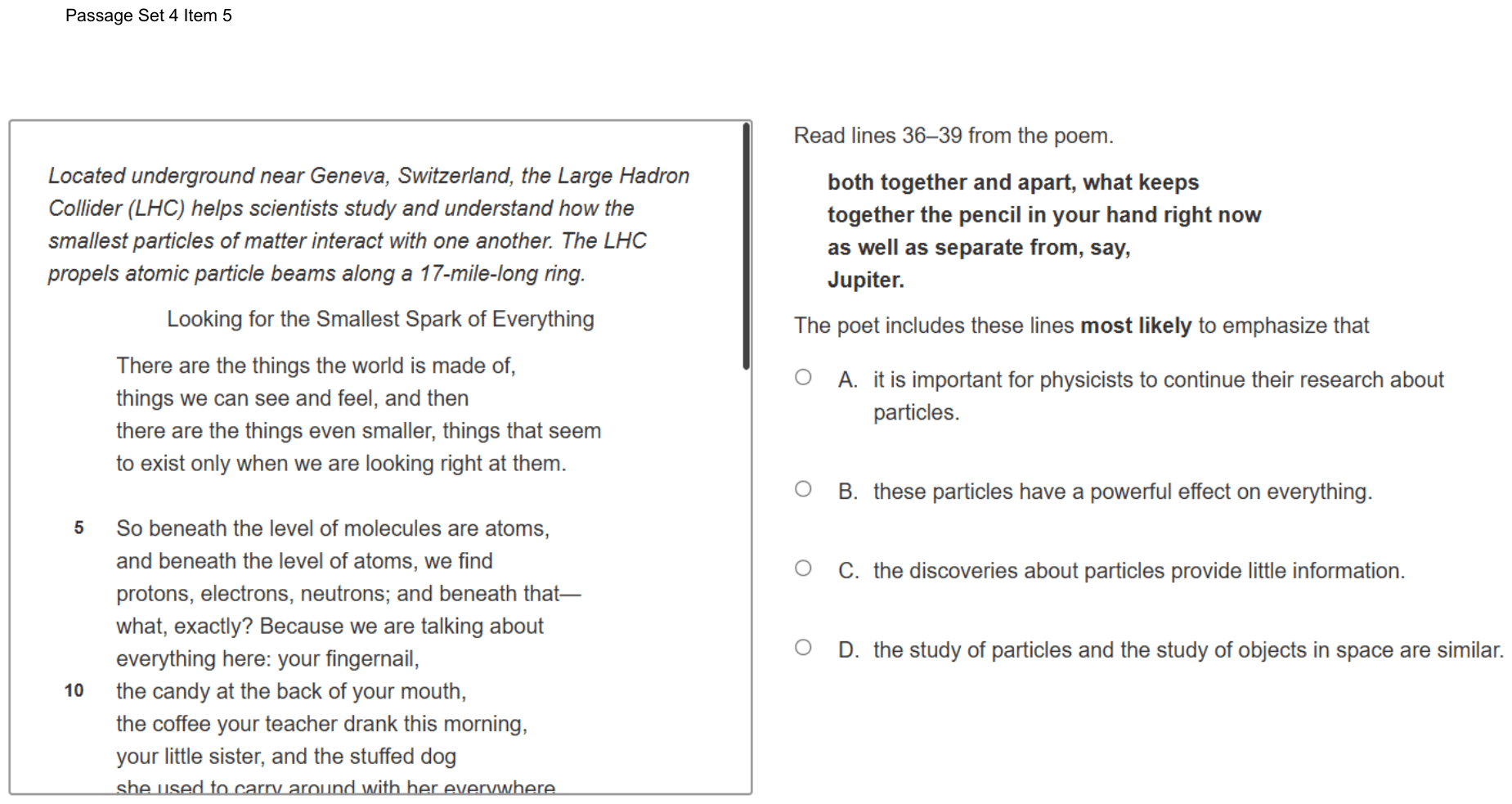
Read lines 36–39 from the poem.
both together and apart, what keeps
together the pencil in your hand right now
as well as separate from, say,
Jupiter.
The poet includes these lines most likely to emphasize that
- Ait is important for physicists to continue their research about particles.
- Bthese particles have a powerful effect on everything.
- Cthe discoveries about particles provide little information.
- Dthe study of particles and the study of objects in space are similar.
Show the answer
Correct answer: B
The question asks for the most likely reason the poet includes lines 36–39 in the poem.
A. Incorrect. While the poem implies that the research is important, lines 36–39 do not point to a need for more research. Instead, the lines explain the power of the particles in the universe.
B. CORRECT. The particles that are “Everything and everywhere” (line 15) make up the objects mentioned in lines 36–39: a “pencil in your hand” and the planet “Jupiter.” Even though these objects are different from each other and extremely far apart in the universe, they are made up of and affected by these particles. The “powerful effect” is that the particles keep the objects “both together and apart” (line 36).
C. Incorrect. While the physicists can only “jot down / what they can, whatever seems most real” (lines 41–42), the discoveries about particles are ongoing and informative. The speaker shares that the particles are “everything and everywhere” (line 15) and that they “spin” (line 34), and that “this is how gravity / enters our world” (lines 34–35).
D. Incorrect. The speaker states that particles keep together objects in space, such as Jupiter, as well as objects on Earth, such as “the pencil in your hand right now” (line 37). However, in lines 36–39, the speaker is not comparing the study of subatomic particles with the study of objects in space (astronomy); the speaker is implying that because particles are “everything and everywhere” (line 15), the study of particles affects our understanding of everything in the universe, regardless of location.
Question analysis
This question asks why the poet of “Looking for the Smallest Spark of Everything” includes lines 36–39, about what keeps a pencil in your hand together and separate from the planet Jupiter. The quoted lines begin partway through a sentence, so students must read the lines before them to see what the sentence is about before judging the poet’s purpose.
- Grade level
- Grade 7 reading and task
- Compared with grade 7
- At grade 7 Explaining why a poet includes certain lines is typical grade 7 work. The quoted lines start partway through a sentence, so students must read lines 33–35 to see what the sentence is about, an extra step but not an unusual one.
- Estimated difficulty
- Moderate: several steps, or a close reading with one strong distractor.
- Thinking it demands
- Depth of knowledge 2, skills and concepts · mainly analyze
- What makes it hard
- Complex sentences moderate
- Reading between the lines minor
- Evidence
- Answered from one paragraph or stanza
- Reading level
- Passage: 346 words (a poem; reading level not measured); question and choices: about grade 8, 75 words.
- Corrected from the DOE handbook
- The explanation of C reversed cause and effect in the poem; one word was changed.
- Students, last 30 days
- Not enough answers yet to show (it takes 10).
Why it is hard, traps and wrong answers (shows the answer)
Why it is hard
The quoted lines are the tail of a sentence, and without its start they read like a list of objects. Students who go back to lines 33–35 see that the spin of the particles is what holds things “together and apart,” and the pencil and Jupiter show how far that reaches. Those who read the fragment alone fasten on Jupiter and think of astronomy, while those who read on to the physicists who “jot down / what they can” may decide that little is known.
Complex sentences moderate Understanding the question
The quoted lines begin mid-sentence with “both together and apart, what keeps,” so students must read back to lines 33–35 to learn that the subject is the particles’ spin, “how gravity / enters our world.” (Abedi & Lord, 2001; Freedle & Kostin, 1993; Messick, 1989)
Reading between the lines minor Working it out
The lines never say “everything”; students must see that a pencil in your hand and a distant planet stand for things near and small and things far and huge, so the effect reaches all matter. (Graesser, Singer & Trabasso, 1994; Kintsch, 1998)
Strategy: Read lines 33–39 as one sentence, work out what the subject of “what keeps” is, and then ask what point the two examples in lines 37–39 are meant to make.
Traps
- Twists what the text says: Uses the text's topic and ideas but changes what it says: who did it, how much, when, or why.
- Wrong part of the text: A choice is true of another paragraph, stanza or speaker than the one asked about.
- Reads too much in: A reasonable-sounding conclusion that goes further than the text allows.
The wrong answers, classified
A Reads too much in (Graesser, Singer & Trabasso, 1994)
Assumes the lines push for more research, a common message in writing about science, but they state what the particles do, not what physicists should go on doing.
C Wrong part of the text (Kirsch & Mosenthal, 1990)
Draws on “The one thing we know for sure” in line 33 and the physicists who “jot down / what they can” in lines 41–42, but lines 36–39 state confidently what the particles do.
D Twists what the text says (King et al., 2004)
Sees a planet next to a pencil and builds a comparison between particle physics and astronomy, though the lines show one force acting on both objects, not two fields of study.
What was corrected from the DOE handbook, and why
- Explanation: Rejecting C, the handbook's explanation says the particles “spin” “because ‘this is how gravity / enters our world’”. The poem says it the other way round: “The one thing we know for sure / is that they spin. This is how gravity / enters our world”, so the spinning is how gravity enters. It now says the particles “spin”, and that “this is how gravity / enters our world”. The answer, B, is unchanged.
Working it out, step by step
Figure out what the question asks
This asks why the poet includes lines 36–39. The lines start in the middle of a sentence. So read the whole sentence, from line 33, to see what it is about.
Read lines 33–39 as one sentence
Lines 33–34 say “The one thing we know for sure / is that they spin.” “They” means the tiny particles. Then the poem goes on: “This is how gravity / enters our world, how our world is held / both together and apart, what keeps / together the pencil in your hand right now / as well as separate from, say, / Jupiter.”
Work out what it means
“This” points back to the spinning. The spinning is how gravity comes into our world. Gravity is the pull that draws things toward each other. So the particles’ spin holds a pencil together and keeps it apart from Jupiter. A pencil is small and close. Jupiter is a huge planet, far away. Together they stand for everything.
Check each choice
- A does not fit. The lines say what particles do. They do not say physicists must keep working.
- B fits. The particles affect everything, from a pencil to a planet.
- C does not fit. These lines state facts with confidence. The physicists who “jot down / what they can” come later, in lines 41–42.
- D does not fit. The pencil and Jupiter are things the particles affect. They are not two subjects of study being compared.
Watch out: D is tempting because Jupiter is in space. But the lines show one force acting on both objects, not two kinds of science.
Choose the answer
A small pencil and a giant planet show that the particles’ effect reaches everything. So the answer is B, “these particles have a powerful effect on everything.”
Why this answer and not the closest wrong one
D is the closest wrong choice, since it also notices Jupiter. But D is about studying particles and studying space. The lines are not about study. They say the spin is “what keeps / together the pencil in your hand” and keeps it apart from Jupiter. Small and near, huge and far: that means everything, so B fits.
More questions like this
The original DOE question
Question 7 of 120
2026 Practice Test B English, question 28Uses the passage above: “Looking for the Smallest Spark of Everything”.
Question
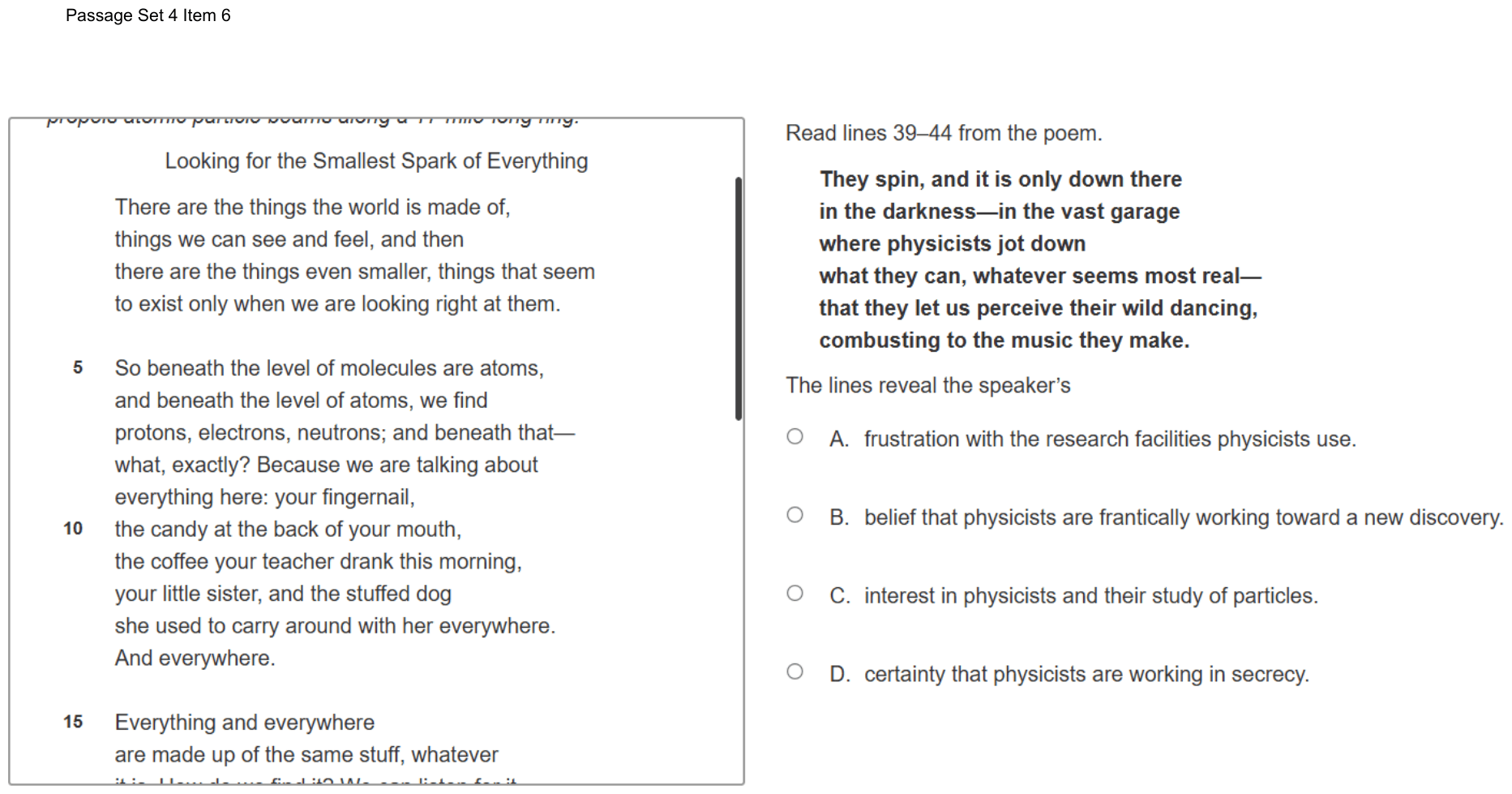
Read lines 39–44 from the poem.
They spin, and it is only down there
in the darkness—in the vast garage
where physicists jot down
what they can, whatever seems most real—
that they let us perceive their wild dancing,
combusting to the music they make.
The lines reveal the speaker’s
- Afrustration with the research facilities physicists use.
- Bbelief that physicists are frantically working toward a new discovery.
- Cinterest in physicists and their study of particles.
- Dcertainty that physicists are working in secrecy.
Show the answer
Correct answer: C
The question asks what lines 39–44 reveal about the speaker.
A. Incorrect. While the discoveries are made “in the darkness” (line 40), the imagery conveys the speaker’s positive tone through descriptions like “perceive their wild dancing” (line 43) and “combusting to the music they make” (line 44), not frustration.
B. Incorrect. In lines 39–44, the imagery of energetic movement (“They spin,” “their wild dancing,” and “combusting to the music they make”) is used to describe the particles, not the physicists.
C. CORRECT. The speaker uses the phrases “only down there” (line 39), “physicists jot down … whatever seems most real” (lines 41–42), and “they let us perceive” (line 43) to convey that the physicists have a rare role in studying the mysteries of the universe and that the speaker appreciates and is interested in their work.
D. Incorrect. While the description of the experiments occurring “in the darkness” (line 40) may create a sense of secrecy, the secrets that the darkness refers to are the mysteries of subatomic particles, not the work processes that the physicists use.
Question analysis
The final six lines of “Looking for the Smallest Spark of Everything” describe particles spinning in the darkness of a “vast garage” where physicists work. This question asks what those lines reveal about the speaker. The long sentence is broken by dashes and mixes images of the particles with images of the scientists, so students must sort out which words describe which.
- Grade level
- Grade 8 reading and task
- Compared with grade 7
- Above grade 7 Grade 7 students infer a speaker’s attitude, usually from a clear statement. These six lines form one sentence broken by dashes, students must keep track of who does what, and the attitude is never stated, so the task is above typical grade 7 work.
- Estimated difficulty
- Hard: combines ideas, needs a plan, and has more than one tempting wrong answer.
- Thinking it demands
- Depth of knowledge 2, skills and concepts · mainly analyze
- What makes it hard
- Complex sentences major
- Figurative or literary language moderate
- Reading between the lines moderate
- Evidence
- Answered from one paragraph or stanza
- Reading level
- Passage: 346 words (a poem; reading level not measured); question and choices: about grade 8, 82 words.
- Students, last 30 days
- Not enough answers yet to show (it takes 10).
Why it is hard, traps and wrong answers (shows the answer)
Why it is hard
The sentence is the hardest part: the physicists appear in a clause set off by dashes, and the two uses of “they” around them refer to different subjects. Students who attach “wild dancing” to the physicists see frantic work, and those who stop at “in the darkness” see secrecy. The right choice is mild and general, so it is easy to pass over, yet it fits because the speaker lingers on the scene with evident fascination and nothing in the lines expresses frustration or certainty.
Complex sentences major Understanding the question
Lines 39–44 are one sentence broken by a dash clause, and its two uses of “they” point different ways: “what they can” means the physicists, “they let us perceive” the spinning particles. (Abedi & Lord, 2001; Freedle & Kostin, 1993; Messick, 1989)
Figurative or literary language moderate Understanding the question
The particles’ “wild dancing,” “combusting to the music they make,” and the lab as “the vast garage” are images whose tone, delight rather than complaint, students must judge. (Graesser, Singer & Trabasso, 1994; Kintsch, 1998)
Reading between the lines moderate Working it out
No line states the speaker’s attitude; interest has to be read from how closely the speaker follows the work of physicists who “jot down / what they can, whatever seems most real.” (Graesser, Singer & Trabasso, 1994; Kintsch, 1998)
Strategy: Untangle the sentence in lines 39–44 by finding who spins, who jots things down and who lets us perceive, then decide what the description reveals about how the speaker regards the scene.
Traps
- Twists what the text says: Uses the text's topic and ideas but changes what it says: who did it, how much, when, or why.
- Wrong tone or attitude: Misjudges the tone, attitude or point of view, such as reading admiration as criticism, or taking a character's or subject's feelings for the author's.
- Reads too much in: A reasonable-sounding conclusion that goes further than the text allows.
The wrong answers, classified
A Wrong tone or attitude (Graesser, Singer & Trabasso, 1994)
Links “the vast garage” to the garage bands’ “terrible music” of line 32 and hears a complaint, though the lines end on the delighted image of “wild dancing.”
B Twists what the text says (King et al., 2004)
Gives the particles’ “wild dancing” and “combusting” to the physicists, misled by the pronouns around them, though the physicists only “jot down / what they can.”
D Reads too much in (Graesser, Singer & Trabasso, 1994)
Reads “only down there / in the darkness” as a sign of hidden work, though the darkness belongs to the underground tunnel, and nothing in the lines suggests secrecy.
Working it out, step by step
Figure out what the question asks
This asks what lines 39–44 show about the speaker. The lines are one long sentence. It uses the word “they” for two different groups. So first sort out who is doing what.
Sort out who does what
- “They spin” means the particles spin.
- “physicists jot down / what they can” means the physicists write down what they can. Here “they” is the physicists.
- “they let us perceive their wild dancing” means the particles let us see their dance. Perceive means notice or see. Here “they” is the particles again.
Put the sentence in plain words
The part between the dashes describes the place. It is the huge tunnel, “the vast garage,” where physicists take notes. Without that part, the sentence says this: only down there do the particles let us see their wild dance. Combusting means bursting into flame. It is a lively, joyful picture.
Decide what it shows about the speaker
The speaker brings the physicists into the scene and shows their careful work. They write down “whatever seems most real.” The speaker also shows that all of us see the particles only through this research. The speaker cares about the physicists and what they study. That is interest.
Check each choice
- A does not fit. “The vast garage” is playful, and the lines end in delight. There is no complaint.
- B does not fit. The wild motion belongs to the particles. The physicists only “jot down / what they can.”
- C fits. The speaker follows the physicists’ work and the particles they study.
- D does not fit. It is dark because the tunnel is underground. Nothing suggests the work is secret.
Watch out: B is tempting because the lines sound frantic, or wild and rushed. But “they let us perceive” means the particles, so the dancing is theirs, not the physicists’.
Choose the answer
The lines show the speaker paying close attention to physicists and the particles they study. So the answer is C, “interest in physicists and their study of particles.”
Why this answer and not the closest wrong one
B is the closest wrong choice. The words “wild dancing” and “combusting” do sound frantic. But they describe the particles. In “they let us perceive,” “they” means the particles. The physicists just “jot down / what they can.” So the lines do not show physicists rushing. They show the speaker’s interest, which is C.
More questions like this
The original DOE question
Question 8 of 120
2026 Practice Test C English, question 20Passage Bird Talk
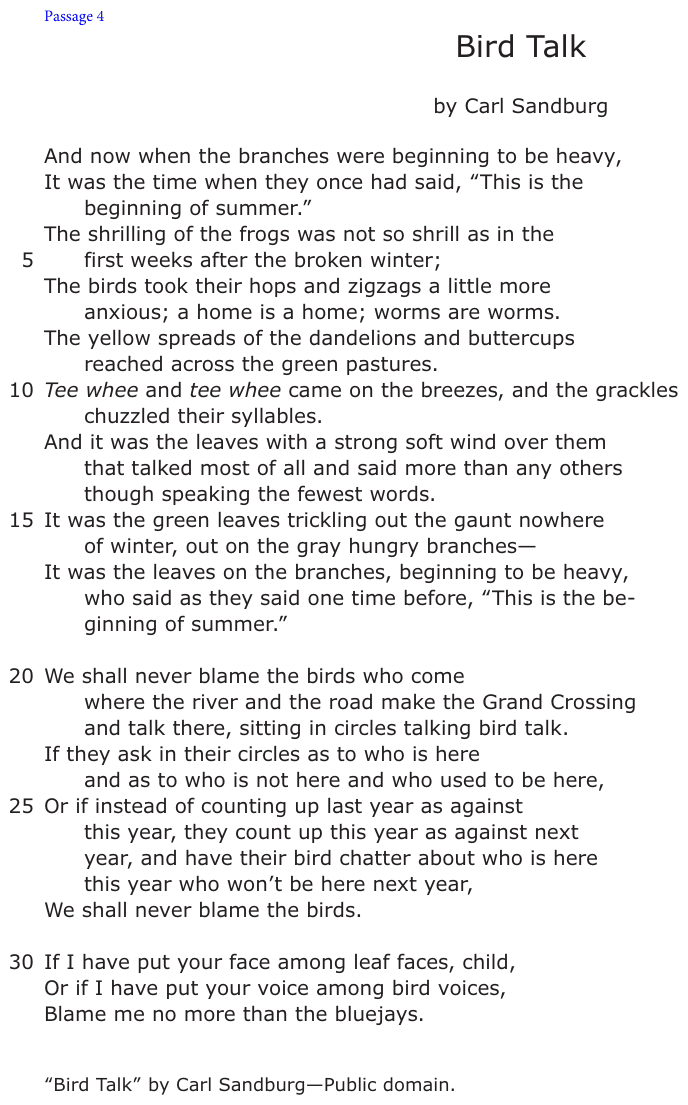
Bird Talk
by Carl Sandburg
And now when the branches were beginning to be heavy,
It was the time when they once had said, “This is the
beginning of summer.”
The shrilling of the frogs was not so shrill as in the
first weeks after the broken winter;
The birds took their hops and zigzags a little more
anxious; a home is a home; worms are worms.
The yellow spreads of the dandelions and buttercups
reached across the green pastures.
Tee whee and tee whee came on the breezes, and the grackles
chuzzled their syllables.
And it was the leaves with a strong soft wind over them
that talked most of all and said more than any others
though speaking the fewest words.
It was the green leaves trickling out the gaunt nowhere
of winter, out on the gray hungry branches—
It was the leaves on the branches, beginning to be heavy,
who said as they said one time before, “This is the be-
ginning of summer.”
We shall never blame the birds who come
where the river and the road make the Grand Crossing
and talk there, sitting in circles talking bird talk.
If they ask in their circles as to who is here
and as to who is not here and who used to be here,
Or if instead of counting up last year as against
this year, they count up this year as against next
year, and have their bird chatter about who is here
this year who won’t be here next year,
We shall never blame the birds.
If I have put your face among leaf faces, child,
Or if I have put your voice among bird voices,
Blame me no more than the bluejays.
“Bird Talk” by Carl Sandburg—Public domain.
Question
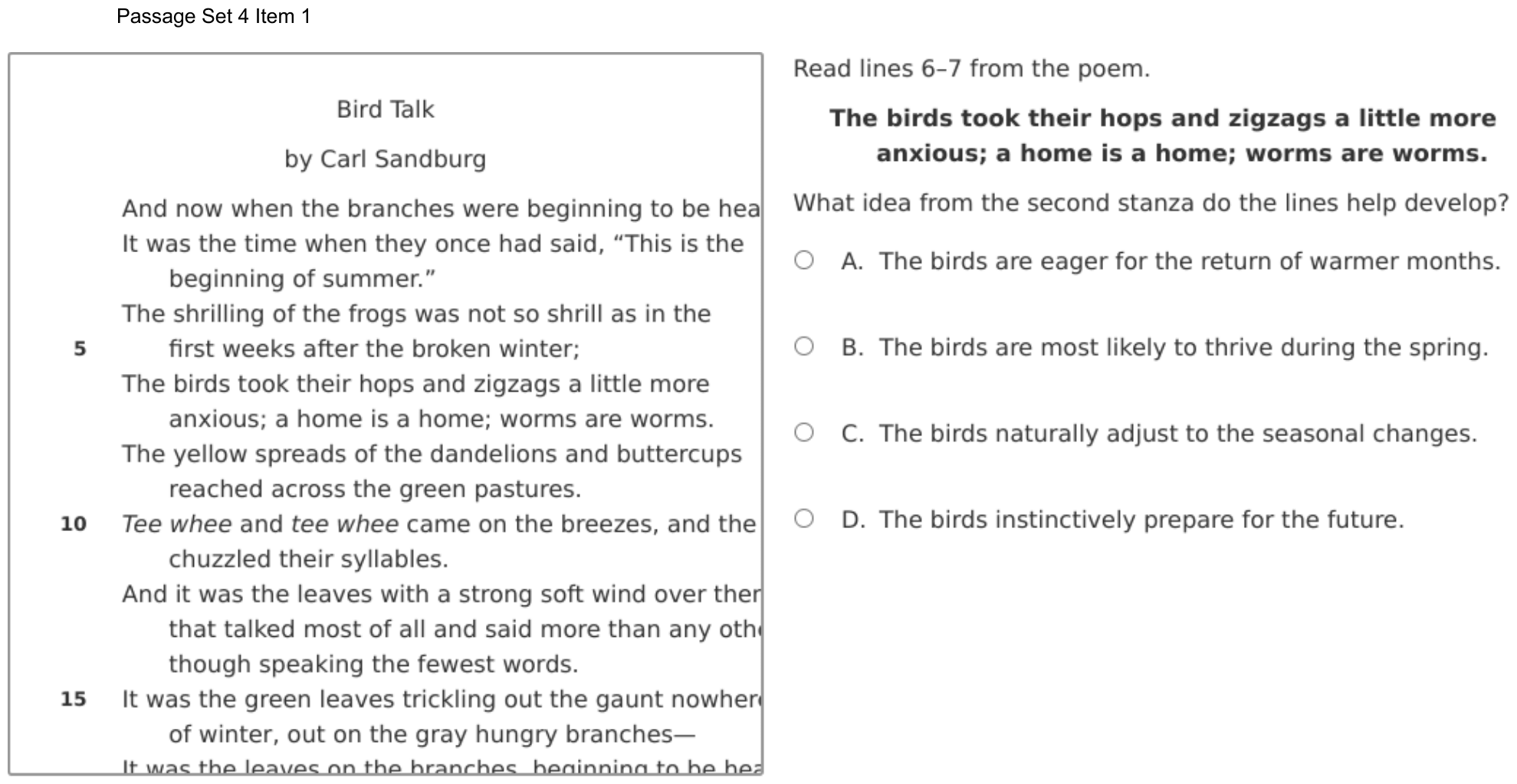
Read lines 6–7 from the poem.
The birds took their hops and zigzags a little more
anxious; a home is a home; worms are worms.
What idea from the second stanza do the lines help develop?
- AThe birds are eager for the return of warmer months.
- BThe birds are most likely to thrive during the spring.
- CThe birds naturally adjust to the seasonal changes.
- DThe birds instinctively prepare for the future.
Show the answer
Correct answer: C
The question asks how lines 6–7 from the poem develop an idea from the second stanza.
A. Incorrect. In lines 2–3, the tree branches exclaim that “ ‘This is the / beginning of summer,’ ” and the birds respond by taking “their hops and zigzags a little more / anxious” (lines 6–7); however, the birds’ eager reaction to the return of warmer weather is not referenced in the second stanza of the poem, which is more about the nature of birds generally than the changing of the seasons.
B. Incorrect. Birds are more likely to thrive in warmer weather as evidenced by some birds’ migration to a warmer climate during winter, and the creatures in the first stanza are responding to the “ ‘beginning of summer’ ” (line 3) in their own way, such as the birds who are taking “their hops and zigzags a little more / anxious” (lines 6–7). However, the thriving of birds during a particular season is not the focus of the second stanza; rather, it is focused on the general nature of birds.
C. CORRECT. The birds are taking “their hops and zigzags a little more / anxious” (lines 6–7) in light of warmer weather, but they are not making a big to-do of the change because “a home is a home; worms are worms” (line 7) any time of the year. Such a natural adjustment to seasonal changes is reflected in the second stanza, where the birds “count up this year as against next / year” (lines 26–27) because they are well accustomed to the cyclical nature of things.
D. Incorrect. Although the birds’ actions of “hops and zigzags” (line 6) may indicate some sort of preparation, these actions are not preparation but rather the internalized cognizance of the change that has occurred with little conscious thought. As revealed in the second stanza, birds do not ponder much about past or future but rather adapt naturally as things change.
Question analysis
This question on Carl Sandburg’s poem “Bird Talk” quotes lines 6–7, where the birds hop and zigzag “a little more anxious,” and asks which idea from the second stanza they help develop. Students must link two compressed lines in the first stanza to a later stanza about birds gathered at the Grand Crossing, and every choice sounds like a fair claim about birds.
- Grade level
- Grade 8 reading and task
- Compared with grade 7
- Above grade 7 Typical grade 7 poetry questions ask what one line or stanza shows on its own. Here two compressed lines from the first stanza must be tied to an idea the second stanza never states, in Sandburg’s loose, unusual phrasing.
- Estimated difficulty
- Among the hardest on the SHSAT: a non-obvious approach, heavy reading, or a well-hidden trap.
- Thinking it demands
- Depth of knowledge 3, strategic thinking · mainly analyze
- What makes it hard
- Reading between the lines major
- A very close wrong answer moderate
- Evidence in several places moderate
- Figurative or literary language moderate
- Evidence
- Answered from several paragraphs or stanzas
- Reading level
- Passage: 296 words (a poem; reading level not measured); question and choices: about grade 5, 70 words.
- Students, last 30 days
- Not enough answers yet to show (it takes 10).
Why it is hard, traps and wrong answers (shows the answer)
Why it is hard
The stem runs in an unusual direction: two lines from the first stanza must help develop an idea that only the second stanza holds, and the poem never states it. Students who read “next year” as planning are drawn to preparation, a choice built on the key’s own frame, while others answer from the first stanza’s summer or from what they know about birds. The question rewards hearing the birds’ roll call of who is gone as the same matter-of-fact acceptance as “worms are worms.”
Reading between the lines major Working it out
Neither stanza states the shared idea: students must hear calm acceptance in “a home is a home; worms are worms” and in birds tallying “who won’t be here next year,” then call it adjusting to change. (Graesser, Singer & Trabasso, 1994; Kintsch, 1998)
A very close wrong answer moderate Choosing the answer
The choice about instinctive preparation shares the key’s shape, birds acting by nature as time passes; it differs only in what the birds do, prepare for the future rather than adjust to the seasons. (Embretson & Wetzel, 1987; Gorin & Embretson, 2006; Ascalon et al., 2007)
Evidence in several places moderate Working it out
Lines 6–7 sit in the first stanza and the idea lives in the second, lines 20–29, so students must carry two lines across the poem and match them to the gathering at the Grand Crossing. (Kirsch & Mosenthal, 1990; Gorin & Embretson, 2006)
Figurative or literary language moderate Understanding the question
“A home is a home; worms are worms” says nothing on its surface; its meaning, a shrug that life goes on as it always has, has to be read from the repetition. (Graesser, Singer & Trabasso, 1994; Kintsch, 1998)
Strategy: Paraphrase the second stanza first: what are the birds doing and saying at the Grand Crossing? Then reread lines 6–7 and ask which idea about birds both passages share.
Traps
- Reads too much in: A reasonable-sounding conclusion that goes further than the text allows.
- Wrong part of the text: A choice is true of another paragraph, stanza or speaker than the one asked about.
- Outside knowledge: A choice is plausible in the real world but not supported by this text.
The wrong answers, classified
A Wrong part of the text (Kirsch & Mosenthal, 1990)
Hears “a little more anxious” as eagerness for the summer announced in lines 2–3, an idea of the first stanza, while the second stanza never mentions weather or warmth.
B Outside knowledge (King et al., 2004; Recht & Leslie, 1988)
Brings in the real fact that birds do well in warm weather, which neither lines 6–7 nor the birds’ talk of who is gone says, and the poem’s season is summer, not spring.
D Reads too much in (Graesser, Singer & Trabasso, 1994)
Sees nest-building in “a home is a home” and planning in counting “this year as against next / year,” but the birds only note who will be missing and make no preparations.
Working it out, step by step
Figure out what the question asks
This question points in an unusual direction. Lines 6–7 are in the first stanza. A stanza is a group of lines set apart by a blank line. But the idea you need is in the second stanza, lines 20–29. The question asks which idea in stanza 2 these earlier lines also help build. So find the idea in stanza 2 first. Then see how lines 6–7 support it.
Find the idea in stanza 2
In stanza 2, birds sit “in circles talking bird talk.” They ask “who is here / and as to who is not here and who used to be here.” They also talk about “who is here / this year who won’t be here next year.” The birds simply count the changes. They are not upset by them. The speaker says, “We shall never blame the birds.” The idea: birds take the changes that time brings as a normal part of life.
Read lines 6–7 closely
Lines 6–7 say “The birds took their hops and zigzags a little more / anxious; a home is a home; worms are worms.” As summer comes, the birds hop about a little more nervously and busily. That is a small change. Then the speaker shrugs: “a home is a home; worms are worms.” Life goes on as it always does. The birds change a little and carry on, with no fuss.
See what the two parts share
Both parts show birds meeting change calmly. In lines 6–7, the season turns, and the birds adjust a little. To adjust is to change a little to fit something new. In stanza 2, the birds note who has come and gone, and life goes on. So lines 6–7 help build stanza 2’s idea: birds naturally adjust to the changing seasons.
Check each choice
- A does not fit. Stanza 2 never mentions warm weather or being eager for it.
- B does not fit. Nothing in the poem says birds do best in spring. The poem’s season is the start of summer.
- C fits. Both parts show birds taking seasonal change calmly, as a matter of course.
- D does not fit. The birds talk about next year, but they make no plans for it.
Watch out: D is tempting because “a home is a home” can sound like nest building. But the birds only count who will be missing. They do not get ready for anything.
Choose the answer
Lines 6–7 and stanza 2 both show birds accepting change as natural. So the answer is C, “The birds naturally adjust to the seasonal changes.”
Why this answer and not the closest wrong one
D is the closest wrong choice. Like C, it says birds act by nature as time passes. But D says they prepare, or get ready. In stanza 2, the birds talk about next year only to count who “won’t be here next year.” In lines 6–7, they hop about and carry on. They adjust to change. They do not plan for it.
More questions like this
The original DOE question
The passage “Bird Talk” as printed (page 32)
Question 9 of 120
2026 Practice Test C English, question 21Uses the passage above: “Bird Talk”.
Question
Read lines 12–14 from the poem.
And it was the leaves with a strong soft wind over them
that talked most of all and said more than any others
though speaking the fewest words.
What does the phrase “talked most of all” in line 13 convey?
- AIt establishes that the speaker thinks the sound of wind in the leaves is the best indication that the season is changing.
- BIt introduces the idea that the sound of the wind in the leaves remains constant throughout the seasons.
- CIt suggests that the speaker is overwhelmed by the sounds of nature that emerge as the season changes.
- DIt emphasizes that the sounds of nature enable the speaker to appreciate each season of the year.
Show the answer
Correct answer: A
This question asks for what a phrase reveals about the speaker’s perspective on the change in seasons.
A. CORRECT. The first stanza of the poem establishes the way different parts of the natural world, including both plants and animals, respond to the change in season. These lines reflect the way the wind in the leaves is the best indication of the seasonal change because it is the wind in the leaves that “talked most of all and said more than any others / though speaking the fewest words” (lines 13–14).
B. Incorrect. Although the sound of the wind is the most obvious sign of the seasonal change per the speaker, it is in response to the “ ‘beginning of summer’ ” (line 3) that the wind speaks through the leaves. The poem does not reveal that this figurative speech occurs throughout the seasons, only that it occurs during the transition to summer.
C. Incorrect. While the language used by the speaker indicates a deep appreciation for the natural phenomenon being witnessed, the language used does not indicate a feeling of being overwhelmed but rather a feeling of awareness.
D. Incorrect. Using the personification of the wind “speaking” (line 14) indicates an appreciation by the speaker for the power and volume of the wind’s voice, but only one instance of the wind’s speech, that which occurs at the “ ‘beginning of summer’ ” (line 3), is chronicled by the speaker in the poem.
Question analysis
Students interpret the personification in lines 12–14 of “Bird Talk,” where the leaves under a strong soft wind “talked most of all,” and decide what that phrase conveys. Because the leaves also speak “the fewest words,” the line seems to contradict itself, and its meaning depends on how it fits Sandburg’s first stanza about the start of summer.
- Grade level
- Grade 7 reading and task
- Compared with grade 7
- At grade 7 Explaining what a figurative phrase conveys about a speaker’s view is standard grade 7 work. The three lines are printed with the question, though the phrase still has to be read against the rest of the first stanza.
- Estimated difficulty
- Moderate: several steps, or a close reading with one strong distractor.
- Thinking it demands
- Depth of knowledge 2, skills and concepts · mainly understand
- What makes it hard
- Figurative or literary language moderate
- Reading between the lines moderate
- Evidence
- Answered from one paragraph or stanza
- Reading level
- Passage: 296 words (a poem; reading level not measured); question and choices: about grade 6, 119 words.
- Students, last 30 days
- Not enough answers yet to show (it takes 10).
Why it is hard, traps and wrong answers (shows the answer)
Why it is hard
The phrase ranks the leaves above the shrilling frogs and chattering birds as voices of the season, but it never says what they are best at, so students must supply the idea of a sign. The tempting wrong readings take the speaker’s pleasure in nature and stretch it to every season, or hear “talked most of all” as noise. The quiet words around the phrase, “strong soft wind” and “fewest words,” point to a calm sound that tells the most.
Figurative or literary language moderate Understanding the question
The leaves are personified, and the line seems to contradict itself: they “talked most of all and said more than any others / though speaking the fewest words.” (Graesser, Singer & Trabasso, 1994; Kintsch, 1998)
Reading between the lines moderate Working it out
Students must turn “said more than any others” into a judgment, that the leaves are the surest sign of summer, which lines 17–19 confirm when the leaves themselves announce “the beginning of summer.” (Graesser, Singer & Trabasso, 1994; Kintsch, 1998)
Strategy: Restate lines 12–14 in plain words, especially the contrast between saying more and speaking fewer words, then test each choice against the whole first stanza.
Traps
- Too broad or too strong: A choice overstates, generalizes, or uses absolute words the text does not support.
- Wrong tone or attitude: Misjudges the tone, attitude or point of view, such as reading admiration as criticism, or taking a character's or subject's feelings for the author's.
- Twists what the text says: Uses the text's topic and ideas but changes what it says: who did it, how much, when, or why.
The wrong answers, classified
B Twists what the text says (King et al., 2004)
Stretches “as they said one time before” into a sound heard all year, though the leaves have only just come out of “the gaunt nowhere / of winter.”
C Wrong tone or attitude (Graesser, Singer & Trabasso, 1994)
Hears “talked most of all” as a din that swamps the speaker, though the “strong soft wind” and “fewest words” describe a quiet sound noted calmly, with no sign of strain.
D Too broad or too strong (King et al., 2004)
Rightly senses the speaker’s pleasure in nature’s voices but widens it to “each season of the year,” though the poem watches only the turn to summer and singles out the leaves.
Working it out, step by step
Figure out what the question asks
This asks what a phrase conveys, or gets across. The phrase is “talked most of all” in line 13. Leaves can’t really talk. Giving a thing human actions, like talking, is called personification. You need to work out what the speaker means by saying the leaves talked the most.
Read lines 12–14
Lines 12–14 say “And it was the leaves with a strong soft wind over them / that talked most of all and said more than any others / though speaking the fewest words.” The others are the frogs and birds from earlier lines. The leaves “said more than any others,” yet they used “the fewest words.” So the quiet rustle of the leaves tells you more than all the frog and bird calls.
Find what the leaves say
The stanza ends with the leaves speaking. Lines 17–19 say it was “the leaves on the branches, beginning to be heavy,” who said “This is the beginning of summer.” So the leaves’ message is that the season has changed. The new leaves, rustling in the wind, are the clearest sign that summer has come.
Check each choice
- A fits. The leaves say the most about the season, so they are the best sign that it is changing.
- B does not fit. The leaves have just come out of “the gaunt nowhere / of winter.” Gaunt means thin and bare. The leaves do not rustle the same way all year.
- C does not fit. A “strong soft wind” and “the fewest words” describe a quiet sound. Nothing shows the speaker is overwhelmed, or swamped.
- D does not fit. The poem watches only one change, the start of summer, not each season.
Watch out: D is tempting because the speaker clearly enjoys nature’s sounds. But it stretches that to “each season of the year,” which the poem never covers.
Choose the answer
“Talked most of all” shows that the leaves tell the most about the change of season. So the answer is A, “It establishes that the speaker thinks the sound of wind in the leaves is the best indication that the season is changing.”
Why this answer and not the closest wrong one
D is the closest wrong choice. The speaker does seem to enjoy the sounds of nature. But the poem covers just one change, the turn to summer. And the phrase does more than show enjoyment. It ranks the leaves above the frogs and birds. They say the most about the change, so they are the best sign of it.
More questions like this
The original DOE question
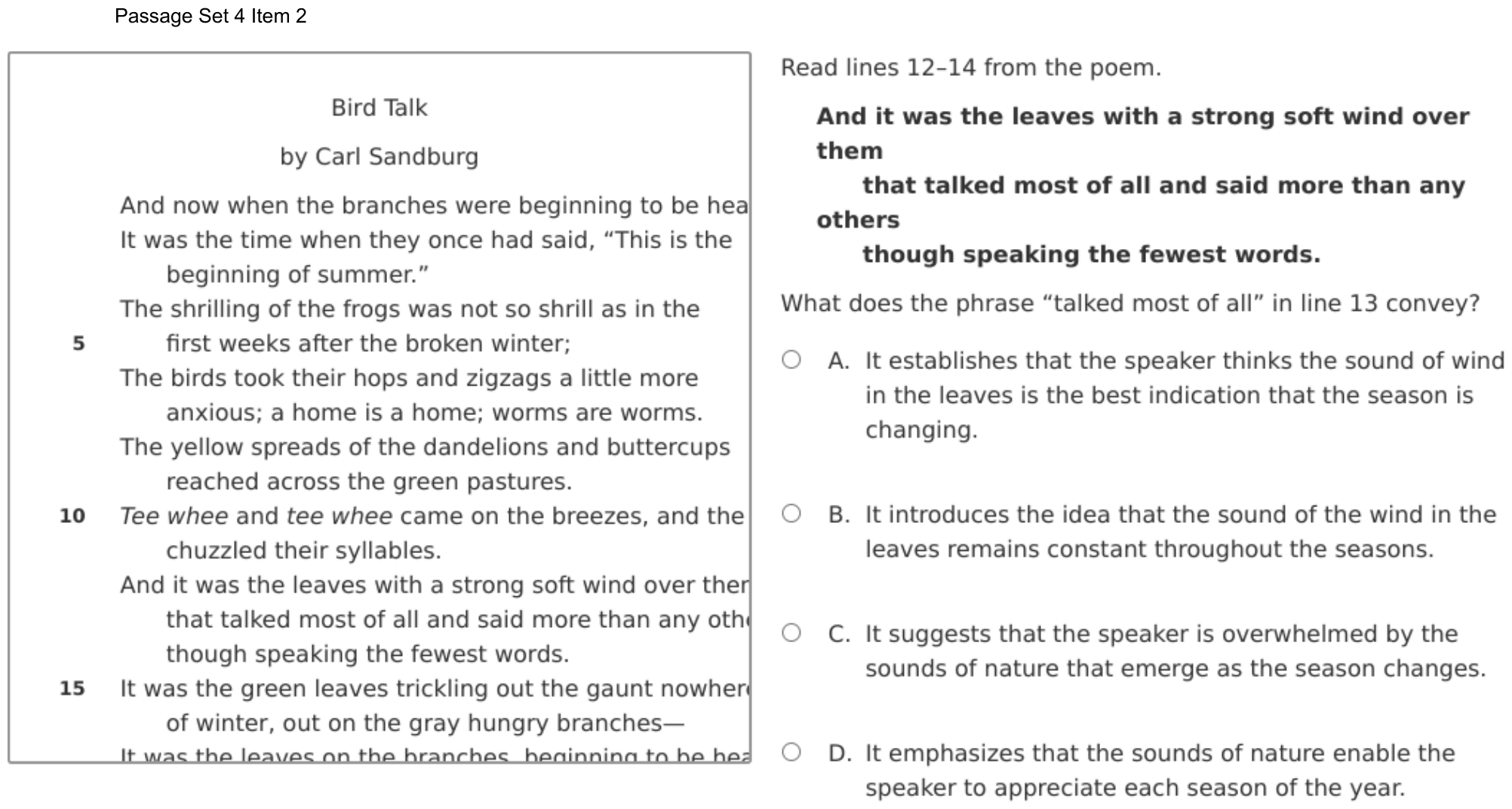
Question 10 of 120
2026 Practice Test C English, question 22Uses the passage above: “Bird Talk”.
Question
How does the repetition of “ ‘This is the beginning of summer’ ” in lines 2–3 and lines 18–19 contribute to the meaning of the poem?
- AIt suggests that the shift to summer occurs in the same way each year.
- BIt emphasizes the idea that living things are prepared for the change of season.
- CIt highlights the idea that the first signs of summer are surprising each year.
- DIt builds expectations about what the natural world looks like during a change of season.
Show the answer
Correct answer: A
The question asks how the repetition of a phrase contributes to the meaning of the poem in terms of conveying information about a cyclical event.
A. CORRECT. This phrase is used twice verbatim, in both cases to show the figurative words spoken by the branches (lines 2–3) and the leaves on the branches (lines 18–19). Repetition of this phrase conveys the idea that the transition to summer occurs in the same manner each subsequent year and thus evokes the same response from nature.
B. Incorrect. While living things—branches and leaves—both make identical figurative utterances, they do so not because they have prepared for such an event. Rather, these living things take the change in stride because of the sameness and expectedness of the seasonal shifts, which occur in the same way each time.
C. Incorrect. Even though the branches and leaves have been imbued by the speaker with some degree of consciousness in their figurative ability to speak, they are not surprised by the change in seasons. They say the same thing each year because the same thing occurs each year in the same way.
D. Incorrect. Certain lines of the poem do describe the natural world during the change of seasons, such as lines 8–9: “The yellow spreads of the dandelions and buttercups / reached across the green pastures.” However, this repeated phrase serves to evoke a sense of sameness and inevitability; it is not a phrase related to the physical appearance of the natural world, only the way the natural world responds to the seasonal change with simple acceptance for its sameness. The repeated lines do not hold any sort of expectation or anticipation for the coming of summer; they help relay observations made about the state of the season.
Question analysis
This poetry question asks how the repetition of “This is the beginning of summer,” said by the branches in lines 2–3 and by the leaves in lines 18–19 of Sandburg’s “Bird Talk,” contributes to the poem’s meaning. Students must judge what the repetition does, not only what the words say, and the four choices read the repeated line in quite different ways.
- Grade level
- Grade 7 reading and task
- Compared with grade 7
- At grade 7 Explaining what a repeated phrase adds to a poem is familiar grade 7 work. Both passages are pointed out by line number, so the task is to judge the effect of the repetition rather than to find it.
- Estimated difficulty
- Straightforward: two steps or one careful reading.
- Thinking it demands
- Depth of knowledge 2, skills and concepts · mainly analyze
- What makes it hard
- How, not what moderate
- Reading between the lines minor
- Evidence
- Answered from one paragraph or stanza
- Reading level
- Passage: 296 words (a poem; reading level not measured); question and choices: about grade 7, 79 words.
- Students, last 30 days
- Not enough answers yet to show (it takes 10).
Why it is hard, traps and wrong answers (shows the answer)
Why it is hard
Both quotations are pointed out, so the work is deciding what the echo adds. Students who know that repetition emphasizes may grab a choice that begins “emphasizes,” and those who hear the quoted words as a cry of discovery may pick surprise, even though that choice shares the key’s “each year.” Reading the lead-ins, “once had said” and “one time before,” settles it: the line is an old, expected announcement.
How, not what moderate Working it out
The question asks what repeating the line does for the poem, not what the line says, so students must judge an effect of structure: the same words open the first stanza and close it. (Anderson & Krathwohl, 2001)
Reading between the lines minor Working it out
The clue is in the lead-ins, “they once had said” in line 2 and “as they said one time before” in line 18, which present the announcement as words said at this point in earlier years. (Graesser, Singer & Trabasso, 1994; Kintsch, 1998)
Strategy: Reread each quoted passage together with the line that leads into it, then decide what the poet gains by having the branches and the leaves say the same words.
Traps
- Reads too much in: A reasonable-sounding conclusion that goes further than the text allows.
- Wrong tone or attitude: Misjudges the tone, attitude or point of view, such as reading admiration as criticism, or taking a character's or subject's feelings for the author's.
- Wrong purpose or structure: Names a purpose, structure or effect that the part does not serve, or describes what a part says when the question asks what it does.
The wrong answers, classified
B Reads too much in (Graesser, Singer & Trabasso, 1994)
Moves from the calm, repeated announcement to the claim that branches and leaves were ready for summer, but saying the same words again shows recurrence, not preparation.
C Wrong tone or attitude (Graesser, Singer & Trabasso, 1994)
Keeps the idea of “each year” but hears the quoted words as a cry of surprise, though “once had said” and “one time before” make them a familiar, expected announcement.
D Wrong purpose or structure (Anderson & Krathwohl, 2001)
Gives the repeated line the job of the stanza’s pictures, the dandelions and green pastures, though it names when summer begins and says nothing about how the land looks.
Working it out, step by step
Figure out what the question asks
This asks about repetition, which means using the same words more than once. The words “This is the beginning of summer” appear in lines 2–3. They come back in lines 18–19. You need to work out what saying them twice adds to the poem’s meaning.
Read the words that lead in
Look at the words just before each quotation. Line 2 says “It was the time when they once had said.” Line 18 says the leaves “said as they said one time before.” Both lead-ins point to the past. The branches and leaves have said these words before, at this same time in other years.
Work out what the repetition shows
The same words come back, just as summer itself comes back. Each year the branches get heavy, the leaves come out, and it is summer again. The change happens the same way every time. So the repeated line works like a yearly announcement that nobody finds strange. It shows that the shift to summer follows a familiar pattern.
Check each choice
- A fits. The repeated words show summer arriving the same way each year.
- B does not fit. Saying the words again shows that summer returns. It does not show that living things got ready for it.
- C does not fit. Something said “one time before” is familiar, not surprising.
- D does not fit. The line only names a time. Pictures like the yellow dandelions show how the land looks.
Watch out: C also says “each year,” so it can look right. But the quoted words are calm, like an old saying, not a cry of surprise.
Choose the answer
The repeated line is an old announcement, made again because summer comes again. So the answer is A, “It suggests that the shift to summer occurs in the same way each year.”
Why this answer and not the closest wrong one
C is the closest wrong choice, because it also points to something that happens each year. But C says the first signs of summer are a surprise. The lead-ins say the opposite. The branches “once had said” these words, and the leaves said them “one time before.” Words said many times before are expected. They show a pattern, not a surprise.
More questions like this
The original DOE question
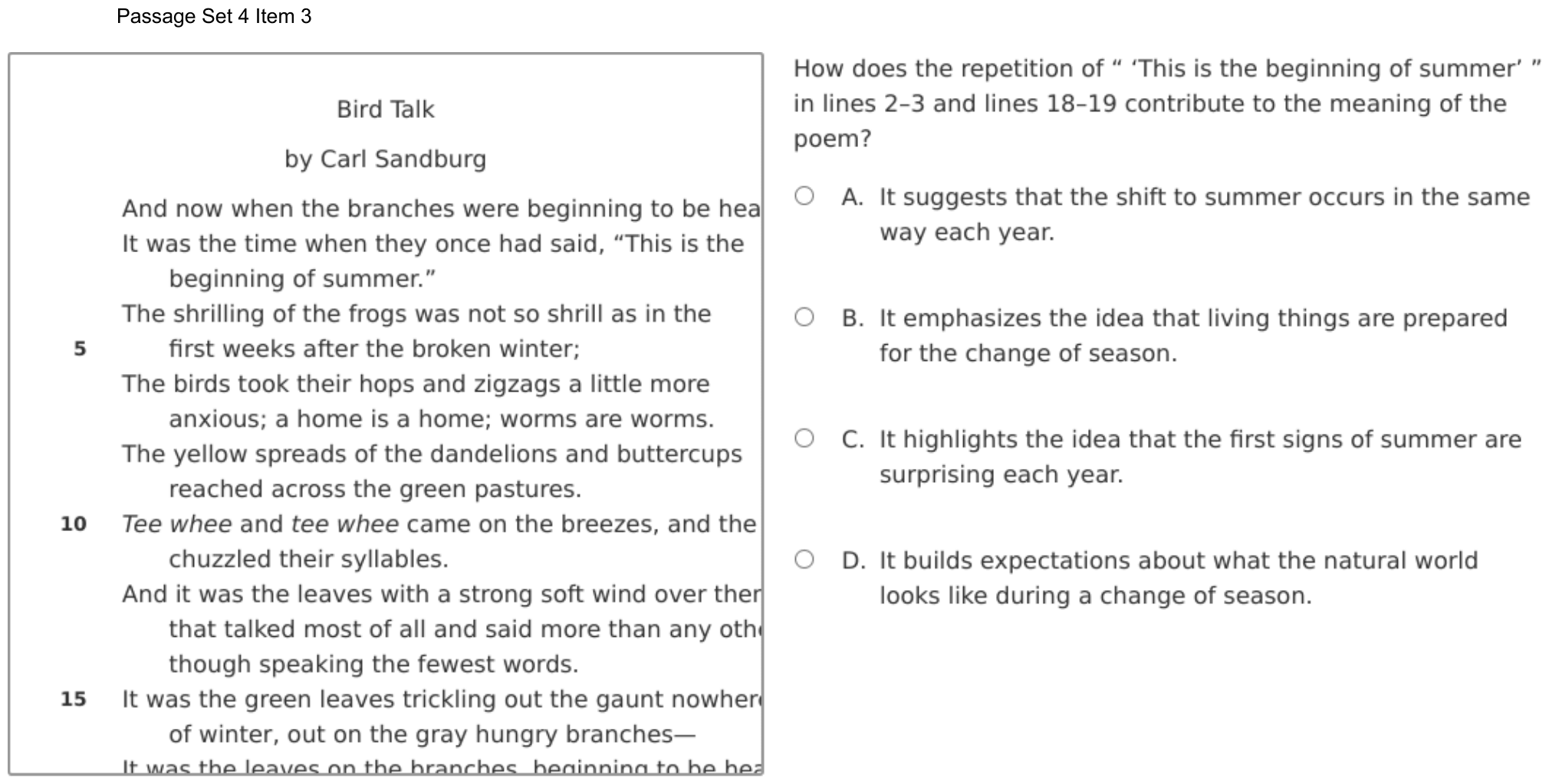
Question 11 of 120
2026 Practice Test C English, question 23Uses the passage above: “Bird Talk”.
Question
Which lines from the poem best contrast with the idea of winter’s scarcity and bleakness?
- A“The shrilling of the frogs was not so shrill as in the / first weeks after the broken winter;” (lines 4–5)
- B“The yellow spreads of the dandelions and buttercups / reached across the green pastures.” (lines 8–9)
- C“Tee whee and tee whee came on the breezes, and the grackles / chuzzled their syllables.” (lines 10–11)
- D“Or if instead of counting up last year as against / this year, they count up this year as against next” (lines 25–26)
Show the answer
Correct answer: B
The question asks for the identification of a description that contrasts with the scarcity and bleakness of winter.
A. Incorrect. These lines indicate that the frogs are first very excited about the shift from winter to spring, which causes them to make a loud “shrilling,” yet their sounds lessen after a time and grow weaker. As such, these lines contrast two periods of spring (early vs. later) and the response of the frogs to these two periods; the lines do not contrast the bleakness of winter with the abundance of spring or summer.
B. CORRECT. During winter, there is scarcity of plant life and a bleak landscape: trees lose their leaves, snow covers the ground, and nature appears dark and shuttered. In contrast, these lines reveal the bright “yellow spreads” of flowers and the verdant “green pastures” that are signs that winter has abated.
C. Incorrect. This description contrasts the sounds of “the breezes” of warmer air and the sounds made by grackles—a type of bird—rather than the bleakness and scarcity of winter and the abundance of the “ ‘beginning of summer’ ” (line 3).
D. Incorrect. These lines show the contrast between the two ways of looking at things in terms of past vs. present or present vs. future; in this instance, the lines reveal the way birds naturally expect and adapt to the passing of time and the change of seasons. The lines do not present a contrast between winter and spring.
Question analysis
This textual evidence question on Carl Sandburg’s poem “Bird Talk” asks which lines best contrast with the idea of winter’s scarcity and bleakness. Students compare four quotations about frogs, flowers, birdsong and the birds’ yearly counting, and the challenge is finding the one whose images most fully show the opposite of a bare, bleak season.
- Grade level
- Grade 7 reading and task
- Compared with grade 7
- At grade 7 Choosing lines that fit an idea is routine grade 7 evidence work. The twist is that students look for the opposite of an idea, winter’s scarcity and bleakness, rather than support for it, though the quoted images are concrete.
- Estimated difficulty
- Straightforward: two steps or one careful reading.
- Thinking it demands
- Depth of knowledge 2, skills and concepts · mainly evaluate
- What makes it hard
- Every choice must be checked minor
- Hard words minor
- Evidence
- Answered from one sentence or line
- Reading level
- Passage: 296 words (a poem; reading level not measured); question and choices: about grade 6, 85 words.
- Students, last 30 days
- Not enough answers yet to show (it takes 10).
Why it is hard, traps and wrong answers (shows the answer)
Why it is hard
The question turns the usual evidence task around: students picture a scarce, bleak winter and then look for its opposite. The line that names winter outright is a trap, since it only compares the frogs’ noise in two stretches of spring, and the grackles’ calls show life without plenty. The flowers spreading “across the green pastures” are the one image of abundance and color.
Every choice must be checked minor Choosing the answer
Every quotation carries some sign of the season, frogs, flowers, birdsong and the birds’ yearly count, so each must be tested for images of plenty and color set against a bare winter. (Embretson & Wetzel, 1987)
Hard words minor Understanding the question
The stem’s “scarcity” and “bleakness” define what to look for; a student unsure of them cannot tell that yellow and green spreading across pastures is their opposite. (Perfetti, 2007; Freedle & Kostin, 1993)
Strategy: First picture what a scarce, bleak winter looks like, then read each quotation for images that show the plain opposite of that picture.
Traps
- Word match: Repeats striking words or phrases from the text, so it looks supported, but its meaning does not fit the question.
- Supports only part of the claim: In a question about evidence: a line that backs one half of the claim but not the other, or a related point rather than the claim itself.
The wrong answers, classified
A Word match (Freedle & Kostin, 1993)
Is drawn by “the broken winter,” the only mention of winter among the choices, but the lines compare the frogs’ shrilling early and later in spring, not winter’s bareness with plenty.
C Supports only part of the claim (King et al., 2004; Thissen, Steinberg & Fitzpatrick, 1989)
Picks the birdsong, which does show life returning after a silent season, but the calls say nothing about scarcity giving way to plenty, as the spreading flowers in lines 8–9 do.
D Word match (Freedle & Kostin, 1993)
Takes “as against” for the contrast the question asks about, though these lines set one year against another in the birds’ talk and hold no image of winter or of growth.
Working it out, step by step
Figure out what the question asks
This asks you to find lines that show the opposite of winter. Scarcity means not having enough of something. Bleakness means looking bare, cold and gloomy. So picture winter: bare branches, no flowers, gray and brown fields. Then look for the lines that show plenty and bright color instead.
Read lines 8–9
Lines 8–9 say “The yellow spreads of the dandelions and buttercups / reached across the green pastures.” Dandelions and buttercups are small yellow flowers. Pastures are grassy fields. A spread is a wide area covered with something. Here, yellow flowers stretch across green fields. That is a picture of color everywhere and plenty of growth. It is the exact opposite of a bare, gray winter.
Check each choice
- A does not fit. It mentions “the broken winter,” but it only compares how shrill, or sharp and high, the frogs sounded at two times. Nothing in it shows plenty.
- B fits. Yellow flowers spread over green fields, full of color and life.
- C does not fit. The birdsong shows that life is back. But it gives no picture of plenty or color to set against a bare winter.
- D does not fit. These lines compare one year with another in the birds’ talk. There is no winter and no growth in them.
Watch out: A is the only choice that names winter, so it can seem to fit. But mentioning winter is not the same as contrasting with it.
Choose the answer
Only lines 8–9 show plenty and bright color, the opposite of a scarce, bleak winter. So the answer is B, lines 8–9: “The yellow spreads of the dandelions and buttercups / reached across the green pastures.”
Why this answer and not the closest wrong one
C is a close wrong choice, since birdsong is a sign that life is back. But the question asks for a contrast with scarcity, or not having enough. Sounds alone do not show plenty. Lines 8–9 show flowers spreading wide across green fields. That picture of color and plenty is the clearest opposite of a bare, gray winter.
More questions like this
The original DOE question
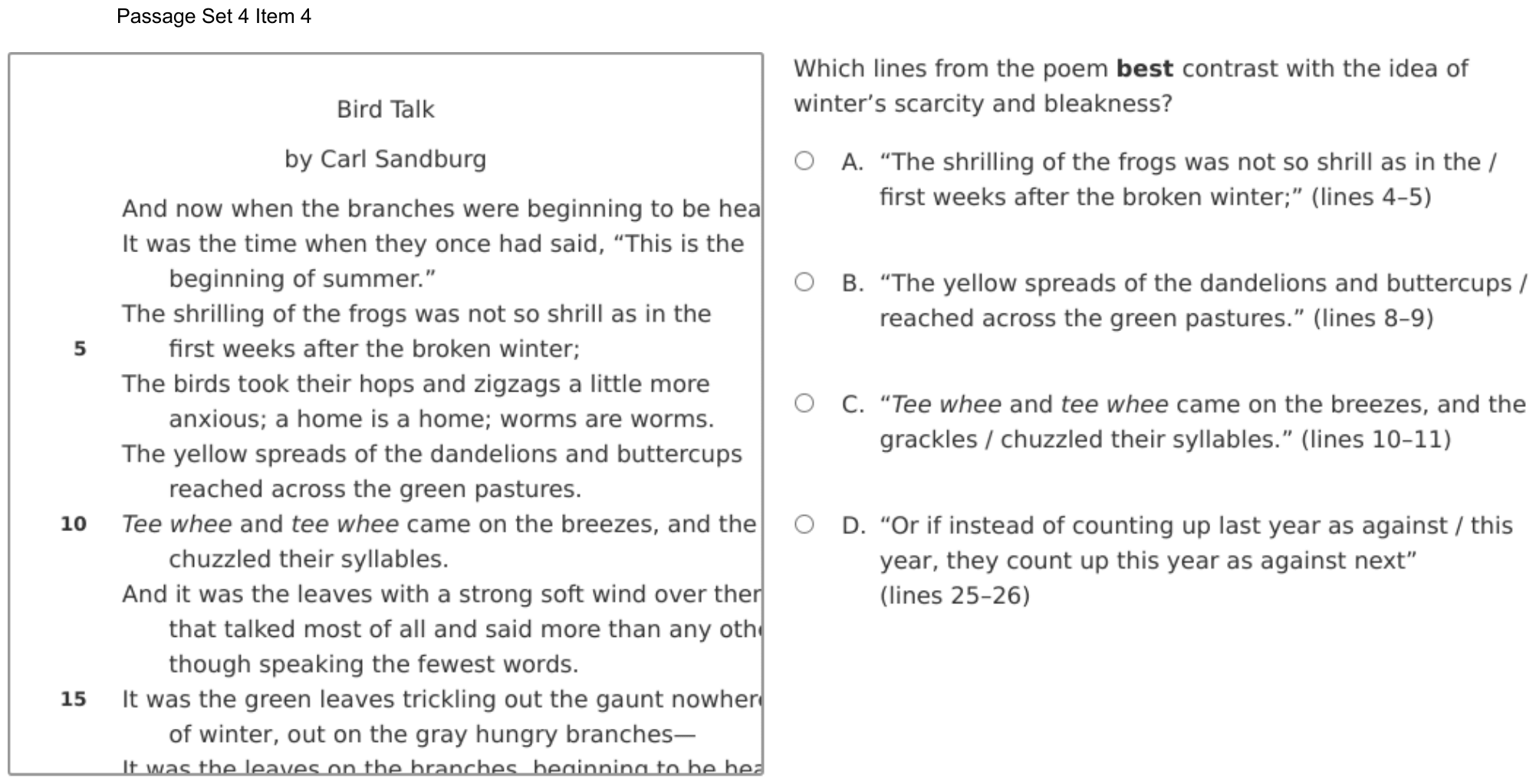
Question 12 of 120
2026 Practice Test C English, question 24Uses the passage above: “Bird Talk”.
Question
Throughout the poem, the poet conveys the speaker’s point of view by
- Agradually moving the speaker’s attention from one element of nature to another.
- Bproviding the speaker’s motivation for describing the landscape in great detail.
- Chighlighting the speaker’s emotional response as each season passes.
- Dshifting the speaker’s focus from external observations to personal reflection.
Show the answer
Correct answer: D
This question asks for an explanation of how the poet conveys the speaker’s point of view on the natural world and the change of seasons as presented in the poem.
A. Incorrect. Though in the first stanza the speaker describes various elements of nature such as branches, frogs, birds, flowers, and leaves, these elemental shifts are not precisely gradual and occur only in the first stanza. Further, the first stanza, though appreciative of the natural world, is primarily descriptive and does not develop the speaker’s perspective to the degree that other parts of the poem do.
B. Incorrect. While it may be inferred that the speaker describes the landscape to such a degree because it has revealed a seasonal shift, that this is indeed the speaker’s motivation is never explicitly conveyed by the poet.
C. Incorrect. Multiple seasons do not pass in the poem; only the shift to the “ ‘beginning of summer’ ” (line 3) occurs in an endless cycle. Further, the speaker does not reveal an emotional response; it is the responses of nature that the speaker describes.
D. CORRECT. The first stanza is the speaker’s observations of the natural world embracing a new season. In the second stanza, the speaker begins to reflect on how the natural world, as embodied by the birds, calmly accepts seasonal change in its perpetual sameness. The reflection continues in the third stanza, where it is revealed that the speaker has been addressing these observations to a child.
Question analysis
This point-of-view question asks how the poet of “Bird Talk” conveys the speaker’s point of view throughout the poem. Students must keep in mind the long opening description of early summer and the two shorter stanzas after it, and decide which description of the poet’s method holds from the first line to the last.
- Grade level
- Grade 8 reading and task
- Compared with grade 7
- Above grade 7 Grade 7 point-of-view questions often ask what a speaker thinks. This one asks how the poet conveys that view across all three stanzas of a long free-verse poem, and the choices name methods in general terms, closer to grade 8 work.
- Estimated difficulty
- Hard: combines ideas, needs a plan, and has more than one tempting wrong answer.
- Thinking it demands
- Depth of knowledge 3, strategic thinking · mainly analyze
- What makes it hard
- Evidence in several places moderate
- A very close wrong answer moderate
- How, not what moderate
- Figurative or literary language minor
- Evidence
- Answered from the whole text
- Reading level
- Passage: 296 words (a poem; reading level not measured); question and choices: about grade 10, 54 words.
- Students, last 30 days
- Not enough answers yet to show (it takes 10).
Why it is hard, traps and wrong answers (shows the answer)
Why it is hard
The first stanza takes up 19 of the poem’s 32 lines and moves steadily from branches to frogs, birds, flowers and leaves, so a choice that describes it alone feels right. The point of view shows only when the poem turns to “We” and then to “I” addressing a child, and that third stanza is three hard lines. Students must keep the whole poem’s course in mind and choose the method that holds from first line to last.
Evidence in several places moderate Working it out
The answer depends on all three stanzas at once: the long catalog of the season in lines 1–19, the shift to “We shall never blame the birds,” and the closing “If I have put your face … child.” (Kirsch & Mosenthal, 1990; Gorin & Embretson, 2006)
A very close wrong answer moderate Choosing the answer
The choice about moving from one element of nature to another and the key both describe a shift in the speaker’s attention; they differ in what shifts, nature to nature or the outside world to the speaker’s own thoughts. (Embretson & Wetzel, 1987; Gorin & Embretson, 2006; Ascalon et al., 2007)
How, not what moderate Working it out
The stem asks how the poet conveys a point of view, a method, so a choice must describe what the speaker does across the poem, not what the speaker sees. (Anderson & Krathwohl, 2001)
Figurative or literary language minor Understanding the question
The last stanza is cryptic, “Blame me no more than the bluejays,” and students who miss that the speaker is now talking about putting a child into the poem lose the move to reflection. (Graesser, Singer & Trabasso, 1994; Kintsch, 1998)
Strategy: Write one phrase for what the speaker attends to in each stanza, then keep only a choice that describes the whole sequence, not one stanza.
Traps
- Too narrow: A single detail offered as the central idea or a summary, or a summary that keeps minor details and leaves out an essential part.
- Reads too much in: A reasonable-sounding conclusion that goes further than the text allows.
- Twists what the text says: Uses the text's topic and ideas but changes what it says: who did it, how much, when, or why.
The wrong answers, classified
A Too narrow (King et al., 2004)
Describes the first stanza well, its walk from branches to frogs, birds, flowers and leaves, but misses the later turn to “We” and to the speaker’s own “I.”
B Reads too much in (Graesser, Singer & Trabasso, 1994)
Supplies a reason for all the description, perhaps from the closing words to a child, but the speaker never says why the landscape is described, and the reflection is not a motive.
C Twists what the text says (King et al., 2004)
Sees that the poem follows nature through a change of season but makes it many seasons and hands the creatures’ reactions, such as the birds’ anxious hops, to the speaker as feelings.
Working it out, step by step
Figure out what the question asks
This asks about point of view: how the speaker, the voice talking in the poem, sees things. It also asks how the poet shows that view across the whole poem. So look at what the speaker pays attention to in each of the three stanzas. A stanza is a group of lines set apart by a blank line.
Follow the speaker through the stanzas
- Stanza 1, lines 1–19: the speaker describes the world outside. There are branches, frogs, birds, flowers and leaves at the start of summer.
- Stanza 2, lines 20–29: the speaker starts to judge and think. “We shall never blame the birds.”
- Stanza 3, lines 30–32: the speaker says “I” and talks to a child: “If I have put your face among leaf faces, child.”
Name the change in focus
The poem starts with external observations, or things the speaker sees and hears outside. It ends with personal reflection, or the speaker’s own thoughts. In the last stanza, the speaker admits to putting a child’s face and voice into the poem. The speaker asks to be blamed “no more than the bluejays.” Since “We shall never blame the birds,” that means not at all. This move from looking outward to looking inward is how the speaker’s view comes through.
Check each choice
- A does not fit. Moving from branches to frogs to birds happens only in stanza 1. It misses the turn to “We” and “I.”
- B does not fit. The speaker never says why the landscape is described.
- C does not fit. Only one change of season happens, the start of summer. The anxious feelings belong to the birds, not the speaker.
- D fits. The speaker moves from describing nature to thinking about it.
Watch out: A describes stanza 1 very well. But the question says “Throughout the poem,” so the answer must cover all three stanzas.
Choose the answer
The speaker starts by watching nature and ends by thinking aloud to a child. So the answer is D, “shifting the speaker’s focus from external observations to personal reflection.”
Why this answer and not the closest wrong one
A is the closest wrong choice. Stanza 1 really does move from one part of nature to another. But that is only 19 of the 32 lines. In stanzas 2 and 3, the speaker turns to “We” and then “I,” and shares personal thoughts. Only D describes the speaker’s path from the first line to the last.
More questions like this
The original DOE question
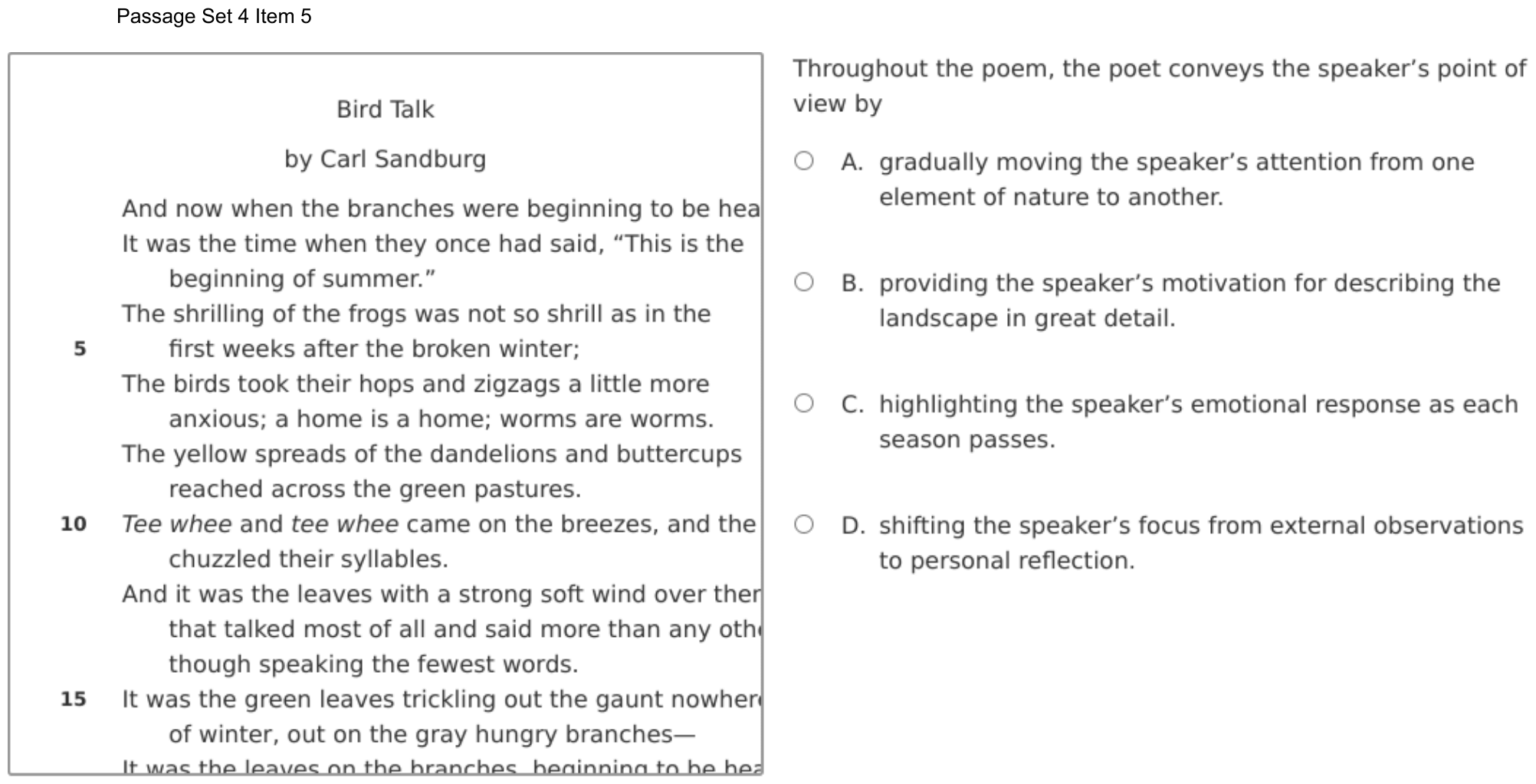
Question 13 of 120
2026 Practice Test C English, question 25Uses the passage above: “Bird Talk”.
Question
Over the course of the poem, a central idea is developed mainly through the speaker’s
- Asense of eager anticipation as winter ends.
- Bdescription of the changes in nature as the seasons transition.
- Cobservation of the birds’ behavior as summer begins.
- Dprediction of future alterations in the physical landscape.
Show the answer
Correct answer: B
The question asks how the central idea about the natural acceptance of change by nature is developed by the speaker of the poem.
A. Incorrect. The speaker is an observer of the changes in nature as propelled by the seasons and shows no personal eagerness for the end of winter. Further, even though nature rejoices at the end of winter as exemplified by “the shrilling of the frogs” (line 4), the speaker merely records this and does not share in this display.
B. CORRECT. The response of nature to the “beginning of summer” (line 3) is the primary focus of the poem as revealed by the speaker through vivid descriptions of the sights, sounds, movements, and attitudes of the natural world.
C. Incorrect. The second stanza of the poem begins a reflection on birds “sitting in circles talking bird talk” (line 22) and taking a sort of attendance of who is present, but this behavioral description is largely figurative and meant to illustrate a point about the way the birds adapt quickly to change, not to develop a central idea of the poem in terms of how nature responds generally.
D. Incorrect. Seasonal changes are inevitable and cyclical per the speaker, but the speaker does not predict future changes to the landscape as a method of developing the central idea. Rather, the speaker describes nature’s response to changes that have already occurred.
Question analysis
Students decide how the speaker of Carl Sandburg’s “Bird Talk” mainly develops a central idea of the poem. The question does not name the idea, so students must work it out across the poem’s three stanzas and then weigh four accounts of what the speaker does, each tied to a different part or feature of the poem.
- Grade level
- Grade 7 reading and task
- Compared with grade 7
- At grade 7 Tracing how a central idea develops is core grade 7 work. Here the idea is never stated, so students must first infer it from 32 lines of free verse and then judge what the speaker mainly does to build it.
- Estimated difficulty
- Moderate: several steps, or a close reading with one strong distractor.
- Thinking it demands
- Depth of knowledge 3, strategic thinking · mainly analyze
- What makes it hard
- A very close wrong answer moderate
- Reading between the lines moderate
- Evidence in several places minor
- Evidence
- Answered from the whole text
- Reading level
- Passage: 296 words (a poem; reading level not measured); question and choices: about grade 9, 48 words.
- Students, last 30 days
- Not enough answers yet to show (it takes 10).
Why it is hard, traps and wrong answers (shows the answer)
Why it is hard
The title “Bird Talk” and the whole second stanza push students toward the birds, and the key differs from that choice only in taking in all of nature. Two other choices credit the speaker with something the poem gives elsewhere: the eagerness belongs to the frogs and birds, and the only look ahead is the birds’ talk of next year. Weighing what the speaker does across all 32 lines points to the description of nature changing.
A very close wrong answer moderate Choosing the answer
The choice about the birds’ behavior as summer begins matches the key’s frame, the speaker watching nature at the turn of the season; it differs only in narrowing nature to birds. (Embretson & Wetzel, 1987; Gorin & Embretson, 2006; Ascalon et al., 2007)
Reading between the lines moderate Working it out
The central idea is never stated, so students must first work out that the poem is about nature meeting the year’s turn calmly, then judge which of the speaker’s acts builds it most. (Graesser, Singer & Trabasso, 1994; Kintsch, 1998)
Evidence in several places minor Working it out
Birds appear in lines 6–7, 10–11, 20–29 and 31–32, so the title and the second stanza make them look central until the branches, frogs, flowers and leaves are counted too. (Kirsch & Mosenthal, 1990; Gorin & Embretson, 2006)
Strategy: Put the poem’s central idea into a sentence of your own, then ask which choice describes something the speaker really does and does the most to build that idea.
Traps
- Too narrow: A single detail offered as the central idea or a summary, or a summary that keeps minor details and leaves out an essential part.
- Wrong tone or attitude: Misjudges the tone, attitude or point of view, such as reading admiration as criticism, or taking a character's or subject's feelings for the author's.
- Reads too much in: A reasonable-sounding conclusion that goes further than the text allows.
The wrong answers, classified
A Wrong tone or attitude (Graesser, Singer & Trabasso, 1994)
Gives the speaker the stir of the shrilling frogs and anxious birds, but the speaker records it calmly, and the poem opens after winter, at “the beginning of summer.”
C Too narrow (King et al., 2004)
Follows the title and the birds’ circles at the Grand Crossing, but birds are one thread in a poem that also tracks branches, frogs, dandelions and leaves into summer.
D Reads too much in (Graesser, Singer & Trabasso, 1994)
Builds a forecast from the birds counting “this year as against next / year,” but that talk concerns who will be gone, not the land, and the speaker predicts nothing.
Working it out, step by step
Figure out what the question asks
This asks how a central idea is mainly built. A central idea is a big point the whole poem makes. First, put that idea in your own words. Then ask what the speaker does most, across the whole poem, to build it.
Find the central idea
The poem shows nature at “the beginning of summer.” The branches grow heavy, the frogs quiet down, the flowers spread and the leaves come out. In stanza 2, the birds calmly count who has come and gone. A central idea is that nature moves through the seasons, and living things accept the change as natural.
See how the speaker builds it
Most of the poem is description. Stanza 1 fills 19 of the 32 lines with changes in nature. It shows “The yellow spreads of the dandelions and buttercups” and “the green leaves trickling out the gaunt nowhere / of winter.” Trickling out means coming out slowly, a little at a time. Gaunt means thin and bare. Detail by detail, the speaker shows the season turning. That description is the main way the idea is built.
Check each choice
- A does not fit. The frogs and birds are stirred up, but the speaker describes them calmly. The poem also starts after winter is over.
- B fits. The speaker describes nature changing as the seasons turn.
- C does not fit. Birds are only one part. The poem also covers branches, frogs, flowers and leaves.
- D does not fit. The speaker predicts nothing about the land. The birds’ talk of next year is about who will be gone.
Watch out: C is tempting because the poem is called “Bird Talk” and stanza 2 is all about birds. But the central idea is about all of nature.
Choose the answer
The speaker builds the idea mostly through details of nature changing as summer begins. So the answer is B, “description of the changes in nature as the seasons transition.”
Why this answer and not the closest wrong one
C is the closest wrong choice. It also has the speaker watching nature as summer begins. But it narrows nature to birds. The poem’s changes come from many living things: branches, frogs, dandelions, buttercups and leaves. Only B takes in all of them, so only B describes how the whole poem builds its idea.
More questions like this
The original DOE question
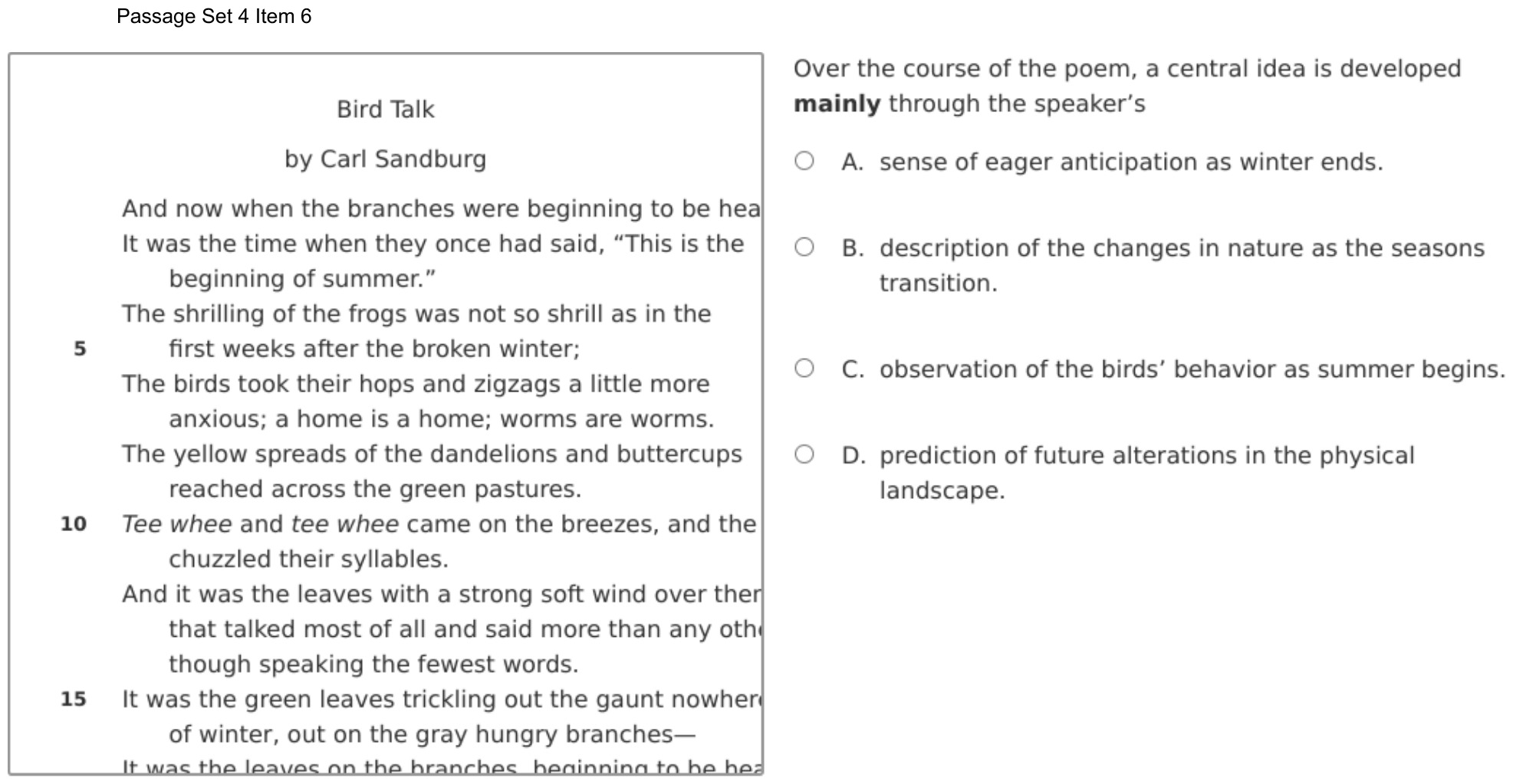
Question 14 of 120
2026 Practice Test C Math, question 1Question
What is the prime factorization of 756?
- A
- B
- C
- D
Show the answer
Correct answer: D
Determine the prime factors of 756 using a factor tree:
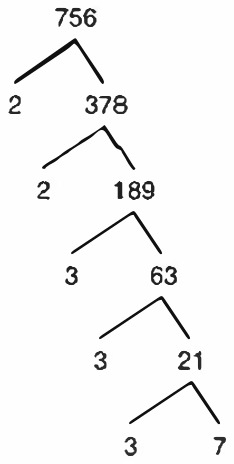
The prime factors are 2, 2, 3, 3, 3, and 7, or , which can be expressed using exponents as .
Question analysis
This number question asks for the prime factorization of 756, written with exponents. Students break the number into prime factors, with a factor tree or repeated division, and match the result to one of four products. Every choice multiplies back to 756, so the real test is whether each factor shown is actually prime.
- Grade level
- Grade 6 content, by NYS standard
- Compared with grade 7
- Below grade 7 Factor trees and exponent notation are grade 6 skills, and 756 splits quickly by small divisors. What adds a little is that every choice multiplies out to 756, so checking the product alone settles nothing.
- Estimated difficulty
- Straightforward: two steps or one careful reading.
- Thinking it demands
- Depth of knowledge 1, recall and reproduction · mainly apply
- What makes it hard
- A very close wrong answer moderate
- Something you must already know minor
- Solution
- 3 steps
- Reading level
- Question and choices: about grade 11, 10 words.
- Students, last 30 days
- Not enough answers yet to show (it takes 10).
Why it is hard, traps and wrong answers (shows the answer)
Why it is hard
The factoring itself is quick: halving twice and dividing by 3 three times leaves 7. The question is built so that multiplying back proves nothing, since every choice equals 756, and three of them simply stop the factor tree at a composite number. Students who check only the product, or who take an odd factor such as 21 or 27 for a prime, pick a factorization that is unfinished.
A very close wrong answer moderate Choosing the answer
2² · 3² · 21 shares the right answer's 2² and differs only in 3² · 21 against 3³ · 7, and both equal 756, so neither an estimate nor a product check separates them. (Embretson & Wetzel, 1987; Gorin & Embretson, 2006; Ascalon et al., 2007)
Something you must already know minor Working it out
Students must know that a prime factorization may hold only primes, and must spot that 21, 9 and 27 are composite even though none of them is even. (Anderson & Krathwohl, 2001)
Strategy: Divide 756 by 2 while the result is even, then by 3 while it divides evenly, and keep going until every factor left is prime; then compare factor by factor, not by product.
Traps
- Stops one step early: A choice is a number from partway through the solution.
- Misunderstands the concept: A wrong belief about a concept: that percents can be added, that area grows like length, that averages can be averaged, that a bigger denominator means a bigger fraction.
The wrong answers, classified
A Stops one step early (King et al., 2004; Gierl et al., 2017)
Divides out 2 twice and 3 twice, then stops at 21, which is 3 × 7, so one composite factor remains in a product that still equals 756.
B Misunderstands the concept (Smith, diSessa & Roschelle, 1993; De Bock et al., 1998; Ni & Zhou, 2005)
Splits off a 3 and a 7 but keeps 9 as if it were prime, perhaps because it is odd, though 9 = 3 × 3.
C Stops one step early (King et al., 2004; Gierl et al., 2017)
Splits 756 into 4 × 189 and 189 into 7 × 27, then stops, not seeing that 27 is 3 × 3 × 3.
Worked solution, step by step
Formulas used
- Writing a repeated factor with an exponent
- a is the number being multiplied, called the base. n is the exponent, the small raised number. It tells how many times a appears in the product. So 2² means 2 × 2, and 3³ means 3 × 3 × 3. Exponents are a short way to write a factor that repeats.
Sort out the question
You need the prime factorization of 756. That means writing 756 as a product of prime numbers only. A product is the answer to a multiplication. A prime number has exactly two factors, 1 and itself. Examples are 2, 3, 5 and 7.
All four choices multiply to 756. So multiplying a choice back does not pick the answer. You must check that every factor is prime.
Divide by 2 while you can
A factor tree splits a number into two factors, again and again. Start with the smallest prime, 2. 756 is even, so 2 goes into it:
378 is even too:
189 is odd, so 2 does not go into it. You have pulled out two 2s.
Divide by 3 while you can
Add the digits of 189: . A number can be divided by 3 when its digits add up to a number that 3 goes into. 3 goes into 18, so it goes into 189:
7 is prime, so the tree stops. You have pulled out three 3s and one 7.
Write the factors with exponents
Collect every prime you pulled out:
Use the exponent rule. Two 2s make , and three 3s make . The choices use a raised dot, ·, for times. So 756 is .
Choose the answer
Watch out: each wrong choice is a factor tree that stopped too soon. A ends in 21, which is 3 × 7. B has 9, which is 3 × 3. C has 27, which is 3 × 3 × 3. Being odd does not make a number prime.
Only D uses primes alone. So the answer is D, .
Check your answer
Multiply your answer back: , and . Then look at each factor. 2, 3 and 7 are all prime. D passes both tests.
More questions like this
The original DOE question
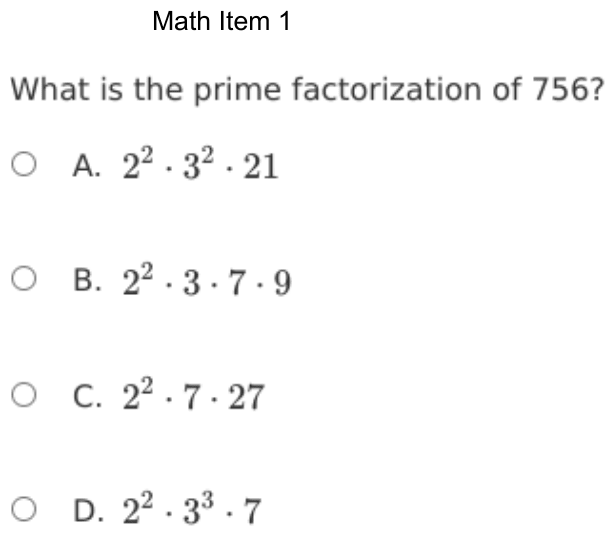
Question 15 of 120
2026 Practice Test C Math, question 2Question
If , what is the value of m?
- A
- B
- C2
- D3
Show the answer
Correct answer: B
The quantity means the same as , so the equation can be rewritten:
Subtract 4 from both sides:
Multiply both sides of the equation by m:
Solve for m:
Simplify:
Question analysis
This equation question asks for the value of m when 8 divided by m, plus 4, equals 20. Students undo the addition, then work out what m must be for 8 divided by it to give the value left. Because m is the divisor rather than the number being divided, the last step needs care.
- Grade level
- Grade 7 content, by NYS standard
- Compared with grade 7
- At grade 7 Undoing an addition and then a division is typical two-step grade 7 equation work. The unknown sitting in a denominator is less common than px + q = r, which makes the last step easier to get backward.
- Estimated difficulty
- Straightforward: two steps or one careful reading.
- Thinking it demands
- Depth of knowledge 1, recall and reproduction · mainly apply
- What makes it hard
- Error-prone arithmetic moderate
- Something you must already know minor
- Solution
- 3 steps
- Reading level
- Question and choices: about grade 6, 10 words.
- Students, last 30 days
- Not enough answers yet to show (it takes 10).
Why it is hard, traps and wrong answers (shows the answer)
Why it is hard
Undoing the + 4 is routine, so nearly all the risk sits in the last step, where m divides 8 rather than being divided by it. Students who read 8 ÷ m = 16 as asking how many 8s make 16 answer 2, and substituting it back, 8 ÷ 2 + 4 = 8, shows at once that it fails. The right value makes 8 ÷ 1/2 = 16, a division that gives a larger number, which feels wrong but is correct.
Error-prone arithmetic moderate Working it out
The unknown is the divisor, so 8 ÷ m = 16 ends in m = 8 ÷ 16, a quotient less than 1; the familiar order, 16 ÷ 8, gives a whole number instead. (Brown & Burton, 1978; Junker & Sijtsma, 2001)
Something you must already know minor Working it out
Students must see that (8 ÷ m) is the fraction 8/m and that freeing m from a denominator means multiplying both sides by it, a move grade 7 equations rarely need. (Anderson & Krathwohl, 2001)
Strategy: Subtract 4 from both sides, multiply both sides by m so the unknown is no longer in a denominator, then divide; check by substituting your value back into the equation.
Traps
- Wrong operation: Adds instead of multiplying, divides the wrong way round, turns a ratio or rate upside down, or undoes a step in the wrong direction (subtracts what should be added back).
The wrong answers, classified
A Wrong operation (Hegarty, Mayer & Monk, 1995; King et al., 2004)
Adds 4 to 20 instead of subtracting it, so 8 ÷ m = 24 and m = 8/24, which simplifies to 1/3.
C Wrong operation (Hegarty, Mayer & Monk, 1995; King et al., 2004)
Gets 8 ÷ m = 16 correctly but then divides 16 by 8, putting the divisor and the dividend the wrong way round, so m comes out as 2.
D Wrong operation (Hegarty, Mayer & Monk, 1995; King et al., 2004)
Makes both mistakes, adding 4 to get 8 ÷ m = 24 and then dividing 24 by 8 instead of 8 by 24.
Worked solution, step by step
Formulas used
- Keeping an equation balanced
- a and b are the two sides of an equation, and c is any number. An equation is like a balanced scale. Subtract the same number from both sides, or multiply both sides by the same number, and it stays balanced. That is how you get the unknown by itself.
Sort out the question
The equation is . You need the value of m. Here m is the number you divide 8 by. In words: 8 divided by some number, plus 4, makes 20.
Undo the plus 4
A fraction bar means divide, so is the same as . Subtract 4 from both sides to undo the plus 4:
Now 8 divided by m equals 16.
Watch out: adding 4 instead gives 24 on the right. That leads to choice A, 1/3, or to D, 3.
Get m out of the bottom
m is on the bottom of the fraction. Multiply both sides by m to free it:
Now divide both sides by 16:
8 goes into both 8 and 16, so 8/16 simplifies to 1/2.
Choose the answer
Watch out: it is tempting to divide 16 by 8 and get 2, choice C. But ask yourself: 8 divided by what number makes 16? To get an answer bigger than 8, you must divide by a number less than 1.
So the answer is B, 1/2.
Check your answer
Put 1/2 back into the equation. How many halves are in 8? There are 16, so . Then . That matches the equation, so m = 1/2 is right.
More questions like this
The original DOE question
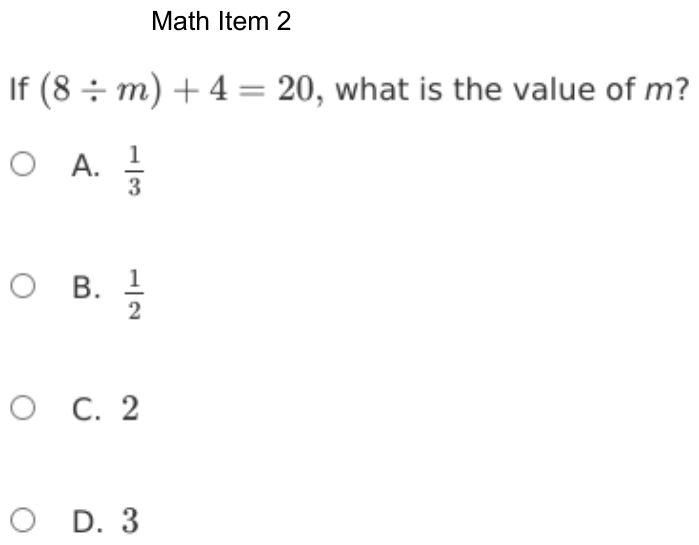
Question 16 of 120
2026 Practice Test C Math, question 3Question
What is the value of x in the equation shown above?
- A336
- B240
- C−240
- D−336
Show the answer
Correct answer: D
Simplify . First, subtract x from both sides of the equation. Then, divide both sides by 5.
Question analysis
This algebra question gives the equation 6x = x − 1,680, with x on both sides, and asks for the value of x. Students collect the x terms on one side and divide by the coefficient that remains. The choices pair two sizes with both signs, so every move across the equals sign has to keep its sign right.
- Grade level
- Grade 8 content, by NYS standard
- Compared with grade 7
- At grade 7 An unknown on both sides of the equals sign is a grade 8 topic, yet gathering the x terms here takes one subtraction and one division, the same work as a two-step grade 7 equation.
- Estimated difficulty
- Straightforward: two steps or one careful reading.
- Thinking it demands
- Depth of knowledge 1, recall and reproduction · mainly apply
- What makes it hard
- Error-prone arithmetic moderate
- A very close wrong answer moderate
- Solution
- 2 steps
- Reading level
- Question and choices: about grade 5, 12 words.
- Corrected from the DOE handbook
- A line of the explanation’s working, printed without its fraction bars and equals sign, was restored.
- Students, last 30 days
- Not enough answers yet to show (it takes 10).
Why it is hard, traps and wrong answers (shows the answer)
Why it is hard
Collecting the x terms takes one subtraction, and the only way the method goes wrong is moving x across the equals sign, which turns the 5 into a 7. The sign is the bigger hazard: 6x equals x minus a large number, so x must be negative, yet the division 1,680 ÷ 5 is done on positive numbers. Substituting −336 back gives −2,016 on each side, which confirms both the size and the sign.
Error-prone arithmetic moderate Working it out
Subtracting x from both sides leaves 5x = −1,680, and 1,680 ÷ 5 = 336 has to be worked out by hand while the negative sign is carried through to the result. (Brown & Burton, 1978; Junker & Sijtsma, 2001)
A very close wrong answer moderate Choosing the answer
The choices are two sizes, 336 and 240, each offered with both signs, so 336 and −336 are written the same except for the minus; only tracking the sign of 1,680 separates them. (Embretson & Wetzel, 1987; Gorin & Embretson, 2006; Ascalon et al., 2007)
Strategy: Subtract x from both sides so the unknown appears once, divide by the coefficient that is left, and substitute the result into both sides to check that they match.
Traps
- Negatives and direction: Arithmetic with negative numbers, the order of a subtraction, or direction on a number line. (Moving a term across the equals sign without changing its sign is a faulty procedure.)
- A faulty procedure: A systematic but wrong procedure: adding fractions straight across, applying an exponent to each term of a sum, dropping a sign when moving a term.
The wrong answers, classified
A Negatives and direction (Brown & Burton, 1978)
Reaches 5x = −1,680 correctly but drops the negative sign when dividing by 5, giving a positive 336 of the right size.
B A faulty procedure (Brown & Burton, 1978; Tatsuoka, 1983)
Moves x to the left without changing its sign, getting 7x, and also loses the minus on 1,680, so 1,680 ÷ 7 = 240.
C A faulty procedure (Brown & Burton, 1978; Tatsuoka, 1983)
Moves x to the left side without changing its sign, writing 6x + x = −1,680, so divides by 7 and gets −240.
What was corrected from the DOE handbook, and why
- Explanation: The DOE’s explanation page for this question is one of the pages replaced in the appendix, and on it the step between 5x = −1,680 and x = −336 shows only 5x over 5 and −1,680 over 5: the two fraction bars and the equals sign between them are missing, so the line is not an equation. The sentence above it says to divide both sides by 5, and the 2022–23 guide, which first printed this explanation, prints the step as 5x/5 = −1,680/5. The site shows 5x/5 = −1,680/5.
Worked solution, step by step
Formulas used
- Keeping an equation balanced
- a and b are the two sides of an equation, and c is any number (not 0 when you divide). An equation is like a balanced scale. Subtract the same thing from both sides, or divide both sides by the same number, and it stays balanced.
- Dividing a negative by a positive
- a and b are positive numbers, so −a is negative. Divide the sizes as usual. Then give the answer a minus sign, because a negative divided by a positive is negative.
Sort out the question
The equation is . You need the value of x. Here 6x means 6 times x. The unknown x is on both sides. So first gather it on one side.
Subtract x from both sides
Take x away from both sides. On the right, x − x is 0, so only −1,680 is left:
Six x’s take away one x leaves five x’s.
Watch out: moving x to the left without changing its sign gives 7x. Dividing by 7 then leads to choice C, −240, or B, 240.
Divide both sides by 5
5x means 5 times x. Divide both sides by 5 to undo it:
Find the size first. Split 1,680 into 1,500 + 180:
A negative divided by a positive is negative:
Choose the answer
Watch out: the minus sign is easy to drop. Positive 336 is choice A. Carry the sign of −1,680 all the way to the end.
So the answer is D, −336.
Check your answer
Put −336 into both sides. The left side is . The right side is . The two sides match, so x = −336 is right.
More questions like this
The original DOE question
Question 17 of 120
2026 Practice Test C Math, question 4Question
A person buys a used car with a down payment of $1,200 and makes monthly payments of $275 for 3 years. What is the total amount the person pays for the car?
- A$2,025
- B$9,900
- C$11,100
- D$13,500
Show the answer
Correct answer: C
Determine the total cost of the car by adding the down payment to the total monthly payments over 3 years.
There are 12 months in a year, so multiply (12 months/year × 3 years) to get a total of 36 months. Determine the total monthly payments by multiplying the monthly payment ($275) × the total number of months (36):
Determine the total cost of the car by adding the down payment ($1,200) to the total monthly payments ($9,900):
The total cost of the car is $11,100.
Question analysis
A used car is bought with a down payment of $1,200 followed by monthly payments of $275 for 3 years, and students find the total paid. The work is to count the payments, multiply, and add the down payment. Mixing up years and months, or forgetting the money paid up front, leads to the wrong totals among the choices.
- NYS standards
- Grade level
- Grade 6 content, by NYS standard
- Compared with grade 7
- Below grade 7 A total made of one payment up front plus equal monthly payments is a short whole-number calculation, simpler than grade 7 word problems with percents or negatives. The only conversion is from years to months.
- Estimated difficulty
- Routine: one familiar step, little to misread.
- Thinking it demands
- Depth of knowledge 2, skills and concepts · mainly apply
- What makes it hard
- Much to keep track of minor
- Error-prone arithmetic minor
- Solution
- 3 steps
- Reading level
- Question and choices: about grade 5, 29 words.
- Students, last 30 days
- Not enough answers yet to show (it takes 10).
Why it is hard, traps and wrong answers (shows the answer)
Why it is hard
The situation is familiar and the method direct, so this is one of the easier questions on the test. Points are lost in two places: turning 3 years into 36 payments, and remembering the money paid up front after the long multiplication. Each slip, like paying the down payment once a year, leads to a listed total, so checking that the answer holds exactly one $1,200 and 36 payments of $275 is worth the seconds.
Much to keep track of minor Working it out
The $1,200 down payment is paid once while the $275 repeats every month, so it has to be set aside while 36 payments are totaled and then added at the end. (Sweller, 1988; Carpenter, Just & Shell, 1990)
Error-prone arithmetic minor Working it out
The product 275 × 36 = 9,900 is a two-digit multiplication done by hand; splitting it as 275 × 4 = 1,100 and then 1,100 × 9 makes it quick and safe. (Brown & Burton, 1978; Junker & Sijtsma, 2001)
Strategy: Turn 3 years into a number of months, multiply the monthly payment by it, and add the down payment once at the end.
Traps
- Stops one step early: A choice is a number from partway through the solution.
- Units or scale: The answer is wanted in other units, or a rate or scale must be converted first.
- Misreads the question: Misses or misreads a condition or a word in the question: "at least", "each", "remaining", "not".
The wrong answers, classified
A Units or scale (King et al., 2004)
Multiplies the $275 by 3, the number of years, instead of by 36 months, then adds the $1,200 down payment: 825 + 1,200 = 2,025.
B Stops one step early (King et al., 2004; Gierl et al., 2017)
Finds the 36 monthly payments, 36 × $275 = $9,900, and stops without adding the $1,200 down payment made at the start.
D Misreads the question (Hegarty, Mayer & Monk, 1995)
Works out one year as $1,200 + 12 × $275 = $4,500 and multiplies by 3, so the down payment is paid three times instead of once.
Worked solution, step by step
Formulas used
- Changing years into months
- Each year has 12 months. Multiply the number of years by 12 to get the number of months. You need months here because a payment is made every month.
- Total cost with a down payment
- The down payment is money paid once, at the start. The monthly payment is paid every month. Multiply it by the number of months to get all the monthly payments. Then add the down payment only once, because it is paid only once.
Sort out the question
The person pays $1,200 once, at the start. This is the down payment. Then the person pays $275 every month for 3 years. You need the total amount paid for the car.
The payments come once a month, but the time is given in years. So change the years into months first.
Change 3 years into months
Use the months formula:
So the person makes 36 monthly payments.
Watch out: multiplying $275 by 3 counts only 3 payments. That leads to choice A, $2,025.
Add up the monthly payments
Multiply $275 by 36. A quick way is to split 36 into 4 × 9:
So the 36 payments add up to $9,900.
Watch out: stopping here gives choice B, $9,900. The down payment is still missing.
Add the down payment once
Use the total-cost formula:
The person pays $11,100 in all. Adding $1,200 for every year counts it three times. That gives choice D, $13,500.
So the answer is C, $11,100.
Check your answer
Estimate. $275 is a little less than $300, and . Add the $1,200: . The real total should be a little less than $12,000. $11,100 fits.
More questions like this
The original DOE question
Question 18 of 120
2026 Practice Test C Math, question 6Question
In the parallelogram above, what is the value of x?
- A36
- B18
- C6
- D5
Show the answer
Correct answer: A
In a parallelogram, any two adjacent angles are supplementary, so the sum of the two given angles is equal to 180°.
Write an equation showing that the sum of and is equal to 180°:
Solve for x:
Question analysis
A parallelogram is drawn with the two angles at the ends of its left side labeled 3x° and 2x°, and students find the value of x. It tests the angle facts of a parallelogram and solving a simple equation. Knowing what the two angles must add up to is the key fact, since the figure gives no other number.
- NYS standards
- Grade level
- Grade 8 content, by NYS standard
- Compared with grade 7
- At grade 7 The angle fact needed, about consecutive angles of a parallelogram, rests on grade 8 parallel-line reasoning. Once it is known, the work is one short equation, like a typical grade 7 problem about angle sums.
- Estimated difficulty
- Straightforward: two steps or one careful reading.
- Thinking it demands
- Depth of knowledge 2, skills and concepts · mainly apply
- What makes it hard
- Solution
- 2 steps
- Reading level
- Question and choices: about grade 7, 10 words.
- Students, last 30 days
- Not enough answers yet to show (it takes 10).
Why it is hard, traps and wrong answers (shows the answer)
Why it is hard
Once the angle fact is in place, 5x = 180 is a one-line equation, so the question tests recall more than computation. Students who use 90° for the pair land on half the right value, and the two smallest choices come only from combining the labels' 3 and 2. A sense check helps: x = 36 makes the angles 108° and 72°, one obtuse and one acute, just as the drawing shows.
Something you must already know moderate Working it out
The figure gives no number of degrees, only 3x° and 2x°, so everything rests on recalling that the two angles at the ends of one side of a parallelogram add to 180°. (Anderson & Krathwohl, 2001)
Reading a figure, table or graph minor Understanding the question
The marked angles sit at the upper and lower ends of the left side, consecutive rather than opposite, which is what makes them supplementary instead of equal. (Lesh, Post & Behr, 1987; Kirsch & Mosenthal, 1990)
Strategy: Decide what two angles that share a side of a parallelogram add up to, set 3x + 2x equal to that total, solve for x, and check that the two angles fit the figure.
Traps
- Wrong formula: Uses a related but wrong formula: perimeter for area, diameter for radius, area for volume, or a misremembered one.
- Stops one step early: A choice is a number from partway through the solution.
- Numbers taken from the question: Combines the numbers in the question without a model of the situation, or is simply a number that appears in the question.
The wrong answers, classified
B Wrong formula (King et al., 2004)
Uses 90° as the total of the two angles, the complementary total, so 5x = 90 gives 18, though consecutive angles of a parallelogram add to 180°.
C Numbers taken from the question (Hegarty, Mayer & Monk, 1995)
Multiplies the two coefficients from the labels, 3 × 2 = 6, without using any angle fact or writing an equation.
D Stops one step early (King et al., 2004; Gierl et al., 2017)
Combines 3x + 2x into 5x and gives the coefficient 5, stopping before dividing the 180° total by it.
Worked solution, step by step
Formulas used
- Neighboring angles of a parallelogram
- a and b are two angles of a parallelogram that share a side, like the top left and bottom left angles. They always add to 180°. Here is why. The four angles add to 360°, and opposite angles are equal. So each pair of neighbors is half of 360°.
Sort out the question
The figure is a parallelogram. That is a four-sided shape whose opposite sides are parallel, so they never meet. Two angles are marked: 3x° at the upper left and 2x° at the lower left. You need the value of x.
Write an equation for the angles
The two marked angles are at the two ends of the left side. So they are neighbors, not opposite angles. Use the rule that neighbors add to 180°:
Watch out: the total is 180°, not 90°. Using 90 gives 5x = 90 and x = 18, choice B.
Solve for x
Three x’s plus two x’s make five x’s:
Divide both sides by 5 to get x alone:
Watch out: stopping at 5, the number in front of x, gives choice D. Multiplying 3 × 2 = 6 gives choice C, but that uses no angle fact.
Choose the answer
The value of x is 36. It is a number, not the size of an angle. The angles themselves are 3 × 36 and 2 × 36 degrees.
So the answer is A, 36.
Check your answer
Find the two angles. The top one is degrees. The bottom one is degrees. They add to 180°. In the figure, the top angle is wide, more than 90°. The bottom one is narrow, less than 90°. That matches.
More questions like this
The original DOE question
Question 19 of 120
2026 Practice Test C Math, question 7Question
For what values of x is the above inequality true?
- A
- B
- C
- D
Show the answer
Correct answer: C
Divide to solve for x:
Rewriting with the x term first requires reversing the inequality symbol in order to keep the meaning “x is less than ”.
Question analysis
This inequality question asks which values of x make −12 > 6x true. Students solve a one-step inequality by dividing and then state the solution with x written first. A negative number on one side and the variable on the other make the direction of the symbol the main thing to get right.
- Grade level
- Grade 7 content, by NYS standard
- Compared with grade 7
- Below grade 7 Grade 7 inequalities usually take two steps, such as 3x + 4 > 19. This one needs a single division, and the care goes into reading the result correctly when the variable ends up on the right of the symbol.
- Estimated difficulty
- Straightforward: two steps or one careful reading.
- Thinking it demands
- Depth of knowledge 1, recall and reproduction · mainly apply
- What makes it hard
- A very close wrong answer moderate
- Something you must already know minor
- Solution
- 2 steps
- Reading level
- Question and choices: about grade 10, 15 words.
- Students, last 30 days
- Not enough answers yet to show (it takes 10).
Why it is hard, traps and wrong answers (shows the answer)
Why it is hard
One division finds the boundary, so the question is really about direction. Two things pull students the wrong way: the −12 on the left makes the inequality look like one that must be flipped, and the result −2 > x has x on the right, where it is easy to read backward. Testing x = −3, which gives −12 > −18, shows that values below −2 work.
A very close wrong answer moderate Choosing the answer
x < −2 and x > −2 share the boundary −2 and differ only in direction, so finding the right number settles nothing until the direction is read correctly. (Embretson & Wetzel, 1987; Gorin & Embretson, 2006; Ascalon et al., 2007)
Something you must already know minor Working it out
Students must know that the symbol flips only when both sides are multiplied or divided by a negative number, and that −2 > x says the same as x < −2. (Anderson & Krathwohl, 2001)
Strategy: Divide both sides by 6, asking whether you divided by a negative number, then rewrite the result with x on the left so that the symbol still opens toward the larger side.
Traps
- Negatives and direction: Arithmetic with negative numbers, the order of a subtraction, or direction on a number line. (Moving a term across the equals sign without changing its sign is a faulty procedure.)
- Wrong operation: Adds instead of multiplying, divides the wrong way round, turns a ratio or rate upside down, or undoes a step in the wrong direction (subtracts what should be added back).
The wrong answers, classified
A Wrong operation (Hegarty, Mayer & Monk, 1995; King et al., 2004)
Adds 6 to −12 instead of dividing by 6, getting −6, and also reverses the direction, so both the boundary and the symbol are wrong.
B Wrong operation (Hegarty, Mayer & Monk, 1995; King et al., 2004)
Undoes the 6 by adding it to −12 rather than dividing, as if 6x meant x − 6, getting −6 > x and so x < −6.
D Negatives and direction (Brown & Burton, 1978)
Finds −2 > x but flips the symbol because −12 is negative, or reads −2 > x as x > −2, though dividing by a positive 6 keeps the direction.
Worked solution, step by step
Formulas used
- Dividing both sides of an inequality
- a and b are the two sides of an inequality, and c is the number you divide by. If c is positive, the symbol stays the same. It flips only when you multiply or divide both sides by a negative number. Here c is 6, which is positive.
- Reading an inequality the other way
- a and b are any two numbers. Saying a is greater than b is the same as saying b is less than a. When you swap the two sides, turn the symbol around. Its point still aims at the smaller number.
Sort out the question
The inequality is . The symbol > means is greater than. So it says −12 is greater than 6 times x. You need every value of x that makes this true.
Divide both sides by 6
To get x alone, divide both sides by 6:
You divided by 6, which is positive. So the symbol does not flip.
Watch out: −12 is negative, but that does not matter. Only dividing by a negative number flips the symbol.
Put x first
says −2 is greater than x. That means x is less than −2. Swap the sides and turn the symbol around:
Watch out: keeping > when you swap the sides gives choice D, . That is the opposite meaning.
Choose the answer
Choices A and B use −6. That comes from adding 6 to −12 instead of dividing by 6. The right boundary is −2, and x is below it.
So the answer is C, .
Check your answer
Test a number below −2, such as −3. Then , and is true. Now test 0, which is above −2. Then , and is false. So only numbers below −2 work.
More questions like this
The original DOE question
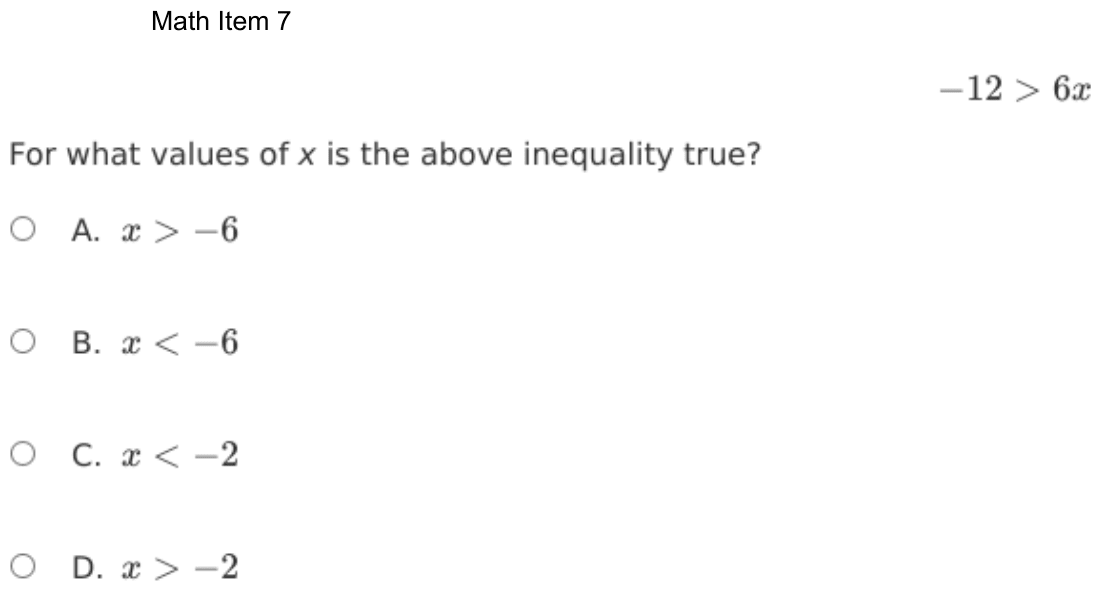
Question 20 of 120
2026 Practice Test C Math, question 9Question
Maria rides her bicycle to school at a constant speed of 15 miles per hour. If the distance to school is 6 miles, how many minutes will it take Maria to get to school?
- A10
- B15
- C24
- D30
Show the answer
Correct answer: C
Maria’s rate of speed is given as 15 miles per hour. Since 1 hour is equivalent to 60 minutes, her rate of speed, in miles per minute, can be determined.
, or mile per minute.
Therefore, it takes Maria 4 minutes to ride 1 mile.
The distance to school is 6 miles, so it will take minutes to ride to school.
Question analysis
Maria bikes 6 miles to school at a constant 15 miles per hour, and students find how many minutes the ride takes. It tests using a rate to find a time and converting hours to minutes. With the speed given per hour and the question asking, in bold, for minutes, keeping track of units is the main hurdle.
- Grade level
- Grade 6 content, by NYS standard
- Compared with grade 7
- Below grade 7 Distance, speed and time with whole numbers is grade 6 rate work. The only extra demand is an answer in minutes when the speed is per hour, a conversion grade 7 students make routinely.
- Estimated difficulty
- Straightforward: two steps or one careful reading.
- Thinking it demands
- Depth of knowledge 2, skills and concepts · mainly apply
- What makes it hard
- Solution
- 2 steps
- Reading level
- Question and choices: about grade 6, 32 words.
- Students, last 30 days
- Not enough answers yet to show (it takes 10).
Why it is hard, traps and wrong answers (shows the answer)
Why it is hard
The numbers are small, but the speed is per hour and the answer is wanted in minutes, so students have to choose a route through the units. Finding the minutes per mile first, 4 at 15 miles an hour, turns the rest into a single multiplication. The wrong choices come from using a number in the stem as the answer, from mixing the 60 minutes with the 6 miles, or from rounding 0.4 hour to a half hour.
Something you must already know minor Working it out
Nothing on the page says that time is distance divided by speed or that an hour has 60 minutes, and the bold word minutes requires both. (Anderson & Krathwohl, 2001)
Error-prone arithmetic minor Working it out
6 ÷ 15 is less than 1, 0.4 hour, and turning it into minutes means 0.4 × 60; the cleaner route, 60 ÷ 15 = 4 minutes a mile, avoids decimals. (Brown & Burton, 1978; Junker & Sijtsma, 2001)
Strategy: Find how many minutes Maria needs to ride one mile at 15 miles per hour, then multiply by the number of miles to school.
Traps
- Numbers taken from the question: Combines the numbers in the question without a model of the situation, or is simply a number that appears in the question.
- Rounds too early: Rounds a value partway through, or rounds the wrong way, so the final answer drifts from the exact one.
The wrong answers, classified
A Numbers taken from the question (Hegarty, Mayer & Monk, 1995)
Divides the 60 minutes in an hour by the 6 miles, 60 ÷ 6 = 10, as if the ride took a full hour, and ignores the 15 mph speed.
B Numbers taken from the question (Hegarty, Mayer & Monk, 1995)
Takes the 15 in 15 miles per hour as the number of minutes, a number copied from the question without any calculation.
D Rounds too early (King et al., 2004)
Sees that 6 miles is a little under half of 15, rounds the time of 0.4 hour up to half an hour, and gives 30 minutes.
Worked solution, step by step
Formulas used
- Minutes for each mile
- Miles per hour tells how many miles you ride in one hour, which is 60 minutes. Sharing the 60 minutes evenly among those miles gives the minutes for each mile. This works when the speed stays the same the whole time.
- Distance, speed and time
- Distance is how far you go, here in miles. Speed is how far you go in one hour. Dividing the distance by the speed gives the time in hours.
Sort out the question
Maria rides at a constant speed of 15 miles per hour. Constant means it never changes. School is 6 miles away. You need the time in minutes, not hours. You must know that one hour has 60 minutes.
Find the minutes for one mile
15 miles per hour means Maria rides 15 miles in 60 minutes. Use the minutes-per-mile formula:
So each mile takes Maria 4 minutes.
Find the minutes for 6 miles
Each of the 6 miles takes 4 minutes:
So the ride takes 24 minutes.
Watch out: 15 is the speed, not a time, so choice B is a trap. And , choice A, ignores the speed.
Choose the answer
Another way is the time formula. , so the ride takes 0.4 of an hour. In minutes, that is .
Watch out: rounding 0.4 hour up to half an hour gives choice D, 30.
So the answer is C, 24.
Check your answer
Check with the speed. 24 minutes is of an hour. In a full hour Maria rides 15 miles. So in 2/5 of an hour she rides miles. That is exactly the distance to school.
More questions like this
The original DOE question
Question 21 of 120
2026 Practice Test C Math, question 10Question
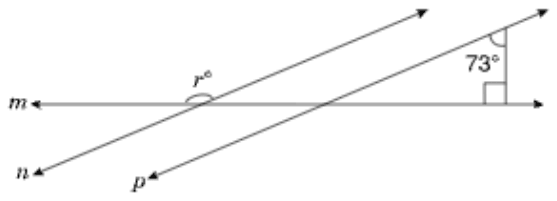
In the figure above, . Straight line m intersects both line n and line p. What is the value of r?
- A17
- B117
- C163
- D173
Show the answer
Correct answer: C
The triangle formed by line p, line m, and the line segment connecting the two contains a 73° angle, a right angle (90°), and a missing angle measuring x°. The sum of the interior angles of a triangle is 180°, so begin by finding the value of x:
Line m is a straight line, so it has a measure of 180°. The 17° angle from the triangle and the adjacent angle outside the triangle are supplementary, so they have a sum of 180°. Let s represent the measure of the adjacent angle outside the triangle. The value of s can be determined by subtracting:
Given that n and p are parallel lines and that they have been cut by a transversal, line m, then corresponding angles are congruent. Angles r and s are corresponding angles, so the value of r is congruent to the value of s, which is 163°.
Question analysis
Two parallel lines, n and p, cross a straight line m, and a segment drawn at a right angle to m forms a small triangle with lines m and p, where a 73° angle is marked. Students find the angle r at line n. It combines a triangle's angle sum, a straight angle and parallel lines, and the angle wanted sits away from the marked ones.
- NYS standards
- Grade level
- Grade 8 content, by NYS standard
- Compared with grade 7
- Above grade 7 Grade 7 angle problems use supplementary, vertical and adjacent angles. This one also needs the angle sum of a triangle and the angles formed by parallel lines and a transversal, grade 8 facts, chained across a busy figure.
- Estimated difficulty
- Hard: combines ideas, needs a plan, and has more than one tempting wrong answer.
- Thinking it demands
- Depth of knowledge 2, skills and concepts · mainly apply
- What makes it hard
- Reading a figure, table or graph moderate
- Combines ideas moderate
- Something you must already know minor
- Solution
- 3 steps
- Reading level
- Question and choices: about grade 3, 21 words.
- Students, last 30 days
- Not enough answers yet to show (it takes 10).
Why it is hard, traps and wrong answers (shows the answer)
Why it is hard
Each fact needs only a subtraction, but the student has to plan a route from the 73° angle at line p over to r at line n. The first number the route gives, the triangle's 17° angle, is listed, and it is the acute partner of r rather than r itself. The figure helps here: r is drawn plainly obtuse, and 163 is also 90 + 73, the triangle's exterior angle, which confirms it.
Reading a figure, table or graph moderate Understanding the question
The 73° sits between line p and the vertical segment, not between p and m, and r is the obtuse angle above m on the left of line n, far from every marked angle. (Lesh, Post & Behr, 1987; Kirsch & Mosenthal, 1990)
Combines ideas moderate Working it out
Three facts chain together: the triangle's angles sum to 180°, the angles along straight line m sum to 180°, and corresponding angles at the parallel lines n and p are equal. (Embretson, 1998; Daniel & Embretson, 2010)
Something you must already know minor Working it out
The angle pairs formed by a line crossing two parallel lines are a grade 8 topic, and the question uses them without naming them. (Anderson & Krathwohl, 2001)
Strategy: Find the third angle of the right triangle, use the straight line m to get the angle beside it, then carry that angle over to line n using the parallel lines.
Traps
- Stops one step early: A choice is a number from partway through the solution.
- An arithmetic slip: The right method with a plausible arithmetic error: a digit, a place value or a times-table fact.
The wrong answers, classified
A Stops one step early (King et al., 2004; Gierl et al., 2017)
Finds the triangle's third angle, 180 − 90 − 73 = 17, and stops, though r is the obtuse angle next to the 17° angle, not that angle itself.
B Little reason to choose it (Haladyna & Downing, 1993; Rodriguez, 2005)
No angle fact in the figure gives 117; even 180 − 73 is 107, so this choice mostly catches guesses at an obtuse angle.
D An arithmetic slip (Junker & Sijtsma, 2001)
Finds the 17° angle and subtracts it from 180 but borrows without reducing the 8, so 180 − 17 comes out as 173.
Worked solution, step by step
Formulas used
- Angles of a triangle
- a, b and c are the three angles inside any triangle. They always add up to 180°. If you know two of them, subtract their sum from 180° to find the third.
- Angles on a straight line
- a and b are two angles side by side on a straight line. Together they make a half turn, which is 180°. Use it to find the angle next to one you already know.
- Corresponding angles
- The symbol ∥ means is parallel to. When line m crosses two parallel lines, it makes the same angles at each crossing. Angles in the same position at the two crossings are called corresponding angles. They are equal.
Sort out the question
Lines n and p are parallel, and line m crosses both. Near line p, a straight-up segment meets line m. The small square shows a right angle, 90°. Line p, line m and that segment make a small triangle. Its top angle is 73°.
You need r, the wide angle where line n crosses line m.
Find the triangle’s third angle
The third angle is where line p crosses line m. Call it x. Use the triangle rule:
So that angle is 17°.
Watch out: this is not r. Stopping here gives choice A, 17.
Use the straight line m
The 17° angle sits above line m, on the right of line p. Beside it, on the left of line p, is a wide angle. Call it s. The two angles fill the straight line m, so they add to 180°:
So s is 163°.
Watch out: borrow carefully. 180 − 17 is 163, not 173, choice D.
Carry the angle to line n
Angle s is above line m and to the left of line p. Angle r is above line m and to the left of line n. They are in the same position, so they are corresponding angles. Since n and p are parallel:
So the answer is C, 163.
Check your answer
Look at the figure. Angle r is wider than a right angle, so it must be more than 90°. That rules out 17. Also, the narrow angle beside r, on the right of line n, matches the 17° angle at line p. And , as it should on a straight line.
More questions like this
The original DOE question
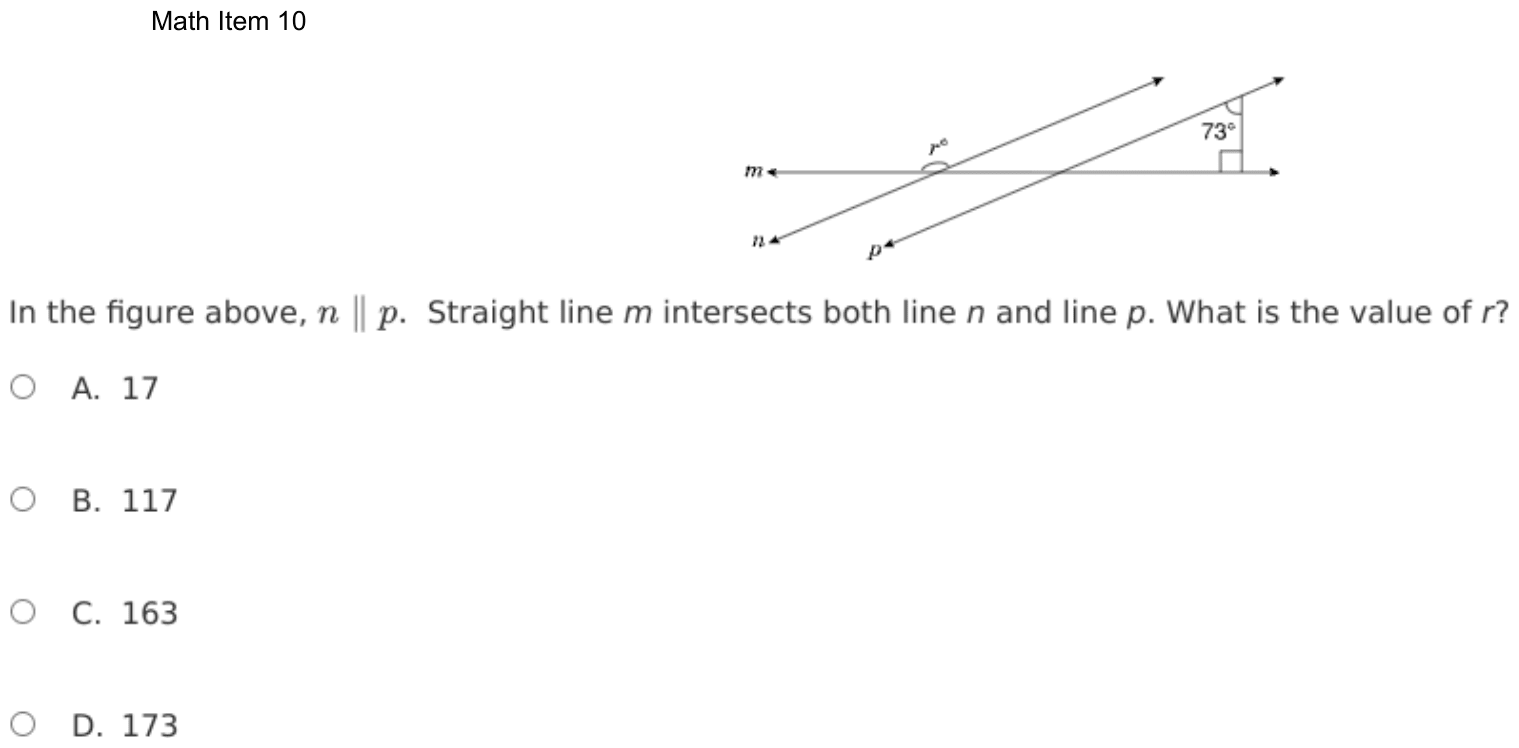
Question 22 of 120
2026 Practice Test C Math, question 11Question
Allison has 5 stamp albums with 576 stamps in each album. If she transfers her stamp collection to 6 albums, each holding 378 stamps, how many stamps will be left over?
- A198
- B612
- C620
- D632
Show the answer
Correct answer: B
Determine the total number of stamps in 5 albums holding 576 stamps:
Determine the total number of stamps in 6 albums holding 378 stamps:
Subtract 2,268 from 2,880 to find the number of stamps that will be left over:
Question analysis
Allison moves a stamp collection from 5 albums of 576 stamps into 6 albums that hold 378 each, and students find how many stamps are left over. It tests multiplying and subtracting large whole numbers in a word problem. The question gives no total, so the collection has to be counted before the new albums' capacity is taken away.
- Grade level
- Grade 7 content, by NYS standard
- Compared with grade 7
- Below grade 7 Whole-number multiplication and subtraction in a three-step word problem is easier than grade 7 work with fractions, decimals or negatives. Because the products are large, a slip or a rounded estimate easily gives another choice.
- Estimated difficulty
- Straightforward: two steps or one careful reading.
- Thinking it demands
- Depth of knowledge 2, skills and concepts · mainly apply
- What makes it hard
- A very close wrong answer moderate
- Error-prone arithmetic minor
- Solution
- 3 steps
- Reading level
- Question and choices: about grade 6, 27 words.
- Students, last 30 days
- Not enough answers yet to show (it takes 10).
Why it is hard, traps and wrong answers (shows the answer)
Why it is hard
The plan is clear from the stem: count the stamps, then take away what the six new albums hold, so the question tests careful arithmetic. Its choices punish the estimating that saves time elsewhere, since rounding either factor shifts the result by only a few tens, onto another listed number. Students who skip the album counts altogether and compare one album with one album find 198 waiting.
A very close wrong answer moderate Choosing the answer
612, 620 and 632 lie within 20 of one another, so rounding 576 and 378 to friendly numbers before multiplying lands on a wrong choice; only exact products separate them. (Embretson & Wetzel, 1987; Gorin & Embretson, 2006; Ascalon et al., 2007)
Error-prone arithmetic minor Working it out
Two products of three-digit numbers, 5 × 576 = 2,880 and 6 × 378 = 2,268, must be done by hand and then subtracted with regrouping. (Brown & Burton, 1978; Junker & Sijtsma, 2001)
Strategy: Multiply to find the total number of stamps, multiply again to find how many the six new albums hold, subtract, and check the last digit of each product.
Traps
- Rounds too early: Rounds a value partway through, or rounds the wrong way, so the final answer drifts from the exact one.
- Numbers taken from the question: Combines the numbers in the question without a model of the situation, or is simply a number that appears in the question.
The wrong answers, classified
A Numbers taken from the question (Hegarty, Mayer & Monk, 1995)
Subtracts 378 from 576, comparing one old album with one new album, and ignores that there are 5 old albums and 6 new ones.
C Rounds too early (King et al., 2004)
Rounds 576 to 580 and 378 to 380 before multiplying, so 2,900 − 2,280 = 620, an estimate rather than the exact number left over.
D Rounds too early (King et al., 2004)
Rounds only 576 up to 580, getting 2,900 stamps, then subtracts the exact 2,268, so the count comes out 20 too high.
Worked solution, step by step
Formulas used
- Total in equal groups
- Here the groups are albums. The amount in each group is how many stamps one album holds. When every group is the same size, multiplying is a fast way to add them all up.
Sort out the question
Allison has 5 albums with 576 stamps in each. She moves all her stamps into 6 new albums. Each new album holds 378 stamps. Some stamps will not fit. You need the number left over.
Count all her stamps
Use the equal-groups formula. Split 576 into 500 + 76 to make it easy:
Allison has 2,880 stamps.
Count what the new albums hold
Do the same for the 6 new albums. Split 378 into 300 + 78:
The new albums hold 2,268 stamps in all.
Subtract to find the leftovers
The stamps left over are the ones she has minus the ones that fit:
Watch out: , choice A, compares just one old album with one new one. Rounding to 580 and 380 first gives 620, choice C. Rounding only 576 gives 632, choice D. Use the exact numbers.
So the answer is B, 612.
Check your answer
Add the leftovers to the stamps that fit: . That is exactly the number Allison started with. So no stamps were lost or counted twice.
More questions like this
The original DOE question
Question 23 of 120
2026 Practice Test C Math, question 13Question
Start with the number 135.28 and perform the following steps in order:
- Step 1: Multiply by 10.
- Step 2: Add 0.5 to the result of Step 1.
- Step 3: Drop the digits after the decimal point.
- Step 4: Divide by 10.
What is the result?
- A13.5
- B135
- C135.2
- D135.3
Show the answer
Correct answer: D
Begin by multiplying 135.28 by 10:
Add 0.5:
Drop the digits after the decimal point, so becomes .
Divide by 10:
Question analysis
Students start with 135.28 and carry out four listed steps: multiply by 10, add 0.5, drop the digits after the decimal point, and divide by 10. It tests place value and operations with decimals. Skipping a step, or doing two of them in the wrong order, changes the result, and the choices are built from those slips.
- NYS standards
- 6.NS.3 multi-digit decimal operations
- Grade level
- Grade 6 content, by NYS standard
- Compared with grade 7
- Below grade 7 Multiplying and dividing a decimal by 10 and adding 0.5 are grade 5 and 6 skills. The four steps are spelled out, so the demand is following them exactly and in order, not choosing a method.
- Estimated difficulty
- Straightforward: two steps or one careful reading.
- Thinking it demands
- Depth of knowledge 1, recall and reproduction · mainly apply
- What makes it hard
- A very close wrong answer moderate
- Many steps minor
- Error-prone arithmetic minor
- Solution
- 4 steps
- Reading level
- Question and choices: about grade 3, 36 words.
- Students, last 30 days
- Not enough answers yet to show (it takes 10).
Why it is hard, traps and wrong answers (shows the answer)
Why it is hard
The steps spell out how to round 135.28 to the nearest tenth, but nothing says so, and they have to be followed exactly. The decisive moment is step 2, where adding 0.5 pushes 1,352.8 past 1,353; skip it and the digits are simply cut, not rounded. Students who recognize the routine can check the result directly, since 135.28 lies closer to 135.3 than to 135.2.
A very close wrong answer moderate Choosing the answer
135.3 and 135.2 differ only in the tenths digit, and 135 shares their whole-number part, so a rough sense of the result's size rules out nothing. (Embretson & Wetzel, 1987; Gorin & Embretson, 2006; Ascalon et al., 2007)
Many steps minor Working it out
Four listed steps move the decimal point twice, and doing them in another order, or skipping one, still produces a believable number near 135. (Daniel & Embretson, 2010; Enright, Morley & Sheehan, 2002)
Error-prone arithmetic minor Working it out
Adding 0.5 to 1,352.8 carries into the ones place, since 8 tenths and 5 tenths make 1.3, which turns 1,352 into 1,353 before the decimals are dropped. (Brown & Burton, 1978; Junker & Sijtsma, 2001)
Strategy: Write down the number after each step instead of doing them in your head, and carry out the steps exactly in the order listed.
Traps
- Misreads the question: Misses or misreads a condition or a word in the question: "at least", "each", "remaining", "not".
- Rounds too early: Rounds a value partway through, or rounds the wrong way, so the final answer drifts from the exact one.
The wrong answers, classified
A Misreads the question (Hegarty, Mayer & Monk, 1995)
Skips step 1, so adds 0.5 to 135.28, drops the decimals to get 135, and then divides by 10 to reach 13.5.
B Misreads the question (Hegarty, Mayer & Monk, 1995)
Divides by 10 before dropping the digits after the decimal point, so 1,353.3 becomes 135.33 and then 135, doing steps 3 and 4 in reverse order.
C Rounds too early (King et al., 2004)
Leaves out step 2, or adds 0.5 without carrying, so 1,352 is kept and 135.2 results: 135.28 cut down instead of rounded up.
Worked solution, step by step
Formulas used
- Multiplying and dividing by 10
- a is any decimal number. Multiplying by 10 moves its decimal point one place to the right, so each digit is worth ten times as much. Dividing by 10 moves the point one place to the left. The two steps undo each other.
Sort out the question
You start with 135.28 and do four steps, in order. Write down the number after each step. Doing them in your head, or in another order, leads to a wrong choice. You need the number at the end.
Multiply by 10
Step 1. Multiplying by 10 moves the decimal point one place to the right:
The digits stay the same. Only the decimal point moves.
Add 0.5
Step 2. Line up the decimal points. 8 tenths plus 5 tenths is 13 tenths. That is 1 whole and 3 tenths, so carry the 1 into the ones place:
Watch out: skipping this step, or forgetting to carry, keeps 1,352. That leads to choice C, 135.2.
Drop the digits after the point
Step 3. Cut off the digits after the decimal point. Do not round. So 1,353.3 becomes 1,353.
Watch out: do step 3 before step 4. Dividing first gives 135.33. Dropping its decimals then gives 135, choice B.
Divide by 10
Step 4. Dividing by 10 moves the decimal point one place to the left:
Skipping step 1 gives 13.5, choice A. So the answer is D, 135.3.
Check your answer
These four steps are a recipe for rounding to the nearest tenth. 135.28 is between 135.2 and 135.3. Its hundredths digit is 8, which is 5 or more, so it rounds up to 135.3. The recipe and the rounding agree.
More questions like this
The original DOE question
Question 24 of 120
2026 Practice Test C Math, question 14Question
If , what is the value of ?
- A−18
- B−6
- C−2
- D2
Show the answer
Correct answer: B
Substitute for each value of x in the expression:
minus
Evaluate the terms involving exponents:
minus
Evaluate the terms involving multiplication:
minus
Simplify the expression:
The absolute value of is 6, and the absolute value of is 12, so is the equivalent of subtracting 12 from 6:
Question analysis
This substitution question sets x = −2 in an expression that subtracts one absolute value from another: the first holds x, x squared and x cubed, the second x, 2x and 3x. Students evaluate the expression. It tests powers of negative numbers, absolute value and integer subtraction, and the signs of the square and the cube are where answers go wrong.
- NYS standards
- Grade level
- Grade 7 content, by NYS standard
- Compared with grade 7
- At grade 7 Substituting a negative number and taking absolute values is typical grade 7 sign practice. This expression puts a square and a cube of a negative inside one pair of bars and then subtracts two absolute values, so there are several places to slip.
- Estimated difficulty
- Moderate: several steps, or a close reading with one strong distractor.
- Thinking it demands
- Depth of knowledge 1, recall and reproduction · mainly apply
- What makes it hard
- Error-prone arithmetic moderate
- Many steps minor
- Solution
- 4 steps
- Reading level
- Question and choices: about grade 7, 8 words.
- Students, last 30 days
- Not enough answers yet to show (it takes 10).
Why it is hard, traps and wrong answers (shows the answer)
Why it is hard
Every step is routine, but the expression stacks sign decisions, and each wrong choice records a different one going wrong. The powers of −2 alternate in sign, which students who treat every power as positive, or the square as negative, miss. The last step catches students who know the rules: both absolute values are positive, yet 6 − 12 is still negative, so the answer keeps its minus sign.
Error-prone arithmetic moderate Working it out
With x = −2 the square is 4 but the cube is −8, so the first bars hold −2 + 4 − 8 = −6, and the sign changes from each term to the next. (Brown & Burton, 1978; Junker & Sijtsma, 2001)
Many steps minor Working it out
Six terms are substituted, two pairs of bars are simplified and made positive, and only then is 12 subtracted from 6, four stages that must come in a fixed order. (Daniel & Embretson, 2010; Enright, Morley & Sheehan, 2002)
Strategy: Work out each power of −2 separately, keeping its sign, add the terms inside each pair of bars, take both absolute values, and subtract only at the end.
Traps
- Negatives and direction: Arithmetic with negative numbers, the order of a subtraction, or direction on a number line. (Moving a term across the equals sign without changing its sign is a faulty procedure.)
- A faulty procedure: A systematic but wrong procedure: adding fractions straight across, applying an exponent to each term of a sum, dropping a sign when moving a term.
The wrong answers, classified
A A faulty procedure (Brown & Burton, 1978; Tatsuoka, 1983)
Simplifies both insides correctly but treats the first bars like parentheses, keeping −6, so −6 − 12 = −18.
C Negatives and direction (Brown & Burton, 1978)
Takes (−2)³ as positive 8, as if every power of a negative were positive, so the first bars hold −2 + 4 + 8 = 10, and 10 − 12 = −2.
D Negatives and direction (Brown & Burton, 1978)
Takes (−2)² as −4, so the first bars hold −2 − 4 − 8 = −14, and 14 − 12 = 2; dropping the minus from x throughout also gives 2.
Worked solution, step by step
Formulas used
- Absolute value
- a is any number. The bars mean absolute value: how far a is from 0 on the number line. A distance is never negative, so |−6| = 6 and |6| = 6. Work out what is inside the bars first, then take the absolute value.
- Powers of a negative number
- The small raised number is the exponent. It tells how many times −2 is multiplied by itself. Two negatives multiply to a positive. So an even number of negative factors gives a positive answer, and an odd number gives a negative one.
Sort out the question
You need the value of when x = −2. The bars | | mean absolute value. Work out each pair of bars on its own. Subtract only at the end.
Find the powers of −2
Put −2 in for x. Keep each negative sign:
The square is positive, but the cube is negative.
Watch out: taking as +8 makes the first bars hold 10. That leads to choice C, −2.
Work out the first bars
Add the three terms inside the first pair of bars:
−2 + 4 is 2, and 2 + (−8) is −6. The distance from −6 to 0 is 6.
Work out the second bars
Here 2x means 2 times x, so it is −4. And 3x is −6:
All three terms are negative, so they add to −12. Its absolute value is 12.
Subtract the second value
Now subtract the second value from the first:
Watch out: the bars make each part positive, but the difference can still be negative. Keeping −6 inside the first bars gives −6 − 12 = −18, choice A.
So the answer is B, −6.
Check your answer
Check the second bars a faster way. , and . That matches. Also, the second value, 12, is bigger than the first, 6. So the difference must be negative, as −6 is.
More questions like this
The original DOE question
Question 25 of 120
2026 Practice Test C Math, question 15Question
A grocery store sells 1-gallon containers of milk for $3.99. The store also sells orange juice in a 6-pack of 5.5-fluid-ounce bottles for $1.79. Suppose the store wants to sell its orange juice in gallon containers instead. To the nearest dollar, how much more would a gallon of orange juice cost than a gallon of milk?
Enter your answer in the space.
Fill-in question: work out the answer and type it as a number.
Show the answer
Correct answer: 3
To determine the cost of a gallon of orange juice, begin by finding the total number of ounces in the 6-pack of bottles:
So, 33 oz of orange juice costs $1.79.
There are 128 oz in 1 gallon. Set up a proportion using the $1.79 cost per 33 oz of orange juice and the unknown cost (x) per 1 gallon of orange juice:
Cross multiply to solve for x in the proportion:
So, the orange juice costs $6.94 per gallon, and the milk costs $3.99 per gallon.
Subtract the cost per gallon of milk from the cost per gallon of orange juice.
Round the difference to the nearest dollar.
$2.95 rounds to $3.
Question analysis
A store sells milk by the gallon for $3.99 and orange juice in six-packs of 5.5-fluid-ounce bottles for $1.79. Students work out what a gallon of the juice would cost at the same price per ounce and how much more that is than the milk, to the nearest dollar. The ounces in a gallon must be known, and several steps involve decimals.
- Grade level
- Grade 7 content, by NYS standard
- Compared with grade 7
- Above grade 7 Unit prices are grade 6 and 7 work, but this chains five steps with decimals and needs a fact the question does not give, the number of fluid ounces in a gallon. Typing a rounded difference, with no choices, adds risk.
- Estimated difficulty
- Hard: combines ideas, needs a plan, and has more than one tempting wrong answer.
- Thinking it demands
- Depth of knowledge 2, skills and concepts · mainly apply
- What makes it hard
- Something you must already know moderate
- Many steps moderate
- Error-prone arithmetic minor
- An answer in an unexpected form minor
- Solution
- 5 steps
- Reading level
- Question and choices: about grade 5, 60 words.
- Corrected from the DOE handbook
- A rounded value in the explanation is now marked as approximate (≈ instead of =).
- Students, last 30 days
- Not enough answers yet to show (it takes 10).
Why it is hard, traps and wrong answers (shows the answer)
Why it is hard
The calculation is long, and its key fact is missing from the page. Students who know the 128 fluid ounces still face a division by 33 that does not come out evenly, which tempts them to round the price per ounce to 5 cents and lose about 50 cents a gallon. Keeping the exact quotient to the end, or scaling 33 ounces up by about 3.9, keeps the difference near $2.95, which rounds to 3.
Something you must already know moderate Working it out
The question never says that a gallon holds 128 fluid ounces, yet the whole comparison depends on it; the 6-pack holds only 6 × 5.5 = 33 ounces. (Anderson & Krathwohl, 2001)
Many steps moderate Working it out
Five moves follow one another: the ounces in a pack, the scale-up to 128 ounces, the division by 33, the subtraction of $3.99 and the rounding to a whole dollar. (Daniel & Embretson, 2010; Enright, Morley & Sheehan, 2002)
Error-prone arithmetic minor Working it out
1.79 × 128 = 229.12 and 229.12 ÷ 33 are long decimal calculations without a calculator, and a slip in either moves the price of a gallon. (Brown & Burton, 1978; Junker & Sijtsma, 2001)
An answer in an unexpected form minor Choosing the answer
The rounded difference is typed with no choices, so an unrounded $2.95, or a figure rounded too soon, looks just as finished as the whole-dollar answer. (Enright, Morley & Sheehan, 2002)
Strategy: Find the ounces in one six-pack, scale its price up to the 128 fluid ounces in a gallon, subtract the milk's price, and round only at the end.
Traps
- Stops one step early: A choice is a number from partway through the solution.
- Rounds too early: Rounds a value partway through, or rounds the wrong way, so the final answer drifts from the exact one.
- Misreads the question: Misses or misreads a condition or a word in the question: "at least", "each", "remaining", "not".
The wrong answers, classified
7 Stops one step early (King et al., 2004; Gierl et al., 2017)
Finds the juice's cost per gallon, about $6.94, rounds it to $7, and enters that without subtracting the $3.99 price of the milk.
2 Rounds too early (King et al., 2004)
Rounds the price per ounce, 1.79 ÷ 33 ≈ 0.054, to $0.05, so a gallon costs $6.40 and the difference, $2.41, rounds to 2.
2.95 Misreads the question (Hegarty, Mayer & Monk, 1995)
Works out the difference of $2.95 correctly but enters it as it stands, though the question asks for it to the nearest dollar.
What was corrected from the DOE handbook, and why
- Explanation: The DOE’s explanation goes from 33x = $229.12 to “x = $6.94”. But 229.12 ÷ 33 = 6.9430…, so $6.94 is the cost per gallon rounded to the cent. The site writes x ≈ $6.94. Nothing else changes: $6.94 − $3.99 = $2.95, which rounds to $3, and the unrounded cost gives the same answer.
Worked solution, step by step
Formulas used
- Fluid ounces in a gallon
- A gallon holds 128 fluid ounces. This is a fact you must know, because the question does not give it. A fluid ounce measures an amount of liquid. Multiply gallons by 128 to change them into fluid ounces.
- Cross-multiplying a proportion
- A proportion says two ratios are equal. Here each ratio is ounces over dollars. a and c are the tops, and b and d are the bottoms. Multiply each top by the other bottom, and the two products are equal. That turns the proportion into an equation.
Sort out the question
Milk costs $3.99 for 1 gallon. Orange juice comes in a 6-pack of 5.5-fluid-ounce bottles for $1.79. You need how much more a gallon of juice would cost than a gallon of milk. Round to the nearest dollar.
The question doesn’t say how big a gallon is. You must know this fact: 1 gallon is 128 fluid ounces.
Find the ounces in a 6-pack
Each of the 6 bottles holds 5.5 fluid ounces:
So $1.79 buys 33 fluid ounces of juice.
Set up a proportion
Let x be the cost in dollars of a gallon, 128 fluid ounces, of juice. The price per ounce stays the same. So ounces over dollars is the same for the pack and the gallon:
Cross-multiply:
Find the cost of a gallon
Divide both sides by 33:
The sign ≈ means about equal. The exact value is 6.943…, so a gallon of juice costs about $6.94.
Watch out: don’t round too early. One ounce costs about $0.054. Rounding that to $0.05 makes a gallon $6.40, and your answer becomes 2.
Subtract the milk’s price
Find how much more the juice costs:
A gallon of juice costs $2.95 more than a gallon of milk.
Watch out: entering 7, the juice’s price, forgets to subtract the milk.
Round and enter it
The question asks for the nearest dollar. $2.95 is between $2 and $3. Its cents, 95, are 50 or more, so it rounds up to $3. Do not enter 2.95.
Type only the number in the box. So you would enter 3.
Check your answer
Estimate. 128 ounces is almost 4 packs, since . Four packs cost dollars, so a gallon costs a bit less than that. Milk costs about $4. About $7 minus $4 is $3, which matches.
More questions like this
The original DOE question

Question 26 of 120
2026 Practice Test C Math, question 16Question
- A−1
- B0
- C
- D1
Show the answer
Correct answer: B
Simplify the expression.
is the equivalent of subtracting 3 from 3, and is the equivalent of adding 3 to 3:
The zero property of division states that zero divided by any nonzero number equals zero, so .
Question analysis
This fraction has 3 plus negative 3 on top and 3 minus negative 3 on the bottom, and students find its value. It tests adding and subtracting negative numbers and dividing integers. The top and the bottom look almost alike, so each sign has to be read carefully before anything is divided.
- Grade level
- Grade 7 content, by NYS standard
- Compared with grade 7
- Below grade 7 Adding and subtracting a negative integer and dividing are grade 7 basics, and here the numbers are small. It is a short routine calculation, easier than typical grade 7 work, though the two signs invite a quick misreading.
- Estimated difficulty
- Routine: one familiar step, little to misread.
- Thinking it demands
- Depth of knowledge 1, recall and reproduction · mainly apply
- What makes it hard
- Error-prone arithmetic minor
- Solution
- 2 steps
- Reading level
- Question and choices: about grade 16+, 2 words.
- Corrected from the DOE handbook
- A grammatical error in the explanation was corrected.
- A rule stated too broadly in the explanation was corrected.
- Students, last 30 days
- Not enough answers yet to show (it takes 10).
Why it is hard, traps and wrong answers (shows the answer)
Why it is hard
The arithmetic is two one-step sign calculations and a division by 6. The danger is reading the top and the bottom as alike: they differ in a single sign, and treating them the same way gives 1 or −1. Students who rewrite 3 − (−3) as 3 + 3 and 3 + (−3) as 3 − 3 see 0 over 6 at once, and zero divided by a nonzero number is zero.
Error-prone arithmetic minor Working it out
The top adds −3 and the bottom subtracts −3, signs that look nearly the same but give 0 and 6, so each has to be rewritten before anything is divided. (Brown & Burton, 1978; Junker & Sijtsma, 2001)
Strategy: Simplify the top and the bottom separately, rewriting the subtraction of a negative as an addition, and only then divide the top by the bottom.
Traps
- Negatives and direction: Arithmetic with negative numbers, the order of a subtraction, or direction on a number line. (Moving a term across the equals sign without changing its sign is a faulty procedure.)
The wrong answers, classified
A Negatives and direction (Brown & Burton, 1978)
Adds the sizes on top and keeps the minus, taking 3 + (−3) as −6, so the fraction becomes −6/6 = −1.
C Little reason to choose it (Haladyna & Downing, 1993; Rodriguez, 2005)
No sign rule gives a top of 1, so 1/6 mostly draws students who find the bottom, 6, and are unsure what a top of 0 means.
D Negatives and direction (Brown & Burton, 1978)
Treats the top like the bottom, adding 3 and 3 in both places, so the fraction becomes 6/6 = 1.
What was corrected from the DOE handbook, and why
- Explanation: The DOE’s explanation says “3 − (−3) is equivalent of adding 3 to 3”, without the article that the same sentence uses in “3 + (−3) is the equivalent of subtracting 3 from 3”. The site now says “is the equivalent of adding 3 to 3”.
- Explanation: The DOE’s explanation says “The zero property of division states that zero divided by any number equals zero.” Zero divided by zero is undefined, not zero, so the rule holds only when the divisor is not zero. The site now says “zero divided by any nonzero number equals zero”. Here the divisor is 6, so 0/6 = 0, as before.
Worked solution, step by step
Formulas used
- Adding a negative
- a and b are numbers. Adding a negative is the same as subtracting. On a number line, adding −3 moves you 3 steps left, just like subtracting 3.
- Subtracting a negative
- a and b are numbers. Subtracting a negative is the same as adding. Taking away a debt of 3 dollars leaves you 3 dollars better off. On a number line, you move right.
- Zero divided by a number
- b is any number except 0. Zero split into b equal parts leaves 0 in each part. The rule needs b not to be 0, because dividing by 0 has no answer.
Sort out the question
The top of the fraction is , and the bottom is . A fraction bar means divide. Work out the top and the bottom separately first. Then divide the top by the bottom.
Work out the top
Adding −3 is the same as subtracting 3:
A number plus its opposite is always 0.
Watch out: do not add the 3s and keep the minus sign. That makes the top −6 and leads to choice A, −1.
Work out the bottom
Subtracting −3 is the same as adding 3:
Watch out: the top and bottom look alike, but they are not. Making both of them 6 gives 6/6 = 1, choice D.
Divide the top by the bottom
Now the fraction is 0 over 6. Zero divided by any number other than zero is zero:
A top of 0 does not make the fraction 1/6, choice C. So the answer is B, 0.
Check your answer
Check by multiplying. A division is right when the answer times the bottom gives the top. Here , which is the top. So 0/6 really is 0.
More questions like this
The original DOE question
Question 27 of 120
2026 Practice Test C Math, question 17Question

What is the distance between the midpoints of and ?
- A unit
- B1 unit
- C units
- D2 units
Show the answer
Correct answer: A
begins at 1 and ends at 7. Determine the length of :
The midpoint of a line segment is located exactly halfway between the two endpoints. Since is 6 units in length, the two endpoints are 6 units apart. Determine the location of the midpoint, in relation to each endpoint, by dividing 6 by 2:
The location of the midpoint of is 3 units from either endpoint. Find the midpoint by either adding 3 to the location of M (1) or subtracting 3 from the location of N (7):
The midpoint of is located at 4.
begins at 3 and ends at 6. Determine the length of :
Since is 3 units in length, the two endpoints are 3 units apart. Determine the location of the midpoint, in relation to each endpoint, by dividing 3 by 2:
The location of the midpoint of is 1.5 units from either endpoint. Find the midpoint by either adding 1.5 to the location of R (3) or subtracting 1.5 from the location of S (6):
The midpoint of is located at 4.5.
Determine the distance between the two midpoints by subtracting:
0.5 is equivalent to , making the distance between the two midpoints unit.
Question analysis
A number line from 0 to 8 shows points M, R, S and N, and students find the distance between the midpoint of segment MN and the midpoint of segment RS. It tests locating points and finding distances on a number line. One segment sits inside the other, and several lengths in the figure can be mistaken for the distance wanted.
- Grade level
- Grade 7 content, by NYS standard
- Compared with grade 7
- At grade 7 Finding distances between points on a number line is grade 7 work, here with whole-number positions. Two midpoints must be located before their distance can be found, so the task takes three short steps rather than one.
- Estimated difficulty
- Straightforward: two steps or one careful reading.
- Thinking it demands
- Depth of knowledge 2, skills and concepts · mainly apply
- What makes it hard
- Reading a figure, table or graph minor
- Many steps minor
- Solution
- 3 steps
- Reading level
- Question and choices: about grade 8, 17 words.
- Students, last 30 days
- Not enough answers yet to show (it takes 10).
Why it is hard, traps and wrong answers (shows the answer)
Why it is hard
The positions are whole numbers, so the midpoints come from simple averages, (1 + 7) ÷ 2 and (3 + 6) ÷ 2. The difficulty is keeping several lengths apart: the half-lengths of the two segments, the gaps at their ends, and the distance actually asked for, half a unit. Marking both midpoints on the number line before subtracting makes the small gap visible.
Reading a figure, table or graph minor Understanding the question
Segment RS lies inside MN, from 3 to 6, and its midpoint, 4 1/2, falls between two ticks of the number line rather than on a labeled point. (Lesh, Post & Behr, 1987; Kirsch & Mosenthal, 1990)
Many steps minor Working it out
Two midpoints have to be found, at 4 and 4 1/2, before their distance is taken, and the half-length of RS met on the way, 1 1/2, is among the choices. (Daniel & Embretson, 2010; Enright, Morley & Sheehan, 2002)
Strategy: Find each midpoint as the average of its segment's two endpoints, then subtract the smaller midpoint from the larger one.
Traps
- Stops one step early: A choice is a number from partway through the solution.
- Answers a different question: A choice is right for another quantity: the other unknown, the rest instead of the part, the part instead of the whole.
The wrong answers, classified
B Stops one step early (King et al., 2004; Gierl et al., 2017)
Sees that RS starts 2 units in from M and ends 1 unit in from N, and takes the difference of those gaps, 1, without halving it.
C Answers a different question (King et al., 2004; Hegarty, Mayer & Monk, 1995)
Halves each segment, 3 units for MN and 1 1/2 for RS, and subtracts the half-lengths instead of comparing the midpoints' positions.
D Answers a different question (King et al., 2004; Hegarty, Mayer & Monk, 1995)
Gives the distance from M to R, 2 units, the gap between the left ends of the two segments, without locating any midpoint.
Worked solution, step by step
Formulas used
- Midpoint on a number line
- a and b are the numbers at the two ends of a segment. The midpoint is the point exactly halfway between them. Adding the ends and dividing by 2 finds their average, which is the middle.
- Distance on a number line
- The distance between two points on a number line is how many units apart they are. Subtract the smaller number from the larger one, so the distance is never negative.
Sort out the question
The number line shows M at 1, R at 3, S at 6 and N at 7. Segment MN goes from 1 to 7. Segment RS goes from 3 to 6. A midpoint is the point exactly halfway along a segment. You need the distance between the two midpoints.
Find the midpoint of MN
Use the midpoint formula with the ends 1 and 7:
The midpoint of MN is at 4, which is 3 units from each end.
Find the midpoint of RS
Use the same formula with the ends 3 and 6:
The midpoint of RS is at 4.5. That is halfway between the marks for 4 and 5, where no point is labeled.
Subtract the two midpoints
Use the distance formula:
0.5 is one half, so the midpoints are 1/2 unit apart.
Watch out: half of MN is 3, and half of RS is 1 1/2. Subtracting those gives 1 1/2, choice C. But they are half-lengths, not positions. And 2, choice D, is only the distance from M to R.
Choose the answer
The midpoints, 4 and 4.5, are close together because RS sits near the middle of MN. So the answer is A, 1/2 unit.
Check your answer
Find each midpoint another way: walk half the length from the left end. MN is units long, and . RS is units long, and . Same midpoints, 1/2 unit apart.
More questions like this
The original DOE question
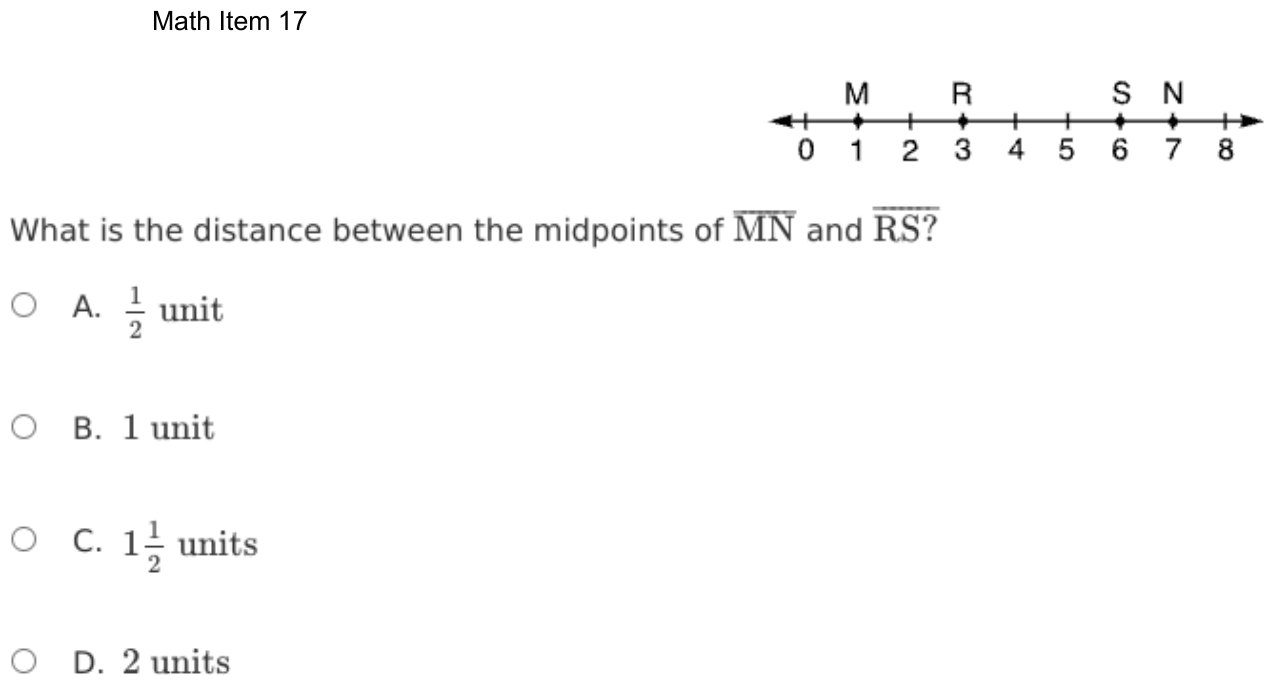
Question 28 of 120
2026 Practice Test C Math, question 18Question
I.
II.
III.
If s is a positive integer and t is a negative integer, which of the above expressions must be a positive number?
- AII only
- BI and II only
- CII and III only
- DI, II, and III
Show the answer
Correct answer: D
Each of the three expressions must be considered:
Expression I: , where s is a positive integer and t is a negative integer:
Subtracting a negative integer is the equivalent of adding a positive integer, so is equivalent to finding the value of , which must result in a positive number.
Expression II: , where s is a positive integer and t is a negative integer:
Squaring a negative integer results in a positive integer, so is equivalent to finding the value of , which must result in a positive number.
Expression III: , where s is a positive integer and t is a negative integer:
A negative exponent results in the reciprocal of the same exponential expression, so is equivalent to finding the value of , which must result in a positive number.
Therefore, Expressions I, II, and III must all result in a positive number.
Question analysis
Three expressions, s − t, s times t squared, and s to the power t, are listed, and students decide which must be positive when s is a positive integer and t is a negative integer. It tests sign rules for subtraction and multiplication and the meaning of a negative exponent. Each expression has to be judged for every possible pair, not just one example.
- NYS standards
- Grade level
- Grade 8 content, by NYS standard
- Compared with grade 7
- Above grade 7 Grade 7 students learn sign rules for subtracting and multiplying signed numbers. Here they reason about letters rather than numbers, decide what must always hold, and handle a negative exponent, a grade 8 idea.
- Estimated difficulty
- Hard: combines ideas, needs a plan, and has more than one tempting wrong answer.
- Thinking it demands
- Depth of knowledge 2, skills and concepts · mainly analyze
- What makes it hard
- Variables instead of numbers moderate
- Something you must already know moderate
- Every choice must be checked minor
- Solution
- 3 steps
- Reading level
- Question and choices: about grade 5, 42 words.
- Corrected from the DOE handbook
- Two steps of the explanation that treated t as a positive number were corrected.
- A punctuation error in the explanation was corrected.
- Students, last 30 days
- Not enough answers yet to show (it takes 10).
Why it is hard, traps and wrong answers (shows the answer)
Why it is hard
The three expressions test three different sign facts: subtracting a negative, squaring a negative, and raising to a negative power. The last is the trap, since a negative exponent seems to promise a negative result when it really gives a fraction, and that belief alone leads to a listed choice. Trying s = 2 and t = −3 gives 5, 18 and 1/8, all positive, and the rules show why no other pair can change that.
Variables instead of numbers moderate Understanding the question
No values are given for s and t, only their signs, and must means each expression has to be positive for every such pair, not just for one example. (Koedinger & Nathan, 2004; Enright, Morley & Sheehan, 2002)
Something you must already know moderate Working it out
Expression III needs the meaning of a negative exponent, s to the power t equals 1 over s to the power −t, a grade 8 rule the question does not state. (Anderson & Krathwohl, 2001)
Every choice must be checked minor Choosing the answer
Each of the three expressions is judged on its own and the choices combine the verdicts, so one wrong judgment anywhere points to a wrong combination. (Embretson & Wetzel, 1987)
Strategy: Try a pair such as s = 2 and t = −3 in each expression, then explain why its sign could or could not change for any other positive s and negative t.
Traps
- Misunderstands the concept: A wrong belief about a concept: that percents can be added, that area grows like length, that averages can be averaged, that a bigger denominator means a bigger fraction.
- Negatives and direction: Arithmetic with negative numbers, the order of a subtraction, or direction on a number line. (Moving a term across the equals sign without changing its sign is a faulty procedure.)
The wrong answers, classified
A Misunderstands the concept (Smith, diSessa & Roschelle, 1993; De Bock et al., 1998; Ni & Zhou, 2005)
Trusts only the squared expression, believing that subtracting t must make s smaller and that a negative exponent makes a negative number.
B Misunderstands the concept (Smith, diSessa & Roschelle, 1993; De Bock et al., 1998; Ni & Zhou, 2005)
Handles the subtraction and the square correctly but believes a negative exponent makes the result negative, though s to the power t is a positive fraction such as 1/8.
C Negatives and direction (Brown & Burton, 1978)
Reads s − t as taking a number away from s, so thinks it could be negative, missing that subtracting the negative t adds to s.
What was corrected from the DOE handbook, and why
- Explanation: The question makes t the negative integer, but two steps of the DOE’s explanation write the negative integer as −t, as if t were positive. For Expression I it says “s − (−t) is equivalent to finding the value of s + t, which must result in a positive number”: s − (−t) is not Expression I, and with the question’s t, s + t need not be positive (s = 1 and t = −2 give −1). For Expression III it says “s^(−t) is equivalent to finding the value of 1/s^t”, about s^(−t) rather than Expression III. The site now says that s − t is equivalent to s + (−t), and that s^t is equivalent to 1/s^(−t). Since t is negative, −t is a positive integer, so s + (−t) is the sum of two positive integers and 1/s^(−t) is the reciprocal of a positive integer: both positive, and the answer, I, II and III, is unchanged. The step for Expression II, s(−t)² = st², is true for any t and is unchanged.
- Explanation: The DOE’s explanation introduces Expression III as “s^t. where s is a positive integer and t is a negative integer”, with a period where Expressions I and II (and the 2022–23 guide, which first printed this explanation) have a comma. The site has the comma.
Worked solution, step by step
Formulas used
- Subtracting a number
- s and t are integers, and −t is the opposite of t. Subtracting a number is the same as adding its opposite. When t is negative, −t is positive. So subtracting t adds a positive amount.
- A negative exponent
- s is the base and t is the exponent. When t is negative, −t is positive. So a negative exponent means 1 over the base to a positive exponent. For example, 2 to the power −3 is 1 over 2³, which is 1/8.
Sort out the question
An integer is a whole number or its opposite, such as −2, 0 or 5. Here s is a positive integer, like 1, 2 or 3. And t is a negative integer, like −1, −2 or −3. Must means always. An expression counts only if it is positive for every such pair.
Try one pair of numbers
Try s = 2 and t = −3 in each expression:
- I:
- II:
- III:
All three are positive this time. Now see why that always happens.
Explain expression I
Use the rule for subtracting:
t is negative, so its opposite, −t, is positive. So s − t is a positive plus a positive. That is always positive.
Watch out: subtracting does not always make a number smaller. Subtracting a negative makes it bigger. Missing this leads to choice C.
Explain expression II
means t × t. A negative times a negative is positive, so is always positive. Then is a positive times a positive. That is always positive too.
Explain expression III
Use the rule for a negative exponent:
−t is a positive integer, so is a positive integer. So is 1 over a positive number. That is a positive fraction.
Watch out: a negative exponent does not make the answer negative. It makes a fraction. Thinking it does leads to choice B, I and II only.
Choose the answer
Each of the three expressions is positive for every positive s and negative t. None of them can ever be zero or negative.
So the answer is D, I, II, and III.
Check your answer
Try the values closest to 0: s = 1 and t = −1. I gives . II gives . III gives . All three are still positive.
More questions like this
The original DOE question
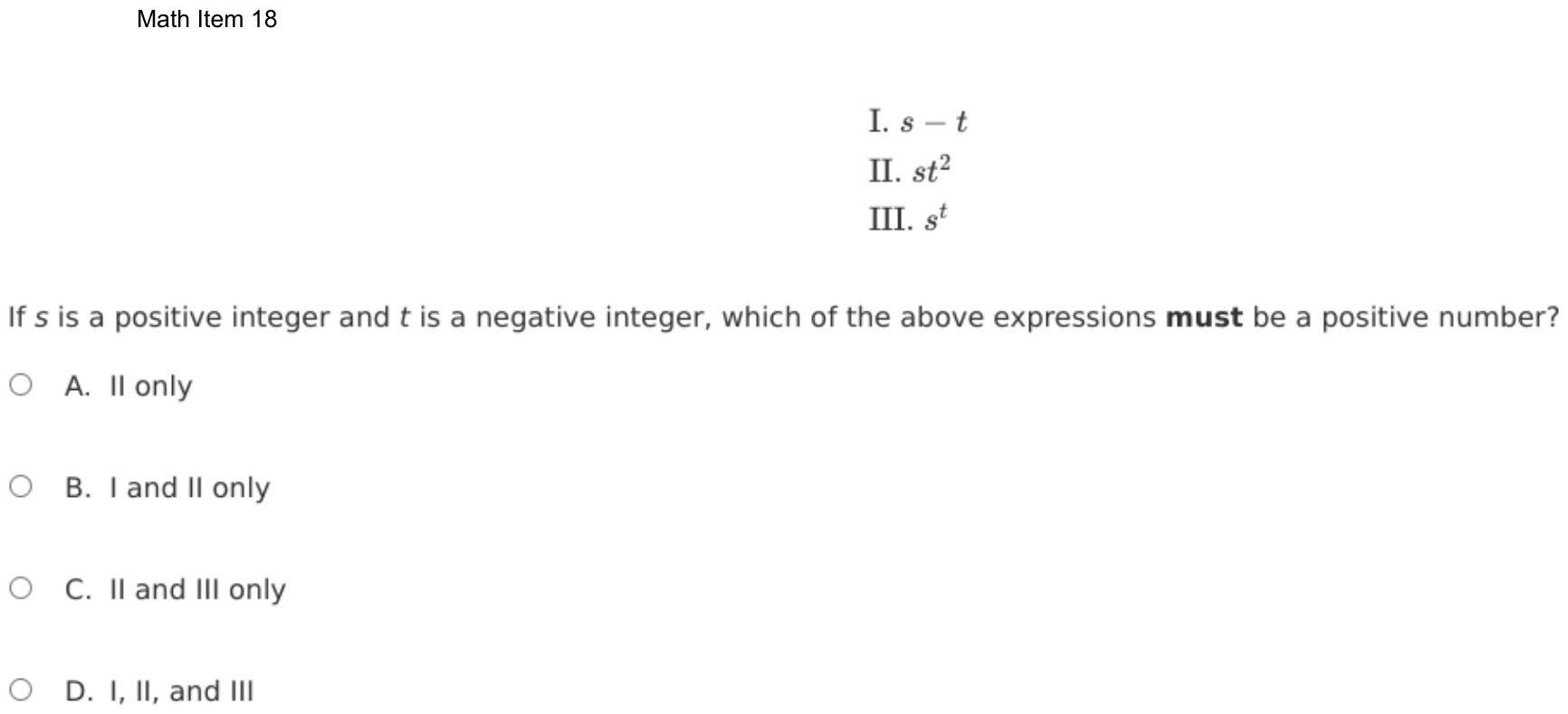
Question 29 of 120
2026 Practice Test C Math, question 19Question
What is the value of ?
- A
- B
- C
- D
Show the answer
Correct answer: C
Evaluate the expression by multiplying the terms in the numerator and the terms in the denominator. The product of two negative values is positive:
Simplify the result:
Question analysis
This question asks for the product of negative three fourths and negative two fifths. Students multiply the fractions, settle the sign of the result, and simplify. The choices mix positive and negative answers with results from other operations, so both the sign and the operation have to be right.
- Grade level
- Grade 7 content, by NYS standard
- Compared with grade 7
- At grade 7 Multiplying two negative fractions is a standard grade 7 exercise, done here in one product and one simplification. It matches typical classroom work, with the sign rule and lowest terms as the only points of care.
- Estimated difficulty
- Routine: one familiar step, little to misread.
- Thinking it demands
- Depth of knowledge 1, recall and reproduction · mainly apply
- What makes it hard
- A very close wrong answer minor
- Error-prone arithmetic minor
- Solution
- 2 steps
- Reading level
- Question and choices: about grade 10, 10 words.
- Students, last 30 days
- Not enough answers yet to show (it takes 10).
Why it is hard, traps and wrong answers (shows the answer)
Why it is hard
This is a single product of two fractions, and most students finish it quickly. The choices are built around two decisions, the sign of the product and the operation itself: two of them come from subtracting the fractions, and one keeps a minus sign that two negative factors cancel. Settling the sign first, positive, rules out half of the choices before any multiplying.
A very close wrong answer minor Choosing the answer
3/10 and −3/10 are identical except for the sign, so the size alone does not separate them; only the rule for multiplying two negatives does. (Embretson & Wetzel, 1987; Gorin & Embretson, 2006; Ascalon et al., 2007)
Error-prone arithmetic minor Working it out
Two negative fractions are multiplied, 3 × 2 over 4 × 5, and the product 6/20 has to be reduced to 3/10 before it matches a choice. (Brown & Burton, 1978; Junker & Sijtsma, 2001)
Strategy: Decide the sign of the product first, then multiply the numerators and the denominators and reduce the fraction to lowest terms.
Traps
- Negatives and direction: Arithmetic with negative numbers, the order of a subtraction, or direction on a number line. (Moving a term across the equals sign without changing its sign is a faulty procedure.)
- Wrong operation: Adds instead of multiplying, divides the wrong way round, turns a ratio or rate upside down, or undoes a step in the wrong direction (subtracts what should be added back).
The wrong answers, classified
A Wrong operation (Hegarty, Mayer & Monk, 1995; King et al., 2004)
Subtracts the fractions instead of multiplying them, −3/4 − (−2/5) = −15/20 + 8/20, which gives −7/20.
B Negatives and direction (Brown & Burton, 1978)
Multiplies the sizes correctly, 3/4 × 2/5 = 6/20 = 3/10, but keeps a minus sign, though two negative factors give a positive product.
D Wrong operation (Hegarty, Mayer & Monk, 1995; King et al., 2004)
Drops both signs and subtracts the sizes, 3/4 − 2/5 = 15/20 − 8/20 = 7/20, instead of multiplying the fractions.
Worked solution, step by step
Formulas used
- Multiplying fractions
- a and c are the tops (numerators). b and d are the bottoms (denominators). Multiply the tops together and the bottoms together. You do not need a common denominator to multiply. That is only for adding and subtracting.
- Multiplying two negatives
- a and b are positive numbers, so −a and −b are negative. A negative times a negative is positive. So when both factors are negative, the minus signs cancel.
Sort out the question
The two fractions sit side by side in parentheses, with nothing between them. That means multiply. Both fractions are negative. You need their product, the answer to the multiplication.
Decide the sign first
A negative times a negative is positive. So the answer will be positive. That rules out choices A and B.
Watch out: choice B, −3/10, has the right size but the wrong sign. The two minus signs cancel.
Multiply tops and bottoms
Now multiply the sizes. Multiply the tops, then the bottoms:
Watch out: do not find a common denominator. That is for adding and subtracting. Subtracting the fractions gives 7/20 or −7/20, choices D and A.
Simplify the fraction
2 goes into both 6 and 20. Divide the top and the bottom by 2:
The product is positive 3/10. So the answer is C, 3/10.
Check your answer
Use decimals. 3/4 is 0.75 and 2/5 is 0.4. Then , which is 3/10. Two negatives give a positive, so the product is positive 3/10.
More questions like this
The original DOE question
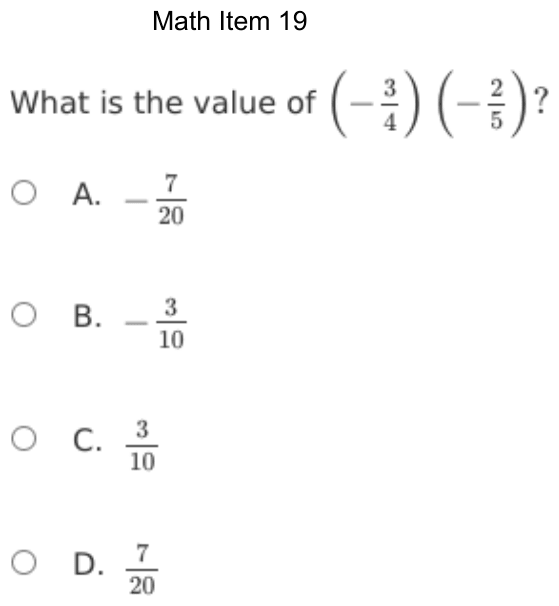
Question 30 of 120
2026 Practice Test C Math, question 21Question
In a fruit basket, the ratio of apples to oranges is the same as the ratio of cherries to walnuts. If there are 6 oranges, 16 cherries, and 48 walnuts, how many apples are there?
- A2
- B3
- C18
- D38
Show the answer
Correct answer: A
The ratios of the items are equal, so they can be expressed using a proportion.
Let a represent the number of apples, o the number of oranges, c the number of cherries, and w the number of walnuts. Write a proportion showing apples:oranges is equal to cherries:walnuts:
Substitute the given values for oranges (6), cherries (16), and walnuts (48):
Cross multiply to form an equation to solve for the number of apples (a):
Solve for the value of a:
Question analysis
In a fruit basket, the ratio of apples to oranges equals the ratio of cherries to walnuts, and students find the number of apples from the counts of oranges, cherries and walnuts. It tests setting up and solving a proportion. Matching each quantity to its place in the ratio matters, since the wrong order gives a very different count.
- Grade level
- Grade 6 content, by NYS standard
- Compared with grade 7
- Below grade 7 Equal ratios with whole numbers are grade 6 work, and the numbers divide evenly. Grade 7 proportion problems are usually longer; here the only care is keeping apples with oranges in the same order as cherries with walnuts.
- Estimated difficulty
- Straightforward: two steps or one careful reading.
- Thinking it demands
- Depth of knowledge 2, skills and concepts · mainly apply
- What makes it hard
- Turning words into math minor
- Much to keep track of minor
- Solution
- 2 steps
- Reading level
- Question and choices: about grade 7, 32 words.
- Students, last 30 days
- Not enough answers yet to show (it takes 10).
Why it is hard, traps and wrong answers (shows the answer)
Why it is hard
The numbers divide evenly, since 16/48 is 1/3, so the work is in the setup. Writing the two ratios in the order the sentence gives them makes the apples a third of the oranges; writing either one upside down makes them three times the oranges. A quick sense check helps: cherries are fewer than walnuts, so apples must be fewer than oranges.
Turning words into math minor Understanding the question
The sentence pairs apples with oranges and cherries with walnuts in the same order, so a/6 = 16/48; reading either pair the other way turns one ratio upside down. (Hegarty, Mayer & Monk, 1995; Koedinger & Nathan, 2004)
Much to keep track of minor Working it out
Four kinds of fruit are named and three counts given, and the unknown apples must be matched with the smaller count, the cherries, not the larger, the walnuts. (Sweller, 1988; Carpenter, Just & Shell, 1990)
Strategy: Write apples over oranges equal to cherries over walnuts, simplify the known ratio, and scale it to match the 6 oranges.
Traps
- Wrong operation: Adds instead of multiplying, divides the wrong way round, turns a ratio or rate upside down, or undoes a step in the wrong direction (subtracts what should be added back).
- Stops one step early: A choice is a number from partway through the solution.
- Misunderstands the concept: A wrong belief about a concept: that percents can be added, that area grows like length, that averages can be averaged, that a bigger denominator means a bigger fraction.
The wrong answers, classified
B Stops one step early (King et al., 2004; Gierl et al., 2017)
Divides the 48 walnuts by the 16 cherries to get the factor 3 and stops before using it to divide the 6 oranges.
C Wrong operation (Hegarty, Mayer & Monk, 1995; King et al., 2004)
Turns one ratio upside down, setting apples over oranges equal to 48 over 16, so the apples come out as 3 × 6 = 18.
D Misunderstands the concept (Smith, diSessa & Roschelle, 1993; De Bock et al., 1998; Ni & Zhou, 2005)
Reasons with differences instead of ratios, taking the gap of 32 between walnuts and cherries and adding it to the 6 oranges.
Worked solution, step by step
Formulas used
- Equal ratios
- A ratio compares two amounts. Writing it as a fraction puts the first thing named on top. The question says the two ratios are the same, so the two fractions are equal. Keep the same order in both.
Sort out the question
A ratio compares two amounts. The ratio of apples to oranges equals the ratio of cherries to walnuts. You know there are 6 oranges, 16 cherries and 48 walnuts. You need the number of apples.
Write the proportion
Put the first thing of each pair on top. Apples go with oranges, and cherries go with walnuts. Let a be the number of apples:
Watch out: keep the order the same. Writing 48 over 16 flips the second ratio. That gives 18, choice C.
Simplify the known ratio
16 goes into both 16 and 48. Divide the top and the bottom by 16:
So there is 1 cherry for every 3 walnuts. There must also be 1 apple for every 3 oranges.
Find the apples
Now the proportion is:
The bottom 6 is 3 × 2, so the top is 1 × 2. That makes .
Watch out: is choice B, but that is not the number of apples. And 38 comes from using differences instead of ratios.
So the answer is A, 2.
Check your answer
Compare the ratios. Apples to oranges is 2 to 6. Cherries to walnuts is 16 to 48. In both, the second number is 3 times the first: and . So the ratios are equal.
More questions like this
The original DOE question
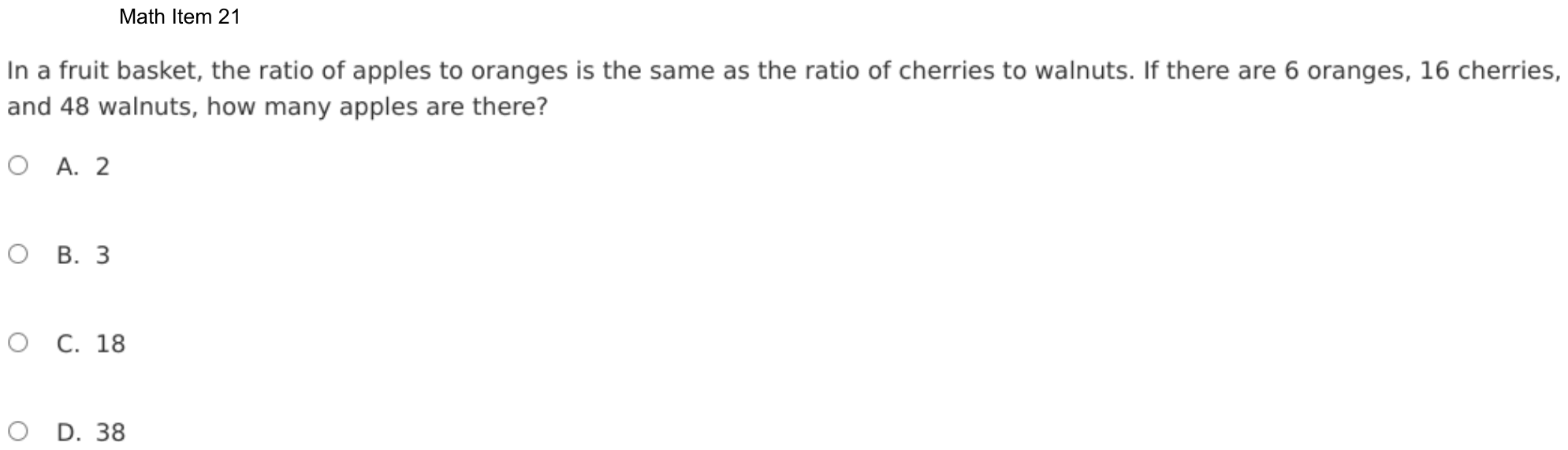
Question 31 of 120
2026 Practice Test C Math, question 23Question
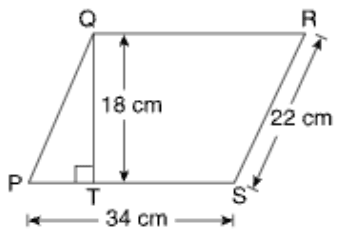
On parallelogram PQRS above, the length of is 18 centimeters. What is the area of the parallelogram?
- A112 sq cm
- B396 sq cm
- C612 sq cm
- D748 sq cm
Show the answer
Correct answer: C
PQRS is a parallelogram in which PS is a base and QT is an altitude. The base is 34 cm in length, and the height is the length of the altitude, so the height is 18 cm.
To determine the area of a parallelogram, multiply the base × the height:
Question analysis
Parallelogram PQRS is drawn with a 34 cm base PS, a 22 cm slanted side and an 18 cm segment QT at a right angle to the base, and students find its area. It tests the area formula for a parallelogram. One labeled length is not needed, so the base and height that go together have to be chosen.
- NYS standards
- 6.G.1 area of polygons
- Grade level
- Grade 6 content, by NYS standard
- Compared with grade 7
- Below grade 7 The area of a parallelogram is grade 6 content, used here once with the height already drawn and labeled. Grade 7 area tasks usually involve circles, composite shapes or scale drawings, so this is easier.
- Estimated difficulty
- Routine: one familiar step, little to misread.
- Thinking it demands
- Depth of knowledge 1, recall and reproduction · mainly apply
- What makes it hard
- Solution
- 1 step
- Reading level
- Question and choices: about grade 5, 25 words.
- Students, last 30 days
- Not enough answers yet to show (it takes 10).
Why it is hard, traps and wrong answers (shows the answer)
Why it is hard
One multiplication answers the question once the right pair of lengths is chosen. Each wrong choice pairs or combines the labeled lengths in another way: the two sides as for a rectangle, the height with the slanted side, or all four sides as a perimeter. Following the right-angle mark at T from QT down to PS identifies the base and height that belong together.
Reading a figure, table or graph minor Understanding the question
Three lengths are labeled, 34 cm, 18 cm and 22 cm, but only the base PS and the height QT meet at the right-angle mark; the slanted side RS is not needed. (Lesh, Post & Behr, 1987; Kirsch & Mosenthal, 1990)
Something you must already know minor Working it out
The formula, base times height, is not given, and the height must be the perpendicular distance between two sides, not the length of a slanted side. (Anderson & Krathwohl, 2001)
Strategy: Multiply the base by the height measured at a right angle to it, and check that the length you use as the height meets that base at a right-angle mark.
Traps
- Wrong formula: Uses a related but wrong formula: perimeter for area, diameter for radius, area for volume, or a misremembered one.
- Information you don't need: The question gives numbers or facts that play no part in the answer.
The wrong answers, classified
A Wrong formula (King et al., 2004)
Adds all four sides, 2 × (34 + 22) = 112, finding the perimeter of the parallelogram instead of its area.
B Misreads the figure (Lesh, Post & Behr, 1987; Kirsch & Mosenthal, 1990)
Multiplies the 18 cm height by the 22 cm slanted side, a pair that does not meet at a right angle, getting 396.
D Wrong formula (King et al., 2004)
Multiplies the two side lengths, 34 × 22 = 748, as if a parallelogram's area were side times side like a rectangle's.
Worked solution, step by step
Formulas used
- Area of a parallelogram
- A is the area. b is the base, the side the shape sits on. h is the height, the straight-up distance from the base to the opposite side, at a right angle to the base. It works because you can cut a triangle off one end, move it to the other end, and make a rectangle.
Sort out the question
PQRS is a parallelogram, a four-sided shape whose opposite sides are parallel. The figure shows three lengths. Side PS, the bottom, is 34 cm. Segment QT goes straight down from Q to PS and is 18 cm. Side RS is slanted and is 22 cm. You need the area, in square centimeters.
Pick the base and the height
The base is PS, 34 cm. The height must meet the base at a right angle. The small square at T shows that QT does. So the height is QT, 18 cm.
Watch out: the 22 cm side is slanted, so it is not the height. Multiplying 22 × 18 gives 396, choice B.
Multiply the base by the height
Use the area formula:
Break it up to multiply:
The area is 612 square centimeters.
Choose the answer
Watch out: 34 × 22 = 748, choice D, treats the shape like a rectangle. Adding all four sides gives 112, choice A. That is the perimeter, the distance around.
So the answer is C, 612 sq cm.
Check your answer
Estimate: 34 is about 30 and 18 is about 20, and . 612 is close. Also, the area must be less than , because the height is shorter than the slanted side.
More questions like this
The original DOE question
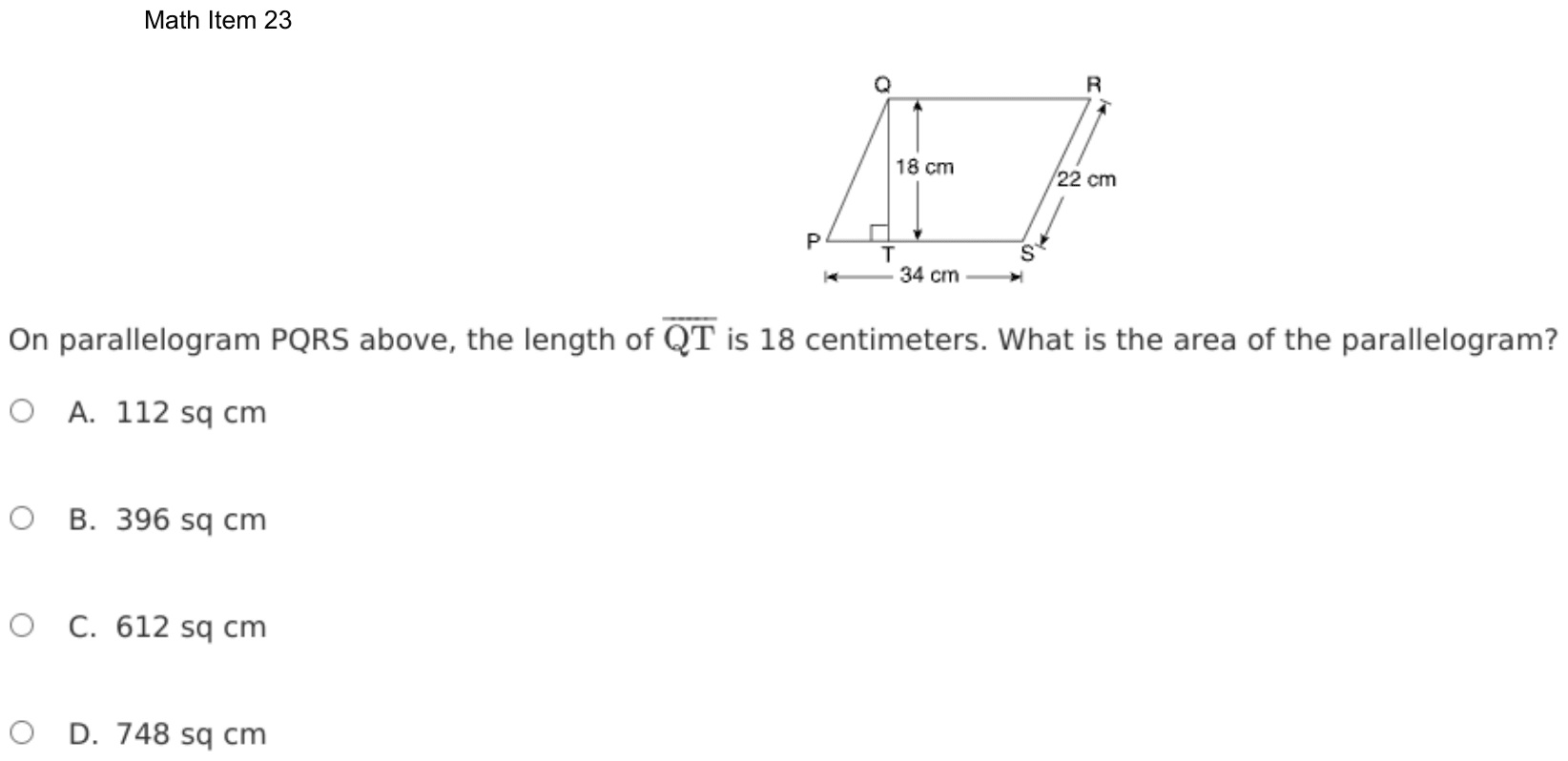
Question 32 of 120
2026 Practice Test C Math, question 24Question
In a showing of an artist’s works, the ratio of the number of paintings, drawings, and photographs shown is 3:5:4, respectively. If the number of drawings shown was 45, what is the total number of photographs and paintings that were shown?
- A36
- B63
- C84
- D108
Show the answer
Correct answer: B
The ratio of paintings to drawings to photographs is .
First, determine the number of actual paintings and photographs.
Since the number of actual drawings is 45, each ratio is multiplied by 9, since .
| Type | Ratio | Actual Number |
|---|---|---|
| Paintings | 3 | 27 |
| Drawings | 5 | 45 |
| Photographs | 4 | 36 |
Then, add the actual number of paintings and photographs.
Question analysis
An art showing has paintings, drawings and photographs in the ratio 3:5:4, and 45 drawings were shown. Students find the total number of photographs and paintings. It tests using a three-part ratio to find actual amounts, and the question asks for two of the three groups together, not any single group or the whole show.
- Grade level
- Grade 7 content, by NYS standard
- Compared with grade 7
- At grade 7 Scaling a ratio from one known part is grade 6 and 7 work. A three-part ratio, and a question about two of the three groups combined, make it a three-step task typical of grade 7 ratio problems.
- Estimated difficulty
- Moderate: several steps, or a close reading with one strong distractor.
- Thinking it demands
- Depth of knowledge 2, skills and concepts · mainly apply
- What makes it hard
- Much to keep track of moderate
- Turning words into math minor
- Solution
- 3 steps
- Reading level
- Question and choices: about grade 10, 39 words.
- Students, last 30 days
- Not enough answers yet to show (it takes 10).
Why it is hard, traps and wrong answers (shows the answer)
Why it is hard
The scale factor comes from one division, 45 ÷ 5 = 9, so the risk lies in what to do with it. Two tempting results are listed: the photographs alone, and the whole show with the drawings added in. Multiplying the 3 + 4 = 7 parts for paintings and photographs by 9 gives the total in one step and avoids both.
Much to keep track of moderate Working it out
The ratio has three parts, the known count belongs to the middle part, drawings, and the question wants the first and third parts combined, so three roles must be tracked. (Sweller, 1988; Carpenter, Just & Shell, 1990)
Turning words into math minor Understanding the question
The word respectively assigns 3, 5 and 4 to paintings, drawings and photographs in that order, and the question then names two of them in the other order. (Hegarty, Mayer & Monk, 1995; Koedinger & Nathan, 2004)
Strategy: Find how many works each ratio part stands for from the drawings, multiply it by the parts for paintings and for photographs, and add only those two.
Traps
- Stops one step early: A choice is a number from partway through the solution.
- Answers a different question: A choice is right for another quantity: the other unknown, the rest instead of the part, the part instead of the whole.
The wrong answers, classified
A Stops one step early (King et al., 2004; Gierl et al., 2017)
Finds the photographs, 4 × 9 = 36, and stops before adding the 27 paintings that the question also asks about.
C Numbers taken from the question (Hegarty, Mayer & Monk, 1995)
Multiplies the 7 parts for paintings and photographs by 12, the total of the ratio's parts, instead of by 9.
D Answers a different question (King et al., 2004; Hegarty, Mayer & Monk, 1995)
Finds every group correctly but adds the 45 drawings too, giving the whole show, 108, rather than the paintings and photographs.
Worked solution, step by step
Formulas used
- Using the parts of a ratio
- The ratio 3:5:4 splits the show into equal parts. Parts is how many parts a group has. Each part stands for the same number of works. Find that number from the group you know, then multiply each group’s parts by it.
Sort out the question
The ratio of paintings to drawings to photographs is 3:5:4. Respectively means in that order: 3 for paintings, 5 for drawings and 4 for photographs. There were 45 drawings. You need the number of photographs and paintings together.
Find the value of one part
Drawings are 5 parts, and there were 45 drawings:
So each part of the ratio stands for 9 works.
Find each group
Multiply each group’s parts by 9:
Type Parts Actual number Paintings 3 Drawings 5 Photographs 4 The drawings row gives 45, which matches the question.
Add only the two groups asked for
Add the paintings and the photographs:
Watch out: 36 alone, choice A, leaves out the paintings. Adding the 45 drawings too gives 108, choice D, the whole show.
So the answer is B, 63.
Check your answer
Paintings and photographs are parts. Each part is 9 works, so . That matches. Also, 63 to 45 is the same as 7 to 5, just as the ratio says.
More questions like this
The original DOE question
Question 33 of 120
2026 Practice Test C Math, question 25Question
For each foot of curtain width, yard of fabric is needed to make ruffles. How many yards of fabric are needed per foot of curtain width?
- A yd
- B yd
- C yd
- D yd
Show the answer
Correct answer: C
It takes yard of fabric to make foot of curtain width.
To find the ratio of 1 foot of curtain width to foot of curtain width , divide.
So the amount of fabric needed for 1 foot of curtain width is times the amount needed for foot of curtain width.
The amount of fabric needed for 1 foot of curtain width is yards.
Question analysis
Making ruffles takes 5/6 yard of fabric for every 3/8 foot of curtain width, and students find how many yards of fabric one foot of curtain width needs. It tests finding a unit rate when both quantities are fractions. The two units differ, and choosing whether to multiply, divide or add the fractions is the crucial decision.
- Grade level
- Grade 7 content, by NYS standard
- Compared with grade 7
- At grade 7 Computing a unit rate from a ratio of two fractions is the grade 7 rate standard itself. Two units, feet and yards, and an unfamiliar sewing setting make it harder to see which fraction divides which.
- Estimated difficulty
- Moderate: several steps, or a close reading with one strong distractor.
- Thinking it demands
- Depth of knowledge 2, skills and concepts · mainly apply
- What makes it hard
- Turning words into math moderate
- Error-prone arithmetic minor
- Solution
- 2 steps
- Reading level
- Question and choices: about grade 5, 36 words.
- Students, last 30 days
- Not enough answers yet to show (it takes 10).
Why it is hard, traps and wrong answers (shows the answer)
Why it is hard
Two fractions and two units, feet and yards, leave students to decide whether to multiply, divide or add, and each wrong choice records one of those decisions. A sense check rules out the most tempting one before any arithmetic: a whole foot is more than 3/8 foot, so it needs more than 5/6 yard, yet multiplying gives only 5/16. Dividing the yards by the feet then picks out the answer among the rest.
Turning words into math moderate Understanding the question
“For each 3/8 foot of curtain width, 5/6 yard of fabric” gives the rate as a pair of fractions, and “per foot” means dividing the yards by the feet. (Hegarty, Mayer & Monk, 1995; Koedinger & Nathan, 2004)
Error-prone arithmetic minor Working it out
Dividing by 3/8 means multiplying by 8/3, and the product 40/18 has to be reduced to 20/9, an improper fraction rather than a whole number. (Brown & Burton, 1978; Junker & Sijtsma, 2001)
Strategy: Divide the yards of fabric by the feet of curtain width, since a rate per foot puts feet in the denominator, then simplify the fraction.
Traps
- Wrong operation: Adds instead of multiplying, divides the wrong way round, turns a ratio or rate upside down, or undoes a step in the wrong direction (subtracts what should be added back).
The wrong answers, classified
A Wrong operation (Hegarty, Mayer & Monk, 1995; King et al., 2004)
Multiplies 5/6 by 3/8 instead of dividing, getting 15/48 = 5/16, so a whole foot seems to need less fabric than 3/8 foot.
B Wrong operation (Hegarty, Mayer & Monk, 1995; King et al., 2004)
Adds 5/6 and 3/8 over a common denominator, 20/24 + 9/24 = 29/24, combining yards with feet instead of forming a rate.
D Wrong operation (Hegarty, Mayer & Monk, 1995; King et al., 2004)
Finds that a foot is 8/3 times 3/8 foot, then adds 8/3 and 5/6 instead of multiplying them: 16/6 + 5/6 = 21/6 = 7/2.
Worked solution, step by step
Formulas used
- Unit rate
- A unit rate tells how much for exactly 1 of something. Here it is yards of fabric for 1 foot of curtain. Per foot means for each foot, so feet go on the bottom. Divide the yards by the feet.
- Dividing by a fraction
- a is any number, and b/c is a fraction. Dividing by a fraction is the same as multiplying by its reciprocal, the fraction flipped upside down. It works because b/c fits into 1 exactly c/b times.
Sort out the question
For every 3/8 foot of curtain width, you need 5/6 yard of fabric. You need the yards of fabric for 1 whole foot. That is a unit rate, an amount for exactly 1 foot.
3/8 foot is less than a whole foot. So a whole foot needs more than 5/6 yard.
Set up the division
Per foot means divide the yards by the feet:
Watch out: multiplying 5/6 by 3/8 gives 5/16, choice A. That is less fabric for more curtain, which makes no sense. Adding them gives 29/24, choice B, but you can’t add yards and feet.
Multiply by the reciprocal
Flip 3/8 to get 8/3, and multiply:
The 8/3 says a whole foot is 8/3 times as long as 3/8 foot. So it needs 8/3 times as much fabric.
Watch out: adding 8/3 and 5/6 gives 7/2, choice D. Multiply them instead.
Simplify the fraction
2 goes into both 40 and 18:
So 1 foot of curtain width needs 20/9 yards of fabric, a little more than 2 yards. So the answer is C, 20/9 yd.
Check your answer
Multiply back. 3/8 foot should need 3/8 of the fabric for a whole foot: yard. That is the amount the question gives. Also, 20/9 is more than 5/6, as it should be.
More questions like this
The original DOE question
Question 34 of 120
2026 Practice Test C Math, question 26Question
Which straight line is the graph of a proportional relationship?
- A
- B
- C
- D
Show the answer
Correct answer: D
The graph of any proportional line must intersect the origin, .
The only line on the coordinate plane that contains is .
Both point and point have a y-value that is of the x-value, and every point on the line fits the proportional equation .
When . So the line contains the origin, .
Question analysis
A coordinate grid shows four straight lines, each named by two labeled points such as M and S or V and Q, and students choose the one that is the graph of a proportional relationship. It tests recognizing proportional relationships on a graph. Every line is straight, so being straight is not enough, and the lines must be told apart by what defines proportionality.
- NYS standards
- 7.RP.2a testing for proportionality
- Grade level
- Grade 7 content, by NYS standard
- Compared with grade 7
- At grade 7 Deciding from a graph whether a relationship is proportional is a named grade 7 skill, and this is a typical case: four lines on a clean grid, each checked against the same rule, with no calculation needed.
- Estimated difficulty
- Routine: one familiar step, little to misread.
- Thinking it demands
- Depth of knowledge 1, recall and reproduction · mainly understand
- What makes it hard
- Solution
- 1 step
- Reading level
- Question and choices: about grade 9, 14 words.
- Corrected from the DOE handbook
- Coordinates and an equation in the explanation were corrected to match the graph.
- Students, last 30 days
- Not enough answers yet to show (it takes 10).
Why it is hard, traps and wrong answers (shows the answer)
Why it is hard
Once the origin rule is recalled, the graph answers the question at a glance: only the line from O through T and R starts at (0, 0). Students who think of proportional as any steady pattern have three other candidates, from the falling line through M and S to the flat line at height 3. The steep line through V and P is the closest call, because its lower end disappears near the corner where the axes meet.
Something you must already know minor Working it out
The rule that a proportional graph is a straight line through the origin is not printed, and all four lines are straight, so straightness alone rules none of them out. (Anderson & Krathwohl, 2001)
Reading a figure, table or graph minor Understanding the question
Line VP runs off the grid just right of O, crossing the x-axis at (1, 0), so whether it passes through the origin has to be read from the gridlines, not from its general direction. (Lesh, Post & Behr, 1987; Kirsch & Mosenthal, 1990)
Strategy: Recall what every proportional graph must look like, then test each line: see where it would be when x is 0, and whether y divided by x stays the same at both labeled points.
Traps
- Misunderstands the concept: A wrong belief about a concept: that percents can be added, that area grows like length, that averages can be averaged, that a bigger denominator means a bigger fraction.
- Misreads the figure: Reads a value, label or tick spacing in a figure, table or graph wrongly.
The wrong answers, classified
A Misunderstands the concept (Smith, diSessa & Roschelle, 1993; De Bock et al., 1998; Ni & Zhou, 2005)
Takes MS as proportional because it is straight and meets both axes, though it starts at (0, 8) and its y-values fall as x rises.
B Misreads the figure (Lesh, Post & Behr, 1987; Kirsch & Mosenthal, 1990)
Sees the steep line’s lower end vanish near O and assumes it passes through the origin, though VP crosses the x-axis at (1, 0).
C Misunderstands the concept (Smith, diSessa & Roschelle, 1993; De Bock et al., 1998; Ni & Zhou, 2005)
Mistakes the steady y-value of 3 along VQ for a constant of proportionality, though y ÷ x falls from 3/2 at V to 1/2 at Q.
What was corrected from the DOE handbook, and why
- Explanation: The DOE’s explanation says “Both point T (1, 4) and point R (2, 8) have a y-value that is 4 times the x-value, and every point on the line fits the proportional equation y = 4x”, and then “When x = 0, y = 4(0).” On the graph, T is at (4, 1) and R at (8, 2): each y-value is 1/4 of its x-value, and the line through the origin, T and R is y = (1/4)x. (The line y = 4x would pass through (1, 4) and (2, 8), which are not marked.) The 2022–23 guide, which first printed this question with the same graph, has the same slip. The site now gives T (4, 1) and R (8, 2), “a y-value that is 1/4 of the x-value”, y = (1/4)x, and y = (1/4)(0) at x = 0. The answer is unchanged: TR is still the only line through the origin.
Worked solution, step by step
Formulas used
- Proportional relationship
- y and x are two amounts that change together. k is the constant of proportionality: the number you always multiply x by to get y. When x is 0, y is k times 0, which is 0. So the graph is a straight line through the origin, the point (0, 0) where the axes meet.
Sort out the question
The grid shows four straight lines. Each one is named by two labeled points on it: line MS, line VP, line VQ and line TR.
You need the line that shows a proportional relationship. In that kind of relationship, y is always the same number times x. For example, y might always be 3 times x.
Recall what a proportional graph looks like
Use the rule . Put in 0 for x:
So every proportional graph goes through the origin. That is the corner point (0, 0), labeled O, where the two axes meet. The graph must also be a straight line.
All four lines here are straight. So being straight does not settle it. Look for the line through O.
Check where each line starts
- Line MS meets the y-axis at M (0, 8). When x is 0, y is 8, not 0.
- Line VP is steep. Its lower end crosses the x-axis at (1, 0), one unit to the right of O.
- Line VQ is flat at a height of 3. It never comes down to 0.
- Line TR starts at O and runs up through T and R.
Watch out: the lower end of line VP looks close to O. Follow it along the grid lines. It misses O by one unit, so choice B is wrong.
Test the ratio on line TR
In a proportional relationship, the ratio y ÷ x is the same at every point. T is at (4, 1) and R is at (8, 2):
Both give . So each y-value is of its x-value, and the line is .
Watch out: line VQ keeps the same y-value, 3, but not the same ratio. At V it is , and at Q it is . So choice C is wrong.
Give the answer
Line MS starts at 8 on the y-axis, so choice A is out too. Only line TR goes through the origin and keeps y ÷ x the same.
So the answer is D, line TR.
Check your answer
Put the origin into the rule for line TR: . So (0, 0) is on the line. Then test R: , which matches R (8, 2). The rule fits every labeled point on the line.
More questions like this
The original DOE question
Question 35 of 120
2026 Practice Test C Math, question 27Question
Some friends are buying bags of ice for a picnic. The graph shows the cost of the ice, in dollars, in relation to the weight, in pounds. Which statement about a point on the graph is true?
- AThe point (20, 3) means that 3 lbs of ice costs $20.00.
- BThe point (1, 0.15) means that 1 bag of ice costs $0.15.
- CThe point (10, 1.5) means that 10 lbs of ice costs $1.50.
- DThe point (0, 0) means that 0 lbs of ice will be needed if 0 people go to the picnic.
Show the answer
Correct answer: C
The x-axis represents the weight, in pounds (lbs), of ice purchased, and the y-axis represents the cost of the ice, in dollars.
The x-value in the point (10, 1.5) represents 10 lbs of ice, and the y-value represents 1.5 dollars, or $1.50. Therefore, the cost of 10 lbs of ice is $1.50.
Question analysis
Some friends buying ice for a picnic use a graph of the ice's cost in dollars against its weight in pounds, a straight line from the origin. Students pick the statement that correctly explains what a point on the graph means. Each statement names a point that really is on the line, so the units and the order of the coordinates decide.
- Grade level
- Grade 7 content, by NYS standard
- Compared with grade 7
- At grade 7 Explaining what a point on a proportional graph means in its situation is a named grade 7 skill. The graph is clear and starts at the origin, but each statement has to be read closely against the axis labels.
- Estimated difficulty
- Straightforward: two steps or one careful reading.
- Thinking it demands
- Depth of knowledge 2, skills and concepts · mainly understand
- What makes it hard
- Reading a figure, table or graph moderate
- Every choice must be checked minor
- Solution
- 2 steps
- Reading level
- Question and choices: about grade 2, 77 words.
- Students, last 30 days
- Not enough answers yet to show (it takes 10).
Why it is hard, traps and wrong answers (shows the answer)
Why it is hard
Nothing needs computing, but each statement attaches words to two numbers, and three of them attach the wrong words. The point (1, 0.15) is the unit rate students are trained to look for, and the “bags” in the stem’s story make its statement sound right, though the graph measures pounds. Saying each point aloud as so many pounds for so many dollars exposes the swapped coordinates and the extra people as well.
Reading a figure, table or graph moderate Understanding the question
Each statement must be checked against the axis labels: x is the weight of ice in pounds and y the cost in dollars, on a grid ruled every 2 pounds and every $0.30. (Lesh, Post & Behr, 1987; Kirsch & Mosenthal, 1990)
Every choice must be checked minor Choosing the answer
All four statements name a point that really lies on the line, (1, 0.15) included, so being on the graph rules nothing out; only the meaning given to each coordinate does. (Embretson & Wetzel, 1987)
Strategy: Read both axis labels and their units first, then for each choice say in words what its x-coordinate and its y-coordinate stand for, and compare that with the statement.
Traps
- Misreads the figure: Reads a value, label or tick spacing in a figure, table or graph wrongly.
- Units or scale: The answer is wanted in other units, or a rate or scale must be converted first.
- Misunderstands the concept: A wrong belief about a concept: that percents can be added, that area grows like length, that averages can be averaged, that a bigger denominator means a bigger fraction.
The wrong answers, classified
A Misreads the figure (Lesh, Post & Behr, 1987; Kirsch & Mosenthal, 1990)
Reads the point (20, 3) backward, taking 20 as the price and 3 as the weight, though x counts pounds of ice and y counts dollars.
B Units or scale (King et al., 2004)
Confirms that (1, 0.15) is on the line, the cost of 1 pound, but accepts “1 bag” because the friends buy bags, though the x-axis measures pounds.
D Misunderstands the concept (Smith, diSessa & Roschelle, 1993; De Bock et al., 1998; Ni & Zhou, 2005)
Knows (0, 0) is on every proportional graph and accepts a true-sounding story about people, though the graph never counts people; the point means 0 pounds cost $0.
Worked solution, step by step
Formulas used
- Unit rate
- The cost is in dollars, and the weight is in pounds. The unit rate is the cost of just 1 pound. On a straight line through the origin, it is the same at every point. So you can find it from any point you can read.
Sort out the question
The graph is called ICE COSTS. Read both axes first:
- The x-axis, across the bottom, is the weight of the ice in pounds (lb).
- The y-axis, up the side, is the cost in dollars.
A point is written (x, y), weight first and cost second. So a point means: x pounds of ice cost y dollars. You need the statement that says this correctly.
Find the cost of one pound
The line reaches $3.00 at 20 pounds. Use the unit rate formula:
So 1 pound of ice costs $0.15. This helps you test each point.
Test the point in choice C
Find 10 on the weight axis and go straight up to the line. The line crosses there at 1.5 on the cost axis. The unit rate agrees:
So the point (10, 1.5) means 10 pounds of ice cost $1.50. That is exactly what choice C says.
Check the other statements
Each one names a real point on the line. The problem is the meaning it gives the numbers.
Watch out: choice A reads (20, 3) backward. It means 20 pounds cost $3, not 3 pounds cost $20.
Watch out: choice B is tricky. The point (1, 0.15) is on the line, but the x-axis counts pounds, not bags. So it means 1 pound costs $0.15.
Choice D talks about people, but the graph never counts people. The point (0, 0) means 0 pounds cost $0.
Give the answer
Only choice C gives the right meaning to both numbers.
So the answer is C, 10 lbs of ice costs $1.50.
Check your answer
Use halves. The point (20, 3) says 20 pounds cost $3.00. Half as much ice, 10 pounds, should cost half as much. Half of $3.00 is $1.50. That matches choice C.
More questions like this
The original DOE question
Question 36 of 120
2026 Practice Test C Math, question 30Question
Out of 2,000 high school seniors, 191 were enrolled in the Honor Society. What percentage of the entire group of 2,000 seniors were in the Honor Society?
- A0.955%
- B1.91%
- C9.55%
- D19.1%
Show the answer
Correct answer: C
The fraction represents the 191 high school seniors out of 2,000 enrolled in the Honor Society.
To determine the percentage, convert the fraction to a decimal. Then, rewrite the decimal as a percentage.
Question analysis
Out of 2,000 high school seniors, 191 belong to the Honor Society, and students find what percent of the whole group that is. It tests writing a part of a whole as a percent. Several choices share the same digits, so the decimal point has to be placed with care when the fraction becomes a percent.
- Grade level
- Grade 6 content, by NYS standard
- Compared with grade 7
- Below grade 7 Writing a part of a whole as a percent is grade 6 work, done here with one division and one conversion. The awkward numbers, 191 out of 2,000, make placing the decimal point the only real demand.
- Estimated difficulty
- Straightforward: two steps or one careful reading.
- Thinking it demands
- Depth of knowledge 1, recall and reproduction · mainly apply
- What makes it hard
- Error-prone arithmetic moderate
- Solution
- 2 steps
- Reading level
- Question and choices: about grade 7, 24 words.
- Students, last 30 days
- Not enough answers yet to show (it takes 10).
Why it is hard, traps and wrong answers (shows the answer)
Why it is hard
The method is a single fraction, 191 over 2,000, so the question tests decimal places. The four choices share the digits 955 or 191 and differ only in where the point falls, which means a slip of one place still finds a choice waiting. A rough check settles it: 191 is a little under 200, and 200 is 10% of 2,000, so the share must be a little under 10%.
Error-prone arithmetic moderate Working it out
Dividing 191 by 2,000 gives 0.0955, with a zero right after the decimal point, and writing it as a percent moves the point two more places; each move is a chance to land one place off. (Brown & Burton, 1978; Junker & Sijtsma, 2001)
Strategy: Write the Honor Society members as a fraction of all 2,000 seniors, divide, and move the decimal point two places to the right to turn the decimal into a percent.
Traps
- An arithmetic slip: The right method with a plausible arithmetic error: a digit, a place value or a times-table fact.
- Misunderstands the concept: A wrong belief about a concept: that percents can be added, that area grows like length, that averages can be averaged, that a bigger denominator means a bigger fraction.
The wrong answers, classified
A An arithmetic slip (Junker & Sijtsma, 2001)
Finds 0.0955 but moves the decimal point only one place when writing the percent, giving 0.955%, ten times too small.
B Misunderstands the concept (Smith, diSessa & Roschelle, 1993; De Bock et al., 1998; Ni & Zhou, 2005)
Divides 191 by 100, as if a percent were always out of 100, and never uses the 2,000 seniors, so 191 ÷ 100 = 1.91 becomes 1.91%.
D An arithmetic slip (Junker & Sijtsma, 2001)
Divides 191 by 1,000 instead of 2,000, dropping the 2 while moving the decimal point, so 0.191 becomes 19.1%, twice the true share.
Worked solution, step by step
Formulas used
- Percent of a whole
- The part is the smaller group you care about. The whole is the entire group. The fraction tells what share of the whole the part is. Multiplying by 100 turns that share into a percent, which means out of 100.
Sort out the question
There are 2,000 seniors in all. Of them, 191 are in the Honor Society. You need the percent of all 2,000 seniors who are in it.
So 191 is the part, and 2,000 is the whole.
Write the share as a fraction
Put the part over the whole:
This fraction says 191 out of every 2,000 seniors. Next, turn it into a decimal by dividing.
Divide to get a decimal
Dividing by 2,000 is the same as dividing by 2 and then by 1,000:
Dividing by 1,000 moves the decimal point 3 places to the left. So the share is 0.0955.
Change the decimal to a percent
Multiply by 100. That moves the decimal point 2 places to the right:
So the share is 9.55%.
Watch out: moving the point only 1 place gives 0.955%, choice A. Dividing by 1,000 instead of 2,000 gives 19.1%, choice D. Dividing 191 by 100 gives 1.91%, choice B.
Give the answer
The 191 Honor Society members are 9.55% of all 2,000 seniors. That is a little less than one tenth of them.
So the answer is C, 9.55%.
Check your answer
Estimate. 191 is a little less than 200. And 200 out of 2,000 is one tenth, which is 10%. So the answer should be a little less than 10%. Only 9.55% fits.
More questions like this
The original DOE question
Question 37 of 120
2026 Practice Test C Math, question 31Question
NUMBER OF VISITORS
TO BROOKSIDE ZOO
| Male | Female | |
|---|---|---|
| Children | 360 | 340 |
| Adults | 210 | 290 |
The table above shows the number of people who visited Brookside Zoo in one day. The largest of the four groups made up what percentage of all visitors on that day?
- A30%
- B28%
- C24%
- D17%
Show the answer
Correct answer: A
First, determine the total number of visitors.
The largest group is 360 (Male Children).
Find the percent that represents .
Question analysis
A two-way table counts one day's visitors to Brookside Zoo by age, children or adults, and by male or female. Students find what percent of all visitors the largest of the four groups made up. They must total every cell first, then make sure the count they divide is really the largest one.
- NYS standards
- 6.RP.3c percent as a rate per 100
- Grade level
- Grade 6 content, by NYS standard
- Compared with grade 7
- Below grade 7 Finding what percent one count is of a total is grade 6 work. A two-way table adds two quick steps, totaling the four groups and spotting the largest, but the numbers divide evenly, so it stays below grade 7 demand.
- Estimated difficulty
- Straightforward: two steps or one careful reading.
- Thinking it demands
- Depth of knowledge 1, recall and reproduction · mainly apply
- What makes it hard
- Reading a figure, table or graph minor
- Many steps minor
- Solution
- 3 steps
- Reading level
- Question and choices: about grade 5, 39 words.
- Students, last 30 days
- Not enough answers yet to show (it takes 10).
Why it is hard, traps and wrong answers (shows the answer)
Why it is hard
The arithmetic is friendly, since 360 over 1,200 reduces to 3 over 10, so the work is in reading the table. Two of its cells are close, 340 just below 360, and every wrong choice is the share of one of the other groups. Adding all four counts first, and circling the largest before dividing, keeps the right cell in play.
Reading a figure, table or graph minor Understanding the question
The two-way table gives four separate counts and no totals, so the 1,200 visitors must be added up from the cells and the largest group picked out of a grid. (Lesh, Post & Behr, 1987; Kirsch & Mosenthal, 1990)
Many steps minor Working it out
Three short steps run in order: total the four cells, pick the largest, and divide; using the wrong cell in the last step still gives a believable percent. (Daniel & Embretson, 2010; Enright, Morley & Sheehan, 2002)
Strategy: Add all four cells for the day's total, pick the biggest single cell, and divide it by the total; simplifying the fraction before dividing keeps the arithmetic short.
Traps
- Misreads the question: Misses or misreads a condition or a word in the question: "at least", "each", "remaining", "not".
- Answers a different question: A choice is right for another quantity: the other unknown, the rest instead of the part, the part instead of the whole.
- Misreads the figure: Reads a value, label or tick spacing in a figure, table or graph wrongly.
The wrong answers, classified
B Misreads the figure (Lesh, Post & Behr, 1987; Kirsch & Mosenthal, 1990)
Takes 340, the female children, as the largest cell, misjudging it against the 360 male children beside it, so 340 ÷ 1,200 ≈ 28%.
C Answers a different question (King et al., 2004; Hegarty, Mayer & Monk, 1995)
Answers for the larger adult group, the 290 female adults, as if the question were about adults, so 290 ÷ 1,200 ≈ 24%.
D Misreads the question (Hegarty, Mayer & Monk, 1995)
Reads largest as smallest and uses the 210 male adults, so 210 ÷ 1,200 = 17.5%, and takes the nearest choice.
Worked solution, step by step
Formulas used
- Percent of a whole
- The part is the one group you care about. The whole is everyone. The fraction tells what share of everyone the group is. Multiplying by 100 turns that share into a percent, which means out of 100.
Sort out the question
The table splits one day’s visitors into four groups:
Male Female Children 360 340 Adults 210 290 You need the largest group as a percent of all the visitors. The table gives no total, so you must find it.
Add up all the visitors
Add all four groups to get the whole:
So 1,200 people visited the zoo that day.
Find the largest group
Compare the four numbers. The biggest is 360, the male children.
Watch out: 340 is close to 360, but it is smaller. Using 340 gives about 28%, choice B. Using the 290 female adults gives about 24%, choice C. And 210 is the smallest group, which gives 17.5%, near choice D.
Find the percent
Put the part over the whole. Then simplify by dividing the top and bottom by 120:
Now multiply by 100 to get a percent:
So the male children made up 30% of the visitors.
Give the answer
The largest group, 360 male children, is 30% of all 1,200 visitors.
So the answer is A, 30%.
Check your answer
Work backward. 30% of 1,200 is , the male children. Also, with four groups an even split would be 25% each. The largest group should be a bit more than 25%, and 30% is.
More questions like this
The original DOE question
Question 38 of 120
2026 Practice Test C Math, question 32Question
The box plot shows the average monthly high temperatures in New York City for 12 months. What is the difference between the range and the interquartile range of the temperature data?
Enter your answer in the space.
Fill-in question: work out the answer and type it as a number.
Show the answer
Correct answer: 15
Determine the range by subtracting the minimum value on the box plot from the maximum value on the box plot:
Maximum value , Minimum value
Determine the interquartile range by subtracting the lower quartile value on the box plot from the upper quartile value on the box plot:
Upper Quartile Value , Lower Quartile Value
Determine the difference between the range (45° F) and the interquartile range (30° F):
Question analysis
A box plot of New York City's average monthly high temperatures for 12 months sits above a number line labeled every 4 degrees. Students type the difference between the range and the interquartile range of the data. Two of the plot's values fall between labeled ticks, so careful reading of the scale decides the answer.
- Grade level
- Grade 7 content, by NYS standard
- Compared with grade 7
- Above grade 7 Reading a box plot and finding its interquartile range are grade 7 skills. Here two of the five values fall between ticks spaced 4 apart, and the range, the IQR and their difference must all be found and typed with no choices.
- Estimated difficulty
- Hard: combines ideas, needs a plan, and has more than one tempting wrong answer.
- Thinking it demands
- Depth of knowledge 2, skills and concepts · mainly apply
- What makes it hard
- Solution
- 3 steps
- Reading level
- Question and choices: about grade 7, 36 words.
- Students, last 30 days
- Not enough answers yet to show (it takes 10).
Why it is hard, traps and wrong answers (shows the answer)
Why it is hard
The method is standard, but the key rests on reading the scale between its labels. The axis is ticked only every 4 degrees, and the minimum and the upper quartile land off the ticks, so rounding either one to the nearest label moves the result by a degree or two with nothing to flag it. Students who find the range correctly can also stop there, entering 45, the larger of the two spreads, instead of the difference the question asks for.
Reading a figure, table or graph major Understanding the question
Two of the five values fall between ticks spaced 4 degrees apart: the left whisker ends just short of the 40 tick, at 39, and the box’s right edge sits midway between 76 and 80, at 78. (Lesh, Post & Behr, 1987; Kirsch & Mosenthal, 1990)
Many steps minor Working it out
Four values are read and combined in three subtractions, the range, the interquartile range and then their difference, so one misread value changes the final entry. (Daniel & Embretson, 2010; Enright, Morley & Sheehan, 2002)
Something you must already know minor Working it out
Neither measure is defined on the page: the range spans the whiskers, and the interquartile range is the width of the box, the upper quartile minus the lower. (Anderson & Krathwohl, 2001)
An answer in an unexpected form minor Choosing the answer
The result is typed with no choices to compare, so an entry one or two degrees off, from rounding a value to the nearest tick, looks just as finished as the right one. (Enright, Morley & Sheehan, 2002)
Strategy: Read the minimum, both quartiles and the maximum, judging where each mark falls between the ticks, then subtract for the range and for the IQR, and subtract those two results.
Traps
- Misreads the figure: Reads a value, label or tick spacing in a figure, table or graph wrongly.
- Stops one step early: A choice is a number from partway through the solution.
The wrong answers, classified
14 Misreads the figure (Lesh, Post & Behr, 1987; Kirsch & Mosenthal, 1990)
Reads the left whisker’s end as 40, the nearest labeled tick, instead of 39, so the range becomes 84 − 40 = 44 and 44 − 30 = 14.
45 Stops one step early (King et al., 2004; Gierl et al., 2017)
Finds the range, 84 − 39 = 45 degrees, and enters it, stopping before the interquartile range of 30 is subtracted from it.
17 Misreads the figure (Lesh, Post & Behr, 1987; Kirsch & Mosenthal, 1990)
Reads the box’s right edge as 76, the tick just left of it, instead of 78, so the IQR becomes 76 − 48 = 28 and 45 − 28 = 17.
Worked solution, step by step
Formulas used
- Range
- The maximum is the greatest value, at the right end of the right whisker. The minimum is the least value, at the left end of the left whisker. The range tells how far the whole set of data spreads.
- Interquartile range (IQR)
- Q3 is the upper quartile, the right edge of the box. Q1 is the lower quartile, the left edge of the box. The IQR is the width of the box. It tells how far the middle half of the data spreads.
Sort out the question
A box plot shows data with five numbers. The two whiskers are the lines on each side of the box. Their ends are the minimum, the least value, and the maximum, the greatest. The box runs from the lower quartile to the upper quartile. These are the middles of the lower half and the upper half of the data. The line inside the box is the median, the middle value.
You need the range minus the interquartile range (IQR), in degrees.
Read the values between the ticks
The ticks on the number line are 4 degrees apart. So each degree is one quarter of the space between two ticks. Three values sit right on ticks: the box’s left edge at 48, the median at 64, and the right whisker’s end at 84.
- The left whisker starts just left of the 40 tick. It sits about one quarter of the way back toward 36. So the minimum is degrees.
- The box’s right edge is halfway between 76 and 80. Halfway is 78 degrees.
Find the range
Use the range formula:
The data spread over 45 degrees.
Watch out: rounding the minimum to the 40 tick gives a range of 44. Then the final answer comes out 14, which is wrong.
Find the IQR
Use the IQR formula with the two edges of the box:
The middle half of the data spreads over 30 degrees.
Watch out: reading the box’s right edge as 76 gives an IQR of 28. Then the final answer comes out 17.
Subtract the IQR from the range
The question asks for the difference between the two:
Watch out: 45 is only the range. Do not stop there. Type only the number, with no degree sign.
So you would enter 15.
Check your answer
The range covers the whole plot, and the IQR covers only the box. So their difference is the two whiskers added together. The left whisker is degrees long. The right whisker is degrees long. , which matches.
More questions like this
The original DOE question
Question 39 of 120
2026 Practice Test C Math, question 33Question
A bag contains 40 tiles that are either red, green, or blue. A tile is selected at random, the color is recorded, and the tile is put back in the bag. This process is carried out 120 times, and 18 of those times a red tile is selected. Based on the information, what is the most likely number of red tiles in the bag?
- A6
- B15
- C18
- D30
Show the answer
Correct answer: A
First, determine what fraction of the sample were red tiles, given 18 of the 120 tiles drawn were red.
To predict how many of the actual 40 tiles in the bag are red, multiply 40 by the fraction of red tiles in the sample.
Question analysis
A bag holds 40 red, green and blue tiles, and a tile is drawn and put back 120 times, with red coming up 18 times. Students predict the most likely number of red tiles in the bag. It tests using experimental results to estimate what is in the bag, and the draws outnumber the tiles, which can confuse the scaling.
- Grade level
- Grade 6 content, by NYS standard
- Compared with grade 7
- At grade 7 Predicting from repeated trials is grade 6 probability, and grade 7 students make similar estimates from samples. The twist is scaling down, from 120 draws to a bag of 40 tiles, rather than up to a larger group.
- Estimated difficulty
- Straightforward: two steps or one careful reading.
- Thinking it demands
- Depth of knowledge 2, skills and concepts · mainly apply
- What makes it hard
- Solution
- 2 steps
- Reading level
- Question and choices: about grade 6, 61 words.
- Students, last 30 days
- Not enough answers yet to show (it takes 10).
Why it is hard, traps and wrong answers (shows the answer)
Why it is hard
There are more draws than tiles, which is what makes this unusual: the 120 draws must be scaled down to a bag of 40, not up to a bigger group. Red came up 18 times because each tile went back in the bag, so 18 is not a count of red tiles. Since there are three draws for every tile, dividing the 18 red draws by 3 gives the same estimate as taking 3/20 of 40.
Turning words into math minor Understanding the question
The 18 red draws come from 120 draws with the tile put back each time, so they give a share, 3/20, to take of the 40 tiles, not a count of red tiles. (Hegarty, Mayer & Monk, 1995; Koedinger & Nathan, 2004)
Something you must already know minor Working it out
Students must know that the share of red in repeated draws estimates the share of red tiles in the bag; the stem never says to multiply 40 by that share. (Anderson & Krathwohl, 2001)
Strategy: Write the red draws as a fraction of all 120 draws, simplify it, and take that same fraction of the 40 tiles in the bag.
Traps
- Stops one step early: A choice is a number from partway through the solution.
- Numbers taken from the question: Combines the numbers in the question without a model of the situation, or is simply a number that appears in the question.
The wrong answers, classified
B Stops one step early (King et al., 2004; Gierl et al., 2017)
Finds that red came up in 18 of 120 draws, or 15%, and gives 15 as the count, stopping before taking that share of the 40 tiles.
C Numbers taken from the question (Hegarty, Mayer & Monk, 1995)
Gives 18, the number of times red was drawn, as the number of red tiles, though each tile went back and could be drawn many times.
D Little reason to choose it (Haladyna & Downing, 1993; Rodriguez, 2005)
No working from 18 red draws in 120 gives 30 red tiles, three quarters of the bag, when red came up in fewer than one draw in six.
Worked solution, step by step
Formulas used
- Predicting from repeated draws
- The fraction is the share of draws that came up red. That share is your best guess for the share of tiles that are red. Multiply it by the number of tiles in the bag to predict the red tiles. The sign ≈ means about equal.
Sort out the question
The bag has 40 tiles, each red, green or blue. A tile is drawn, its color is written down, and it goes back in the bag. This happens 120 times, and red comes up 18 times.
You need the most likely number of red tiles in the bag.
See why 18 is not the answer
Each tile goes back in the bag after it is drawn. So the same red tile can be drawn again and again. That means 18 counts draws, not tiles.
Watch out: choice C, 18, mixes up the number of red draws with the number of red tiles.
Find the share of red draws
Red came up 18 times out of 120. Simplify by dividing the top and bottom by 6:
As a decimal, that is 0.15, or 15%.
Watch out: 15 is a percent here, not a number of tiles. Stopping now gives choice B.
Take that share of the bag
Use the same share of the 40 tiles in the bag:
So about 6 of the 40 tiles are red.
Give the answer
The best prediction is 6 red tiles. The other 34 tiles are probably green or blue.
So the answer is A, 6.
Check your answer
There were 120 draws for 40 tiles. That is 3 draws for every tile. So divide the red draws by 3: . Same answer. Choice D, 30 red tiles, would be three quarters of the bag. Then red would come up far more than 18 times.
More questions like this
The original DOE question
Question 40 of 120
2026 Practice Test C Math, question 34Question
A teacher will randomly select 3 students to be on a school committee. He will choose either a student from Classroom A or a student from Classroom B with each selection. This tree diagram shows the selection possibilities.
What is the probability that the teacher will select 2 students from Classroom A and 1 student from Classroom B (in any order) for the committee?
- A
- B
- C
- D
Show the answer
Correct answer: B
The tree diagram shows that each of the 3 randomly selected students is from Classroom A or Classroom B. So the first chosen is either A or B, represented by the left column of the diagram.
The second student is either A or B, so if the first is A, the first two chosen will be either AA or AB. If the first is B, then the first two chosen will be either BA or BB, represented by the middle column.
The third student is either A or B, so if the first 2 were AA, the group of 3 would be either AAA or AAB. These outcomes are represented by the top two boxes of the right column. This pattern is followed so that 8 distinct outcomes can be visualized in order:
AAA, AAB, ABA, ABB, BAA, BAB, BBA, BBB
Since the order does not matter, there are 3 groups made up of 2 students from Classroom A and 1 student from Classroom B: AAB, ABA, and BAA.
Out of 8 possible outcomes, 3 outcomes have 2 students from Classroom A and 1 student from Classroom B. Therefore, the probability is 3 out of 8, or .
Question analysis
A teacher picks 3 students for a committee, each from Classroom A or Classroom B, and a tree diagram shows every possible sequence of picks. Students find the probability of getting 2 students from A and 1 from B in any order. Reading the tree as a list of outcomes, and counting each order, is the key.
- NYS standards
- Grade level
- Grade 7 content, by NYS standard
- Compared with grade 7
- At grade 7 Finding a compound probability from a tree diagram is a grade 7 standard, and here the tree is already drawn. Listing its paths and counting the ones that fit the event, in any order, is typical grade 7 classwork.
- Estimated difficulty
- Straightforward: two steps or one careful reading.
- Thinking it demands
- Depth of knowledge 2, skills and concepts · mainly apply
- What makes it hard
- Reading a figure, table or graph moderate
- Much to keep track of minor
- Solution
- 3 steps
- Reading level
- Question and choices: about grade 7, 65 words.
- Students, last 30 days
- Not enough answers yet to show (it takes 10).
Why it is hard, traps and wrong answers (shows the answer)
Why it is hard
The tree does the hard part of the setup, but it shows each outcome only as a path through three columns, not as a list. The parenthesis “in any order” is the key phrase: missing it leaves a single path, while reading the event loosely, as at least two from Classroom A, adds A, A, A. Writing out all eight paths and marking those with exactly two A’s settles the count.
Reading a figure, table or graph moderate Understanding the question
The tree prints only A or B in each box, so the eight three-pick outcomes, such as A, B, A, have to be read by tracing each path across all three columns. (Lesh, Post & Behr, 1987; Kirsch & Mosenthal, 1990)
Much to keep track of minor Working it out
All eight paths must be tracked while counting those with exactly two A’s and one B, and “in any order” means three of them count, not just A, A, B. (Sweller, 1988; Carpenter, Just & Shell, 1990)
Strategy: Follow each path through the tree to write out every three-letter outcome, mark the ones with exactly two A's and one B, and divide by the total number of outcomes.
Traps
- Misreads the question: Misses or misreads a condition or a word in the question: "at least", "each", "remaining", "not".
- Answers a different question: A choice is right for another quantity: the other unknown, the rest instead of the part, the part instead of the whole.
The wrong answers, classified
A Misreads the question (Hegarty, Mayer & Monk, 1995)
Counts only the path A, A, B, missing the stem’s “in any order”, so it finds 1 of the 8 outcomes instead of 3.
C Answers a different question (King et al., 2004; Hegarty, Mayer & Monk, 1995)
Counts every outcome with at least two picks from Classroom A, adding A, A, A to the three right paths, so 4 of 8, or 1/2.
D Answers a different question (King et al., 2004; Hegarty, Mayer & Monk, 1995)
Counts every outcome that mixes the two classrooms, including those with two from B, so 6 of the 8 outcomes, or 3/4.
Worked solution, step by step
Formulas used
- Probability
- P is the probability, the chance something happens. The top counts the outcomes that fit the event. The bottom counts every outcome that can happen. This works when every outcome is equally likely, like each path through this tree.
Sort out the question
The teacher picks 3 students, one at a time. Each pick is from Classroom A or Classroom B.
You need the chance of getting 2 students from A and 1 from B. The words “in any order” matter. They mean the B can be the first, second or third pick.
List every path in the tree
Each path from left to right is one outcome, or possible result. The top path is A, then A, then A. Read all of them:
AAA, AAB, ABA, ABB, BAA, BAB, BBA, BBB
Each pick has 2 choices, so there are outcomes in all.
Mark the ones that fit
Look for exactly two A’s and one B. Three outcomes fit: AAB, ABA and BAA.
Watch out: counting only AAB misses “in any order” and gives , choice A. AAA has three A’s, not two. Counting it too gives , choice C. Counting every mixed outcome gives , choice D, but three of those have two B’s.
Find the probability
Use the probability formula. 3 outcomes fit, out of 8:
So the answer is B, .
Check your answer
Count every outcome by type. Two A’s and one B: 3 outcomes. Two B’s and one A: 3 outcomes (ABB, BAB, BBA). All A’s: 1. All B’s: 1. , so each outcome was counted once.
More questions like this
The original DOE question
Question 41 of 120
2026 Practice Test C Math, question 36Question
A deck of 52 playing cards contains 13 hearts. Sara has 12 cards from this deck in her hand, 3 of which are hearts. The other cards remain in the deck. What is the probability that a card drawn at random from the remainder of the deck will be a heart?
- A
- B
- C
- D
Show the answer
Correct answer: B
First, determine the number of cards in the remaining deck:
Next, determine the number of hearts left in the remaining deck:
Last, determine the probability of drawing a heart from the remaining deck:
Question analysis
A standard deck of 52 playing cards has 13 hearts, and Sara holds 12 cards, 3 of them hearts. Students find the probability that a card drawn at random from the rest of the deck is a heart. Her hand changes both the number of hearts and the number of cards left, so both counts must be updated.
- NYS standards
- 6.SP.8a uniform probability models
- Grade level
- Grade 6 content, by NYS standard
- Compared with grade 7
- At grade 7 Finding a simple probability is grade 6 content. This one adds a step many grade 7 problems skip: the cards in Sara's hand must be taken out of both the hearts and the whole deck first.
- Estimated difficulty
- Straightforward: two steps or one careful reading.
- Thinking it demands
- Depth of knowledge 2, skills and concepts · mainly apply
- What makes it hard
- Much to keep track of minor
- Turning words into math minor
- Solution
- 3 steps
- Reading level
- Question and choices: about grade 3, 51 words.
- Students, last 30 days
- Not enough answers yet to show (it takes 10).
Why it is hard, traps and wrong answers (shows the answer)
Why it is hard
The careful route takes two subtractions and a fraction: 10 hearts among 40 cards. The numbers are kind, because Sara’s hand is a quarter hearts, just like the full deck, so a student who ignores her hand and divides 13 by 52 also reaches 1/4. The wrong choices come from describing her hand instead of the deck, or from comparing hearts with the cards that are not hearts.
Much to keep track of minor Working it out
Four counts are in play, 52 cards, 13 hearts, Sara’s 12 cards and her 3 hearts, and both the hearts and the total must be reduced before the fraction is formed. (Sweller, 1988; Carpenter, Just & Shell, 1990)
Turning words into math minor Understanding the question
“The other cards remain in the deck” and “the remainder of the deck” point to the 40 cards Sara is not holding, not to the full 52 or to her hand. (Hegarty, Mayer & Monk, 1995; Koedinger & Nathan, 2004)
Strategy: Work out how many cards are left in the deck and how many of them are hearts, then write the hearts left over the cards left and simplify.
Traps
- Answers a different question: A choice is right for another quantity: the other unknown, the rest instead of the part, the part instead of the whole.
- Misunderstands the concept: A wrong belief about a concept: that percents can be added, that area grows like length, that averages can be averaged, that a bigger denominator means a bigger fraction.
- Numbers taken from the question: Combines the numbers in the question without a model of the situation, or is simply a number that appears in the question.
The wrong answers, classified
A Numbers taken from the question (Hegarty, Mayer & Monk, 1995)
Matches the 10 hearts left in the deck to the 10 in 1/10, never dividing them by the 40 cards that remain.
C Answers a different question (King et al., 2004; Hegarty, Mayer & Monk, 1995)
Puts Sara’s 3 hearts over the deck’s 13, or her 12 cards over 52, both 3/13, which describes her hand rather than the cards left.
D Misunderstands the concept (Smith, diSessa & Roschelle, 1993; De Bock et al., 1998; Ni & Zhou, 2005)
Compares the 10 hearts left with the 30 other cards left, a part-to-part ratio of 1 to 3, instead of with all 40 cards.
Worked solution, step by step
Formulas used
- Probability
- P is the probability, the chance something happens. The top counts the cards that are hearts. The bottom counts every card you could draw. Each card is equally likely to be drawn, so the fraction gives the chance.
Sort out the question
A full deck has 52 cards, and 13 of them are hearts. Sara holds 12 cards, and 3 of those are hearts. The rest of the cards stay in the deck.
You need the chance that a card drawn from the rest of the deck is a heart. Her hand changes both counts.
Count the cards left
Take Sara’s 12 cards out of the deck:
So 40 cards are left in the deck.
Count the hearts left
Sara holds 3 of the 13 hearts. Take those out:
So 10 hearts are left in the deck.
Find the probability
Use the probability formula. Put the hearts left over all the cards left, then simplify:
Watch out: comparing the 10 hearts with the 30 cards that are not hearts gives , choice D. The bottom must be all 40 cards. Choice C, , describes Sara’s hand, not the deck. Choice A, , uses the 10 hearts but forgets the 40 cards.
Give the answer
The chance of drawing a heart from the rest of the deck is 1 in 4.
So the answer is B, .
Check your answer
10 is one quarter of 40, because . Here is another check. Sara’s hand is 3 hearts out of 12, which is also one quarter. Taking a hand that is one quarter hearts out of a deck that is one quarter hearts leaves one quarter hearts.
More questions like this
The original DOE question
Question 42 of 120
2026 Practice Test C Math, question 37Question
The table shows the probability of randomly picking each flavor of candy from a bowl.
PICKING CANDY FROM
A BOWL
| Flavor | Probability |
|---|---|
| Butterscotch | 0.57 |
| Lemon | 0.095 |
| Maple | 0.125 |
| Strawberry | 0.21 |
Which flavor is most likely to be randomly picked?
- Abutterscotch
- Blemon
- Cmaple
- Dstrawberry
Show the answer
Correct answer: A
The flavor most likely to be picked at random is butterscotch, because its probability is the greatest of the probabilities in the list. More than half the candies in the bowl are butterscotch.
Question analysis
A table lists the probability of picking butterscotch, lemon, maple or strawberry candy at random from a bowl, each as a decimal. Students decide which flavor is most likely to be picked. It tests the meaning of probability and comparing decimals, which have different numbers of digits here and must be compared by place value.
- Grade level
- Grade 6 content, by NYS standard
- Compared with grade 7
- Below grade 7 Reading probabilities as likelihoods is grade 6 content, and this needs only a comparison of four decimals. The one demand is comparing decimals with different numbers of digits, a skill from earlier grades.
- Estimated difficulty
- Routine: one familiar step, little to misread.
- Thinking it demands
- Depth of knowledge 1, recall and reproduction · mainly understand
- What makes it hard
- Error-prone arithmetic minor
- Solution
- 1 step
- Reading level
- Question and choices: about grade 9, 37 words.
- Students, last 30 days
- Not enough answers yet to show (it takes 10).
Why it is hard, traps and wrong answers (shows the answer)
Why it is hard
One idea answers the question: the most likely flavor has the greatest probability. The only obstacle is comparing decimals of different lengths, where 0.125 and 0.095 look bigger than 0.57 to students who count digits. Writing each as thousandths, 570, 95, 125 and 210, or noticing that 0.57 alone is more than one half, makes the order plain.
Error-prone arithmetic minor Working it out
The probabilities have two and three decimal places, 0.57 beside 0.095 and 0.125, so comparing them by length, or by their digits as whole numbers, ranks them wrongly. (Brown & Burton, 1978; Junker & Sijtsma, 2001)
Strategy: Line the four decimals up by place value, adding zeros so each has three decimal places, and compare them digit by digit starting from the tenths place.
Traps
- Misunderstands the concept: A wrong belief about a concept: that percents can be added, that area grows like length, that averages can be averaged, that a bigger denominator means a bigger fraction.
The wrong answers, classified
B Misreads the figure (Lesh, Post & Behr, 1987; Kirsch & Mosenthal, 1990)
Reads lemon’s 0.095 as 0.95, overlooking the 0 in the tenths place, so it looks almost certain and larger than 0.57.
C Misunderstands the concept (Smith, diSessa & Roschelle, 1993; De Bock et al., 1998; Ni & Zhou, 2005)
Treats the decimal with more digits as the larger, or compares 125 with 57 as whole numbers, so 0.125 seems bigger than 0.57.
D Little reason to choose it (Haladyna & Downing, 1993; Rodriguez, 2005)
No common misreading makes 0.21 the largest, since it is neither the longest decimal nor the one with the biggest digits, so it mostly draws guesses.
Worked solution, step by step
Formulas used
- Probability
- P is the probability of picking a flavor. It is a number from 0 to 1. The more candies of a flavor there are, the bigger its probability. So the flavor with the greatest probability is the most likely to be picked.
Sort out the question
The table gives the probability of picking each of four flavors. You need the flavor that is most likely to be picked.
The greater the probability, the more likely the pick. So you need the greatest of the four decimals.
Line up the decimals
The decimals have different numbers of digits. Add zeros at the end so each has three decimal places. This does not change their values:
Flavor Probability Butterscotch 0.570 Lemon 0.095 Maple 0.125 Strawberry 0.210 Compare the tenths digits
Start with the first digit after the decimal point, the tenths place. The tenths digits are 5, 0, 1 and 2. The biggest is 5, so 0.570 is the greatest.
Watch out: 0.125 has more digits than 0.57, but it is smaller. Compare place by place, not by length. That mistake leads to choice C. Also, lemon is 0.095, not 0.95, so choice B is out.
Give the answer
Butterscotch has the greatest probability, 0.57. So it is the flavor most likely to be picked.
So the answer is A, butterscotch.
Check your answer
0.57 is more than 0.5, which is one half. So more than half the candies are butterscotch. The other three flavors add up to , less than half. So butterscotch must be the most likely.
More questions like this
The original DOE question
Question 43 of 120
2026 Practice Test C Math, question 38Question
This formula can be used to determine p, the number of pages that will be in a book that contains w words, with an average of r words per page, and f extra pages in the front for the title and publishing information.
If the formula is solved for w, it can be used to find the number of words in a book with p pages. What will the formula be if it is solved for w?
- A
- B
- C
- D
Show the answer
Correct answer: A
Apply the properties of equality to solve for w.
Subtract f from both sides of the equation.
Multiply both sides by r.
Question analysis
A formula gives the number of pages p in a book from its number of words w, the average words per page r, and the extra front pages f. Students choose the formula solved for w. It tests rearranging a formula with inverse operations, and with only letters there are no numbers to check, so the order of the steps matters.
- Grade level
- Grade 8 content, by NYS standard
- Compared with grade 7
- Above grade 7 Grade 7 students solve two-step equations such as 5 = x/4 + 2 with numbers. Rearranging a formula with four letters to solve for a different one is grade 8 work, with no numbers to check against.
- Estimated difficulty
- Moderate: several steps, or a close reading with one strong distractor.
- Thinking it demands
- Depth of knowledge 1, recall and reproduction · mainly apply
- What makes it hard
- Variables instead of numbers moderate
- Many steps minor
- Solution
- 2 steps
- Reading level
- Question and choices: about grade 5, 82 words.
- Students, last 30 days
- Not enough answers yet to show (it takes 10).
Why it is hard, traps and wrong answers (shows the answer)
Why it is hard
The formula is short, but solving it for w means undoing two operations in reverse order, with letters only. The tempting shortcut multiplies p by r and leaves the f untouched, which yields a formula that looks as finished as the right one. Swapping p and w without undoing anything is the other quick trap. Substituting a small book, 5,000 words at 250 a page with 4 front pages, shows which formula gives back 5,000.
Variables instead of numbers moderate Understanding the question
Four letters and no numbers mean each choice has to be judged by its structure, unless students pick values such as r = 250, w = 5,000 and f = 4 to test it. (Koedinger & Nathan, 2004; Enright, Morley & Sheehan, 2002)
Many steps minor Working it out
Two inverse operations must come in order, subtracting f before multiplying by r; multiplying first means the f would have to be multiplied by r as well. (Daniel & Embretson, 2010; Enright, Morley & Sheehan, 2002)
Strategy: Treat it like a two-step equation with numbers: undo what was done to w last, then the step before, applying each operation to the whole of the other side.
Traps
- A faulty procedure: A systematic but wrong procedure: adding fractions straight across, applying an exponent to each term of a sum, dropping a sign when moving a term.
- Misunderstands the concept: A wrong belief about a concept: that percents can be added, that area grows like length, that averages can be averaged, that a bigger denominator means a bigger fraction.
- Numbers taken from the question: Combines the numbers in the question without a model of the situation, or is simply a number that appears in the question.
The wrong answers, classified
B Misunderstands the concept (Smith, diSessa & Roschelle, 1993; De Bock et al., 1998; Ni & Zhou, 2005)
Treats solving for w as trading the places of p and w, keeping the 1/r and the + f exactly where they were.
C A faulty procedure (Brown & Burton, 1978; Tatsuoka, 1983)
Multiplies p by r to undo the 1/r but leaves the + f alone, neither subtracting it first nor multiplying it by r too.
D Numbers taken from the question (Hegarty, Mayer & Monk, 1995)
Adds the other three letters, r + p + f, keeping the formula’s letters but none of its multiplication or division.
Worked solution, step by step
Formulas used
- Multiplying by the reciprocal
- r is any number except 0. The reciprocal of r is 1/r, the number flipped upside down. A number times its reciprocal is always 1. So multiplying by r undoes the 1/r in front of w and leaves w by itself.
Sort out the question
The formula is . Here p is the number of pages, w the number of words, r the words on each page, and f the extra front pages.
You need the formula solved for w. That means w alone on one side of the equal sign.
See what happens to w
Read the formula like a recipe. Start with w. First it is multiplied by , which is the same as dividing by r. Then f is added.
To get w back, undo the steps in reverse order. Take away f first. Then undo the .
Subtract f from both sides
Taking f from both sides keeps them equal:
Now the only thing left to undo is the .
Multiply both sides by r
Use the reciprocal rule. Multiply both whole sides by r:
So .
Watch out: , choice C, multiplies only p by r. The f must be taken away before you multiply. Or, if you multiply first, every term gets multiplied by r.
Give the answer
Choice B only trades the places of p and w, and it undoes nothing. Choice D just adds the letters.
So the answer is A, .
Check your answer
Try a book with 5,000 words, 250 words a page and 4 front pages. The first formula gives pages. Choice A gives back the words: . Choice C gives , which is wrong.
More questions like this
The original DOE question
Question 44 of 120
2026 Practice Test C Math, question 39Question
A shipment contains 170 small boxes of medical supplies. In a random sample of 20 of these boxes, 8 have damage and the others are undamaged. Based on this sample, what is the best prediction of the number of undamaged boxes in the shipment, not including the boxes in the random sample?
- A60
- B68
- C90
- D102
Show the answer
Correct answer: C
Determine the fraction of undamaged boxes in the sample, given 8 of the 20 boxes are damaged.
Subtract the number of boxes in the sample from 170.
Basing the prediction of undamaged boxes on the sample, multiply the number of boxes not in the sample by the fraction of undamaged boxes in the sample.
Question analysis
A shipment holds 170 boxes of medical supplies, and in a random sample of 20, 8 are damaged. Students predict how many undamaged boxes are in the shipment, leaving out the boxes in the sample. It tests using a sample to make a prediction, and the question's two conditions each lead to a different tempting wrong choice.
- Grade level
- Grade 7 content, by NYS standard
- Compared with grade 7
- At grade 7 Predicting from a random sample is grade 7 proportional reasoning. This version adds two conditions, undamaged rather than damaged and the shipment without the sample, so it takes three steps and a close reading.
- Estimated difficulty
- Moderate: several steps, or a close reading with one strong distractor.
- Thinking it demands
- Depth of knowledge 2, skills and concepts · mainly apply
- What makes it hard
- Much to keep track of moderate
- Many steps minor
- Solution
- 3 steps
- Reading level
- Question and choices: about grade 8, 49 words.
- Students, last 30 days
- Not enough answers yet to show (it takes 10).
Why it is hard, traps and wrong answers (shows the answer)
Why it is hard
The proportion itself is routine; the question is built around two conditions that each change the numbers. The stem reports the damaged boxes, but the question asks about undamaged ones, and its bold not removes the 20 sampled boxes from the shipment. Each wrong choice matches one way of mishandling the two conditions, so checking the result against both words, undamaged and not, is what the question rewards.
Much to keep track of moderate Working it out
Two conditions point away from the obvious numbers: the question wants undamaged boxes while the stem counts the 8 damaged, and it leaves out the 20 sampled, so 150 boxes, not 170. (Sweller, 1988; Carpenter, Just & Shell, 1990)
Many steps minor Working it out
Three steps follow in order, the undamaged share 12/20, the 150 boxes outside the sample, and their product, and each wrong turn lands on a listed choice. (Daniel & Embretson, 2010; Enright, Morley & Sheehan, 2002)
Strategy: Find the fraction of the sample that is undamaged, count the boxes that were not sampled, and multiply; then check that the answer describes the group of boxes asked about.
Traps
- Misreads the question: Misses or misreads a condition or a word in the question: "at least", "each", "remaining", "not".
- Answers a different question: A choice is right for another quantity: the other unknown, the rest instead of the part, the part instead of the whole.
The wrong answers, classified
A Answers a different question (King et al., 2004; Hegarty, Mayer & Monk, 1995)
Uses the damaged share, 8 of 20 or 0.4, instead of the undamaged share, taking it of the 150 unsampled boxes: 0.4 × 150 = 60.
B Answers a different question (King et al., 2004; Hegarty, Mayer & Monk, 1995)
Takes the damaged share of the whole shipment, 0.4 × 170 = 68, answering for damaged boxes and keeping the 20 sampled ones as well.
D Misreads the question (Hegarty, Mayer & Monk, 1995)
Finds the undamaged share, 0.6, but takes it of all 170 boxes, missing the bold not that leaves the 20 sampled boxes out: 0.6 × 170 = 102.
Worked solution, step by step
Formulas used
- Predicting from a sample
- A sample is a small group chosen at random from a bigger group. The fraction is the share of the sample with some feature. A random sample is likely to look like the bigger group. So use the same share of the group you are predicting for.
Sort out the question
The shipment has 170 boxes. A random sample of 20 boxes was checked, and 8 of them were damaged.
You need to predict the undamaged boxes in the shipment, not counting the 20 in the sample. Two words matter: undamaged and not.
Find the undamaged share
The sample has undamaged boxes. Write that as a share of the sample, and simplify:
So 0.6, or 60%, of the sample is undamaged.
Watch out: is the damaged share. Using it leads to choice A or B.
Count the boxes outside the sample
The question leaves out the 20 boxes in the sample. Take them away from the shipment:
So the prediction is about 150 boxes.
Make the prediction
Use the same undamaged share for the 150 boxes:
About 90 of those boxes should be undamaged.
Watch out: , choice D, forgets the bold not. It counts the sample boxes again.
Give the answer
The best prediction is 90 undamaged boxes outside the sample.
So the answer is C, 90.
Check your answer
Predict the damaged boxes outside the sample too: . Then , every box outside the sample. Also, 12 out of 20 is a bit more than half. And 90 is a bit more than half of 150.
More questions like this
The original DOE question
Question 45 of 120
2026 Practice Test C Math, question 40Question
In basketball, a player can earn 1 point for making a free throw and 2 points for making another basket. Marcus makes a mean of 8 free throws per game, and he scores a total of at least 25 points per game. The inequality below shows this relationship, where b represents the number of 2-point baskets Marcus makes.
What is the number of 2-point baskets Marcus needs to make if he wants to score at least his minimum total points for a game and make his mean number of free throws?
- A
- B
- C
- D
Show the answer
Correct answer: B
Solve the inequality .
Since the number of baskets made must be a whole number, the fewest 2-point baskets, b, he must make is 9.
Question analysis
In basketball, Marcus makes a mean of 8 one-point free throws a game and wants at least 25 points, shown by the inequality 2b + 8 ≥ 25. Students find how many 2-point baskets he needs. It tests solving a two-step inequality and interpreting the solution in context, since a player cannot make part of a basket.
- NYS standards
- 7.EE.4b two-step inequalities
- Grade level
- Grade 7 content, by NYS standard
- Compared with grade 7
- At grade 7 Solving a two-step inequality from a word problem is a grade 7 standard. Here the inequality is already written, so the extra demand is interpreting its solution as a count of baskets, typical of grade 7 tasks.
- Estimated difficulty
- Straightforward: two steps or one careful reading.
- Thinking it demands
- Depth of knowledge 2, skills and concepts · mainly apply
- What makes it hard
- An answer in an unexpected form minor
- Complex sentences minor
- Solution
- 3 steps
- Reading level
- Question and choices: about grade 5, 92 words.
- Students, last 30 days
- Not enough answers yet to show (it takes 10).
Why it is hard, traps and wrong answers (shows the answer)
Why it is hard
The inequality is handed over, so the solving is two routine moves; the judgment comes after. Dividing 17 by 2 leaves a half, and since a basket cannot be split, the boundary has to move up to 9: eight baskets give 2(8) + 8 = 24 points, one short of 25. Students who flip the symbol while dividing, or who move the 8 without changing its sign, still find a choice to match.
An answer in an unexpected form minor Choosing the answer
Solving gives b ≥ 8.5, which no choice shows; it has to be recognized as b ≥ 9, because Marcus cannot make half a basket. (Enright, Morley & Sheehan, 2002)
Complex sentences minor Understanding the question
The 33-word question restates the given inequality as “at least his minimum total points” and “make his mean number of free throws”, wording harder than the math it describes. (Abedi & Lord, 2001; Freedle & Kostin, 1993; Messick, 1989)
Strategy: Undo the added 8 and then the 2 to solve for b, then ask which whole numbers of baskets actually reach 25 points, testing the boundary value in the original inequality.
Traps
- Negatives and direction: Arithmetic with negative numbers, the order of a subtraction, or direction on a number line. (Moving a term across the equals sign without changing its sign is a faulty procedure.)
- A faulty procedure: A systematic but wrong procedure: adding fractions straight across, applying an exponent to each term of a sum, dropping a sign when moving a term.
- Numbers taken from the question: Combines the numbers in the question without a model of the situation, or is simply a number that appears in the question.
The wrong answers, classified
A Negatives and direction (Brown & Burton, 1978)
Reverses the inequality when dividing by 2, as if dividing always flipped it, so b ≤ 8.5, and whole baskets give b ≤ 8.
C A faulty procedure (Brown & Burton, 1978; Tatsuoka, 1983)
Moves the 8 to the right without changing its sign, so 2b ≥ 33 and b ≥ 16.5, then drops the half to match b ≥ 16.
D Numbers taken from the question (Hegarty, Mayer & Monk, 1995)
Takes the 25-point total from the inequality as a limit on baskets and writes at most, a number copied from the question rather than solved for.
Worked solution, step by step
Formulas used
- Solving an inequality
- A and B are the two sides. The sign ≥ means greater than or equal to. Taking the same amount C from both sides keeps the sign the same. Dividing both sides by a positive number, like 2, also keeps it the same. Only a negative number flips it.
Sort out the question
A free throw is worth 1 point, and each other basket is worth 2 points. Marcus makes 8 free throws, which give 8 points. The letter b is the number of 2-point baskets, so they give 2b points.
He wants at least 25 points in all. That is the inequality . An inequality compares two amounts. The sign ≥ means greater than or equal to. You need the values of b that work.
Subtract 8 from both sides
Undo the added 8 first:
Watch out: adding 8 instead gives . That leads to choice C, which is wrong.
Divide both sides by 2
2b means 2 times b. Divide both sides by 2. Since 2 is positive, the sign stays the same:
Watch out: do not flip the sign here. Flipping it gives , which leads to choice A.
Think about whole baskets
Marcus cannot make half a basket. So test the whole numbers near 8.5:
Eight baskets give 24 points, one short of 25. Nine baskets give 26 points, which is enough. So he needs 9 or more baskets.
Give the answer
The number of baskets is 9 or more, written . Choice D, , just copies the 25 from the points.
So the answer is B, .
Check your answer
Try a bigger number, such as b = 12. Then points, which is at least 25. Any number of baskets above 9 also works, and that is what ≥ says. Below 9, the total stays at 24 points or fewer.
More questions like this
The original DOE question
Question 46 of 120
2026 Practice Test C Math, question 43Question
A softball player bought bottles of water for her team to have at practice. The total number of bottles she bought, b, is proportional to n, the number of players at practice. Which equation represents the relationship between b and n? The constant of proportionality is p.
- A
- B
- C
- D
Show the answer
Correct answer: A
In this context, the constant of proportionality, p, represents the relationship between b, the number of bottles of water, and n, the number of players on the team.
The number of bottles of water is the product of the constant of proportionality and the number of players.
The equation that represents this relationship is .
Question analysis
A softball player buys bottles of water for practice, and the number of bottles, b, is proportional to the number of players, n, with constant of proportionality p. Students choose the equation that represents the relationship. It tests writing an equation for a proportional relationship using letters only, so the meaning of proportional has to be clear.
- NYS standards
- 7.RP.2c proportional relationship equations
- Grade level
- Grade 7 content, by NYS standard
- Compared with grade 7
- Below grade 7 Grade 7 students write equations for proportional relationships from tables, graphs and descriptions, usually with a number to find. Here the constant is already given as a letter, so only the general form must be recalled, a short task.
- Estimated difficulty
- Routine: one familiar step, little to misread.
- Thinking it demands
- Depth of knowledge 1, recall and reproduction · mainly remember
- What makes it hard
- Solution
- 1 step
- Reading level
- Question and choices: about grade 7, 51 words.
- Students, last 30 days
- Not enough answers yet to show (it takes 10).
Why it is hard, traps and wrong answers (shows the answer)
Why it is hard
This is a recall question dressed in a short story: the softball team adds nothing but names for the letters. The one idea needed is that proportional means multiplied by a constant, so doubling the players doubles the bottles. Students who think of a constant as something added, or as a fixed total, are drawn to the two sums that use the same letters.
Something you must already know minor Working it out
The general form of a proportional relationship, one amount equal to the constant times the other, has to be recalled; the stem names p but never says it multiplies. (Anderson & Krathwohl, 2001)
Variables instead of numbers minor Understanding the question
No numbers are given, only b, n and p, so a choice cannot be checked by computing unless students make up a case, such as 2 bottles per player for 10 players. (Koedinger & Nathan, 2004; Enright, Morley & Sheehan, 2002)
Strategy: Recall how two proportional quantities are linked through the constant of proportionality, then test each choice with sample numbers: if the players double, the bottles should double too.
Traps
- Misunderstands the concept: A wrong belief about a concept: that percents can be added, that area grows like length, that averages can be averaged, that a bigger denominator means a bigger fraction.
The wrong answers, classified
B Misunderstands the concept (Smith, diSessa & Roschelle, 1993; De Bock et al., 1998; Ni & Zhou, 2005)
Treats proportional as adding a fixed amount, so the bottles would be the players plus p, rather than the players multiplied by a constant.
C Misunderstands the concept (Smith, diSessa & Roschelle, 1993; De Bock et al., 1998; Ni & Zhou, 2005)
Takes the constant of proportionality as the total of bottles and players, confusing a constant sum with a constant ratio.
D Little reason to choose it (Haladyna & Downing, 1993; Rodriguez, 2005)
Puts all three letters into one sum equal to 1, an equation that uses the right letters but matches no idea of proportion, so it mostly draws guesses.
Worked solution, step by step
Formulas used
- Proportional relationship
- y and x are two amounts that change together. k is the constant of proportionality, the number you always multiply x by to get y. Because it is a multiplication, doubling x doubles y.
Sort out the question
The letter b is the number of bottles, and n is the number of players. The bottles are proportional to the players. The constant of proportionality is p.
You need the equation that links b and n. There are no numbers, only letters.
Recall what proportional means
Proportional means one amount is always a fixed number times the other. For example, say there are 2 bottles for each player. Then 10 players need 20 bottles, and 20 players need 40 bottles. Doubling the players doubles the bottles.
The fixed number, here 2, is the constant of proportionality.
Write it with these letters
Start with the rule . The bottles take the place of y, the players take the place of x, and p is the constant:
Here pn means p times n.
Check the other choices
Watch out: choice B, , adds instead of multiplying. With p = 2, 10 players give 12 bottles. Then 20 players give 22, which is not double.
Choice C makes p a total of bottles and players, not a multiplier. Choice D makes all three letters add up to 1, which does not fit at all.
Give the answer
Only multiplies the players by a constant. So it is the only choice where doubling the players doubles the bottles.
So the answer is A, .
Check your answer
Try p = 3 bottles per player. With 5 players, . With 10 players, . Twice the players, twice the bottles. Also, , so b ÷ n gives back the constant.
More questions like this
The original DOE question
Question 47 of 120
2026 Practice Test C Math, question 45Question
Malik earns $10 per hour at his job. He wants to change to a job that will pay $12 per hour. What will be the percent increase in Malik’s hourly pay if he makes this job change?
- A2%
- B20%
- C83%
- D120%
Show the answer
Correct answer: B
Subtract to determine the amount of increase in Malik’s hourly pay if he changes jobs.
Divide the increase amount by the original hourly pay rate.
Multiply the quotient by 100 to express the decimal amount as a percentage.
Question analysis
Malik earns $10 an hour and wants to switch to a job that pays $12 an hour. Students find the percent increase in his hourly pay. It tests finding a percent change. The numbers are easy, so the challenge is knowing which amounts to compare and how to turn that comparison into a percent.
- NYS standards
- 7.RP.3 multistep ratio and percent problems
- Grade level
- Grade 7 content, by NYS standard
- Compared with grade 7
- At grade 7 Percent increase is grade 7 content, and this case uses whole-dollar wages that make the arithmetic easy. The demand is comparing the change with the right amount rather than reporting the change itself or a ratio of the wages.
- Estimated difficulty
- Straightforward: two steps or one careful reading.
- Thinking it demands
- Depth of knowledge 2, skills and concepts · mainly apply
- What makes it hard
- Solution
- 2 steps
- Reading level
- Question and choices: about grade 2, 35 words.
- Students, last 30 days
- Not enough answers yet to show (it takes 10).
Why it is hard, traps and wrong answers (shows the answer)
Why it is hard
The numbers could hardly be friendlier, a $2 raise on $10, so the question checks what to divide by what. Dividing $12 by $10 gives 1.2, the new pay as a percent of the old, and stopping there is tempting because the division feels like the whole job. Reading the $2 itself as 2% is the other quick error, since dollars of change are not percent of change.
Something you must already know minor Working it out
The rule for percent change, the change divided by the starting amount, is not given, and each wrong choice comes from a different comparison of the $10 and the $12. (Anderson & Krathwohl, 2001)
Turning words into math minor Understanding the question
“Percent increase in Malik’s hourly pay” has to be read as the $2 rise measured against the $10 he earns now, not as the new wage compared with the old. (Hegarty, Mayer & Monk, 1995; Koedinger & Nathan, 2004)
Strategy: Find how many dollars the hourly pay goes up, then divide that change by the pay Malik earns now and write the result as a percent.
Traps
- Answers a different question: A choice is right for another quantity: the other unknown, the rest instead of the part, the part instead of the whole.
- Misunderstands the concept: A wrong belief about a concept: that percents can be added, that area grows like length, that averages can be averaged, that a bigger denominator means a bigger fraction.
- Wrong operation: Adds instead of multiplying, divides the wrong way round, turns a ratio or rate upside down, or undoes a step in the wrong direction (subtracts what should be added back).
The wrong answers, classified
A Misunderstands the concept (Smith, diSessa & Roschelle, 1993; De Bock et al., 1998; Ni & Zhou, 2005)
Finds the $2 increase and reads it as 2%, as if a change in dollars were a percent, without dividing it by the original $10.
C Wrong operation (Hegarty, Mayer & Monk, 1995; King et al., 2004)
Divides the old pay by the new, 10 ÷ 12 ≈ 0.83, turning the ratio of the wages upside down and reporting 83%.
D Answers a different question (King et al., 2004; Hegarty, Mayer & Monk, 1995)
Divides the new pay by the old, 12 ÷ 10 = 1.2, which gives the new wage as a percent of the old, not the increase.
Worked solution, step by step
Formulas used
- Percent increase
- The original is the amount before the change. The new amount is the amount after it. The top is how much it went up. Dividing by the original compares the change with where you started. Multiplying by 100 makes it a percent.
Sort out the question
Malik earns $10 an hour now. The new job pays $12 an hour. You need the percent increase.
That means: how much does his pay go up, compared with what he earns now? So $10 is the original amount, and $12 is the new amount.
Find the increase in dollars
Subtract the old pay from the new pay:
His pay goes up by $2 an hour.
Watch out: $2 is an amount of money, not a percent. Calling it 2% gives choice A.
Compare the increase with the original
Use the percent increase formula. Divide the $2 by the original $10, then multiply by 100:
So the pay goes up by 20%.
Watch out: is 120%, choice D. That is the new pay as a percent of the old, not the increase. And is about 83%, choice C, which is upside down.
Give the answer
The $2 raise is 20% of Malik’s current pay.
So the answer is B, 20%.
Check your answer
Work forward. 20% of $10 is dollars. Add that to $10, and you get $12, the new pay. It works. Note that 120% is the new pay compared with the old pay, which is the same as a 20% increase.
More questions like this
The original DOE question
Question 48 of 120
2026 Practice Test C Math, question 46Question
A rain gauge shows that 10 centimeters of rain fell yesterday. If 1 inch is equal to approximately 2.5 centimeters, about how many inches of rain fell yesterday?
- A1
- B2.5
- C4
- D10
Show the answer
Correct answer: C
Set up a proportion to solve:
10 centimeters is approximately 4 inches.
Question analysis
A rain gauge shows that 10 centimeters of rain fell, and 1 inch is about 2.5 centimeters. Students find about how many inches of rain fell. It tests converting between metric and customary units with a given conversion fact, and the main risk is converting in the wrong direction or reusing a number from the question.
- NYS standards
- 6.RP.3d converting measurement units
- Grade level
- Grade 6 content, by NYS standard
- Compared with grade 7
- Below grade 7 Converting units with a given conversion fact is grade 6 content, and this needs a single division with friendly numbers, lighter than grade 7 work with rates and percents.
- Estimated difficulty
- Routine: one familiar step, little to misread.
- Thinking it demands
- Depth of knowledge 1, recall and reproduction · mainly apply
- What makes it hard
- Turning words into math minor
- Solution
- 1 step
- Reading level
- Question and choices: about grade 10, 25 words.
- Students, last 30 days
- Not enough answers yet to show (it takes 10).
Why it is hard, traps and wrong answers (shows the answer)
Why it is hard
A single division answers the question, and its numbers are friendly: four lengths of 2.5 centimeters make 10. Every wrong choice is simply a number from the stem, so the only real risk is reaching for a given value instead of converting. Inches are longer than centimeters, so the rainfall in inches has to be less than 10 but more than the 1 inch that 2.5 centimeters make.
Turning words into math minor Understanding the question
The fact “1 inch is equal to approximately 2.5 centimeters” has to be turned into a division, how many 2.5-centimeter lengths fit into 10, rather than a multiplication. (Hegarty, Mayer & Monk, 1995; Koedinger & Nathan, 2004)
Strategy: Ask how many groups of 2.5 centimeters fit into the 10 centimeters of rain, since each group of 2.5 centimeters makes one inch.
Traps
- Numbers taken from the question: Combines the numbers in the question without a model of the situation, or is simply a number that appears in the question.
- Units or scale: The answer is wanted in other units, or a rate or scale must be converted first.
The wrong answers, classified
A Numbers taken from the question (Hegarty, Mayer & Monk, 1995)
Picks the 1 from the conversion fact, 1 inch for 2.5 centimeters, reading the given fact as the answer instead of applying it to 10 centimeters.
B Numbers taken from the question (Hegarty, Mayer & Monk, 1995)
Picks 2.5, the number of centimeters in one inch, straight from the conversion fact rather than finding how many inches 10 centimeters make.
D Units or scale (King et al., 2004)
Keeps the 10 from the rain gauge, as if centimeters and inches were the same size, so no conversion is done at all.
Worked solution, step by step
Formulas used
- Converting centimeters to inches
- About 2.5 centimeters make 1 inch. So each group of 2.5 centimeters is 1 inch. Dividing the centimeters by 2.5 counts how many of those groups fit. That count is the number of inches.
Sort out the question
The rain gauge shows 10 centimeters (cm) of rain. You know that 1 inch is about 2.5 cm. You need the rain in inches.
Decide whether to multiply or divide
An inch is longer than a centimeter. So it takes fewer inches than centimeters to measure the same rain. The answer must be less than 10. That tells you to divide, not multiply.
Watch out: choice D, 10, keeps the same number, as if inches and centimeters were the same size.
Divide by 2.5
Use the conversion formula:
You can see it by adding: . Four groups of 2.5 cm fit into 10 cm. So 10 cm is about 4 inches.
Give the answer
Watch out: choices A and B, 1 and 2.5, are just the numbers in the conversion fact. They do not use the 10 cm at all.
About 4 inches of rain fell. So the answer is C, 4.
Check your answer
Change back. Each inch is 2.5 cm, so 4 inches is cm. That is what the gauge showed. Also, 4 inches is less than 10, as it should be, because inches are longer.
More questions like this
The original DOE question
Question 49 of 120
2026 Practice Test C Math, question 47Question
The height of a plant, in millimeters, is proportional to the number of days the plant has grown. The plant has grown 20 millimeters in 8 days. What is the constant of proportionality, in millimeters per day?
- A0.4
- B2.5
- C12
- D20
Show the answer
Correct answer: B
The constant of proportionality is determined by dividing the number of millimeters by the number of days:
Question analysis
A plant's height in millimeters is proportional to the number of days it has grown, and it grew 20 millimeters in 8 days. Students find the constant of proportionality in millimeters per day. It tests finding a unit rate, and the order of the division decides whether the rate comes out in the units asked for.
- Grade level
- Grade 7 content, by NYS standard
- Compared with grade 7
- Below grade 7 Finding a constant of proportionality from one pair of values is a basic grade 7 skill. With one division and the units named in the question, it asks less than most grade 7 problems.
- Estimated difficulty
- Routine: one familiar step, little to misread.
- Thinking it demands
- Depth of knowledge 1, recall and reproduction · mainly apply
- What makes it hard
- Solution
- 1 step
- Reading level
- Question and choices: about grade 7, 35 words.
- Students, last 30 days
- Not enough answers yet to show (it takes 10).
Why it is hard, traps and wrong answers (shows the answer)
Why it is hard
One division gives the constant, and the question itself names the order by asking for millimeters per day. The tempting slip is dividing the smaller number by the larger, 8 by 20, out of habit, which gives a rate in days per millimeter. A plant that grows 20 millimeters in 8 days grows more than 2 millimeters a day, a quick sense check on any result.
Something you must already know minor Working it out
Students must know that the constant is the height divided by the days; the units in the question, millimeters per day, name the order of the division. (Anderson & Krathwohl, 2001)
Strategy: Use the units in the question, millimeters per day, as the instruction: divide the millimeters grown by the number of days.
Traps
- Wrong operation: Adds instead of multiplying, divides the wrong way round, turns a ratio or rate upside down, or undoes a step in the wrong direction (subtracts what should be added back).
- Numbers taken from the question: Combines the numbers in the question without a model of the situation, or is simply a number that appears in the question.
The wrong answers, classified
A Wrong operation (Hegarty, Mayer & Monk, 1995; King et al., 2004)
Divides the days by the millimeters, 8 ÷ 20 = 0.4, which gives days per millimeter, the rate turned upside down.
C Numbers taken from the question (Hegarty, Mayer & Monk, 1995)
Subtracts the days from the millimeters, 20 − 8 = 12, combining the two numbers without thinking about a rate.
D Numbers taken from the question (Hegarty, Mayer & Monk, 1995)
Gives the 20 millimeters the plant grew over all 8 days, the total growth, rather than the growth for each single day.
Worked solution, step by step
Formulas used
- Constant of proportionality
- Here y is the height in millimeters, and x is the number of days. k is the growth in one day, in millimeters per day. In a proportional relationship, y = kx, so dividing y by x gives k.
Sort out the question
The plant’s height is proportional to the number of days it grows. It grew 20 millimeters (mm) in 8 days.
You need the constant of proportionality in millimeters per day. Per day means for each day. So you need how much the plant grows in one day.
Divide millimeters by days
The units tell you the order: millimeters per day means millimeters divided by days. Use the formula:
So the plant grows 2.5 mm each day.
Avoid the tempting slips
Watch out: , choice A, is days per millimeter. That is the rate upside down.
Choice C, 12, comes from . Subtracting does not make a rate. Choice D, 20, is the growth over all 8 days, not one day.
Give the answer
The constant of proportionality is 2.5 mm per day.
So the answer is B, 2.5.
Check your answer
Multiply back. At 2.5 mm a day for 8 days, the plant grows mm. That matches. Also, 2 mm a day would give only 16 mm, and 3 mm a day would give 24 mm. So the rate must be between 2 and 3.
More questions like this
The original DOE question
Question 50 of 120
2026 Practice Test C Math, question 48Question
Which table shows a proportional relationship?
- A
x y 0 0 4 8 3 - B
x y 0 1 4 8 6 - C
x y 0 −1 4 8 0 - D
x y 0 0 4 12 8 16
Show the answer
Correct answer: A
The first table is the only one with a constant of proportionality, .
In each ordered pair, .
Question analysis
Four tables each give y for x = 0, 4 and 8, with some values written as fractions or negatives. Students choose the table that shows a proportional relationship. It tests recognizing proportional relationships from a table, which means checking every row against one rule rather than judging by the pattern.
- Grade level
- Grade 7 content, by NYS standard
- Compared with grade 7
- At grade 7 Deciding from a table whether a relationship is proportional is a core grade 7 skill. The fractions and negative values in the tables make each ratio a careful check rather than a glance.
- Estimated difficulty
- Straightforward: two steps or one careful reading.
- Thinking it demands
- Depth of knowledge 2, skills and concepts · mainly apply
- What makes it hard
- Every choice must be checked moderate
- Error-prone arithmetic minor
- Solution
- 2 steps
- Reading level
- Question and choices: about grade 9, 13 words.
- Students, last 30 days
- Not enough answers yet to show (it takes 10).
Why it is hard, traps and wrong answers (shows the answer)
Why it is hard
Two quick tests decide proportionality, and the tables are built so that each test alone lets a wrong table through. The last table starts at (0, 0) like the right one, while the middle two grow by equal steps like the right one. Only checking that y ÷ x is the same in every row with x not 0 separates the one table whose ratio stays at 3/8.
Every choice must be checked moderate Choosing the answer
Each table has to be tested row by row, and two of them start at (0, 0), so the opening row settles nothing; only y ÷ x in the other rows separates them. (Embretson & Wetzel, 1987)
Error-prone arithmetic minor Working it out
The y-values include 3/2, 7/2 and −1/2, so the ratios mean dividing fractions by 4, such as (3/2) ÷ 4 = 3/8, and comparing them with 3 ÷ 8. (Brown & Burton, 1978; Junker & Sijtsma, 2001)
Strategy: For each table, divide y by x in every row where x is not zero, and check that the quotient never changes and that y is 0 when x is 0.
Traps
- Misunderstands the concept: A wrong belief about a concept: that percents can be added, that area grows like length, that averages can be averaged, that a bigger denominator means a bigger fraction.
- Checks only one number: Tries one value in each choice and takes the first that works, when that value happens to work for a wrong choice too; a second value would rule it out.
The wrong answers, classified
B Misunderstands the concept (Smith, diSessa & Roschelle, 1993; De Bock et al., 1998; Ni & Zhou, 2005)
Sees y rise by the same 5/2 each time x rises by 4 and takes the steady change as proportional, missing that y is 1 when x is 0.
C Misreads the figure (Lesh, Post & Behr, 1987; Kirsch & Mosenthal, 1990)
Spots a 0 in the y column and a steady rise of 1/2, but that 0 belongs to x = 8, while at x = 0 the table gives −1.
D Checks only one number (Schoenfeld, 1985)
Checks only the row (0, 0), which every proportional table has, or only 12 ÷ 4 = 3, without testing 16 ÷ 8 = 2 in the last row.
Worked solution, step by step
Formulas used
- Proportional relationship
- y and x are the two amounts in each row. k is the constant of proportionality, the same number in every row. Two tests follow from it. When x is 0, y must be 0. And y ÷ x must equal k in every row where x is not 0.
Sort out the question
Each table gives y for x = 0, 4 and 8. You need the one that shows a proportional relationship. That means y is always the same number times x.
Use two tests. First, y must be 0 when x is 0. Second, y ÷ x must be the same in the other rows.
Test the row where x is 0
Look at the top row of each table:
- Table A: y = 0. It passes.
- Table B: y = 1. It fails.
- Table C: y = −1. It fails.
- Table D: y = 0. It passes.
Watch out: tables B and C go up by equal steps. Steady steps are not enough, because they do not start at 0. Table C does have a 0, but it is next to x = 8.
Test the ratio in table A
Divide y by x. Dividing by 4 is the same as multiplying by :
Both rows give . Table A passes both tests.
Test the ratio in table D
Divide y by x in the same way:
The ratios are different, so table D is not proportional.
Watch out: table D starts at (0, 0) like a proportional table. If you check only that row, or only the row with 4, you will pick choice D.
Give the answer
Only table A starts at (0, 0) and keeps y ÷ x the same.
So the answer is A, the table with y = 0, and 3.
Check your answer
Use the rule for table A, . When x = 4, . When x = 8, . Both match. Doubling x from 4 to 8 also doubles y.
More questions like this
The original DOE question
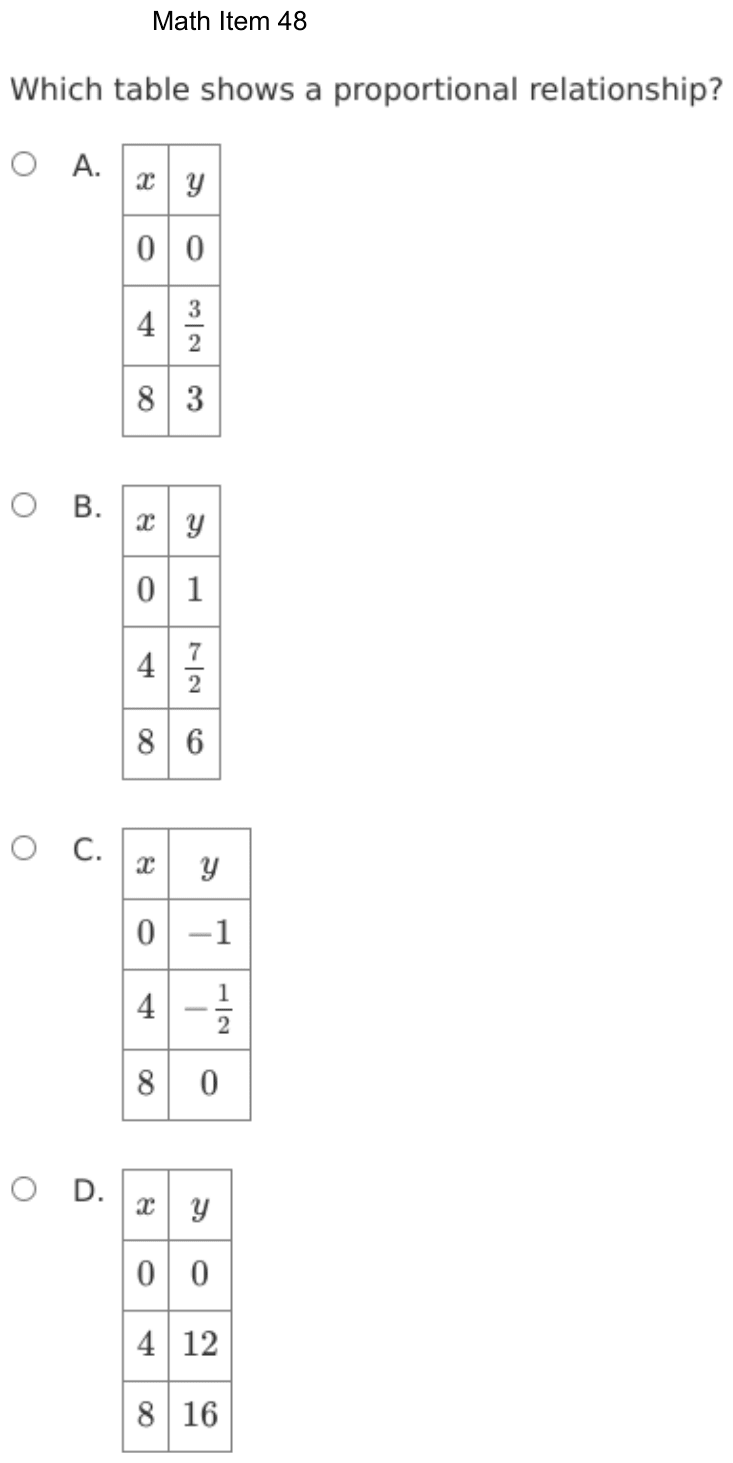
Question 51 of 120
2026 Practice Test C Math, question 50Question
Terry wants to pour cement around the edge of the circular patio in her backyard. The patio has a radius of 5 feet. What is the distance, in feet, around the edge of the patio? Use 3.14 for .
- A15.7
- B31.4
- C49.3
- D78.5
Show the answer
Correct answer: B
To find the distance around a circle if the radius is known, use the formula for circumference, .
Question analysis
Terry wants to pour cement around the edge of a circular patio with a radius of 5 feet. Students find the distance around the edge, using 3.14 for π. It tests the circumference of a circle, and because the formulas for a circle's area and circumference both use the radius, they are easy to mix up.
- NYS standards
- 7.G.4 circle area and circumference
- Grade level
- Grade 7 content, by NYS standard
- Compared with grade 7
- At grade 7 Applying a circle formula is a grade 7 standard, and this is a one-formula problem with a given value for π. The only demand beyond routine is recalling the right formula, which the test does not print.
- Estimated difficulty
- Straightforward: two steps or one careful reading.
- Thinking it demands
- Depth of knowledge 1, recall and reproduction · mainly apply
- What makes it hard
- Something you must already know moderate
- Turning words into math minor
- Solution
- 2 steps
- Reading level
- Question and choices: about grade 4, 37 words.
- Students, last 30 days
- Not enough answers yet to show (it takes 10).
Why it is hard, traps and wrong answers (shows the answer)
Why it is hard
One formula and one multiplication finish the problem once the right formula is chosen. The cement in the story pulls toward area, and the area, 78.5, is listed, as is half the circumference, from multiplying 3.14 by the radius alone. Remembering that the circumference is π times the diameter, here 10 feet, and that the answer is in feet, not square feet, settles it.
Something you must already know moderate Working it out
The circumference formula is not printed, and the area formula uses the same radius and π, so recalling the wrong one gives a number that looks just as finished. (Anderson & Krathwohl, 2001)
Turning words into math minor Understanding the question
Pouring cement suggests covering a surface, but the question asks for “the distance, in feet, around the edge”, which is the circumference, not the area. (Hegarty, Mayer & Monk, 1995; Koedinger & Nathan, 2004)
Strategy: Decide which circle measurement the distance around the edge is, recall its formula, and substitute the radius and 3.14, doubling the radius wherever the formula calls for the diameter.
Traps
- Wrong formula: Uses a related but wrong formula: perimeter for area, diameter for radius, area for volume, or a misremembered one.
- A formula you must know: Needs a formula the test does not give: area, circumference, volume, probability rules.
- A faulty procedure: A systematic but wrong procedure: adding fractions straight across, applying an exponent to each term of a sum, dropping a sign when moving a term.
The wrong answers, classified
A Wrong formula (King et al., 2004)
Multiplies π by the radius, 3.14 × 5 = 15.7, using the radius where C = πd needs the diameter, so it finds half the distance around.
C A faulty procedure (Brown & Burton, 1978; Tatsuoka, 1983)
Starts from the area formula and squares π instead of the radius, 3.14 × 3.14 × 5 ≈ 49.3, mixing the wrong formula with a slip in squaring.
D Wrong formula (King et al., 2004)
Finds the patio’s area, 3.14 × 5² = 78.5 square feet, using the area formula instead of the circumference for the distance around.
Worked solution, step by step
Formulas used
- Circumference of a circle
- C is the circumference, the distance around the circle. r is the radius, the distance from the center to the edge. π (pi) is a fixed number, about 3.14. 2r is the diameter, the distance all the way across. The distance around is always about 3.14 times that.
- Area of a circle
- A is the area, the space inside the circle, in square units. r² means r times r. It is here so you can tell the two formulas apart. This question does not use it.
Sort out the question
The patio is a circle with a radius of 5 feet. The radius is the distance from the center to the edge. Terry wants cement around the edge.
You need the distance around the edge, in feet. The distance around a circle is called its circumference. Use 3.14 for π.
Choose the right formula
The distance around is a length, so use the circumference formula, .
Watch out: pouring cement may make you think of area. The area, square feet, is choice D. That is the space inside the patio, not the distance around it.
Put in the numbers
Put 3.14 in for π and 5 in for r. Multiply 2 by 5 first, because that is easy:
The distance around the patio is 31.4 feet.
Watch out: , choice A, forgets the 2. It goes only halfway around.
Give the answer
The distance around the edge of the patio is 31.4 feet.
So the answer is B, 31.4.
Check your answer
Estimate. The diameter is 10 feet. The distance around a circle is a little more than 3 times its diameter. , so about 31 feet makes sense. Choice D, 78.5, is far too big, and it is in square feet.
More questions like this
The original DOE question
Question 52 of 120
2026 Practice Test D English, question 35Passage Martial Arts for the Mind and Body
Martial Arts for the Mind and Body
(1) The martial arts blend a series of physical movements with strategic mental discipline so that practitioners can defend themselves, physically defeat an opponent, or both. (2) Historians are unsure of exactly when and where martial arts were first used. (3) Martial arts have been practiced by several different societies for many centuries. (4) Martial arts such as karate, kung fu, tae kwon do, and judo are still taught and practiced as methods of self-defense, but they offer students more than that. (5) The study of martial arts can provide students with a way to enhance their mental discipline as well as their physical fitness.
(6) Discipline, focus, and respect are important qualities for everyone to have. (7) However, for most people these qualities are not innate; they must be learned and practiced. (8) The study of martial arts can provide an opportunity to develop these skills. (9) Students are rewarded for their dedication by passing tests and advancing to higher ranks or levels. (10) For example, in a typical tae kwon do class, students learn discipline by diligently practicing moves, improve focus by listening carefully, and demonstrate respect by bowing to the instructor and following directions.
(11) For teenagers, martial arts classes provide a safe and structured environment for gaining physical skills, building confidence, and enjoying a sense of community. (12) A lot of teens go through hard situations as they try to do well in school and in life. (13) A martial arts class can provide teens with a physical outlet for stress while also challenging them mentally. (14) Participating in a martial arts program also helps children and teens focus on self-improvement rather than on competition. (15) Progressing through levels of achievement involves mastering more physically demanding techniques. (16) It requires students to take responsibility and be accountable for achieving set goals. (17) Students gain confidence and experience companionship with other students who are progressing through the ranks.
(18) Adults who practice martial arts can experience many of the same benefits that younger people do, but perhaps the greatest of these is health and fitness. (19) Adult martial arts students often see changes in their body within weeks of beginning a program.
(20) For people interested in studying a martial art, there are many ways to learn and practice. (21) In addition to private studios, community recreation centers often offer low-cost or free martial arts classes. (22) There are even online videos that introduce students to the basic concepts. (23) People should study martial arts.
Question
What is the best way to combine sentences 2 and 3?
- AHistorians, who are unsure of exactly when and where martial arts were first used, know that martial arts have been practiced by several different societies for many centuries.
- BWhile historians are unsure of exactly when and where martial arts were first used, they do know that martial arts have been practiced by several different societies for many centuries.
- CBecause historians know that martial arts have been practiced by several different societies for many centuries, they are unsure of exactly when and where martial arts were first used.
- DMartial arts have been practiced by several different societies for many centuries, and historians are unsure of exactly when and where martial arts were first used.
Show the answer
Correct answer: B
The question asks for the best way to combine sentences 2 and 3.
A. Incorrect. This way of combining sentences 2 and 3 places unnecessary emphasis on characterizing historians, and it does not clearly show the contrasting relationship between the idea from sentence 2 that historians do not know the exact origins of martial arts and the idea in sentence 3 that historians know that martial arts have a long history.
B. CORRECT. This option is correct because the word “while” at the beginning of the sentence best indicates the contrast between the ideas in sentences 2 and 3. Sentence 2 states that historians do not know the exact origins of martial arts (“unsure of exactly when and where”). Sentence 3 describes what historians do know about these origins (“practiced by several different societies for many centuries”). This combination indicates that historians have a general understanding about the origins of martial arts even though they cannot confirm the exact details.
C. Incorrect. Starting this sentence with the word “because” indicates a cause-and-effect relationship that does not exist between the ideas in the original sentences. The idea from sentence 3, that historians know that martial arts have been practiced for many years, did not cause the idea in sentence 2, that historians do not know exact details about the origins of martial arts.
D. Incorrect. The conjunction (connecting word) “and” does not clearly show how the ideas in sentences 2 and 3 are related. While “and” can be used to combine related sentences, it does not demonstrate the contrast between the idea in sentence 2, that historians do not know the exact origins of martial arts, and the idea in sentence 3, that historians know that martial arts have a long history.
Question analysis
This sentence-combining question uses sentences 2 and 3 of a passage on the benefits of martial arts: historians are unsure when and where martial arts were first used, and the arts have been practiced by many societies for centuries. Students must choose the combination whose connecting word shows how the two facts relate, among four grammatical versions.
- Grade level
- Grade 7 reading and task
- Compared with grade 7
- At grade 7 Joining two sentences with a word that shows how their ideas relate is routine grade 7 work. Both sentences are short and plain, and the four versions differ mainly in one connecting word or structure, so the task is typical.
- Estimated difficulty
- Straightforward: two steps or one careful reading.
- Thinking it demands
- Depth of knowledge 2, skills and concepts · mainly evaluate
- What makes it hard
- How sentences fit together moderate
- Every choice must be checked minor
- Evidence
- Answered from one sentence or line
- Reading level
- Passage: about grade 11, 402 words; question and choices: about grade 13, 122 words.
- Students, last 30 days
- Not enough answers yet to show (it takes 10).
Why it is hard, traps and wrong answers (shows the answer)
Why it is hard
The two sentences are short and plain, and the only real decision is the relationship between them: uncertainty about origins set against knowledge of a long history. The relative-clause version tempts most because it sounds polished and keeps everything, yet it turns the uncertainty into a description of historians and drops the contrast. The versions with “Because” and “and” are easier to rule out once the contrast is named, since one invents a cause and the other only adds.
How sentences fit together moderate Working it out
Sentence 2 says what historians do not know and sentence 3 what they do, so the combined sentence needs a word that marks that contrast, which students should name before reading the choices. (Halliday & Hasan, 1976)
Every choice must be checked minor Choosing the answer
All four versions keep both facts and are grammatical, so each must be read through to see whether its opening word or structure shows contrast, addition, cause or mere description. (Embretson & Wetzel, 1987)
Strategy: Before reading the choices, decide how sentence 3 relates to sentence 2: an added fact, a cause, or a contrast. Then pick the version whose opening word or structure signals that relationship.
Traps
- Wrong transition: A connecting word or phrase that signals the wrong relationship, such as contrast where the idea continues.
- Changes the meaning: A revision is correct English but no longer says what the writer meant.
The wrong answers, classified
A Changes the meaning (Connors & Lunsford, 1988)
Keeps both facts in one polished sentence, but tucking sentence 2 into a “who” clause makes it a description of historians and hides the contrast between unknown and known.
C Wrong transition (Halliday & Hasan, 1976)
Opens with “Because,” making the long history the cause of historians’ uncertainty about origins, a cause-and-effect link the two facts do not have.
D Wrong transition (Halliday & Hasan, 1976)
Joins the sentences with “and,” which simply adds one fact to the other in reverse order, so nothing signals that what historians know contrasts with what they don’t.
Working it out, step by step
Figure out what the question asks
This asks how to join two sentences into one. The best way shows how the two ideas are related. So first figure out how they relate.
Read sentences 2 and 3
Sentence 2: “Historians are unsure of exactly when and where martial arts were first used.” Sentence 3: “Martial arts have been practiced by several different societies for many centuries.” A historian studies the past. Sentence 2 tells what historians don’t know. Sentence 3 tells what they do know. That is a contrast: two ideas that pull different ways.
Name the rule
When two ideas contrast, join them with a contrast word, such as while, although or but. Here “while” means although. For example: Sam forgot the exact date. He knew it was in May. Joined: While Sam forgot the exact date, he knew it was in May.
Check each choice
- A is wrong. The part that starts with “who” just describes the historians. The contrast between not knowing and knowing gets lost.
- B is right. “While” shows the contrast. The words “do know” make it even clearer.
- C is wrong. “Because” means one thing causes the other. A long history does not cause historians to be unsure.
- D is wrong. “And” just adds one fact to another. It does not show the contrast.
Watch out: A sounds smooth and keeps every fact, so it is tempting. But a good combined sentence must also show how the ideas relate.
Choose the answer
B joins the two facts and shows the contrast. So the answer is B, “While historians are unsure of exactly when and where martial arts were first used, they do know that martial arts have been practiced by several different societies for many centuries.”
Why this answer and not the closest wrong one
A is the closest wrong answer. It keeps both facts in one smooth sentence. But tucking sentence 2 into a “who” part turns it into a description of historians. Nothing marks the turn from what they don’t know to what they do. B’s “While” and “do know” make that contrast plain.
More questions like this
The original DOE question
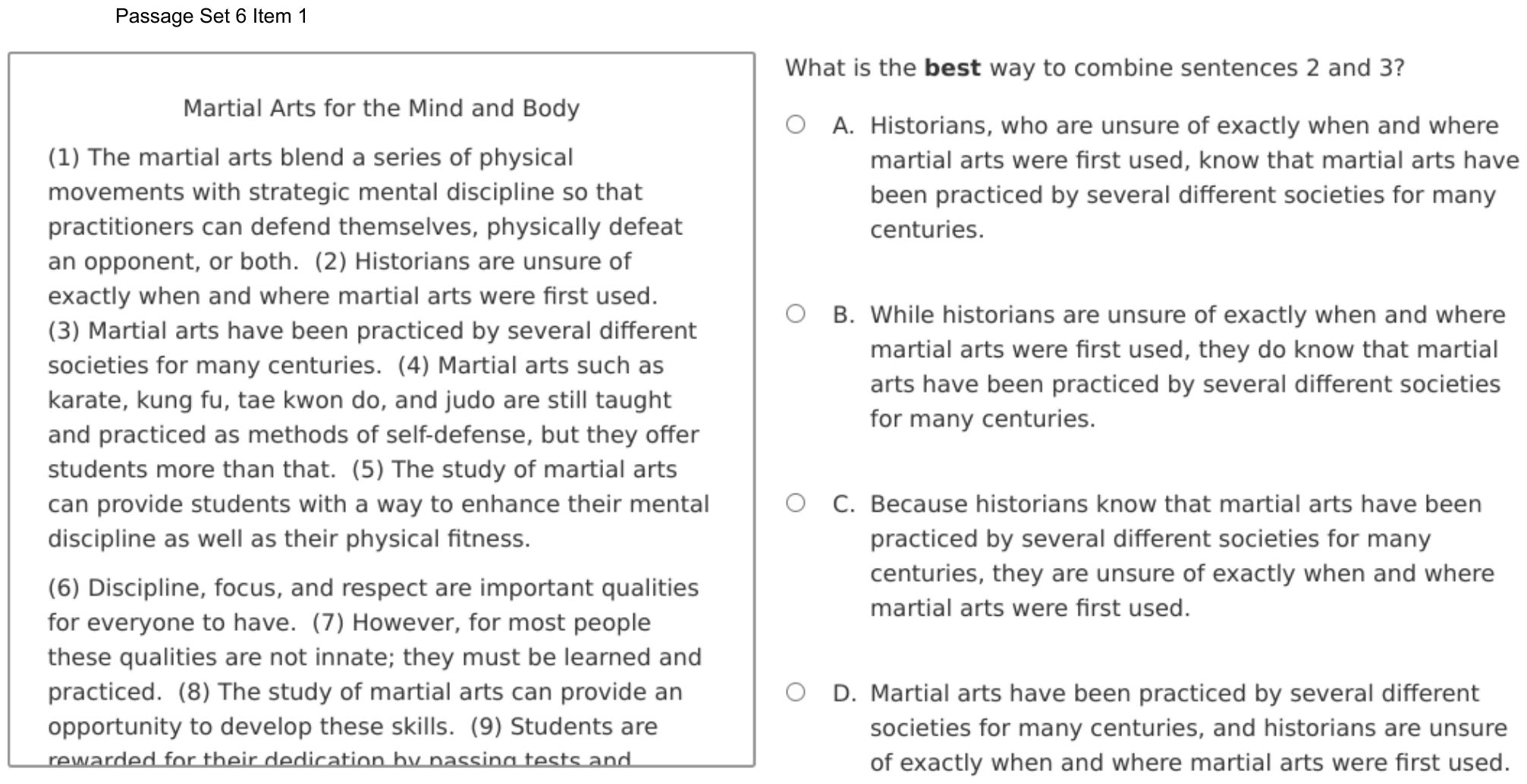
The passage “Martial Arts for the Mind and Body” as printed (page 52)
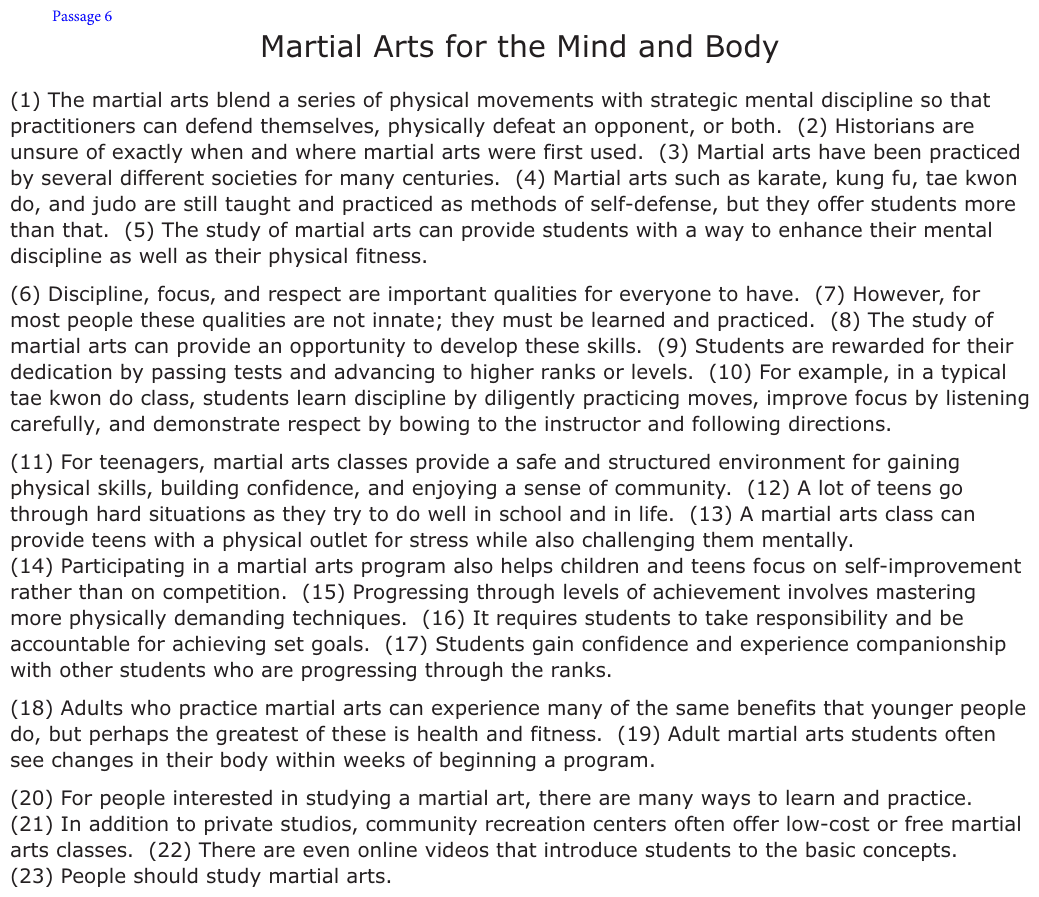
Question 53 of 120
2026 Practice Test D English, question 36Uses the passage above: “Martial Arts for the Mind and Body”.
Question
Where should sentence 10 be moved to improve the organization of the second paragraph (sentences 6–10)?
- Ato the beginning of the paragraph (before sentence 6)
- Bbetween sentences 6 and 7
- Cbetween sentences 7 and 8
- Dbetween sentences 8 and 9
Show the answer
Correct answer: D
The question asks where sentence 10 should be moved to improve the organization of the second paragraph.
A. Incorrect. Starting this paragraph with sentence 10 would weaken the paragraph’s organization because it would place a supporting detail sentence (sentence 10) before the topic sentence (sentence 6). Sentence 6 belongs at the beginning of the paragraph because it introduces the topic—the qualities of discipline, focus, and respect. Sentence 10 supports the key idea of the paragraph, that these qualities can be developed through the study of martial arts. If sentence 10 preceded sentence 6, the transitional phrase “for example” would refer to an unspecified topic and idea.
B. Incorrect. Sentence 6 presents the idea that “discipline, focus, and respect are important qualities for everyone to have,” but the example in sentence 10 does not directly relate to this idea. Sentence 10 explains how martial arts develop these qualities, not why they are important qualities to have. Because sentence 10 is not directly related to the idea in sentence 6 (the qualities are important), it should not follow sentence 6.
C. Incorrect. Sentences 7 and 8 should not be separated, because the idea presented in sentence 8—that “the study of martial arts can provide an opportunity to develop these skills”—is directly related to the idea from sentence 7—that the skills of discipline, focus, and respect “are not innate; they must be learned and practiced.” Sentence 10 supports the idea from sentence 8 by describing an example from a typical martial arts class, so sentence 10 should not precede sentence 8.
D. CORRECT. This option is correct because sentence 10 logically follows and supports the idea in sentence 8 that “the study of martial arts can provide an opportunity to develop” the qualities of discipline, focus, and respect. Sentence 10 explains this idea with examples, describing three specific ways that students in a typical tae kwon do class develop discipline, focus, and respect—by “diligently practicing,” “listening carefully,” and “bowing to the instructor and following directions.”
Question analysis
This organization question asks where sentence 10, a “For example” sentence describing a typical tae kwon do class, should be moved within the second paragraph of the martial arts passage. Students must work out what idea the example illustrates and read the paragraph with the sentence in each position, since several spots sound acceptable.
- Grade level
- Grade 7 reading and task
- Compared with grade 7
- At grade 7 Placing a sentence where it supports the right idea is regular grade 7 revision work. The paragraph is five plain sentences and the opening “For example” is a strong clue, which keeps the demand typical of grade 7.
- Estimated difficulty
- Moderate: several steps, or a close reading with one strong distractor.
- Thinking it demands
- Depth of knowledge 2, skills and concepts · mainly analyze
- What makes it hard
- How sentences fit together moderate
- A very close wrong answer minor
- Much to keep track of minor
- Evidence
- Answered from one paragraph or stanza
- Reading level
- Passage: about grade 11, 402 words; question and choices: about grade 7, 31 words.
- Students, last 30 days
- Not enough answers yet to show (it takes 10).
Why it is hard, traps and wrong answers (shows the answer)
Why it is hard
The example sentence fits loosely almost anywhere in a paragraph about discipline, focus and respect, so students have to ask what exactly it is an example of. The slot just before sentence 8 is the trap: the class’s practicing seems to illustrate sentence 7’s claim that the qualities “must be learned and practiced,” but the paragraph has not yet brought in martial arts. Those who match the example to sentence 8’s claim about martial arts place it correctly.
How sentences fit together moderate Working it out
Sentence 10 opens with “For example,” so it must follow the claim it illustrates, sentence 8’s point that studying martial arts can “develop these skills,” before sentence 9 turns to rewards. (Halliday & Hasan, 1976)
A very close wrong answer minor Choosing the answer
The slots before and after sentence 8 are neighbors, and the tae kwon do class could seem to illustrate sentence 7 as well as sentence 8, so only rereading tells them apart. (Embretson & Wetzel, 1987; Gorin & Embretson, 2006; Ascalon et al., 2007)
Much to keep track of minor Working it out
Each of the four positions means rereading a five-sentence paragraph in a new order in your head while keeping track of what “these qualities” and “these skills” refer to. (Sweller, 1988; Carpenter, Just & Shell, 1990)
Strategy: Ask which sentence the tae kwon do class is an example of, then reread the paragraph with sentence 10 placed right after it and check that every sentence still follows the one before.
Traps
- Sentence in the wrong place: Puts a sentence where it breaks the order of ideas or separates it from what it refers to.
The wrong answers, classified
A Sentence in the wrong place (Halliday & Hasan, 1976)
Moves the example to the front, where “For example” would point back to nothing and the topic sentence would come after its own illustration.
B Sentence in the wrong place (Halliday & Hasan, 1976)
Places the example after sentence 6, but the class shows how the qualities are built, not why everyone needs them, and it would cut sentence 7’s “However” off from sentence 6.
C Sentence in the wrong place (Halliday & Hasan, 1976)
Hears sentence 7’s “learned and practiced” echoed in “learn” and “practicing,” but the example must come after sentence 8, which first connects the qualities to martial arts.
Working it out, step by step
Figure out what the question asks
This asks where to move sentence 10 so paragraph 2 reads in a better order. Sentence 10 starts with “For example.” So it must come right after the idea it is an example of.
Name the rule
An example goes right after the claim it shows. “For example” points back to the sentence before it. For instance: Reading builds your word power. For example, you meet new words in every book. If the example came first, it would point back to nothing.
Find what sentence 10 shows
Sentence 10 says students “learn discipline by diligently practicing moves, improve focus by listening carefully, and demonstrate respect by bowing to the instructor and following directions.” Diligently means with steady, careful effort. This shows how martial arts build those three qualities. Sentence 8 makes that claim: “The study of martial arts can provide an opportunity to develop these skills.” So sentence 10 belongs right after sentence 8.
Read the new order
Now the paragraph runs 6, 7, 8, 10, 9. Sentence 6 names the qualities. Sentence 7 says they “must be learned and practiced.” Sentence 8 says martial arts can build them. Sentence 10 gives the tae kwon do example. Then sentence 9 tells how students are rewarded. Each sentence leads to the next.
Check each choice
- A is wrong. “For example” would point back to nothing.
- B is wrong. Sentence 6 says why the qualities matter, but the class shows how they are built. It would also cut sentence 7’s “However” off from sentence 6.
- C is wrong. Sentence 7 never mentions martial arts. Sentence 8 is the first to link the qualities to martial arts.
- D is right. The example follows the claim it shows.
Watch out: Sentence 7 says “learned and practiced,” and sentence 10 uses “learn” and “practicing.” That echo pulls you toward C.
Choose the answer
Sentence 10 gives an example of sentence 8’s claim. It belongs right after it. So the answer is D, “between sentences 8 and 9.”
Why this answer and not the closest wrong one
C is the closest wrong answer, because sentence 7 talks about learning and practice too. But sentence 7 does not mention martial arts. Sentence 8 claims that martial arts can build these skills, and the tae kwon do class is an example of exactly that. So the example belongs right after sentence 8.
More questions like this
The original DOE question
Question 54 of 120
2026 Practice Test D English, question 37Uses the passage above: “Martial Arts for the Mind and Body”.
Question
Which revision of sentence 12 best maintains the formal style established in the passage?
- AA lot of teens have to put up with difficult things while trying to do well in school and in life.
- BMany teenagers deal with tough situations as they try to stay on top of their studies and do well in life.
- CMany teenagers encounter challenges as they work to succeed both academically and personally.
- DA lot of teens face problems as they work to keep up with their schoolwork and find personal success.
Show the answer
Correct answer: C
The question asks for the revision of sentence 12 that best maintains the formal style established in the passage.
A. Incorrect. The phrases “A lot,” “put up with,” “difficult things,” and “do well in school” are worded informally; therefore, this sentence does not consistently maintain the formal style established in the passage.
B. Incorrect. The phrases “deal with,” “tough situations,” “stay on top of,” and “do well in life” are worded informally; therefore, this sentence does not consistently maintain the formal style established in the passage.
C. CORRECT. This option is correct because it uses clear and scholarly wording throughout the whole sentence. The phrases “many teenagers,” “encounter challenges,” and “succeed both academically and personally” make the sentence’s style more consistently formal than the other options.
D. Incorrect. The phrases “A lot,” “face problems,” and “keep up with” are worded informally; therefore, this sentence does not consistently maintain the formal style established in the passage.
Question analysis
This style question asks which revision of sentence 12, “A lot of teens go through hard situations as they try to do well in school and in life,” best keeps the formal style of the martial arts passage. Students compare four rewrites phrase by phrase, listening for casual expressions in each one.
- Grade level
- Grade 6 reading and task
- Compared with grade 7
- Below grade 7 Keeping a formal style is practiced from grade 6, and here it is tested in one sentence with familiar casual phrases. Typical grade 7 style work asks for subtler choices of precise, content-specific words across a passage.
- Estimated difficulty
- Routine: one familiar step, little to misread.
- Thinking it demands
- Depth of knowledge 1, recall and reproduction · mainly evaluate
- What makes it hard
- Evidence
- Answered from one sentence or line
- Reading level
- Passage: about grade 11, 402 words; question and choices: about grade 8, 87 words.
- Students, last 30 days
- Not enough answers yet to show (it takes 10).
Why it is hard, traps and wrong answers (shows the answer)
Why it is hard
Most students hear the casual phrases at once, and only one version avoids all of them, so this is one of the easier revising questions. The risk is stopping at a formal start: one version opens with “Many teenagers” and then slides into “tough situations,” and another sounds serious with “face problems” but begins with “A lot of teens.” Checking every phrase, not the first few words, is all the question asks.
Every choice must be checked minor Choosing the answer
Each rewrite mixes formal and casual wording, “Many teenagers” beside “deal with” and “stay on top of,” so every phrase of every version has to be checked, not just the opening words. (Embretson & Wetzel, 1987)
Something you must already know minor Working it out
Students must recognize idioms such as “put up with” and “keep up with” as spoken English, a sense of register that the question expects them to bring. (Anderson & Krathwohl, 2001)
Strategy: Underline every casual phrase in each rewrite, such as everyday idioms or vague words, and keep only the version with none; one formal phrase is not enough.
Traps
- Wordy, vague or informal: A revision is grammatical but wordy, imprecise or too casual for the passage.
The wrong answers, classified
A Wordy, vague or informal (Connors & Lunsford, 1988)
Trades “go through hard situations” for “put up with difficult things” and keeps “A lot of teens,” swapping one set of casual phrases for another.
B Wordy, vague or informal (Connors & Lunsford, 1988)
Is reassured by the formal opening “Many teenagers,” but the rest, “deal with,” “tough situations” and “stay on top of,” is everyday speech.
D Wordy, vague or informal (Connors & Lunsford, 1988)
Likes the more serious “face problems” and “personal success,” but keeps the casual “A lot of teens” and “keep up with their schoolwork.”
Working it out, step by step
Figure out what the question asks
This asks which rewrite of sentence 12 matches the passage’s formal style. Formal style is the careful, serious way of writing you use in a school report. It skips the casual words you might use with friends.
Spot the casual words
Sentence 12 says, “A lot of teens go through hard situations as they try to do well in school and in life.” “A lot of,” “teens” and “go through” sound like talking with a friend. Compare sentence 11, which speaks of “a safe and structured environment.” The rest of the passage uses careful words like those.
Name the rule
Formal writing uses exact, serious words and skips everyday sayings. For example, Kids have a ton of homework is casual. Students have a large amount of homework is formal. Check every phrase in each choice, not just the first few words.
Check each choice
- A is wrong. “A lot of teens,” “put up with” and “difficult things” are casual.
- B is wrong. It starts well with “Many teenagers.” But “deal with,” “tough situations” and “stay on top of” are casual.
- C is right. Every phrase is formal. To encounter challenges is to meet hard problems. Academically means in school. Personally means in your own life.
- D is wrong. “Face problems” sounds serious. But “A lot of teens” and “keep up with” are casual.
Watch out: B and D each have a formal phrase or two. One formal phrase is not enough.
Choose the answer
Only C is formal from start to finish. So the answer is C, “Many teenagers encounter challenges as they work to succeed both academically and personally.”
Why this answer and not the closest wrong one
B is the closest wrong answer, because it opens with the formal “Many teenagers.” But it then slides into everyday phrases like “deal with” and “stay on top of.” C keeps the same meaning and stays formal from start to end. Words like “encounter challenges” and “academically” match the careful style of the passage.
More questions like this
The original DOE question
Question 55 of 120
2026 Practice Test D English, question 38Uses the passage above: “Martial Arts for the Mind and Body”.
Question
Which transitional phrase should be added to the beginning of sentence 17?
- AOver time,
- BIn fact,
- CEven so,
- DFor instance,
Show the answer
Correct answer: A
The question asks for the transitional phrase that should be added to the beginning of sentence 17.
A. CORRECT. This option is correct because it best shows the chronological progression between the ideas in sentence 16—progressing through levels of achievement “requires students to take responsibility and be accountable for achieving set goals”—and the ideas in sentence 17—“students gain confidence and experience companionship with other students who are progressing through the ranks.” The transitional phrase “over time” shows the gradual nature of the relationship between the cause in sentence 16 and the effect in sentence 17.
B. Incorrect. Though the ideas in sentences 16 and 17 are related, “in fact” does not show the correct relationship between the ideas. The transitional phrase “in fact” emphasizes an idea by giving a detail or example of greater intensity, but the ideas in sentence 16—progressing through levels “requires students to take responsibility and be accountable for achieving set goals”—and the ideas in sentence 17—“students gain confidence and experience companionship with other students who are progressing through the ranks”—are related by cause and effect rather than by (degree of) intensity.
C. Incorrect. The transitional phrase “even so” is used to connect opposing ideas, but the ideas in sentence 16—progressing through levels “requires students to take responsibility and be accountable for achieving set goals”—do not contrast with the ideas in sentence 17—“students gain confidence and experience companionship with other students who are progressing through the ranks.”
D. Incorrect. Although the transitional phrase “for instance” connects an idea with a related example, it does not show the cause-and-effect relationship between the ideas in sentence 16—progressing through levels “requires students to take responsibility and be accountable for achieving set goals”—and the ideas in sentence 17—“students gain confidence and experience companionship with other students who are progressing through the ranks.”
Question analysis
This transition question asks which phrase should begin sentence 17 of the martial arts passage, which says students gain confidence and companionship with others progressing through the ranks. Students must work out how it relates to sentences 15 and 16, on mastering harder techniques and meeting set goals, because all four phrases are common openers that sound natural.
- NYS standards
- 7W2d transitions in informative writing
- Grade level
- Grade 7 reading and task
- Compared with grade 7
- At grade 7 Choosing a transition that fits the link between sentences is routine grade 7 writing work. The sentences are short and plain, but more than one phrase sounds acceptable on a first reading, so careful but typical reasoning is needed.
- Estimated difficulty
- Moderate: several steps, or a close reading with one strong distractor.
- Thinking it demands
- Depth of knowledge 2, skills and concepts · mainly evaluate
- What makes it hard
- How sentences fit together moderate
- Reading between the lines minor
- Evidence
- Answered from one paragraph or stanza
- Reading level
- Passage: about grade 11, 402 words; question and choices: about grade 3, 19 words.
- Corrected from the DOE handbook
- A grammar slip in the explanation was corrected.
- Students, last 30 days
- Not enough answers yet to show (it takes 10).
Why it is hard, traps and wrong answers (shows the answer)
Why it is hard
All four phrases are common transitions, and “In fact” in particular sounds natural in front of almost any sentence that adds a point. The question rewards naming the link first: sentence 17 describes what students gain as they move up, a result that comes with time, not a stronger restatement, a contrast or an example. Students who read sentences 15 to 17 as one progression find the time phrase; those who test each phrase by sound tend to stop at the emphatic one.
How sentences fit together moderate Working it out
Sentence 16 says moving up the levels makes students responsible for “achieving set goals”; sentence 17 gives what they gain while “progressing through the ranks,” a result that builds up gradually. (Halliday & Hasan, 1976)
Reading between the lines minor Working it out
No word in either sentence says time passes or that one thing causes another, so students must infer that confidence and companionship come from the effort described in sentences 15 and 16. (Graesser, Singer & Trabasso, 1994; Kintsch, 1998)
Strategy: Restate sentences 16 and 17 in your own words and name the link between them, such as example, contrast, emphasis or time, before trying each phrase in front of sentence 17.
Traps
- Wrong transition: A connecting word or phrase that signals the wrong relationship, such as contrast where the idea continues.
The wrong answers, classified
B Wrong transition (Halliday & Hasan, 1976)
Hears “In fact” as a natural way to add a point, but sentence 17 does not restate sentence 16 more strongly; it names what follows from meeting goals.
C Wrong transition (Halliday & Hasan, 1976)
Sets the hard work of sentences 15 and 16 against the rewards of sentence 17 and calls it a contrast, though gaining confidence follows from that work rather than despite it.
D Wrong transition (Halliday & Hasan, 1976)
Takes sentence 17 as an example of sentence 16, but confidence and companionship are results of taking responsibility for goals, not instances of it.
What was corrected from the DOE handbook, and why
- Explanation: The DOE’s explanation of Option C says “the ideas in sentence 16 … does not contrast with the ideas in sentence 17.” The subject is “ideas,” so the site now says “do not contrast.”
Working it out, step by step
Figure out what the question asks
This asks for a transition to start sentence 17. A transition is a word or phrase that shows how two ideas connect. First figure out the link between sentences 16 and 17. Then pick the phrase that names it.
Read sentences 15 to 17
Sentence 15 says moving up “involves mastering more physically demanding techniques.” Sentence 16 says, “It requires students to take responsibility and be accountable for achieving set goals.” Being accountable means you must answer for your own results. Sentence 17 says, “Students gain confidence and experience companionship with other students who are progressing through the ranks.” Companionship means friendship.
Name the link
Confidence and friendship don’t come in one day. They grow as students keep working and moving up the ranks. So sentence 17 is a result that builds slowly. A time phrase fits. For example: I practiced piano every day. Over time, I could play the whole song.
Check each choice
- A is right. “Over time” shows the rewards grow as students keep working.
- B is wrong. “In fact” adds a stronger version of the same point. Sentence 17 makes a new point.
- C is wrong. “Even so” means in spite of that. Confidence comes because of hard work, not in spite of it.
- D is wrong. “For instance” starts an example. Confidence is a result of taking responsibility, not an example of it.
Watch out: “In fact” sounds natural in front of almost any sentence. Name the link before you test the phrases by sound.
Choose the answer
With the phrase added, sentence 17 begins Over time, students gain confidence. So the answer is A, “Over time,” added to the beginning of sentence 17.
Why this answer and not the closest wrong one
B is the closest wrong answer, since “In fact” is a common way to add a point. But “In fact” signals a stronger restatement. Sentence 17 doesn’t restate sentence 16. It tells what students gain as they keep moving up. That gain builds slowly, so “Over time” fits best.
More questions like this
The original DOE question
Question 56 of 120
2026 Practice Test D English, question 39Uses the passage above: “Martial Arts for the Mind and Body”.
Question
Which sentence would best follow and support sentence 18?
- AAdult students gain discipline, focus, self-control, and respect, which are qualities that help them advance in their careers.
- BMany adults initially train in a martial art simply to get exercise without realizing that the training also helps develop other skills.
- CThe exercise involved in training helps people strengthen their heart, boost endurance, improve balance, and develop muscle tone.
- DPeople who commit to training in the martial arts are usually concerned about improving their overall physical health.
Show the answer
Correct answer: C
The question asks for the sentence that would best follow and support sentence 18.
A. Incorrect. Though the idea of advancing one’s career is certainly appealing for adults, this benefit is not directly tied to “health and fitness” and, therefore, does not support sentence 18.
B. Incorrect. While the passage does discuss potential benefits related to discipline, focus, and confidence (sentences 6 and 11), sentence 18 is solely related to health and fitness benefits and should not be followed by a description of “other skills.”
C. CORRECT. This option is correct because sentence 18 conveys that the greatest benefit of practicing martial arts is “health and fitness,” and the sentence illustrates some specific ways that martial arts training helps improve physical fitness—“strengthen their heart, boost endurance, improve balance, and develop muscle tone.”
D. Incorrect. Some readers may choose this option because sentence 5, sentence 15, and sentence 18 discuss the physical aspects of practicing martial arts, but the idea that people who practice martial arts are concerned about their overall health does not provide further details about the connection between training and health.
Question analysis
This supporting-details question asks which sentence would best follow and support sentence 18 of the martial arts passage, which says adults gain many of the same benefits as younger students and names the greatest of them. Every choice is about adults or training, so students must match the exact point of sentence 18 rather than its general subject.
- NYS standards
- 7W2b developing a topic
- Grade level
- Grade 7 reading and task
- Compared with grade 7
- At grade 7 Adding a detail that supports a given sentence is a regular grade 7 writing task. Sentence 18 names its focus plainly and its paragraph is only two sentences long, so the demand is typical, though two choices stay close to the topic.
- Estimated difficulty
- Straightforward: two steps or one careful reading.
- Thinking it demands
- Depth of knowledge 2, skills and concepts · mainly evaluate
- What makes it hard
- How sentences fit together moderate
- A very close wrong answer minor
- Evidence
- Answered from one paragraph or stanza
- Reading level
- Passage: about grade 11, 402 words; question and choices: about grade 11, 84 words.
- Corrected from the DOE handbook
- The DOE printed this question’s explanation after a different question; the site matches the question with its own explanation.
- Students, last 30 days
- Not enough answers yet to show (it takes 10).
Why it is hard, traps and wrong answers (shows the answer)
Why it is hard
Sentence 18 states its focus plainly, so the question mostly tests whether students hold to it. Two choices drift back to the mental side of the passage, discipline, focus and other skills, which paragraphs 2 and 3 have already covered. The closest wrong answer stays on physical health but describes the people who train, so it adds nothing about how training improves fitness; the key is the only one to list effects on the body.
How sentences fit together moderate Working it out
Sentence 18 names one benefit, “perhaps the greatest of these is health and fitness,” so the next sentence must give details of that benefit, not of the mental ones the passage covered earlier. (Halliday & Hasan, 1976)
A very close wrong answer minor Choosing the answer
The choice about health-minded trainees and the key both concern training and physical health; the key says what the exercise does for the body, the other only what trainees care about. (Embretson & Wetzel, 1987; Gorin & Embretson, 2006; Ascalon et al., 2007)
Strategy: Reread sentence 18 and note which benefit it singles out, then ask of each choice whether it gives specific details about that benefit or shifts to another one.
Traps
- Off the point: Adds or keeps something that does not support the paragraph's or the passage's focus, or an introduction or conclusion that misses the main point.
The wrong answers, classified
A Off the point (Halliday & Hasan, 1976)
Lists discipline, focus, self-control and respect, qualities from paragraph 2, and adds careers, but sentence 18 singles out health and fitness for adults.
B Off the point (Halliday & Hasan, 1976)
Starts with adults training “to get exercise,” which sounds on topic, but its point is the other skills they gain without realizing it, a turn away from fitness.
D Off the point (Halliday & Hasan, 1976)
Stays on physical health but says what trainees care about, not what training does for them, so it gives no detail about the benefit sentence 18 names.
What was corrected from the DOE handbook, and why
- Explanation: In the DOE’s explanations appendix, the explanation printed after this question belongs to question 40 (“the concluding sentence that best replaces sentence 23 and supports the topic presented in the passage”) and marks B correct, and this question’s explanation (“the sentence that would best follow and support sentence 18”) is printed after question 40, marking C correct. Read page by page, the appendix gives this question the answer B. The site gives the question the explanation that restates it, and the answer follows that explanation: C, because sentence 18 names health and fitness as the greatest benefit for adults, and Option C gives specific ways that training improves fitness.
Working it out, step by step
Figure out what the question asks
This asks which sentence should come right after sentence 18 and support it. To support a sentence is to give details that back it up. So first find what sentence 18 is about.
Read sentence 18
Sentence 18 says adults “can experience many of the same benefits that younger people do, but perhaps the greatest of these is health and fitness.” A benefit is a good result. So the next sentence should give details about health and fitness. It should show how training helps the body.
Name the rule
A supporting sentence stays on the same point and adds details. For example: Dogs make good pets. They are loyal, playful and easy to train. The second sentence gives details about the first. A sentence about cats would drift off the point.
Check each choice
- A is wrong. Discipline, focus and respect are qualities of the mind. Careers are off the point too.
- B is wrong. It starts with exercise, then turns to “other skills.”
- C is right. It names four ways training helps the body. Endurance means being able to keep going for a long time. Muscle tone means firm, strong muscles.
- D is wrong. It tells what people who train care about, not what training does for them.
Watch out: D stays on physical health, so it looks on topic. But it gives no details about how training improves fitness.
Choose the answer
Only C gives details of the health and fitness benefit. So the answer is C, “The exercise involved in training helps people strengthen their heart, boost endurance, improve balance, and develop muscle tone.”
Why this answer and not the closest wrong one
D is the closest wrong answer, because it also talks about physical health. But it describes the people who train, not the benefit. Sentence 18 names health and fitness as the greatest benefit. C backs that up with real effects on the body: a stronger heart, endurance, balance and muscle tone.
More questions like this
The original DOE question
Question 57 of 120
2026 Practice Test D English, question 40Uses the passage above: “Martial Arts for the Mind and Body”.
Question
Which concluding sentence should replace sentence 23 to best support the topic presented in the passage?
- AWith so many ways to begin studying martial arts, people can easily discover how the skills needed to progress in rank may help them in life.
- BBy taking advantage of opportunities to practice martial arts, people can experience the satisfaction of achieving goals while also improving themselves.
- CBecause people are eager to reap the mental and physical benefits of studying martial arts, enrollment in martial arts courses has increased.
- DWhile taking martial arts classes can improve health for both young people and adults, the effects are clearly more immediate for adults.
Show the answer
Correct answer: B
The question asks for the concluding sentence that best replaces sentence 23 and supports the topic presented in the passage.
A. Incorrect. The phrase “the skills needed to progress in rank” is vague, and progressing in rank is not related to the overall topic of the passage, which is the benefits of studying martial arts. The topic of the passage is not the “many ways to begin studying martial arts” or how “people can easily discover” the benefits of martial arts.
B. CORRECT. This option is correct because it best supports the topic of the passage—the benefits of studying martial arts—by stating two reasons why people should study martial arts: to “experience the satisfaction of achieving goals while also improving themselves.”
C. Incorrect. Some readers may choose this option because it refers to the benefits of martial arts, but the word “because” and the detail that “enrollment in martial arts courses has increased” make this sentence unrelated to the overall topic of the passage, which is about the benefits of studying martial arts, not the number of people who participate.
D. Incorrect. Although the benefits of studying martial arts are described for both teens (in the third paragraph) and adults (in the fourth paragraph), the topic of the passage is the overall benefits of studying martial arts, which include mental discipline (discussed in the first, second, and third paragraphs) in addition to health benefits. Furthermore, the passage does not compare the health effects of studying martial arts across age groups.
Question analysis
This conclusion question asks which sentence should replace sentence 23, the bare closing line “People should study martial arts,” to best support the topic of the passage. Students must keep all five paragraphs in view, from mental discipline to fitness to ways of getting started, because every choice sounds like a reasonable final line when read on its own.
- NYS standards
- 7W2e concluding informative writing
- Grade level
- Grade 8 reading and task
- Compared with grade 7
- Above grade 7 Grade 7 writers choose conclusions that follow from a passage’s topic. This passage covers mental and physical benefits for different ages, and each long choice picks up a real thread, so judging the best fit takes more than typical grade 7 work.
- Estimated difficulty
- Hard: combines ideas, needs a plan, and has more than one tempting wrong answer.
- Thinking it demands
- Depth of knowledge 2, skills and concepts · mainly evaluate
- What makes it hard
- A very close wrong answer moderate
- Evidence in several places moderate
- A lot to read minor
- Evidence
- Answered from the whole text
- Reading level
- Passage: about grade 11, 402 words; question and choices: about grade 12, 106 words.
- Corrected from the DOE handbook
- The DOE printed this question’s explanation after a different question; the site matches the question with its own explanation.
- Students, last 30 days
- Not enough answers yet to show (it takes 10).
Why it is hard, traps and wrong answers (shows the answer)
Why it is hard
Every ending borrows something real from the passage: ways to begin, ranks, mental and physical benefits, or adults’ quick results. The work is deciding what the whole passage is about, the benefits of martial arts for mind and body, and then noticing which ending adds a new claim or shrinks the topic. The rank-based ending is hardest to reject because it is shaped like the key and promises help “in life,” but its focus is how easily people discover rank skills.
A very close wrong answer moderate Choosing the answer
The rank choice is built like the key, a phrase about ways or chances to train followed by what people gain; it differs in resting on the vague “skills needed to progress in rank.” (Embretson & Wetzel, 1987; Gorin & Embretson, 2006; Ascalon et al., 2007)
Evidence in several places moderate Working it out
The topic is pieced together from all five paragraphs, from the opening’s mind-and-body claim through teens, adults’ fitness and ways to learn, so a fitting ending must cover both kinds of benefit. (Kirsch & Mosenthal, 1990; Gorin & Embretson, 2006)
A lot to read minor Understanding the question
Each choice is a two-part sentence of 21 to 26 words, and each picks up a real thread of the passage, so all four must be held against the topic. (Kintsch, 1998; Gorin & Embretson, 2006; Freedle & Kostin, 1993)
Strategy: State the passage’s topic in a few words using all five paragraphs, then test each ending: does it sum up that topic, or does it narrow it or add a new claim?
Traps
- Off the point: Adds or keeps something that does not support the paragraph's or the passage's focus, or an introduction or conclusion that misses the main point.
- Too narrow: A single detail offered as the central idea or a summary, or a summary that keeps minor details and leaves out an essential part.
The wrong answers, classified
A Too narrow (King et al., 2004)
Follows on from the last paragraph’s many ways to start, but rests the ending on vague “skills needed to progress in rank,” one thread of paragraphs 2 and 3, not the benefits overall.
C Off the point (Halliday & Hasan, 1976)
Names the passage’s “mental and physical benefits,” which fits, but ends on rising enrollment, a claim about numbers of students that the passage never discusses.
D Half right (King et al., 2004; Thissen, Steinberg & Fitzpatrick, 1989)
Rightly says training can improve health for young people and adults, but adds that adults clearly benefit sooner, a comparison the passage never makes, and drops the mental benefits.
What was corrected from the DOE handbook, and why
- Explanation: In the DOE’s explanations appendix, the explanation printed after this question belongs to question 39 (“the sentence that would best follow and support sentence 18”) and marks C correct, and this question’s explanation (“the concluding sentence that best replaces sentence 23 and supports the topic presented in the passage”) is printed after question 39, marking B correct. Read page by page, the appendix gives this question the answer C. The site gives the question the explanation that restates it, and the answer follows that explanation: B, because it sums up the passage’s topic, the benefits of studying martial arts.
Working it out, step by step
Figure out what the question asks
This asks for a better last sentence. A good concluding sentence sums up the topic of the whole passage. Sentence 23, “People should study martial arts,” is short and plain. It doesn’t remind the reader why.
Find the passage’s topic
Sentence 5 states the topic. Martial arts can help students “enhance their mental discipline as well as their physical fitness.” Enhance means improve. Paragraph 2 covers discipline, focus and respect. Paragraph 3 covers teens and goals. Paragraph 4 covers adults and fitness. Paragraph 5 lists ways to start. So the topic is how martial arts help both mind and body.
Name the rule
A conclusion should sum up the main point. It should not shrink the point or add a brand-new claim. For example, after a report on why sleep matters, a good ending is Getting enough sleep helps both your body and your mind. A poor one is More people buy pillows now.
Check each choice
- A is wrong. It rests on vague “skills needed to progress in rank,” one small part of the passage.
- B is right. “Opportunities to practice” follows paragraph 5. “Achieving goals” and “improving themselves” sum up the benefits.
- C is wrong. Enrollment is the number of people who sign up. The passage never says it has gone up.
- D is wrong. The passage never says adults see results sooner than young people. D also leaves out the benefits to the mind.
Watch out: A is built like B and promises help “in life.” But it shrinks the topic to rank skills.
Choose the answer
B sums up what the whole passage says martial arts offer. So the answer is B, “By taking advantage of opportunities to practice martial arts, people can experience the satisfaction of achieving goals while also improving themselves.”
Why this answer and not the closest wrong one
A is the closest wrong answer. Like B, it starts with ways to begin and ends with what people gain. But its gain is vague “skills needed to progress in rank.” That is only one thread of the passage. B sums up the whole topic: reaching goals and improving yourself.
More questions like this
The original DOE question
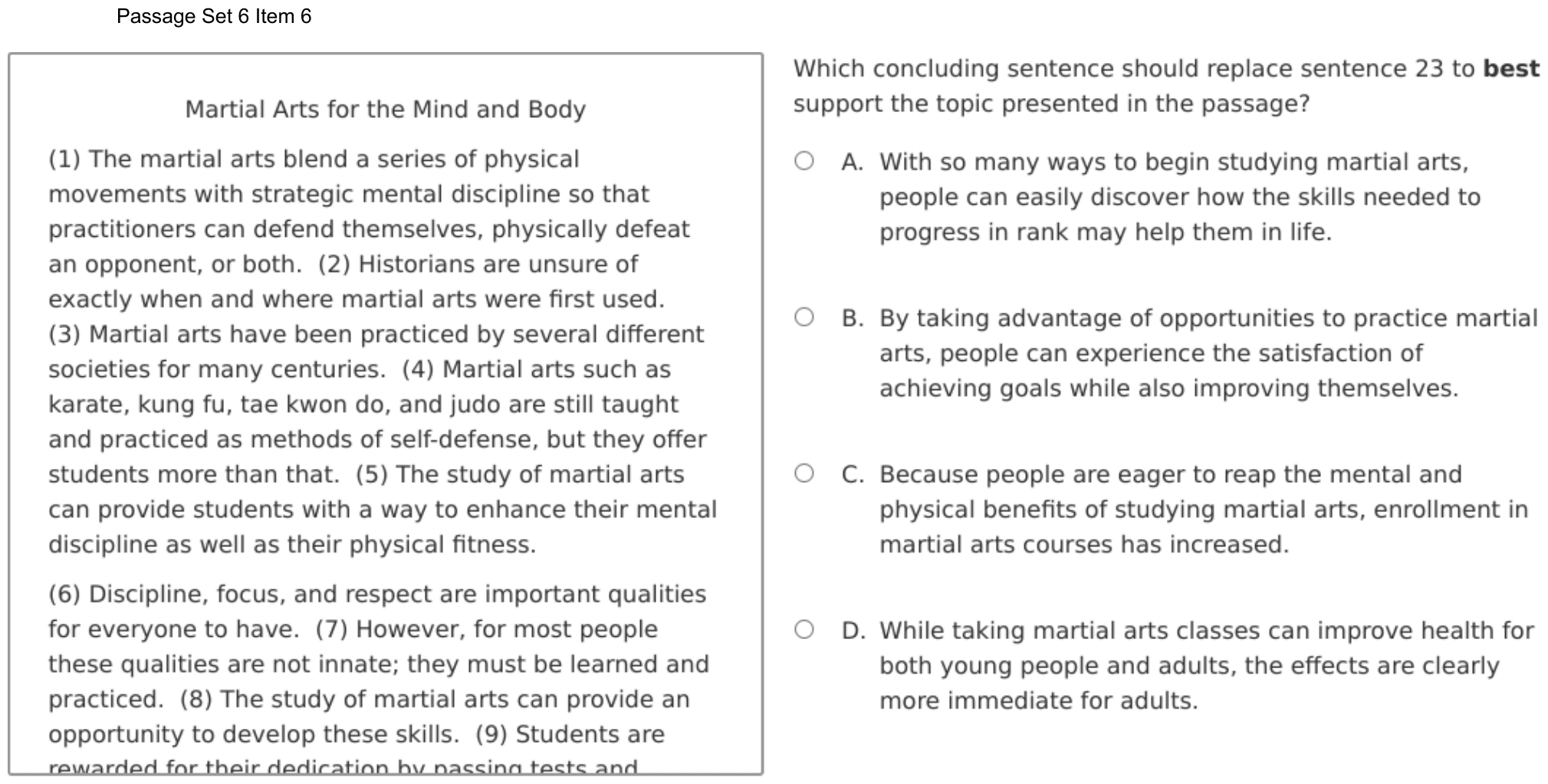
Question 58 of 120
2026 Practice Test D English, question 50Question
What is the best way to combine the sentences?
(1) Scientists now believe that Jupiter may have as many as seventy-nine moons.
(2) One of Jupiter’s moons is named Io.
(3) Io has the greatest number of active volcanoes in the solar system.
- AIo, which is one of Jupiter’s moons, has the greatest number of active volcanoes in the solar system, and scientists now believe that Jupiter may have as many as seventy-nine moons.
- BScientists now believe that Jupiter may have as many as seventy-nine moons, and one of them is named Io, which has the greatest number of active volcanoes in the solar system.
- CScientists now believe that Jupiter may have as many as seventy-nine moons, including one named Io, which has the greatest number of active volcanoes in the solar system.
- DIo, a moon with the greatest number of active volcanoes in the solar system, is one of Jupiter’s moons, and scientists now believe that Jupiter may have as many as seventy-nine moons.
Show the answer
Correct answer: C
The question asks for the best way to combine the sentences.
A. Incorrect. Although the sentence incorporates the ideas presented in the three original sentences, it is incorrect because the combination suggests an incorrect relationship between the ideas. By beginning with “Io,” the sentence places emphasis on the moon and the detail about the number of active volcanoes rather than the key idea that “scientists now believe that Jupiter may have as many as seventy-nine moons.” Since Io is an example of one of Jupiter’s moons, the details about Io should follow and be subordinate to the main clause, which provides new information about the number of Jupiter’s moons in general.
B. Incorrect. Although the sentence incorporates all three ideas from the original sentences and correctly places the detail about the number of active volcanoes on Io in a dependent clause, this option is incorrect because it presents an imprecise relationship between the ideas. By using the conjunction (connecting word) “and,” the sentence construction suggests that scientists “now believe” that “Jupiter may have as many as seventy-nine moons” and that “one of them is named Io,” instead of presenting Io as an example of one of Jupiter’s moons.
C. CORRECT. This sentence is the best way to combine the original sentences because it uses a complex sentence to present ideas clearly and precisely, and it shows the relationship between the ideas in the original sentences. The sentence starts by stating the number of moons scientists now believe Jupiter may have and then specifies that one of those moons is named Io. The dependent clause “which has the greatest number of active volcanoes in the solar system” immediately follows the word “Io” to provide additional information about the moon. A dependent clause contains a subject (“which,” referring to Io) and a verb (“has”) but is not a complete sentence on its own.
D. Incorrect. The sentence incorporates the key ideas from the original sentences, but its structure does not accurately present the relationship between these ideas. The beginning of the sentence includes the detail about Io having “the greatest number of active volcanoes in the solar system” before specifying that Io is one of the seventy-nine moons of Jupiter. The presentation of the details about Io at the beginning lessens the emphasis of the key idea that “scientists now believe that Jupiter may have as many as seventy-nine moons.”
Question analysis
This sentence-combining question gives three short sentences: scientists believe Jupiter may have as many as seventy-nine moons, one moon is named Io, and Io has the most active volcanoes in the solar system. Students must choose the single sentence that joins all three facts while showing how they relate, and the four versions differ only in order and connecting structure.
- Grade level
- Grade 7 reading and task
- Compared with grade 7
- At grade 7 Combining sentences so the ideas relate clearly is grade 7 language work. The three sentences are short, but every version keeps all the facts, so the choice rests on which idea leads and which is tucked into a clause, a typical grade 7 demand.
- Estimated difficulty
- Moderate: several steps, or a close reading with one strong distractor.
- Thinking it demands
- Depth of knowledge 2, skills and concepts · mainly evaluate
- What makes it hard
- A very close wrong answer moderate
- How sentences fit together moderate
- Every choice must be checked minor
- Evidence
- Answered from one sentence or line
- Reading level
- Question and choices: about grade 10, 162 words.
- Students, last 30 days
- Not enough answers yet to show (it takes 10).
Why it is hard, traps and wrong answers (shows the answer)
Why it is hard
Because every version keeps all three facts and is grammatical, the question is about emphasis and connection, which students rarely check for. Two versions open with Io and its volcanoes and leave the seventy-nine moons trailing after “and,” and one of them also calls Io a moon twice. The strongest pull is the version with the right order that still joins Io with “and,” so Io’s name reads as a second piece of news rather than an example of the moons just counted.
A very close wrong answer moderate Choosing the answer
The “and one of them is named Io” version matches the key in its order and in its which-clause about volcanoes; only its connector differs from the key’s “including one named Io.” (Embretson & Wetzel, 1987; Gorin & Embretson, 2006; Ascalon et al., 2007)
How sentences fit together moderate Working it out
Students must see that sentence 1 is the main news and that sentences 2 and 3 narrow to one example, so Io belongs inside the sentence about Jupiter’s seventy-nine moons. (Halliday & Hasan, 1976)
Every choice must be checked minor Choosing the answer
Every version is grammatical and keeps all three facts, so none can be ruled out by an error; each is judged on which idea leads and how the others attach. (Embretson & Wetzel, 1987)
Strategy: Decide which of the three sentences states the main idea and which ones add detail, then check whether each version’s order and structure show that relationship.
Traps
- Wrong transition: A connecting word or phrase that signals the wrong relationship, such as contrast where the idea continues.
- Changes the meaning: A revision is correct English but no longer says what the writer meant.
The wrong answers, classified
A Changes the meaning (Connors & Lunsford, 1988)
Opens with Io and its volcanoes and adds the moon count with “and,” so the main news about Jupiter trails behind its own example as an afterthought.
B Wrong transition (Halliday & Hasan, 1976)
Keeps the right order and the which-clause, but “and one of them is named Io” adds Io as a second piece of news instead of an example of those moons.
D Changes the meaning (Connors & Lunsford, 1988)
Leads with Io’s volcanoes, then says Io “is one of Jupiter’s moons” right after calling it “a moon,” and leaves the main news about Jupiter for the end.
Working it out, step by step
Figure out what the question asks
This asks for the best way to join three sentences into one. All four choices keep every fact. So the best one shows how the facts relate. Decide which fact is the main idea and which ones add detail.
Find the main idea
Sentence 1 is the big news: “Scientists now believe that Jupiter may have as many as seventy-nine moons.” Sentences 2 and 3 zoom in on one of those moons, Io. Io is an example of the moons, and its volcanoes are a detail about Io. So the main idea should come first, and Io should fit inside it.
Name the rule
Put the main idea in the main part of the sentence. Tuck the details in with words like including and which. For example: My school has thirty clubs. One is chess. The chess club meets on Fridays. Joined: My school has thirty clubs, including a chess club, which meets on Fridays.
Check each choice
- A is wrong. It starts with Io and its volcanoes. The main news about Jupiter trails at the end after “and.”
- B is wrong. The order is right. But “and one of them is named Io” adds Io as a second piece of news, not as an example.
- C is right. “Including one named Io” shows Io is one of the moons. Then “which” adds the fact about its volcanoes.
- D is wrong. It calls Io “a moon,” then says again that it “is one of Jupiter’s moons.” The main news comes last.
Watch out: B is very close to C. The only change is “and one of them is named Io” in place of “including one named Io.” The word “including” shows that Io belongs to the group.
Choose the answer
C leads with the main news and tucks in Io as an example. So the answer is C, “Scientists now believe that Jupiter may have as many as seventy-nine moons, including one named Io, which has the greatest number of active volcanoes in the solar system.”
Why this answer and not the closest wrong one
B is the closest wrong answer. It has the right order and the same “which” clause. But “and” tacks Io’s name on as a separate fact, as if it were more news. “Including” shows that Io is one of the seventy-nine moons. That ties the three facts together most clearly.
More questions like this
The original DOE question
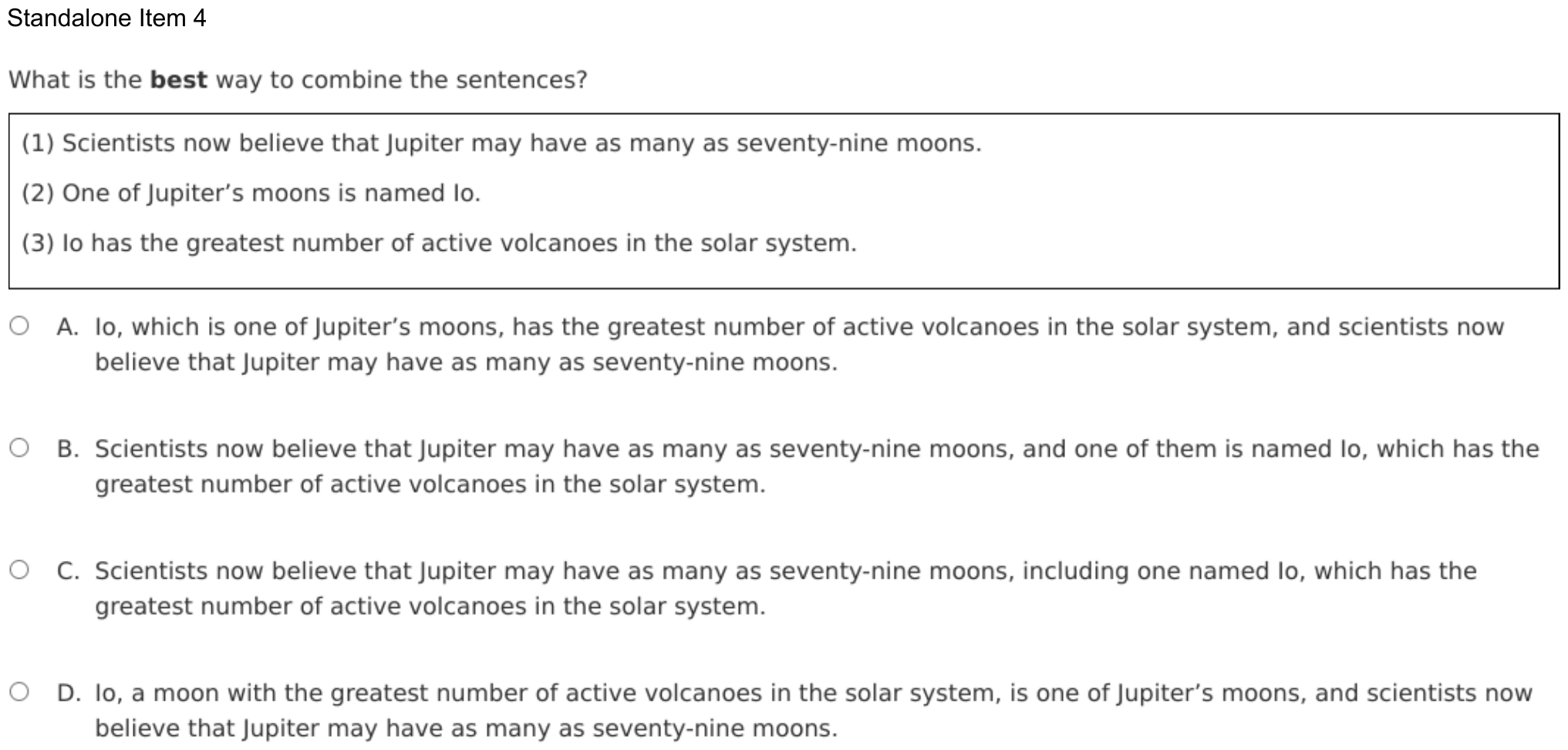
Question 59 of 120
2026 Practice Test D Math, question 1Question
What is the prime factorization of 3,575?
- A
- B
- C
- D
Show the answer
Correct answer: B
By observation, 3,575 ends in 75; therefore, 3,575 is divisible by 25.
Test 143 for factors and eliminate 3, 5, and 7, but 11 is a factor.
; both 11 and 13 are prime numbers.
The first factor, 25, is not prime but is the product of primes, .
The prime factorization of 3,575 is .
Question analysis
This number question asks for the prime factorization of 3,575, chosen from four products of factors. Students divide by primes, using divisibility tests, until only primes remain. The four products look much alike, so the work must be carried all the way through, keeping count of every prime divided out along the way.
- Grade level
- Grade 6 content, by NYS standard
- Compared with grade 7
- Below grade 7 Breaking a number into primes is grade 6 number work that relies on divisibility tests. The number here is larger than in most class examples, but the work is still a few divisions, lighter than typical grade 7 problems.
- Estimated difficulty
- Straightforward: two steps or one careful reading.
- Thinking it demands
- Depth of knowledge 1, recall and reproduction · mainly apply
- What makes it hard
- A very close wrong answer moderate
- Something you must already know minor
- Solution
- 3 steps
- Reading level
- Question and choices: about grade 11, 10 words.
- Students, last 30 days
- Not enough answers yet to show (it takes 10).
Why it is hard, traps and wrong answers (shows the answer)
Why it is hard
Three of the four choices multiply back to 3,575, so checking a product rules out only the one that equals 715. The question turns on whether 143 is prime: it survives the quick tests for 2, 3 and 5, and the factor 11 is easy to miss. Students who keep dividing until every factor is prime, and who write a prime as often as it divides, finish in under a minute.
A very close wrong answer moderate Choosing the answer
5² · 143 matches the right factorization in its first factor and multiplies back to 3,575 just as well, so a product check cannot separate them; only splitting 143 into 11 × 13 does. (Embretson & Wetzel, 1987; Gorin & Embretson, 2006; Ascalon et al., 2007)
Something you must already know minor Working it out
Nothing on the page defines a prime factorization or gives a test for 11, and 143 passes the familiar quick tests for 2, 3 and 5, so it looks prime. (Anderson & Krathwohl, 2001)
Strategy: Divide by the smallest prime that goes in evenly, again and again, writing down every prime you use until the quotient reaches 1, then compare that list with each choice.
Traps
- Stops one step early: A choice is a number from partway through the solution.
- Misunderstands the concept: A wrong belief about a concept: that percents can be added, that area grows like length, that averages can be averaged, that a bigger denominator means a bigger fraction.
The wrong answers, classified
A Misunderstands the concept (Smith, diSessa & Roschelle, 1993; De Bock et al., 1998; Ni & Zhou, 2005)
Lists each prime that divides 3,575 only once, 5, 11 and 13, as if a factorization named which primes divide it, though their product is only 715.
C Stops one step early (King et al., 2004; Gierl et al., 2017)
Divides out one 5 and stops at 5 · 715, a true factorization but not a prime one, though 715 ends in 5 and splits further.
D Stops one step early (King et al., 2004; Gierl et al., 2017)
Divides by 25 and stops at 143, which passes the tests for 2, 3 and 5 and looks prime, though 143 = 11 × 13.
Worked solution, step by step
Formulas used
- Divisibility by 25
- A number is divisible by 25 when 25 goes into it with no remainder. You only need to look at the last two digits. If they are 00, 25, 50 or 75, the number is divisible by 25. This works because 100 is 4 × 25, so the hundreds never leave a remainder.
- Writing a repeated factor with an exponent
- a is any number. The small raised 2 is an exponent. It tells you how many times a is used as a factor, so 5² means 5 × 5 = 25. Use an exponent in a prime factorization when the same prime shows up more than once.
Sort out the question
A prime number is a whole number greater than 1 whose only factors are 1 and itself. Examples are 2, 3, 5, 7, 11 and 13. The prime factorization of 3,575 writes it as a product (the answer to a multiplication) of prime numbers only. So you must break 3,575 down until every factor is prime.
Divide by 25 first
3,575 ends in 75. So it is divisible by 25:
That means 3,575 = 25 × 143. But 25 is not prime. It is 5 × 5, which you can write as 5².
Test 143 for prime factors
Now see if 143 splits. Try the primes in order. 143 is odd, so 2 does not work. Its digits add to 1 + 4 + 3 = 8, which is not a multiple of 3, so 3 does not work. It does not end in 0 or 5, so 5 does not work. Since 7 × 20 = 140, 143 ÷ 7 leaves a remainder of 3, so 7 does not work. Now try 11:
So 143 = 11 × 13, and both 11 and 13 are prime.
Watch out: 143 looks prime, but it is not. Stopping at 5² · 143 leads to choice D.
Put all the primes together
Collect every prime you found. The 5 appears twice, then 11 and 13 once each. The dot · means times, just like ×.
Watch out: write the 5 twice, since it divides 3,575 twice. Writing it once gives 5 · 11 · 13, choice A, which equals only 715. Choice C, 5 · 715, stops too early, because 715 ends in 5 and splits further.
So the answer is B, .
Check your answer
Multiply the primes back together: 25 × 11 = 275, and 275 × 13 = 3,575. That is the number you started with. Also, 5, 11 and 13 are all prime, so nothing can be split further.
More questions like this
The original DOE question
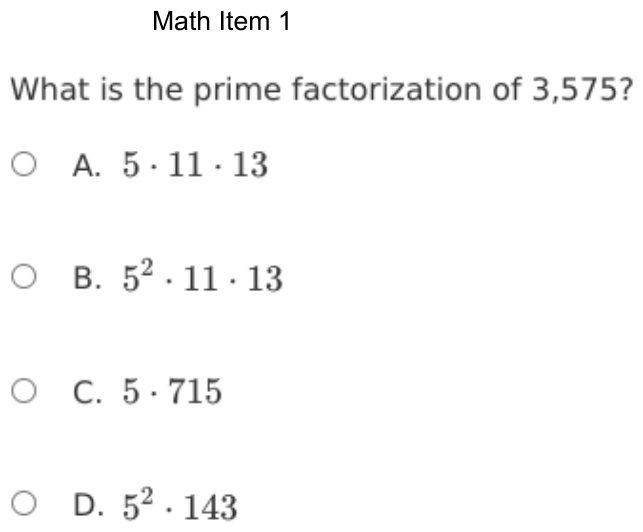
Question 60 of 120
2026 Practice Test D Math, question 2Question
What is the value of z in ?
- A1
- B5
- C
- D
Show the answer
Correct answer: D
First, multiply both sides of the equation by 10 to eliminate the fractions. In other words, multiply each term by 10.
Then, distribute and combine like terms to find the value for z.
Question analysis
This algebra question gives an equation with three letters and fractions, x over 10 plus (y − x) over 5 equals z over 10, and asks for the value of z. Students clear the denominators, distribute and combine like terms. The two fractions on the left have different denominators, which is where the usual slip happens.
- NYS standards
- Grade level
- Grade 7 content, by NYS standard
- Compared with grade 7
- At grade 7 Grade 7 students add and expand linear expressions with fraction coefficients, usually in one letter. Here three letters appear, one numerator is a difference, and the result is an expression rather than a number, which adds abstraction but no new skill.
- Estimated difficulty
- Moderate: several steps, or a close reading with one strong distractor.
- Thinking it demands
- Depth of knowledge 1, recall and reproduction · mainly apply
- What makes it hard
- Variables instead of numbers moderate
- Error-prone arithmetic moderate
- Solution
- 3 steps
- Reading level
- Question and choices: about grade 6, 10 words.
- Students, last 30 days
- Not enough answers yet to show (it takes 10).
Why it is hard, traps and wrong answers (shows the answer)
Why it is hard
The equation has three fractions and three letters, and the work is three routine moves: multiply through by 10, distribute, collect the x terms. Most errors come from the middle term, whose denominator 5 differs from the other two; treating it as tenths makes z simply y. Students who test values should avoid x = y, since that pair makes y and 2y − x agree, and x = y = 1 even makes the number 1 fit.
Variables instead of numbers moderate Understanding the question
The answer is z in terms of x and y, not a number, yet two choices are plain numbers, 1 and 5, which tempt students who expect the equation to give z a single value. (Koedinger & Nathan, 2004; Enright, Morley & Sheehan, 2002)
Error-prone arithmetic moderate Working it out
Clearing the denominators turns (y − x)/5 into 2(y − x), and the −2x from distributing must then combine with the lone x to leave −x, two places where a factor or a sign slips. (Brown & Burton, 1978; Junker & Sijtsma, 2001)
Strategy: Multiply every term on both sides by 10 so no fractions remain, distribute across the parentheses, and combine the x terms; substituting small numbers for x and y checks the result.
Traps
- A faulty procedure: A systematic but wrong procedure: adding fractions straight across, applying an exponent to each term of a sum, dropping a sign when moving a term.
- Numbers taken from the question: Combines the numbers in the question without a model of the situation, or is simply a number that appears in the question.
The wrong answers, classified
A Checks only one number (Schoenfeld, 1985)
Tests x = 1 and y = 1, gets 1/10 + 0 = z/10, so z = 1, and takes the choice that reads 1; any pair with x ≠ y rules it out.
B Numbers taken from the question (Hegarty, Mayer & Monk, 1995)
Expects z to be a number and takes the 5 from the middle denominator, a number copied from the equation rather than the result of any step.
C A faulty procedure (Brown & Burton, 1978; Tatsuoka, 1983)
Adds the numerators x and y − x over 10 as if (y − x)/5 were already in tenths, so the left side becomes y/10 and z = y.
Worked solution, step by step
Formulas used
- Doing the same to both sides
- a and b are the two sides of an equation. Multiplying both sides by the same number keeps them equal, like adding the same weight to both pans of a balance. Here 10 is a good choice, because it clears away every fraction.
- The distributive property
- a is the number outside the parentheses, and b and c are the terms inside. Multiply a by each term inside, and keep the minus sign between them. It works because a groups of (b − c) is a groups of b minus a groups of c.
Sort out the question
The equation has three letters, x, y and z. You need z written using x and y. The answer will not be one number, because x and y can be anything. The fractions make the work messy, so clear them first.
Multiply every term by 10
The bottoms are 10, 5 and 10, and each one divides into 10. So multiply every term by 10:
10 times x/10 is x. Since 10 ÷ 5 = 2, 10 times (y − x)/5 is 2(y − x). And 10 times z/10 is z.
Distribute the 2
Use the distributive property. Multiply the 2 by both y and x:
So the equation becomes:
Combine like terms
Like terms have the same letter. Here x and −2x are like terms. Since 1 − 2 = −1, they combine to −x:
That leaves:
Watch out: do not add the tops of x/10 and (y − x)/5 straight away. Their bottoms are different. Doing it anyway gives z = y, choice C. Choices A and B are plain numbers, but z changes when x and y do.
So the answer is D, .
Check your answer
Pick numbers. Let x = 2 and y = 7. The left side is 2/10 + 5/5 = 0.2 + 1 = 1.2. Choice D gives z = 2 × 7 − 2 = 12, and 12/10 = 1.2. Both sides match.
More questions like this
The original DOE question
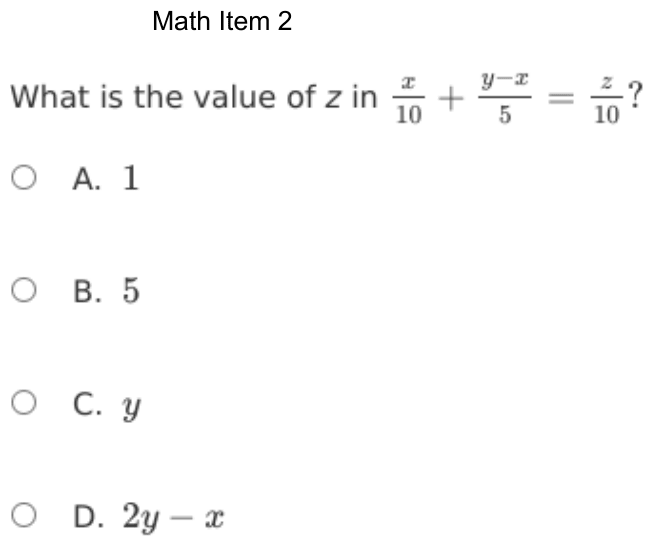
Question 61 of 120
2026 Practice Test D Math, question 3Question
Two sets, R and S, are described below. The sum of the elements in set R equals the sum of the elements in set S.
What is the value of ?
- A−7
- B−5
- C5
- D7
Show the answer
Correct answer: B
First, find the sum for each set by adding the terms in each set separately.
The sum for set R is , which is .
The sum for set S is , which is .
The question states that these two sums are equal to each other, so write the equation and then rearrange using inverse operations.
If the rearranging to obtain the target value is unclear, use the equation and find a few possible values for x and y.
For example, if , then because . If , then because . Then find the value of . No matter which values are chosen, will always be .
Question analysis
Two sets of four numbers, R and S, each contain one unknown, x and y, and the sums of the two sets are equal. Students find the value of x − y without being able to find x or y alone. It tests writing and rearranging an equation, and deciding which way round the difference goes is the tricky part.
- Grade level
- Grade 7 content, by NYS standard
- Compared with grade 7
- At grade 7 Grade 7 students write and solve equations with one unknown. This one has two unknowns that are never found separately; students must rearrange to get their difference, a less familiar goal, though the arithmetic is light.
- Estimated difficulty
- Moderate: several steps, or a close reading with one strong distractor.
- Thinking it demands
- Depth of knowledge 2, skills and concepts · mainly apply
- What makes it hard
- A very close wrong answer moderate
- Variables instead of numbers minor
- Solution
- 3 steps
- Reading level
- Question and choices: about grade 4, 33 words.
- Students, last 30 days
- Not enough answers yet to show (it takes 10).
Why it is hard, traps and wrong answers (shows the answer)
Why it is hard
The sums take seconds; the point is lost on the sign. Because set R's known numbers add to more than set S's, x has to be the smaller unknown, so x − y is negative, but subtracting the two known sums in the order they appear gives a positive 5. Choosing one pair of values that balances the sets, such as x = 1 and y = 6, settles the sign at once.
A very close wrong answer moderate Choosing the answer
The choices pair −5 with 5 and −7 with 7, so the size 5 is easy to reach and only the order of subtraction, x − y rather than y − x, separates the right choice from its opposite. (Embretson & Wetzel, 1987; Gorin & Embretson, 2006; Ascalon et al., 2007)
Variables instead of numbers minor Understanding the question
Neither x nor y can be found, only the gap between them, so students who look for a value of each letter stall; the question rewards rearranging x + 16 = y + 11. (Koedinger & Nathan, 2004; Enright, Morley & Sheehan, 2002)
Strategy: Add the known numbers in each set, set the two sums equal, then move both letters to one side so it reads x − y; testing one pair of values confirms the sign.
Traps
- Negatives and direction: Arithmetic with negative numbers, the order of a subtraction, or direction on a number line. (Moving a term across the equals sign without changing its sign is a faulty procedure.)
The wrong answers, classified
A Little reason to choose it (Haladyna & Downing, 1993; Rodriguez, 2005)
No common working gives −7; it needs a slip in a sum, such as 18 for 5 + 3 + 8, so it mostly draws guesses near −5.
C Negatives and direction (Brown & Burton, 1978)
Subtracts the known sums in the order the sets appear, 16 − 11 = 5, which is y − x, missing that R's larger known sum makes x the smaller unknown.
D Little reason to choose it (Haladyna & Downing, 1993; Rodriguez, 2005)
Needs two unrelated errors, a slip in a sum and the subtraction reversed, so no single line of working reaches 7 and it mostly catches guesses.
Worked solution, step by step
Formulas used
- Doing the same to both sides
- a and b are two equal amounts, and c is any number or letter. Taking the same thing away from both sides keeps them equal. You use it to move terms around until the equation shows what you want.
Sort out the question
Set R holds 5, x, 3 and 8. Set S holds 6, y, 4 and 1. The elements (the members) of R add up to the same total as the elements of S. You cannot find x or y alone. But you can find , the gap between them.
Add up each set
Add the known numbers in each set, and keep the letter:
The two sums are equal, so:
Rearrange to get x − y
You want on one side. Subtract y from both sides:
Then subtract 16 from both sides:
Make sense of the sign
Set R already has 16 from its numbers, but set S has only 11. So y must be 5 more than x to make the sums match. That makes negative.
Watch out: 16 − 11 = 5 is , not . Using it leads to choice C.
So the answer is B, −5.
Check your answer
Try real values. If x = 1, then R adds to 17. So y + 11 = 17, and y = 6. Then . Try x = 10: then y = 15, and 10 − 15 = −5 again.
More questions like this
The original DOE question
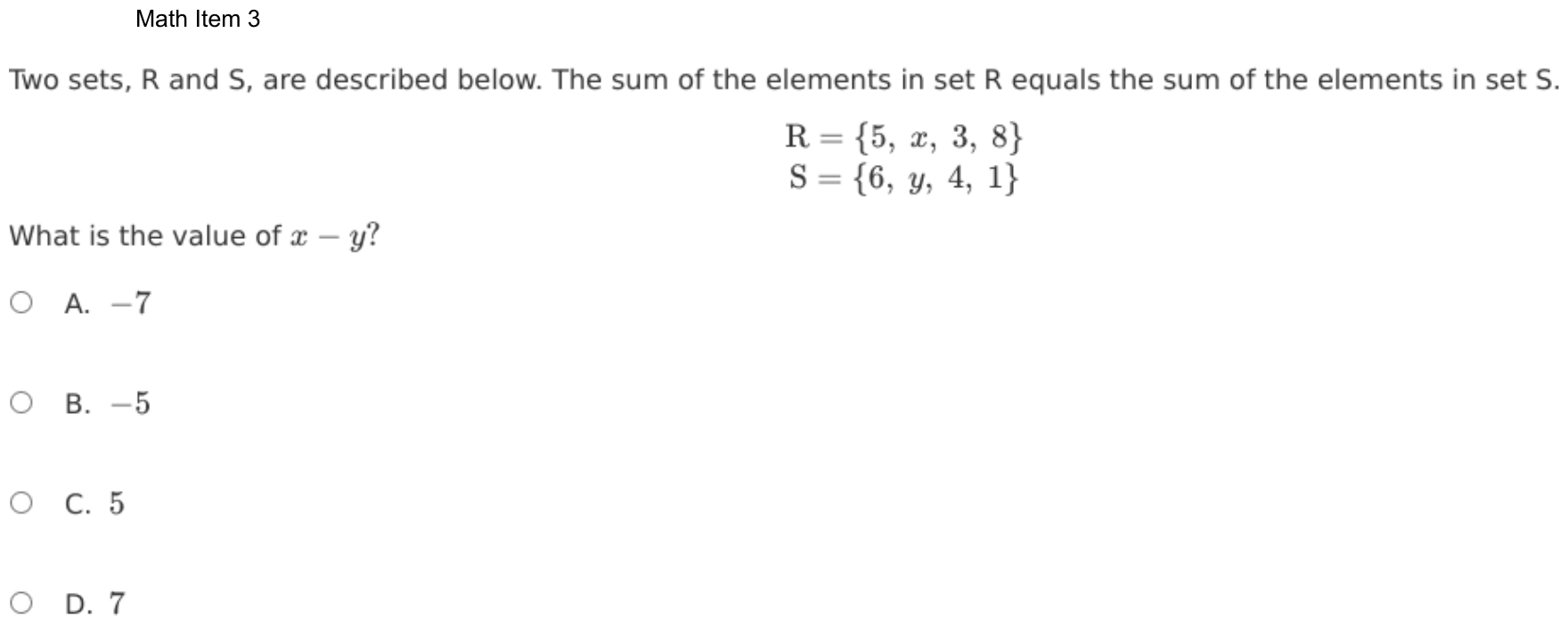
Question 62 of 120
2026 Practice Test D Math, question 4Question
If , what is the value of ?
- A
- B
- C
- D
Show the answer
Correct answer: C
The first step is to substitute the value for x into the expression to get .
Then, evaluate the denominator and finally divide the numerator by the denominator.
Question analysis
This substitution question sets x equal to one fourth and asks for the value of 2 divided by (2 − x). Students substitute, subtract a fraction from a whole number, and divide by the result. The expression is a stacked fraction, so treating the whole denominator as one quantity and dividing rather than multiplying are where students slip.
- NYS standards
- Grade level
- Grade 6 content, by NYS standard
- Compared with grade 7
- Below grade 7 Substituting a value and dividing by a fraction are grade 6 skills, and here they take three short steps with friendly numbers. The stacked fraction asks for care, but the demand is below typical grade 7 work with signed rational numbers.
- Estimated difficulty
- Straightforward: two steps or one careful reading.
- Thinking it demands
- Depth of knowledge 1, recall and reproduction · mainly apply
- What makes it hard
- Error-prone arithmetic moderate
- An answer in an unexpected form minor
- Solution
- 3 steps
- Reading level
- Question and choices: about grade 10, 12 words.
- Students, last 30 days
- Not enough answers yet to show (it takes 10).
Why it is hard, traps and wrong answers (shows the answer)
Why it is hard
Substitution is one step, so the question is about handling a fraction inside a fraction. The bar over 2 − x groups the whole denominator, and the division by 7/4 must flip it; both errors lead to listed choices. A size check helps: 2 − 1/4 is a little less than 2, so the value must be a little more than 1, which rules out every wrong choice.
Error-prone arithmetic moderate Working it out
The denominator 2 − 1/4 has to become 7/4 before anything is divided, and dividing 2 by 7/4 means multiplying by 4/7; multiplying by 7/4 instead is the usual slip. (Brown & Burton, 1978; Junker & Sijtsma, 2001)
An answer in an unexpected form minor Choosing the answer
The work ends at the improper fraction 8/7, but the choices show it only as a mixed number, listed among 3/4, 8/9 and 3 1/2. (Enright, Morley & Sheehan, 2002)
Strategy: Simplify the denominator to a single fraction first, then divide 2 by that fraction by multiplying by its reciprocal; treating the fraction bar as a grouping symbol avoids the common slip.
Traps
- Wrong operation: Adds instead of multiplying, divides the wrong way round, turns a ratio or rate upside down, or undoes a step in the wrong direction (subtracts what should be added back).
- Order of operations: Working left to right, or distributing a minus sign wrongly, gives a choice.
- Negatives and direction: Arithmetic with negative numbers, the order of a subtraction, or direction on a number line. (Moving a term across the equals sign without changing its sign is a faulty procedure.)
The wrong answers, classified
A Order of operations (Brown & Burton, 1978)
Lets the fraction bar cover only the first 2, working 2/2 − 1/4 = 1 − 1/4 = 3/4 instead of dividing 2 by the whole denominator.
B Negatives and direction (Brown & Burton, 1978)
Adds 1/4 to 2 instead of subtracting it, so the denominator becomes 9/4, and 2 ÷ 9/4 = 8/9.
D Wrong operation (Hegarty, Mayer & Monk, 1995; King et al., 2004)
Finds the denominator 7/4 correctly but multiplies 2 by it instead of dividing, 2 × 7/4 = 14/4 = 3 1/2.
Worked solution, step by step
Formulas used
- Dividing by a fraction
- a is any number, and b/c is a fraction. To divide by a fraction, multiply by its reciprocal (the fraction flipped upside down). It works because dividing asks how many copies of b/c fit into a.
- Changing an improper fraction to a mixed number
- Use it when the top, a, is bigger than the bottom, b. q is how many whole times b fits into a. r is the remainder, what is left over. For 8/7, the 7 fits once with 1 left, so 8/7 = 1 1/7.
Sort out the question
You know . You need the value of 2 divided by (2 − x). A fraction bar means divide. It also groups, so you work out the whole bottom, 2 − x, before you divide.
Work out the bottom
Put in 1/4 for x. To subtract, write 2 as fourths, since 2 = 8/4:
The bottom is 7/4.
Watch out: the sign is minus. Adding 1/4 gives 9/4 and then 8/9, choice B.
Divide 2 by 7/4
Now the problem is 2 ÷ 7/4. Use the rule for dividing by a fraction. Flip 7/4 to get 4/7, then multiply:
Watch out: multiplying by 7/4 instead of 4/7 gives 14/4 = 3 1/2, choice D.
Write it as a mixed number
The choices use mixed numbers. 7 fits into 8 once, with 1 left over:
Watch out: the fraction bar covers all of 2 − 1/4. Working 2/2 = 1 first and then taking away 1/4 gives 3/4, choice A.
So the answer is C, .
Check your answer
Estimate. The bottom, 1 3/4, is a bit less than 2. So 2 divided by it should be a bit more than 1, and 1 1/7 fits. Also check by multiplying: 7/4 × 8/7 = 56/28 = 2. That is the top, so the division is right.
More questions like this
The original DOE question
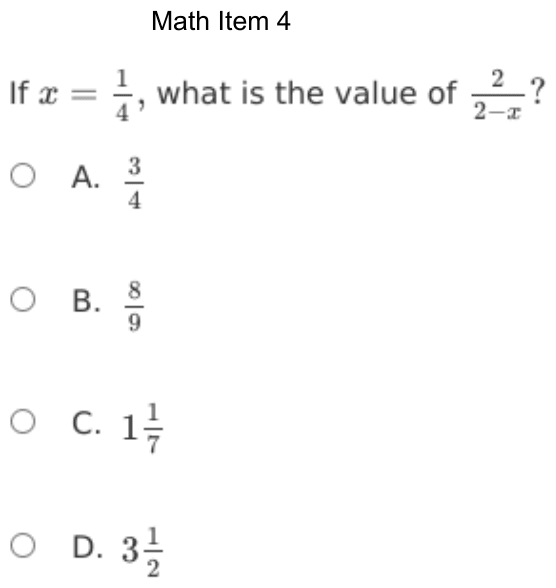
Question 63 of 120
2026 Practice Test D Math, question 6Question
The cost of shipping a package is $12, plus $2 for each additional pound over 3 pounds. Which expression represents the total cost, in dollars, of shipping a package that weighs p pounds? Assume that .
- A
- B
- C
- D
Show the answer
Correct answer: B
Since the additional cost per pound is not added until the package weighs more than 3 pounds, the total cost for 1, 2, or 3 pounds is $12.
- 1 pound is $12
- 2 pounds is $12
- 3 pounds is $12
Since p is greater than or equal to 3 pounds, the total cost for:
- 4 pounds is
- 5 pounds is
- p pounds is
You may try to write the expression without generating the pattern by recognizing that subtracting 3 from the number of pounds for the package before multiplying by $2 and then adding $12 results in the total cost.
Question analysis
Shipping a package costs $12, plus $2 for each additional pound over 3 pounds, and students choose the expression for the total cost of a package that weighs p pounds. It tests writing an algebraic expression from a word problem. The per-pound charge starts only after the first 3 pounds, and turning that phrase into algebra is the tricky part.
- Grade level
- Grade 6 content, by NYS standard
- Compared with grade 7
- At grade 7 Writing an expression from a cost description is grade 6 algebra. Because the per-pound charge starts only after the first 3 pounds, it is less routine than a fee plus a simple rate, in line with typical grade 7 demand.
- Estimated difficulty
- Moderate: several steps, or a close reading with one strong distractor.
- Thinking it demands
- Depth of knowledge 2, skills and concepts · mainly apply
- What makes it hard
- Turning words into math moderate
- A very close wrong answer moderate
- Variables instead of numbers minor
- Solution
- 2 steps
- Reading level
- Question and choices: about grade 6, 37 words.
- Students, last 30 days
- Not enough answers yet to show (it takes 10).
Why it is hard, traps and wrong answers (shows the answer)
Why it is hard
The question rewards modeling the fee in two parts: a flat $12 that covers the first 3 pounds, and $2 for each pound beyond them. The two choices that start with 12 look equally reasonable until a weight is tried, and the two that begin with 14p come from merging the fee with the per-pound charge. Testing p = 3, which must cost exactly $12, rules out three choices in one step.
Turning words into math moderate Understanding the question
“$2 for each additional pound over 3 pounds” must become 2(p − 3), a charge on the pounds beyond the first 3, and the word “over” invites writing p + 3 instead. (Hegarty, Mayer & Monk, 1995; Koedinger & Nathan, 2004)
A very close wrong answer moderate Choosing the answer
12 + 2(p + 3) and 12 + 2(p − 3) differ only in the sign inside the parentheses, so their shape cannot separate them; only a test weight or a careful reading can. (Embretson & Wetzel, 1987; Gorin & Embretson, 2006; Ascalon et al., 2007)
Variables instead of numbers minor Understanding the question
The weight is the letter p, so there is no cost to work out and compare; choosing a weight such as 5 pounds, which costs $16, turns every choice into a number. (Koedinger & Nathan, 2004; Enright, Morley & Sheehan, 2002)
Strategy: Test a weight such as 5 pounds: work out its cost from the description, then substitute 5 for p in each choice and keep the one that gives the same cost.
Traps
- Follows a key word: Picks the operation from a single word rather than the situation: "removed" so subtract, "of" so multiply, "more" so add, when the situation needs something else.
- Numbers taken from the question: Combines the numbers in the question without a model of the situation, or is simply a number that appears in the question.
The wrong answers, classified
A Follows a key word (Hegarty, Mayer & Monk, 1995)
Reads “over 3 pounds” as adding 3, so the $2 charge applies to p + 3 pounds instead of only the pounds above the first 3.
C Numbers taken from the question (Hegarty, Mayer & Monk, 1995)
Merges the $12 and the $2 into $14 for every pound and tacks on the 3 from the stem, building an expression from its numbers without a model.
D Numbers taken from the question (Hegarty, Mayer & Monk, 1995)
Charges $14 for every pound by merging the fee with the $2 rate, then subtracts 3 for the first 3 pounds, mixing dollars with pounds.
Worked solution, step by step
Formulas used
- Cost with a base fee and a rate
- The base fee is the set price, $12, which covers the first 3 pounds. The rate is the price for each pound after that, $2. The extra pounds are the pounds over 3, which is p − 3. Use it when a price has a fixed part plus a part per unit.
Sort out the question
Shipping costs $12 to start. Each pound over 3 pounds adds $2. The package weighs p pounds, and p is at least 3. You need an expression for the total cost in dollars.
Count the extra pounds
Only the pounds above 3 cost extra. To find them, take 3 away from the weight:
For example, a 5-pound package has 5 − 3 = 2 extra pounds.
Watch out: over 3 pounds means more than 3. It does not tell you to add 3. Writing p + 3 leads to choice A.
Build the expression
Each extra pound costs $2, so the extra pounds cost 2(p − 3) dollars. Add the $12 base fee:
Watch out: the $12 is paid once, not for every pound. Choices C and D charge $14 for every pound, which mixes up the fee and the rate.
Test each choice with 5 pounds
A 5-pound package costs $12 plus two $2 charges, which is $16. Put p = 5 into each choice:
Choice Value when p = 5 A 12 + 2(8) = 28 B 12 + 2(2) = 16 C 14(5) + 3 = 73 D 14(5) − 3 = 67 Only B gives $16. So the answer is B, .
Check your answer
Try p = 3, the smallest weight allowed. There are no extra pounds, so it should cost just $12. Choice B gives 12 + 2(0) = 12. Try p = 4: 12 + 2(1) = 14, which is $12 plus one $2 charge.
More questions like this
The original DOE question
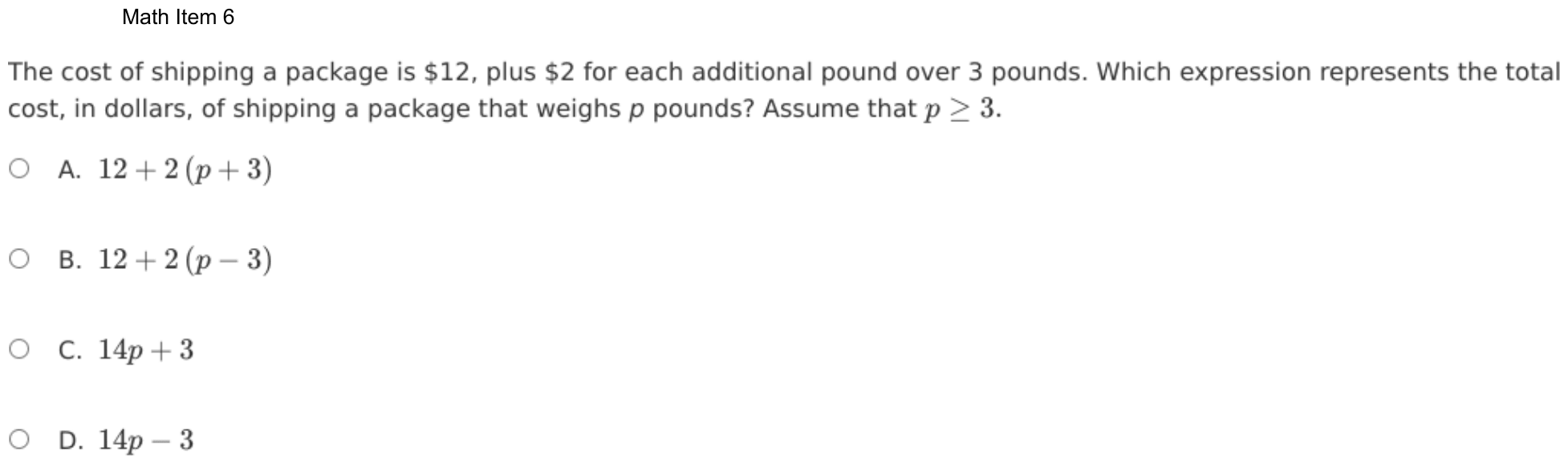
Question 64 of 120
2026 Practice Test D Math, question 10Question
For what values of x is the above inequality true?
- A
- B
- C
- D
Show the answer
Correct answer: A
Use inverse operations to isolate the variable x by first getting the x variable on one side.
Now, when dividing by , the direction of the inequality sign changes.
Another way to solve is to keep the coefficient of x positive and then recognize that is the same as .
Question analysis
This algebra question asks which values of x make the inequality 2x + 11 > 3x + 9 true, choosing from four solution sets. It tests solving a linear inequality with the variable on both sides. Collecting the x terms can leave a negative coefficient, and handling the inequality sign at that point is where most mistakes happen.
- Grade level
- Grade 8 content, by NYS standard
- Compared with grade 7
- At grade 7 Two-step inequalities are grade 7 work, and having x on both sides, a grade 8 idea, takes only one extra subtraction here. The demand matches a careful grade 7 problem, with one sign decision that is easy to get wrong.
- Estimated difficulty
- Moderate: several steps, or a close reading with one strong distractor.
- Thinking it demands
- Depth of knowledge 1, recall and reproduction · mainly apply
- What makes it hard
- Error-prone arithmetic moderate
- A very close wrong answer moderate
- Solution
- 2 steps
- Reading level
- Question and choices: about grade 10, 15 words.
- Corrected from the DOE handbook
- A grammatical error in the explanation was corrected.
- Students, last 30 days
- Not enough answers yet to show (it takes 10).
Why it is hard, traps and wrong answers (shows the answer)
Why it is hard
The boundary 2 comes out of two routine moves; the direction is where points are lost. Whichever side the x terms are collected on, the last step either divides by a negative or leaves x on the right, and both moments invite a reversed answer. A second risk is moving the 9 without changing its sign, which yields 20. Substituting x = 0, which makes 11 > 9 true, confirms the direction.
Error-prone arithmetic moderate Working it out
Subtracting 3x from both sides leaves −x > −2, and dividing by −1 must reverse the sign; subtracting 2x instead leaves 2 > x, which still has to be read from the x side. (Brown & Burton, 1978; Junker & Sijtsma, 2001)
A very close wrong answer moderate Choosing the answer
x < 2 and x > 2 share the boundary and differ only in direction, so finding the 2 settles nothing; only the sign rule or a test value such as x = 0 decides. (Embretson & Wetzel, 1987; Gorin & Embretson, 2006; Ascalon et al., 2007)
Strategy: Subtract 2x from both sides so the x term stays positive, undo the + 9, then rewrite the result with x first; testing a value in the original inequality checks the direction.
Traps
- Negatives and direction: Arithmetic with negative numbers, the order of a subtraction, or direction on a number line. (Moving a term across the equals sign without changing its sign is a faulty procedure.)
- A faulty procedure: A systematic but wrong procedure: adding fractions straight across, applying an exponent to each term of a sum, dropping a sign when moving a term.
The wrong answers, classified
B Negatives and direction (Brown & Burton, 1978)
Reaches −x > −2 but divides by −1 without reversing the inequality, or reads 2 > x as x > 2, so the direction comes out backwards.
C A faulty procedure (Brown & Burton, 1978; Tatsuoka, 1983)
Moves the 9 across the inequality without changing its sign, 11 + 9 = 20 instead of 11 − 9 = 2, and keeps the direction right.
D A faulty procedure (Brown & Burton, 1978; Tatsuoka, 1983)
Moves the 9 without changing its sign to get 20 > x, then also rewrites that statement backwards as x > 20, two errors at once.
What was corrected from the DOE handbook, and why
- Explanation: The DOE’s explanation says “Another way to solve is to keep the coefficient of x positive and then recognizing that 2 > x is the same as x < 2.” The two verbs joined by “and then” should have the same form, so the site now says “and then recognize that”.
Worked solution, step by step
Formulas used
- Doing the same to both sides of an inequality
- a and b are the two sides, and c is any number or term. Subtracting (or adding) the same amount on both sides keeps the inequality true and its sign the same. That is how you move terms from one side to the other.
- Dividing by a negative number
- a and b are any numbers. Multiplying or dividing both sides by a negative number flips the sign, so > becomes <. For example, 3 > 2, but −3 < −2. Use it whenever you divide by a negative number.
Sort out the question
The sign > means is greater than. You need every value of x that makes 2x + 11 greater than 3x + 9. The answer is a range of values, not one number. Solve it like an equation, but keep an eye on the direction of the sign.
Gather the x terms on one side
The right side has more x’s, 3x, than the left side, 2x. So subtract 2x from both sides. That keeps the x term positive:
Get x by itself
Subtract 9 from both sides:
Watch out: to move the 9, subtract it from both sides. Adding it instead gives 20 > x, which leads to choice C or D.
Read it from the x side
says 2 is greater than x. That is the same as saying x is less than 2:
Watch out: when you swap the sides, the sign must point the other way. Writing gives choice B. If you subtract 3x instead, you get . Dividing by −1 then flips the sign, and you get again.
So the answer is A, .
Check your answer
Test x = 0, which is less than 2. The left side is 11 and the right side is 9, and 11 > 9 is true. Test x = 5, which is more than 2. The left side is 21 and the right side is 24, and 21 > 24 is false. So only values below 2 work.
More questions like this
The original DOE question
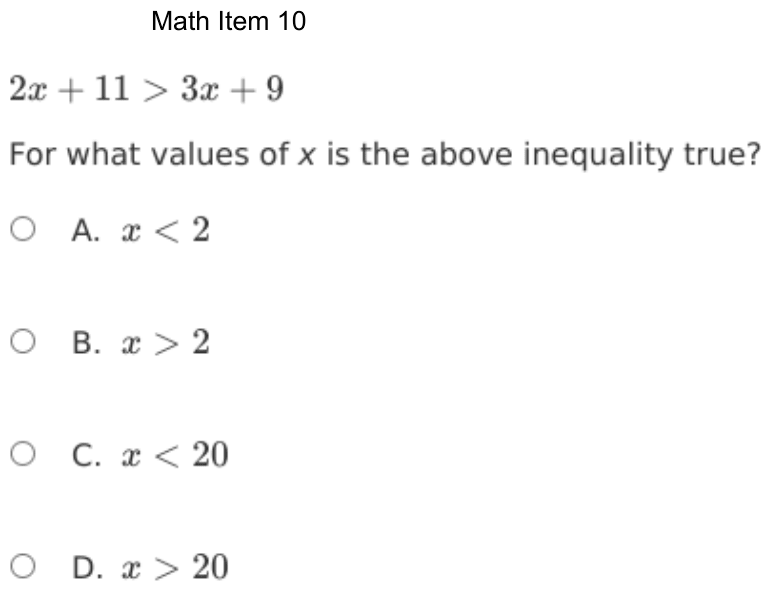
Question 65 of 120
2026 Practice Test D Math, question 11Question
In a scale drawing of a triangular park, the sides measure 5 inches, 7 inches, and 8 inches. The perimeter of the actual park is 25 miles. What is the actual length of the shortest side of the park?
- A6.25 mi
- B8.75 mi
- C10 mi
- D15.625 mi
Show the answer
Correct answer: A
To find the perimeter of a triangle, add the measures of the three sides. The perimeter of the scale drawing is inches.
Now, use the perimeters to find the scale factor for the scale drawing to the actual perimeter.
The scale factor is 20 inches to 25 miles, which reduces to a scale factor of 4 inches to 5 miles. Note that the scale for the perimeter is the same as the scale for the side lengths.
Since the smallest side on the scale drawing is 5 inches, use the scale factor to find the actual side length of the smallest side:
Question analysis
A scale drawing of a triangular park has sides of 5, 7 and 8 inches, and the real park's perimeter is 25 miles. Students find the actual length of the park's shortest side. It tests scale drawings and proportional reasoning; the scale is not given directly, so it must be worked out from the two perimeters first.
- Grade level
- Grade 7 content, by NYS standard
- Compared with grade 7
- At grade 7 Scale drawings are a grade 7 topic, and this is a standard scale problem. The one twist is that the scale is not stated: it must come from comparing the two perimeters before any side can be converted.
- Estimated difficulty
- Straightforward: two steps or one careful reading.
- Thinking it demands
- Depth of knowledge 2, skills and concepts · mainly apply
- What makes it hard
- Turning words into math minor
- Many steps minor
- Solution
- 3 steps
- Reading level
- Question and choices: about grade 2, 39 words.
- Students, last 30 days
- Not enough answers yet to show (it takes 10).
Why it is hard, traps and wrong answers (shows the answer)
Why it is hard
A scale drawing multiplies every length by one factor, and the perimeter shares that factor, so the work is short once the two perimeters are paired. The common loss is reasoning with differences: the perimeter grows by 5, so a side seems to grow by 5 as well. Converting to miles per inch first, then checking that the three real sides add back to 25 miles, guards against that error and against scaling the wrong side.
Turning words into math minor Understanding the question
The 25 miles is the park's perimeter, not a side, so it must be matched with the drawing's perimeter, 5 + 7 + 8 = 20 inches, before any side can be scaled. (Hegarty, Mayer & Monk, 1995; Koedinger & Nathan, 2004)
Many steps minor Working it out
Three operations in a row, adding the sides, dividing 25 by 20 for 1.25 miles per inch, and multiplying the 5-inch side, each produce a number the next step needs. (Daniel & Embretson, 2010; Enright, Morley & Sheehan, 2002)
Strategy: Add the three drawn sides to get the drawing's perimeter, divide the real perimeter by it to find the miles per inch, then multiply the shortest drawn side by that scale.
Traps
- Answers a different question: A choice is right for another quantity: the other unknown, the rest instead of the part, the part instead of the whole.
- Misreads the question: Misses or misreads a condition or a word in the question: "at least", "each", "remaining", "not".
The wrong answers, classified
B Answers a different question (King et al., 2004; Hegarty, Mayer & Monk, 1995)
Finds the scale of 1.25 miles per inch but applies it to the 7-inch side, the middle one, giving 8.75 miles instead of the shortest side.
C Misunderstands the concept (Smith, diSessa & Roschelle, 1993; De Bock et al., 1998; Ni & Zhou, 2005)
Keeps a constant difference instead of a constant ratio: the perimeter grows by 5, from 20 to 25, so it adds 5 to the 5-inch side.
D Misreads the question (Hegarty, Mayer & Monk, 1995)
Pairs the 25 miles with the longest side, 8 inches, instead of the 20-inch perimeter, so each inch seems to be 3.125 miles and 5 inches 15.625.
Worked solution, step by step
Formulas used
- Perimeter of a triangle
- P is the perimeter, the distance all the way around. a, b and c are the lengths of the three sides. You add them because going once around the triangle covers each side once.
- Using a scale
- The drawing length is measured on the drawing, in inches. Miles per inch is how many real miles each inch stands for. In a scale drawing, every length is multiplied by the same number, so the perimeter and each side use the same scale.
Sort out the question
A scale drawing is a smaller copy, with every length shrunk by the same amount. The drawing’s sides are 5, 7 and 8 inches. The real park’s perimeter, the distance all the way around, is 25 miles. You need the real length of the shortest side.
Find the drawing’s perimeter
Add the three sides of the drawing:
The drawing’s perimeter is 20 inches. It stands for the real perimeter of 25 miles.
Watch out: 25 miles is the whole way around, not one side. Matching it with the 8-inch side gives 15.625 miles, choice D.
Find the scale
20 inches stand for 25 miles. Divide to find how many miles 1 inch stands for:
So each inch on the drawing is 1.25 miles in the park.
Scale the shortest side
The shortest side on the drawing is 5 inches. Multiply it by the scale:
The real shortest side is 6.25 miles.
Watch out: the perimeter grew by 5, from 20 to 25, but you cannot just add 5 to a side. That gives 10 miles, choice C. Scaling multiplies. Also use the 5-inch side, not the 7-inch side, which gives 8.75 miles, choice B.
So the answer is A, 6.25 mi.
Check your answer
Scale all three sides: 5 × 1.25 = 6.25, 7 × 1.25 = 8.75 and 8 × 1.25 = 10. Add them: 6.25 + 8.75 + 10 = 25 miles. That is the park’s perimeter, so the scale is right.
More questions like this
The original DOE question
Question 66 of 120
2026 Practice Test D Math, question 12Question
P is the center of the circle above, and R, S, and T are points on the circle. What is the value of x?
- A12
- B15
- C17
- D19
Show the answer
Correct answer: D
represents the radius of the circle and has length 12.
Both and are radii and also have length 12.
Therefore, the length of , which is a diameter, is 24 and is also represented by .
Question analysis
A circle with center P has points R, S and T on it, a segment SP labeled 12, and a vertical segment from S that splits RT into a piece labeled x and a piece labeled 5. Students find the value of x. It tests basic circle facts, and the challenge is seeing which lengths in the figure must be equal.
- Grade level
- Grade 7 content, by NYS standard
- Compared with grade 7
- At grade 7 Grade 7 circle work centers on area and circumference formulas. This needs only the fact that every radius has the same length, but spotting which segments are radii in a figure with extra markings is less routine than using a formula.
- Estimated difficulty
- Moderate: several steps, or a close reading with one strong distractor.
- Thinking it demands
- Depth of knowledge 2, skills and concepts · mainly apply
- What makes it hard
- Reading a figure, table or graph moderate
- No obvious method minor
- Solution
- 2 steps
- Reading level
- Question and choices: about grade 3, 24 words.
- Students, last 30 days
- Not enough answers yet to show (it takes 10).
Why it is hard, traps and wrong answers (shows the answer)
Why it is hard
The figure gives one measurement on a slanted radius and two labels on the diameter, and the right angle at the foot of the vertical segment is a decoy. Once RP and PT are seen as radii, RT is 24, and x is that diameter less the 5. Students who never connect the slanted 12 to the horizontal line fall back on the labeled numbers, adding 12 and 5, or take x to end at the center.
Reading a figure, table or graph moderate Understanding the question
The 12 labels the slanted segment SP, not the horizontal one, and the arrow for x runs from R past the center P to the foot of the vertical segment, so x is neither a radius nor a whole diameter. (Lesh, Post & Behr, 1987; Kirsch & Mosenthal, 1990)
No obvious method minor Working it out
The right-angle mark and the triangle under S suggest the Pythagorean theorem, which is no help; the way in is seeing that RP and PT are radii as well. (Schoenfeld, 1985)
Strategy: Mark every segment from P to the circle as 12, notice that R and T are the ends of a diameter, then write an equation for that diameter using x and the 5.
Traps
- Misreads the figure: Reads a value, label or tick spacing in a figure, table or graph wrongly.
- Information you don't need: The question gives numbers or facts that play no part in the answer.
- Numbers taken from the question: Combines the numbers in the question without a model of the situation, or is simply a number that appears in the question.
The wrong answers, classified
A Misreads the figure (Lesh, Post & Behr, 1987; Kirsch & Mosenthal, 1990)
Reads x as the radius RP, as if its arrow ended at the center P, though it runs past P to the foot of the vertical segment.
B Trusting the picture (Lesh, Post & Behr, 1987)
Judges x from the drawing, where it looks about three times as long as the piece labeled 5, instead of working from the radius of 12.
C Numbers taken from the question (Hegarty, Mayer & Monk, 1995)
Adds the two labeled numbers, 12 + 5 = 17, without placing the 12 on the diameter, as if x were a radius plus the 5.
Worked solution, step by step
Formulas used
- Radius and diameter
- r is the radius, the distance from the center to any point on the circle. d is the diameter, the distance straight across the circle through the center. A diameter is two radii laid end to end, one on each side of the center, so it is twice as long.
Sort out the question
P is the center of the circle, and R, S and T are on the circle. Segment SP is 12. Segment RT goes straight across through P. A short line from S meets RT at a right angle. It splits RT into x, from R to that point, and 5, from that point to T. You need x.
See that SP is a radius
SP runs from the center P to the point S on the circle. So SP is a radius, and the radius is 12. Every radius of a circle has the same length. RP and PT also run from the center to the circle, so RP = 12 and PT = 12.
Find the diameter RT
RT passes through the center, so it is a diameter. Use the formula with r = 12:
RT is 24 long. It is the radius RP plus the radius PT.
Solve for x
RT is also split into x and 5, so:
Subtract 5 from both sides:
Watch out: x runs from R past the center P, so it is longer than a radius. Reading it as 12, choice A, stops at P. Adding 12 + 5 = 17, choice C, puts the 12 in the wrong place.
Work from the numbers, not the picture
The figure is not drawn to scale. In it, x looks about three times as long as 5, which suggests 15, choice B. Trust the labels instead. The right triangle under S is not needed at all.
So the answer is D, 19.
Check your answer
The point where the short line meets RT is 19 from R. P is 12 from R, so that point is 19 − 12 = 7 past the center. Then 7 + 5 = 12, which is PT, a radius. Everything fits.
More questions like this
The original DOE question
Question 67 of 120
2026 Practice Test D Math, question 13Question
In the right triangle shown above, what is the measure of the smallest angle?
- A43°
- B44°
- C46°
- D47°
Show the answer
Correct answer: A
Since the three angles of a triangle have a sum of 180°, and since one angle is a right angle, the other two angles have a sum of 90°. By writing an equation and using inverse operations, the value of x can be found.
Now, use substitution to find the measure of the two angles to determine the smallest angle of the triangle.
The smallest angle is 43°.
Question analysis
A right triangle has its two other angles labeled (2x + 9)° and (3x − 14)°, and students find the measure of the smallest angle. It tests the angle sum of a triangle and solving a linear equation. Finding x is not the end: both angles must be worked out and compared to see which one is smallest.
- NYS standards
- Grade level
- Grade 8 content, by NYS standard
- Compared with grade 7
- Above grade 7 Grade 7 students write equations for unknown angles using complementary and supplementary angles. This also needs the angle sum of a triangle, which New York places in grade 8, plus substituting back and comparing, though each step is short.
- Estimated difficulty
- Moderate: several steps, or a close reading with one strong distractor.
- Thinking it demands
- Depth of knowledge 2, skills and concepts · mainly apply
- What makes it hard
- Combines ideas moderate
- Many steps minor
- Something you must already know minor
- Solution
- 4 steps
- Reading level
- Question and choices: about grade 6, 14 words.
- Students, last 30 days
- Not enough answers yet to show (it takes 10).
Why it is hard, traps and wrong answers (shows the answer)
Why it is hard
Setting the sum of the two labeled angles to 90° is the decision; the algebra after it is routine. The trap waits at the end: x = 19 is not an angle, and the expression at the top vertex, 2x + 9, gives the larger acute angle, 47°. Evaluating both expressions and checking that they add to 90° takes seconds and shows which one is smaller.
Combines ideas moderate Working it out
The angle facts and the algebra meet in one equation: the right angle means the two labeled angles add to 90°, and only that sum makes (2x + 9) + (3x − 14) solvable. (Embretson, 1998; Daniel & Embretson, 2010)
Many steps minor Working it out
After solving 5x − 5 = 90, both angle expressions must be evaluated and compared, because the question wants an angle, not x, and not the first angle found. (Daniel & Embretson, 2010; Enright, Morley & Sheehan, 2002)
Something you must already know minor Working it out
The 180° angle sum of a triangle is not printed, and only the small square at the bottom left shows that one angle is 90°. (Anderson & Krathwohl, 2001)
Strategy: Use the right angle to see that the other two angles add to 90°, solve that equation for x, then substitute into both expressions and compare them.
Traps
- Answers a different question: A choice is right for another quantity: the other unknown, the rest instead of the part, the part instead of the whole.
- A formula you must know: Needs a formula the test does not give: area, circumference, volume, probability rules.
The wrong answers, classified
B Little reason to choose it (Haladyna & Downing, 1993; Rodriguez, 2005)
No common working gives 44°; it sits one degree from the right measure and fits no consistent value of x, so it mostly draws estimates and guesses.
C Little reason to choose it (Haladyna & Downing, 1993; Rodriguez, 2005)
No common working gives 46°, which would need x = 20 and two angles adding to 95°, so it mostly catches guesses near 45°.
D Answers a different question (King et al., 2004; Hegarty, Mayer & Monk, 1995)
Solves x = 19 correctly but answers with 2x + 9 = 47°, the larger acute angle, instead of evaluating both expressions to find the smaller.
Worked solution, step by step
Formulas used
- Angles in a triangle
- a, b and c are the three angles of any triangle, in degrees. They always add up to 180 degrees. If you tear off the three corners and set them side by side, they make a straight line.
- The two other angles of a right triangle
- a and b are the two angles that are not the right angle. A right angle is 90 degrees, so the other two share what is left of the 180: 180 − 90 = 90.
Sort out the question
The small square at the bottom left corner marks a right angle, which is 90°. The top angle is (2x + 9)°, and the bottom right angle is (3x − 14)°. You need the smallest of the three angles. First find x, then find each angle.
Write an equation
The three angles add to 180°. The right angle uses 90° of that, so the other two angles add to 90°:
Solve for x
Combine the x terms, 2x + 3x = 5x. Combine the numbers, 9 − 14 = −5:
Add 5 to both sides, then divide both sides by 5:
Find both angles
Put x = 19 into each expression:
The three angles are 47°, 43° and 90°.
Watch out: x = 19 is not an angle. And the first angle you find, 47°, is not the smallest one. Stopping there gives choice D.
Pick the smallest angle
Compare 47°, 43° and 90°. The smallest is 43°. The figure is not drawn to scale, so do not judge the angles by how they look. Use the numbers.
So the answer is A, 43°.
Check your answer
Add the three angles: 47 + 43 + 90 = 180. That is the right total for a triangle. Also, 47 + 43 = 90, so the two smaller angles fill exactly what the right angle leaves.
More questions like this
The original DOE question
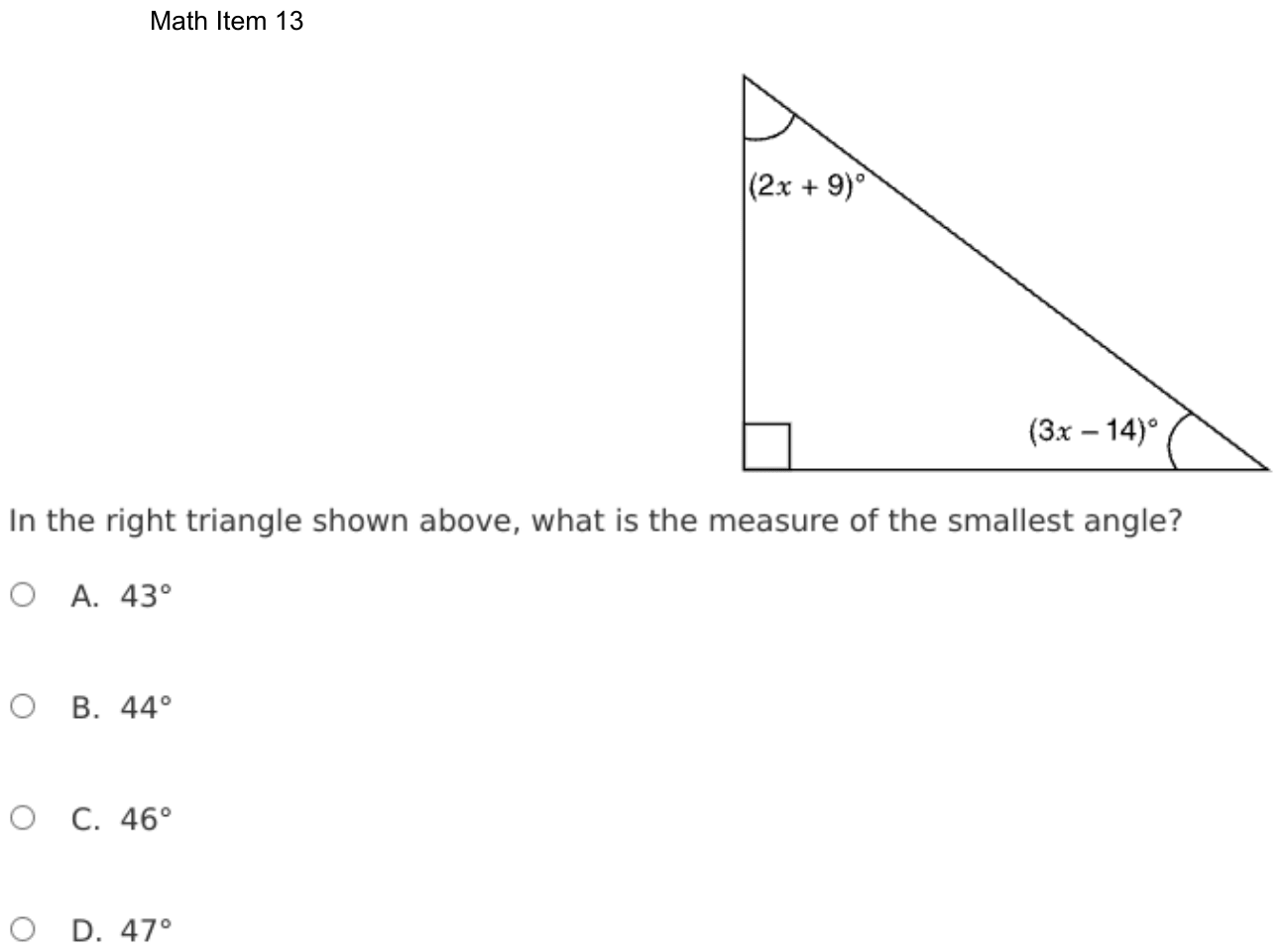
Question 68 of 120
2026 Practice Test D Math, question 14Question
James must read 84 pages of a book for a class assignment. If he reads of the pages in the morning and of the remaining pages in the afternoon, how many pages will he still need to read?
- A35
- B42
- C45
- D56
Show the answer
Correct answer: B
Pages read in the morning:
Pages remaining after the morning:
Pages read in the afternoon:
Pages he still needs to read:
Question analysis
James must read 84 pages for a class assignment: 1/4 of them in the morning, then 1/3 of the remaining pages in the afternoon. Students find how many pages he still has left to read. It tests finding a fraction of a quantity in stages, and the bold word remaining decides which amount the second fraction is taken of.
- Grade level
- Grade 7 content, by NYS standard
- Compared with grade 7
- At grade 7 Taking fractions of a quantity in stages is typical grade 7 work. The numbers divide evenly and the bold word flags the trap, so the four short steps match routine grade 7 demand.
- Estimated difficulty
- Straightforward: two steps or one careful reading.
- Thinking it demands
- Depth of knowledge 2, skills and concepts · mainly apply
- What makes it hard
- Many steps moderate
- Turning words into math minor
- Solution
- 4 steps
- Reading level
- Question and choices: about grade 7, 39 words.
- Students, last 30 days
- Not enough answers yet to show (it takes 10).
Why it is hard, traps and wrong answers (shows the answer)
Why it is hard
Each step is simple, but the second fraction has a different whole from the first. Students who take 1/3 of the full 84 pages get a tidy 28 and a listed answer, despite the bold word that warns against it. Here the pages read and the pages left both come to 42, so confusing those two quantities costs nothing, and checking that 21 + 21 + 42 = 84 confirms the work.
Many steps moderate Working it out
Four operations in order, a quarter of 84, a subtraction, a third of the 63 left, and a second subtraction, each feed the next, so a slip early carries through. (Daniel & Embretson, 2010; Enright, Morley & Sheehan, 2002)
Turning words into math minor Understanding the question
The bold “remaining” moves the base of the second fraction from all 84 pages to the 63 left after the morning, and “still need to read” asks for what is left, not what was read. (Hegarty, Mayer & Monk, 1995; Koedinger & Nathan, 2004)
Strategy: Work in order: find the morning's pages, subtract to get what remains, take 1/3 of that remainder, and subtract again; a quick bar sketch of the 84 pages helps.
Traps
- Misreads the question: Misses or misreads a condition or a word in the question: "at least", "each", "remaining", "not".
The wrong answers, classified
A Misreads the question (Hegarty, Mayer & Monk, 1995)
Takes 1/3 of all 84 pages for the afternoon, 28, instead of 1/3 of the 63 remaining, so 84 − 21 − 28 = 35.
C Little reason to choose it (Haladyna & Downing, 1993; Rodriguez, 2005)
No common working gives 45; it is not a fraction or a difference of any page count in the problem, so it mostly draws guesses near 42.
D Misreads the question (Hegarty, Mayer & Monk, 1995)
Takes the afternoon's third from all 84 pages and subtracts only that, 84 − 28 = 56, overlooking the 21 pages already read in the morning.
Worked solution, step by step
Formulas used
- A fraction of a number
- n is the whole amount, and a/b is the fraction you take. The word of means multiply. When the top, a, is 1, this is just n divided by b. For example, 1/4 of 84 is 84 ÷ 4.
Sort out the question
James has 84 pages to read. In the morning he reads 1/4 of all the pages. In the afternoon he reads 1/3 of the remaining pages, the ones still left after the morning. You need the number of pages he still has to read after that.
Find the morning pages
Take 1/4 of 84:
He reads 21 pages in the morning. That leaves:
63 pages are left after the morning.
Find the afternoon pages
The afternoon fraction is 1/3 of the 63 pages left, not of all 84:
He reads 21 pages in the afternoon.
Watch out: taking 1/3 of all 84 pages gives 28. Then 84 − 21 − 28 = 35, choice A. The bold word remaining tells you to use 63.
Find the pages still to read
Take the afternoon pages away from the 63 pages left after the morning:
He still needs to read 42 pages.
Watch out: subtract both readings, morning and afternoon. Taking only 28 from 84 gives 56, choice D.
So the answer is B, 42.
Check your answer
Add up all the parts: 21 pages in the morning, 21 in the afternoon and 42 still to read. 21 + 21 + 42 = 84, the whole assignment. Another way: after he reads 1/3 of the 63 pages, 2/3 of them are left, and 2/3 of 63 is 42.
More questions like this
The original DOE question
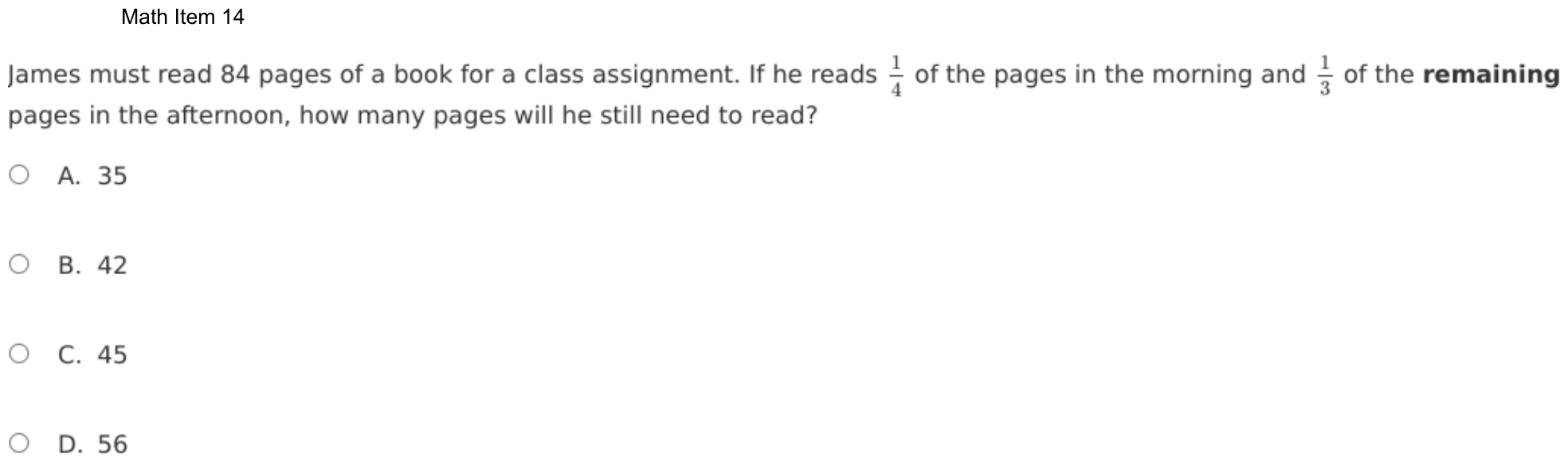
Question 69 of 120
2026 Practice Test D Math, question 15Question
What is the value of the expression shown above?
- A
- B
- C
- D
Show the answer
Correct answer: C
To add fractions, find a common denominator and rename the fractions using the common denominator. The least common denominator for 11, 22, and 33 is 66. After adding the fractions, the final fraction can be reduced to lowest terms.
Question analysis
This fractions question asks for the value of 1/11 + 1/22 + 1/33. Students find a common denominator for three fractions, rename each one, add and simplify. The denominators are all multiples of 11, and adding the tops and bottoms straight across, or forgetting to rename a numerator, leads to tempting wrong choices.
- Grade level
- Grade 7 content, by NYS standard
- Compared with grade 7
- Below grade 7 Adding fractions with unlike denominators is taught before grade 7. Finding a common denominator for three related numbers and simplifying is short, routine work, lighter than typical grade 7 problems with signed rational numbers.
- Estimated difficulty
- Straightforward: two steps or one careful reading.
- Thinking it demands
- Depth of knowledge 1, recall and reproduction · mainly apply
- What makes it hard
- Error-prone arithmetic moderate
- An answer in an unexpected form minor
- Solution
- 3 steps
- Reading level
- Question and choices: about grade 9, 14 words.
- Students, last 30 days
- Not enough answers yet to show (it takes 10).
Why it is hard, traps and wrong answers (shows the answer)
Why it is hard
The question checks whether students rename fractions before adding, and each wrong choice comes from a shortcut that skips that step or stops early. Seeing that 22 and 33 are multiples of 11 points to 66 as the common denominator. A size check helps too: the sum must be more than 1/11, its largest term, which rules out two of the wrong choices at once.
Error-prone arithmetic moderate Working it out
Three unlike denominators must be renamed over 66, not over the product of all three, and the numerators 6, 3 and 2 have to be found one by one before adding. (Brown & Burton, 1978; Junker & Sijtsma, 2001)
An answer in an unexpected form minor Choosing the answer
The sum comes out as 11/66, which must be reduced to match a choice; its simplest form has a denominator, 6, unlike any in the expression. (Enright, Morley & Sheehan, 2002)
Strategy: Notice that 22 and 33 are multiples of 11, rename all three fractions over their least common multiple, add the numerators, and simplify the result.
Traps
- A faulty procedure: A systematic but wrong procedure: adding fractions straight across, applying an exponent to each term of a sum, dropping a sign when moving a term.
- Stops one step early: A choice is a number from partway through the solution.
The wrong answers, classified
A A faulty procedure (Brown & Burton, 1978; Tatsuoka, 1983)
Adds the numerators and the denominators straight across, 3 over 11 + 22 + 33 = 66, and simplifies 3/66 to 1/22.
B A faulty procedure (Brown & Burton, 1978; Tatsuoka, 1983)
Puts the three 1s over the largest denominator, 33, without renaming the other two fractions, so 3/33 simplifies to 1/11.
D Stops one step early (King et al., 2004; Gierl et al., 2017)
Adds the first two fractions correctly, 2/22 + 1/22 = 3/22, and stops before adding the third fraction, 1/33.
Worked solution, step by step
Formulas used
- Equivalent fractions
- a/b is a fraction, and n is any number except 0. Multiplying the top and the bottom by the same n gives an equal fraction. It works because n/n is 1, and multiplying by 1 changes nothing. Use it to give fractions the same bottom.
- Adding fractions with the same denominator
- d is the denominator, the bottom number, which tells the size of each piece. a, b and c are the numerators, the top numbers, which count the pieces. When the pieces are the same size, add the tops and keep the bottom.
Sort out the question
You need to add three fractions: 1/11, 1/22 and 1/33. Their denominators (bottom numbers) are all different. You can only add fractions when the pieces are the same size. So first give all three the same denominator.
Find a common denominator
A common denominator is a number that 11, 22 and 33 all divide into. Notice that 22 = 2 × 11 and 33 = 3 × 11. So the smallest number that all three divide into is:
Rename each fraction
Multiply the top and bottom of each fraction by the number that makes the bottom 66:
Add the tops
Now every piece is a sixty-sixth. Add the tops and keep the bottom:
Watch out: never add the bottoms. Adding straight across gives 3/66 = 1/22, choice A. Putting the three 1s over 33 gives 3/33 = 1/11, choice B.
Simplify the fraction
To simplify, divide the top and bottom by a number that goes into both. Here 11 goes into 11 and into 66:
Watch out: add all three fractions. Stopping after the first two gives 3/22, choice D.
So the answer is C, .
Check your answer
Estimate with decimals. 1/11 is about 0.091, 1/22 is about 0.045 and 1/33 is about 0.030. They add to about 0.166. And 1/6 is 0.1666…, a match. The other choices are all 0.136 or less.
More questions like this
The original DOE question
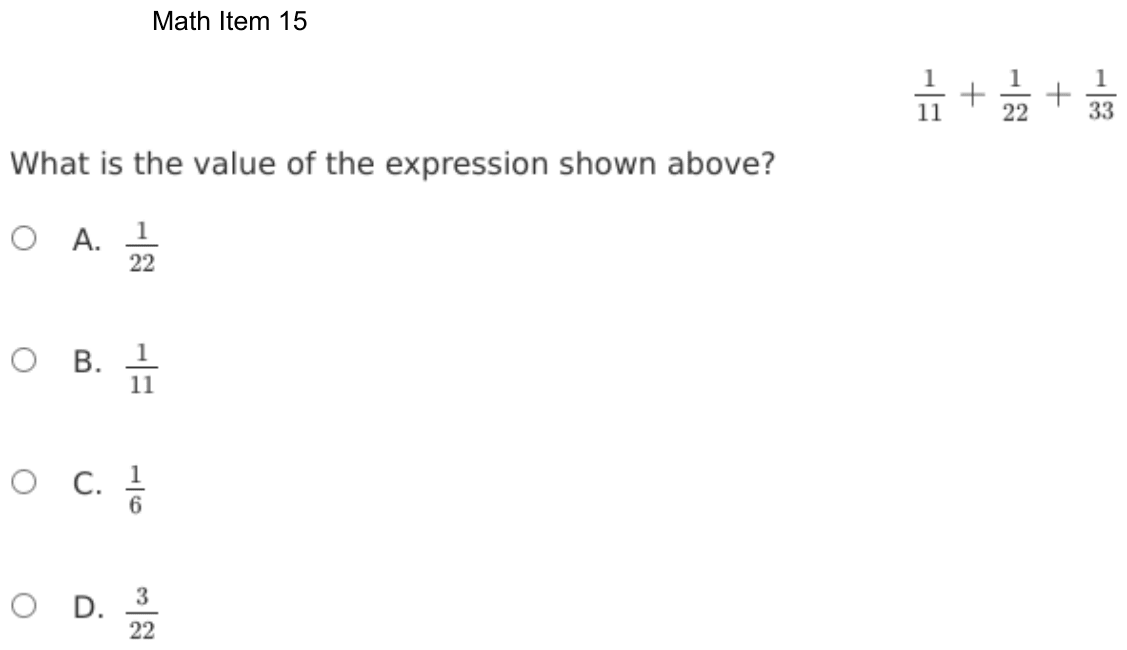
Question 70 of 120
2026 Practice Test D Math, question 16Question
The table shows the proportional relationship between x cups of oatmeal and y ounces of raisins in a bread recipe.
BREAD RECIPE
| Cups of Oatmeal (x) | Ounces of Raisins (y) |
|---|---|
| 2 | 1.0 |
| 3 | 1.5 |
| 6 | 3.0 |
What is the constant of proportionality of the number of ounces of raisins to the number of cups of oatmeal?
Enter your answer in the space.
Fill-in question: work out the answer and type it as a number.
Show the answer
Correct answer: 0.5
To find p, the constant of proportionality of ounces of raisins, y, to cups of oatmeal, x, use the equation .
The table shows that there is 1 ounce of raisins for 2 cups of oatmeal.
The constant of proportionality is 0.5.
Question analysis
A table for a bread recipe lists cups of oatmeal and the ounces of raisins that go with them, in a proportional relationship. Students type the constant of proportionality of raisins to oatmeal. It tests reading a unit rate from a table, and the order in which the question names the two quantities matters.
- NYS standards
- 7.RP.2b constant of proportionality
- Grade level
- Grade 7 content, by NYS standard
- Compared with grade 7
- Below grade 7 Finding a constant of proportionality from a table is a grade 7 standard, and here a single division in one row gives it. The demand is lighter than typical grade 7 work; the order of the ratio in the wording needs the most care.
- Estimated difficulty
- Straightforward: two steps or one careful reading.
- Thinking it demands
- Depth of knowledge 1, recall and reproduction · mainly apply
- What makes it hard
- Turning words into math moderate
- An answer in an unexpected form minor
- Solution
- 1 step
- Reading level
- Question and choices: about grade 6, 56 words.
- Students, last 30 days
- Not enough answers yet to show (it takes 10).
Why it is hard, traps and wrong answers (shows the answer)
Why it is hard
Every row gives the same ratio, so the division itself is easy; the question tests which quantity goes on top. Because oatmeal comes first in the table and its numbers are the larger ones, dividing cups by ounces feels natural and produces a clean whole number. Writing the relationship as y = kx, raisins equal k times oatmeal, and checking it on a second row such as 3 cups and 1.5 ounces fixes the order.
Turning words into math moderate Understanding the question
The phrase “of the number of ounces of raisins to the number of cups of oatmeal” fixes the order y ÷ x, while the table lists oatmeal first, inviting 2 ÷ 1.0. (Hegarty, Mayer & Monk, 1995; Koedinger & Nathan, 2004)
An answer in an unexpected form minor Choosing the answer
The constant is typed in with no choices, so an upside-down ratio of 2, a whole number, looks as finished as the decimal the table actually gives. (Enright, Morley & Sheehan, 2002)
Strategy: Divide an ounces-of-raisins value by the cups of oatmeal in the same row, in the order the question names them, and check that every row gives the same value.
Traps
- Wrong operation: Adds instead of multiplying, divides the wrong way round, turns a ratio or rate upside down, or undoes a step in the wrong direction (subtracts what should be added back).
- Numbers taken from the question: Combines the numbers in the question without a model of the situation, or is simply a number that appears in the question.
The wrong answers, classified
2 Wrong operation (Hegarty, Mayer & Monk, 1995; King et al., 2004)
Divides cups of oatmeal by ounces of raisins, 2 ÷ 1.0, turning the ratio upside down: cups per ounce instead of ounces per cup.
1 Numbers taken from the question (Hegarty, Mayer & Monk, 1995)
Reads the first raisin amount, 1.0 ounce, as the constant without dividing it by the 2 cups of oatmeal in the same row.
Worked solution, step by step
Formulas used
- Constant of proportionality
- x and y are two amounts that grow together at the same rate. k is the constant of proportionality, the number you always multiply x by to get y. Here y is ounces of raisins and x is cups of oatmeal, so k is ounces of raisins per cup of oatmeal.
Sort out the question
The table shows cups of oatmeal, x, and ounces of raisins, y. Proportional means the raisins are always the same multiple of the oatmeal. That multiple is the constant of proportionality. The question asks for raisins to oatmeal. So you want ounces of raisins for each cup of oatmeal: y ÷ x.
Divide y by x in one row
Use the first row of the table: 2 cups of oatmeal go with 1.0 ounce of raisins.
So there is 0.5 ounce of raisins for each cup of oatmeal.
Check the other rows
A constant must be the same in every row:
Every row gives 0.5, so the rule is .
Watch out: the table lists oatmeal first, which tempts you to divide 2 by 1.0. That gives 2, which is cups per ounce, the ratio upside down. And 1.0 alone is just one raisin amount, not the constant.
Enter the answer
Type the constant in the box as a number, with no units. On this site, 0.5, .5 and 1/2 all count.
So you would enter 0.5.
Check your answer
Multiply each oatmeal amount by 0.5: 2 × 0.5 = 1.0, 3 × 0.5 = 1.5 and 6 × 0.5 = 3.0. Each result matches the raisins in its row. Also, every raisin number is smaller than its oatmeal number, so the constant must be less than 1.
More questions like this
The original DOE question
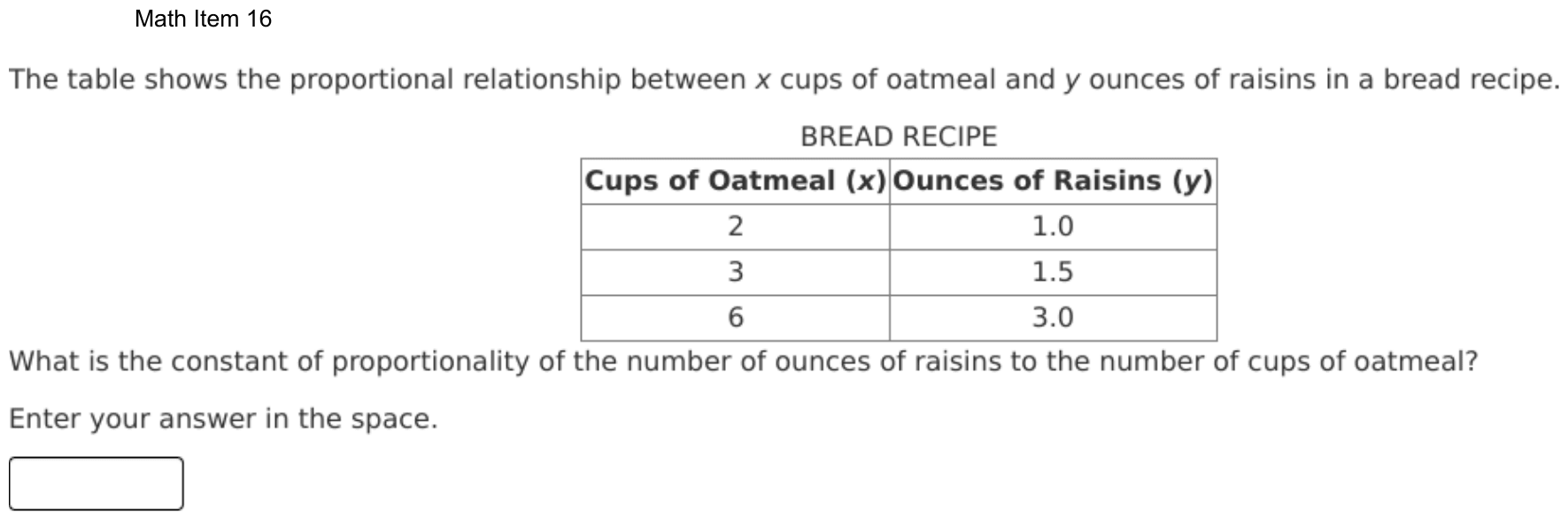
Question 71 of 120
2026 Practice Test D Math, question 17Question
At Midville High School, 64 students are members of either the orchestra or the choir, or both. Of these students, 38 are members of the orchestra, and 46 are members of the choir. What fraction of the total is the number of students who are members of both the orchestra and the choir?
- A
- B
- C
- D
Show the answer
Correct answer: D
First, add the number of students that are members of the orchestra and the number of students that are members of the choir.
Then, subtract to find the number of students that are members of both orchestra and choir.
Then, find the fraction of the 64 students that are members of both orchestra and choir.
Question analysis
At Midville High School, 64 students belong to the orchestra, the choir or both; 38 are in the orchestra and 46 in the choir. Students find what fraction of the 64 belong to both groups. It is a Venn diagram counting question with a fraction, and the students in both groups are included in each membership number.
- Grade level
- Grade 7 content, by NYS standard
- Compared with grade 7
- At grade 7 Overlapping groups are seldom taught directly in grade 7, though the arithmetic is whole-number addition and subtraction. Students must first find the overlap and then choose the right whole for the fraction, two decisions where errors are common.
- Estimated difficulty
- Moderate: several steps, or a close reading with one strong distractor.
- Thinking it demands
- Depth of knowledge 2, skills and concepts · mainly apply
- What makes it hard
- Turning words into math moderate
- No obvious method minor
- An answer in an unexpected form minor
- Solution
- 3 steps
- Reading level
- Question and choices: about grade 5, 54 words.
- Corrected from the DOE handbook
- A misstatement in the explanation’s first step was corrected.
- Students, last 30 days
- Not enough answers yet to show (it takes 10).
Why it is hard, traps and wrong answers (shows the answer)
Why it is hard
The question hides its key number: the students in both groups appear only as the amount by which 38 + 46 overshoots 64. A sketch of two overlapping circles, with 20 in the middle, 18 in orchestra only and 26 in choir only, shows the whole group at once. After that, the remaining risk is the denominator, since the question asks for a fraction of all 64 students, not of one group.
Turning words into math moderate Understanding the question
“Either the orchestra or the choir, or both” means the 64 counts each student once, while 38 + 46 counts the students in both groups twice; the overlap itself is never stated. (Hegarty, Mayer & Monk, 1995; Koedinger & Nathan, 2004)
No obvious method minor Working it out
Nothing names the step that finds the overlap: the excess of 38 + 46 = 84 over 64 is the number in both groups, an idea students must bring themselves. (Schoenfeld, 1985)
An answer in an unexpected form minor Choosing the answer
The fraction 20/64 appears only in lowest terms, so it must be simplified by 4 before it can be matched with a choice. (Enright, Morley & Sheehan, 2002)
Strategy: Add the orchestra and choir counts, subtract the 64 students to find how many were counted twice, then put that number over the total and simplify.
Traps
- Answers a different question: A choice is right for another quantity: the other unknown, the rest instead of the part, the part instead of the whole.
- Overlapping groups: Things in two groups at once are counted twice, or not subtracted.
The wrong answers, classified
A Overlapping groups (King et al., 2004)
Takes 38 + 46 = 84 as the number of students, counting those in both groups twice, and puts the stated 64 over it to get 16/21.
B Answers a different question (King et al., 2004; Hegarty, Mayer & Monk, 1995)
Finds the 20 students in both groups but compares them with the 38 orchestra members instead of all 64 students, so 20/38 = 10/19.
C Answers a different question (King et al., 2004; Hegarty, Mayer & Monk, 1995)
Finds the 20 students in both groups but divides by the 46 choir members, using one group as the whole instead of all 64, so 20/46 = 10/23.
What was corrected from the DOE handbook, and why
- Explanation: The DOE’s explanation begins “First, add the number of students that are members of both orchestra and choir. 38 + 46 = 84.” But 38 is the number of orchestra members and 46 the number of choir members; the number of students in both is what the next step finds (84 − 64 = 20). The site now says “First, add the number of students that are members of the orchestra and the number of students that are members of the choir.”
Worked solution, step by step
Formulas used
- Counting two groups that overlap
- O is the number in the orchestra, and C is the number in the choir. Students in both groups are counted in O and again in C. Subtracting them once makes each student count one time. Here every student is in at least one group, so this gives everyone.
- Fraction of a total
- The part is the group you are asked about. The whole is the full group it comes from. Here the part is the students in both groups, and the whole is all 64 students. Simplify by dividing the top and bottom by the same number.
Sort out the question
There are 64 students in all. Each one is in the orchestra, the choir or both. 38 are in the orchestra, and 46 are in the choir. Some students are in both, but the question does not say how many. You need that number as a fraction of all 64 students.
Add the two groups
Add the number in the orchestra and the number in the choir:
That is more than the 64 students there are. Why? A student in both groups is counted once with the orchestra and once more with the choir.
Find the students in both
The extra amount over 64 is the students who were counted twice:
So 20 students are in both groups. This is the overlap rule turned around: both = O + C − total.
Watch out: 84 is not the number of students. Putting 64 over 84 gives 16/21, choice A.
Write the fraction and simplify
The part is 20 students, and the whole is all 64 students. Both numbers divide by 4:
Watch out: the whole is all 64 students, not one group. Using 38 gives 10/19, choice B. Using 46 gives 10/23, choice C.
So the answer is D, .
Check your answer
Split the 64 students into three groups that do not overlap. Only orchestra: 38 − 20 = 18. Only choir: 46 − 20 = 26. Both: 20. Add them: 18 + 26 + 20 = 64. That matches the total, so 20 is right.
More questions like this
The original DOE question
Question 72 of 120
2026 Practice Test D Math, question 18Question
Which of the following decimals is equivalent to ?
- A
- B
- C
- D
Show the answer
Correct answer: C
First, add the mixed numbers. Then, convert the fraction to a decimal.
Question analysis
This question asks which repeating decimal equals the sum of the mixed numbers 1 2/3 and 2 4/9. Students rename the fractions with a common denominator, add, and convert the fraction part to a decimal with a bar over its repeating digit. The choices differ in both the whole number and the repeating digit, so each step has to be right.
- NYS standards
- Grade level
- Grade 7 content, by NYS standard
- Compared with grade 7
- At grade 7 Adding mixed numbers and writing a fraction as a repeating decimal are standard grade 7 skills. This combines them in three short steps; renaming a fraction and reading the bar notation are the only places that need care.
- Estimated difficulty
- Straightforward: two steps or one careful reading.
- Thinking it demands
- Depth of knowledge 1, recall and reproduction · mainly apply
- What makes it hard
- Error-prone arithmetic moderate
- An answer in an unexpected form minor
- Solution
- 3 steps
- Reading level
- Question and choices: about grade 13, 13 words.
- Students, last 30 days
- Not enough answers yet to show (it takes 10).
Why it is hard, traps and wrong answers (shows the answer)
Why it is hard
Two fraction moves and one conversion stand between the sum and the choices. The carry is the main hazard: 10/9 has to become 1 1/9, and students who keep only the 1/9 land on a choice with the wrong whole number. Estimating first, about 1.7 + 2.4 = 4.1, rules out both choices that begin with 3 and the one that equals 5.
Error-prone arithmetic moderate Working it out
Adding 2/3 and 4/9 needs 2/3 renamed as 6/9, and the sum 10/9 is more than 1, so a whole must be carried into the 3 before converting. (Brown & Burton, 1978; Junker & Sijtsma, 2001)
An answer in an unexpected form minor Choosing the answer
The choices are repeating decimals with bars, so a mixed number in ninths has to be recognized as a digit repeating forever; knowing that ninths repeat their numerator makes the match quick. (Enright, Morley & Sheehan, 2002)
Strategy: Rename 2/3 as ninths, add the whole numbers and the fractions separately, regroup any fraction of 9/9 or more as a whole, then divide the leftover numerator by 9.
Traps
- A faulty procedure: A systematic but wrong procedure: adding fractions straight across, applying an exponent to each term of a sum, dropping a sign when moving a term.
- Answer in another form: The right answer is written differently from the way you worked it out.
The wrong answers, classified
A An arithmetic slip (Junker & Sijtsma, 2001)
Adds the fractions to 10/9 but keeps only the 1/9 left over, forgetting to carry the whole 1 into the 3, so the sum becomes 3 1/9.
B A faulty procedure (Brown & Burton, 1978; Tatsuoka, 1983)
Adds the numerators 2 and 4 over 9 without renaming 2/3 as 6/9, so gets 3 6/9, which is 3.666…
D A faulty procedure (Brown & Burton, 1978; Tatsuoka, 1983)
Reaches 4 1/9 but repeats the denominator's 9 instead of the numerator's 1, as if one ninth were 0.999… rather than 0.111…
Worked solution, step by step
Formulas used
- Equivalent fractions
- a/b is a fraction, and n is any number except 0. Multiplying the top and the bottom by the same n gives an equal fraction, because n/n is 1. Use it to give two fractions the same bottom before you add them.
- Ninths as repeating decimals
- 1 divided by 9 is 0.111…, with 1s that go on forever. The bar over a digit means that digit repeats forever. Ninths from 1/9 to 8/9 repeat their top digit, so 4/9 is 0.444… and 2/9 is 0.222…
Sort out the question
You need to add two mixed numbers, 1 2/3 and 2 4/9. A mixed number is a whole number plus a fraction. Then write the sum as a decimal. The choices are repeating decimals, where the bar over a digit means it repeats forever.
Rename two thirds as ninths
The fractions 2/3 and 4/9 have different bottoms. Since 3 × 3 = 9, multiply the top and bottom of 2/3 by 3:
So 1 2/3 is the same as 1 6/9.
Watch out: adding the tops 2 and 4 over 9 without renaming gives 3 6/9, choice B.
Add the mixed numbers
Add the whole numbers, then add the fractions:
10/9 is more than 1. It is 9/9 plus 1/9, or 1 1/9. Carry the 1 into the whole number:
Watch out: forgetting to carry the 1 gives 3 1/9, choice A.
Change it to a decimal
One ninth is 0.111…, with the 1 repeating forever. So:
Watch out: ninths repeat the top digit, not the 9. Choice D, 4.999…, does not match 4 1/9.
So the answer is C, .
Check your answer
Use rough decimals. 1 2/3 is about 1.667, and 2 4/9 is about 2.444. Their sum is about 4.111. That matches 4.111… and rules out both choices that start with 3. And 4.999… is almost 5, which is too big.
More questions like this
The original DOE question
Question 73 of 120
2026 Practice Test D Math, question 19Question
A store manager purchases a piece of furniture for $456.00. To determine the selling price, the manager increases the purchase cost by 125%. A customer buys the furniture and pays an additional 8% sales tax. How much does the customer pay for the furniture?
- A$615.60
- B$627.48
- C$1,108.08
- D$1,846.80
Show the answer
Correct answer: C
Given a purchase price of $456.00, the 125% increase in price is calculated as:
The selling price equals the purchase price plus the increase, or:
The sales tax on the selling price is:
The customer pays the selling price plus the sales tax:
Question analysis
A store manager buys a piece of furniture for $456.00 and raises the price by 125% to set the selling price, and the customer also pays 8% sales tax. Students find the total the customer pays. It tests percent increase and sales tax in sequence, and reading an increase of more than 100% correctly is the main challenge.
- NYS standards
- Grade level
- Grade 7 content, by NYS standard
- Compared with grade 7
- Above grade 7 Grade 7 students find markups and sales tax, usually with increases under 100%. An increase of more than 100% is unusual and easy to misread, and two percent changes must be applied in order, which goes beyond routine grade 7 work.
- Estimated difficulty
- Hard: combines ideas, needs a plan, and has more than one tempting wrong answer.
- Thinking it demands
- Depth of knowledge 2, skills and concepts · mainly apply
- What makes it hard
- Turning words into math moderate
- Many steps moderate
- Error-prone arithmetic minor
- Solution
- 4 steps
- Reading level
- Question and choices: about grade 7, 41 words.
- Students, last 30 days
- Not enough answers yet to show (it takes 10).
Why it is hard, traps and wrong answers (shows the answer)
Why it is hard
A percent above 100 is unusual in grade 7 work, and it is the center of the question: the markup more than doubles the price. Students who treat “by 125%” as “125% of” still find a listed answer after adding tax, and so do students who add $125. A rough check helps: the selling price must be more than twice $456, about $1,000, and the tax adds less than a tenth of that.
Turning words into math moderate Understanding the question
“Increases the purchase cost by 125%” adds 125% of $456 to the $456 itself, a multiplier of 2.25; reading it as 125% of the cost leaves the original price out. (Hegarty, Mayer & Monk, 1995; Koedinger & Nathan, 2004)
Many steps moderate Working it out
Four steps in a row, the increase, the selling price, the tax and the total, each depend on the one before, and two of them are easy to merge or skip. (Daniel & Embretson, 2010; Enright, Morley & Sheehan, 2002)
Error-prone arithmetic minor Working it out
Taking 8% of $1,026 means multiplying by 0.08, and a decimal point one place off, 0.8, makes the tax ten times too large. (Brown & Burton, 1978; Junker & Sijtsma, 2001)
Strategy: Turn each percent change into a multiplier, remembering that an increase by a percent is added to the original amount, apply the markup and then the tax, and estimate to check the size.
Traps
- Stops one step early: A choice is a number from partway through the solution.
- Misunderstands the concept: A wrong belief about a concept: that percents can be added, that area grows like length, that averages can be averaged, that a bigger denominator means a bigger fraction.
- An arithmetic slip: The right method with a plausible arithmetic error: a digit, a place value or a times-table fact.
The wrong answers, classified
A Stops one step early (King et al., 2004; Gierl et al., 2017)
Finds the increase, 125% of $456 = $570, and uses it as the selling price without adding back the $456 cost, then adds 8% tax.
B Misunderstands the concept (Smith, diSessa & Roschelle, 1993; De Bock et al., 1998; Ni & Zhou, 2005)
Reads the 125% increase as $125, a fixed amount, so the selling price is $581, and then adds 8% tax correctly to reach $627.48.
D An arithmetic slip (Junker & Sijtsma, 2001)
Finds the $1,026 selling price correctly but writes 8% as 0.8, adding $820.80 in tax instead of $82.08.
Worked solution, step by step
Formulas used
- Percent of a number
- n is the starting amount, and p is the percent. Percent means out of 100, so 125% is 125/100 = 1.25 and 8% is 8/100 = 0.08. Multiply n by that decimal to find the part.
- Price after an increase
- The old price is what you start with. The increase is the amount added on. To increase by a percent, find that percent of the old price, then add it to the old price. Sales tax is added the same way.
Sort out the question
The manager pays $456.00 for the furniture. The selling price is that cost increased by 125%. The customer then pays 8% sales tax on top. Sales tax is an extra charge, a percent of the price. You need the total the customer pays.
Find the increase
Find 125% of $456. As a decimal, 125% is 1.25, which is 1 and a quarter. A quarter of 456 is 114:
The increase is $570.
Find the selling price
Increases by means the increase is added to the cost:
The selling price is $1,026.
Watch out: $570 is only the increase. Using it as the price gives $615.60, choice A. And 125% is a percent, not $125. Adding $125 leads to $627.48, choice B.
Find the sales tax
As a decimal, 8% is 0.08. Find 8% of the selling price:
The tax is $82.08.
Watch out: 8% is 0.08, not 0.8. Using 0.8 makes the tax ten times too big and gives $1,846.80, choice D.
Add the tax to the price
The customer pays the selling price plus the tax:
So the answer is C, $1,108.08.
Check your answer
Estimate. The price more than doubles: $456 plus $570 is about $1,000. Tax of 8% adds about $80. So the total should be a bit over $1,080, and only $1,108.08 is close. Or multiply in one go: 456 × 2.25 × 1.08 = 1,108.08.
More questions like this
The original DOE question
Question 74 of 120
2026 Practice Test D Math, question 20Question
What is the value of ?
- A−76
- B−4
- C4
- D148
Show the answer
Correct answer: B
Use the order of operations to evaluate the expression. It is important to recognize that the fraction bar is a grouping symbol and so the entire numerator should be evaluated first. Exponents are evaluated first.
Then multiplication, recognizing that the product of a negative factor and a positive factor is negative.
Then addition and subtraction in order from left to right, recognizing the rules for adding and subtracting signed numbers.
And finally the fraction can be evaluated by division, recognizing that the quotient of a positive and a negative number is negative.
Question analysis
This arithmetic question asks for the value of a fraction whose numerator, −9(−4)² + 36(−4) + 304, is divided by −4. Students follow the order of operations with negative numbers: a square, two products, a sum and a division. Every step carries a sign, and one dropped negative changes the result completely.
- NYS standards
- Grade level
- Grade 7 content, by NYS standard
- Compared with grade 7
- At grade 7 Order of operations with negative numbers is standard grade 7 practice. This expression stacks a squared negative, two products and a division by a negative into one fraction, so it takes more steps than usual, each with a sign to track.
- Estimated difficulty
- Moderate: several steps, or a close reading with one strong distractor.
- Thinking it demands
- Depth of knowledge 1, recall and reproduction · mainly apply
- What makes it hard
- Error-prone arithmetic moderate
- Many steps minor
- A very close wrong answer minor
- Solution
- 4 steps
- Reading level
- Question and choices: about grade 5, 6 words.
- Students, last 30 days
- Not enough answers yet to show (it takes 10).
Why it is hard, traps and wrong answers (shows the answer)
Why it is hard
Nothing here is conceptually new; the question measures care with signs under the order of operations. The parentheses in (−4)² decide whether −9 multiplies 16 or −16, and the two products of −144 then nearly cancel the 304, leaving a small numerator whose sign is easy to lose. Writing each intermediate value with its sign, line by line, prevents most errors.
Error-prone arithmetic moderate Working it out
Five sign decisions sit in one expression: squaring −4, two products with a negative factor, a sum that climbs from −288 past zero, and a division by −4. (Brown & Burton, 1978; Junker & Sijtsma, 2001)
Many steps minor Working it out
The numerator alone takes an exponent, two multiplications and two additions before the single division, and all of it must be finished before dividing. (Daniel & Embretson, 2010; Enright, Morley & Sheehan, 2002)
A very close wrong answer minor Choosing the answer
The right value and the choice 4 differ only in sign, so a student with the right size must still check the sign of a positive numerator over −4. (Embretson & Wetzel, 1987; Gorin & Embretson, 2006; Ascalon et al., 2007)
Strategy: Treat the fraction bar as grouping: square −4 first, do the two multiplications, combine the numerator from left to right, and only then divide by −4, writing each sign as you go.
Traps
- Negatives and direction: Arithmetic with negative numbers, the order of a subtraction, or direction on a number line. (Moving a term across the equals sign without changing its sign is a faulty procedure.)
- Order of operations: Working left to right, or distributing a minus sign wrongly, gives a choice.
The wrong answers, classified
A Order of operations (Brown & Burton, 1978)
Squares as if the minus sat outside the parentheses, taking (−4)² as −16, so −9 × (−16) = 144, the numerator becomes 304, and 304 ÷ (−4) = −76.
C Negatives and direction (Brown & Burton, 1978)
Works the numerator out correctly as 16 but divides by −4 as if the signs did not matter, giving a positive quotient.
D Negatives and direction (Brown & Burton, 1978)
Drops every negative sign, adding 144 + 144 + 304 = 592 and dividing by 4, so 148 keeps none of the signs in the problem.
Worked solution, step by step
Formulas used
- Order of operations
- This is the order for working out an expression. Grouping means parentheses and the fraction bar. Exponents are small raised numbers, like the 2 in (−4)². Next, multiply and divide from left to right. Last, add and subtract from left to right.
- Squaring a negative number
- a is a positive number, so −a is negative. Squaring means multiplying a number by itself. A negative times a negative is positive, so a negative number squared is positive. For example, (−4)² = 16.
- Signs when you multiply or divide
- When two numbers have different signs, their product or quotient is negative. When they have the same sign, it is positive. A quotient is the answer to a division.
Sort out the question
You need the value of one big fraction. The fraction bar is a grouping symbol, so finish the whole top first. Then divide by −4. Follow the order of operations, and track every minus sign.
Do the exponent first
The only exponent is (−4)². Squaring means multiplying a number by itself:
Watch out: (−4)² is 16, not −16. Using −16 makes the top 304, which gives −76, choice A.
Do the multiplication
Now multiply. A negative times a positive is negative:
So the top becomes:
Add from left to right
Add the two negatives first:
Then add 304. Since 304 is more than 288, the result is positive:
The whole top is 16.
Divide by −4
Now divide the top by the bottom. A positive divided by a negative is negative:
Watch out: positive 4, choice C, ignores the negative bottom. Dropping every minus sign gives 592 ÷ 4 = 148, choice D.
So the answer is B, −4.
Check your answer
Multiply back. If the answer is −4, then −4 times the bottom, −4, should give the top. It does: (−4) × (−4) = 16. Also, the top is positive and the bottom is negative, so the answer must be negative.
More questions like this
The original DOE question
Question 75 of 120
2026 Practice Test D Math, question 21Question
Maxie borrowed $7.75 from her mother, $11.00 from her father, and $4.50 from her brother to purchase a video game. Her grandmother gave her $25.00 as a gift. How much money will Maxie have left or still owe if she uses the money her grandmother gave her to pay back the money she borrowed?
- AMaxie will still owe $2.25.
- BMaxie will still owe $1.75.
- CMaxie will have $1.75 left.
- DMaxie will have $2.25 left.
Show the answer
Correct answer: C
First, determine the total amount Maxie borrowed, in dollars:
Then use subtraction to determine the difference between the amount her grandmother gave her and the amount she borrowed:
The difference is positive, which means that Maxie will still have $1.75 left from the amount her grandmother gave her.
Question analysis
Maxie borrowed money from her mother, father and brother to buy a video game, then received $25.00 from her grandmother to pay them back. Students decide how much money she will have left over or still owe. It tests adding and subtracting decimals with money, and the choices also test which way the difference goes.
- Grade level
- Grade 6 content, by NYS standard
- Compared with grade 7
- Below grade 7 Adding and subtracting money amounts is grade 6 decimal work. Here it takes one sum and one difference, and the only further demand is deciding whether the result is money left or money owed, well below typical grade 7 tasks.
- Estimated difficulty
- Routine: one familiar step, little to misread.
- Thinking it demands
- Depth of knowledge 2, skills and concepts · mainly apply
- What makes it hard
- Error-prone arithmetic minor
- Turning words into math minor
- Solution
- 2 steps
- Reading level
- Question and choices: about grade 4, 66 words.
- Students, last 30 days
- Not enough answers yet to show (it takes 10).
Why it is hard, traps and wrong answers (shows the answer)
Why it is hard
Few students miss this one, since it needs only one addition and one subtraction with money. The choices come in pairs, so the right amount must also be matched with the right outcome. Lining up the decimal points, and asking whether $25.00 is more or less than the $23.25 borrowed, settles both the amount and whether Maxie owes or keeps money.
Error-prone arithmetic minor Working it out
The loans add to $23.25, and subtracting that from $25.00 means borrowing across two zeros, a classic place for a digit to go wrong. (Brown & Burton, 1978; Junker & Sijtsma, 2001)
Turning words into math minor Understanding the question
Each amount appears twice among the choices, once as money left and once as money owed, so the result must also be read for direction by asking which is larger, the gift or the loans. (Hegarty, Mayer & Monk, 1995; Koedinger & Nathan, 2004)
Strategy: Add the three amounts borrowed, compare the total with the $25.00 gift, and decide from which is larger whether Maxie ends up with money left or still owes some.
Traps
- Negatives and direction: Arithmetic with negative numbers, the order of a subtraction, or direction on a number line. (Moving a term across the equals sign without changing its sign is a faulty procedure.)
- A faulty procedure: A systematic but wrong procedure: adding fractions straight across, applying an exponent to each term of a sum, dropping a sign when moving a term.
The wrong answers, classified
A Little reason to choose it (Haladyna & Downing, 1993; Rodriguez, 2005)
Needs two errors at once, a wrong difference such as $2.25 and the reversed outcome, so no single line of working reaches it and it mostly draws guesses.
B Negatives and direction (Brown & Burton, 1978)
Finds the $1.75 difference correctly but reverses its meaning, as if the $25.00 gift fell short of the $23.25 borrowed instead of covering it.
D A faulty procedure (Brown & Burton, 1978; Tatsuoka, 1983)
Subtracts $23.25 from $25.00 column by column, taking the smaller digit from the larger instead of borrowing, so 5 − 0 and 2 − 0 give $2.25.
Worked solution, step by step
Formulas used
- Money left over
- Money she has is the $25.00 gift. Money she owes is the total she borrowed. If the result is positive, she has that much left. If it were negative, she would still owe that much. Comparing the two amounts first tells you which.
Sort out the question
Maxie borrowed from three people: $7.75, $11.00 and $4.50. Her grandmother gave her $25.00. She uses the $25.00 to pay everyone back. You need to know if money is left over or if she still owes some, and how much.
Add up what she borrowed
Line up the decimal points and add:
She owes $23.25 in all. That is the amount she must pay back.
Compare the gift with the debt
The gift, $25.00, is more than the $23.25 she owes. So she can pay everyone back and still have money left. She will not owe anything.
Watch out: once you find $1.75, keep its meaning straight. Saying she still owes $1.75, choice B, gets the direction backwards.
Subtract to find what is left
Take the debt away from the gift:
You need to regroup (borrow) across the zeros. Think of $25.00 as 24 dollars and 100 cents. Then 100 − 25 = 75 cents, and 24 − 23 = 1 dollar.
Watch out: taking the smaller digit from the larger one in each column gives $2.25, choice D.
So the answer is C: Maxie will have $1.75 left.
Check your answer
Add back. The $23.25 she pays plus the $1.75 she keeps is 23.25 + 1.75 = 25.00. That is the whole gift, so the subtraction is right.
More questions like this
The original DOE question
Question 76 of 120
2026 Practice Test D Math, question 22Question
Seth grows strawberries in his garden.
- He picked cups of strawberries on Monday.
- He picked 4 cups of strawberries on Tuesday.
- He ate cup of strawberries for breakfast each day on Wednesday, Thursday, and Friday.
How many cups of strawberries did Seth have left?
- A
- B
- C6
- D9
Show the answer
Correct answer: B
When Seth picks strawberries, the value represents a positive number, and when he eats the strawberries, the value represents a negative number. Write an expression and then evaluate the expression, where the negative value is multiplied by 3 because he ate the same amount on 3 different days.
If the multiplication is confusing, evaluate the expression below which represents the sum for the 5 days with each day listed separately.
Question analysis
Seth picked strawberries on Monday and Tuesday, in amounts given as a mixed number and a whole number, then ate the same fraction of a cup at breakfast on three days. Students find how many cups he has left. It tests adding, multiplying and subtracting fractions in a short word problem, and the eaten amount repeats each day.
- Grade level
- Grade 7 content, by NYS standard
- Compared with grade 7
- Below grade 7 Adding mixed numbers and multiplying a fraction by a whole number are skills from before grade 7. The three steps are short and the numbers friendly, so the demand is below typical grade 7 work with signed rational numbers.
- Estimated difficulty
- Straightforward: two steps or one careful reading.
- Thinking it demands
- Depth of knowledge 2, skills and concepts · mainly apply
- What makes it hard
- Error-prone arithmetic moderate
- Turning words into math minor
- Solution
- 3 steps
- Reading level
- Question and choices: about grade 6, 47 words.
- Students, last 30 days
- Not enough answers yet to show (it takes 10).
Why it is hard, traps and wrong answers (shows the answer)
Why it is hard
The bulleted list lays out the story day by day, so setting up the problem is easy; the points are lost in the fractions. The number of breakfast days, 3, sits right beside the 3/4 cup, and subtracting 3 cups instead of three quarters of a cup each day is the tempting shortcut. Writing every amount in fourths, 26/4 picked and 9/4 eaten, makes the last step a whole-number subtraction.
Error-prone arithmetic moderate Working it out
Three breakfasts of 3/4 cup make 9/4 = 2 1/4 cups, and taking that from 6 1/2 means renaming the half as 2/4, two fraction steps where a slip is easy. (Brown & Burton, 1978; Junker & Sijtsma, 2001)
Turning words into math minor Understanding the question
Picking adds and eating subtracts, and “each day on Wednesday, Thursday, and Friday” means the 3/4 cup counts three times, not once. (Hegarty, Mayer & Monk, 1995; Koedinger & Nathan, 2004)
Strategy: Add the two amounts picked, multiply the breakfast amount by the number of days, and subtract that from the total; writing every amount in fourths keeps the arithmetic simple.
Traps
- Numbers taken from the question: Combines the numbers in the question without a model of the situation, or is simply a number that appears in the question.
- Wrong operation: Adds instead of multiplying, divides the wrong way round, turns a ratio or rate upside down, or undoes a step in the wrong direction (subtracts what should be added back).
The wrong answers, classified
A Numbers taken from the question (Hegarty, Mayer & Monk, 1995)
Subtracts 3 cups, the number of breakfast days, instead of 3 × 3/4 = 2 1/4 cups, so 6 1/2 − 3 = 3 1/2.
C Little reason to choose it (Haladyna & Downing, 1993; Rodriguez, 2005)
No common working gives exactly 6; it is near the 6 1/2 cups picked and mostly catches students who drop the fractions or guess.
D Wrong operation (Hegarty, Mayer & Monk, 1995; King et al., 2004)
Adds the 2 1/4 cups eaten to the 6 1/2 cups picked instead of subtracting, 8 3/4 cups, and takes the nearest choice, 9.
Worked solution, step by step
Formulas used
- Total of a repeated amount
- Use it when the same amount happens again and again. Here Seth eats 3/4 cup on each of 3 days, so the number of times is 3 and the amount each time is 3/4 cup.
- A whole number times a fraction
- n is a whole number, and a/b is a fraction. Multiply the whole number by the top only, and keep the bottom. It works because n groups of a pieces make n × a pieces, and each piece is still size 1/b.
Sort out the question
Seth picked 2 1/2 cups on Monday and 4 cups on Tuesday. Then he ate 3/4 cup each day on Wednesday, Thursday and Friday. That is 3 days of eating. Picking adds strawberries, and eating takes them away. You need the number of cups he has left.
Add what he picked
Add the two days of picking:
He picked 6 1/2 cups in all, before he ate any.
Find how much he ate
He ate 3/4 cup on each of 3 days. Multiply:
To change 9/4 to a mixed number, note that 4 fits into 9 twice, with 1 left over. He ate 2 1/4 cups.
Watch out: he ate 3/4 cup three times, not 3 cups. Subtracting 3 gives 3 1/2, choice A.
Take away what he ate
Write the half as fourths, so both fractions have the same bottom: 1/2 = 2/4. Then subtract the wholes and the fourths:
Watch out: eating takes away. Adding the 2 1/4 cups gives 8 3/4, and the nearest choice is 9, choice D.
So the answer is B, cups.
Check your answer
Use decimals. 2.5 + 4 = 6.5 cups picked. 3 × 0.75 = 2.25 cups eaten. Then 6.5 − 2.25 = 4.25 cups, which is 4 1/4.
More questions like this
The original DOE question
Question 77 of 120
2026 Practice Test D Math, question 23Question
Which situation involves quantities that combine to equal zero?
- Areceiving $5 as a gift and then giving $5 to a friend
- Bbuying a book for $10 and then buying lunch for $10
- Cgetting on an elevator at the ground floor, rising 3 floors, and then rising 3 more floors
- Dstarting in a cave 20 feet below the ground, climbing up 20 feet, and then climbing up 20 feet more
Show the answer
Correct answer: A
When looking for a situation where quantities combine to make zero, find two values with the same absolute value where one value is positive and one value is negative.
In the situation in option A, receiving a gift of $5 is represented by , and giving a friend $5 is represented by . These values combine to equal zero because .
Question analysis
This question gives four everyday situations involving money, an elevator and a cave, and asks which one involves quantities that combine to make zero. It tests representing gains and losses, or ups and downs, with positive and negative numbers. Equal numbers alone do not make zero, so the direction of each amount must be read carefully.
- Grade level
- Grade 7 content, by NYS standard
- Compared with grade 7
- Below grade 7 Describing situations where opposite quantities make zero is named in the grade 7 standards, and this is its most direct form: one reading of four everyday situations, easier than typical grade 7 work with signed numbers.
- Estimated difficulty
- Routine: one familiar step, little to misread.
- Thinking it demands
- Depth of knowledge 1, recall and reproduction · mainly understand
- What makes it hard
- Solution
- 1 step
- Reading level
- Question and choices: about grade 5, 60 words.
- Students, last 30 days
- Not enough answers yet to show (it takes 10).
Why it is hard, traps and wrong answers (shows the answer)
Why it is hard
The idea that a quantity and its opposite add to zero is familiar, and the right situation states it plainly. The wrong choices are built from equal amounts: two of them repeat a number but move in one direction, and the cave climb reaches zero partway before going 20 feet past it. Writing each situation as a sum of signed numbers takes a few seconds and settles it.
Turning words into math minor Understanding the question
Each situation must be turned into signed numbers, receiving or rising as plus and giving or buying as minus, before its total can be judged. (Hegarty, Mayer & Monk, 1995; Koedinger & Nathan, 2004)
Every choice must be checked minor Choosing the answer
Every choice repeats one amount, $5, $10, 3 floors or 20 feet, so equal numbers alone do not identify the answer; the direction of each move has to be checked. (Embretson & Wetzel, 1987)
Strategy: Write each situation as signed numbers, using + for gains or upward moves and − for losses or downward moves, add them, and see which total is zero.
Traps
- Stops one step early: A choice is a number from partway through the solution.
- Misunderstands the concept: A wrong belief about a concept: that percents can be added, that area grows like length, that averages can be averaged, that a bigger denominator means a bigger fraction.
The wrong answers, classified
B Misunderstands the concept (Smith, diSessa & Roschelle, 1993; De Bock et al., 1998; Ni & Zhou, 2005)
Treats the two equal $10 amounts as opposites that cancel, though buying a book and buying lunch both take money away, for a total of −$20.
C Misunderstands the concept (Smith, diSessa & Roschelle, 1993; De Bock et al., 1998; Ni & Zhou, 2005)
Pairs the two 3s as amounts that cancel, missing that rising and then rising again both go up, ending 6 floors above the ground floor.
D Stops one step early (King et al., 2004; Gierl et al., 2017)
Sees that starting 20 feet below ground and climbing 20 feet reaches zero, then overlooks the last 20 feet climbed, which ends 20 feet above ground.
Worked solution, step by step
Formulas used
- Opposites add to zero
- a is any number, and −a is its opposite: the same size, but the other sign. A number and its opposite always add to 0. On a number line, they sit the same distance from 0 on opposite sides. Equal moves in opposite directions cancel out.
Sort out the question
You need the situation whose amounts add up to zero. Give each amount a sign. Use + for getting money or going up. Use − for spending money or going down. Then add the amounts in each choice. The direction matters, not just the numbers.
Write each choice with signs
Turn each situation into signed numbers and add them up:
Choice Amounts Total A +5, then −5 0 B −10, then −10 −20 C +3, then +3 +6 D start at −20, then +20, then +20 +20 Look at the tricky choices
In B, buying a book and buying lunch both take money away. Equal amounts cancel only when they go in opposite directions. In C, rising and rising again both go up, so you end 6 floors up.
Watch out: in D, starting at −20 and climbing 20 feet does reach 0, ground level. But then you climb 20 feet more. You end at +20, 20 feet above the ground, so D is wrong.
Choose the zero total
Only choice A has two opposite amounts of the same size. Getting $5 is +5, and giving $5 away is −5:
So the answer is A: receiving $5 as a gift and then giving $5 to a friend.
Check your answer
Think about where you end up. In A, you end with exactly the money you started with, so the total change is zero. In every other choice, you end with less money, higher up, or above the ground.
More questions like this
The original DOE question
Question 78 of 120
2026 Practice Test D Math, question 24Question
An athlete runs kilometer in minute. At this rate, how many kilometers would the athlete run in 1 minute?
- A
- B
- C
- D6
Show the answer
Correct answer: B
To determine the number of kilometers in 1 minute, find the unit rate in kilometers per minute: .
To evaluate the fraction, use the reciprocal when dividing to get kilometer per 1 minute.
Question analysis
An athlete runs 1/8 kilometer in 3/4 minute, and students find how many kilometers the athlete would run in 1 minute at the same rate. It tests unit rates with fractions. Both the distance and the time are fractions, so deciding which one to divide by which is the main challenge.
- Grade level
- Grade 7 content, by NYS standard
- Compared with grade 7
- At grade 7 Computing a unit rate from a ratio of fractions is the grade 7 standard itself, and this is a standard example: one fraction divided by another in two short steps, with the order of division the only real decision.
- Estimated difficulty
- Straightforward: two steps or one careful reading.
- Thinking it demands
- Depth of knowledge 2, skills and concepts · mainly apply
- What makes it hard
- Error-prone arithmetic moderate
- Turning words into math minor
- Solution
- 2 steps
- Reading level
- Question and choices: about grade 9, 23 words.
- Students, last 30 days
- Not enough answers yet to show (it takes 10).
Why it is hard, traps and wrong answers (shows the answer)
Why it is hard
The question is a unit rate with fractions, and its wrong choices are the other ways to combine 1/8 and 3/4. Since 1 minute is only a third longer than 3/4 minute, the distance must be only a third more than 1/8 kilometer, which rules out the product and both large choices at once. Dividing with the units written in, kilometers over minutes, keeps the order right.
Error-prone arithmetic moderate Working it out
The rate is a fraction divided by a fraction, 1/8 ÷ 3/4, and only the 3/4 may be flipped; multiplying straight across or dividing the other way round both give listed choices. (Brown & Burton, 1978; Junker & Sijtsma, 2001)
Turning words into math minor Understanding the question
Kilometers in 1 minute means kilometers per minute, so the 1/8 goes on top even though the time, 3/4, is the larger number. (Hegarty, Mayer & Monk, 1995; Koedinger & Nathan, 2004)
Strategy: Divide the distance by the time, kilometers over minutes, by multiplying 1/8 by the reciprocal of 3/4, and check that the units of the result are kilometers per minute.
Traps
- Wrong operation: Adds instead of multiplying, divides the wrong way round, turns a ratio or rate upside down, or undoes a step in the wrong direction (subtracts what should be added back).
The wrong answers, classified
A Wrong operation (Hegarty, Mayer & Monk, 1995; King et al., 2004)
Multiplies 1/8 by 3/4 instead of dividing, getting 3/32, which is less than the 1/8 kilometer already run in under a minute.
C Wrong operation (Hegarty, Mayer & Monk, 1995; King et al., 2004)
Splits the 3/4 minute into quarters but multiplies 1/8 by 3 instead of dividing, then multiplies by 4 for a full minute, giving 12/8 = 1 1/2.
D Wrong operation (Hegarty, Mayer & Monk, 1995; King et al., 2004)
Divides 3/4 by 1/8, minutes by kilometers, which gives 6 minutes per kilometer, the rate turned upside down.
Worked solution, step by step
Formulas used
- Unit rate
- A unit rate tells how much happens in 1 unit of time. Here the distance is in kilometers and the time is in minutes, so the rate is kilometers per minute. You divide because you are sharing the distance equally over the minutes.
- Dividing fractions
- a, b, c and d are numbers that are not zero. To divide by a fraction, multiply by its reciprocal (the fraction flipped upside down). Flip only the second fraction, the one you divide by.
Sort out the question
The athlete runs 1/8 kilometer in 3/4 minute, which is less than a full minute. You need how far the athlete runs in 1 whole minute at the same speed. That is the unit rate, in kilometers per minute.
Set up the division
Kilometers per minute means kilometers divided by minutes. So the distance comes first and the time second:
Watch out: dividing the other way, 3/4 ÷ 1/8, gives 6. That is minutes per kilometer, the rate turned upside down, choice D.
Divide the fractions
Flip 3/4 to get 4/3, then multiply. Multiply the tops and multiply the bottoms:
Simplify by dividing the top and bottom by 4:
Watch out: multiplying 1/8 × 3/4 without flipping gives 3/32, choice A.
Make sense of the answer
In 1 minute, the athlete runs 1/6 kilometer. That is a bit more than 1/8 kilometer, which makes sense. A full minute is a bit longer than 3/4 minute, so the athlete goes a bit farther. Choice C, 1 1/2 kilometers, would be 12 times as far in barely more time.
So the answer is B, kilometer.
Check your answer
Work in quarter minutes. In 3 quarter minutes, the athlete runs 1/8 km. So in 1 quarter minute, the athlete runs 1/8 ÷ 3 = 1/24 km. A full minute has 4 quarters: 4 × 1/24 = 4/24 = 1/6 km.
More questions like this
The original DOE question
Question 79 of 120
2026 Practice Test D Math, question 25Question
A bus trip takes 9 hours if the mean speed is 50 miles per hour. How many hours would this trip take if the mean speed was 45 miles per hour?
- A8
- B10
- C12
- D14
Show the answer
Correct answer: B
First, find the length of the bus trip in miles by multiplying the time, 9 hours, by the average (mean) speed, 50 miles per hour, to get 450 miles.
Then, divide the total distance, 450 miles, by the average (mean) speed, 45 miles per hour, to get the total time:
Question analysis
A bus trip takes 9 hours at a mean speed of 50 miles per hour, and students find how long the same trip takes at 45 miles per hour. It tests speed, distance and time. Working out the fixed distance first is the key, since guessing how the time should change leads many students astray.
- NYS standards
- 6.RP.3b unit rate problems
- Grade level
- Grade 6 content, by NYS standard
- Compared with grade 7
- Below grade 7 Speed, distance and time problems are grade 6 rate work, and this one uses whole numbers in two steps. Its only twist is how the time responds when the speed changes, which makes it easier than typical grade 7 rate problems.
- Estimated difficulty
- Straightforward: two steps or one careful reading.
- Thinking it demands
- Depth of knowledge 2, skills and concepts · mainly apply
- What makes it hard
- No obvious method moderate
- Something you must already know minor
- Solution
- 2 steps
- Reading level
- Question and choices: about grade 3, 28 words.
- Students, last 30 days
- Not enough answers yet to show (it takes 10).
Why it is hard, traps and wrong answers (shows the answer)
Why it is hard
Two short calculations solve it, but only after noticing that speed and time move in opposite directions: a slower bus takes longer. Students who scale the 9 hours by 45/50, as in a direct proportion, get a little over 8 hours, a result that should feel wrong for a slower trip. Finding the distance first turns the question into one division with no direction to decide.
No obvious method moderate Working it out
The question never mentions the trip's length, yet the 450-mile distance is what stays fixed; setting up a proportion between hours and speeds, the usual reflex, points the wrong way. (Schoenfeld, 1985)
Something you must already know minor Working it out
Students must bring distance = speed × time themselves, to turn 9 hours at 50 miles per hour into miles before dividing by the new speed. (Anderson & Krathwohl, 2001)
Strategy: Find the trip's length in miles from the first speed and time, since that length stays the same, then divide it by the new mean speed.
Traps
- Misunderstands the concept: A wrong belief about a concept: that percents can be added, that area grows like length, that averages can be averaged, that a bigger denominator means a bigger fraction.
- Numbers taken from the question: Combines the numbers in the question without a model of the situation, or is simply a number that appears in the question.
The wrong answers, classified
A Misunderstands the concept (Smith, diSessa & Roschelle, 1993; De Bock et al., 1998; Ni & Zhou, 2005)
Treats time as proportional to speed, scaling 9 hours by 45/50 to 8.1, about 8, though a slower bus needs more time, not less.
C Little reason to choose it (Haladyna & Downing, 1993; Rodriguez, 2005)
No common working gives 12 hours; it needs a slip such as 540 miles for 9 × 50, so it mostly draws guesses.
D Numbers taken from the question (Hegarty, Mayer & Monk, 1995)
Adds the 5-mile-per-hour drop in speed to the 9 hours, 9 + 5 = 14, combining numbers from the question without a model of the trip.
Worked solution, step by step
Formulas used
- Distance, speed and time
- d is the distance traveled. r is the rate, or speed, such as miles per hour. t is the time. It works because at 50 miles each hour, 9 hours covers 9 groups of 50 miles.
- Finding the time
- This is the same rule turned around. d is the distance and r is the speed. Divide the distance by the speed to find t, the number of hours. Use it when you know how far and how fast.
Sort out the question
A bus trip takes 9 hours at a mean speed of 50 miles per hour. The mean speed is the average speed over the whole trip. You need the time for the same trip at 45 miles per hour. The length of the trip does not change, so find it first.
Find the length of the trip
Use distance equals speed times time, with a speed of 50 miles per hour and a time of 9 hours:
The trip is 450 miles long.
Find the new time
Now the bus goes 45 miles per hour over the same 450 miles. Divide the distance by the speed:
The trip takes 10 hours.
Check that it makes sense
A slower bus needs more time for the same trip. 10 hours is more than 9 hours, so it fits.
Watch out: time does not shrink with speed. Scaling 9 hours by 45/50 gives about 8 hours, choice A, which would make the slower bus arrive sooner. Adding the drop of 5 miles per hour to 9 hours gives 14, choice D, which has no reason behind it.
So the answer is B, 10 hours.
Check your answer
Check the distance both ways. At 50 miles per hour for 9 hours, the bus goes 50 × 9 = 450 miles. At 45 miles per hour for 10 hours, it goes 45 × 10 = 450 miles. Same trip, same distance.
More questions like this
The original DOE question
Question 80 of 120
2026 Practice Test D Math, question 27Question
A birdseed mixture is sunflower seeds. The cost of the sunflower seeds is $0.10 per ounce. At this rate, what is the cost of the sunflower seeds in 25 pounds of this birdseed? (Note: 1 lb = 16 oz.)
- A$10.00
- B$16.00
- C$40.00
- D$160.00
Show the answer
Correct answer: B
First, calculate the amount of sunflower seeds in 25 pounds of this birdseed by using ratio reasoning to find that there are 10 pounds of sunflower seeds in the birdseed.
Then, use ratio reasoning to find the cost of the sunflower seeds per pound.
The cost of the sunflower seeds is $1.60 per pound.
Finally, find the total cost using ratios by multiplying the unit cost per pound by 10 pounds.
The first two steps above could be done in the other order; that is, find $1.60 per pound first and 10 pounds of sunflower seeds second.
Question analysis
A birdseed mixture is two-fifths sunflower seeds, which cost 10 cents an ounce, and students find the cost of the sunflower seeds in 25 pounds of the mix. It combines a fraction of a whole, a pounds-to-ounces conversion and a unit price. Each step's result looks like a possible answer, so keeping track of which quantity is in hand matters.
- Grade level
- Grade 7 content, by NYS standard
- Compared with grade 7
- At grade 7 Multistep ratio problems with a unit conversion are typical grade 7 work. This one chains three short steps, a fraction of the mixture, pounds to ounces and a price per ounce, and the numbers are chosen to come out evenly.
- Estimated difficulty
- Moderate: several steps, or a close reading with one strong distractor.
- Thinking it demands
- Depth of knowledge 2, skills and concepts · mainly apply
- What makes it hard
- Many steps moderate
- Combines ideas minor
- Solution
- 3 steps
- Reading level
- Question and choices: about grade 3, 35 words.
- Students, last 30 days
- Not enough answers yet to show (it takes 10).
Why it is hard, traps and wrong answers (shows the answer)
Why it is hard
Each step is routine, but the steps can be done in more than one order, and every partial result looks like a price once a dollar sign is put in front of it. Each wrong choice leaves something out: the 2/5, the price per ounce, or the conversion and the price together. Labelling each number with its unit, pounds, ounces or dollars, as it is found keeps the chain straight and shows when it is finished.
Many steps moderate Working it out
Three operations are chained: 2/5 of 25 pounds gives 10 pounds of sunflower seeds, the note turns them into 160 ounces, and $0.10 an ounce prices them; stopping at 10 pounds or 160 ounces, or skipping the 2/5, gives a listed choice. (Daniel & Embretson, 2010; Enright, Morley & Sheehan, 2002)
Combines ideas minor Working it out
A fraction of a mixture, a pounds-to-ounces conversion and a price per ounce meet in one question, and the price is per ounce while the amount is given in pounds. (Embretson, 1998; Daniel & Embretson, 2010)
Strategy: Find the weight of the sunflower seeds first, change it to ounces with the note, then multiply by the price per ounce; or turn the price into dollars per pound first.
Traps
- Stops one step early: A choice is a number from partway through the solution.
- Answers a different question: A choice is right for another quantity: the other unknown, the rest instead of the part, the part instead of the whole.
The wrong answers, classified
A Stops one step early (King et al., 2004; Gierl et al., 2017)
Finds that 10 of the 25 pounds are sunflower seeds and stops, giving that weight as $10.00 without converting it to ounces or pricing it.
C Answers a different question (King et al., 2004; Hegarty, Mayer & Monk, 1995)
Prices all 25 pounds of birdseed, 400 ounces at $0.10 an ounce, never taking the 2/5 of the mixture that is sunflower seeds.
D Stops one step early (King et al., 2004; Gierl et al., 2017)
Converts the 10 pounds of sunflower seeds to 160 ounces and stops, reading the number of ounces as the cost without multiplying by $0.10.
Worked solution, step by step
Formulas used
- A fraction of an amount
- The whole is the full amount, here 25 pounds of birdseed. The fraction tells how much of it you want. To find 2/5 of something, split it into 5 equal parts and take 2 of them. Multiplying does both at once.
- Changing pounds to ounces
- The note says 1 pound is 16 ounces. So each pound turns into 16 ounces. An ounce is smaller than a pound, so you get a bigger number.
- Total cost
- The units here are ounces. The price of one unit is $0.10 for one ounce. Every ounce costs the same, so you multiply the number of ounces by the price of one.
Sort out the question
You know:
- The birdseed is sunflower seeds.
- There are 25 pounds of birdseed.
- Sunflower seeds cost $0.10 per ounce.
- 1 pound = 16 ounces.
You need the cost, in dollars, of just the sunflower seeds. The price is per ounce, but the weight is in pounds. So you will need to change pounds to ounces.
Find the weight of sunflower seeds
Only 2/5 of the birdseed is sunflower seeds. Find 2/5 of 25 pounds:
Another way: 25 ÷ 5 = 5, and 2 fifths is 2 × 5 = 10. So there are 10 pounds of sunflower seeds.
Watch out: 10 is a number of pounds, not dollars. Stopping here and calling it $10.00 leads to choice A.
Change pounds to ounces
The price is per ounce, so turn the 10 pounds into ounces. Each pound is 16 ounces:
There are 160 ounces of sunflower seeds.
Watch out: 160 is a number of ounces, not dollars. Calling it $160.00 leads to choice D.
Find the cost
Each ounce costs $0.10. Multiply:
The sunflower seeds cost $16.00.
Watch out: skipping the 2/5 prices all 25 pounds. That is 400 ounces, and , choice C.
So the answer is B, $16.00.
Check your answer
Do it in another order. One pound of sunflower seeds costs dollars. Ten pounds cost dollars. You get $16.00 again.
More questions like this
The original DOE question
Question 81 of 120
2026 Practice Test D Math, question 28Question
A graph shows the relationship between the number of gallons of water, y, that has been added to a tank and the number of hours, x, that water has been added to the tank at a constant rate. What does the ordered pair (3, 24) represent?
- AThree gallons of water was added in 24 hours.
- BThree gallons of water was added per hour.
- CTwenty-four gallons of water was added in 3 hours.
- DTwenty-four gallons of water was added per hour.
Show the answer
Correct answer: C
It is given that x-values on the graph represent the numbers of hours for which water was added to the tank, and the y-values represent the numbers of gallons of water added in x hours. In the ordered pair (3, 24), 3 represents an x-value and 24 represents a y-value.
Therefore, (3, 24) represents a data point for 24 gallons of water being added to the tank in a 3-hour period.
Question analysis
A graph relates the gallons of water added to a tank, y, to the hours it has been filling at a constant rate, x. Students choose what the ordered pair (3, 24) means in the situation. It tests interpreting coordinates in context, and the four statements mix totals with rates and switch the two numbers around.
- Grade level
- Grade 7 content, by NYS standard
- Compared with grade 7
- At grade 7 Explaining what a point on the graph of a proportional relationship means is named in the grade 7 standards. This is a direct case with no graph to read, though the stem introduces the two quantities in an order that needs care.
- Estimated difficulty
- Straightforward: two steps or one careful reading.
- Thinking it demands
- Depth of knowledge 2, skills and concepts · mainly understand
- What makes it hard
- Solution
- 1 step
- Reading level
- Question and choices: about grade 5, 76 words.
- Students, last 30 days
- Not enough answers yet to show (it takes 10).
Why it is hard, traps and wrong answers (shows the answer)
Why it is hard
One fact decides the question: an ordered pair lists x first. The choices then test two confusions, which number is the gallons and whether a point is a rate. Reading the pair aloud as “after 3 hours, 24 gallons”, and noting that 24 ÷ 3 gives a rate of 8 gallons an hour that no choice states, rules out all three wrong statements.
Reading a figure, table or graph minor Understanding the question
No graph is drawn, and the stem names y, the gallons, before x, the hours, so the pair (3, 24) has to be matched to its letters, not to the order the quantities were mentioned. (Lesh, Post & Behr, 1987; Kirsch & Mosenthal, 1990)
A very close wrong answer minor Choosing the answer
The four statements reuse 3 and 24 in two frames, a total added “in” some hours and an amount “per hour”, so the right statement and its swapped twin differ only in which number counts gallons. (Embretson & Wetzel, 1987; Gorin & Embretson, 2006; Ascalon et al., 2007)
Strategy: Recall that an ordered pair lists x first and y second, write down what x and y measure here, and read the pair as one sentence about hours and gallons.
Traps
- Misreads the question: Misses or misreads a condition or a word in the question: "at least", "each", "remaining", "not".
- Misunderstands the concept: A wrong belief about a concept: that percents can be added, that area grows like length, that averages can be averaged, that a bigger denominator means a bigger fraction.
The wrong answers, classified
A Misreads the question (Hegarty, Mayer & Monk, 1995)
Pairs the numbers with the quantities in the order the stem names them, gallons first, so reads (3, 24) as 3 gallons in 24 hours.
B Misunderstands the concept (Smith, diSessa & Roschelle, 1993; De Bock et al., 1998; Ni & Zhou, 2005)
Takes the first coordinate for a rate and pins it to gallons, mixing up one point on the graph with the constant rate, which is 8 gallons an hour.
D Misunderstands the concept (Smith, diSessa & Roschelle, 1993; De Bock et al., 1998; Ni & Zhou, 2005)
Reads the 24 gallons as the amount added each hour, taking a point’s y-value for the rate, though 24 is the total after 3 hours.
Worked solution, step by step
Formulas used
- An ordered pair
- An ordered pair names one point on a graph. The first number is always the x-value. The second number is always the y-value. Here x counts hours and y counts gallons. So a pair tells how many gallons were added after that many hours.
- Rate from a point
- When water is added at a constant rate, divide the y-value by the x-value. The result is the rate: gallons added in 1 hour. A point itself shows a total, not a rate.
Sort out the question
The graph links two amounts:
- x is the number of hours water has been added.
- y is the number of gallons added.
You need to say what the point (3, 24) means. No graph is drawn, so you work from the words.
Match each number to its letter
In an ordered pair, x always comes first and y second. So in (3, 24):
- x = 3, which means 3 hours.
- y = 24, which means 24 gallons.
Watch out: the question names gallons first and hours second. Do not match the numbers to the words in that order. That mistake reads 3 as gallons and 24 as hours, choice A.
Read the pair as a sentence
Put the two meanings together: after 3 hours, 24 gallons have been added in all. The 24 is a total for the whole 3 hours.
Watch out: 24 is not the amount for each hour. The rate per hour is gallons. So choice D, 24 gallons per hour, is wrong. Choice B, 3 gallons per hour, is also not the rate.
So the answer is C, twenty-four gallons of water was added in 3 hours.
Check your answer
Use the rate of 8 gallons each hour. In 3 hours, gallons go in. That matches choice C. No choice says 8 gallons per hour, so both “per hour” choices must be wrong.
More questions like this
The original DOE question
Question 82 of 120
2026 Practice Test D Math, question 29Question
Karl has one red spinner and one blue spinner. Each spinner is divided into 4 equal sections, numbered 1 through 4. He spins each spinner once and writes down the number that each lands on. What is the probability that the two numbers, when multiplied together, will have 4 as a product?
- A
- B
- C
- D
Show the answer
Correct answer: B
There are four possible outcomes for each spin of the spinner:
1, 2, 3, 4
The possible outcomes of two spins are:
Of the 16 possible outcomes, only 3 pairings have a product of 4: 14, 22, and 41.
Therefore, the probability that the two numbers resulting from two consecutive spins have a product of 4 is .
Question analysis
Karl spins a red spinner and a blue spinner, each with four equal sections numbered 1 to 4, and multiplies the two results. This compound probability question asks for the chance that the product is 4. Students build the sample space of outcomes, and listing every pair rather than the ones that come to mind is the safe route.
- NYS standards
- Grade level
- Grade 7 content, by NYS standard
- Compared with grade 7
- At grade 7 Finding a compound probability from a list or table of equally likely outcomes is standard grade 7 work. Two four-section spinners give a small sample space that is quick to write out, and the event needs one careful scan of the products.
- Estimated difficulty
- Moderate: several steps, or a close reading with one strong distractor.
- Thinking it demands
- Depth of knowledge 2, skills and concepts · mainly apply
- What makes it hard
- Something you must already know moderate
- Much to keep track of minor
- Solution
- 3 steps
- Reading level
- Question and choices: about grade 5, 52 words.
- Students, last 30 days
- Not enough answers yet to show (it takes 10).
Why it is hard, traps and wrong answers (shows the answer)
Why it is hard
The question is decided by the count of favorable outcomes, not by any calculation. Students who think of 4 only as 2 × 2 find one outcome, and those who think in factor pairs find two, which is not a listed choice and should send them back to the table. A 4-by-4 grid of products, red down the side and blue across, shows all three cells at once.
Something you must already know moderate Working it out
Nothing in the stem says that red 1 with blue 4 and red 4 with blue 1 are separate outcomes, or that two four-part spinners give 16 equally likely pairs. (Anderson & Krathwohl, 2001)
Much to keep track of minor Working it out
All 16 pairs must be scanned for a product of 4, and the two pairs that use 1 and 4 are easy to miss beside the obvious 2 times 2. (Sweller, 1988; Carpenter, Just & Shell, 1990)
Strategy: Make a 4-by-4 table with the red spinner's numbers down the side and the blue spinner's across the top, write each product in its cell, and count the cells that match.
Traps
- Misreads the question: Misses or misreads a condition or a word in the question: "at least", "each", "remaining", "not".
- Stops one step early: A choice is a number from partway through the solution.
The wrong answers, classified
A Stops one step early (King et al., 2004; Gierl et al., 2017)
Finds only the double, 2 and 2, and stops, missing the two outcomes in which a 1 on one spinner meets a 4 on the other.
C Little reason to choose it (Haladyna & Downing, 1993; Rodriguez, 2005)
No count of the 16 outcomes gives a denominator of 7, so 4/7 has no working behind it and mostly attracts guesses.
D Misreads the question (Hegarty, Mayer & Monk, 1995)
Counts the 7 outcomes in which either spinner shows a 4, reading “4 as a product” as a pair that simply contains a 4.
Worked solution, step by step
Formulas used
- Probability of an event
- P is the probability, the chance that something happens. An outcome is one possible result. This works when every outcome is equally likely, like landing on equal sections of a spinner.
- Counting outcomes of two actions
- a is the number of results for the first action, and b is the number for the second. Each result of the first can go with each result of the second, so you multiply.
Sort out the question
Karl spins two spinners, one red and one blue. Each has 4 equal sections, numbered 1 to 4. He multiplies the two numbers. You need the probability that the product, the answer to a multiplication, is 4.
Count all the outcomes
The red spinner has 4 results, and so does the blue one. Each red result can go with each blue result:
So there are 16 outcomes, all equally likely. Red 1 with blue 4 is not the same as red 4 with blue 1. They come from different spinners.
Make a table of products
Write each product in a table. Red goes down the side and blue goes across the top.
Red × Blue 1 2 3 4 1 1 2 3 4 2 2 4 6 8 3 3 6 9 12 4 4 8 12 16 Three cells show 4: red 1 with blue 4, red 2 with blue 2, and red 4 with blue 1.
Watch out: thinking of 4 only as 2 × 2 finds one outcome. That gives 1/16, choice A.
Find the probability
Use the probability rule. Three outcomes give 4, out of 16 in all:
Watch out: 7 outcomes have a 4 on at least one spinner. But that counts pairs that show a 4, not pairs whose product is 4. That mistake gives 7/16, choice D.
So the answer is B, .
Check your answer
List the ways to multiply two numbers from 1 to 4 and get 4: , and . That is 3 ways. The table has 16 cells, and 13 of them are not 4. So a small chance like 3/16 makes sense.
More questions like this
The original DOE question
Question 83 of 120
2026 Practice Test D Math, question 30Question
A recipe uses cup of sugar for every cups of flour. A cook wants to increase the recipe. How many cups of sugar are needed for each cup of flour?
- A
- B
- C
- D
Show the answer
Correct answer: A
To find the cups of sugar for each cup of flour, find the unit rate using this ratio:
Then, convert the denominator to an improper fraction and divide to find the cups of sugar per cup of flour.
Question analysis
A recipe uses 2/3 cup of sugar for every 1 1/4 cups of flour, and this unit rate question asks how many cups of sugar go with each cup of flour. Students divide one fraction by a mixed number. Deciding which amount to divide by which, and converting the mixed number first, are where mistakes creep in.
- Grade level
- Grade 7 content, by NYS standard
- Compared with grade 7
- At grade 7 Computing a unit rate from a ratio of fractions is exactly the grade 7 standard. This one divides by a mixed number, and the cook's plan to enlarge the recipe adds wording without adding any numbers to use.
- Estimated difficulty
- Moderate: several steps, or a close reading with one strong distractor.
- Thinking it demands
- Depth of knowledge 2, skills and concepts · mainly apply
- What makes it hard
- Error-prone arithmetic moderate
- Turning words into math minor
- Solution
- 2 steps
- Reading level
- Question and choices: about grade 5, 36 words.
- Students, last 30 days
- Not enough answers yet to show (it takes 10).
Why it is hard, traps and wrong answers (shows the answer)
Why it is hard
The work is a single fraction division, but it involves a mixed number and an awkward result. Students unsure of the rule multiply the two amounts or divide them the other way round, and each gives a tidy listed fraction. A size check settles it: 1 1/4 cups of flour take only 2/3 cup of sugar, so one cup of flour needs less than 2/3 cup, which leaves a single choice.
Error-prone arithmetic moderate Working it out
The divisor is the mixed number 1 1/4, which must become 5/4 before dividing; then 2/3 × 4/5 gives 8/15, a fraction that does not simplify and looks unfinished. (Brown & Burton, 1978; Junker & Sijtsma, 2001)
Turning words into math minor Understanding the question
The phrase “for each cup of flour” puts flour in the denominator, sugar ÷ flour, and the sentence about increasing the recipe adds nothing to the calculation. (Hegarty, Mayer & Monk, 1995; Koedinger & Nathan, 2004)
Strategy: Write the sugar over the flour, change 1 1/4 to an improper fraction, and divide by multiplying by its reciprocal, keeping sugar on top because the question asks for sugar per cup of flour.
Traps
- Wrong operation: Adds instead of multiplying, divides the wrong way round, turns a ratio or rate upside down, or undoes a step in the wrong direction (subtracts what should be added back).
- A faulty procedure: A systematic but wrong procedure: adding fractions straight across, applying an exponent to each term of a sum, dropping a sign when moving a term.
The wrong answers, classified
B Wrong operation (Hegarty, Mayer & Monk, 1995; King et al., 2004)
Multiplies 2/3 by 5/4 instead of dividing, getting 10/12 = 5/6, more sugar for one cup of flour than the recipe uses for 1 1/4 cups.
C Wrong operation (Hegarty, Mayer & Monk, 1995; King et al., 2004)
Divides the flour by the sugar, 5/4 ÷ 2/3 = 15/8 = 1 7/8, which is cups of flour for each cup of sugar, the rate upside down.
D A faulty procedure (Brown & Burton, 1978; Tatsuoka, 1983)
Splits the mixed number apart, dividing 2/3 by only the 1/4 to get 2 2/3, then adding the whole 1 to make 3 2/3.
Worked solution, step by step
Formulas used
- Unit rate
- A unit rate tells how much of one thing goes with 1 of another. Here it is the cups of sugar for 1 cup of flour. The amount you want goes on top. The amount you want to make 1 goes on the bottom.
- Mixed number to fraction
- w is the whole number, and n/d is the fraction part. Multiply the whole number by the bottom, add the top, and keep the bottom. It works because each whole holds d pieces of size 1/d.
- Dividing fractions
- a, b, c and d are numbers that are not zero. To divide by a fraction, multiply by its reciprocal, the fraction flipped upside down. Flip only the fraction you divide by.
Sort out the question
The recipe uses cup of sugar for every cups of flour. You need the cups of sugar for each 1 cup of flour. The part about making more of the recipe gives no numbers, so you can set it aside.
Set up the unit rate
You want sugar for each cup of flour. So sugar goes on top and flour goes on the bottom:
Watch out: dividing the other way, flour by sugar, gives . That is cups of flour for each cup of sugar, choice C.
Change the mixed number
You cannot divide by a mixed number directly. Change it to a fraction first. Each whole has 4 fourths:
Divide the fractions
Multiply by the reciprocal of 5/4, which is 4/5. Multiply the tops and multiply the bottoms:
The fraction 8/15 cannot be simplified, since 8 and 15 share no factor but 1.
Watch out: multiplying without flipping gives , choice B.
So the answer is A, .
Check your answer
More than 1 cup of flour takes only 2/3 cup of sugar. So 1 cup of flour needs a bit less than 2/3. Since , the answer 8/15 is a bit less. Also, , which brings back the recipe.
More questions like this
The original DOE question
Question 84 of 120
2026 Practice Test D Math, question 31Question
A box contains an unknown number of green marbles. An experimenter adds 100 red marbles to the box, mixes the marbles thoroughly, and then draws out 10 marbles at random. Assume that this sample is representative of the proportion in the box. If there are 2 red marbles and 8 green marbles in this sample, approximately how many green marbles are in the box?
- A80
- B300
- C400
- D500
Show the answer
Correct answer: C
In this context, the phrase “this sample is representative” means that the ratio of 2 red marbles to 8 green marbles is the same as the ratio of red to green marbles in the entire box. Use this ratio of 2 to 8 to set up a proportion and solve, where x represents the number of green marbles in the box.
Question analysis
An experimenter adds 100 red marbles to a box of green marbles, mixes them, and draws a sample of 10 with 2 red and 8 green. This sampling question asks students to estimate how many green marbles the box holds. It applies a ratio from a representative sample, worked from a count known for the box rather than for the sample.
- Grade level
- Grade 6 content, by NYS standard
- Compared with grade 7
- At grade 7 Using a representative sample to reason about a population is grade 6 and 7 work. The twist is that the known count, the 100 red marbles added, belongs to the box rather than the sample, so the usual scaling runs in an unfamiliar direction.
- Estimated difficulty
- Moderate: several steps, or a close reading with one strong distractor.
- Thinking it demands
- Depth of knowledge 2, skills and concepts · mainly apply
- What makes it hard
- Turning words into math moderate
- Much to keep track of minor
- Solution
- 2 steps
- Reading level
- Question and choices: about grade 8, 60 words.
- Students, last 30 days
- Not enough answers yet to show (it takes 10).
Why it is hard, traps and wrong answers (shows the answer)
Why it is hard
This is the logic of estimating a population by tagging, and the twist is that the known count belongs to the marbles that were added, not to the ones being estimated. Scaling the sample up by 50, so that its 2 red become the box’s 100, turns its 8 green into the estimate in one step. Students who scale by way of the whole box often stop at the box’s total, and those who treat 100 as the whole box scale the wrong amount.
Turning words into math moderate Understanding the question
The 100 red marbles are counted in the box, while the 2 red and 8 green are counted in a sample of 10, so “representative of the proportion” must become 2 : 8 = 100 : x. (Hegarty, Mayer & Monk, 1995; Koedinger & Nathan, 2004)
Much to keep track of minor Working it out
Three ratios can be read from the sample, red to green, red to all and green to all, and only the first two connect to the known 100 red marbles. (Sweller, 1988; Carpenter, Just & Shell, 1990)
Strategy: Use the sample's ratio of red to green marbles, then scale it up until the red part matches the 100 red marbles known to be in the box.
Traps
- Answers a different question: A choice is right for another quantity: the other unknown, the rest instead of the part, the part instead of the whole.
- Misunderstands the concept: A wrong belief about a concept: that percents can be added, that area grows like length, that averages can be averaged, that a bigger denominator means a bigger fraction.
The wrong answers, classified
A Misreads the question (Hegarty, Mayer & Monk, 1995)
Scales the sample’s 8 green in 10 up to 100 marbles, getting 80, as if the 100 red marbles added were every marble in the box.
B Misunderstands the concept (Smith, diSessa & Roschelle, 1993; De Bock et al., 1998; Ni & Zhou, 2005)
Reads the sample’s 2 to 8 as red to all marbles, so 2/8 = 100/400 makes 400 marbles in the box, then subtracts the 100 red ones.
D Answers a different question (King et al., 2004; Hegarty, Mayer & Monk, 1995)
Uses 2 red in 10 marbles to find 500 marbles in the whole box, then stops without taking away the 100 red ones to leave the green.
Worked solution, step by step
Formulas used
- Equal ratios (a proportion)
- A ratio compares two amounts. A proportion says two ratios are equal. A sample that is representative has the same mix as the whole box. So the box is the sample scaled up.
Sort out the question
You know:
- The box has an unknown number of green marbles.
- 100 red marbles are added to the box.
- A sample of 10 marbles has 2 red and 8 green.
Representative means the sample has the same mix as the box. You need the number of green marbles in the box. Notice that the 100 red marbles are counted in the box, not in the sample.
Set up the proportion
In the sample, red to green is 2 to 8. In the box, red to green is 100 to x, where x is the number of green marbles. The two ratios are equal:
Scale up the sample
How do you get from 2 red to 100 red? Multiply by 50, since . The green marbles grow by the same factor:
So the box has about 400 green marbles.
Avoid the tempting wrong totals
Watch out: there is another way that can trip you up. In the sample, 2 of 10 marbles are red. So the 100 red marbles are 2/10 of the box, and the box holds 500 marbles in all. But 100 of those are red. Stopping at 500 gives choice D.
Taking away the red ones gives green marbles, the same answer. Treating 100 as the whole box gives 80 green, choice A. Reading 2 to 8 as red to all marbles gives 300, choice B.
So the answer is C, 400.
Check your answer
Picture the finished box: 400 green and 100 red, so 500 marbles. The red part is . The sample had red too. The mix matches, so 400 makes sense.
More questions like this
The original DOE question
Question 85 of 120
2026 Practice Test D Math, question 32Question
There were 36 people at Emily’s party. If each person at the party drank 2 cups of juice, how many gallons of juice did they drink altogether?
Note: 1 gallon = 4 quarts; 1 quart = 4 cups.
- A
- B
- C9
- D72
Show the answer
Correct answer: B
Since 36 people each drank 2 cups of juice, the total amount of juice they drank was cups.
Convert 72 cups to gallons:
Question analysis
At Emily's party 36 people each drank 2 cups of juice, and this unit conversion question asks how many gallons they drank in all, given 4 quarts to a gallon and 4 cups to a quart. Students multiply to get the total in cups, then convert through quarts to gallons, and the bold word gallons sets the unit of the answer.
- Grade level
- Grade 6 content, by NYS standard
- Compared with grade 7
- Below grade 7 Converting units with given factors is grade 6 work. This adds a first step, the total number of cups, and a two-stage conversion through quarts, but the numbers are friendly and the path is routine for grade 7 students.
- Estimated difficulty
- Straightforward: two steps or one careful reading.
- Thinking it demands
- Depth of knowledge 2, skills and concepts · mainly apply
- What makes it hard
- Many steps minor
- Turning words into math minor
- Solution
- 3 steps
- Reading level
- Question and choices: about grade 5, 32 words.
- Corrected from the DOE handbook
- A stray word at the end of the explanation was removed.
- Students, last 30 days
- Not enough answers yet to show (it takes 10).
Why it is hard, traps and wrong answers (shows the answer)
Why it is hard
With both conversion facts printed, the question is mainly about keeping the units straight. Students who skip the word each convert 36 cups instead of 72, and those who stop at cups find a total that is right in the wrong unit. Working out that a gallon is 4 × 4 = 16 cups before dividing turns two conversions into one and avoids adding the 4s.
Many steps minor Working it out
A multiplication, 36 × 2, comes before two divisions by 4, cups to quarts and quarts to gallons, and stopping after the first step leaves a believable 72. (Daniel & Embretson, 2010; Enright, Morley & Sheehan, 2002)
Turning words into math minor Understanding the question
The word “each” turns 36 people into 72 cups, and the bold word gallons sets the unit of the answer, a change the note supplies in two steps. (Hegarty, Mayer & Monk, 1995; Koedinger & Nathan, 2004)
Strategy: Find the total number of cups first, then divide by 4 to get quarts and by 4 again to get gallons, or work out how many cups make a gallon and divide once.
Traps
- Units or scale: The answer is wanted in other units, or a rate or scale must be converted first.
- Misreads the question: Misses or misreads a condition or a word in the question: "at least", "each", "remaining", "not".
The wrong answers, classified
A Misreads the question (Hegarty, Mayer & Monk, 1995)
Converts 36 cups to gallons, 36 ÷ 16 = 2 1/4, missing the word each, so every person’s second cup of juice is left out.
C Units or scale (King et al., 2004)
Uses 8 cups to a gallon, adding the two 4s in the note instead of multiplying them, so 72 cups become 72 ÷ 8 = 9 gallons.
D Units or scale (King et al., 2004)
Finds the 72 cups of juice and stops, giving the amount in cups though the bold word gallons asks for it in gallons.
What was corrected from the DOE handbook, and why
- Explanation: The DOE’s explanation ends with a line that reads only “lineExtend”, a formatting code left in the document by mistake. The site leaves it out.
Worked solution, step by step
Formulas used
- Total amount
- When every person has the same amount, multiply the number of people by the amount each one has. The word each tells you to multiply.
- Cups in a gallon
- A gallon holds 4 quarts, and each quart holds 4 cups. So a gallon holds 4 groups of 4 cups. You multiply, not add, because each of the 4 quarts has its own 4 cups.
- Changing cups to gallons
- It takes 16 cups to make 1 gallon. Dividing by 16 finds how many groups of 16 cups there are. A gallon is bigger than a cup, so the number of gallons is smaller.
Sort out the question
You know:
- 36 people were at the party.
- Each person drank 2 cups of juice.
- 1 gallon = 4 quarts, and 1 quart = 4 cups.
You need the total amount of juice in gallons. The bold word tells you the unit of the answer.
Find the total in cups
Each of the 36 people drank 2 cups:
They drank 72 cups in all.
Watch out: skipping the word each uses only 36 cups. Then gallons, choice A.
Find the cups in a gallon
A gallon is 4 quarts, and each quart is 4 cups:
So 1 gallon holds 16 cups.
Watch out: adding the two 4s gives 8 cups in a gallon. Then , choice C.
Change cups to gallons
Divide the cups by 16. Simplify the fraction by dividing the top and bottom by 8:
They drank gallons of juice.
Watch out: 72 is the amount in cups. The question asks for gallons, so 72, choice D, is in the wrong unit.
So the answer is B, .
Check your answer
Work backward. gallons is quarts. 18 quarts is cups. Shared among 36 people, that is cups each. It matches.
More questions like this
The original DOE question
Question 86 of 120
2026 Practice Test D Math, question 33Question
A car costing $24,000 is subject to a sales tax of 8%. If Bindu made a $10,000 down payment on this car, what is the total amount she has left to pay?
- A$14,000
- B$15,620
- C$15,920
- D$25,920
Show the answer
Correct answer: C
First, find the sales tax. Then, add the sales tax to the cost of the car. Finally, subtract the down payment to find out how much she has left to pay.
Question analysis
Bindu buys a $24,000 car with an 8% sales tax and makes a $10,000 down payment, and students find how much she still has to pay. This percent word problem combines finding a tax, adding it to the price and subtracting a payment. Every step must be done in order, since leaving one out gives an amount that looks just as reasonable.
- NYS standards
- Grade level
- Grade 7 content, by NYS standard
- Compared with grade 7
- At grade 7 Adding sales tax to a price is a standard grade 7 percent task. This one also subtracts a down payment at the end, three routine steps with round numbers, much like a typical classroom problem.
- Estimated difficulty
- Straightforward: two steps or one careful reading.
- Thinking it demands
- Depth of knowledge 2, skills and concepts · mainly apply
- What makes it hard
- Many steps minor
- Error-prone arithmetic minor
- Solution
- 3 steps
- Reading level
- Question and choices: about grade 5, 29 words.
- Students, last 30 days
- Not enough answers yet to show (it takes 10).
Why it is hard, traps and wrong answers (shows the answer)
Why it is hard
The method is the standard one for tax on a purchase, so the question checks order and completeness. Forgetting the tax or forgetting the down payment each produces an amount as reasonable-looking as the answer, and a careless 8 × 24 produces one just $300 below it. Multiplying the price by 1.08 in one step, which gives $25,920, is a second route that catches a slip in the tax.
Many steps minor Working it out
Three operations come in a fixed order, 8% of $24,000, then adding the tax, then subtracting the $10,000, and leaving out the first or the last gives a listed choice. (Daniel & Embretson, 2010; Enright, Morley & Sheehan, 2002)
Error-prone arithmetic minor Working it out
Finding 8% of $24,000 comes down to 8 × 24 = 192 with two zeros added, and a lost carry in that product turns $1,920 into $1,620. (Brown & Burton, 1978; Junker & Sijtsma, 2001)
Strategy: Find 8% of the price and add it, or multiply the price by 1.08, to get the full cost with tax, then subtract what Bindu has already paid.
Traps
- Stops one step early: A choice is a number from partway through the solution.
- Misreads the question: Misses or misreads a condition or a word in the question: "at least", "each", "remaining", "not".
The wrong answers, classified
A Misreads the question (Hegarty, Mayer & Monk, 1995)
Subtracts the $10,000 down payment from the $24,000 price and never adds the 8% sales tax, so the tax is simply left out.
B An arithmetic slip (Junker & Sijtsma, 2001)
Drops the carried 3 when multiplying 8 × 24, so the tax comes out $1,620 instead of $1,920 and the balance $300 too low.
D Stops one step early (King et al., 2004; Gierl et al., 2017)
Adds the $1,920 tax to the price correctly but stops at $25,920, the full cost, forgetting to subtract the $10,000 Bindu already paid.
Worked solution, step by step
Formulas used
- Percent of a number
- Percent means out of 100. So 8% is 8/100, or 0.08. To find a percent of a number, change the percent to a decimal and multiply it by the whole.
- Amount left to pay
- The price plus the tax is the full cost. A down payment is money paid at the start. Subtract it, because that part is already paid.
Sort out the question
You know:
- The car costs $24,000.
- The sales tax is 8%. Sales tax is extra money added to a price.
- Bindu paid $10,000 at the start. That is the down payment.
You need the amount Bindu still has to pay. Work in order: tax, then full cost, then subtract.
Find the sales tax
Change 8% to the decimal 0.08. Multiply it by the price:
A quick way: 1% of 24,000 is 240, so 8% is . The tax is $1,920.
Watch out: in 8 × 24 you carry a 3 from 8 × 4 = 32. Dropping it gives 162, so the tax looks like $1,620. That leads to $15,620, choice B.
Find the full cost
Add the tax to the price:
The car costs $25,920 with tax.
Watch out: this is not the answer yet. Stopping here gives $25,920, choice D. Bindu already paid part of it.
Subtract the down payment
Bindu already paid $10,000. Take it away:
She has $15,920 left to pay.
Watch out: leaving out the tax gives , choice A.
So the answer is C, $15,920.
Check your answer
Use a shortcut for the full cost. The price plus 8% more is 108% of the price, or 1.08 times it: . Then . Same answer.
More questions like this
The original DOE question
Question 87 of 120
2026 Practice Test D Math, question 34Question
Last week, Emily rode the bus to school on 3 of the 5 mornings and rode the bus home on 4 of the 5 afternoons. Based on last week’s events, what is the probability that Emily will ride the bus in the morning and the afternoon next Monday?
- A
- B
- C
- D
Show the answer
Correct answer: C
Using the joint probability formula, find the product of the two independent events. The probability that Emily will ride the bus to school on any given morning is . The probability that Emily will ride the bus home on any given afternoon is . Therefore, the probability that Emily will ride the bus in the morning and the afternoon is .
Question analysis
Last week Emily rode the bus to school on 3 of 5 mornings and home on 4 of 5 afternoons. This probability question asks how likely she is to ride the bus both ways next Monday, based on those frequencies. Students turn each count into a probability and combine the two, deciding how chances join when both events must happen.
- NYS standards
- Grade level
- Grade 7 content, by NYS standard
- Compared with grade 7
- At grade 7 Compound probability is grade 7 work, often done with a table of outcomes. Each chance here comes from one week's frequencies, and joining the morning and afternoon events in one step is about the usual grade 7 demand.
- Estimated difficulty
- Moderate: several steps, or a close reading with one strong distractor.
- Thinking it demands
- Depth of knowledge 2, skills and concepts · mainly apply
- What makes it hard
- Something you must already know moderate
- Turning words into math minor
- Solution
- 3 steps
- Reading level
- Question and choices: about grade 5, 48 words.
- Corrected from the DOE handbook
- An inaccurate detail in the explanation was corrected.
- Students, last 30 days
- Not enough answers yet to show (it takes 10).
Why it is hard, traps and wrong answers (shows the answer)
Why it is hard
Once the two chances are written, the question is how they combine. Pooling the week into 7 bus rides out of 10 trips, or adding fractions in some way, gives listed choices that look reasonable, since each lies between 0 and 1. Picturing the 25 pairings of a morning with an afternoon, 3 × 4 = 12 of which have both rides, shows why the chances multiply.
Something you must already know moderate Working it out
The rule that two independent events both happen with the product of their chances, 3/5 times 4/5, is not given, and “the morning and the afternoon” is the only signal for it. (Anderson & Krathwohl, 2001)
Turning words into math minor Understanding the question
The counts “3 of the 5 mornings” and “4 of the 5 afternoons” have to become two separate probabilities based on last week, not one pool of 10 trips. (Hegarty, Mayer & Monk, 1995; Koedinger & Nathan, 2004)
Strategy: Turn each count into a probability, then multiply them, since both rides must happen; picturing a table of 5 mornings by 5 afternoons shows why multiplying works.
Traps
- Misunderstands the concept: A wrong belief about a concept: that percents can be added, that area grows like length, that averages can be averaged, that a bigger denominator means a bigger fraction.
- A faulty procedure: A systematic but wrong procedure: adding fractions straight across, applying an exponent to each term of a sum, dropping a sign when moving a term.
- Wrong operation: Adds instead of multiplying, divides the wrong way round, turns a ratio or rate upside down, or undoes a step in the wrong direction (subtracts what should be added back).
The wrong answers, classified
A Wrong operation (Hegarty, Mayer & Monk, 1995; King et al., 2004)
Subtracts the morning chance from the afternoon chance, 4/5 − 3/5 = 1/5, an operation with no meaning for two rides that must both happen.
B A faulty procedure (Brown & Burton, 1978; Tatsuoka, 1983)
Adds the numerators, 3 + 4, but multiplies the denominators, 5 × 5, mixing the rule for adding fractions with the rule for multiplying them.
D Misunderstands the concept (Smith, diSessa & Roschelle, 1993; De Bock et al., 1998; Ni & Zhou, 2005)
Pools the week’s trips into 7 bus rides out of 10, a rate for a single trip, as if riding both ways next Monday were just as likely.
What was corrected from the DOE handbook, and why
- Explanation: The DOE’s explanation says “The probability that Emily will ride the bus to school on any given afternoon is 4/5.” The question says she rode the bus home on 4 of the 5 afternoons; her rides to school are the morning ones. The site now says “ride the bus home on any given afternoon”.
Worked solution, step by step
Formulas used
- Probability from past results
- P is the probability, the chance something happens. You use what happened before to predict the chance it happens again. Emily rode in 3 of 5 mornings, so the chance for one morning is 3/5.
- Both of two independent events
- A and B are two events. Independent means one does not change the chance of the other. To find the chance that both happen, multiply their chances. The result is smaller than either one, since both must happen.
Sort out the question
Last week Emily:
- rode the bus to school on 3 of the 5 mornings;
- rode the bus home on 4 of the 5 afternoons.
You need the chance that she rides the bus in the morning and in the afternoon next Monday. The word and means both rides must happen.
Write each chance
Use last week to find each chance:
- Bus to school on a morning:
- Bus home on an afternoon:
Keep them apart. The morning rides go to school, and the afternoon rides go home.
Multiply the two chances
Both rides must happen, so multiply:
Why multiply? Pair each of the 5 mornings with each of the 5 afternoons. That makes 25 pairs. In of them, she rides both times. So the chance is 12 out of 25.
Avoid the tempting wrong choices
Watch out: pooling the week gives 7 rides out of 10 trips, or 7/10, choice D. That is the chance for one trip, not for two trips on one day.
Adding the tops but multiplying the bottoms gives 7/25, choice B. Subtracting the chances gives 1/5, choice A.
So the answer is C, .
Check your answer
The chance of both rides must be less than the chance of each ride alone. As decimals, 12/25 = 0.48. That is less than 3/5 = 0.6 and 4/5 = 0.8. Choice D, 7/10 = 0.7, is more than 3/5, so it cannot be right.
More questions like this
The original DOE question
Question 88 of 120
2026 Practice Test D Math, question 35Question
XYZ Corporation hired 6 people as summer workers. Of these 6 people, 3 will be hired as permanent employees in the fall. If 2 of the 6 people are male, how many of the possible groups of 3 people hired in the fall will include only 1 male?
- A4
- B6
- C12
- D24
Show the answer
Correct answer: C
An organized list can be used to determine the number of groups of 3 people that include only 1 male.
Let the letters A, B, C, and D represent the females, and let the numbers 1 and 2 represent the males.
Then, create a list of all possible combinations of 3 people with only 1 male.
AB1, AB2, AC1, AC2, AD1, AD2
BC1, BC2, BD1, BD2
CD1, CD2
There are 12 possible groups with only 1 male.
Question analysis
A company hired 6 summer workers, 2 of them male, and will keep 3 as permanent employees in the fall. This counting question asks how many possible groups of 3 include only 1 male. Students count combinations where order does not matter, and the bold word only, with two kinds of workers to combine, makes careful listing essential.
- NYS standards
- 7.SP.8b sample spaces for compound events
- Grade level
- Grade 7 content, by NYS standard
- Compared with grade 7
- Above grade 7 Grade 7 students list outcomes with organized lists and tree diagrams, usually ordered ones. Counting unordered groups of three under an "only one" condition, built from two kinds of people, goes beyond that typical work.
- Estimated difficulty
- Hard: combines ideas, needs a plan, and has more than one tempting wrong answer.
- Thinking it demands
- Depth of knowledge 2, skills and concepts · mainly apply
- What makes it hard
- Combines ideas moderate
- Something you must already know minor
- Turning words into math minor
- Solution
- 3 steps
- Reading level
- Question and choices: about grade 7, 41 words.
- Students, last 30 days
- Not enough answers yet to show (it takes 10).
Why it is hard, traps and wrong answers (shows the answer)
Why it is hard
The question hides a two-stage count in a hiring story. Students tend to get one stage right and forget the other: they count the pairs of women and stop, or they count ordered picks and so find every group twice. Naming the women A to D and the men 1 and 2, then listing the pairs of women alphabetically with each man attached, makes every group visible and checkable.
Combines ideas moderate Working it out
Two counts are joined: the 6 ways to pick 2 of the 4 women, then the 2 ways to pick the man, and the total is their product. (Embretson, 1998; Daniel & Embretson, 2010)
Something you must already know minor Working it out
Students must already know that a group is the same whichever order its members are named, so picking one woman and then another repeats the reverse pick. (Anderson & Krathwohl, 2001)
Turning words into math minor Understanding the question
The bold word only means exactly one man, so the other two places in each group of 3 must go to two of the 4 women, a step the stem leaves unsaid. (Hegarty, Mayer & Monk, 1995; Koedinger & Nathan, 2004)
Strategy: Name the women A to D and the men 1 and 2, list every pair of women without repeats, then attach each man to each pair and count the groups.
Traps
- Stops one step early: A choice is a number from partway through the solution.
- Overlapping groups: Things in two groups at once are counted twice, or not subtracted.
The wrong answers, classified
A Numbers taken from the question (Hegarty, Mayer & Monk, 1995)
Multiplies the 2 men by the 2 places left for women, 2 × 2 = 4, using numbers from the question without listing a single group.
B Stops one step early (King et al., 2004; Gierl et al., 2017)
Counts the 6 pairs of women correctly but stops before pairing each one with either of the 2 men, which doubles the count.
D Overlapping groups (King et al., 2004)
Counts ordered picks of the two women, 4 × 3 = 12 instead of 6, so each group appears twice, then doubles for the men to reach 24.
Worked solution, step by step
Formulas used
- Counting with two choices
- Each way of picking the man can go with each way of picking the two women. So you multiply the two counts. It is like outfits: 2 shirts with 6 pairs of pants make 12 outfits.
Sort out the question
Six people work for the summer. Two are male, so the other 4 are female. Three will be hired in the fall.
You need the number of groups of 3 with only 1 male. That means exactly 1 man and 2 women. In a group, order does not matter. Ann, Bea and Carl is the same group as Carl, Ann and Bea.
Give each person a name
Call the women A, B, C and D. Call the men 1 and 2. Every group you want has 2 letters and 1 number, like AB1.
List the pairs of women
List each pair once. Start with A, then pair B only with letters after it, and so on:
- AB, AC, AD
- BC, BD
- CD
That is 6 pairs. BA is not new, since it is the same pair as AB.
Watch out: counting the order gives pairs, each one twice. Then doubling for the men gives 24, choice D.
Add a man to each pair
Each pair of women can go with man 1 or man 2. Use the counting rule:
Watch out: stopping at the 6 pairs of women leaves out the men. That gives 6, choice B.
So the answer is C, 12.
Check your answer
Write out every group. With man 1: AB1, AC1, AD1, BC1, BD1, CD1. With man 2: AB2, AC2, AD2, BC2, BD2, CD2. Each list has 6 groups, and . No group repeats, and each has just one man.
More questions like this
The original DOE question
Question 89 of 120
2026 Practice Test D Math, question 38Question
Melissa has a bag of marbles that are all the same size. The bag contains three red (R) marbles, three green (G) marbles, and two white (W) marbles. For an experiment, she will take two marbles out of the bag without looking. Which list shows the sample space for Melissa’s experiment?
- AR, G, W
- BRG, RW, GW
- CR, R, R, G, G, G, W, W
- DRR, RG, RW, GG, GW, WW
Show the answer
Correct answer: D
The sample space of a random experiment is the collection of all possible outcomes. For this experiment, R represents a red marble, G represents a green marble, and W represents a white marble.
Since two marbles are being drawn, the possible outcomes for the first marble drawn are R, G, W.
List the possible results for each initial outcome combined with the second choice of marble. For example, if the first marble and second marble are both red, the sample space will include RR (red, red).
RR, RG, RW
GR, GG, GW
WR, WG, WW
Since order does not matter in this selection, remove any pairing that presents a duplicate choice, such as RG and GR—only one of the two pairings will be included in the sample space. Those are removed and leave a sample space of:
RR, RG, RW, GG, GW, WW
Question analysis
A bag holds three red, three green and two white marbles, and Melissa will take out two without looking. This probability question asks which list shows the sample space for her experiment. Students must know what a sample space is and what one outcome of drawing two marbles looks like, then decide which color pairs are possible.
- NYS standards
- 7.SP.8b sample spaces for compound events
- Grade level
- Grade 7 content, by NYS standard
- Compared with grade 7
- At grade 7 Representing the sample space of a compound event is a named grade 7 skill. Nothing is computed here; the demand is knowing what one outcome of drawing two marbles looks like and which pairs the bag allows, much as in grade 7 classwork.
- Estimated difficulty
- Moderate: several steps, or a close reading with one strong distractor.
- Thinking it demands
- Depth of knowledge 2, skills and concepts · mainly understand
- What makes it hard
- Something you must already know moderate
- A very close wrong answer moderate
- Solution
- 2 steps
- Reading level
- Question and choices: about grade 3, 71 words.
- Students, last 30 days
- Not enough answers yet to show (it takes 10).
Why it is hard, traps and wrong answers (shows the answer)
Why it is hard
The question tests a definition more than a skill, and three choices describe something real: the colors of one marble, the contents of the bag, and the pairs of different colors. The strongest pull comes from treating the colors as three single objects, which leaves out the pairs of one color although the bag holds three reds, three greens and two whites. Asking what Melissa could be holding after the draw settles it.
Something you must already know moderate Working it out
The term sample space is not defined in the question: students must know it means every possible result of the whole experiment, here a pair of colors drawn together. (Anderson & Krathwohl, 2001)
A very close wrong answer moderate Choosing the answer
The three mixed pairs, RG, RW and GW, form a complete-looking list that is the right list minus RR, GG and WW, so only asking whether two marbles of one color can come out together separates them. (Embretson & Wetzel, 1987; Gorin & Embretson, 2006; Ascalon et al., 2007)
Strategy: Describe one possible result of taking out two marbles, then build the list systematically, starting from each color and pairing it with every color that could come out with it.
Traps
- Misunderstands the concept: A wrong belief about a concept: that percents can be added, that area grows like length, that averages can be averaged, that a bigger denominator means a bigger fraction.
- Without replacement: In a second pick there is one fewer item, which changes the probability.
- Answers a different question: A choice is right for another quantity: the other unknown, the rest instead of the part, the part instead of the whole.
The wrong answers, classified
A Answers a different question (King et al., 2004; Hegarty, Mayer & Monk, 1995)
Lists the colors a single marble can be, the sample space for drawing one marble, though Melissa takes out two.
B Without replacement (Fischbein & Schnarch, 1997)
Leaves out pairs of one color, as if drawing a red marble left no red behind, though the bag holds three reds, three greens and two whites.
C Misunderstands the concept (Smith, diSessa & Roschelle, 1993; De Bock et al., 1998; Ni & Zhou, 2005)
Lists the eight marbles in the bag, describing what the bag holds rather than the possible results of taking two out.
Worked solution, step by step
Formulas used
- Sample space
- An outcome is one possible result of an experiment. The sample space lists every outcome once. For this experiment, one outcome is the pair of colors Melissa holds after she takes out two marbles.
Sort out the question
The bag holds 3 red (R), 3 green (G) and 2 white (W) marbles. Melissa takes out 2 marbles without looking.
You need the sample space: every possible result of taking out 2 marbles. So each outcome must name two colors, like RG for one red and one green.
List pairs by the first color
Start with each color the first marble could be. Then pair it with each color the second could be:
- First red: RR, RG, RW
- First green: GR, GG, GW
- First white: WR, WG, WW
That gives 9 pairs.
Remove pairs that repeat
Melissa ends up holding two marbles. One red and one green is the same result whichever came out first. So GR is the same as RG. Cross out GR, WR and WG. Six pairs are left:
RR, RG, RW, GG, GW, WW
Check the same-color pairs
Can both marbles be the same color? Yes. The bag has 3 reds, 3 greens and 2 whites, so RR, GG and WW can all happen.
Watch out: choice B leaves out RR, GG and WW. That would only be right if the bag had one marble of each color. Choice A is the colors of one marble. Choice C lists the marbles in the bag, not results.
So the answer is D, RR, RG, RW, GG, GW, WW.
Check your answer
Ask what Melissa could be holding. Two reds? Yes, there are 3. Two whites? Yes, there are exactly 2. A green and a white? Yes. Every pair in D can happen, and no possible pair is missing. Choice B misses three pairs that can happen.
More questions like this
The original DOE question
Question 90 of 120
2026 Practice Test D Math, question 39Question
The table shows the probabilities of a hockey team scoring different numbers of goals in a game.
HOCKEY GOAL PROBABILITIES
| Number of Goals | Probability |
|---|---|
| 0 | 0.16 |
| 1 | 0.21 |
| 2 | 0.29 |
| 3 | 0.21 |
| 4 | 0.09 |
| 5 | 0.04 |
What is the probability that the team will score three or more goals in the next game?
- A0.13
- B0.21
- C0.34
- D0.50
Show the answer
Correct answer: C
To find the probability that any one of several mutually exclusive events occurs, use the addition rule, and add the probabilities of each event:
Using the data in the table, the probability that the team will score 3 or more goals in the next game is represented by
Question analysis
A table gives the probabilities of a hockey team scoring 0 to 5 goals in a game, and students find the chance that it scores three or more goals in the next one. This probability question tests adding the probabilities of separate outcomes. Reading exactly which rows the phrase covers is the main point of care.
- Grade level
- Grade 6 content, by NYS standard
- Compared with grade 7
- Below grade 7 Finding the probability of an event from a given probability model is grade 6 work in New York. Here the model is a table, and the task is choosing the right rows and adding decimals, shorter than typical grade 7 work.
- Estimated difficulty
- Routine: one familiar step, little to misread.
- Thinking it demands
- Depth of knowledge 1, recall and reproduction · mainly apply
- What makes it hard
- Solution
- 2 steps
- Reading level
- Question and choices: about grade 8, 40 words.
- Students, last 30 days
- Not enough answers yet to show (it takes 10).
Why it is hard, traps and wrong answers (shows the answer)
Why it is hard
Adding three decimals is easy, so the question turns on which rows the words cover. Including the 3-goal row, and not stopping at it, are the two decisions, and each misreading gives a listed choice. Checking the complement, 1 − (0.16 + 0.21 + 0.29), confirms both the sum and the choice of rows.
Turning words into math minor Understanding the question
The phrase “three or more goals” has to become the three rows for 3, 4 and 5 goals, starting at the 3-goal row itself. (Hegarty, Mayer & Monk, 1995; Koedinger & Nathan, 2004)
Reading a figure, table or graph minor Understanding the question
The table lists six probabilities, two of them both 0.21, so the rows for 3, 4 and 5 goals must be picked out by their goal counts, not by their values. (Lesh, Post & Behr, 1987; Kirsch & Mosenthal, 1990)
Strategy: Decide which rows the words "three or more" cover, add their probabilities, and check by subtracting the total of the other rows from 1.
Traps
- Counting the ends: Inclusive or exclusive ends, fence posts, consecutive numbers: an answer that is one too many or too few, or an endpoint drawn open where it belongs closed (or the reverse).
- Misreads the question: Misses or misreads a condition or a word in the question: "at least", "each", "remaining", "not".
- Misunderstands the concept: A wrong belief about a concept: that percents can be added, that area grows like length, that averages can be averaged, that a bigger denominator means a bigger fraction.
The wrong answers, classified
A Counting the ends (Brown & Burton, 1978)
Adds only the rows for 4 and 5 goals, 0.09 + 0.04 = 0.13, reading three or more as more than three and leaving out the end row.
B Misreads the question (Hegarty, Mayer & Monk, 1995)
Reads only the row for exactly 3 goals, 0.21, overlooking the words “or more” and the two rows below it.
D Misunderstands the concept (Smith, diSessa & Roschelle, 1993; De Bock et al., 1998; Ni & Zhou, 2005)
Counts 3 of the 6 rows, for 3, 4 and 5 goals, as half the outcomes, ignoring that the table gives them different probabilities.
Worked solution, step by step
Formulas used
- Adding probabilities
- A and B are two events that cannot both happen at once, like scoring exactly 3 goals and exactly 4 goals. The chance that one or the other happens is the sum of their chances.
- The chance it does not happen
- The chances of all possible outcomes add up to 1. So the chance an event does not happen is 1 minus the chance it does. Use it to check an answer from the other side.
Sort out the question
The table gives the chance of each number of goals, from 0 to 5. You need the chance the team scores three or more goals in the next game.
Pick the right rows
Three or more means 3 goals, 4 goals or 5 goals. The row for 3 counts too. Read those three rows:
- 3 goals: 0.21
- 4 goals: 0.09
- 5 goals: 0.04
Watch out: leaving out the 3-goal row gives 0.09 + 0.04 = 0.13, choice A. Using only the 3-goal row gives 0.21, choice B.
Add the chances
A game can end with only one number of goals. So add the three chances:
Watch out: three of the six rows is half the rows, but that does not make the chance 0.50, choice D. The rows have different chances.
So the answer is C, 0.34.
Check your answer
Find the chance of fewer than 3 goals, the other rows: . Then the chance of 3 or more is . Both ways give 0.34.
More questions like this
The original DOE question
Question 91 of 120
2026 Practice Test D Math, question 40Question
A team is participating in a contest to collect canned goods for a food drive. The team has 53 points and must have a total of at least 100 points to win a prize. The team earns 5 points for each can of food a member collects. Which inequality can be used to find x, the number of cans of food the team needs to collect to win a prize?
- A
- B
- C
- D
Show the answer
Correct answer: D
Since each can is worth 5 points, the total number of points earned from all the cans, x, is 5x. The team started with 53 points. That is a constant value and doesn’t change. So the total number of points the team will earn is . The team wants to earn at least (≥) 100 points, so they need total points.
Question analysis
A team has 53 points in a canned-food drive, earns 5 points for each can, and needs at least 100 points to win a prize. Students choose the inequality for x, the number of cans the team must collect. It tests writing an inequality from words, where the starting points and the points per can must each take the right place.
- Grade level
- Grade 7 content, by NYS standard
- Compared with grade 7
- At grade 7 Writing an inequality for a word problem with a starting amount and a rate is grade 7 work. The four choices pair two expressions with two symbols, so students make one decision about the terms and one about the phrase "at least".
- Estimated difficulty
- Straightforward: two steps or one careful reading.
- Thinking it demands
- Depth of knowledge 2, skills and concepts · mainly apply
- What makes it hard
- Turning words into math moderate
- A very close wrong answer minor
- Solution
- 2 steps
- Reading level
- Question and choices: about grade 4, 71 words.
- Students, last 30 days
- Not enough answers yet to show (it takes 10).
Why it is hard, traps and wrong answers (shows the answer)
Why it is hard
The choices form a two-by-two grid: which number goes with x, and which way the symbol points. Each decision can be made separately, so a student who settles both gets the item, while one mistake lands on a listed choice. Testing two numbers of cans, 5, which leaves the team at 78 points, and 10, which lifts it to 103, rules out every wrong inequality.
Turning words into math moderate Understanding the question
The 53 points the team “has” are a fixed start, the “5 points for each can” go with x, and “at least 100” calls for ≥, though “least” can sound like less. (Hegarty, Mayer & Monk, 1995; Koedinger & Nathan, 2004)
A very close wrong answer minor Choosing the answer
The four choices are two expressions, 5 + 53x and 53 + 5x, each with ≤ and with ≥, so the right one and the strongest wrong one differ only in the symbol. (Embretson & Wetzel, 1987; Gorin & Embretson, 2006; Ascalon et al., 2007)
Strategy: Work out the team's total points after 2 cans and then after x cans, translate "at least 100" into a symbol, and compare the result with each choice.
Traps
- Misreads the question: Misses or misreads a condition or a word in the question: "at least", "each", "remaining", "not".
- Misunderstands the concept: A wrong belief about a concept: that percents can be added, that area grows like length, that averages can be averaged, that a bigger denominator means a bigger fraction.
The wrong answers, classified
A Misunderstands the concept (Smith, diSessa & Roschelle, 1993; De Bock et al., 1998; Ni & Zhou, 2005)
Attaches x to the 53 points the team already has and also reverses “at least”, combining the mistakes behind the other two wrong choices.
B Misunderstands the concept (Smith, diSessa & Roschelle, 1993; De Bock et al., 1998; Ni & Zhou, 2005)
Keeps the right symbol but multiplies the number of cans by 53 and adds 5, putting the starting points where the points per can belong.
C Misreads the question (Hegarty, Mayer & Monk, 1995)
Writes the points correctly as 53 + 5x but reads “at least 100” as at most 100, reversing the inequality.
Worked solution, step by step
Formulas used
- Total with a start and a rate
- The start is the amount you have now, here 53 points. The rate is what each item adds, here 5 points for each can. x is the number of items. The start is added once, and the rate is multiplied by x.
- At least
- The sign ≥ means is greater than or equal to. At least 100 means 100 or more. So the total must be greater than or equal to 100.
Sort out the question
You know:
- The team already has 53 points.
- It earns 5 points for each can.
- It needs at least 100 points to win.
x is the number of cans. You need the inequality that shows this.
Write the total points
Try 2 cans first. The team gets 5 points for each, so points. For x cans, the total is:
Watch out: the 53 points do not repeat for each can. gives 53 points for each can, as in choices A and B.
Choose the sign
At least 100 means 100 or more, so use ≥:
Watch out: “least” sounds like “less,” but at least means the total can be 100 or higher. Using ≤ gives choice C.
So the answer is D, .
Check your answer
Test two numbers of cans. With 10 cans, , and 103 ≥ 100 is true. The team wins. With 9 cans, , and 98 ≥ 100 is false. The team is short. Choice D gets both right.
More questions like this
The original DOE question
Question 92 of 120
2026 Practice Test D Math, question 41Question
The distance an eagle flies is proportional to the time the eagle spends flying. An eagle flies 90 miles in 3 hours. What is the constant of proportionality for this relationship?
- A3
- B30
- C60
- D90
Show the answer
Correct answer: B
The constant of proportionality is the ratio of y (90) to x (3). . So the constant of proportionality is 30.
Question analysis
An eagle flies 90 miles in 3 hours, and the distance it flies is proportional to its flying time. This proportional relationship question asks for the constant of proportionality. Students need to know that the constant is the unit rate, here miles per hour, and find it from the two values given.
- NYS standards
- 7.RP.2b constant of proportionality
- Grade level
- Grade 7 content, by NYS standard
- Compared with grade 7
- Below grade 7 Grade 7 students find constants of proportionality in tables, graphs and equations. This one is a single division of miles by hours given in a sentence, the same unit rate work students do in grade 6.
- Estimated difficulty
- Routine: one familiar step, little to misread.
- Thinking it demands
- Depth of knowledge 1, recall and reproduction · mainly apply
- What makes it hard
- Solution
- 1 step
- Reading level
- Question and choices: about grade 7, 29 words.
- Students, last 30 days
- Not enough answers yet to show (it takes 10).
Why it is hard, traps and wrong answers (shows the answer)
Why it is hard
One division answers the question, so it is among the easiest on the test. The wrong choices are the two numbers in the stem and one unrelated value, so a student who knows what the constant means is not tempted. Checking that the constant times 3 hours gives back the 90 miles confirms it.
Something you must already know minor Working it out
Students must know that the constant of proportionality is the unit rate, distance over time, here the miles flown in a single hour; the stem gives only the term. (Anderson & Krathwohl, 2001)
Strategy: Divide the distance by the time, because the constant of proportionality is the distance flown in one hour, then check by multiplying it by the 3 hours.
Traps
- Numbers taken from the question: Combines the numbers in the question without a model of the situation, or is simply a number that appears in the question.
The wrong answers, classified
A Numbers taken from the question (Hegarty, Mayer & Monk, 1995)
Gives the 3 hours printed in the stem as the constant, instead of the miles flown in each hour.
C Little reason to choose it (Haladyna & Downing, 1993; Rodriguez, 2005)
No working from 90 miles and 3 hours leads to 60, which may echo the 60 minutes in an hour, so it mostly attracts guesses.
D Numbers taken from the question (Hegarty, Mayer & Monk, 1995)
Gives the 90 miles, the distance for the whole 3-hour flight, as if the eagle covered it in a single hour.
Worked solution, step by step
Formulas used
- Proportional relationship
- x is one amount, here the time in hours, and y is the other, here the distance in miles. k is the constant of proportionality. It is the same for every pair, and it equals y divided by x. Here it is the miles flown in 1 hour.
Sort out the question
The eagle flies 90 miles in 3 hours. Proportional means the distance is always the same number times the time. That number is the constant of proportionality. You need to find it.
Divide the distance by the time
Use the formula. The distance is y and the time is x:
The constant is 30. It means the eagle flies 30 miles in each hour.
Avoid the numbers in the question
Watch out: 3 is the number of hours, choice A. And 90 is the distance for all 3 hours, choice D. Neither is the distance for 1 hour.
So the answer is B, 30.
Check your answer
Multiply back. At 30 miles each hour, the eagle flies miles in 3 hours. That matches the question. Hour by hour, it goes 30, 60, then 90 miles.
More questions like this
The original DOE question
Question 93 of 120
2026 Practice Test D Math, question 42Question
A student reads of a book in hour. What fraction of the book can the student read in 1 hour?
- A
- B
- C
- D
Show the answer
Correct answer: B
To find the fraction of the book the student can read in 1 hour, find the unit rate per hour. First, set up the ratio.
Then use division to find the unit rate.
Another way to solve the problem is to set up the ratio and then multiply both the numerator and denominator by 3, since hour times 3 equals 1 hour.
Question analysis
A student reads 1/12 of a book in 1/3 of an hour, and this rate question asks what fraction of the book the student can read in a whole hour. It tests finding a unit rate when both amounts are fractions. Deciding whether to multiply or divide, and which fraction goes on top, decides the result.
- Grade level
- Grade 7 content, by NYS standard
- Compared with grade 7
- At grade 7 Computing a unit rate from a ratio of fractions is the grade 7 standard itself. This is a short example with unit fractions, where scaling the time up to a whole hour is as quick as dividing.
- Estimated difficulty
- Straightforward: two steps or one careful reading.
- Thinking it demands
- Depth of knowledge 2, skills and concepts · mainly apply
- What makes it hard
- Error-prone arithmetic minor
- Turning words into math minor
- Solution
- 2 steps
- Reading level
- Question and choices: about grade 5, 25 words.
- Students, last 30 days
- Not enough answers yet to show (it takes 10).
Why it is hard, traps and wrong answers (shows the answer)
Why it is hard
Thinking in thirds of an hour makes this quick: an hour holds three of them, so the student reads three twelfths of the book. Students who reach for a fraction rule instead must choose between multiplying and dividing, and between two orders of division. A sense check rules out two wrong choices at once: a whole hour must cover more than 1/12 of the book, and no more than the whole book.
Error-prone arithmetic minor Working it out
Both amounts are unit fractions, and 1/12 ÷ 1/3 means multiplying by 3, which gives 3/12 that still has to be simplified to match a choice. (Brown & Burton, 1978; Junker & Sijtsma, 2001)
Turning words into math minor Understanding the question
The phrase “fraction of the book … in 1 hour” asks for book per hour, so the fraction of the book is divided by the time, not the other way round. (Hegarty, Mayer & Monk, 1995; Koedinger & Nathan, 2004)
Strategy: Ask how many thirds of an hour make 1 hour, then scale the fraction of the book by the same factor; or divide the fraction of the book by the time.
Traps
- Wrong operation: Adds instead of multiplying, divides the wrong way round, turns a ratio or rate upside down, or undoes a step in the wrong direction (subtracts what should be added back).
- Numbers taken from the question: Combines the numbers in the question without a model of the situation, or is simply a number that appears in the question.
The wrong answers, classified
A Wrong operation (Hegarty, Mayer & Monk, 1995; King et al., 2004)
Multiplies 1/12 by 1/3 instead of dividing, getting 1/36, which would mean reading less of the book in an hour than in a third of one.
C Numbers taken from the question (Hegarty, Mayer & Monk, 1995)
Adds the two fractions, 1/12 + 4/12 = 5/12, combining an amount of the book with an amount of time as if they were alike.
D Wrong operation (Hegarty, Mayer & Monk, 1995; King et al., 2004)
Divides the time by the amount read, 1/3 ÷ 1/12 = 12/3, which is hours per book, the rate turned upside down.
Worked solution, step by step
Formulas used
- Unit rate
- A unit rate tells how much happens in 1 unit, here 1 hour. Put the part of the book on top and the time on the bottom. Dividing finds the part of the book for one whole hour.
- Dividing fractions
- a, b, c and d are numbers that are not zero. To divide by a fraction, multiply by its reciprocal, the fraction flipped upside down. Flip only the fraction you divide by.
Sort out the question
The student reads of a book in of an hour. You need the part of the book read in 1 whole hour. That is a unit rate.
Scale up to one hour
One hour holds three thirds of an hour. So in 1 hour the student reads 3 times as much:
To simplify 3/12, divide the top and bottom by 3. The student reads 1/4 of the book in 1 hour.
Check with the unit rate
Divide the part of the book by the time. Multiply by the reciprocal of 1/3, which is 3/1:
Both ways give 1/4.
Avoid the wrong operations
Watch out: multiplying gives , choice A. That is less than 1/12. But in a full hour, the student must read more than in a third of an hour. Dividing the time by the book gives 12/3, choice D. That is 4 whole books.
So the answer is B, .
Check your answer
If the student reads 1/4 of the book each hour, the whole book takes 4 hours. In 1/3 of an hour, the student reads of the book. That matches the question.
More questions like this
The original DOE question
Question 94 of 120
2026 Practice Test D Math, question 44Question
A bakery charges $1.25 for each cupcake and $2.50 for a serving tray. The equation describes p, the price of c cupcakes and a serving tray, not including tax.
If Samantha bought some cupcakes and a serving tray for a total of $22.50, not including tax, how many cupcakes did she buy?
- A4
- B9
- C16
- D18
Show the answer
Correct answer: C
Using the specified equation , determine the number of cupcakes Samantha bought by substituting the total paid ($22.50) for p, and solve the equation for the value of c, the number of cupcakes bought.
Question analysis
A bakery's price for c cupcakes and a serving tray is given by the equation p = 2.50 + 1.25c, and Samantha paid $22.50 before tax. This equation question asks how many cupcakes she bought. Students substitute the total and solve a two-step equation with decimal money amounts, undoing the steps in the right order.
- Grade level
- Grade 7 content, by NYS standard
- Compared with grade 7
- At grade 7 Solving a two-step equation of the form px + q = r in a money context is core grade 7 algebra. The equation is given, so the work is substituting the total and dividing by a decimal, a routine example.
- Estimated difficulty
- Straightforward: two steps or one careful reading.
- Thinking it demands
- Depth of knowledge 1, recall and reproduction · mainly apply
- What makes it hard
- Error-prone arithmetic minor
- Solution
- 2 steps
- Reading level
- Question and choices: about grade 6, 50 words.
- Students, last 30 days
- Not enough answers yet to show (it takes 10).
Why it is hard, traps and wrong answers (shows the answer)
Why it is hard
The equation is supplied, so the question is a two-step solve with money. The tray’s $2.50 has to come off the total before dividing, and students who divide the whole $22.50 by $1.25 get a whole number that matches a choice, so nothing warns them. Substituting the chosen number back into p = 2.50 + 1.25c is a quick, decisive check.
Error-prone arithmetic minor Working it out
After subtracting the tray, $20 must be divided by $1.25, a decimal divisor that is easiest handled as 2,000 ÷ 125 or by noting that 4 cupcakes cost $5. (Brown & Burton, 1978; Junker & Sijtsma, 2001)
Strategy: Substitute the total for p, subtract the tray's cost from both sides, then divide by the price of one cupcake; check by putting your number back into the equation.
Traps
- Misreads the question: Misses or misreads a condition or a word in the question: "at least", "each", "remaining", "not".
- Numbers taken from the question: Combines the numbers in the question without a model of the situation, or is simply a number that appears in the question.
The wrong answers, classified
A Stops one step early (King et al., 2004; Gierl et al., 2017)
Notes that 4 cupcakes cost $5.00 and that the $20 left after the tray holds four such amounts, then gives the 4 groups instead of 16 cupcakes.
B Numbers taken from the question (Hegarty, Mayer & Monk, 1995)
Divides the $22.50 total by the $2.50 tray price, combining two numbers from the question without using the equation.
D Misreads the question (Hegarty, Mayer & Monk, 1995)
Divides the whole $22.50 by $1.25 a cupcake, forgetting that $2.50 of the total paid for the serving tray.
Worked solution, step by step
Formulas used
- Doing the same to both sides
- a and b are the two sides of an equation, and n is any number (not zero when you divide). An equation is like a balanced scale. Doing the same thing to both sides keeps it level. That is how you get c, the number of cupcakes, by itself.
Sort out the question
The equation gives the price. p is the price in dollars, and c is the number of cupcakes. The 2.50 is the tray, and 1.25 is the price of one cupcake. Samantha paid $22.50. You need c.
Put in the total
Samantha paid $22.50 in all, so put 22.50 in place of p. Now the equation has only one unknown, c:
Subtract the tray
Take 2.50 away from both sides. That removes the cost of the tray:
So $20.00 went to cupcakes alone.
Watch out: dividing all of $22.50 by $1.25 gives 18, choice D. That forgets the tray.
Divide by the price of one cupcake
Divide both sides by 1.25:
An easy way: 4 cupcakes cost dollars. $20 is 4 groups of $5. So Samantha bought cupcakes.
Watch out: 4 is the number of $5 groups, not cupcakes. That is choice A.
So the answer is C, 16.
Check your answer
Put 16 back into the equation. , and . That is what Samantha paid, so 16 is right.
More questions like this
The original DOE question
Question 95 of 120
2026 Practice Test D Math, question 47Question
What shape will result from a horizontal slice of the figure above?
- Aa square that has 2-inch sides
- Ba triangle that has 2-inch sides
- Ca rectangle that has a 2-inch side and a 6-inch side
- Da triangle that has one 2-inch side and two 6-inch sides
Show the answer
Correct answer: A
Based on the diagram, the figure shown is a right rectangular prism with a square base. A horizontal slice of the figure will be a plane parallel to the square base, as in this example.
Since the horizontal slice is parallel to the base, it will be congruent to the base, which is a square with 2-inch sides.
Question analysis
A figure shows a right rectangular prism measuring 2 inches by 2 inches by 6 inches, standing on end. This geometry question asks what two-dimensional shape a horizontal slice of the prism makes. It tests visualizing cross-sections of solids, using the labeled lengths to name both the shape and its size.
- NYS standards
- 7.G.3 slicing three-dimensional solids
- Grade level
- Grade 7 content, by NYS standard
- Compared with grade 7
- At grade 7 Describing the shape made by slicing a prism parallel to its base is exactly the grade 7 standard. This is its simplest case, a single slice of a labeled right prism, typical of a classroom example.
- Estimated difficulty
- Routine: one familiar step, little to misread.
- Thinking it demands
- Depth of knowledge 1, recall and reproduction · mainly understand
- What makes it hard
- Solution
- 1 step
- Reading level
- Question and choices: about grade 2, 46 words.
- Students, last 30 days
- Not enough answers yet to show (it takes 10).
Why it is hard, traps and wrong answers (shows the answer)
Why it is hard
A horizontal cut runs parallel to the ground, and this prism stands on a square base, so the slice copies the base. The main danger is picturing the cut along the tall front face, which gives a 2-by-6 rectangle, the shape a vertical slice makes. The two triangles need a slanted cut through a corner and catch only students guessing.
Reading a figure, table or graph minor Understanding the question
The prism is drawn standing on end, 6 inches tall on a 2-by-2 base, so the cut has to be pictured in a flat drawing where the tall front face is the most visible shape. (Lesh, Post & Behr, 1987; Kirsch & Mosenthal, 1990)
Something you must already know minor Working it out
Students must know that a slice parallel to the base of a prism has the same shape and size as the base, which here is the square at the bottom. (Anderson & Krathwohl, 2001)
Strategy: Picture a flat cut across the prism parallel to the ground, ask which face of the prism that cut runs parallel to, and read that face's edge lengths from the labels.
Traps
- Misreads the question: Misses or misreads a condition or a word in the question: "at least", "each", "remaining", "not".
- Misunderstands the concept: A wrong belief about a concept: that percents can be added, that area grows like length, that averages can be averaged, that a bigger denominator means a bigger fraction.
The wrong answers, classified
B Misunderstands the concept (Smith, diSessa & Roschelle, 1993; De Bock et al., 1998; Ni & Zhou, 2005)
Expects a slice to cut off a corner and make a triangle, as a cut through a pyramid might, not a cut parallel to this square base.
C Misreads the question (Hegarty, Mayer & Monk, 1995)
Describes a vertical slice, which runs down the 6-inch height and makes a 2-by-6 rectangle, mixing up horizontal and vertical.
D Numbers taken from the question (Hegarty, Mayer & Monk, 1995)
Builds a triangle from the labels in the figure, one 2-inch and two 6-inch sides, a shape no horizontal cut of this prism can make.
Worked solution, step by step
Formulas used
- A slice parallel to the base
- The sign ≅ means congruent: the same shape and the same size. A prism has the same shape all the way up, like a stack of matching cards. So a cut parallel to its base, at any height, is a copy of the base.
Sort out the question
The figure is a right rectangular prism, a box shape whose faces are all rectangles. It stands on end. The two edges along the bottom are labeled 2 in. The tall edge is labeled 6 in.
You need the shape you get from a horizontal slice. Horizontal means flat, like the floor or a tabletop.
Find the base
The base is the face the prism stands on. The two bottom edges you can see are both labeled 2 in. The right-angle mark on the top face shows its corners are square. The top and the bottom match. So the base is a square with 2-inch sides.
Picture the slice
A horizontal slice cuts straight across the prism, parallel to the base. The walls of the prism go straight up, so the slice is a copy of the base. It is a square with 2-inch sides, at whatever height you cut.
The 6-inch height does not matter. It only tells how tall the stack of squares is.
Rule out the other shapes
Watch out: a 2-inch by 6-inch rectangle, choice C, comes from a vertical slice. That cut goes straight down, through the 6-inch height. A triangle, choice B or D, needs a slanted cut through a corner.
So the answer is A, a square that has 2-inch sides.
Check your answer
Picture the slice sliding up and down. At the bottom, it matches the base, 2 in. by 2 in. At the top, it matches the top face, the same square. In between, the walls are straight, so its size never changes.
More questions like this
The original DOE question
Question 96 of 120
2026 Practice Test D Math, question 48Question
The perimeter of square W is twice the perimeter of equilateral triangle X. What is the ratio of the length of one side of square W to the length of one side of equilateral triangle X?
- A3:8
- B2:3
- C3:2
- D2:1
Show the answer
Correct answer: C
First, set up the ratio of the perimeter of the square to the triangle as 2:1 because the question states that the perimeter of the square is twice the perimeter of the triangle.
Recognizing that the square has 4 equal sides and that an equilateral triangle has 3 sides, use division to find the ratio of the sides.
Perimeter:
Sides:
Question analysis
The perimeter of square W is twice the perimeter of equilateral triangle X, and students find the ratio of a side of the square to a side of the triangle. This ratio question uses perimeters of regular shapes with no lengths given. Turning a comparison of perimeters into one of sides, and keeping the ratio in the order asked, are the tricky parts.
- NYS standards
- Grade level
- Grade 7 content, by NYS standard
- Compared with grade 7
- Above grade 7 Grade 7 ratio problems usually supply numbers to work with. This one gives only a relationship between two perimeters, so students must bring in the number of sides of each shape themselves and keep the ratio in the order asked.
- Estimated difficulty
- Hard: combines ideas, needs a plan, and has more than one tempting wrong answer.
- Thinking it demands
- Depth of knowledge 2, skills and concepts · mainly apply
- What makes it hard
- Turning words into math moderate
- Variables instead of numbers moderate
- A very close wrong answer minor
- Solution
- 3 steps
- Reading level
- Question and choices: about grade 9, 36 words.
- Students, last 30 days
- Not enough answers yet to show (it takes 10).
Why it is hard, traps and wrong answers (shows the answer)
Why it is hard
The question turns a statement about perimeters into a ratio of sides, and the natural guess, that the sides keep the perimeters’ 2 to 1, ignores that the square shares its perimeter among 4 sides and the triangle among 3. Choosing a triangle perimeter such as 12 makes the comparison concrete. The order of the ratio still has to be checked at the end, because its reverse is listed too.
Turning words into math moderate Understanding the question
“The perimeter of square W is twice the perimeter of equilateral triangle X” must become 4s = 2 × 3t, with the 2 on the triangle’s side; written backward, it gives the triangle the larger perimeter. (Hegarty, Mayer & Monk, 1995; Koedinger & Nathan, 2004)
Variables instead of numbers moderate Understanding the question
No side length is given, so students must either work with letters for the two sides or choose a convenient perimeter themselves, such as 12 for the triangle. (Koedinger & Nathan, 2004; Enright, Morley & Sheehan, 2002)
A very close wrong answer minor Choosing the answer
The ratios 3:2 and 2:3 use the same two numbers, so only keeping the square’s side first, as the question orders it, separates the answer from its reverse. (Embretson & Wetzel, 1987; Gorin & Embretson, 2006; Ascalon et al., 2007)
Strategy: Pick an easy side length for the triangle, find its perimeter, double that for the square, divide by the square's number of sides, and write square to triangle.
Traps
- Misunderstands the concept: A wrong belief about a concept: that percents can be added, that area grows like length, that averages can be averaged, that a bigger denominator means a bigger fraction.
- Wrong operation: Adds instead of multiplying, divides the wrong way round, turns a ratio or rate upside down, or undoes a step in the wrong direction (subtracts what should be added back).
- Equation written backwards: Writes a comparison the wrong way round, word for word: "six times as many students as professors" as 6S = P. The bigger quantity gets the bigger number.
The wrong answers, classified
A Equation written backwards (Clement, Lochhead & Monk, 1981)
Writes the comparison backward, 2 × 4s = 3t, giving the triangle the larger perimeter, so the ratio of the sides comes out 3:8.
B Wrong operation (Hegarty, Mayer & Monk, 1995; King et al., 2004)
Finds the right relationship but turns the ratio upside down, giving the triangle’s side to the square’s instead of the square’s side first.
D Misunderstands the concept (Smith, diSessa & Roschelle, 1993; De Bock et al., 1998; Ni & Zhou, 2005)
Assumes the sides are in the same ratio as the perimeters, 2:1, ignoring that the square has 4 sides and the triangle only 3.
Worked solution, step by step
Formulas used
- Perimeter of a square
- P is the perimeter, the distance around the shape. s is the length of one side. A square has 4 equal sides, so its perimeter is 4 times one side.
- Perimeter of an equilateral triangle
- An equilateral triangle has 3 equal sides. t is the length of one side. So its perimeter is 3 times one side.
- Ratio
- A ratio compares two amounts in order. a : b means a compared with b. The order matters, so write the amounts in the order the question names them.
Sort out the question
Square W has a perimeter twice as long as the perimeter of triangle X. Equilateral means all 3 sides of X are equal.
You need the ratio of one side of the square to one side of the triangle, in that order. No lengths are given, so you can pick a size to try.
Pick a size for the triangle
Choose an easy side length for the triangle, such as 2 units. All 3 sides are 2, so its perimeter is:
Find the square’s side
The square’s perimeter is twice the triangle’s:
The square has 4 equal sides, so divide by 4:
Each side of the square is 3 units.
Write the ratio in order
The square comes first, then the triangle. Their sides are 3 and 2, so the ratio is 3 : 2.
Watch out: 2 : 1, choice D, compares the perimeters, not the sides. The square splits its perimeter into 4 sides, the triangle into only 3. Choice B, 2 : 3, puts the triangle first. Choice A, 3 : 8, comes from giving the triangle the bigger perimeter.
So the answer is C, 3:2.
Check your answer
Try a different size. Give the triangle sides of 4. Its perimeter is 12, so the square’s is 24. Each side of the square is . The ratio 6 : 4 simplifies to 3 : 2. The size does not change the ratio.
More questions like this
The original DOE question
Question 97 of 120
2026 Practice Test D Math, question 49Question
Anise has a piece of cloth measuring 45 inches by 75 inches. She wants to cut it into squares of equal size, without any cloth left over. What is the greatest possible side length, in inches, of one of those squares?
- A3
- B5
- C15
- D45
Show the answer
Correct answer: C
Given that each piece will be a square, the length and width will be the same. The greatest possible length can be determined by finding the greatest common factor of the length and width of the original piece of cloth.
Begin by finding the prime factorization of the length (75 in.) and width (45 in.).
The common factors can be seen as .
The greatest possible side length, in inches, will be .
Question analysis
Anise wants to cut a 45-inch by 75-inch piece of cloth into equal squares with nothing left over. This factors question asks for the greatest possible side length of each square, in inches. Students must see that the side has to divide both lengths evenly, then find the largest number that does.
- NYS standards
- 6.NS.4 common factors and multiples
- Grade level
- Grade 6 content, by NYS standard
- Compared with grade 7
- Below grade 7 Greatest common factors of two numbers up to 100 are grade 6 content. The cloth setting asks students to recognize that this is what is needed, but the work is one short factor search, below typical grade 7 demand.
- Estimated difficulty
- Straightforward: two steps or one careful reading.
- Thinking it demands
- Depth of knowledge 2, skills and concepts · mainly apply
- What makes it hard
- Solution
- 2 steps
- Reading level
- Question and choices: about grade 4, 39 words.
- Students, last 30 days
- Not enough answers yet to show (it takes 10).
Why it is hard, traps and wrong answers (shows the answer)
Why it is hard
Once the side is seen as a common factor, the work is short, since 45 and 75 share both 3 and 5. Students who spot one shared factor and stop reach a listed choice, and those who think only of the largest square that fits use the full 45-inch width. Checking that 45 and 75 both divide by the chosen side, and that no larger number does, closes it.
Turning words into math minor Understanding the question
The words “squares of equal size, without any cloth left over” mean the side must divide both 45 and 75 exactly; nothing names the greatest common factor. (Hegarty, Mayer & Monk, 1995; Koedinger & Nathan, 2004)
Something you must already know minor Working it out
Finding the greatest common factor of 45 and 75 calls for prime factorization or a list of factors, a grade 6 skill the question assumes. (Anderson & Krathwohl, 2001)
Strategy: Write each length as a product of primes, multiply the primes they share, and check that both 45 and 75 divide evenly by the result.
Traps
- Stops one step early: A choice is a number from partway through the solution.
- Misreads the question: Misses or misreads a condition or a word in the question: "at least", "each", "remaining", "not".
The wrong answers, classified
A Stops one step early (King et al., 2004; Gierl et al., 2017)
Finds a factor that 45 and 75 share, 3, and stops without combining it with the 5 they also share.
B Stops one step early (King et al., 2004; Gierl et al., 2017)
Spots the common factor 5, since both lengths end in 5, and stops before multiplying it by the 3 they also share.
D Misreads the question (Hegarty, Mayer & Monk, 1995)
Uses the cloth’s full width, 45 inches, as the side, the largest square that fits, but 45 does not divide 75, leaving a 45-by-30 strip.
Worked solution, step by step
Formulas used
- Greatest common factor
- A factor divides a number evenly. The greatest common factor, or GCF, is the biggest number that divides both. Write each number as a product of primes, numbers whose only factors are 1 and themselves. Then multiply the primes they share.
Sort out the question
The cloth is 45 inches by 75 inches. It is cut into equal squares, with no cloth left over. You need the greatest side the squares can have.
No cloth left over means the side must fit evenly into 45 and into 75. So the side is a common factor of both. The greatest one is the GCF.
Break each number into primes
Write each length as a product of prime numbers:
The two lists share one 3 and one 5.
Multiply the shared primes
Multiply the primes the two numbers share:
The squares can be 15 inches on a side.
Watch out: 3 and 5 are each common factors, choices A and B. But they are not the greatest. Use every prime the numbers share.
Rule out the full width
Watch out: a 45-inch square, choice D, fits the width. But 75 ÷ 45 = 1 with 30 left over. That leaves a strip of cloth 45 inches by 30 inches.
So the answer is C, 15.
Check your answer
Divide each length by 15: and . So the cloth cuts into 3 rows of 5 squares, with nothing left. Both divisions come out even.
More questions like this
The original DOE question
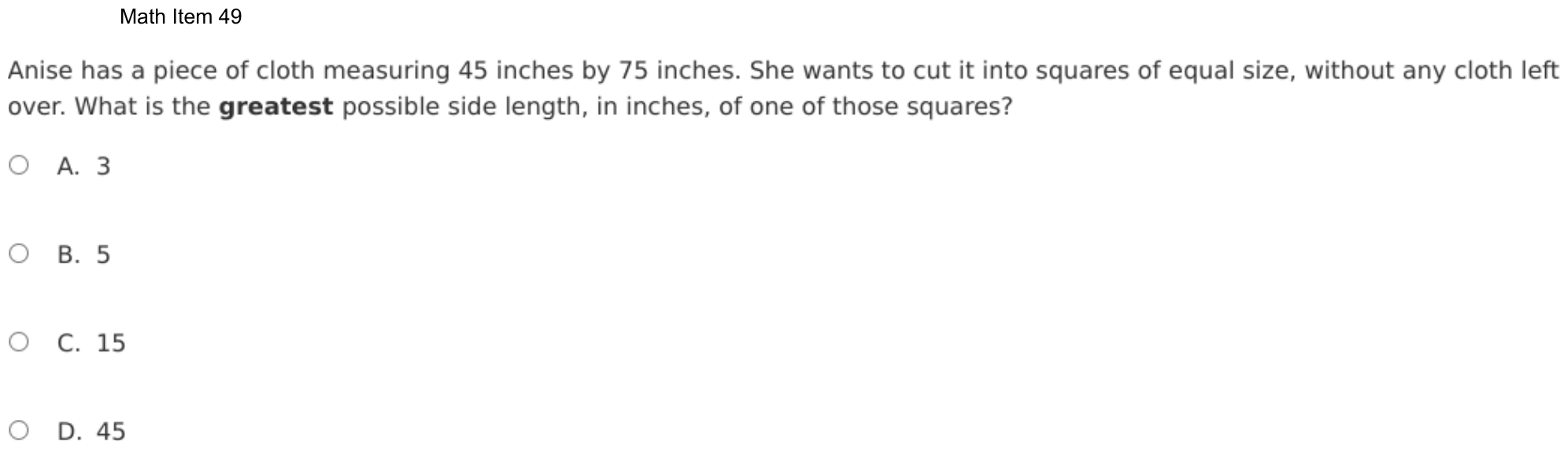
Question 98 of 120
2026 Practice Test D Math, question 50Question
This table shows the number of birds that came to a bird feeder on Monday and Tuesday.
BIRDS AT BIRD FEEDER
| Day | Number of Birds |
|---|---|
| Monday | 30 |
| Tuesday | 24 |
What was the percent decrease in the number of birds from Monday to Tuesday?
- A6%
- B20%
- C24%
- D25%
Show the answer
Correct answer: B
To determine the percent decrease from Monday to Tuesday, first calculate the decrease in the number of birds at the feeder.
The difference in the number of birds at the feeder divided by the number of birds on Monday will yield the percent decrease from Monday to Tuesday.
0.20 represents 20%.
There was a 20% decrease from Monday to Tuesday.
Question analysis
A table shows that 30 birds came to a bird feeder on Monday and 24 on Tuesday. This percent change question asks for the percent decrease from Monday to Tuesday. Students find the change and compare it with one day's count, and choosing the right day as the base decides the result.
- NYS standards
- 7.RP.3 multistep ratio and percent problems
- Grade level
- Grade 7 content, by NYS standard
- Compared with grade 7
- At grade 7 Percent decrease is core grade 7 work, and this is a plain example: one subtraction and one division with friendly numbers. The only real demand is measuring the change against the right day's count.
- Estimated difficulty
- Straightforward: two steps or one careful reading.
- Thinking it demands
- Depth of knowledge 2, skills and concepts · mainly apply
- What makes it hard
- Solution
- 2 steps
- Reading level
- Question and choices: about grade 3, 40 words.
- Students, last 30 days
- Not enough answers yet to show (it takes 10).
Why it is hard, traps and wrong answers (shows the answer)
Why it is hard
The subtraction is trivial, so the question is about the base. Both counts sit in the table, and dividing by the later one gives an equally neat percent that is easy to accept. Saying “a decrease from Monday” and putting Monday’s 30 under the change avoids it, and checking that 20% of 30 is 6 confirms the result.
A very close wrong answer minor Choosing the answer
Dividing the drop of 6 by Monday’s 30 gives 20% and by Tuesday’s 24 gives 25%, two round, listed percents only 5 points apart, so only the choice of base separates them. (Embretson & Wetzel, 1987; Gorin & Embretson, 2006; Ascalon et al., 2007)
Something you must already know minor Working it out
Students must know that a percent decrease is the change divided by the starting amount, here Monday’s count, a rule the question does not state. (Anderson & Krathwohl, 2001)
Strategy: Subtract to find how many fewer birds came on Tuesday, divide by Monday's count, the starting amount, and change the fraction to a percent.
Traps
- Percent of the wrong amount: Finding the whole from a part, or a percent change measured from the wrong starting amount.
- Misunderstands the concept: A wrong belief about a concept: that percents can be added, that area grows like length, that averages can be averaged, that a bigger denominator means a bigger fraction.
- Numbers taken from the question: Combines the numbers in the question without a model of the situation, or is simply a number that appears in the question.
The wrong answers, classified
A Misunderstands the concept (Smith, diSessa & Roschelle, 1993; De Bock et al., 1998; Ni & Zhou, 2005)
Finds the decrease of 6 birds and reads it as 6 percent, as if the count had dropped from 100 rather than from 30.
C Numbers taken from the question (Hegarty, Mayer & Monk, 1995)
Reads Tuesday’s 24 birds as a percent, taking a number straight from the table without working out the change at all.
D Percent of the wrong amount (Parker & Leinhardt, 1995)
Divides the decrease of 6 by Tuesday’s 24 birds instead of Monday’s 30, measuring the change from the later day: 6/24 = 25%.
Worked solution, step by step
Formulas used
- Percent decrease
- Old is the starting amount, here Monday’s count. New is the later amount, Tuesday’s count. The top is how much it dropped. You divide by the starting amount because a change is measured from where you started.
Sort out the question
The table shows 30 birds on Monday and 24 birds on Tuesday. You need the percent decrease from Monday to Tuesday. From Monday means Monday is the starting amount.
Find the drop
Subtract Tuesday’s count from Monday’s:
There were 6 fewer birds.
Watch out: 6 is a number of birds, not a percent. Calling it 6% leads to choice A.
Compare the drop with Monday
Use the formula. Divide the drop by Monday’s count, then multiply by 100:
The number of birds went down by 20%.
Watch out: dividing by Tuesday’s 24 gives , or 25%, choice D. Measure the change from the starting day. Choice C, 24%, just copies a number from the table.
So the answer is B, 20%.
Check your answer
Take 20% of Monday’s count: . Then , which is Tuesday’s count. The answer checks out.
More questions like this
The original DOE question
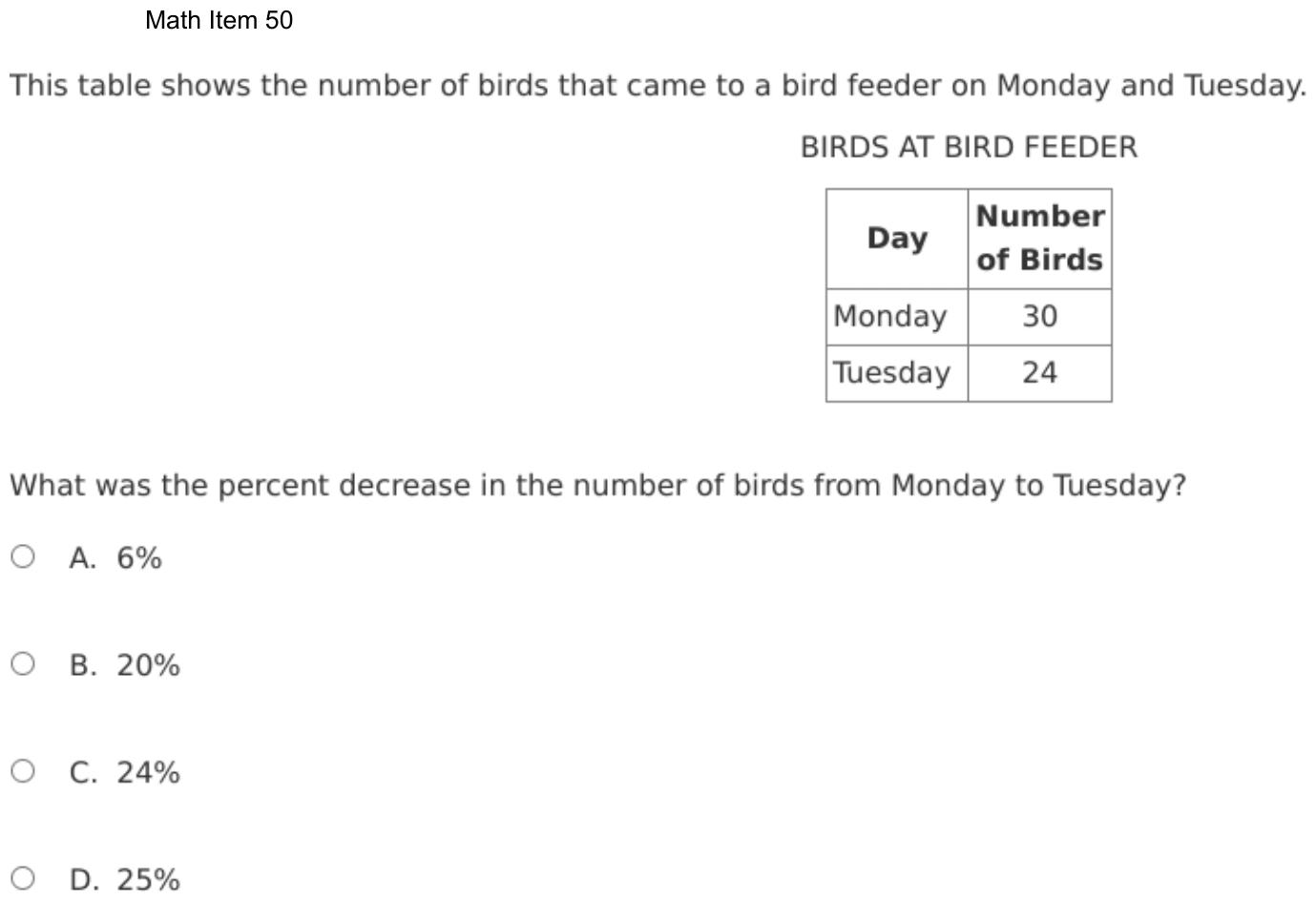
Question 99 of 120
2025 Practice Test A English, question 9Passage Excerpt from “Scribe Like an Egyptian”
Excerpt from “Scribe Like an Egyptian”
by Hilary Wilson
In ancient Egypt, literacy was the key to success. However, contrary to popular belief, not all Egyptian scribes understood hieroglyphs. Many relied instead on the simpler hieratic script for the multitude of everyday documents generated by the Egyptian bureaucracy.
Hieroglyphs—“the Words of God”—compose a writing system with more than 1,000 distinct characters, the meanings of which were lost for 1,500 years before they were deciphered by Jean-François Champollion in 1822. Including both ideograms (which convey a whole word or idea, either concrete or abstract, in a single sign) and phonograms (representing either an alphabetic sound or a group of consonants), [the writing system] was used in formal inscriptions on tomb and temple walls as well as on elaborate funerary papyri. For everyday purposes, however, scribes used a shorthand version of the hieroglyphic script known as hieratic, which was quicker to write and more economical of space. The two writings existed side by side for at least 2,500 years.
Scraps of ancient hieratic writing, mostly penned by student scribes on limestone flakes called ostraca, suggest that no matter how humble his origins, an educated Egyptian could achieve almost anything. Horemheb (d.1292 B.C.) is a good example. Born of middle-ranking parents, his scribal training led to an army career. From Scribe of Recruits, during the reign of Akhenaten (1353–1336 B.C.), Horemheb rose through the military ranks and, by the rule of Tutankhamun (1332–1323 B.C.), he was commander in chief of the Egyptian forces. As a close adviser of the young Pharaoh, Horemheb was appointed “Deputy of the King throughout the Two Lands,” and might have expected to succeed to the throne should the king die childless. He had to wait a few years, but eventually Horemheb achieved the pinnacle of his career by becoming the last king of the 18th Dynasty, making his mark by instituting dramatic reforms to the organisation of the army, the judiciary and administration in general. The lasting success of these changes owed much to his scribal background. . . .
But education was not available to all. Government departments and major temples supported schools, where boys commenced their training at six or seven, sometimes earlier. To these boarding establishments . . . family or household servants delivered the students’ food and drink rations daily for several years, during which time the student was not contributing to the family’s income. Boys from poorer families could only hope to be educated with support from a wealthier relative or patron, or through apprenticeship to an older scribe, perhaps the local clerk or land agent, who would teach them the basics of the scribe’s craft. This limited the scope for employment but such “on the job” training allowed apprentices to help out at home while learning. . . .
Scribal education began with the elementary principles of the hieratic script. The lowliest scribes, who trained for just five or six years, probably learned only the rudiments of the hieroglyphic script. Students were set exemplar documents and extracts from popular texts to copy, to practice their hieratic handwriting on basic-format letters, reports and contracts, while absorbing the good advice contained in the texts. Surviving examples of copy-work sometimes include tutors’ corrections added in red. Some significant Egyptian literary works survive almost exclusively from student copies.
A schoolboy “dictionary” of hieroglyphs with their hieratic equivalents shows that a knowledge of more than 450 signs was required for everyday writing purposes. Lessons in record-keeping and filing and labelling enabled any half-competent scribe to perform that most essential of all scribal functions: the making and updating of lists. For professions such as those of government official, priest or lawyer, a scribe would train for several more years, increasing his vocabulary to perhaps a thousand or more signs. Those with the best handwriting or drawing skills might follow the craft of creating beautifully illustrated copies of funerary texts, commonly called Books of the Dead. Others could become draughtsmen, artists or architects. Doctors compiled their own collections of medication recipes, treatments and associated incantations, many copied from texts found in the House of Life, the temple library. Lawyers had to be familiar with the corpus of civil and religious laws and precedents found in the official records, which were administered by archivists. Egypt’s bureaucratic society depended on the skills of an army of scribes of all ranks from filing clerk to tax assessor. For young Egyptians, “be a scribe” was the best of career advice.
From “Scribe Like an Egyptian” by Hilary Wilson from HISTORY TODAY, August 8, 2019. Copyright © 2019 by History Today Ltd. Company.
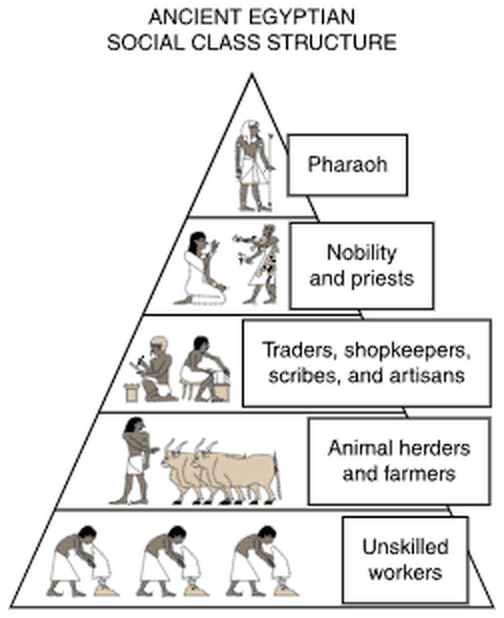
bureaucracy: an administrative staff of government officials
funerary papyri: a sheet or scroll of papyrus containing religious images and hieroglyphs meant to help the deceased be reborn in the afterlife
rudiments: basics
schoolboy: slang that refers to materials used during the course of receiving an education
draughtsmen: people who draw plans of machinery or structures
corpus: a collection of writings
Question
Which sentence from the excerpt best supports the idea that there were different levels of education for a scribe?
- A“However, contrary to popular belief, not all Egyptian scribes understood hieroglyphs.” (paragraph 1)
- B“For everyday purposes, however, scribes used a shorthand version of the hieroglyphic script known as hieratic, which was quicker to write and more economical of space.” (paragraph 2)
- C“This limited the scope for employment but such ‘on the job’ training allowed apprentices to help out at home while learning.” (paragraph 4)
- D“For professions such as those of government official, priest or lawyer, a scribe would train for several more years, increasing his vocabulary to perhaps a thousand or more signs.” (paragraph 6)
Show the answer
Correct answer: D
The question asks for a sentence from the excerpt that best supports the idea that different levels of education were available to scribes.
A. Incorrect. The sentence from paragraph 1 provides evidence that Egyptian scribes used two different forms of writing, but it does not address the topic of education or the different levels of education that were available to scribes.
B. Incorrect. The advantages and purposes of hieratic script are described in this sentence from paragraph 2, but this explanation of the advantages and purposes does not suggest that there were different levels of education for scribes.
C. Incorrect. The fact that scribes could learn their trade through apprenticeships as discussed in this sentence from paragraph 4 does provide evidence that another method of learning to be a scribe was possible, but this process was for a limited entry into becoming a scribe, not the continued education scribes would need in order to work in specific areas.
D. CORRECT. By explaining that certain professions required additional years of training, this sentence from paragraph 6 supports the idea that different levels of education existed for scribes.
Question analysis
This evidence question on Hilary Wilson’s “Scribe Like an Egyptian,” a magazine article about how ancient Egyptian scribes learned their trade, asks which quoted sentence best supports the idea that scribes received different levels of education. The four sentences come from paragraphs 1, 2, 4 and 6, and more than one seems to touch on the idea, so close reading of each decides it.
- Grade level
- Grade 8 reading and task
- Compared with grade 7
- Above grade 7 Choosing the sentence that best supports an idea is routine grade 7 evidence work. Here several quotations touch on ways scribes differed, and the article’s dense, technical wording makes those differences harder to sort than usual.
- Estimated difficulty
- Hard: combines ideas, needs a plan, and has more than one tempting wrong answer.
- Thinking it demands
- Depth of knowledge 3, strategic thinking · mainly evaluate
- What makes it hard
- Reading between the lines moderate
- Every choice must be checked moderate
- Hard words minor
- Evidence
- Answered from several paragraphs or stanzas
- Reading level
- Passage: about grade 12, 810 words; question and choices: about grade 13, 110 words.
- Students, last 30 days
- Not enough answers yet to show (it takes 10).
Why it is hard, traps and wrong answers (shows the answer)
Why it is hard
Two of the wrong sentences are not off topic: one says not all scribes understood hieroglyphs, the other that apprenticeship narrowed a scribe’s job prospects, and both imply that scribes differed. The question rewards asking what the idea actually claims, that schooling itself came in stages, and only the sentence about professions that required more years of training says so outright. Students who stop at the first sentence suggesting a difference lose the point.
Reading between the lines moderate Working it out
The right sentence never says “levels”; students must see that training “for several more years” for official, priest or lawyer posts means a higher tier of schooling than the basic course. (Graesser, Singer & Trabasso, 1994; Kintsch, 1998)
Every choice must be checked moderate Choosing the answer
Two other quotations also hint at differences among scribes, paragraph 1’s “not all Egyptian scribes understood hieroglyphs” and paragraph 4’s “limited the scope for employment,” so each must be weighed, not just scanned. (Embretson & Wetzel, 1987)
Hard words minor Understanding the question
Terms such as “hieratic,” “economical of space” and “scope for employment” slow the reading of the quotations, and the shorthand sentence is hard to dismiss until hieratic is understood as a script. (Perfetti, 2007; Freedle & Kostin, 1993)
Strategy: Ask what a sentence would have to say to prove that scribal education came in levels, then test each quotation against that and prefer a direct statement over a hint.
Traps
- Supports only part of the claim: In a question about evidence: a line that backs one half of the claim but not the other, or a related point rather than the claim itself.
- True but not the answer: A choice says something accurate about the text that does not answer this question.
The wrong answers, classified
A Supports only part of the claim (King et al., 2004; Thissen, Steinberg & Fitzpatrick, 1989)
Reads “not all Egyptian scribes understood hieroglyphs” as proof of different levels of schooling, but it reports a difference in knowledge without saying anything about how scribes were taught.
B True but not the answer (King et al., 2004; Embretson & Wetzel, 1987)
Picks the sentence on hieratic as a faster everyday shorthand, which describes how scribes wrote, not how long or how far any of them studied.
C Supports only part of the claim (King et al., 2004; Thissen, Steinberg & Fitzpatrick, 1989)
Sees that on-the-job training “limited the scope for employment” and takes it for a lower level of education, though the sentence contrasts two routes into the trade, not stages of study.
Working it out, step by step
Figure out what the question asks
This asks for the sentence that best supports one idea: scribes could get “different levels of education.” A level is a stage. Some scribes studied for a short time, and others went on to study more. You need a sentence that shows a difference in schooling, not just any difference between scribes.
Find what each level looked like
Paragraphs 5 and 6 describe the training. Paragraph 5 says the lowest scribes studied for only five or six years. They learned just the basics of hieroglyphs. Paragraph 6 says that more than 450 signs were needed for everyday writing. Then choice D adds a higher level: “For professions such as those of government official, priest or lawyer, a scribe would train for several more years, increasing his vocabulary to perhaps a thousand or more signs.”
Work out what choice D means
A profession is a job that needs special training. Choice D says some jobs needed more years of study and more signs, perhaps over a thousand. A basic scribe stopped sooner and knew fewer signs. So schooling came in stages: a basic course, and then more years for the top jobs. That is what the question means by levels of education.
Check each choice
- A does not fit. It says not all scribes understood hieroglyphs. That is a difference in what scribes knew. It says nothing about how they were taught.
- B does not fit. It explains hieratic, a faster shorthand way of writing. That is about writing, not schooling.
- C does not fit. It is about apprentices, who learned on the job from an older scribe. That is a different way into the work, not a higher or lower stage of study.
- D fits. Some jobs needed several more years of training.
Watch out: A is tempting because it shows that scribes were not all alike. But it never mentions school.
Choose the answer
Only one sentence shows some scribes studying for years after the basic course. So the answer is D.
Why this answer and not the closest wrong one
A is the closest wrong choice. It shows that some scribes knew hieroglyphs and others did not. But it doesn’t say why, or how long anyone studied. D says plainly that some jobs needed several more years of training. That is a level of education above the basic one.
More questions like this
The original DOE question
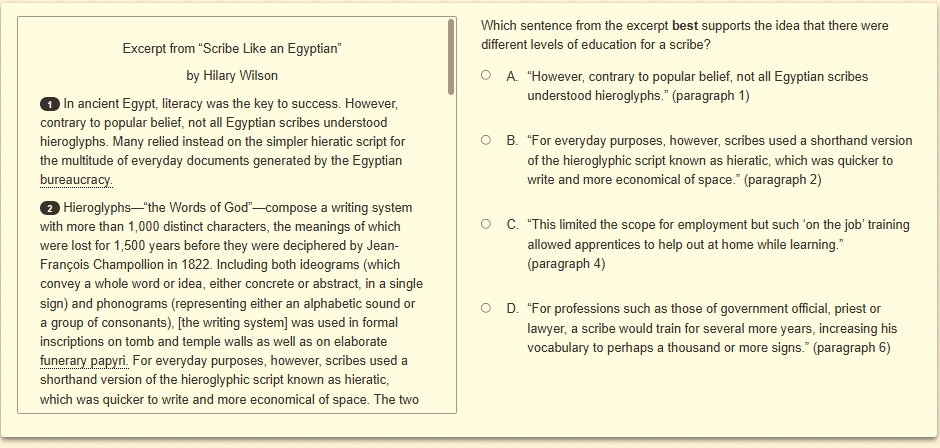
The passage “Excerpt from “Scribe Like an Egyptian”” as shown on the test
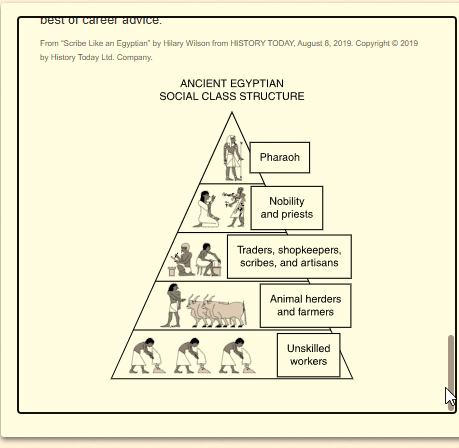
Question 100 of 120
2025 Practice Test A English, question 10Uses the passage above: “Excerpt from “Scribe Like an Egyptian””.
Question
Read this sentence from paragraph 2.
Including both ideograms (which convey a whole word or idea, either concrete or abstract, in a single sign) and phonograms (representing either an alphabetic sound or a group of consonants), [the writing system] was used in formal inscriptions on tomb and temple walls as well as on elaborate funerary papyri.
The author’s purpose for including the sentence is to
- Aexplain that hieroglyphs were reserved for royal and religious purposes.
- Bdemonstrate the methods experts use to interpret hieroglyphs.
- Cclarify the significance of hieroglyphs in language and literature.
- Ddescribe the basic features of hieroglyphs and how they were typically used.
Show the answer
Correct answer: D
The question asks for an explanation of the author’s purpose for including a sentence in paragraph 2 that describes the two types of hieroglyphs and the main uses of this particular writing system.
A. Incorrect. The sentence explains that hieroglyphs were used for formal inscriptions, but it does not suggest that these inscriptions were limited to royal and religious contexts.
B. Incorrect. The sentence describes the two basic types of hieroglyphs, ideograms and phonograms, but it does not address how experts interpret the ancient writing system. A sentence earlier in the paragraph explains that the hieroglyphs were deciphered by Champollion, but it does not explain how he deciphered them.
C. Incorrect. Although the sentence explains that the hieroglyphs were typically used for formal inscriptions, it does not provide an explanation of the significance or importance of hieroglyphs in the Egyptian language.
D. CORRECT. The sentence explains that hieroglyphs included both phonograms and ideograms that were used in formal inscriptions and funeral papyri; therefore, this sentence achieves the purpose of describing the basic features of hieroglyphs as conveying either words and ideas or sounds, in addition to explaining the common uses for the writing system.
Question analysis
This author’s-purpose question quotes a long, technical sentence from paragraph 2 of “Scribe Like an Egyptian” about the ancient Egyptian hieroglyphic writing system, and asks why the author includes it. Students must make sense of its specialist vocabulary before they can say what the sentence contributes to the paragraph and to the article.
- Grade level
- Grade 8 reading and task
- Compared with grade 7
- At grade 7 Explaining why an author includes a sentence is regular grade 7 work. This one is long, with definitions in parentheses and a bracketed insert, but it is quoted in full, so the task stays within one sentence.
- Estimated difficulty
- Straightforward: two steps or one careful reading.
- Thinking it demands
- Depth of knowledge 2, skills and concepts · mainly analyze
- What makes it hard
- Complex sentences moderate
- Hard words minor
- How, not what minor
- Evidence
- Answered from one sentence or line
- Reading level
- Passage: about grade 12, 810 words; question and choices: about grade 11, 103 words.
- Students, last 30 days
- Not enough answers yet to show (it takes 10).
Why it is hard, traps and wrong answers (shows the answer)
Why it is hard
Once the parentheses are set aside, the sentence says two simple things: what kinds of signs hieroglyphs were, and where they appeared. The wrong purposes each go one step beyond that, turning tombs and temples into an exclusive royal and religious use, borrowing Champollion’s deciphering from the sentence before, or claiming a significance the sentence never weighs. Students who untangle the syntax first find the matching purpose quickly.
Complex sentences moderate Understanding the question
The quoted sentence runs fifty words, two parenthetical definitions come before the verb, and its subject, the bracketed “[the writing system],” appears only after thirty words of description. (Abedi & Lord, 2001; Freedle & Kostin, 1993; Messick, 1989)
Hard words minor Understanding the question
“Ideograms,” “phonograms” and “funerary papyri” are specialist terms; the parentheses define the first two, but students who stall on them may not reach the sentence’s plain point about where the signs were used. (Perfetti, 2007; Freedle & Kostin, 1993)
How, not what minor Working it out
The stem asks why the author includes the sentence, so students must match the job it does in paragraph 2 to a purpose, and only one purpose stays within what the sentence actually covers. (Anderson & Krathwohl, 2001)
Strategy: Restate the quoted sentence in plain words, setting the parentheses aside at first, then choose the purpose that fits everything the sentence says and nothing more.
Traps
- Reads too much in: A reasonable-sounding conclusion that goes further than the text allows.
- Wrong part of the text: A choice is true of another paragraph, stanza or speaker than the one asked about.
- Wrong purpose or structure: Names a purpose, structure or effect that the part does not serve, or describes what a part says when the question asks what it does.
The wrong answers, classified
A Reads too much in (Graesser, Singer & Trabasso, 1994)
Reads “formal inscriptions on tomb and temple walls” and “funerary papyri” as royal and religious only, though the sentence names where hieroglyphs usually appeared, not a rule reserving them.
B Wrong part of the text (Kirsch & Mosenthal, 1990)
Remembers that Champollion deciphered the signs, which the sentence before reports, and takes this sentence for an account of how experts read them, though it never mentions interpreting.
C Wrong purpose or structure (Anderson & Krathwohl, 2001)
Chooses an important-sounding purpose, the significance of hieroglyphs in language and literature, though the sentence never says why the script mattered or mentions any literature.
Working it out, step by step
Figure out what the question asks
This asks why the author put this sentence in paragraph 2. In other words, what job does the sentence do? First work out what the sentence says. Then pick the purpose that matches all of it and adds nothing extra.
Untangle the long sentence
The sentence is long, so set the parentheses aside at first. The main part says the writing system “was used in formal inscriptions on tomb and temple walls as well as on elaborate funerary papyri.” An inscription is writing carved or painted on something. Funerary means having to do with burials. Papyri are scrolls made from papyrus, a kind of early paper.
Read the parentheses
Now add back the two kinds of signs. Ideograms “convey a whole word or idea” in one sign. Phonograms stand for “either an alphabetic sound or a group of consonants.” Consonants are letter sounds like b, t and m. So one kind of hieroglyph shows a meaning, and the other shows a sound.
Sum up the sentence’s job
Put the two parts together. The sentence tells what hieroglyphs were made of: signs for ideas and signs for sounds. It also tells where people usually used them: on tombs, temples and burial scrolls. So its job is to describe what hieroglyphs were like and how they were used.
Check each choice
- A does not fit. The sentence says where hieroglyphs usually appeared. It never says they were reserved, or kept only, for kings and religion.
- B does not fit. The sentence before it says Champollion figured out the signs. This sentence never says how experts read them.
- C does not fit. The sentence never says why hieroglyphs mattered, and it never mentions literature.
- D fits. It names both parts: the basic features and the usual uses.
Watch out: Tombs and temples sound royal and religious, so A tempts. But “used in” is not the same as “reserved for.”
Choose the answer
The sentence describes the two kinds of signs and where they were usually used. So the answer is D.
Why this answer and not the closest wrong one
A is the closest wrong choice. Tombs and temples do suggest kings and religion. But the sentence only lists where hieroglyphs were used. It never says they were kept for those uses alone. D matches everything the sentence says and adds nothing it doesn’t.
More questions like this
The original DOE question
Question 101 of 120
2025 Practice Test A English, question 11Uses the passage above: “Excerpt from “Scribe Like an Egyptian””.
Question
Which statement summarizes the process that schools used to train scribes?
- ABoys had to memorize around 450 hieratic signs. Once they had learned these, they were expected to copy literary texts that contained valuable lessons.
- BBoys spent at least five years learning hieratic signs, which they practiced by copying texts. During this period, they were also introduced to basic hieroglyphs.
- CBoys spent five or six years learning the basics of hieratic script. After this period, they could become apprentices and begin learning hieroglyphics.
- DBoys were taught two different scripts. They practiced both types by copying lists and eventually progressed to writing letters, reports, and contracts.
Show the answer
Correct answer: B
The question asks for the best summary of the process that schools used to train scribes.
A. Incorrect. This summary incorrectly explains that scribes were expected to learn 450 hieratic signs instead of 450 hieroglyphs along with their hieratic versions as explained in paragraph 6. In paragraph 5, the author explains that scribes copied texts as part of the process of learning the scripts rather than as practice after the signs had already been memorized.
B. CORRECT. Paragraph 5 explains that students began by learning hieratic script and studied for about five or six years by using “exemplar documents and extracts from popular texts to copy, to practice their hieratic handwriting.” The paragraph also explains that during this time, they learned only the basics of hieroglyphic script.
C. Incorrect. Although paragraph 5 does explain that the scribes spent five or six years learning hieratic script, it does not suggest that hieroglyphs were learned only during apprenticeships.
D. Incorrect. This summary correctly explains that scribes learned two types of scripts, but the second sentence of the summary is incorrect. In paragraph 5, the author explains that the students copied from exemplar texts, but the author clearly states that the purpose of this copy work was “to practice their hieratic handwriting” and does not suggest that the copy work was used to practice hieroglyphs. Paragraph 6 explains that scribes could make lists as part of their professional skills but does not suggest that copy work was used to help them learn this task. Paragraph 5 mentions letters, reports, and contracts as the formats students practiced on while copying, not as a later stage of their training.
Question analysis
This summary question on “Scribe Like an Egyptian” asks which statement sums up how ancient Egyptian schools trained young scribes. Each choice is a two-sentence summary that combines years of study, kinds of script and copying practice, so students must check every detail against what the article says about scribal education.
- Grade level
- Grade 8 reading and task
- Compared with grade 7
- Above grade 7 Summarizing a process is a grade 7 standard, but these four summaries are long, two-part and mostly accurate, and the details they mix up come from three different paragraphs, so judging them asks more than typical grade 7 work.
- Estimated difficulty
- Hard: combines ideas, needs a plan, and has more than one tempting wrong answer.
- Thinking it demands
- Depth of knowledge 2, skills and concepts · mainly understand
- What makes it hard
- A very close wrong answer moderate
- Evidence in several places moderate
- The right answer is reworded minor
- Evidence
- Answered from several paragraphs or stanzas
- Reading level
- Passage: about grade 12, 810 words; question and choices: about grade 7, 104 words.
- Corrected from the DOE handbook
- A detail in the explanation that misdescribes the excerpt was corrected.
- Students, last 30 days
- Not enough answers yet to show (it takes 10).
Why it is hard, traps and wrong answers (shows the answer)
Why it is hard
Every wrong summary opens with something true or nearly true, so a quick reading of first sentences cannot separate them. Most of the errors concern order: one makes copying follow memorizing, one turns apprenticeship into a later stage where hieroglyphs begin, and one makes the copied letters, reports and contracts a later step. Students who check the order of training against paragraph 5, not just the facts, find the only summary with nothing out of place.
A very close wrong answer moderate Choosing the answer
The apprenticeship summary repeats the right one’s opening, years of hieratic study, and parts from it on one phrase: hieroglyphs come “After this period” instead of “During this period.” (Embretson & Wetzel, 1987; Gorin & Embretson, 2006; Ascalon et al., 2007)
Evidence in several places moderate Working it out
The details sit in three paragraphs: the five or six years, the copying and the hieroglyph basics in paragraph 5, apprenticeship in paragraph 4, and the 450-sign dictionary and list-making in paragraph 6. (Kirsch & Mosenthal, 1990; Gorin & Embretson, 2006)
The right answer is reworded minor Choosing the answer
The right summary puts the text in new words, “at least five years” and “basic hieroglyphs,” while wrong ones repeat its own details: “five or six years,” the “450” signs, “letters, reports, and contracts.” (Freedle & Kostin, 1993; Kirsch & Mosenthal, 1990)
Strategy: Note what the article says students learned, for how long and by what method, then check both sentences of each summary against those notes; one wrong detail rules a summary out.
Traps
- Half right: One half of a two-part choice is right and the other is not.
- Twists what the text says: Uses the text's topic and ideas but changes what it says: who did it, how much, when, or why.
The wrong answers, classified
A Twists what the text says (King et al., 2004)
Takes paragraph 6’s 450 signs, hieroglyphs listed with their hieratic forms, as hieratic signs to memorize first, and makes copying come afterward, though copying was how students learned.
C Half right (King et al., 2004; Thissen, Steinberg & Fitzpatrick, 1989)
Gets the five or six years of hieratic right, then makes apprenticeship, the other route paragraph 4 offers poorer boys, a later stage where hieroglyphs are first taught.
D Half right (King et al., 2004; Thissen, Steinberg & Fitzpatrick, 1989)
Rightly says two scripts were taught, then claims students copied lists for both and only later wrote letters, reports and contracts, though paragraph 5 ties copying to hieratic and to those very formats.
What was corrected from the DOE handbook, and why
- Explanation: The DOE’s explanation of Option D ends: “Paragraph 6 explains that scribes could make lists and write letters as part of their professional skills but does not suggest that copy work was used to help them learn these tasks.” Paragraph 6 mentions the making and updating of lists, but not letters. Letters come up in paragraph 5, where students copy texts “to practice their hieratic handwriting” on basic-format letters, reports and contracts, so the excerpt does tie the copy work to letters. The site now says that paragraph 6 explains that scribes could make lists as part of their professional skills but does not suggest that copy work was used to help them learn this task, and that paragraph 5 mentions letters, reports, and contracts as the formats students practiced on while copying, not as a later stage of their training. Option D is still wrong, and the answer, B, is unchanged.
Working it out, step by step
Figure out what the question asks
This asks for the best summary of how schools trained scribes. A summary retells the main steps in a few words. Each choice has two sentences. Both must match the article, including the order of the steps. One wrong detail rules a choice out.
Find the training in paragraph 5
Paragraph 5 says training began with the basics of hieratic script. The lowest scribes studied for five or six years, and others studied longer. In that time they learned only the basics of hieroglyphs. Students were given “exemplar documents and extracts from popular texts to copy, to practice their hieratic handwriting.” Exemplar means model. Extracts are short pieces. So they learned by copying good examples.
Sort out paragraphs 4 and 6
Two other paragraphs hold details that look alike. Paragraph 4 describes apprenticeship. An apprentice learns on the job from a skilled worker. It was another way in for boys from poorer families, not a step after school. Paragraph 6 mentions a list of hieroglyphs with their hieratic forms. It says more than 450 signs were needed for everyday writing. It never says students memorized them before copying.
Check each choice
- A does not fit. The 450 signs were hieroglyphs paired with their hieratic forms. And copying was how students learned, not a step after memorizing.
- B fits. Students spent at least five years on hieratic, practiced by copying, and learned basic hieroglyphs along the way.
- C does not fit. Apprenticeship was a different route, not a later stage. Hieroglyphs were not saved for apprentices.
- D does not fit. The copying was to practice hieratic. Lists come up in paragraph 6 as a job skill, not as practice. Letters, reports and contracts were what students copied, not a later stage.
Choose the answer
Watch out: C starts out right, with five or six years of hieratic. Then it says hieroglyphs came “After this period” instead of during it. That one change makes it wrong.
Only B gets every detail and the order right. So the answer is B.
Why this answer and not the closest wrong one
C is the closest wrong choice. It gets the five or six years of hieratic right. But it says hieroglyphs came afterward, through apprenticeship. Paragraph 5 says students learned the basics of hieroglyphs during their schooling. Apprenticeship was a separate path for poorer boys. B says “During this period,” which matches.
More questions like this
The original DOE question
Question 102 of 120
2025 Practice Test A English, question 12Uses the passage above: “Excerpt from “Scribe Like an Egyptian””.
Question
Which claim is best supported by the information presented in paragraphs 3 and 4?
- AEducation was difficult for the common citizens of Egypt to obtain.
- BOnce students began studying to become scribes, their future held more possibilities.
- CIf someone wanted to become a scribe, support from outside sources such as the government or a temple was necessary.
- DBecoming a successful scribe required a student’s family to sacrifice time and money in order to ensure the best education.
Show the answer
Correct answer: B
The question asks for the claim that is best supported by the details in paragraphs 3 and 4.
A. Incorrect. While paragraph 4 does explain that boys from poorer families had more challenges in receiving an education, the paragraph also provides examples of obtaining a patron or getting an apprenticeship as ways that these aspiring scribes could attain an education. Furthermore, the details in paragraph 3 do not provide any support for the claim that “common citizens” had difficulty getting an education because that paragraph focuses on the example of one person who was able to become a king as a result of his background as a scribe.
B. CORRECT. In paragraph 3, the author provides an example of a person who used his skills as a scribe to rise through the ranks of society by describing the achievements of Horemheb to support the idea that “no matter how humble his origins, an educated Egyptian could achieve almost anything.” The author continues in paragraph 4 to explain that with the proper support, some young Egyptians could become educated, thereby opening more opportunities for themselves.
C. Incorrect. Paragraph 4 explains that schools were supported by the government and religious institutions, but it also explains that apprenticeships were a method of learning the craft of the scribe. As the paragraph indicates, boys could also be helped in their education by support from “a wealthier relative or patron.”
D. Incorrect. In paragraph 4, the author details the sacrifices that families made to keep their sons at the schools, while boys from poorer families could only hope for a patron or an apprenticeship. Paragraph 4 also explains that apprentices could help out at home while learning, so the sacrifice of time and money was not required of every family.
Question analysis
This inference question asks which claim is best supported by paragraphs 3 and 4 of “Scribe Like an Egyptian,” which tell the story of the scribe Horemheb and describe who could get a scribal education in ancient Egypt. Students must weigh each claim against both paragraphs together, and several claims echo a single sentence closely enough to look supported.
- Grade level
- Grade 8 reading and task
- Compared with grade 7
- Above grade 7 Choosing the claim a passage best supports is core grade 7 work. Here the claim must fit two paragraphs that do different jobs, one telling a single man’s story and one explaining access to schooling, and some choices fit only part of that.
- Estimated difficulty
- Hard: combines ideas, needs a plan, and has more than one tempting wrong answer.
- Thinking it demands
- Depth of knowledge 3, strategic thinking · mainly evaluate
- What makes it hard
- Evidence in several places moderate
- The right answer is reworded moderate
- Reading between the lines minor
- Evidence
- Answered from several paragraphs or stanzas
- Reading level
- Passage: about grade 12, 810 words; question and choices: about grade 10, 75 words.
- Corrected from the DOE handbook
- A misdescription of the passage in the explanation of one wrong answer was corrected.
- Students, last 30 days
- Not enough answers yet to show (it takes 10).
Why it is hard, traps and wrong answers (shows the answer)
Why it is hard
The trap is a claim that paragraph 4 seems to state almost word for word, which makes it feel safer than the right one. But the question asks for support from both paragraphs, and Horemheb’s story points the other way, toward what schooling made possible. The two other wrong claims harden paragraph 4’s details into rules, a necessary sponsor or a required family sacrifice, so words like “necessary” and “required” are the ones to test.
Evidence in several places moderate Working it out
The claim must fit two paragraphs that do different work: paragraph 3 follows Horemheb from army scribe to king, and paragraph 4 explains who could pay for schooling and what the alternatives were. (Kirsch & Mosenthal, 1990; Gorin & Embretson, 2006)
The right answer is reworded moderate Choosing the answer
The right claim restates paragraph 3’s “an educated Egyptian could achieve almost anything” in new words, while the most tempting wrong one nearly copies paragraph 4’s opening, “education was not available to all.” (Freedle & Kostin, 1993; Kirsch & Mosenthal, 1990)
Reading between the lines minor Working it out
Students must connect Horemheb’s rise with paragraph 4’s account of who got schooling to see that both paragraphs are about education opening doors, a link the author leaves implicit. (Graesser, Singer & Trabasso, 1994; Kintsch, 1998)
Strategy: Sum up paragraph 3 and paragraph 4 in a sentence each, then test every claim against both summaries, watching for words that make a claim stronger than the text.
Traps
- Too narrow: A single detail offered as the central idea or a summary, or a summary that keeps minor details and leaves out an essential part.
- Too broad or too strong: A choice overstates, generalizes, or uses absolute words the text does not support.
- Reads too much in: A reasonable-sounding conclusion that goes further than the text allows.
The wrong answers, classified
A Too narrow (King et al., 2004)
Rests on paragraph 4’s opening, “education was not available to all,” and ignores paragraph 3, whose Horemheb shows an educated man rising from modest origins to the throne.
C Too broad or too strong (King et al., 2004)
Makes the government and temple schools of paragraph 4 “necessary,” overlooking its other routes: help from “a wealthier relative or patron,” or apprenticeship to a working scribe.
D Reads too much in (Graesser, Singer & Trabasso, 1994)
Turns the rations and lost income that some families bore in paragraph 4 into a requirement for every successful scribe, and adds “the best education,” which the paragraph never mentions.
What was corrected from the DOE handbook, and why
- Explanation: The DOE’s explanation of D said paragraph 4 details sacrifices “necessary for some poorer families,” and that paragraph 3’s Horemheb, born of middle-ranking parents, shows the sacrifice was not required of all families. In paragraph 4 the rations and lost income are those of families whose sons were at the schools; poorer boys could only hope for a patron or an apprenticeship; and paragraph 3 says nothing about what Horemheb’s family gave up. The explanation now says so: D is wrong because apprentices could help out at home while learning, so not every family made the sacrifice.
Working it out, step by step
Figure out what the question asks
This asks which claim is best supported by paragraphs 3 and 4 together. A claim is a statement that someone says is true. The right claim must fit both paragraphs. Watch for strong words, like “necessary,” that go further than the text.
Sum up paragraph 3
Paragraph 3 tells about Horemheb. His parents were middle-ranking, not rich or powerful. His training as a scribe led to a job in the army. He rose to lead the army, then to serve the young king, and in the end he became king himself. The author uses him to show that “no matter how humble his origins, an educated Egyptian could achieve almost anything.” Humble origins means an ordinary family background.
Sum up paragraph 4
Paragraph 4 opens by saying that not everyone could get an education. Government offices and big temples ran schools. Families sent food and drink for years, while the boy earned nothing for them. Poorer boys could hope for help from “a wealthier relative or patron.” A patron is someone who pays for another person’s training. Or they could learn on the job from a working scribe. That path led to fewer jobs.
Put the two paragraphs together
Both paragraphs are about what schooling could do for a boy. Paragraph 3 shows a man rising all the way to king because he trained as a scribe. Paragraph 4 shows that, with the right support, boys could get that schooling. It even notes that the on-the-job path led to fewer jobs. So education opened doors. That is what choice B says.
Check each choice
- A does not fit. It matches only the start of paragraph 4. Paragraph 4 also gives ways in for poorer boys, and paragraph 3 shows a man from an ordinary family rising to the top.
- B fits. Both paragraphs show schooling leading to more possibilities.
- C does not fit. A government or temple school was not “necessary.” A relative, a patron or an apprenticeship could also work.
- D does not fit. Apprentices could help out at home while they learned, so not every family gave up time and money. And the paragraphs never mention “the best education.”
Choose the answer
The claim that fits both paragraphs is that schooling gave a boy more possibilities. So the answer is B.
Why this answer and not the closest wrong one
A is the closest wrong choice, because paragraph 4 begins by saying not everyone could get an education. But the question asks about paragraphs 3 and 4. Paragraph 3 tells of a scribe from an ordinary family who became king. Paragraph 4 shows ways around the cost. Both point to what education made possible, which is B.
More questions like this
The original DOE question
Question 103 of 120
2025 Practice Test A English, question 13Uses the passage above: “Excerpt from “Scribe Like an Egyptian””.
Question
Hieratic script was particularly valuable in a bureaucratic government because
- Ausing hieratic script was an efficient way for scribes to produce large amounts of documentation.
- Bmany members of the general public could comprehend information that was written in hieratic script.
- Cknowledge of hieratic script prepared scribes to serve their society in increasingly challenging roles.
- Dpeople from different professional backgrounds could easily communicate with one another in hieratic script.
Show the answer
Correct answer: A
The question asks why hieratic script was especially valuable in a bureaucratic government.
A. CORRECT. Hieratic script is described in paragraph 1 as being simpler for the “multitude of everyday documents” generated by the government and as “quicker to write and more economical of space” in paragraph 2. The logical conclusion based on these details is that hieratic script was more efficient for the large amounts of documentation produced by the government.
B. Incorrect. In paragraph 4, the author explains that “education was not available to all,” suggesting that only people who were educated could read and write. The excerpt as a whole does not provide sufficient information to indicate what portion of the general public would be able to comprehend material written in hieratic script.
C. Incorrect. The idea that becoming a scribe could lead to taking different positions in society is addressed in paragraphs 3, 4, and 6. However, the use of hieratic script in the fields of medicine, law, or religion does not necessarily explain the value of the script for the bureaucratic government referenced in the question.
D. Incorrect. Although different professions such as doctors and lawyers used hieratic script, the author uses these professions as examples of different job opportunities for scribes in paragraph 6. There is no discussion in the excerpt about different professions communicating with each other, and these professions were not necessarily part of the bureaucratic government.
Question analysis
This inference question on “Scribe Like an Egyptian” asks why hieratic, one of the two scripts of ancient Egypt, was especially valuable to a bureaucratic government. The article never gives the reason in a single sentence, so students must connect what it says about Egypt’s bureaucracy with what it says about the script itself. Each choice offers a reasonable-sounding benefit.
- Grade level
- Grade 7 reading and task
- Compared with grade 7
- At grade 7 Drawing a conclusion from two neighboring paragraphs is typical grade 7 inference work. The word “bureaucratic” and the article’s formal style add some load, but the details needed are close together and plainly stated.
- Estimated difficulty
- Straightforward: two steps or one careful reading.
- Thinking it demands
- Depth of knowledge 2, skills and concepts · mainly understand
- What makes it hard
- Evidence in several places minor
- Hard words minor
- Reading between the lines minor
- Evidence
- Answered from several paragraphs or stanzas
- Reading level
- Passage: about grade 12, 810 words; question and choices: about grade 13, 68 words.
- Students, last 30 days
- Not enough answers yet to show (it takes 10).
Why it is hard, traps and wrong answers (shows the answer)
Why it is hard
The two facts that answer the question sit a few lines apart in the first two paragraphs, so the work is mostly connecting them. The wrong reasons all sound like advantages a simpler script might bring, public readability, career preparation, communication across professions, and each rests on a guess or on the excerpt’s talk of scribal careers rather than on what it says hieratic was used for. Students who return to the description of hieratic itself avoid them.
Evidence in several places minor Working it out
The reason is split between paragraph 1, where hieratic serves the “multitude of everyday documents,” and paragraph 2, where it is “quicker to write and more economical of space.” (Kirsch & Mosenthal, 1990; Gorin & Embretson, 2006)
Hard words minor Understanding the question
The stem turns on “bureaucratic,” a word students must connect to a government that runs on paperwork; without it, the link to large amounts of documentation is hard to see. (Perfetti, 2007; Freedle & Kostin, 1993)
Reading between the lines minor Working it out
No sentence says why hieratic helped the government; students must combine speed and compactness with the sheer volume of records to reach efficiency. (Graesser, Singer & Trabasso, 1994; Kintsch, 1998)
Strategy: Find the sentences that describe hieratic script and what it was used for, then pick the choice those sentences support rather than one that only sounds like an advantage.
Traps
- Reads too much in: A reasonable-sounding conclusion that goes further than the text allows.
- True but not the answer: A choice says something accurate about the text that does not answer this question.
- Outside knowledge: A choice is plausible in the real world but not supported by this text.
The wrong answers, classified
B Reads too much in (Graesser, Singer & Trabasso, 1994)
Reasons that a simpler script must have been readable by ordinary people, though paragraph 4 says “education was not available to all” and the excerpt never says the public read hieratic.
C True but not the answer (King et al., 2004; Embretson & Wetzel, 1987)
Recalls the careers in paragraphs 3 and 6 that schooling opened to scribes, which is true of the excerpt but explains a scribe’s prospects, not why the government valued hieratic.
D Outside knowledge (King et al., 2004; Recht & Leslie, 1988)
Imagines hieratic as a shared language linking doctors, lawyers and officials, a sensible-sounding benefit the excerpt never raises; paragraph 6 names those professions only as careers for scribes.
Working it out, step by step
Figure out what the question asks
This asks why hieratic script was so useful to a bureaucratic government. A bureaucracy is a government run by many officials, with lots of paperwork. Hieratic is the quick, simple form of Egyptian writing. Look for what the article says about hieratic and what it was used for.
Find the evidence in paragraphs 1 and 2
Paragraph 1 says many scribes used hieratic for the “multitude of everyday documents” that the government produced. Multitude means a huge number. Paragraph 2 says hieratic was “quicker to write and more economical of space.” Economical of space means it took up less room on the page.
Connect the two facts
Put the facts together. The government made a huge number of papers. Hieratic was fast to write and used less space. So scribes could turn out lots of papers quickly. Getting a lot done with little time and effort is called being efficient.
Check each choice
- A fits. Hieratic let scribes make large amounts of paperwork quickly.
- B does not fit. Paragraph 4 says “education was not available to all.” The article never says ordinary people could read hieratic.
- C does not fit. Training did lead to careers, but that explains a scribe’s chances, not why the government valued the script.
- D does not fit. Paragraph 6 lists jobs like doctor and lawyer as careers for scribes. It never says those workers wrote to each other in hieratic.
Watch out: B sounds sensible, since a simpler script seems easier for anyone to read. But that is a guess, not something the article says.
Choose the answer
Hieratic was fast and compact, and the government needed a huge number of documents. So the answer is A.
Why this answer and not the closest wrong one
B is the closest wrong choice, because a simpler script does sound easier to read. But the article says only some Egyptians got an education. It never says the public could read hieratic. A rests on two facts the article states: the government made a “multitude of everyday documents,” and hieratic was quicker to write.
More questions like this
The original DOE question
Question 104 of 120
2025 Practice Test A English, question 14Uses the passage above: “Excerpt from “Scribe Like an Egyptian””.
Question
The diagram after paragraph 6 best provides additional support for the topic of the excerpt by
- Ademonstrating the place of scribes in ancient Egyptian social structure.
- Bdepicting the types of tasks performed by each social class.
- Cindicating that scribes were able to easily improve their social ranking.
- Dcomparing the social positions of each social class in ancient Egypt.
Show the answer
Correct answer: A
The question asks how the diagram of ancient Egyptian class structure supports the topic of the excerpt.
A. CORRECT. The focus of the excerpt is the opportunities available to scribes in different professions and how people became scribes and therefore improved their position. By illustrating the position of the scribes in the class structure of ancient Egypt, the diagram supports the idea that scribes were valuable members of society.
B. Incorrect. The professions of the different social classes are shown in the diagram, but it does not address specific tasks. Furthermore, the main topic of the excerpt is the role of the scribes in society rather than the tasks performed by the different social classes.
C. Incorrect. While the diagram does show the position of scribes in the social hierarchy, it does not provide an illustration of movement between the different classes or rankings, so the diagram does not support the idea that scribes were able to improve their social standing.
D. Incorrect. The diagram shows the class structure as hierarchical and can support readers’ efforts to compare the different social positions. However, the role of scribes in society, rather than a general comparison of different classes, is the main focus of the excerpt.
Question analysis
This question on “Scribe Like an Egyptian” asks how the diagram after paragraph 6, a pyramid of ancient Egyptian social classes from the pharaoh at the top to unskilled workers at the base, gives additional support to the excerpt’s topic. Students must decide what the excerpt is mainly about and then judge what the graphic adds, and several choices describe something the pyramid really shows.
- Grade level
- Grade 7 reading and task
- Compared with grade 7
- At grade 7 Linking a graphic to a text is regular grade 7 work, and this five-level pyramid is simple and clearly labeled. The demand lies in naming the excerpt’s topic first and judging how the diagram bears on it.
- Estimated difficulty
- Moderate: several steps, or a close reading with one strong distractor.
- Thinking it demands
- Depth of knowledge 2, skills and concepts · mainly analyze
- What makes it hard
- A very close wrong answer moderate
- Reading a figure, table or graph moderate
- How, not what minor
- Evidence
- Answered from the whole text
- Reading level
- Passage: about grade 12, 810 words; question and choices: about grade 9, 57 words.
- Students, last 30 days
- Not enough answers yet to show (it takes 10).
Why it is hard, traps and wrong answers (shows the answer)
Why it is hard
More than one choice is true of the pyramid, so the question is decided by the excerpt’s topic, not by the picture alone. Students who look only at the diagram see a ranking of all the classes; students who remember that the article is about scribes look for where scribes stand. The choice about rising easily borrows Horemheb’s story from the text and credits it to a drawing that shows no movement.
A very close wrong answer moderate Choosing the answer
The choice about comparing every class’s position differs from the right one in a single detail, all classes rather than scribes, and both are true of the pyramid. (Embretson & Wetzel, 1987; Gorin & Embretson, 2006; Ascalon et al., 2007)
Reading a figure, table or graph moderate Understanding the question
Scribes are not a tier of their own: they share the third of five tiers with merchants and craftsmen, below the pharaoh, nobles and priests and above farmers, herders and laborers. (Lesh, Post & Behr, 1987; Kirsch & Mosenthal, 1990)
How, not what minor Working it out
The stem asks how the diagram supports the excerpt’s topic, so students must first decide the topic is scribes, then judge what the picture adds to it. (Anderson & Krathwohl, 2001)
Strategy: State the excerpt’s topic in a few words, then test each choice twice: is it true of the diagram, and does it connect the diagram to that topic?
Traps
- True but not the answer: A choice says something accurate about the text that does not answer this question.
- Wrong part of the text: A choice is true of another paragraph, stanza or speaker than the one asked about.
- Wrong purpose or structure: Names a purpose, structure or effect that the part does not serve, or describes what a part says when the question asks what it does.
The wrong answers, classified
B Wrong purpose or structure (Anderson & Krathwohl, 2001)
Notices the small figures at work, such as the herders with their cattle, and takes tasks as the diagram’s point, though its labels name classes and the excerpt is about scribes.
C Wrong part of the text (Kirsch & Mosenthal, 1990)
Carries Horemheb’s rise from scribe to king in paragraph 3 over to the diagram, which shows fixed tiers with no arrows or movement, and nothing about rising easily.
D True but not the answer (King et al., 2004; Embretson & Wetzel, 1987)
Describes what the pyramid plainly does, rank all five classes against one another, which is accurate but misses why the diagram belongs with an excerpt about scribes.
Working it out, step by step
Figure out what the question asks
This asks how the diagram after paragraph 6 adds to the topic of the excerpt. First name the topic. Then ask two things about each choice. Is it true of the diagram? And does it connect the diagram to that topic?
Name the excerpt’s topic
The excerpt is about scribes, people trained to read and write for others. It tells how they learned, who could study, and what jobs they could get. Every paragraph comes back to scribes. So the diagram should add something about scribes.
Read the diagram
The diagram is a pyramid with five levels. From the top down, they are the Pharaoh, nobles and priests, then “Traders, shopkeepers, scribes, and artisans,” then herders and farmers, and last unskilled workers. Artisans are skilled craftspeople. Scribes sit in the third level, the middle one. They are below the ruler and the nobles, and above farmers and workers.
Check each choice
- A fits. The diagram shows where scribes stood in Egyptian society, which ties it to the topic.
- B does not fit. The labels name groups of people, not the tasks each group did.
- C does not fit. The levels are fixed, and nothing in the diagram shows anyone moving up. Horemheb’s rise comes from paragraph 3, not the diagram.
- D does not fit. The pyramid does rank all the classes. But that alone does not connect it to an excerpt about scribes.
Watch out: More than one choice is true of the picture. The right one must also fit the topic.
Choose the answer
The diagram supports the topic by showing where scribes fit among the classes of ancient Egypt. So the answer is A.
Why this answer and not the closest wrong one
D is the closest wrong choice, because the pyramid really does compare every class. But the excerpt is about scribes, not about every class. A is true of the diagram too, and it also links the diagram to the topic. It points to the place of scribes in the middle level.
More questions like this
The original DOE question
Question 105 of 120
2025 Practice Test A English, question 15Uses the passage above: “Excerpt from “Scribe Like an Egyptian””.
Question
Based on the excerpt, which statement would the author most strongly agree with?
- ABoys in Egypt were encouraged to enter the same profession as older male relatives.
- BKnowledge of hieroglyphs was helpful to Egyptians who were interested in becoming scribes.
- CHieratic script was more practical to ancient Egyptians than hieroglyphs were.
- DBoys in Egypt who studied for only a few years were unlikely to find employment as scribes.
Show the answer
Correct answer: C
The question asks for a statement with which the author would most strongly agree.
A. Incorrect. The author only addresses boys who entered the profession of scribes. While the author does address the role of the family in supporting a boy’s education or securing an apprenticeship, the author does not provide any discussion to support the idea that boys were only encouraged to follow the professions of their male relatives.
B. Incorrect. The author explains that communication using hieroglyphs was not widely practiced in everyday correspondence and that hieratic script was the more popular form of writing. While being able to read and use hieroglyphs would have been helpful, it was not common for citizens to use this formal form of communication. In addition, scribes were trained to learn hieroglyphs and hieratic script as part of their education, so prior ability to read or compose hieroglyphs was not a requirement.
C. CORRECT. As described in paragraph 2, hieratic script was more efficient and economical than hieroglyphs. Because this script was used for “everyday purposes,” it was the more practical of the scripts as hieroglyphs were reserved for “formal inscriptions.”
D. Incorrect. In paragraph 6, the author indicates that “any half-competent scribe” could become employed in making and updating lists. While the paragraph later indicates that scribes would need to study several more years to be employed in a wider range of professions, there is no indication that employment as a scribe would be unavailable to a boy who studied for only a few years.
Question analysis
This point-of-view question asks which statement the author of “Scribe Like an Egyptian” would most strongly agree with. The four statements deal with family careers, knowledge of hieroglyphs, Egypt’s two scripts and the length of training, so students must test each one against the article and separate what the author says from what merely sounds likely.
- Grade level
- Grade 8 reading and task
- Compared with grade 7
- At grade 7 Inferring which statement an author would accept is typical grade 7 work. The four statements draw on different parts of a dense article, and some sound sensible without being backed by it, so each must be checked carefully.
- Estimated difficulty
- Moderate: several steps, or a close reading with one strong distractor.
- Thinking it demands
- Depth of knowledge 2, skills and concepts · mainly analyze
- What makes it hard
- Every choice must be checked moderate
- Reading between the lines moderate
- Evidence
- Answered from several paragraphs or stanzas
- Reading level
- Passage: about grade 12, 810 words; question and choices: about grade 9, 68 words.
- Students, last 30 days
- Not enough answers yet to show (it takes 10).
Why it is hard, traps and wrong answers (shows the answer)
Why it is hard
The right statement is a comparison the author never makes in so many words, while the statement about hieroglyphs sounds like something any author on scribes would accept. The question rewards asking which statement the excerpt itself backs most firmly, and paragraph 2’s contrast between everyday and formal writing does that directly. The two statements about boys rest on assumptions, sons following relatives and short training leaving boys jobless, that the excerpt never makes and partly contradicts.
Every choice must be checked moderate Choosing the answer
The four statements cover four topics, family careers, hieroglyphs, the two scripts and length of training, so each has to be traced to its own paragraph before they can be compared. (Embretson & Wetzel, 1987)
Reading between the lines moderate Working it out
The author never ranks the scripts; “more practical” has to be drawn from paragraph 2, where hieratic is for “everyday purposes” and quicker to write, while hieroglyphs go on “formal inscriptions.” (Graesser, Singer & Trabasso, 1994; Kintsch, 1998)
Strategy: For each statement, find the paragraph that deals with its topic and decide whether the author says it, implies it or never addresses it; keep the one with the firmest support.
Traps
- Reads too much in: A reasonable-sounding conclusion that goes further than the text allows.
- Twists what the text says: Uses the text's topic and ideas but changes what it says: who did it, how much, when, or why.
- Outside knowledge: A choice is plausible in the real world but not supported by this text.
The wrong answers, classified
A Outside knowledge (King et al., 2004; Recht & Leslie, 1988)
Applies the familiar idea that sons follow their fathers’ trades, perhaps prompted by paragraph 4’s “wealthier relative,” though the excerpt never says boys were steered toward relatives’ professions.
B Twists what the text says (King et al., 2004)
Builds on paragraph 6, where more signs led to better posts, but shifts the benefit to the time before training, though boys learned the signs at school starting at six or seven.
D Reads too much in (Graesser, Singer & Trabasso, 1994)
Infers from paragraph 6’s extra years for officials, priests and lawyers that short training meant no job, though “any half-competent scribe” could keep lists and the least-trained scribes studied only five or six years.
Working it out, step by step
Figure out what the question asks
This asks which statement the author would most strongly agree with. The author may not say it in the same words, but the excerpt must clearly back it. The four choices cover four topics, so find the paragraph for each one.
Find what the author says about the scripts
Paragraph 1 says many scribes used the simpler hieratic script for everyday papers. Paragraph 2 says hieroglyphs went on “formal inscriptions,” such as tomb and temple walls. Hieratic was used for “everyday purposes.” It was faster to write and took less space. Formal means used for special, serious occasions.
Work out what that means
Practical means useful for real, everyday needs. The author shows hieratic doing the daily work, such as letters, reports and contracts. Hieroglyphs were kept for special uses. So the author would agree that hieratic was more practical than hieroglyphs. The author never uses the words “more practical,” but the facts point there.
Check each choice
- A does not fit. The excerpt never says boys were pushed into a relative’s job.
- B does not fit. Boys learned the signs at school, starting at six or seven. The excerpt never says knowing hieroglyphs beforehand helped. Paragraph 1 even says not all scribes understood them.
- C fits. Hieratic was quicker, smaller and used for everyday work.
- D does not fit. Paragraph 6 says “any half-competent scribe” could keep lists. Half-competent means only partly skilled. The lowest scribes studied only five or six years and still worked.
Watch out: B sounds like something any author would accept. But the excerpt does not back it.
Choose the answer
The excerpt shows hieratic doing the everyday work, faster and in less space. So the answer is C.
Why this answer and not the closest wrong one
B is the closest wrong choice. Knowing hieroglyphs sounds helpful for a future scribe. But boys learned their signs at school, and paragraph 1 says not all scribes understood hieroglyphs at all. C rests on paragraph 2, where hieratic is quicker to write and used for “everyday purposes.”
More questions like this
The original DOE question
Question 106 of 120
2025 Practice Test A English, question 55Question
Which revision corrects the error in sentence structure in the paragraph?
The land on Earth has not always been separated into the seven continents, at one time a massive supercontinent, known as Pangaea, covered one-third of Earth’s surface. Additionally, the supercontinent was surrounded by ocean waters called Panthalassa, much of which were in Earth’s Southern Hemisphere. Geologists believe that the supercontinent split apart over millions of years because of the movement of the tectonic plates that form Earth’s crust. In fact, experts predict that over the next 250 million years the movement of the plates will cause the seven continents to merge into a supercontinent again.
- Acontinents. At
- Bsurface; additionally,
- CPanthalassa. Much
- Dcrust, in fact,
Show the answer
Correct answer: A
The question asks for the revision that corrects the error in sentence structure in the paragraph.
A. CORRECT. The first sentence of the paragraph is a run-on because both clauses—“The land on Earth has not always been separated into the seven continents” and “at one time a massive supercontinent, known as Pangaea, covered one-third of Earth’s surface”—are independent clauses. Independent clauses are complete sentences, and two complete sentences should not be combined with just a comma. The revision is correct because it separates the two sentences by placing a period where it is needed after “continents” and by capitalizing the word “At.”
B. Incorrect. While adding a semicolon after “surface” can be considered a correct way to separate the independent clauses “at one time a massive supercontinent, known as Pangaea, covered one-third of Earth’s surface” and “Additionally, the supercontinent was surrounded by ocean waters called Panthalassa, much of which were in Earth’s Southern Hemisphere,” this change does not address the sentence structure error in the paragraph (the run-on sentence). The use of a period separating the independent clauses (complete sentences) is correct as is.
C. Incorrect. Adding a period after “Panthalassa” would separate the dependent clause “much of which were in Earth’s Southern Hemisphere” from its antecedent: “ocean waters called Panthalassa.” The dependent clause cannot stand on its own, because it shares elements with the main clause. A dependent clause is not a complete sentence and must be joined with an independent clause. The clause beginning with “much of which” is an adjective clause that modifies “ocean waters.” Changing the comma to a period creates a new error (a sentence fragment) and does not address the existing sentence structure error at the beginning of the paragraph (the run-on sentence).
D. Incorrect. Removing the period after “crust” would create a run-on sentence because the period is needed to separate two complete sentences—“Geologists believe that the supercontinent split apart over millions of years because of the movement of the tectonic plates that form Earth’s crust” and “In fact, experts predict that over the next 250 million years the movement of the plates will cause the seven continents to merge into a supercontinent again.” A comma after “crust” would combine these sentences into a run-on, creating a new error in the sentence without fixing the existing sentence structure error (the run-on sentence) at the beginning of the paragraph.
Question analysis
This editing question shows a short paragraph about Pangaea, the supercontinent that once covered a third of Earth’s surface, and the ocean around it, with four underlined spots, and asks which revision corrects the error in sentence structure. Each revision changes only punctuation and capitals at one spot, so the decision rests on how the clauses around each spot fit together.
- Grade level
- Grade 6 reading and task
- Compared with grade 7
- Below grade 7 Fixing run-ons and fragments is taught well before grade 7, and this item tests that basic skill in one short paragraph. The sentences are long, with an appositive and a clause beginning “much of which,” but the grammar involved stays simple.
- Estimated difficulty
- Straightforward: two steps or one careful reading.
- Thinking it demands
- Depth of knowledge 2, skills and concepts · mainly apply
- What makes it hard
- A rule that doesn't sound wrong moderate
- Every choice must be checked minor
- Complex sentences minor
- Evidence
- Answered from one paragraph or stanza
- Reading level
- Question and choices: about grade 9, 114 words.
- Corrected from the DOE handbook
- Two grammar terms in the explanation were corrected.
- Students, last 30 days
- Not enough answers yet to show (it takes 10).
Why it is hard, traps and wrong answers (shows the answer)
Why it is hard
The error is in the first sentence, but it hides behind a comma that sounds like an ordinary pause, while the later spots carry features that look riskier: a transition word, a clause beginning “much of which,” the phrase “in fact.” Students who test each spot for a complete sentence on both sides find the splice at once. Those who look for a revision that merely sounds polished are drawn to the semicolon, which is correct but fixes nothing.
A rule that doesn't sound wrong moderate Working it out
The comma after “continents” joins two complete sentences, and because “at one time” sounds like an introductory phrase continuing the thought, the splice reads as a natural pause. (Connors & Lunsford, 1988)
Every choice must be checked minor Choosing the answer
Each revision changes only punctuation at one underlined spot, and the semicolon one is correct English, so students must ask whether each spot was wrong to begin with, not only whether the change looks right. (Embretson & Wetzel, 1987)
Complex sentences minor Understanding the question
The paragraph’s sentences are long, with the appositive “known as Pangaea” and the clause “much of which were,” whose odd-sounding verb draws suspicion to a spot that is correctly punctuated. (Abedi & Lord, 2001; Freedle & Kostin, 1993; Messick, 1989)
Strategy: At each underlined spot, read the words on both sides and ask whether each side could stand as a sentence, then pick the revision that leaves every sentence correctly joined or separated.
Traps
- Fixes what isn't broken: Changes a part of the sentence that was already correct, while the real error stays; or, where the question asks which sentence has an error or should go, picks one that is correct and belongs.
- Fragment or run-on: Creates or keeps a sentence fragment, a run-on sentence or a comma splice.
The wrong answers, classified
B Fixes what isn't broken (Connors & Lunsford, 1988)
Knows a semicolon can join two clauses before “additionally” and picks that tidy-looking change, though the period it replaces was already correct and the comma splice up front remains.
C Fragment or run-on (Connors & Lunsford, 1988)
Treats the long second sentence as a run-on and splits it after “Panthalassa,” leaving “Much of which were in Earth’s Southern Hemisphere” as a fragment with no main clause.
D Fragment or run-on (Connors & Lunsford, 1988)
Thinks “in fact” belongs inside the sentence before it, set off by commas, which joins two complete sentences with only a comma and creates the error the paragraph already has.
What was corrected from the DOE handbook, and why
- Explanation: The DOE’s explanation of Option C says a period after “Panthalassa” would separate the dependent clause “much of which were in Earth’s Southern Hemisphere” “from its subject: ‘ocean waters called Panthalassa.’” The clause has a subject of its own, “much”; “ocean waters called Panthalassa” is its antecedent, the noun phrase that “which” refers to. The explanation also calls the clause “an adjective for ‘ocean waters’”; a clause is not an adjective but an adjective (relative) clause, which modifies the noun. The site now says “from its antecedent” and “an adjective clause that modifies ‘ocean waters.’” The reasoning and the answer, A, are unchanged.
Working it out, step by step
Learn the rule for joining sentences
An independent clause is a group of words with a subject and a verb that can stand alone as a sentence. Two of them can’t be joined with only a comma. That mistake is a run-on sentence, also called a comma splice. For example: I love soccer, my brother loves chess. Fix it with a period: I love soccer. My brother loves chess.
Test each underlined spot
At each spot, read the words on both sides. Ask: could each side stand alone as a sentence?
- After “continents”: both sides are complete. A comma joins them, so this is an error.
- After “surface”: a period already separates two sentences. That is correct.
- After “Panthalassa”: the words after the comma can’t stand alone. The comma is correct.
- After “crust”: a period already separates two sentences. That is correct.
Look closely at the first sentence
The first part says “The land on Earth has not always been separated into the seven continents.” That is a full sentence. The second part says “at one time a massive supercontinent, known as Pangaea, covered one-third of Earth’s surface.” Its subject is “supercontinent,” and its verb is “covered.” So it is a full sentence too. The words “At one time” start a new sentence.
Show the fix
Change the comma to a period, and capitalize the next word: The land on Earth has not always been separated into the seven continents. At one time a massive supercontinent, known as Pangaea, covered one-third of Earth’s surface. Now each sentence stands on its own. That is the revision continents. At.
Check each choice
- A is right. It splits the run-on into two sentences.
- B is wrong. A semicolon could join those two sentences, but the period there was already correct. It fixes nothing.
- C is wrong. “Much of which were in Earth’s Southern Hemisphere” is a dependent clause, a group of words with a verb that can’t be a sentence by itself. “Which” points back to “ocean waters called Panthalassa,” its antecedent. So the clause must stay attached.
- D is wrong. A comma after “crust” would join two full sentences. That makes a new run-on.
Choose the answer
Only the comma after “continents” joins two complete sentences. So the answer is A, continents. At.
Why this answer and not the closest wrong one
B is the closest wrong choice, because a semicolon can correctly join two sentences. But the spot after “surface” already had a period, which was correct. Changing it does not fix the real error. The comma splice after “continents” would still be there. Only A fixes it.
More questions like this
The original DOE question
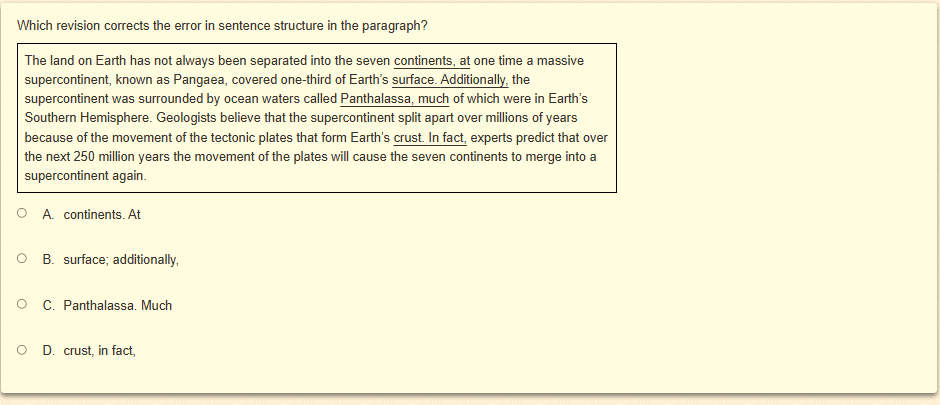
Question 107 of 120
2024 Test A English, question 4Question
Which pair of revisions need to be made in this paragraph?
(1) Both Italian gelato and American ice cream are delightful treats to have on a hot summer day, but many people wonder: what is the difference between the two? (2) To start with, the butterfat content is much higher in ice cream than it is in gelato, making the Italian treat a wiser decision for people looking to make healthier choices. (3) Additionally, the mixing process, which adds less air to the frozen treat, makes gelato denser than ice cream. (4) Finally, gelato is served 10 to 15 degrees warmer than ice cream, which enhances the texture and flavor of the gelato, and allow it to melt more quickly.
- ASentence 1: Delete the colon after wonder AND change is to are.
- BSentence 2: Delete the comma after with AND change it is to they are.
- CSentence 3: Delete the comma after process AND change makes to make.
- DSentence 4: Delete the comma after gelato AND change allow to allows.
Show the answer
Correct answer: D
The question asks for the revisions that are needed to correct errors in the paragraph.
A. Incorrect. The revisions introduce new errors. The colon after “wonder” is needed to set off the question “what is the difference between the two?” from the rest of the sentence. In addition, changing the verb “is” to “are” would be incorrect with the use of the singular noun “difference,” which is the subject of the question.
B. Incorrect. The revisions introduce new errors. The comma following the introductory phrase “To start with” helps with clarity and is needed to separate the phrase from the rest of the sentence. Changing “it is” to “they are” would be incorrect with the use of the singular noun “butterfat content,” which is what the words “it is” refer to in the sentence.
C. Incorrect. The revisions introduce new errors. The comma following “process” is necessary to set off the nonrestrictive clause “which adds less air to the frozen treat” from the rest of the sentence. This clause is considered a nonrestrictive clause because it provides additional, but not essential, information about the mixing process. Changing the verb “makes” to “make” would be incorrect with the use of the singular noun “mixing process,” which is the subject of the sentence.
D. CORRECT. Deleting the comma after “gelato” would include the clause “and allow it to melt more quickly” with the first part of the clause “which enhances the texture and flavor of the gelato.” The word “and” between the two verb phrases (“enhances the texture and flavor of the gelato” and “allow it to melt more quickly”) indicates that the two verb phrases share a subject, “which” (referring to the act of serving gelato 10 to 15 degrees warmer than ice cream). The two ideas should not be separated by a comma within the clause. The entire clause “which enhances the texture and flavor of the gelato and allow it to melt more quickly” should be separated from the main clause only by the comma after “cream” because the entire clause is a nonrestrictive clause. This clause provides additional, but not essential, information about the purpose of serving gelato at a warmer temperature than ice cream. Changing the verb “allow” to “allows” is also necessary to match the use of the singular pronoun “which.”
Question analysis
This editing question gives a four-sentence paragraph comparing Italian gelato with American ice cream and asks which pair of revisions it needs. Students must check subject-verb agreement, what a pronoun refers to and whether each comma or colon belongs, and since every choice bundles two edits in one sentence, a single right-sounding change is not enough.
- Grade level
- Grade 7 reading and task
- Compared with grade 7
- At grade 7 Subject-verb agreement and commas around added clauses are grade 7 conventions. Eight marked spots across four long sentences make this a fuller check than a one-sentence item, but the demand is still typical of grade 7 editing.
- Estimated difficulty
- Moderate: several steps, or a close reading with one strong distractor.
- Thinking it demands
- Depth of knowledge 2, skills and concepts · mainly apply
- What makes it hard
- A rule that doesn't sound wrong moderate
- Every choice must be checked moderate
- Complex sentences minor
- Evidence
- Answered from one paragraph or stanza
- Reading level
- Question and choices: about grade 9, 160 words.
- Students, last 30 days
- Not enough answers yet to show (it takes 10).
Why it is hard, traps and wrong answers (shows the answer)
Why it is hard
The paragraph's only real errors sit at the end of its longest sentence, where a plural noun pair just before the faulty verb hides the mismatch. Students who do not hear “allow” as wrong start doubting correct marks instead, such as the colon before an embedded question or the comma after “To start with.” Every wrong pair also changes a verb or pronoun that already agrees, so reading each edit back into its sentence rules those pairs out.
A rule that doesn't sound wrong moderate Working it out
In sentence 4 the plural pair “texture and flavor” sits just before “and allow,” so the verb sounds right, but it belongs to “which,” the warmer serving, and must match “enhances.” (Connors & Lunsford, 1988)
Every choice must be checked moderate Choosing the answer
Each pair proposes two edits in one sentence, eight in all, and a pair is right only if both of its edits fix real errors, so every edit has to be tried in place. (Embretson & Wetzel, 1987)
Complex sentences minor Understanding the question
Sentence 4 hangs a which-clause with two verbs onto the main clause, and the comma before “and allow” splits that clause's compound predicate in a way few students hear as wrong. (Abedi & Lord, 2001; Freedle & Kostin, 1993; Messick, 1989)
Strategy: Before reading the choices, find each verb's true subject and test every marked comma yourself; then look for the choice whose two edits both fix errors you found.
Traps
- Fixes what isn't broken: Changes a part of the sentence that was already correct, while the real error stays; or, where the question asks which sentence has an error or should go, picks one that is correct and belongs.
- Agreement: A verb that does not agree with its subject, or a pronoun that does not agree with the word it stands for.
- Punctuation: A comma, semicolon, colon, dash or apostrophe used where it does not belong, or missing where it does.
The wrong answers, classified
A Agreement (Connors & Lunsford, 1988)
Hears “the two” as the subject and wants “are,” and distrusts a colon before a question, though “the difference” is singular and the colon is correct.
B Punctuation (Connors & Lunsford, 1988)
Believes a short opener like “To start with” needs no comma and accepts “they are,” though the pronoun stands for the singular “butterfat content.”
C Fixes what isn't broken (Connors & Lunsford, 1988)
Picks edits to a sentence that is already correct, unbalancing the commas around the which-clause and giving the singular “mixing process” a plural verb.
Working it out, step by step
Figure out what the question asks
Each choice offers two changes to one sentence. Both changes must fix real mistakes. If even one change breaks something that was right, the choice is wrong. So test every change in its own sentence.
Learn the rule for two verbs
A verb (an action word) must match its subject (who or what does the action). One thing takes allows. Two or more things take allow.
When one subject does two actions joined by “and,” no comma goes before “and.” Example: The sun warms the air and dries the grass. Both verbs end in s, because one sun does both.
Find the mistakes in sentence 4
Sentence 4 says gelato is served warmer than ice cream, “which enhances the texture and flavor of the gelato, and allow it to melt more quickly.”
“Which” stands for one thing: serving gelato warmer. That one thing does two actions. It “enhances” (improves) the texture and flavor. It also lets the gelato melt faster. So “allow” should be “allows,” to match “enhances.” And the comma before “and” must go.
Check each choice
- A is wrong. The colon (:) after “wonder” correctly leads into the question. And “is” matches “the difference,” which is one thing.
- B is wrong. The comma after “To start with” sets off an opening phrase. And “it is” stands for “the butterfat content,” which is one thing.
- C is wrong. The commas around “which adds less air to the frozen treat” come in a pair. And “makes” matches “the mixing process,” one thing.
- D is right. Both changes fix real mistakes.
Watch out: “The texture and flavor” comes right before “allow.” Those two things make “allow” sound right. But the subject is “which,” not “texture and flavor.”
Choose the answer
The fixed sentence ends: which enhances the texture and flavor of the gelato and allows it to melt more quickly. So the answer is D.
Why this answer and not the closest wrong one
A is the closest wrong answer. “The two” sits near “is,” so “are” can sound right. But the question asks what “the difference” is. A difference is one thing, so “is” is correct. A would add a mistake. In D, both changes fix mistakes that are really there.
More questions like this
The original DOE question
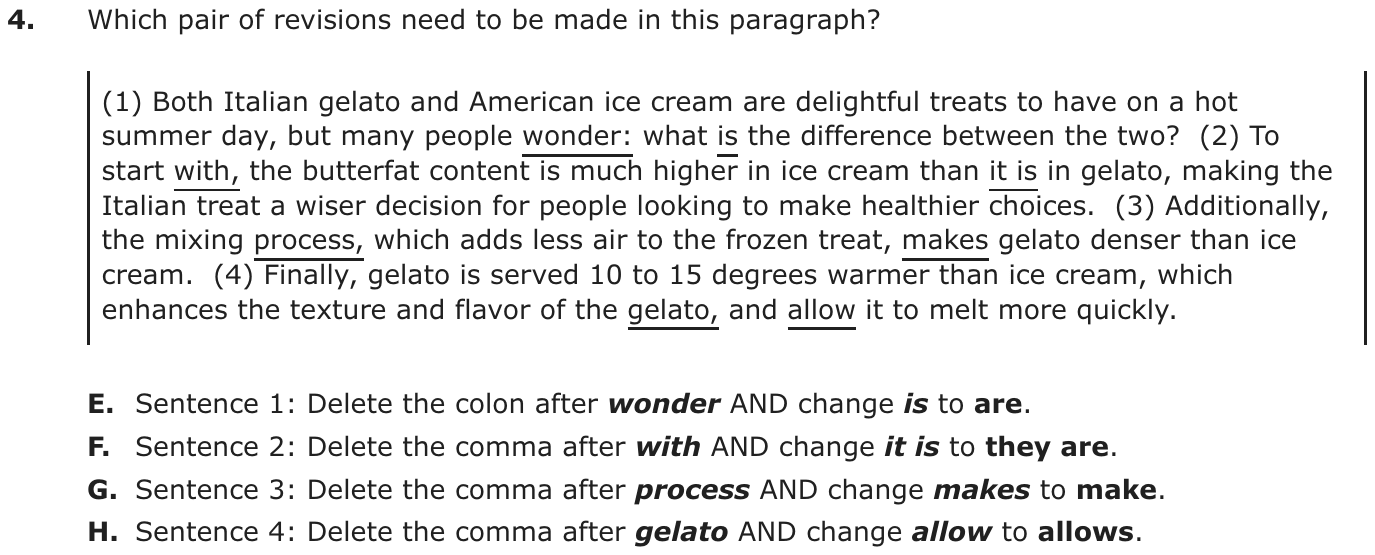
Question 108 of 120
2024 Test A English, question 10Passage Excerpt from “Impressions of an Indian Childhood”
Excerpt from “Impressions of an Indian Childhood”
by Zitkala-Sa
Zitkala-Sa (Gertrude Simmons Bonnin) was a Native American writer, musician, teacher, and political activist who was raised on the Yankton Sioux Reservation in South Dakota. In 1900 she published “Impressions of an Indian Childhood” (the term Indian was commonly used at the time to refer to Native American people) to expose readers to what life is like on a reservation.
Soon after breakfast Mother sometimes began her beadwork. On a bright, clear day, she pulled out the wooden pegs that pinned the skirt of our wigwam1 to the ground, and rolled the canvas part way up on its frame of slender poles. Then the cool morning breezes swept freely through our dwelling, now and then wafting the perfume of sweet grasses from newly burnt prairie.
Untying the long tasseled strings that bound a small brown buckskin2 bag, my mother spread upon a mat beside her bunches of colored beads, just as an artist arranges the paints upon his palette. On a lapboard she smoothed out a double sheet of soft white buckskin; and drawing from a beaded case that hung on the left of her wide belt a long, narrow blade, she trimmed the buckskin into shape. Often she worked upon small moccasins for her small daughter. Then I became intensely interested in her designing. With a proud, beaming face, I watched her work. In [my] imagination, I saw myself walking in a new pair of snugly fitting moccasins. I felt the envious eyes of my playmates upon the pretty red beads decorating my feet.
Close beside my mother I sat on a rug, with a scrap of buckskin in one hand and an awl in the other. This was the beginning of my practical observation lessons in the art of beadwork. From a skein3 of finely twisted threads of silvery sinews my mother pulled out a single one. With an awl she pierced the buckskin, and skillfully threaded it with the white sinew. Picking up the tiny beads one by one, she strung them with the point of her thread, always twisting it carefully after every stitch.
It took many trials before I learned how to knot my sinew thread on the point of my finger, as I saw her do. Then the next difficulty was in keeping my thread stiffly twisted, so that I could easily string my beads upon it. My mother required of me original designs for my lessons in beading. At first I frequently ensnared many a sunny hour into working a long design. Soon I learned from self-inflicted punishment to refrain from drawing complex patterns, for I had to finish whatever I began.
After some experience I usually drew easy and simple crosses and squares. These were some of the set forms. My original designs were not always symmetrical nor sufficiently characteristic, two faults with which my mother had little patience. The quietness of her oversight made me feel strongly responsible and dependent upon my own judgment. She treated me as a dignified little individual as long as I was on my good behavior; and how humiliated I was when some boldness of mine drew forth a rebuke from her!
In the choice of colors she left me to my own taste. I was pleased with an outline of yellow upon a background of dark blue, or a combination of red and myrtle-green. There was another of red with a bluish-gray that was more conventionally used. When I became a little familiar with designing and the various pleasing combinations of color, a harder lesson was given me. It was the sewing on, instead of beads, some tinted porcupine quills, moistened and flattened between the nails of the thumb and forefinger. My mother cut off the prickly ends and burned them at once in the centre fire. These sharp points were poisonous, and worked into the flesh wherever they lodged. For this reason, my mother said, I should not do much alone in quills until I was as tall as my cousin Warca-Ziwin.
Always after these confining lessons I was wild with surplus spirits, and found joyous relief in running loose in the open again. Many a summer afternoon a party of four or five of my playmates roamed over the hills with me. We each carried a light sharpened rod about four feet long, with which we pried up certain sweet roots. When we had eaten all the choice roots we chanced upon, we shouldered our rods and strayed off into patches of a stalky plant under whose yellow blossoms we found little crystal drops of gum. Drop by drop we gathered this nature’s rock-candy, until each of us could boast of a lump the size of a small bird’s egg. Soon satiated with its woody flavor, we tossed away our gum, to return again to the sweet roots.
From “Impressions of an Indian Childhood” by Zitkala-Sa—Public Domain
A BRIEF HISTORY OF BEADWORK IN SOUTH DAKOTA
| Date | Event |
|---|---|
| 1500s | The Dakota use beads made from bones, shells, stones, and animal teeth. European traders bring glass beads to North America. |
| Late 1600s | The Dakota begin trading with the French in Minnesota. |
| 1830s | The Dakota begin using glass beads in clothing, artwork, and decorations in place of Native-made beads. |
| 1862–1865 | The Dakota are expelled from their homelands in Minnesota as a result of the U.S.-Dakota War. |
| 1900s–1920s | The Dakota create items to sell outside their community. |
Source: MNopedia
1wigwam: hut with an arched framework of poles covered with bark, mats, or animal hides
2buckskin: leather made from the skin of a male deer
3skein: coiled length of yarn or other thread loosely wound on a reel
Question
In paragraph 1, the phrases “cool morning breezes swept freely” and “wafting the perfume of sweet grasses” affect the tone of the excerpt by suggesting
- Athe sadness that the author feels reflecting upon her former way of life.
- Bthe enthusiasm with which the author approached her work indoors.
- Cthe fond feelings that the author has toward her childhood experiences.
- Dthe mix of emotions that the author feels toward her work and her mother.
Show the answer
Correct answer: C
The question asks how the phrases “cool morning breezes swept freely” and “wafting the perfume of sweet grasses” affect the tone of the excerpt.
A. Incorrect. Although the author describes in paragraph 1 the setting of her childhood experiences, the positive wording of the phrases the author uses in the paragraph (“swept freely” and “perfume of sweet grasses”) does not suggest a tone of sadness the author feels when she reflects on her former way of life.
B. Incorrect. Although the phrases “cool morning breezes swept freely” and “wafting the perfume of sweet grasses” used in paragraph 1 create a positive tone, the phrases do not suggest an enthusiasm for the author’s work but rather suggest an appreciation of the peaceful beauty of her childhood.
C. CORRECT. In paragraph 1, the phrases “cool morning breezes swept freely” and “wafting the perfume of sweet grasses” are used to describe where the author’s childhood experiences took place. The phrases create a tone of fondness and evoke a feeling of happiness through their lyrical sensory detail: “swept freely” suggests a sense of joyful possibility, while “perfume,” “sweet,” and “cool” convey delight.
D. Incorrect. Although the author describes her mother’s beadwork lessons as “confining” in paragraph 7, the phrases in paragraph 1 do not suggest that the author feels conflicting or mixed emotions toward her work and her mother. Instead, the phrases convey a positive tone by affectionately describing the author’s childhood home.
Question analysis
This reading question asks how two sensory phrases about cool morning breezes and the scent of sweet grasses shape the tone of Zitkala-Sa's 1900 memoir of life on a Sioux reservation. Students must read the feeling behind descriptive language and decide what that feeling is directed at, since the choices pair different emotions with different subjects.
- Grade level
- Grade 7 reading and task
- Compared with grade 7
- At grade 7 Judging how sensory words shape tone is grade 7 reading work. Both phrases are quoted in the question, so little searching is needed, but the 1900 prose keeps the demand at a typical grade 7 level.
- Estimated difficulty
- Straightforward: two steps or one careful reading.
- Thinking it demands
- Depth of knowledge 2, skills and concepts · mainly analyze
- What makes it hard
- Figurative or literary language moderate
- Reading between the lines minor
- Hard words minor
- Evidence
- Answered from one paragraph or stanza
- Reading level
- Passage: about grade 8, 946 words; question and choices: about grade 7, 72 words.
- Corrected from the DOE handbook
- A misstatement of the question in the explanation was corrected.
- Students, last 30 days
- Not enough answers yet to show (it takes 10).
Why it is hard, traps and wrong answers (shows the answer)
Why it is hard
The phrases are so clearly pleasant that the real decision is what the pleasant feeling is about. They describe the wigwam on a clear morning, so the warmth belongs to the author's memory of her childhood, not to the beadwork the rest of the excerpt follows. Students who know the excerpt is about lessons tend to attach the mood to the work, and a few read sadness into any memoir.
Figurative or literary language moderate Understanding the question
The tone comes from sensory images, breezes that “swept freely” and “the perfume of sweet grasses,” which describe air and scent and leave the author's feeling to be read from them. (Graesser, Singer & Trabasso, 1994; Kintsch, 1998)
Reading between the lines minor Working it out
The phrases describe the dwelling, not the author, so her fondness for her childhood has to be inferred from how lovingly she remembers the setting. (Graesser, Singer & Trabasso, 1994; Kintsch, 1998)
Hard words minor Understanding the question
“Wafting” and “perfume,” used for the smell of grasses from newly burnt prairie, are unusual words that must be understood before the tone they create can be judged. (Perfetti, 2007; Freedle & Kostin, 1993)
Strategy: Decide what feeling the quoted words create on their own, then check what they describe: the right choice must match both the feeling and what it is about.
Traps
- Wrong tone or attitude: Misjudges the tone, attitude or point of view, such as reading admiration as criticism, or taking a character's or subject's feelings for the author's.
- Wrong part of the text: A choice is true of another paragraph, stanza or speaker than the one asked about.
The wrong answers, classified
A Wrong tone or attitude (Graesser, Singer & Trabasso, 1994)
Assumes an adult remembering a lost way of life must sound sad, but breezes that sweep freely and the perfume of sweet grasses carry delight, not grief.
B Wrong part of the text (Kirsch & Mosenthal, 1990)
Senses the positive mood but ties it to the beadwork, borrowing the interest the girl shows in paragraph 2, though these phrases describe breezes and scent, not work.
D Wrong part of the text (Kirsch & Mosenthal, 1990)
Brings in the “confining” lessons of paragraph 7 and the rebuke of paragraph 5, feelings that the two morning images of paragraph 1 do not touch.
What was corrected from the DOE handbook, and why
- Explanation: The handbook’s explanation begins by saying the question asks how the two phrases “affect the tone of paragraph 1 in the excerpt.” The phrases are in paragraph 1, but the question asks how they affect the tone of the excerpt, and the answer is about the author’s feelings toward her childhood as a whole. The explanation now reads “affect the tone of the excerpt.”
Working it out, step by step
Figure out what the question asks
This asks about tone. Tone is the feeling or attitude that a writer’s words show. You need the feeling that two phrases from paragraph 1 give the whole excerpt. An excerpt is a part taken from a longer piece.
Find the phrases in paragraph 1
Paragraph 1 describes a clear morning at home. The mother rolls up the side of the wigwam (a hut made of poles and covers). “Then the cool morning breezes swept freely through our dwelling.” A dwelling is a home. The breezes were “now and then wafting the perfume of sweet grasses.”
Work out the feeling
“Wafting” means gently carrying through the air. “Perfume” is a sweet smell. Cool air, sweet smells and breezes moving freely are all pleasant. The author is remembering her childhood home with love. That feeling is fondness, a warm liking for something.
Check each choice
- A is wrong. Nothing in these words is sad. They are bright and pleasant.
- B is wrong. The phrases describe air and smells, not her work.
- C is right. The loving details show warm feelings about her childhood.
- D is wrong. Mixed feelings, like the “confining” lessons, come later, in paragraph 7. These phrases have nothing negative in them.
Watch out: B is tempting, since the excerpt is mostly about beadwork lessons. But these two phrases describe the morning, not the work.
Choose the answer
The phrases make her childhood home feel cool, sweet and free. So the answer is C.
Why this answer and not the closest wrong one
B is the closest wrong answer, because the phrases do sound happy. But a choice must match both the feeling and what the feeling is about. These phrases describe breezes and the smell of grass at her home. That shows fond memories of her childhood, not eagerness to work.
More questions like this
The original DOE question
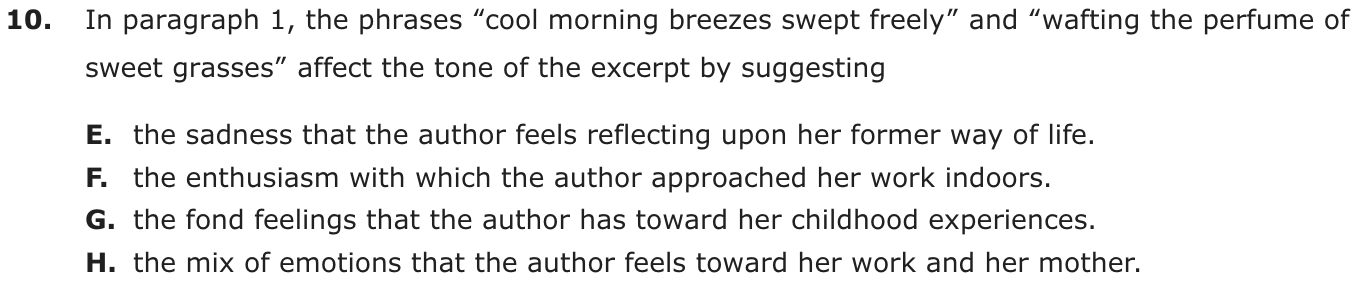
The passage “Excerpt from “Impressions of an Indian Childhood”” as printed (pages 42–43)
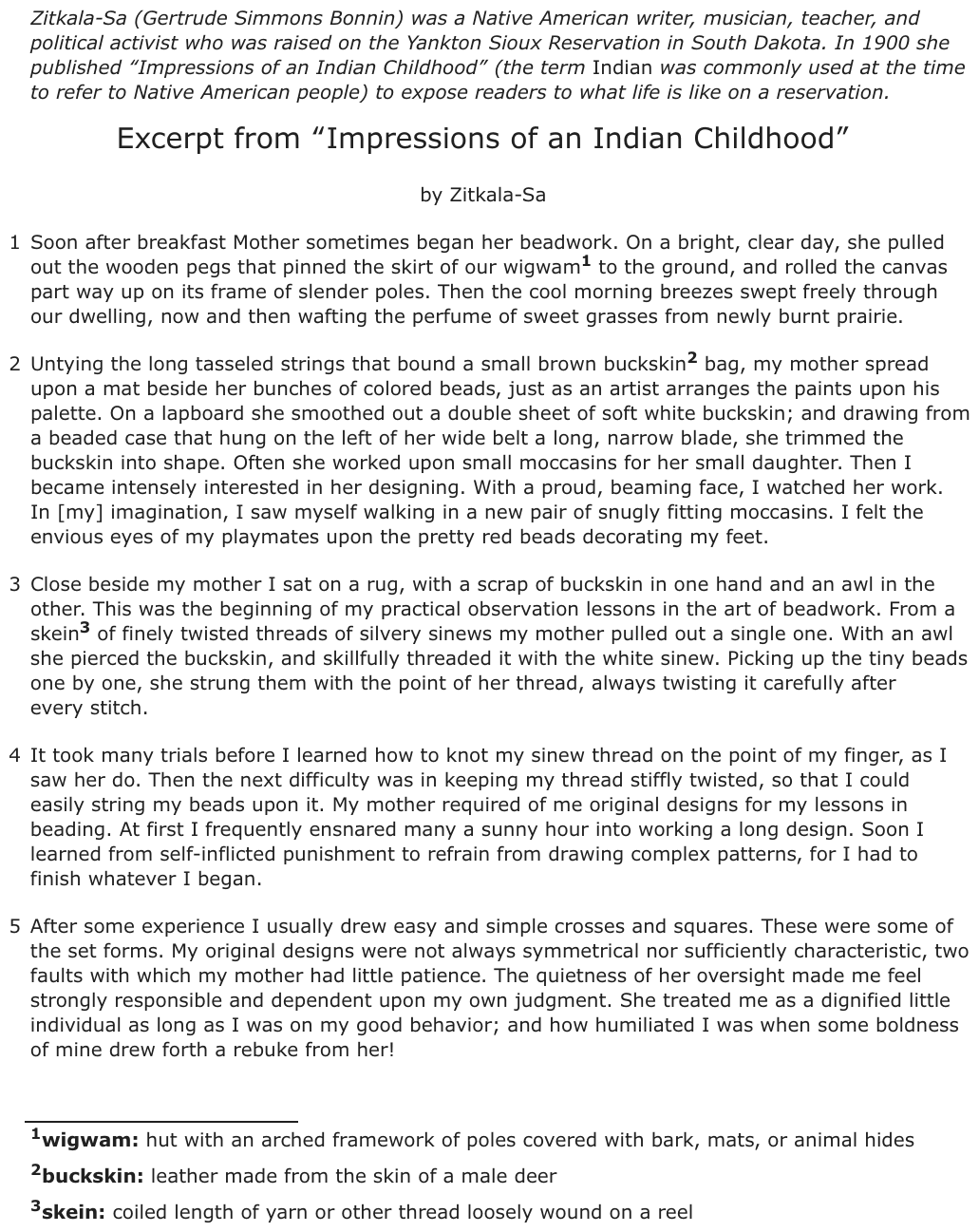
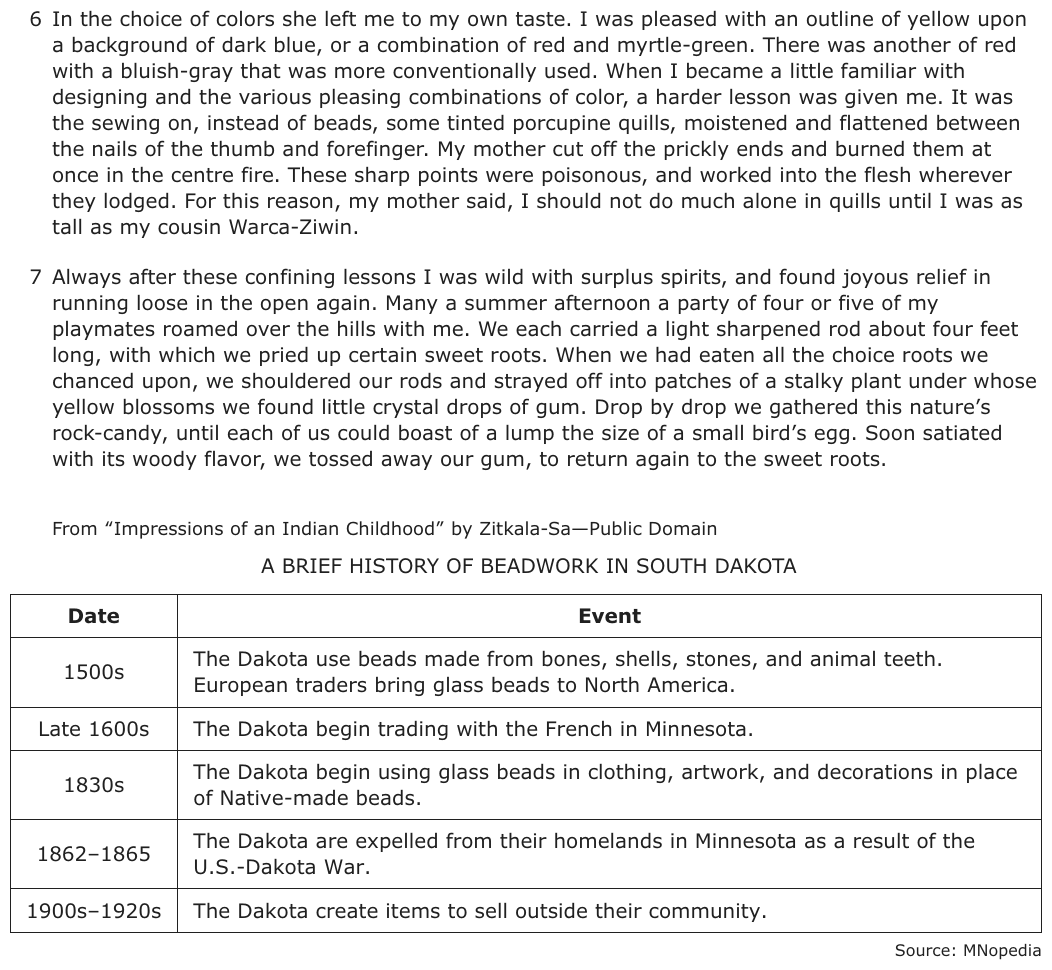
Question 109 of 120
2024 Test A English, question 11Uses the passage above: “Excerpt from “Impressions of an Indian Childhood””.
Question
The author’s use of sequence in paragraphs 1 and 2 contributes to the development of ideas in the excerpt by
- Alisting the many steps that are involved in the process of beading in order to explain its difficulty and complexity.
- Bconveying the importance of following the steps of the beading process in a precise order to work most efficiently.
- Cemphasizing the time required to fully prepare for and execute the many large and small tasks in the activity of beading.
- Ddetailing each step in preparation for beading in order to highlight the author’s enthusiasm for the work.
Show the answer
Correct answer: D
The question asks how the author’s use of sequence in paragraphs 1 and 2 contributes to the development of ideas in the excerpt.
A. Incorrect. In paragraph 2, the author does list the steps her mother takes in preparation to do beadwork, such as “untying the long tasseled strings” of the bag of beads, spreading the beads beside her on a mat, and using “a long, narrow blade” to trim the buckskin into shape. However, the language used to describe this sequence does not indicate that preparing to work with beads is difficult or complex.
B. Incorrect. Although the author’s description of untying the bag of beads, spreading the beads upon a mat, smoothing out a sheet of buckskin, and trimming the buckskin into shape in paragraph 2 indicates that the mother follows a certain routine, it does not place any emphasis on working most efficiently by following the steps of the beading process in a precise order.
C. Incorrect. In paragraph 2, the author describes her mother “untying the long tasseled strings that bound a small brown buckskin bag,” “spread[ing] upon a mat beside her bunches of colored beads,” “smooth[ing] out a double sheet of soft white buckskin; and drawing from a beaded case that hung on the left of her wide belt a long, narrow blade” to trim the buckskin. Although these descriptions do outline the steps in her process for creating beadwork, they do not emphasize the time required to do so, since the author does not mention in the excerpt how long it took her mother to fully prepare for and complete the large and small tasks in the activity of beading.
D. CORRECT. In paragraph 1, the author describes how the morning begins with her mother rolling up the canvas of the wigwam and allowing the breeze to come in. In paragraph 2, the author uses sensory language and precise sequencing to describe the way her mother prepares the beading materials by untying “the long tasseled strings that bound a small brown buckskin bag,” spreading the “bunches of colored beads” beside her, and smoothing out “a double sheet of soft white buckskin.” This combination of sequence and sensory language highlights the author’s enthusiasm for beadwork by emphasizing that the author pays close attention to her mother’s preparations.
Question analysis
This reading question asks how the step-by-step description of a mother preparing her beadwork, in the opening paragraphs of Zitkala-Sa's memoir, contributes to the excerpt's ideas. Every choice agrees that steps are listed, so students must judge which purpose the text actually supports and resist reasons that only sound likely for a craft.
- Grade level
- Grade 8 reading and task
- Compared with grade 7
- Above grade 7 Grade 7 structure questions usually ask what a paragraph adds to a topic. This one asks what an ordered description achieves, in dense 1900 prose where the purpose is never stated outright, which goes beyond typical grade 7 work.
- Estimated difficulty
- Hard: combines ideas, needs a plan, and has more than one tempting wrong answer.
- Thinking it demands
- Depth of knowledge 3, strategic thinking · mainly analyze
- What makes it hard
- How, not what major
- A very close wrong answer moderate
- Reading between the lines moderate
- Complex sentences minor
- Evidence
- Answered from several paragraphs or stanzas
- Reading level
- Passage: about grade 8, 946 words; question and choices: about grade 11, 95 words.
- Corrected from the DOE handbook
- A misquotation of the excerpt in the explanation was corrected.
- Students, last 30 days
- Not enough answers yet to show (it takes 10).
Why it is hard, traps and wrong answers (shows the answer)
Why it is hard
All four choices agree that the paragraphs lay out steps, so the question turns entirely on purpose, and three of the purposes sound like natural reasons to describe a craft. Nothing in paragraphs 1 and 2 calls the work hard, slow or a matter of efficiency; what they do show is a child following every move and becoming intensely interested. Students who look for the narrator's own reaction find the purpose, while those who reason from the steps alone drift to difficulty or time.
How, not what major Working it out
The stem asks what the ordered account of untying the bag, spreading the beads, and smoothing and trimming the buckskin does for the excerpt, a purpose the author never states. (Anderson & Krathwohl, 2001)
A very close wrong answer moderate Choosing the answer
The difficulty choice shares the right one's frame, steps laid out in order to show something, and differs only in what they show: how hard beading is, or how eagerly the girl watched. (Embretson & Wetzel, 1987; Gorin & Embretson, 2006; Ascalon et al., 2007)
Reading between the lines moderate Working it out
The enthusiasm has to be pieced together from the close attention to each step and from “intensely interested” and “a proud, beaming face” in paragraph 2. (Graesser, Singer & Trabasso, 1994; Kintsch, 1998)
Complex sentences minor Understanding the question
Paragraph 2 uses literary word order, as in “my mother spread upon a mat beside her bunches of colored beads,” which slows the reading of the very steps in question. (Abedi & Lord, 2001; Freedle & Kostin, 1993; Messick, 1989)
Strategy: For each choice, look in paragraphs 1 and 2 for words that would prove its purpose; a purpose that no sentence states or shows can be ruled out.
Traps
- Half right: One half of a two-part choice is right and the other is not.
- Wrong purpose or structure: Names a purpose, structure or effect that the part does not serve, or describes what a part says when the question asks what it does.
- Reads too much in: A reasonable-sounding conclusion that goes further than the text allows.
The wrong answers, classified
A Half right (King et al., 2004; Thissen, Steinberg & Fitzpatrick, 1989)
Rightly sees that paragraph 2 lists many preparation steps, then decides the list must show that beading is difficult and complex, which nothing in these paragraphs says.
B Wrong purpose or structure (Anderson & Krathwohl, 2001)
Reads the sequence as instructions about doing the steps in a precise order for efficiency, a purpose a watching child's memories never suggest.
C Reads too much in (Graesser, Singer & Trabasso, 1994)
Reasons that so many steps must take a long time, perhaps recalling the “many a sunny hour” of paragraph 4, but paragraphs 1 and 2 never mention time.
What was corrected from the DOE handbook, and why
- Explanation: In rejecting choice C, the handbook quotes paragraph 2 as “spread[ing them] upon a mat beside her bunches of colored beads.” In the excerpt, the bunches of colored beads are what the mother spreads (“my mother spread upon a mat beside her bunches of colored beads”). The inserted “them” refers to nothing and turns the beads into a place. The quotation now reads “spread[ing] upon a mat beside her bunches of colored beads,” which is how the handbook itself reads the sentence in its reason for rejecting choice A (“spreading the beads beside her on a mat”).
Working it out, step by step
Figure out what the question asks
Sequence means the order in which things happen. Paragraphs 1 and 2 tell the steps of a morning in order. The question asks why the author tells them step by step. What does that careful order help show?
List the steps
In paragraphs 1 and 2, the mother:
- rolls up the side of the wigwam to let in the breeze,
- unties a bag made of buckskin (soft deer leather),
- spreads her beads on a mat,
- smooths out a sheet of buckskin, and
- trims it into shape with a blade.
Find the author’s reaction
Right after the steps, the author tells how she felt. “Then I became intensely interested in her designing. With a proud, beaming face, I watched her work.” Intensely means very strongly. A beaming face has a big, happy smile. She noticed every little step because she was so excited. The details show her enthusiasm, or eager interest.
Check each choice
- A is wrong. The steps are listed, but nothing says beading is hard or complex.
- B is wrong. Nothing says the steps must go in a set order to save effort.
- C is wrong. Paragraphs 1 and 2 never say how long anything takes.
- D is right. The careful details show how closely the girl watched, with eager interest.
Watch out: A is tempting because there are many steps. But many steps don’t prove a task is hard. The author never calls it difficult.
Choose the answer
The step-by-step order shows a child following every move her mother makes. So the answer is D.
Why this answer and not the closest wrong one
A is the closest wrong answer. Like D, it says the steps are listed to show something. But no word in paragraphs 1 and 2 calls beading hard. The author does say she was “intensely interested” and had “a proud, beaming face.” That shows enthusiasm, so D fits better.
More questions like this
The original DOE question
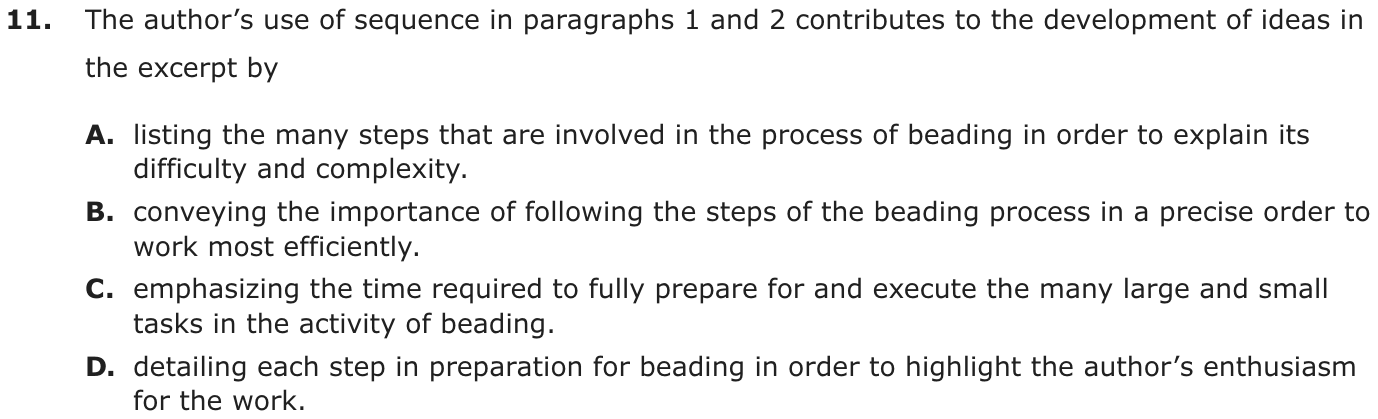
Question 110 of 120
2024 Test A English, question 12Uses the passage above: “Excerpt from “Impressions of an Indian Childhood””.
Question
The phrase “just as an artist arranges the paints upon his palette” in paragraph 2 suggests that
- Abeadwork is a true form of art.
- Bcolor is a source of artistic inspiration.
- Call artistic activities begin with a series of steps.
- Dthe beadworker tries to imitate art.
Show the answer
Correct answer: A
The question asks what the phrase “just as an artist arranges the paints upon his palette” in paragraph 2 suggests in the excerpt.
A. CORRECT. In paragraph 2, by comparing the way her mother arranges the beads to the way a painter “arranges the paints upon his palette,” the author emphasizes that her mother approaches her craft just as a painter does, thus suggesting that beadwork is a true form of art.
B. Incorrect. Although the author mentions “bunches of colored beads” in paragraph 2, this detail does not provide enough evidence for the idea that color inspires beadworkers. The phrase “just as an artist arranges the paints upon his palette” indicates the connection of beadwork to other forms of art in general, not necessarily to the specifics of color as a source of inspiration.
C. Incorrect. In paragraph 2, the author describes her mother “untying the long tasseled strings” and then spreading “upon a mat beside her bunches of colored beads.” However, the phrase “just as an artist arranges the paints upon his palette” does not suggest that all artistic activities begin with a series of steps. There is no mention in the passage of any other artistic activities involving multiple initial steps.
D. Incorrect. In paragraph 2, the author describes how her mother “spread upon a mat beside her bunches of colored beads” as the first step in the artistic process described in the passage. Therefore, the comparison between the mother’s process and a painter arranging paints on a palette suggests that the mother is creating art, not imitating it. There is no indication that the mother is copying a technique she has seen in other art forms.
Question analysis
This reading question asks what the comparison between Zitkala-Sa's mother laying out her colored beads and an artist arranging paints on a palette suggests. It tests reading a simile in context, and the choices include readings that fix on a single word or go further than the comparison itself.
- Grade level
- Grade 6 reading and task
- Compared with grade 7
- Below grade 7 Interpreting a simile is taught by grade 6. The phrase is short and quoted in the question, and one step of interpretation is enough, so this asks less than typical grade 7 work on figurative language.
- Estimated difficulty
- Routine: one familiar step, little to misread.
- Thinking it demands
- Depth of knowledge 2, skills and concepts · mainly understand
- What makes it hard
- Evidence
- Answered from one sentence or line
- Reading level
- Passage: about grade 8, 946 words; question and choices: about grade 6, 45 words.
- Students, last 30 days
- Not enough answers yet to show (it takes 10).
Why it is hard, traps and wrong answers (shows the answer)
Why it is hard
The comparison is quoted in the stem and makes one point: the mother lays out her beads the way a painter lays out paints, so her craft counts as art. Wrong answers fix on the word “paints,” stretch one comparison into a rule about all art, or read the comparison as copying. Asking what the two things being compared have in common settles it.
Figurative or literary language minor Understanding the question
The simile sets the mother laying out bunches of colored beads beside a painter arranging paints, and students must see what that comparison says about beadwork itself. (Graesser, Singer & Trabasso, 1994; Kintsch, 1998)
Strategy: Name the two things being compared and what they share, then choose the idea that comparison supports without adding anything the sentence does not say.
Traps
- Word match: Repeats striking words or phrases from the text, so it looks supported, but its meaning does not fit the question.
- Too broad or too strong: A choice overstates, generalizes, or uses absolute words the text does not support.
- Twists what the text says: Uses the text's topic and ideas but changes what it says: who did it, how much, when, or why.
The wrong answers, classified
B Word match (Freedle & Kostin, 1993)
Links “paints” with the “bunches of colored beads” and decides color is the point, though the simile compares how materials are arranged, not what inspires the artist.
C Too broad or too strong (King et al., 2004)
Turns one comparison about laying out beads into a rule about all artistic activities, a generalization the sentence does not make.
D Twists what the text says (King et al., 2004)
Sees that the simile links beadwork with painting but twists its point, reading it as the mother imitating art rather than practicing it.
Working it out, step by step
Figure out what the question asks
The phrase is a simile. A simile compares two things using “like” or “as.” You need to know what this comparison suggests about the mother’s beadwork.
Read the phrase in paragraph 2
The mother “spread upon a mat beside her bunches of colored beads, just as an artist arranges the paints upon his palette.” The word order is old-fashioned. It means she spread her bunches of colored beads on a mat beside her. A palette is the board a painter uses to hold and mix paints.
Work out what the comparison means
The two things being compared are the mother and a painter. Both lay out their colors before they start to make something. So the author treats her mother like a painter. That means beadwork is real art, just like painting.
Check each choice
- A is right. Comparing the mother to a painter shows that beadwork is a true art.
- B is wrong. The simile is about laying out materials, not about what gives an artist ideas.
- C is wrong. One comparison can’t prove a rule about all art.
- D is wrong. The mother is not copying art. She works the way an artist does, so she is making art.
Watch out: B is tempting because paints and colored beads both bring color to mind. But the simile is about how she arranges them.
Choose the answer
The simile puts the beadworker side by side with a painter. So the answer is A.
Why this answer and not the closest wrong one
B is the closest wrong answer. Paints and colored beads do share color. But the simile compares what the two people do: both arrange their materials before they create. Nothing is said about inspiration, which means where ideas come from. A matches the point that the mother works as an artist does.
More questions like this
The original DOE question

Question 111 of 120
2024 Test A English, question 13Uses the passage above: “Excerpt from “Impressions of an Indian Childhood””.
Question
The details in paragraph 3 convey a central idea of the excerpt by suggesting that
- Athe author was interested in the work because she knew her mother was making something for her.
- Bthe author had difficulty learning through observation but wanted to help her mother.
- Cthe author was determined to behave according to her mother’s standards and sought her approval.
- Dthe author had great admiration for her mother’s precision and mastery of her craft.
Show the answer
Correct answer: D
The question asks how the details in paragraph 3 convey a central idea of the excerpt.
A. Incorrect. In paragraph 2, the author mentions how her mother “worked upon small moccasins for her small daughter” and when she did, the author “became intensely interested in her [mother’s] designing.” However, in paragraph 3, the author is interested in her mother’s work mainly as part of her “lessons in the art of beadwork,” not because she knew her mother was making something for her.
B. Incorrect. In paragraph 3, the author receives “practical observation lessons in the art of beadwork” and describes how “from a skein of finely twisted threads of silvery sinews my mother pulled out a single one” and “pierced the buckskin, and skillfully threaded it with the white sinew.” The author describes the process in such detail that she provides no indication that she had difficulty learning through observation. The author also does not give any indication in the paragraph that she wanted to help her mother; she was there merely to observe and learn.
C. Incorrect. Although the author refers to her beading lessons with her mother as “practical observation lessons in the art of beadwork” and indicates that she sat “close beside” her mother while observing her beadwork, the author provides no indication in the paragraph that she was determined to behave according to her mother’s standards or that she sought her mother’s approval.
D. CORRECT. In paragraph 3, the author describes her mother’s artistry and craftsmanship by using language such as “skillfully threaded,” “picking up the tiny beads one by one,” and “twisting it carefully after every stitch.” These close observations indicate that the author greatly admired her mother’s mastery of her craft and the precision that went into every detail of her work.
Question analysis
This reading question asks how the details in the paragraph where young Zitkala-Sa sits beside her mother, watching her pierce buckskin and string tiny beads, point to a central idea of the excerpt. Several choices name feelings found elsewhere in the memoir, so students must stay with what this one paragraph shows.
- Grade level
- Grade 7 reading and task
- Compared with grade 7
- At grade 7 Linking a paragraph's details to a central idea is grade 7 reading. The answer rests on one short paragraph, but the student must turn its concrete details about thread and beads into an idea, a typical grade 7 demand.
- Estimated difficulty
- Straightforward: two steps or one careful reading.
- Thinking it demands
- Depth of knowledge 2, skills and concepts · mainly understand
- What makes it hard
- Reading between the lines moderate
- The right answer is reworded minor
- Evidence
- Answered from one paragraph or stanza
- Reading level
- Passage: about grade 8, 946 words; question and choices: about grade 9, 73 words.
- Students, last 30 days
- Not enough answers yet to show (it takes 10).
Why it is hard, traps and wrong answers (shows the answer)
Why it is hard
Paragraph 3 is short and concrete, but the feelings named in the choices come from all over the excerpt, so the danger is answering about the excerpt rather than this paragraph. The girl's interest in moccasins made for her belongs to paragraph 2, her struggles to paragraph 4, and good behavior to paragraph 5. Rereading paragraph 3 alone, and noticing how it describes the mother's hands at work, points to the right idea.
Reading between the lines moderate Working it out
Admiration is never named; it has to be inferred from the words chosen for the mother's work: “skillfully threaded,” beads picked up “one by one,” thread twisted “carefully after every stitch.” (Graesser, Singer & Trabasso, 1994; Kintsch, 1998)
The right answer is reworded minor Choosing the answer
The right choice says “precision and mastery,” words absent from paragraph 3, while wrong choices echo the excerpt's own “observation” lessons, its “difficulty” with thread, and the moccasins made for the daughter. (Freedle & Kostin, 1993; Kirsch & Mosenthal, 1990)
Strategy: Reread paragraph 3 by itself and note what its verbs and describing words emphasize, then match that emphasis to a choice and reject ideas drawn from other paragraphs.
Traps
- Wrong part of the text: A choice is true of another paragraph, stanza or speaker than the one asked about.
- Twists what the text says: Uses the text's topic and ideas but changes what it says: who did it, how much, when, or why.
The wrong answers, classified
A Wrong part of the text (Kirsch & Mosenthal, 1990)
Recalls that paragraph 2 makes the girl “intensely interested” when the moccasins are for her, but paragraph 3 presents the watching as the start of her lessons.
B Twists what the text says (King et al., 2004)
Pairs the “observation lessons” of paragraph 3 with the difficulty of paragraph 4 and adds a wish to help, though the girl struggles with her own thread, not with watching.
C Wrong part of the text (Kirsch & Mosenthal, 1990)
Draws on paragraph 5, where the mother treats her with dignity “as long as I was on my good behavior,” but paragraph 3 says nothing about standards or approval.
Working it out, step by step
Figure out what the question asks
Look only at paragraph 3. A central idea is an important message of the whole excerpt. You need the idea that the details in paragraph 3 show.
Find the details in paragraph 3
The girl sits “close beside” her mother and watches. The mother “skillfully threaded it with the white sinew.” Sinew is a strong cord made from an animal’s body. She picks up “the tiny beads one by one.” She keeps “twisting it carefully after every stitch.”
Work out what the details show
Words like “skillfully” and “carefully” show the mother is an expert. She works with precision, which means being exact. Her mastery, or great skill, shows in every small move. The girl notices each one. You watch someone this closely when you admire them, or think highly of them.
Check each choice
- A is wrong. The moccasins made for her come from paragraph 2. Paragraph 3 is about her lessons.
- B is wrong. Her trouble with thread comes in paragraph 4. Nothing says she wants to help.
- C is wrong. Good behavior comes up in paragraph 5, not paragraph 3.
- D is right. The careful details show admiration for her mother’s skill.
Watch out: A, B and C all use ideas from other paragraphs. Stay inside paragraph 3.
Choose the answer
Paragraph 3 shows a girl who watches her mother’s expert hands with wonder. So the answer is D.
Why this answer and not the closest wrong one
A is the closest wrong answer, because the girl really was “intensely interested” when her mother made moccasins for her. But that is in paragraph 2. Paragraph 3 calls the watching “the beginning of my practical observation lessons.” Its details praise how skillfully and carefully the mother works. That fits D.
More questions like this
The original DOE question
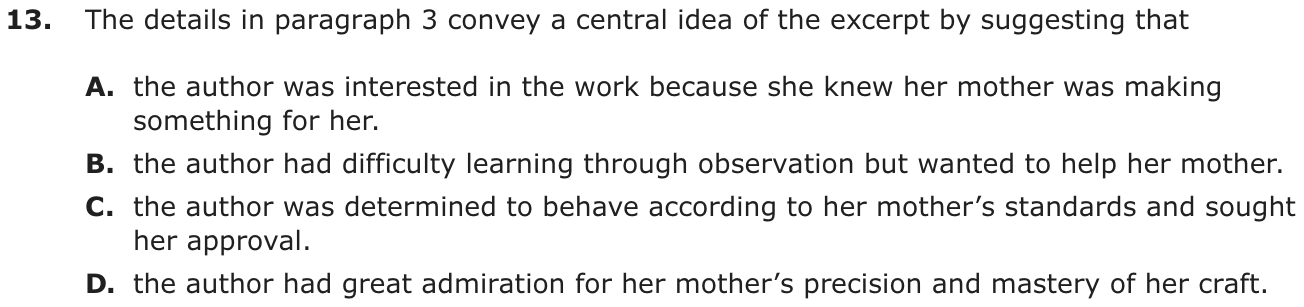
Question 112 of 120
2024 Test A English, question 14Uses the passage above: “Excerpt from “Impressions of an Indian Childhood””.
Question
How does the author distinguish her point of view from that of her mother?
- Aby describing their techniques for knotting sinew thread (paragraph 4)
- Bby describing their approaches to beadwork design (paragraph 5)
- Cby stating her mother’s instructions on working with quills (paragraph 6)
- Dby stating her mother’s ideas about activities after lessons (paragraph 7)
Show the answer
Correct answer: B
The question asks how the author distinguishes her point of view from that of her mother.
A. Incorrect. In paragraph 4, the author explains that “it took many trials before I learned how to knot my sinew thread on the point of my finger, as I saw her do” and that the “difficulty was in keeping my thread stiffly twisted, so that I could easily string my beads upon it.” Although this explanation describes the author’s difficulty in performing the same task as her mother, it does not distinguish her point of view from that of her mother. In fact, they seem to share the same point of view regarding the importance of the technique the author is attempting to learn.
B. CORRECT. In paragraph 5, the author distinguishes her point of view from that of her mother by describing their approaches to beadwork design. In the paragraph, the author states, “I usually drew easy and simple crosses and squares” and “My original designs were not always symmetrical nor sufficiently characteristic, two faults with which my mother had little patience.” The author also distinguishes her point of view from that of her mother by stating that “the quietness of [my mother’s] oversight made me feel strongly responsible and dependent upon my own judgment.”
C. Incorrect. In paragraph 6, the author states, “My mother cut off the prickly ends and burned them at once in the centre fire. These sharp points were poisonous, and worked into the flesh wherever they lodged. For this reason, my mother said, I should not do much alone in quills until I was as tall as my cousin Warca-Ziwin.” Although these instructions explain the importance of having experience and skill when working with quills, they do not distinguish the author’s point of view from that of her mother.
D. Incorrect. In paragraph 7, the author describes her beadwork lessons as “confining” and states that she liked to roam “over the hills” with her playmates after the lessons. However, she makes no mention of her mother in paragraph 7; the activities and ideas stated there belong to the author, not the mother.
Question analysis
This reading question asks how Zitkala-Sa separates her own point of view from her mother's in an excerpt about learning beadwork as a girl. Each choice points to a different paragraph, so students must revisit all four and find where the two perspectives actually differ, not just where one person speaks or acts.
- Grade level
- Grade 7 reading and task
- Compared with grade 7
- At grade 7 Analyzing how an author sets her view apart from another person's is a grade 7 standard. The memoir's sentences are long and old-fashioned, but its paragraphs are short and concrete, so the demand is typical of grade 7 reading.
- Estimated difficulty
- Moderate: several steps, or a close reading with one strong distractor.
- Thinking it demands
- Depth of knowledge 2, skills and concepts · mainly analyze
- What makes it hard
- Every choice must be checked moderate
- How, not what moderate
- Hard words minor
- Evidence
- Answered from several paragraphs or stanzas
- Reading level
- Passage: about grade 8, 946 words; question and choices: about grade 9, 51 words.
- Corrected from the DOE handbook
- A word-order slip in the explanation was corrected.
- Students, last 30 days
- Not enough answers yet to show (it takes 10).
Why it is hard, traps and wrong answers (shows the answer)
Why it is hard
Every paragraph named shows mother and daughter together, or the daughter alone, so each looks like a candidate until it is tested for an actual difference in outlook. The struggle to knot sinew is a difference in skill, not in view, and the warning about quills gives only the mother's side. Paragraph 5 is the one place where the girl's own designs and her mother's impatience with their faults are set side by side.
Every choice must be checked moderate Choosing the answer
Each choice points to a different paragraph, 4 through 7, so all four have to be reread and tested for two outlooks that actually differ, not just one person's action or advice. (Embretson & Wetzel, 1987)
How, not what moderate Working it out
The question asks how the author sets her view apart, so students must find where two outlooks meet and clash: her simple, imperfect designs against the faults her mother “had little patience” with. (Anderson & Krathwohl, 2001)
Hard words minor Understanding the question
The key sentence turns on “not always symmetrical nor sufficiently characteristic,” formal words that must be understood to see the mother's standards behind them. (Perfetti, 2007; Freedle & Kostin, 1993)
Strategy: For each paragraph named, ask whether it shows both the mother's view and the narrator's and sets them against each other; a paragraph with one perspective cannot be the answer.
Traps
- True but not the answer: A choice says something accurate about the text that does not answer this question.
- Wrong part of the text: A choice is true of another paragraph, stanza or speaker than the one asked about.
The wrong answers, classified
A True but not the answer (King et al., 2004; Embretson & Wetzel, 1987)
Sees the girl struggle to knot sinew the way her mother does, a real contrast in skill, but she learns the same method “as I saw her do,” so their views do not differ.
C True but not the answer (King et al., 2004; Embretson & Wetzel, 1987)
Picks the mother's warning about poisonous quills because it states her view, but the narrator reports it without setting any opinion of her own against it.
D Wrong part of the text (Kirsch & Mosenthal, 1990)
Credits the mother with ideas about play after lessons, though paragraph 7 gives only the narrator's own “joyous relief,” and the mother does not appear in it.
What was corrected from the DOE handbook, and why
- Explanation: The handbook reads “The author also distinguishes her point of view from that her of mother.” It now reads “from that of her mother,” as earlier in the same explanation.
Working it out, step by step
Figure out what the question asks
A point of view is how a person sees or judges something. You need a place where the author shows that she and her mother see things differently. Each choice names a different paragraph. Check each one for two views that don’t match.
Find two views in paragraph 5
The girl “usually drew easy and simple crosses and squares.” Then she says: “My original designs were not always symmetrical nor sufficiently characteristic, two faults with which my mother had little patience.”
Work out what it means
Symmetrical means the same on both sides. “Sufficiently characteristic” means typical enough of the usual style. The girl kept her designs easy and simple. Her mother cared about something else. She saw “faults,” or mistakes, in them. Having “little patience” means being quickly annoyed. So the two judge the designs differently.
Check each choice
- A is wrong. In paragraph 4 the girl learns to knot thread “as I saw her do.” She learns her mother’s way, so their views match.
- B is right. Paragraph 5 sets the girl’s designs against her mother’s standards.
- C is wrong. Paragraph 6 gives only the mother’s warning about quills. The girl does not disagree.
- D is wrong. The mother doesn’t appear in paragraph 7 at all.
Watch out: A is tempting because the girl struggles with something her mother can do. But that is a difference in skill, not in point of view.
Choose the answer
Paragraph 5 is the one place where the two views are set side by side. So the answer is B.
Why this answer and not the closest wrong one
A is the closest wrong answer. The girl does struggle to knot thread the way her mother does. But they agree on how it should be done. In paragraph 5, the girl’s simple designs meet her mother’s impatience with their “faults.” That is a real difference in how they see the work.
More questions like this
The original DOE question
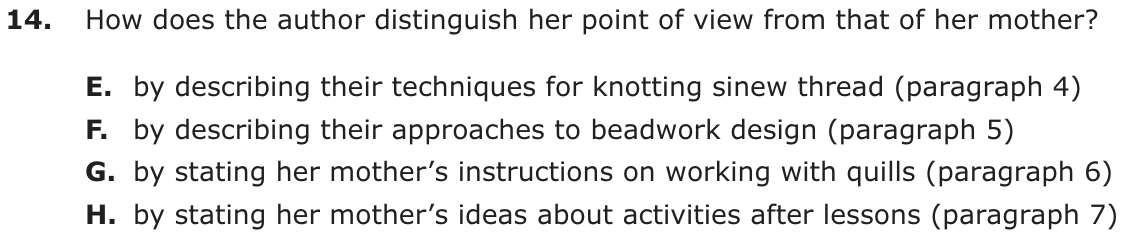
Question 113 of 120
2024 Test A English, question 15Uses the passage above: “Excerpt from “Impressions of an Indian Childhood””.
Question
Read this sentence from paragraph 7.
Always after these confining lessons I was wild with surplus spirits, and found joyous relief in running loose in the open again.
Which sentence best describes how this sentence fits into the overall structure of the excerpt?
- AIt introduces a shift from the author’s demanding relationship with her mother to her more relaxed relationships with friends.
- BIt signals a change from the challenging aspects of life on the reservation to the advantages of living on the prairie.
- CIt highlights a contrast between the focus and control required while working and the freedom of having fun outside.
- DIt concludes the progression of events in the narrative by describing the sequence of events at the end of the author’s day.
Show the answer
Correct answer: C
The question asks which sentence best describes how the sentence from paragraph 7 fits into the overall structure of the excerpt.
A. Incorrect. Though the author feels humiliated “when some boldness of mine drew forth a rebuke from” her mother (paragraph 5) and characterizes her lessons with her mother as “confining” (paragraph 7), the overall passage does not portray a demanding relationship between the author and the mother. The shift introduced in the sentence from paragraph 7 is not from one of the author’s relationships to another; it is from work to play.
B. Incorrect. In paragraph 6, the author explains how working with porcupine quills is difficult because the “sharp points were poisonous, and worked into the flesh wherever they lodged.” Although this sentence suggests that working with porcupine quills was challenging, the sentence from paragraph 7 does not signal a change from the challenging aspects of life on the reservation to the advantages of living on the prairie. Most of paragraph 6 describes the author’s pleasure in creating designs in different colors.
C. CORRECT. In the sentence from paragraph 7, the author refers to her beadwork lessons as “confining” and states that after the lessons, she “was wild with surplus spirits” and “found joyous relief” in being outside and running around. The phrases “surplus spirits” and “joyous relief” highlight a sense of freedom that stands in strong contrast to the “confining” nature of the author’s beadwork lessons, which required intense focus and control.
D. Incorrect. In paragraph 7, the author describes how “many a summer afternoon” after her beadwork lessons, she and her friends used “a light sharpened rod” to gather “sweet roots” and “little crystal drops of gum.” She then explains that they later “tossed away our gum, to return again to the sweet roots.” However, the sentence from paragraph 7 does not conclude the progression of events in the narrative by describing the sequence of events at the end of the author’s day; the sentence appears at the beginning of paragraph 7 and provides a contrast with events from the previous paragraph.
Question analysis
This reading question quotes the sentence that opens the last paragraph of Zitkala-Sa's excerpt, where she tells how she felt after her beadwork lessons, and asks how it fits the overall structure. Several choices describe a turn or a contrast, so students must pin down exactly what is being set against what.
- Grade level
- Grade 7 reading and task
- Compared with grade 7
- At grade 7 Explaining how one sentence fits a text's structure is grade 7 reading. The sentence is quoted and its wording is vivid, but the student must connect it to the paragraphs on both sides of it, a typical grade 7 demand.
- Estimated difficulty
- Moderate: several steps, or a close reading with one strong distractor.
- Thinking it demands
- Depth of knowledge 2, skills and concepts · mainly analyze
- What makes it hard
- How, not what moderate
- A very close wrong answer moderate
- Hard words minor
- Evidence
- Answered from several paragraphs or stanzas
- Reading level
- Passage: about grade 8, 946 words; question and choices: about grade 10, 123 words.
- Students, last 30 days
- Not enough answers yet to show (it takes 10).
Why it is hard, traps and wrong answers (shows the answer)
Why it is hard
The sentence clearly marks a change, and every choice names some change, so the work lies in saying exactly what is set against what. The excerpt contrasts careful, controlled work with free play, and the word “confining” carries that contrast. Students lose the point by making the turn about people, reading one rebuke as a hard relationship, or about the day's timeline, when the sentence describes what always happened after lessons.
How, not what moderate Working it out
The stem asks how the sentence works in the excerpt's structure, so students must name the turn it marks, from the “confining” lessons of paragraphs 3–6 to running loose outdoors. (Anderson & Krathwohl, 2001)
A very close wrong answer moderate Choosing the answer
The relationships choice also describes a move from lessons with her mother to play with friends, and differs from the right one only in calling the bond with her mother demanding. (Embretson & Wetzel, 1987; Gorin & Embretson, 2006; Ascalon et al., 2007)
Hard words minor Understanding the question
Old-fashioned phrasing such as “wild with surplus spirits” and “joyous relief” has to be decoded as a burst of energy after hours of holding still. (Perfetti, 2007; Freedle & Kostin, 1993)
Strategy: Compare paragraph 6 with paragraph 7 and name what changes between them in a few words, then pick the choice whose two halves match both sides of that change.
Traps
- Half right: One half of a two-part choice is right and the other is not.
- Twists what the text says: Uses the text's topic and ideas but changes what it says: who did it, how much, when, or why.
- Wrong purpose or structure: Names a purpose, structure or effect that the part does not serve, or describes what a part says when the question asks what it does.
The wrong answers, classified
A Half right (King et al., 2004; Thissen, Steinberg & Fitzpatrick, 1989)
Notices the move from lessons with her mother to play with friends, but the excerpt shows a quiet, respectful teacher, not a demanding relationship; the turn is from work to play.
B Twists what the text says (King et al., 2004)
Inflates the move outdoors into a contrast between hardships of reservation life and the prairie's advantages, a far broader claim than one sentence about lessons supports.
D Wrong purpose or structure (Anderson & Krathwohl, 2001)
Takes the sentence as closing a day's events, since the excerpt begins after breakfast and paragraph 7 turns to afternoons, though it opens its paragraph with a contrast.
Working it out, step by step
Figure out what the question asks
This asks how one sentence fits the structure of the excerpt. Structure means how the parts are put together. You need to know what change this sentence marks.
Read the sentence closely
The sentence opens paragraph 7: “Always after these confining lessons I was wild with surplus spirits, and found joyous relief in running loose in the open again.” Confining means keeping you shut in or held still. “Surplus spirits” means extra energy. “Joyous relief” is a happy feeling of being free at last.
Compare what comes before and after
Paragraphs 3 to 6 show the lessons. The girl sits still and works with care. She learns to knot thread, plan designs and handle sharp quills. The rest of paragraph 7 shows her roaming the hills with friends. So this sentence turns from careful work to free play.
Check each choice
- A is wrong. The mother is a quiet, respectful teacher, not a demanding one. The shift is from work to play.
- B is wrong. The sentence sets lessons against play. It says nothing about reservation life being hard or the prairie being better.
- C is right. “Confining” lessons are set against “running loose in the open.”
- D is wrong. The sentence starts paragraph 7 and tells what always happened after lessons. It doesn’t end the story.
Watch out: A is tempting because the girl goes from her mother to her friends. But the sentence contrasts how she felt during lessons and after them.
Choose the answer
The sentence contrasts the focus that work needs with the freedom of playing outside. So the answer is C.
Why this answer and not the closest wrong one
A is the closest wrong answer. It also sees a move from lessons with her mother to play with friends. But A calls the relationship demanding. The mother teaches quietly and treats her daughter “as a dignified little individual” (paragraph 5). The real contrast is in the word “confining,” which sets held-still work against free play. That is C.
More questions like this
The original DOE question
Question 114 of 120
2024 Test A English, question 16Uses the passage above: “Excerpt from “Impressions of an Indian Childhood””.
Question
Which sentence best summarizes the process of beading that is described in the excerpt?
- ATake a buckskin bag full of beads and spread them out on a mat in different colors like a paint palette; take a double sheet of buckskin and smooth it out on a table; take a sinew and awl and thread the beads onto the buckskin in a desired pattern.
- BCut the double sheet of buckskin into a shape; take a skein of sinew and pierce the buckskin with an awl; thread the sinew with beads of many different colors in a simple or complex pattern; twist the sinew to keep it tight after every stitch into the buckskin.
- CArrange the beads into groups of colors on a mat; smooth out a double sheet of buckskin and cut it to shape; take a single thread of sinew; pierce the buckskin with an awl; thread the buckskin with the sinew and string it with beads, carefully twisting after every stitch.
- DGather beads, buckskin, sinew, and awl and place them on a mat; cut the buckskin into the desired shape; decide on a pattern for the beads and create it using the sinews and the awl; thread the beads onto the sinew in the desired pattern and twist it tight.
Show the answer
Correct answer: C
The question asks which sentence best summarizes the process of beading that is described in the excerpt.
A. Incorrect. In paragraphs 2 and 3, the author describes how at the beginning of the process her mother “smoothed out a double sheet of soft white buckskin” on a lapboard (paragraph 2) and how she strings the beads into a pattern. However, this sentence does not describe the steps that take place between the preparation and the stringing of the beads. Thus, this sentence does not best summarize the beading process.
B. Incorrect. In paragraphs 2 and 3, the author describes the process her mother uses to string the beads with “the point of her thread, always twisting it carefully after every stitch” (paragraph 3). While this sentence includes some of the steps in the beading process, it does not describe the necessary preparation, namely spreading the beads out on a mat and smoothing out the buckskin on a lapboard. Thus, this sentence does not best summarize the beading process.
C. CORRECT. This sentence best summarizes the process of beading that is described in the excerpt because it includes details about each step in the process. In paragraph 2, the author explains how her mother “spread upon a mat beside her bunches of colored beads” and how “on a lapboard she smoothed out a double sheet of soft white buckskin; and drawing from a beaded case that hung on the left of her wide belt a long, narrow blade, she trimmed the buckskin into shape.” The author continues her description in paragraph 3, stating, “From a skein of finely twisted threads of silvery sinews my mother pulled out a single one. With an awl she pierced the buckskin, and skillfully threaded it with the white sinew. Picking up the tiny beads one by one, she strung them with the point of her thread, always twisting it carefully after every stitch.”
D. Incorrect. In paragraphs 2 and 3, the author describes the process her mother uses as she “smoothed out a double sheet of soft white buckskin” (paragraph 2) on a lapboard before stringing the beads. While this sentence includes most of the steps in the beading process, it excludes the step of piercing the buckskin. This sentence also provides few details about the process of beading and uses vague wording to describe each step. Therefore, the sentence does not best summarize the beading process.
Question analysis
This reading question asks which sentence best summarizes the beadwork process Zitkala-Sa watches her mother carry out, from laying out the materials to stringing the beads. Each choice is a long list of steps, so students must compare them detail by detail with the excerpt and notice what each one adds, leaves out or misplaces.
- Grade level
- Grade 8 reading and task
- Compared with grade 7
- Above grade 7 Summarizing a process is grade 7 reading, but the four summaries are long and nearly alike, and checking them against two paragraphs of 1900 prose with words like awl, sinew and skein is heavier than usual.
- Estimated difficulty
- Hard: combines ideas, needs a plan, and has more than one tempting wrong answer.
- Thinking it demands
- Depth of knowledge 2, skills and concepts · mainly understand
- What makes it hard
- Every choice must be checked major
- A lot to read moderate
- Hard words minor
- Evidence
- Answered from several paragraphs or stanzas
- Reading level
- Passage: about grade 8, 946 words; question and choices: about grade 16+, 212 words.
- Corrected from the DOE handbook
- An inaccurate detail about the excerpt in the explanation was corrected.
- Students, last 30 days
- Not enough answers yet to show (it takes 10).
Why it is hard, traps and wrong answers (shows the answer)
Why it is hard
This question is won by bookkeeping, not insight: list the mother's steps from the two paragraphs, then hold each long summary against the list. The most tempting wrong summary reads like a sensible craft routine in a sensible order, yet it never has the buckskin pierced and puts every tool on the mat. Others open with a familiar image or close with precise stitching while skipping steps, so students who check only the beginning or only the end are caught.
Every choice must be checked major Choosing the answer
Each summary is a chain of four to six steps, so all four must be checked step by step against paragraphs 2 and 3 for steps missing, added or out of order. (Embretson & Wetzel, 1987)
A lot to read moderate Understanding the question
The four choices together run to about 200 words of semicolon-linked steps, and the text they summarize is two paragraphs of dense 1900 prose. (Kintsch, 1998; Gorin & Embretson, 2006; Freedle & Kostin, 1993)
Hard words minor Understanding the question
Words like awl, sinew, skein and lapboard name the tools and materials, and a student unsure of them cannot tell which steps a summary has dropped. (Perfetti, 2007; Freedle & Kostin, 1993)
Strategy: List the mother's steps from paragraphs 2 and 3 in order, then check each choice against your list for a missing step, an invented detail or a step out of place.
Traps
- Too narrow: A single detail offered as the central idea or a summary, or a summary that keeps minor details and leaves out an essential part.
The wrong answers, classified
A Too narrow (King et al., 2004)
Keeps the familiar palette image but leaves out trimming the buckskin, piercing it with the awl and twisting the thread, and even moves the smoothing onto a table.
B Too narrow (King et al., 2004)
Matches paragraph 3's piercing and twisting closely but leaves out the preparation, laying out the beads and smoothing the buckskin, and starts the process with cutting.
D Too narrow (King et al., 2004)
Accepts a tidy, well-ordered outline that keeps most steps but leaves out smoothing the buckskin and piercing it with the awl, and piles every tool onto the mat.
What was corrected from the DOE handbook, and why
- Explanation: In rejecting choice B, the handbook says the choice leaves out the preparation, “namely spreading the beads and the buckskin out on a table.” The excerpt mentions no table: in paragraph 2 the mother spreads the beads on a mat and smooths out the buckskin on a lapboard. The explanation now says so. (Choice A’s “on a table” is part of a wrong answer and is left as printed.)
Working it out, step by step
Figure out what the question asks
You need the summary that best matches the beading steps in the excerpt. A summary is a short retelling of the main points. The best one keeps every main step, in order, and adds nothing new.
List the steps from paragraphs 2 and 3
Paragraphs 2 and 3 give the mother’s steps in order. The last one ends with her “always twisting it carefully after every stitch.”
- Spread the beads on a mat.
- Smooth out a double sheet of buckskin on a lapboard (a board held on the lap).
- Trim the buckskin into shape with a blade.
- Pull out a single sinew, a strong thread.
- Pierce (poke a hole in) the buckskin with an awl, a pointed tool.
- Thread the sinew through the buckskin.
- String the beads, twisting the thread after every stitch.
Check each choice against the list
- A is wrong. It skips trimming, piercing and twisting. It also says “on a table,” but she used a lapboard.
- B is wrong. It starts with cutting. It skips spreading the beads and smoothing the buckskin.
- C is right. It has every step, in the same order.
- D is wrong. It never says to smooth the buckskin or pierce it. It also puts every tool on the mat, but only the beads went there.
Watch out: D sounds like a sensible plan in a sensible order. But a summary must match the excerpt, not just sound right. Check it step by step.
Choose the answer
Only C follows the mother’s steps from start to finish. So the answer is C.
Why this answer and not the closest wrong one
D is the closest wrong answer. It is neat and keeps most of the steps. But it skips smoothing the buckskin and never says to pierce it with the awl. It also piles every tool onto the mat. C matches the excerpt step for step, so it is the best summary.
More questions like this
The original DOE question
Question 115 of 120
2024 Test A English, question 17Uses the passage above: “Excerpt from “Impressions of an Indian Childhood””.
Question
The idea that mastering moccasin design and creation requires experience is best illustrated in the excerpt through
- Athe information about the advanced technique of incorporating porcupine quills into a design.
- Bthe descriptions of the special materials that must be used to make decorated moccasins.
- Cthe descriptions of the various color combinations that make an attractive moccasin design.
- Dthe example of the author successfully and independently using a sharpened rod.
Show the answer
Correct answer: A
The question asks how the idea that mastering moccasin design and creation requires experience is best illustrated in the excerpt.
A. CORRECT. In paragraph 6, the author states that when she became more familiar with elements of design, “a harder lesson was given me.” According to the author, sewing on porcupine quills is a much more difficult task to master because it requires experience in handling the poisonous porcupine quills, which is why her mother told her not to “do much alone in quills” until she was older (paragraph 6). This information best illustrates the idea that mastering moccasin design and creation requires experience.
B. Incorrect. Although the author provides detailed descriptions of the materials used to make decorated moccasins (“colored beads” [paragraph 2]; “a skein of finely twisted threads of silvery sinews” [paragraph 3]; “tinted porcupine quills, moistened and flattened between the nails of the thumb and forefinger” [paragraph 6]), these descriptions do not illustrate the experience that is needed to gain mastery of moccasin design and creation.
C. Incorrect. Although the author describes the color combinations she used in making moccasins (“I was pleased with an outline of yellow upon a background of dark blue, or a combination of red and myrtle-green. There was another of red with a bluish-gray that was more conventionally used” [paragraph 6]), this information mainly illustrates the author’s satisfaction with her moccasin design, not the importance of experience in mastering the creation and design of moccasins.
D. Incorrect. In paragraph 7, the author tells of using a sharpened rod to dig for roots. She explains that she and her playmates used the rods to “[pry] up certain sweet roots,” which they ate before going off to gather gum from a stalky plant. The detail of the sharpened rod is from a recollection about the playtime that followed the “confining lessons” of moccasin making. However, the sharpened rod was not used to create moccasins.
Question analysis
This reading question asks which part of Zitkala-Sa's account of learning to bead moccasins best illustrates the idea that mastering the craft takes experience. The choices point to materials, color combinations, a technique and outdoor play, so students must find the detail that ties skill to practice rather than one that simply describes the craft.
- NYS standards
- 7R1 textual evidence and inferences
- Grade level
- Grade 7 reading and task
- Compared with grade 7
- At grade 7 Choosing the detail that best illustrates an idea is grade 7 evidence work. The idea is stated plainly in the question and each paragraph of the excerpt keeps to one topic, so the demand matches typical grade 7 tasks.
- Estimated difficulty
- Straightforward: two steps or one careful reading.
- Thinking it demands
- Depth of knowledge 2, skills and concepts · mainly evaluate
- What makes it hard
- Evidence
- Answered from one paragraph or stanza
- Reading level
- Passage: about grade 8, 946 words; question and choices: about grade 12, 69 words.
- Corrected from the DOE handbook
- An inaccurate account of the excerpt in the explanation was corrected.
- Students, last 30 days
- Not enough answers yet to show (it takes 10).
Why it is hard, traps and wrong answers (shows the answer)
Why it is hard
The idea of experience is spelled out in paragraph 6, where quillwork is a harder lesson given only after some practice and kept from the girl until she is older. The wrong choices describe things the excerpt really contains, materials, colors and a tool, so they look supported until each is asked whether it shows a learner needing practice. Students who put that one question to every choice find this a quick item.
Evidence in several places minor Working it out
The stem names no paragraph, so students must find where each choice's detail sits, from the beads and sinew of paragraphs 2 and 3 to the rods of paragraph 7. (Kirsch & Mosenthal, 1990; Gorin & Embretson, 2006)
Reading between the lines minor Working it out
The link to experience is implied in paragraph 6: quills come as “a harder lesson” once she is “a little familiar with designing,” and she must wait until she is “as tall as my cousin.” (Graesser, Singer & Trabasso, 1994; Kintsch, 1998)
Strategy: For each choice, find the part of the excerpt it refers to and ask whether it shows a learner needing practice before doing something, not just what the craft involves.
Traps
- Supports only part of the claim: In a question about evidence: a line that backs one half of the claim but not the other, or a related point rather than the claim itself.
- Wrong part of the text: A choice is true of another paragraph, stanza or speaker than the one asked about.
The wrong answers, classified
B Supports only part of the claim (King et al., 2004; Thissen, Steinberg & Fitzpatrick, 1989)
Picks the descriptions of beads, sinew and buckskin, which show what moccasins are made from but say nothing about the experience needed to master making them.
C Supports only part of the claim (King et al., 2004; Thissen, Steinberg & Fitzpatrick, 1989)
Points to the color combinations of paragraph 6, which come just before the quill lesson but show the girl's own taste and freedom to choose, not a skill that takes practice.
D Wrong part of the text (Kirsch & Mosenthal, 1990)
Seizes on the girl using a sharpened rod on her own, but the rods belong to her play in paragraph 7, digging sweet roots, and have nothing to do with moccasins.
What was corrected from the DOE handbook, and why
- Explanation: In rejecting choice D, the handbook says the author used a sharpened rod “to spear gum from trees” and that the children pried up sweet roots “to find the gum.” In paragraph 7 the rods are used to pry up sweet roots, which the children eat; afterwards they stray off to a stalky plant and find drops of gum under its yellow blossoms. Nothing is speared and no trees are mentioned. The explanation now says the rods were used to dig for roots, sweet roots the children ate before going off to gather gum from a stalky plant. The reason for rejecting D, that the rod was not used to make moccasins, is unchanged.
Working it out, step by step
Figure out what the question asks
You need the part of the excerpt that best shows one idea. The idea is that you need experience to master making moccasins. Experience means practice over time. Look for a learner who must practice before doing something harder.
Find the evidence in paragraph 6
Paragraph 6 says: “When I became a little familiar with designing and the various pleasing combinations of color, a harder lesson was given me.” The harder lesson was sewing on porcupine quills. Then her mother said “I should not do much alone in quills until I was as tall as my cousin Warca-Ziwin.”
Work out what it means
Quills are the sharp spines of a porcupine. Their points were “poisonous,” so they were dangerous. The girl got this lesson only after she knew the basics. Even then, she could not do much alone with quills until she was as tall as her cousin. That shows skill grows with experience.
Check each choice
- A is right. Quillwork is a harder skill she must earn through practice.
- B is wrong. The materials show what moccasins are made of, not how skill is gained.
- C is wrong. The colors show her own taste. Her mother “left me to my own taste.”
- D is wrong. The rods were for digging up sweet roots during play. They had nothing to do with moccasins.
Watch out: C comes right before the quills in paragraph 6, so it is easy to pick. But the colors show what she liked, not a skill she had to build up.
Choose the answer
The quill lesson comes only after practice, and working alone comes only once she has grown. So the answer is A.
Why this answer and not the closest wrong one
C is the closest wrong answer, since the colors come just before the quill lesson. But the girl was free to pick the colors she liked. That shows her taste, not a need for experience. The quills are called “a harder lesson,” given only once she knew the basics. That fits A.
More questions like this
The original DOE question
Question 116 of 120
2024 Test A English, question 18Uses the passage above: “Excerpt from “Impressions of an Indian Childhood””.
Question
The table after paragraph 7 expands on a central idea in the excerpt because it shows that
- Athe craft the author was learning was a tradition that endured through many generations and changes.
- Bthe author’s family incorporated traditional materials into their craft as a way of resisting the influence from European traders.
- Cthe uniqueness of the cultural tradition that the author learned as a child was eventually recognized in Europe.
- Dthe author was able to incorporate color into her craftwork as a result of trade with other peoples.
Show the answer
Correct answer: A
The question asks how the table after paragraph 7 expands on a central idea in the excerpt.
A. CORRECT. The table provides the chronology from the 1500s, when the Dakota created beadwork using “beads made from bones, shells, stones, and animal teeth,” to the 1830s, when the Dakota began “using glass beads,” and the 1900s, when they created items to “sell outside their community.” Thus, the table helps expand on a central idea by showing that the craft the author was learning is a tradition that has endured through many generations.
B. Incorrect. Although the table shows that the Dakota used “beads made from bones, shells, stones, and animal teeth” in the 1500s and that by the 1830s began “using glass beads in clothing, artwork, and decorations in place of Native-made beads,” it does not provide any information about the type of materials used by the author’s family.
C. Incorrect. While the information included in the table states that “European traders [brought] glass beads to North America” in the 1500s and that by the 1920s the Dakota created “items to sell outside their community,” there is no mention of whether the uniqueness of Dakota beadwork was recognized in Europe.
D. Incorrect. The table indicates that by the late 1600s the Dakota began trading with French traders from Europe who brought glass beads to the Americas and that by the 1830s the Dakota were “using glass beads in clothing, artwork, and decorations in place of Native-made beads.” However, the table provides no information about whether this work incorporated color. Therefore, the table does not show that the author was able to incorporate color into her craftwork as a result of trade with other peoples.
Question analysis
This reading question asks how a table titled A Brief History of Beadwork in South Dakota, printed after Zitkala-Sa's excerpt, expands on one of its central ideas. Students must read a short timeline of beads, trade and war and connect it to a girl learning beadwork, while avoiding choices that sound historically likely but go beyond the table.
- Grade level
- Grade 7 reading and task
- Compared with grade 7
- At grade 7 Connecting a table to a text's central idea is grade 7 work. The table is short and plainly worded, and linking a people's history to one girl's lessons is a typical grade 7 step.
- Estimated difficulty
- Moderate: several steps, or a close reading with one strong distractor.
- Thinking it demands
- Depth of knowledge 3, strategic thinking · mainly analyze
- What makes it hard
- Reading a figure, table or graph moderate
- Combines ideas moderate
- Reading between the lines minor
- Evidence
- Answered from several paragraphs or stanzas
- Reading level
- Passage: about grade 8, 946 words; question and choices: about grade 11, 87 words.
- Corrected from the DOE handbook
- A date in the explanation was corrected to match the table.
- Students, last 30 days
- Not enough answers yet to show (it takes 10).
Why it is hard, traps and wrong answers (shows the answer)
Why it is hard
The table holds plenty of tempting raw material: European traders, glass beads, sales outside the community. Wrong answers build unsupported stories out of it, about resistance, European recognition or the arrival of color, and the last is the hardest to resist because the excerpt is full of colored beads. Students who sum up the table in one phrase, a craft carried on through centuries of change, can check each choice against what the rows actually say.
Reading a figure, table or graph moderate Understanding the question
The table runs from the 1500s to the 1920s, and its point appears only when the five rows are read as a timeline: new beads, trade, war and expulsion, yet the beadwork goes on. (Lesh, Post & Behr, 1987; Kirsch & Mosenthal, 1990)
Combines ideas moderate Working it out
Students must join the table's history of the Dakota to one girl's lessons in paragraphs 3–6 and see that the craft she learns belongs to that long line. (Embretson, 1998; Daniel & Embretson, 2010)
Reading between the lines minor Working it out
Endurance is never stated; it has to be drawn from a beadwork history that spans four centuries, from bone and shell beads to items made for sale, through every change between. (Graesser, Singer & Trabasso, 1994; Kintsch, 1998)
Strategy: Read the table from top to bottom and say in a few words what it shows over time, then pick the choice that fits that pattern and also connects to the excerpt.
Traps
- Reads too much in: A reasonable-sounding conclusion that goes further than the text allows.
- Outside knowledge: A choice is plausible in the real world but not supported by this text.
- Twists what the text says: Uses the text's topic and ideas but changes what it says: who did it, how much, when, or why.
The wrong answers, classified
B Twists what the text says (King et al., 2004)
Imagines the family holding to traditional materials to resist traders, though the 1830s row shows the Dakota taking up glass beads in place of Native-made ones.
C Reads too much in (Graesser, Singer & Trabasso, 1994)
Joins the European traders of the first row to the sales outside the community in the last and concludes that Europe recognized the craft, which no row states.
D Outside knowledge (King et al., 2004; Recht & Leslie, 1988)
Links the excerpt's colored beads to the glass beads traders brought and assumes trade supplied the color, but the table never mentions color, so that link comes from outside it.
What was corrected from the DOE handbook, and why
- Explanation: In rejecting choice D, the handbook says that “by 1830” the Dakota were using glass beads in clothing, artwork and decorations. The table places that change in the 1830s (“The Dakota begin using glass beads …”), and the handbook’s own reason for rejecting choice B says “by the 1830s.” The explanation now reads “by the 1830s.”
Working it out, step by step
Figure out what the question asks
The excerpt ends with a table, a chart of facts in rows. You need to see how the table adds to a central idea of the excerpt. A central idea is an important message.
Read the table as a timeline
- 1500s: the Dakota make beads from bones, shells, stones and teeth.
- Late 1600s: they begin trading with the French.
- 1830s: they use glass beads “in place of Native-made beads.”
- 1862–1865: a war forces them out of their homelands.
- 1900s–1920s: they make items to sell outside their community.
Find the pattern
The beads change. Trade begins. A war drives the people from their land. But through all of it, the beadwork goes on for hundreds of years. The girl in the excerpt is learning this same craft from her mother. So the table shows her craft is a tradition, a custom passed down through many generations.
Check each choice
- A is right. The craft lasted through many changes over hundreds of years.
- B is wrong. The table shows the Dakota took up glass beads, not that they resisted traders.
- C is wrong. No row says Europe ever praised the craft.
- D is wrong. The table never mentions color.
Watch out: D is tempting because the excerpt is full of colored beads, and traders brought glass beads. But the link to color is a guess. The table doesn’t say it.
Choose the answer
The table shows beadwork lasting through centuries of change, just like the craft the girl learns. So the answer is A.
Why this answer and not the closest wrong one
D is the closest wrong answer. Traders did bring glass beads, and the girl’s beads are colorful. But no row of the table says trade gave the Dakota color. Nothing ties it to the author’s own work either. A sums up what the rows actually show: a craft that went on through change.
More questions like this
The original DOE question
Question 117 of 120
2024 Test A English, question 43Passage Excerpt from The Highest Tide
Excerpt from The Highest Tide
by Jim Lynch
The narrator’s summer job is collecting marine specimens in Puget Sound, Washington. In this excerpt, he is looking for specimens in the mudflats before daybreak. Mudflats, or flats, are coastal landforms created when sediment and silt from tides are deposited as the tides recede.
I rounded the oyster beds, to the far side. . . . It was low tide by then, and I saw the water hesitating at its apex, neither leaving nor returning, patiently waiting for the gravitational gears to shift. Dozens of anxious clams started squirting in unison like they did whenever vibrating grains of sand warned them predators were approaching. I stopped and waited with them, to actually see the moment when the tide started returning with its invisible buffet of plankton for the clams, oysters, mussels and other filter feeders. It was right then, ankle deep in the Sound, feet numbing, eyes relaxed, that I saw the nudibranch.1
In all my time on the flats I’d never seen one before. I’d read about them, sure. I’d handled them at aquariums but never in the wild, and I’d never even seen a photo of one this stunning. It was just three inches long but with dozens of fluorescent, orange-tipped hornlike plumes jutting from the back of its see-through body that appeared to be lit from within.
Nudibranchs are often called the butterflies of the sea, but even that understates their dazzle. Almost everything else in the northern Pacific is dressed to blend with pale surroundings. Nudibranchs don’t bother, in part because they taste so lousy they don’t need camouflage to survive. But also, I decided right then, because their beauty is so startling it earns them a free pass, the same way everyday life brakes for peacocks, parade floats. . . .
The dark mudflats loomed like wet, flattened dunes stretching deep into Skookumchuck Bay in front of our house. From a distance, they looked too barren to support sea life. Up close, they still did, unless you knew where to find the hearty clams, worms and tiny creatures that flourish in mud. . . . I’m not sure why I decided to take a look. It was still an hour before sunrise, and I knew exactly what the bars2 looked like in the moonlight, but for some reason, I couldn’t resist.
I heard it long before I saw it. It was an exhale, a release of sorts, and I instantly wondered if a whale was stranded again. We had a young minke3 stuck out there two summers prior, and it made similar noises until the tide rose high enough for rescuers to help free it. . . . I looked for a hulking silhouette but couldn’t find one. I waited, but there were no more sounds. Still, I went toward what I thought I’d heard, avoiding stepping into the mud until I had to. I knew the flats well enough to know I could get stuck just about anywhere. The general rule was you didn’t venture out past the shells and gravel with an incoming tide. I sank up to my knees twice, and numbing water filled my boots.
. . . I kept stepping toward the one sound I’d heard, a growing part of me hoping I’d find nothing at all. When I stopped to rest and yank up my socks, my headlamp crossed it. My first thought? A giant octopus.
Puget Sound has some of the biggest octopi in the world. They often balloon to a hundred pounds. Even the great Jacques Cousteau4 himself came to study them. But when I saw the long tubular shape of its upper body and the tangle of tentacles below it, I knew it was more than an octopus. I came closer, within fifty feet, close enough to see its large cylindrical siphon5 quiver. I couldn’t tell if it was making any sounds at that point, because it was impossible to hear anything over the blood in my ears. . . .
The creature’s body came to a triangular point above narrow fins that lay flat on the mud like wings, but it was hard to be sure exactly where it all began or ended, or how long its tentacles truly were, because I was afraid to pry my eyes off its jumble of arms for more than half a second. I didn’t know whether I was within reach, and its arms were as big around as my ankle and lined with suckers the size of half-dollars. If they even twitched I would have run. So, I was looking at it and not looking at it while my heart spangled my vision. I saw fragments, pieces, and tried to fuse them in my mind but couldn’t be certain of the whole. I knew what it had to be, but I wouldn’t allow myself to even think the two words. Then I gradually realized the dark shiny disc in the middle of the rubbery mass was too perfectly round to be mud or a reflection.
It was too late to smother my scream. Its eye was the size of a hubcap.6
From THE HIGHEST TIDE by Jim Lynch. Copyright © 2005 by Jim Lynch. Used by permission of Bloomsbury USA. All rights reserved.
1nudibranch: type of sea slug
2bars: sandbars
3minke: species of small whale
4Jacques Cousteau: renowned French oceanographer
5siphon: tube-like organ that is used for drawing in or removing fluids
6hubcap: removable cap over the end of a wheel axle
Question
In paragraph 3, the phrase “the butterflies of the sea” conveys the idea that
- Anudibranchs do not have to work as hard as other animals to survive in the ocean.
- Bnudibranchs have colorful features that make them stand out.
- Cnudibranchs are delicate and have trouble adapting to their environment.
- Dnudibranchs are rare and difficult to find in the ocean.
Show the answer
Correct answer: B
The question asks what idea the phrase “the butterflies of the sea” in paragraph 3 conveys.
A. Incorrect. While the narrator does say that they “taste so lousy they don’t need camouflage to survive” (paragraph 3), the phrase explains that their bright appearance poses no threat to their lives.
B. CORRECT. The narrator describes the vibrant colors of the nudibranch in paragraph 2. Then in paragraph 3, the narrator says that “their beauty is so startling.” The nudibranchs are colorful and unique, just as many butterflies are.
C. Incorrect. The narrator describes the distinct appearance of the nudibranch but does not suggest that nudibranchs struggle to adapt to their environment because of this trait.
D. Incorrect. In paragraph 2, the narrator states, “I’d handled them at aquariums but never in the wild, and I’d never even seen a photo of one this stunning.” Although this suggests that the narrator has rarely encountered a nudibranch in the wild, it does not suggest that they are rare in the wild in general.
Question analysis
This figurative-language question asks what the phrase “the butterflies of the sea” conveys about nudibranchs, the sea slugs the narrator spots on a Puget Sound mudflat in an excerpt from the novel The Highest Tide. Students must use the description around the phrase to decide which quality of butterflies the comparison points to.
- Grade level
- Grade 7 reading and task
- Compared with grade 7
- At grade 7 Interpreting a figurative comparison from context is standard grade 7 language work. The description around the phrase is vivid and close at hand, so the demand is typical, even though the creature itself may be unfamiliar.
- Estimated difficulty
- Straightforward: two steps or one careful reading.
- Thinking it demands
- Depth of knowledge 2, skills and concepts · mainly understand
- What makes it hard
- Figurative or literary language moderate
- An unfamiliar subject minor
- Evidence
- Answered from one paragraph or stanza
- Reading level
- Passage: about grade 6, 902 words; question and choices: about grade 7, 58 words.
- Students, last 30 days
- Not enough answers yet to show (it takes 10).
Why it is hard, traps and wrong answers (shows the answer)
Why it is hard
The nickname is explained in the same sentence, where the narrator says even it “understates their dazzle”, so the question is mostly a matter of reading on a few words. The trap is reading on too far: the next sentences explain why nudibranchs can afford to be showy, a different point. Students who bring their own idea of butterflies as fragile, or who turn the narrator's first sighting into rarity, drift away from what he stresses.
Figurative or literary language moderate Understanding the question
The comparison's point is supplied by the clause right after it, “even that understates their dazzle”, and by paragraph 2's fluorescent, orange-tipped plumes, not by anything butterflies are usually known for. (Graesser, Singer & Trabasso, 1994; Kintsch, 1998)
An unfamiliar subject minor Understanding the question
Few students have seen a nudibranch, footnoted only as a type of sea slug, so the picture of it must be built entirely from paragraph 2's description. (Recht & Leslie, 1988; Kintsch, 1998)
Strategy: Read the phrase with the sentence it sits in and the description of the nudibranch just before it, then decide which quality of butterflies the comparison is pointing to.
Traps
- True but not the answer: A choice says something accurate about the text that does not answer this question.
- Outside knowledge: A choice is plausible in the real world but not supported by this text.
- Reads too much in: A reasonable-sounding conclusion that goes further than the text allows.
The wrong answers, classified
A True but not the answer (King et al., 2004; Embretson & Wetzel, 1987)
Draws on the next sentences, which say nudibranchs taste too lousy to need camouflage, a real point about their survival but not what the butterfly comparison conveys.
C Outside knowledge (King et al., 2004; Recht & Leslie, 1988)
Brings in the familiar idea that butterflies are delicate, which the passage never uses; nothing suggests nudibranchs struggle to adapt, and the comparison is about their dazzle.
D Reads too much in (Graesser, Singer & Trabasso, 1994)
Turns the narrator never having seen one in the wild into a claim that nudibranchs are rare, which reflects his experience, not the meaning of the nickname.
Working it out, step by step
Spot the comparison
This asks about figurative language, words that compare two things to make a point. In paragraph 3, nudibranchs are called “the butterflies of the sea.” You need to decide which quality of butterflies the comparison points to.
Read the rest of the sentence
The sentence goes on: “but even that understates their dazzle.” To understate means to say less than the full truth. Dazzle means bright, eye-catching beauty. So the narrator means nudibranchs are even more dazzling than butterflies.
Look back at paragraph 2
Paragraph 2 describes the one he found. It had “dozens of fluorescent, orange-tipped hornlike plumes.” Fluorescent means glowing with bright color. Plumes are feathery tufts. Its body even seemed “to be lit from within.” Like a butterfly, it is bright and colorful, and it stands out.
Check each choice
- B fits: “colorful features that make them stand out” matches the glowing plumes and the dazzle.
- A is wrong because their bad taste explains how they survive, not what the butterfly phrase means.
- C is wrong because the passage never says nudibranchs are delicate or struggle to fit in.
- D is wrong because the narrator never seeing one in the wild is his own experience, not proof they are rare.
Watch out: A uses real details from the same paragraph. But they answer a different question: why nudibranchs can afford to be showy.
Choose the answer
The butterfly comparison points to the nudibranch’s bright, eye-catching colors. So the answer is B.
Why this answer and not the closest wrong one
A comes closest, since the same paragraph says nudibranchs “don’t need camouflage to survive.” But that explains why they can afford to be bright. The butterfly phrase itself is about their beauty, which even the nickname “understates.” B names that beauty: colorful features that stand out.
More questions like this
The original DOE question

The passage “Excerpt from The Highest Tide” as printed (pages 64–65)
Question 118 of 120
2024 Test A English, question 44Uses the passage above: “Excerpt from The Highest Tide”.
Question
Read these sentences from paragraph 4.
I’m not sure why I decided to take a look. It was still an hour before sunrise, and I knew exactly what the bars looked like in the moonlight, but for some reason, I couldn’t resist.
The sentences contribute to the overall structure of the excerpt by
- Aintroducing the mysterious creature that the narrator discovers.
- Bindicating a shift from the narrator recalling the past to the narrator reflecting on the present.
- Cestablishing a struggle with fear that the narrator must overcome.
- Dbuilding tension through indicating that the narrator is going to see something unexpected.
Show the answer
Correct answer: D
The question asks for an explanation of how selected sentences from paragraph 4 contribute to the overall structure of the excerpt.
A. Incorrect. These sentences set a tense and mysterious tone for what is about to happen in the excerpt, but they do not introduce the creature the narrator discovers.
B. Incorrect. While the narrator reveals that he is familiar with the terrain (“I knew exactly what the bars looked like in the moonlight”), this does not show the narrator recalling the past or reflecting on the present; it demonstrates the narrator’s knowledge of the mudflats.
C. Incorrect. These sentences reveal the narrator’s curiosity, which is his prime motivation for venturing out to the mudflats, and his familiarity with the terrain shows that at this point, he does not feel afraid.
D. CORRECT. The narrator creates a feeling of mystery and suspense with language that shows how the situation is unknown. Phrases such as “I couldn’t resist” and “I’m not sure why” reveal the narrator’s curiosity, as well as the tension of feeling drawn to explore the mudflats in the moonlight.
Question analysis
This text-structure question quotes the narrator's admission that he cannot say why he decided to walk out onto the dark mudflats, and asks how these sentences contribute to the structure of the excerpt from The Highest Tide. Students must judge what the sentences do at this point in the story, not just what they say, and the choices name four quite different jobs.
- Grade level
- Grade 7 reading and task
- Compared with grade 7
- At grade 7 Explaining how a piece of narration shapes a story's structure is grade 7 literary work. The sentences are quoted and short, but the student must look past what they say to the effect they create, a typical grade 7 demand.
- Estimated difficulty
- Moderate: several steps, or a close reading with one strong distractor.
- Thinking it demands
- Depth of knowledge 2, skills and concepts · mainly analyze
- What makes it hard
- How, not what moderate
- Reading between the lines moderate
- Evidence
- Answered from several paragraphs or stanzas
- Reading level
- Passage: about grade 6, 902 words; question and choices: about grade 8, 99 words.
- Students, last 30 days
- Not enough answers yet to show (it takes 10).
Why it is hard, traps and wrong answers (shows the answer)
Why it is hard
The sentences say little on their own, the narrator going out before dawn to a place he knows well, so their purpose shows only from where they sit, right before the sound in paragraph 5. Students who know the ending tend to read the fear and the creature back into this moment, which is why the choices about fear and about introducing the creature pull. The narrator's own puzzlement about why he went is what builds the suspense.
How, not what moderate Working it out
The question asks what the two sentences do in the story, so their content, an early hour and a familiar view of the sandbars, matters only as a setup for what comes next. (Anderson & Krathwohl, 2001)
Reading between the lines moderate Working it out
Nothing is said to be coming; the tension must be inferred from an unexplained pull, “I'm not sure why” and “for some reason, I couldn't resist”, just before the strange sound. (Graesser, Singer & Trabasso, 1994; Kintsch, 1998)
Strategy: Place the two sentences in the order of events, what came before and what comes right after, and ask what job they do for a reader at that point in the story.
Traps
- Wrong part of the text: A choice is true of another paragraph, stanza or speaker than the one asked about.
- Wrong purpose or structure: Names a purpose, structure or effect that the part does not serve, or describes what a part says when the question asks what it does.
The wrong answers, classified
A Wrong part of the text (Kirsch & Mosenthal, 1990)
Jumps ahead to the creature, which is first heard in paragraph 5 and seen in paragraph 6; these sentences only explain why the narrator went out.
B Wrong purpose or structure (Anderson & Krathwohl, 2001)
Notices the present-tense “I'm not sure” and reads it as a shift in time, but it is a passing comment, and the narration around it stays in the past.
C Wrong part of the text (Kirsch & Mosenthal, 1990)
Reads the fear of paragraphs 6 and 8 into this moment, but here the narrator is pulled by curiosity, and fear arrives only when he hopes to find nothing.
Working it out, step by step
Know what the question asks
This asks about structure: what job these two sentences do in the story. Think about where they sit. Then ask how they make a reader feel about what will happen next.
Look at the sentences closely
The narrator says, “I’m not sure why I decided to take a look.” He knows “exactly what the bars looked like in the moonlight.” The bars are sandbars, so there should be nothing new to see. Yet “for some reason, I couldn’t resist.” He can’t explain why he feels pulled out onto the flats.
See what comes right after
The next paragraph begins, “I heard it long before I saw it.” A strange sound leads him to a giant creature. So his mysterious pull comes just before something unexpected. Tension is the nervous feeling of waiting to find out what happens. These sentences build that feeling.
Check each choice
- D fits: the sentences build tension by hinting that something unexpected is coming.
- A is wrong because the creature doesn’t appear yet, since he first hears it in paragraph 5.
- B is wrong because “I’m not sure” is a short comment, and the story stays in the past.
- C is wrong because he is curious here, and fear comes later, when he hopes he will “find nothing at all.”
Watch out: C reads his later fear back into this moment. Right now he is drawn forward, not scared.
Choose the answer
The sentences make you wonder what is waiting out on the flats. So the answer is D.
Why this answer and not the closest wrong one
C comes closest, because the narrator is badly scared by the end. But in these sentences he feels pulled by a curiosity he can’t explain. That unexplained pull, just before a strange sound, builds suspense. D names that job.
More questions like this
The original DOE question
Question 119 of 120
2024 Test A English, question 46Uses the passage above: “Excerpt from The Highest Tide”.
Question
How does the setting affect the plot of the excerpt?
- AThe darkness of the mudflats before sunrise causes the narrator to pay close attention to his surroundings.
- BThe rugged terrain of the mudflats makes it more difficult for the narrator to do his job.
- CThe slow return of the tide along the mudflats forces the narrator to be patient during his journey.
- DThe barren appearance of the mudflats creates a sense of mystery that unsettles the narrator.
Show the answer
Correct answer: A
The question asks how the setting affects the plot of the excerpt.
A. CORRECT. In paragraph 4, the narrator says that it is an hour before sunrise. It is difficult to see because the mudflats are dark, so the narrator, while familiar with the terrain of the mudflats, is cautious.
B. Incorrect. While the terrain of the mudflats is challenging because of the “wet, flattened dunes” (paragraph 4), the narrator is familiar with the terrain and moves carefully. In addition, the excerpt focuses on the narrator’s curiosity and enjoyment as he explores the mudflats, not on his work collecting specimens.
C. Incorrect. In paragraph 1, the narrator watches the water “hesitating at its apex” and “patiently waiting for the gravitational gears to shift.” This illustrates that the narrator is already familiar with the changes in his surroundings, that the tide is slow to move in, and that he can move carefully through the mudflats without the threat of rising water.
D. Incorrect. While the narrator is on the mudflats for the entire excerpt, the phrase “eyes relaxed” in paragraph 1 indicates that the narrator feels comfortable there. The narrator does not show fear until paragraph 6, when a growing fear about the unknown creature arises.
Question analysis
Set on the mudflats of Puget Sound before daybreak, this excerpt from the novel The Highest Tide is the basis for a question about how setting affects plot. Students must link features of the place and time to what the narrator does across the whole excerpt, and each choice pairs a real feature of the setting with an effect that may or may not be in the text.
- Grade level
- Grade 8 reading and task
- Compared with grade 7
- Above grade 7 Analyzing how setting shapes plot is a grade 7 literary standard, but the excerpt never states the link: the effect must be inferred from scattered details, and every choice names a genuine feature of the flats, which is beyond typical work.
- Estimated difficulty
- Hard: combines ideas, needs a plan, and has more than one tempting wrong answer.
- Thinking it demands
- Depth of knowledge 3, strategic thinking · mainly analyze
- What makes it hard
- Reading between the lines major
- The right answer is reworded moderate
- Evidence in several places moderate
- Evidence
- Answered from the whole text
- Reading level
- Passage: about grade 6, 902 words; question and choices: about grade 8, 77 words.
- Corrected from the DOE handbook
- A statement in the explanation that contradicted the excerpt’s introduction was corrected.
- Students, last 30 days
- Not enough answers yet to show (it takes 10).
Why it is hard, traps and wrong answers (shows the answer)
Why it is hard
Every choice names a real feature of the mudflats, so the question turns on which feature the excerpt actually shows shaping events. The darkness never gets a sentence of its own; it is felt in a sound heard before anything is seen, a silhouette that cannot be found and a headlamp beam. The barren look of the flats is the strongest pull, because the scene is eerie, but the narrator knows life hides in the mud and his unease comes from the creature.
Reading between the lines major Working it out
The excerpt never says the darkness changes anything; the effect must be assembled from the hour before sunrise, the sound heard “long before I saw it”, the missing silhouette and the headlamp that finally finds the creature. (Graesser, Singer & Trabasso, 1994; Kintsch, 1998)
The right answer is reworded moderate Choosing the answer
The right choice uses no words from the text, while the wrong ones echo it: the “barren” look of the flats, the water “patiently waiting”, the narrator's summer job. (Freedle & Kostin, 1993; Kirsch & Mosenthal, 1990)
Evidence in several places moderate Working it out
The darkness is established in paragraph 4 and felt in paragraphs 5, 6 and 8, so no single passage shows the setting at work. (Kirsch & Mosenthal, 1990; Gorin & Embretson, 2006)
Strategy: Collect the details of time, place and conditions across the excerpt, then for each choice ask whether the text shows that feature of the setting actually changing what the narrator does.
Traps
- Twists what the text says: Uses the text's topic and ideas but changes what it says: who did it, how much, when, or why.
- Reads too much in: A reasonable-sounding conclusion that goes further than the text allows.
The wrong answers, classified
B Reads too much in (Graesser, Singer & Trabasso, 1994)
Combines the introduction's specimen job with his sinking to his knees to infer a harder workday, though the excerpt follows a strange sound and never shows his work suffering.
C Twists what the text says (King et al., 2004)
Borrows paragraph 1's water “patiently waiting” at low tide and has the tide force the narrator to wait, when he chose to stop and watch it turn.
D Twists what the text says (King et al., 2004)
Joins the flats' barren look from a distance to his later fear, but he knows life hides in the mud, and what unsettles him is the creature, not the landscape.
What was corrected from the DOE handbook, and why
- Explanation: In rejecting choice B, the handbook says “the excerpt shows that the narrator explores the mudflats for curiosity and enjoyment, not work.” But the introduction says the narrator’s summer job is collecting marine specimens and that “in this excerpt, he is looking for specimens in the mudflats before daybreak.” The explanation now says the excerpt focuses on his curiosity and enjoyment as he explores the mudflats, not on his work collecting specimens. That keeps the handbook’s point (the excerpt is not about the terrain making his job harder) without contradicting the introduction.
Working it out, step by step
Know what setting and plot mean
The setting is where and when a story happens. The plot is the chain of events. This asks which part of the setting changes what happens or what the narrator does.
Find the time of day
Paragraph 4 says, “It was still an hour before sunrise.” The narrator is out on the mudflats in the dark. The only light comes from the moon and his headlamp.
See how the dark shapes events
Because it is dark, he must rely on sounds and small clues. He says, “I heard it long before I saw it.” He looks for “a hulking silhouette,” a dark outline, but can’t find one. He spots the creature only when “my headlamp crossed it.” Then he stares hard, trying to make out its shape. The darkness keeps him alert and watching closely.
Check each choice
- A fits: the dark makes him pay close attention to everything around him.
- B is wrong because the excerpt follows a strange sound and never shows the ground making his job harder.
- C is wrong because in paragraph 1 he chooses to stop and watch the tide, and nothing forces him.
- D is wrong because he knows life hides in the mud, and what scares him is the creature.
Watch out: D feels right because the scene is eerie. But the flats’ empty look never troubles him.
Choose the answer
The darkness before sunrise is what keeps the narrator listening and looking so carefully. So the answer is A.
Why this answer and not the closest wrong one
D comes closest, because the dark flats do feel spooky. But the narrator says they only look “too barren to support sea life” from far away, and he knows better. His fear comes from the creature. The darkness, though, shapes every step: he hears before he sees and must watch closely.
More questions like this
The original DOE question
Question 120 of 120
2024 Test A English, question 47Uses the passage above: “Excerpt from The Highest Tide”.
Question
Which sentence from paragraph 5 supports the idea that the narrator is taking a risk?
- A“It was an exhale, a release of sorts, and I instantly wondered if a whale was stranded again.”
- B“I looked for a hulking silhouette but couldn’t find one.”
- C“I waited, but there were no more sounds.”
- D“I knew the flats well enough to know I could get stuck just about anywhere.”
Show the answer
Correct answer: D
The question asks which sentence from paragraph 5 supports the idea that the narrator is taking a risk.
A. Incorrect. In this sentence, the narrator is describing the exhale of a creature and his concern that the sound might be coming from a whale in danger. At no point does the narrator suggest that this is a dangerous situation.
B. Incorrect. This sentence describes a “hulking silhouette” because the narrator is searching for a whale that might be stranded. This expression refers to the size of the whale and not to any danger the narrator might face.
C. Incorrect. The narrator’s words “no more sounds” are used to illustrate his listening for what may be a whale. At this point, the narrator is still concerned about the possibility that a whale may be stranded, not the possibility of being in danger.
D. CORRECT. The idea that the narrator could become stuck in the mud of the flats means that the surroundings pose some danger or difficulty.
Question analysis
Students choose which sentence from one tense paragraph of The Highest Tide shows that the narrator is taking a risk as he follows a strange sound across the mudflats. In this evidence question, all four sentences come from the same scene, so students must tell real danger to the narrator apart from a mood of suspense.
- NYS standards
- 7R1 textual evidence and inferences
- Grade level
- Grade 6 reading and task
- Compared with grade 7
- Below grade 7 Choosing the sentence that supports an idea is a grade 6 and 7 skill. Here all four choices come from one paragraph and only the idea of danger needs matching, a lighter task than typical grade 7 evidence work.
- Estimated difficulty
- Routine: one familiar step, little to misread.
- Thinking it demands
- Depth of knowledge 2, skills and concepts · mainly evaluate
- What makes it hard
- Evidence
- Answered from one paragraph or stanza
- Reading level
- Passage: about grade 6, 902 words; question and choices: about grade 5, 65 words.
- Students, last 30 days
- Not enough answers yet to show (it takes 10).
Why it is hard, traps and wrong answers (shows the answer)
Why it is hard
Only one of the four sentences mentions anything that could happen to the narrator himself, so this is among the easiest questions on the test. The other three build suspense, a strange exhale, a missing silhouette, a silence, and a student who confuses suspense with danger may pick one. Asking who is at risk in each sentence settles it at once.
Reading between the lines minor Working it out
The right sentence states only what the narrator knows, that he could get stuck; it shows a risk because the sentences around it have him walking out onto the mud anyway. (Graesser, Singer & Trabasso, 1994; Kintsch, 1998)
Strategy: Decide what taking a risk would mean for the narrator in this place, then test each sentence for a danger to him rather than a feeling of suspense.
Traps
- Supports only part of the claim: In a question about evidence: a line that backs one half of the claim but not the other, or a related point rather than the claim itself.
- Word match: Repeats striking words or phrases from the text, so it looks supported, but its meaning does not fit the question.
The wrong answers, classified
A Supports only part of the claim (King et al., 2004; Thissen, Steinberg & Fitzpatrick, 1989)
Senses danger in a possibly stranded whale, but the danger would be the whale's, and the sentence shows the narrator only wondering, not exposing himself to anything.
B Word match (Freedle & Kostin, 1993)
Hears menace in “hulking silhouette”, but the phrase describes the size of the whale he expected, and failing to find one puts him in no danger.
C Reads too much in (Graesser, Singer & Trabasso, 1994)
Reads the silence after the sound as ominous, but waiting and listening is a pause in his search, not something that puts him at risk.
Working it out, step by step
Know what the question asks
This asks you to find evidence. Taking a risk means doing something that could hurt you. So look for a sentence that shows a danger to the narrator himself.
Think about the danger on the flats
Mudflats are soft and wet. A person can sink into the mud and get stuck as the water rises. Paragraph 5 even gives a rule: “The general rule was you didn’t venture out past the shells and gravel with an incoming tide.”
Find the sentence about danger
Choice D says, “I knew the flats well enough to know I could get stuck just about anywhere.” So the narrator knows he could get stuck. Yet he keeps walking out toward the sound. That means he is taking a risk.
Check each choice
- D fits: getting stuck is a danger to him, and he goes on anyway.
- A is wrong because a stranded whale would be in danger, not the narrator.
- B is wrong because “hulking silhouette,” a huge dark shape, describes the whale he expected, not a threat.
- C is wrong because waiting in silence builds suspense but puts him in no danger.
Watch out: A, B and C create a spooky mood. But a spooky mood is not the same as a risk.
Choose the answer
Only one sentence names something that could happen to the narrator himself. So the answer is D.
Why this answer and not the closest wrong one
A comes closest, because a stranded whale sounds serious. But the danger in that sentence belongs to the whale. Only D names something that could happen to the narrator: getting stuck in the mud.
More questions like this
The original DOE question