Question
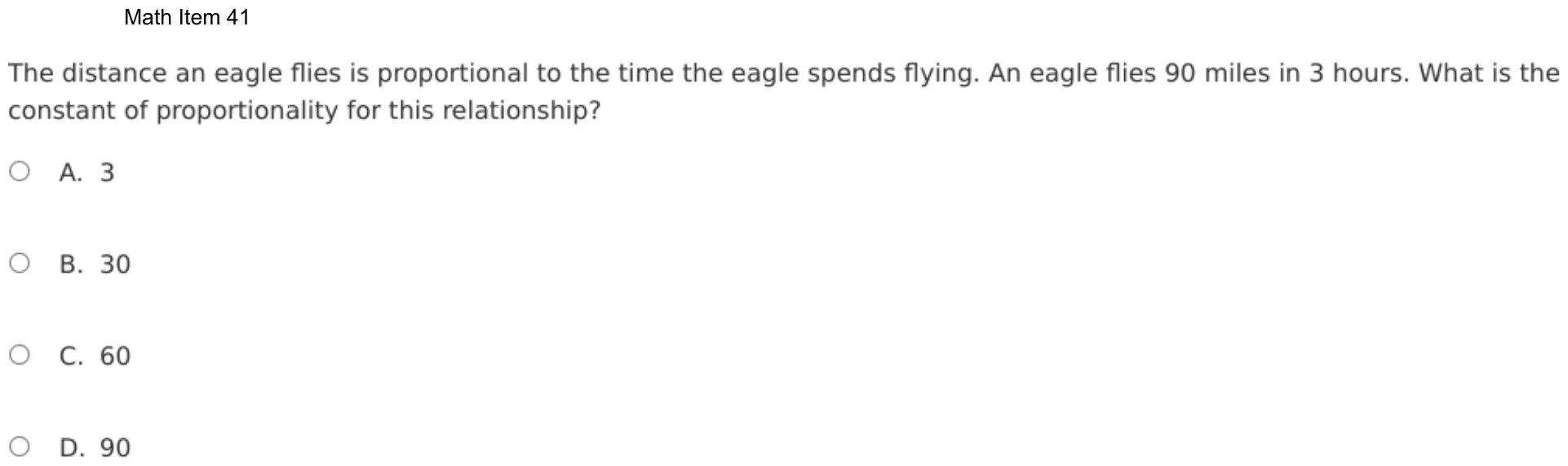
The distance an eagle flies is proportional to the time the eagle spends flying. An eagle flies 90 miles in 3 hours. What is the constant of proportionality for this relationship?
- A3
- B30
- C60
- D90
Show the answer
Correct answer: B
The constant of proportionality is the ratio of y (90) to x (3). . So the constant of proportionality is 30.
Question analysis
An eagle flies 90 miles in 3 hours, and the distance it flies is proportional to its flying time. This proportional relationship question asks for the constant of proportionality. Students need to know that the constant is the unit rate, here miles per hour, and find it from the two values given.
- NYS standards
- 7.RP.2b constant of proportionality
- Grade level
- Grade 7 content, by NYS standard
- Compared with grade 7
- Below grade 7 Grade 7 students find constants of proportionality in tables, graphs and equations. This one is a single division of miles by hours given in a sentence, the same unit rate work students do in grade 6.
- Estimated difficulty
- Routine: one familiar step, little to misread.
- Thinking it demands
- Depth of knowledge 1, recall and reproduction · mainly apply
- What makes it hard
- Solution
- 1 step
- Reading level
- Question and choices: about grade 7, 29 words.
- Students, last 30 days
- Not enough answers yet to show (it takes 10).
Why it is hard, traps and wrong answers (shows the answer)
Why it is hard
One division answers the question, so it is among the easiest on the test. The wrong choices are the two numbers in the stem and one unrelated value, so a student who knows what the constant means is not tempted. Checking that the constant times 3 hours gives back the 90 miles confirms it.
Something you must already know minor Working it out
Students must know that the constant of proportionality is the unit rate, distance over time, here the miles flown in a single hour; the stem gives only the term. (Anderson & Krathwohl, 2001)
Strategy: Divide the distance by the time, because the constant of proportionality is the distance flown in one hour, then check by multiplying it by the 3 hours.
Traps
- Numbers taken from the question: Combines the numbers in the question without a model of the situation, or is simply a number that appears in the question.
The wrong answers, classified
A Numbers taken from the question (Hegarty, Mayer & Monk, 1995)
Gives the 3 hours printed in the stem as the constant, instead of the miles flown in each hour.
C Little reason to choose it (Haladyna & Downing, 1993; Rodriguez, 2005)
No working from 90 miles and 3 hours leads to 60, which may echo the 60 minutes in an hour, so it mostly attracts guesses.
D Numbers taken from the question (Hegarty, Mayer & Monk, 1995)
Gives the 90 miles, the distance for the whole 3-hour flight, as if the eagle covered it in a single hour.
Worked solution, step by step
Formulas used
- Proportional relationship
- x is one amount, here the time in hours, and y is the other, here the distance in miles. k is the constant of proportionality. It is the same for every pair, and it equals y divided by x. Here it is the miles flown in 1 hour.
Sort out the question
The eagle flies 90 miles in 3 hours. Proportional means the distance is always the same number times the time. That number is the constant of proportionality. You need to find it.
Divide the distance by the time
Use the formula. The distance is y and the time is x:
The constant is 30. It means the eagle flies 30 miles in each hour.
Avoid the numbers in the question
Watch out: 3 is the number of hours, choice A. And 90 is the distance for all 3 hours, choice D. Neither is the distance for 1 hour.
So the answer is B, 30.
Check your answer
Multiply back. At 30 miles each hour, the eagle flies miles in 3 hours. That matches the question. Hour by hour, it goes 30, 60, then 90 miles.
More questions like this
The original DOE question