Let’s trace the history of the Specialized High Schools Admissions Test (SHSAT) from 1947 to 2019.
Special education for ability has always been controversial in New York City. These programs have typically been gated by students’ exam performance, which benefits from exposure to accelerated tutoring. In short, they’ve always benefited from family wealth.
📅 Jump to a year
1947 · 1950 · 1953 · 1964 · 1965 · 1966 · 1967 · 1969 · 1970 · 1971 · 1973 · 1974 · 1975 · 1976 · 1977 · 1978 · 1979 · 1980 · 1981 · 1987 · 1988 · 1992 · 1996 · 1997 · 2008 · 2018 · 2019
1947
The “Special Progress” program was established as an accelerated learning program in 1947. Even then, it replaced another acceleration program called “Rapid-Advancement” classes.
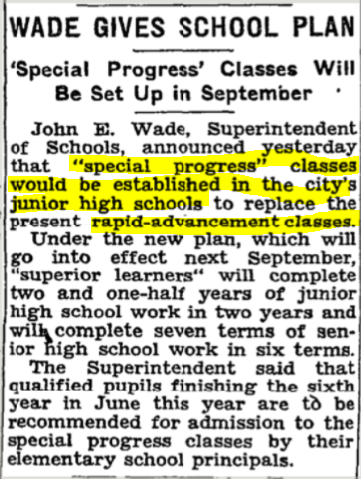
Source: “Wade Gives School Plan: ‘Special Progress’ Classes Will Be Set Up in September,” The New York Times, March 13, 1947.1
1950
Here’s an NYC notice for the “Special Schools” test, in 1950.
This is the earliest notice of the SHSAT exam predecessor I’ve seen in print, and it was 20 years before the Hecht-Calandra Act made this a state law.
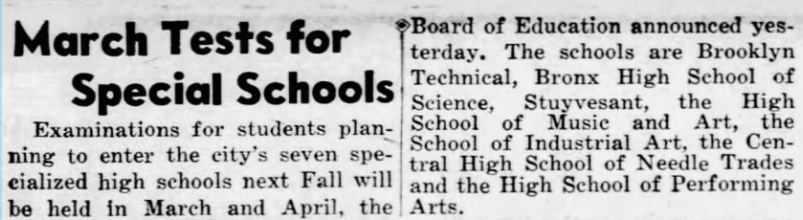
Source: “March Tests for Special Schools,” Daily News, February 12, 1950.2
1953
Now for IGC
“(pre-1970) days the Board of Education set city-wide standards for Intellectually Gifted Classes (IGC) in grades four to six – two years above grade level in reading and 1.5 years above in mathematics.” (Peter Goodman, Ed in the Apple)3
In 1953 IGC ( Intellectually Gifted Classes ) was not an official policy, and also small.4
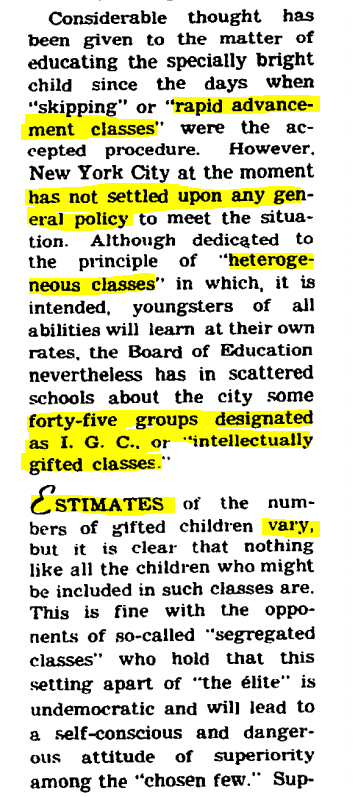
Source: “‘Gifted’ Children Need Help, Too,” The New York Times, May 10, 1953.
1964
In 1964 “Special Progress” program made it into the now infamous Parent And Taxpayers lawsuits.
They claim parents are being forced into Negro schools to attend SP. Little has changed in 60 years.
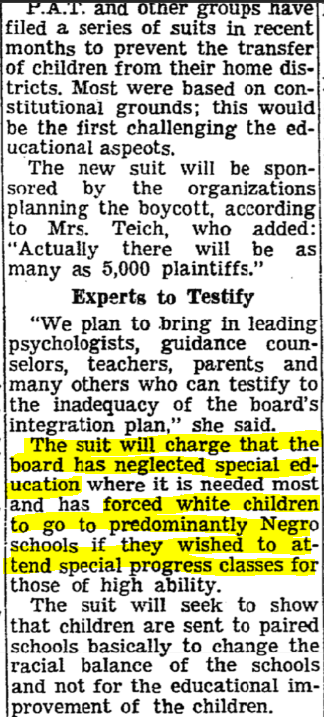
Source: “New Challenge to Schools Due: Suit Will Assert Integration Plan Hurts Education,” The New York Times, September 6, 1964.5
1965
The first discovery class was described as 80% “Black and Puerto-Rican”.
They were also labeled “Culturally Derived Youths Studying In Special Schools”
It was a “Dept. of Welfare” project labelled “Operation 2nd Chance”
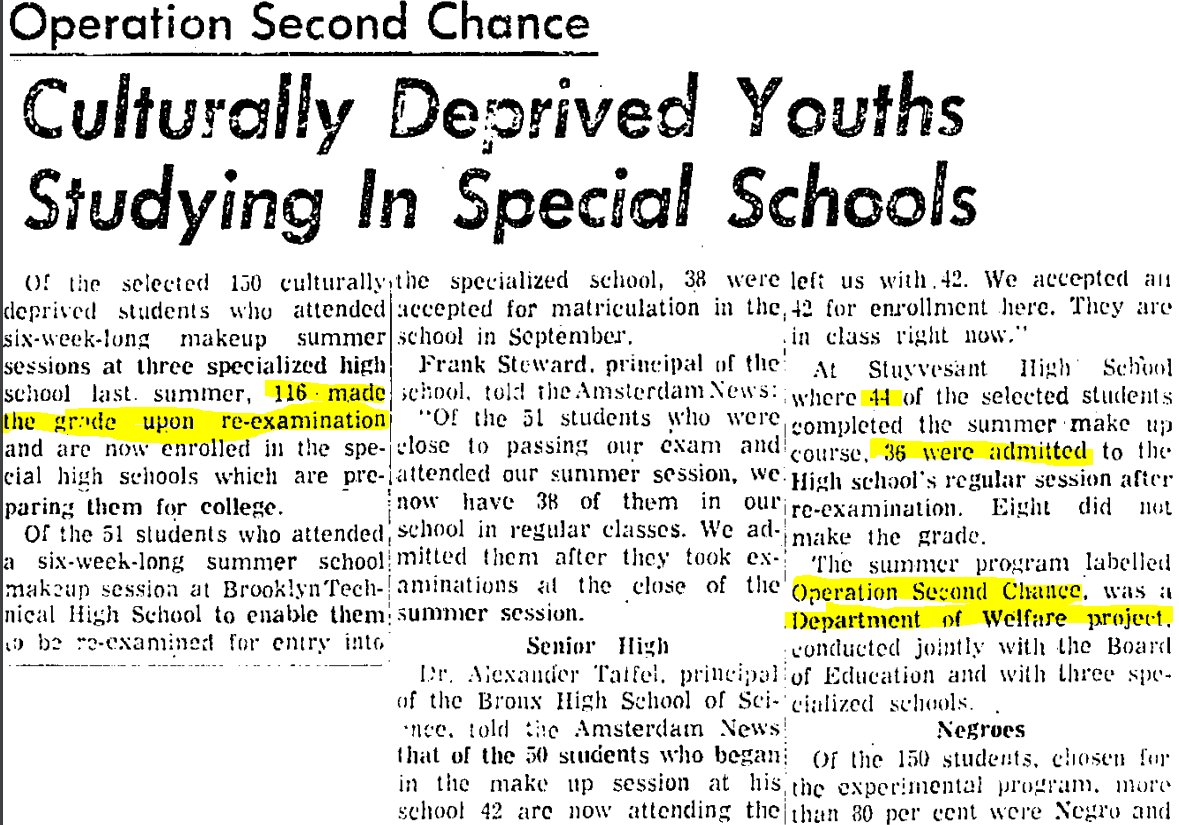
Source: “Operation Second Chance: Culturally Deprived Youths Studying in Special Schools,” New York Amsterdam News, October 9, 1965.6
1966
It’s amazing how stable NYC school population has remained for over 50 years.
Essentially there were the same number of seats in 1966. And about 200,000 fewer NYC students in total.
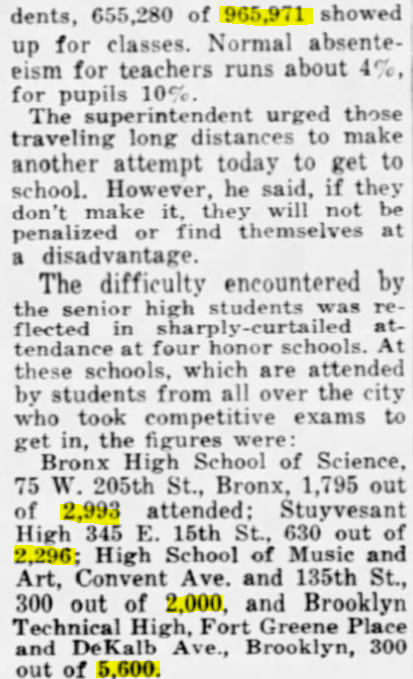
Source: Report on school attendance during the transit strike, Daily News, January 5, 1966.7
1966, Brooklyn Tech had 5800 students, 90% grad rate.
Keep in mind the school system would have been a lot smaller ( allowing a higher “rate” of students of all backgrounds into these schools )
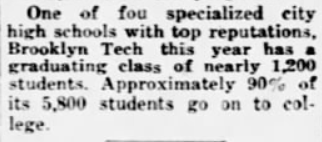
Source: “30 Seniors Criticize Brooklyn Tech,” The New York Times, June 16, 1966.8
Mayor Lindsay argues “it’s not the test, fix K8” in 1966! It’s amazing this excuse without action has been effective for 55 years. Each of these years, another set of promising students are denied a chance at these schools.
This excuse has always been a redirect of course
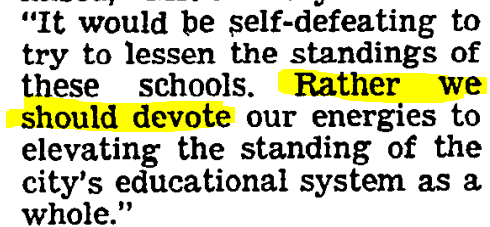
Source: The New York Times, 1966.
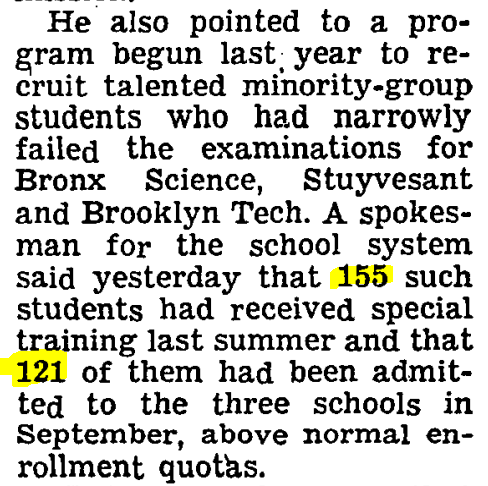
…more importantly, this NYTimes article also points to the start of the discovery program. 1965, with 155 students offered, and 121 students completing the program.
Source: The New York Times, 1966.
1967
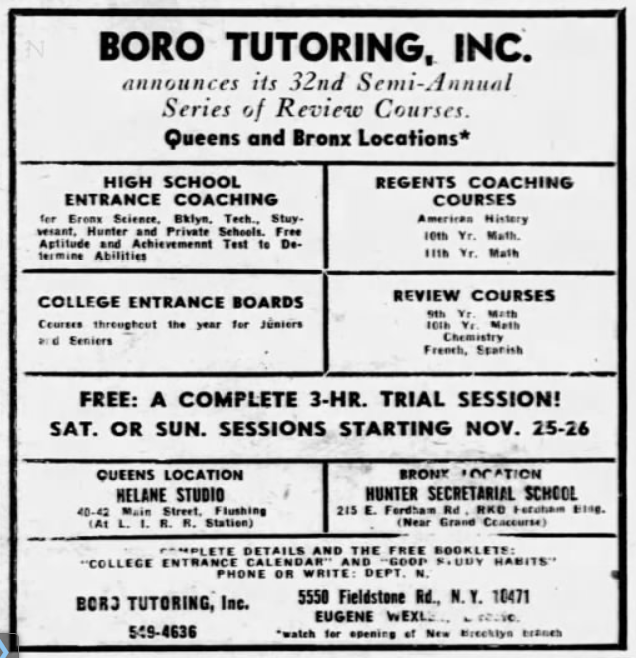
Ad for SHSAT tutoring in the Daily News. 13th Nov, 1967.
This is clearly an established and well-organized operation by that time.
Source: Boro Tutoring, Inc. advertisement, Daily News, November 13, 1967.9
1969
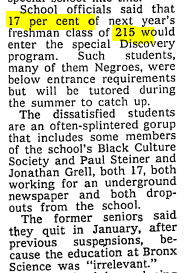
In 1969, Bronx Sci promised the next year’s “Discovery” class would be 17% of their 215 student cohort.
Source: “Bronx Science School Undaunted by Radicals’ Moves,” The New York Times, April 29, 1969.10
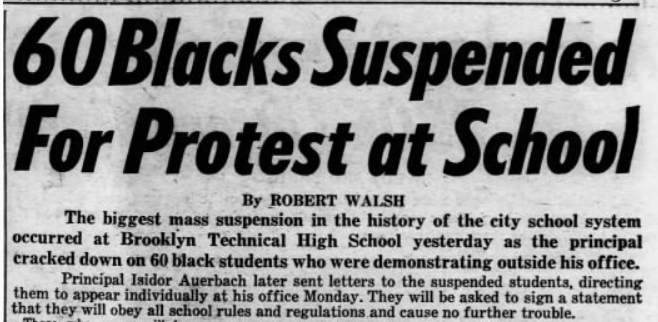
There were “450 Negroes” at Brooklyn Tech in 1969, 60 were suspended for protests. And according to NYDN, that was calm compared to other city schools.
To those wishing for the “good old days” of NYC Specialized High Schools.
Source: Robert Walsh, “60 Blacks Suspended for Protest at School,” Daily News, May 29, 1969.11
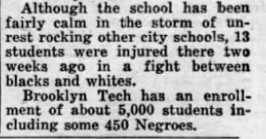
Source: Robert Walsh, “60 Blacks Suspended for Protest at School,” Daily News, May 29, 1969.
1970
Students file a class action complaining that they were “railroaded” into Brooklyn Tech. Jul 3, 1970
Brooklyn Tech didn’t have quite the draw it has today and was a bit easier to get into ( apparently )
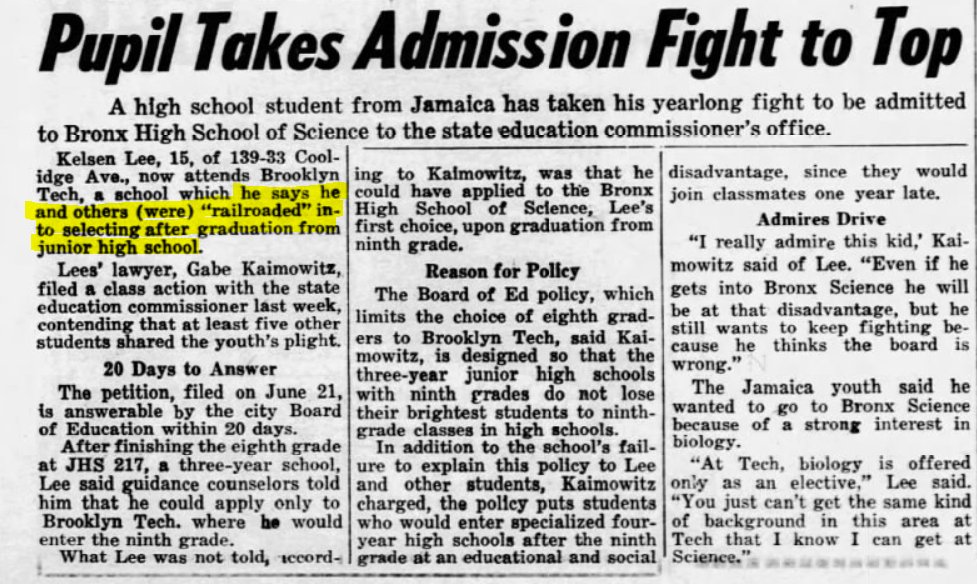
Source: “Pupil Takes Admission Fight to Top,” Daily News, July 3, 1970.12
➡️IGC was real, actual tracking
➡️Sts were promoted between 3-5 sessions by reading score or teacher recs (tracking mobility)
➡️E.g. 3 sessions of “general”, 1 session of “gifted”, highest session is “IGC”
➡️IGC likely went away with the 70s tracking ban13
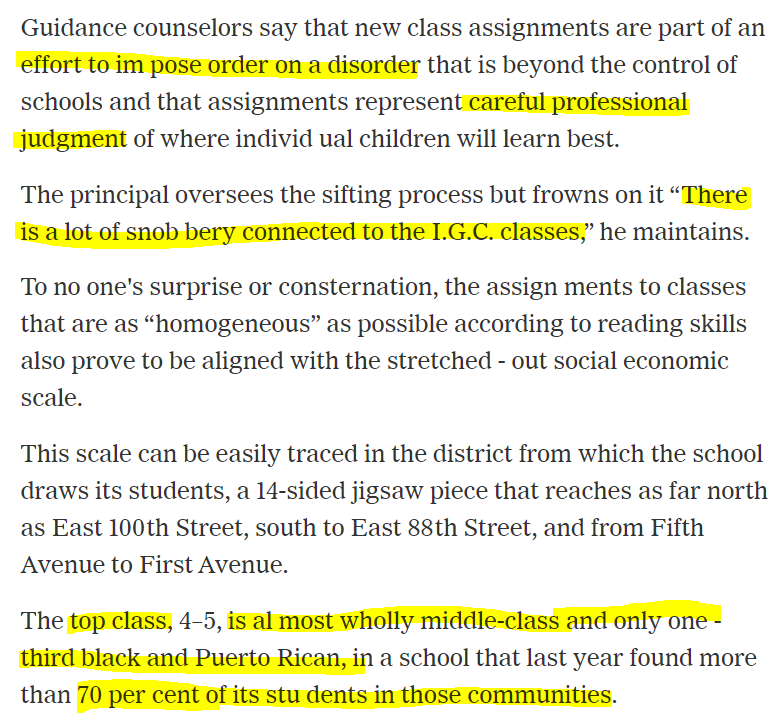
Source: “Class 4-4: Educational Theories Meet Reality,” The New York Times, October 9, 1970.
Sounds very familiar…
This is about Harvey Scribner, who the Hecht-Calandra Act was written to block in 1971. He was seen as an outsider, reformer, and leftist by the education establishment. And he had to be stopped.
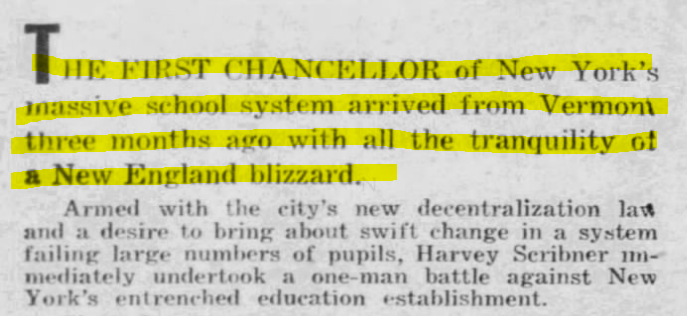
Source: Bert Shanas, first of two articles on Chancellor Harvey Scribner, Daily News, December 3, 1970.14
1971
The justification of the NYS Hecht-Calandra Act in Hecht’s own words.
H-C Act was a response to a *possible* future attempt at modifying school admissions policy. NY Democrats still justify this today.
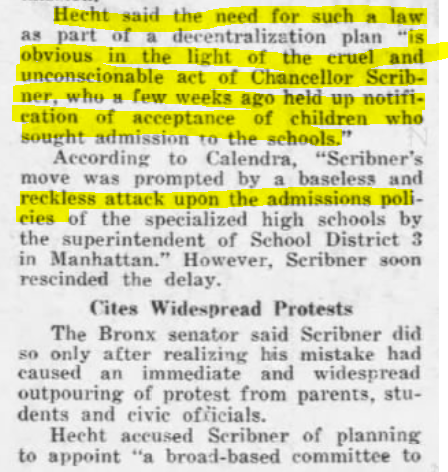
Source: Article on the Hecht-Calandra bill quoting Assemblyman Hecht and Senator Calandra, Daily News, April 4, 1971.15
To all of those who accuse Mayor de Blasio of starting this SHSAT discussion.
From 1971 when the Hecht-Calandra bill was passed…16

Source: “Assembly Votes High School Curb,” The New York Times, May 20, 1971.
From here to the end of 1971, the letters, memos and editorials are from the Governor’s bill jacket for the act, which is on this site in full.
The Daily News:
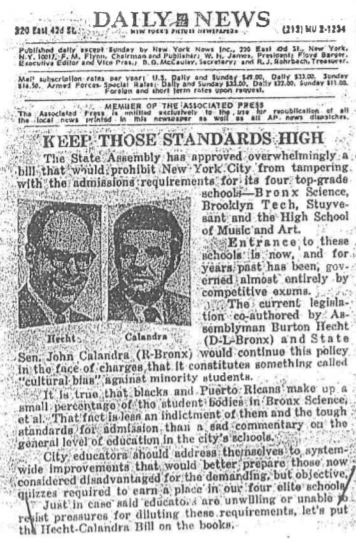
Source: “Keep Those Standards High,” editorial, Daily News, May 24, 1971, in the Governor’s bill jacket.17
The editorial that possibly started it all?
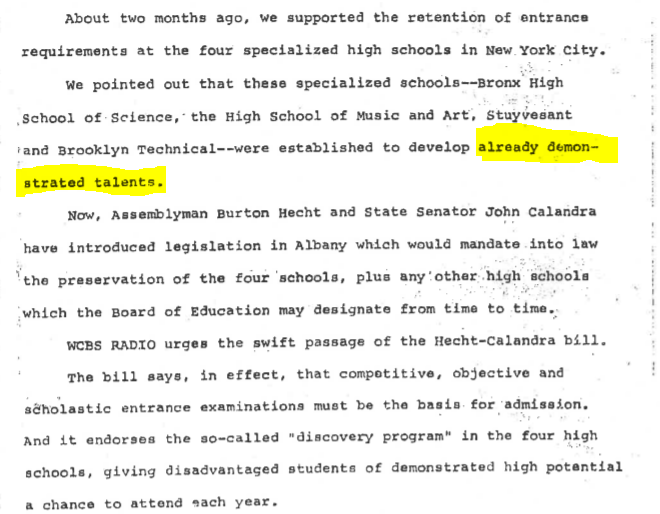
Source: WCBS Radio editorial, in the Governor’s bill jacket.18
The City Council is partly responsible, urging the Governor to sign Hecht-Calandra because supposedly they had little control over the BoE.
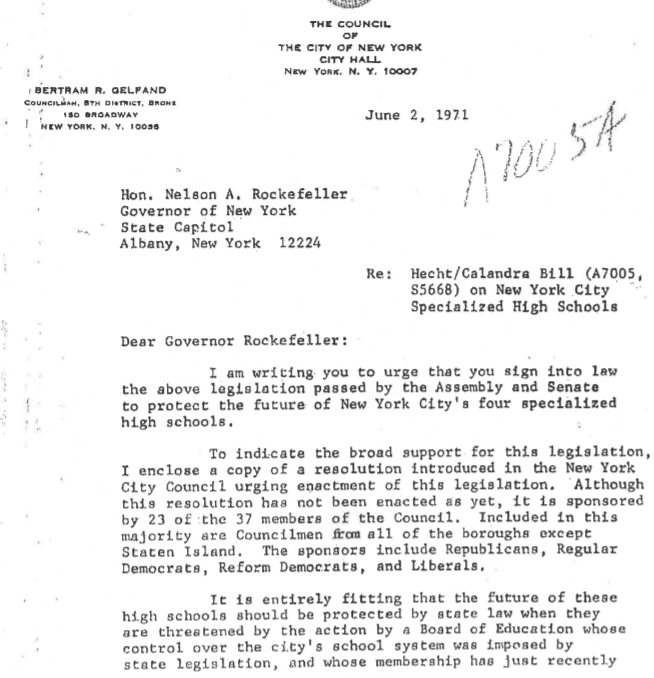
Source: Letter from City Councilman Bertram R. Gelfand to Governor Rockefeller, June 2, 1971, in the Governor’s bill jacket.
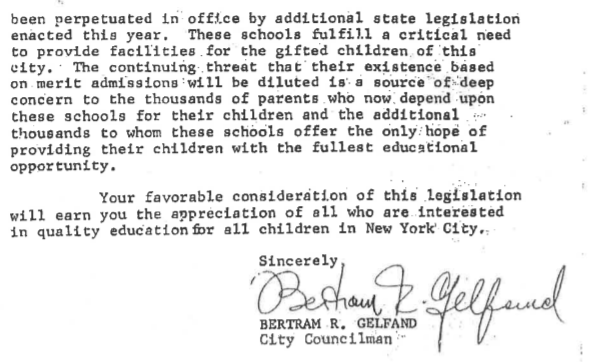
Source: Councilman Gelfand’s letter, page 2, in the Governor’s bill jacket.
The State Education Department urged a veto
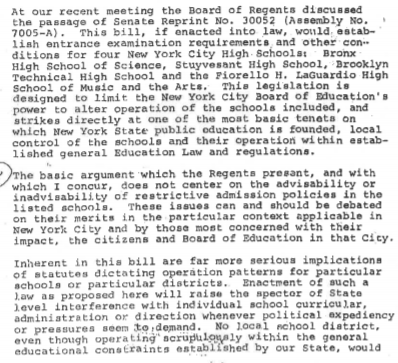
Source: Memorandum on the Board of Regents’ discussion of the bill, in the Governor’s bill jacket.
The BoE argued it had no intention of changing the law, and just wanted the study to be completed.
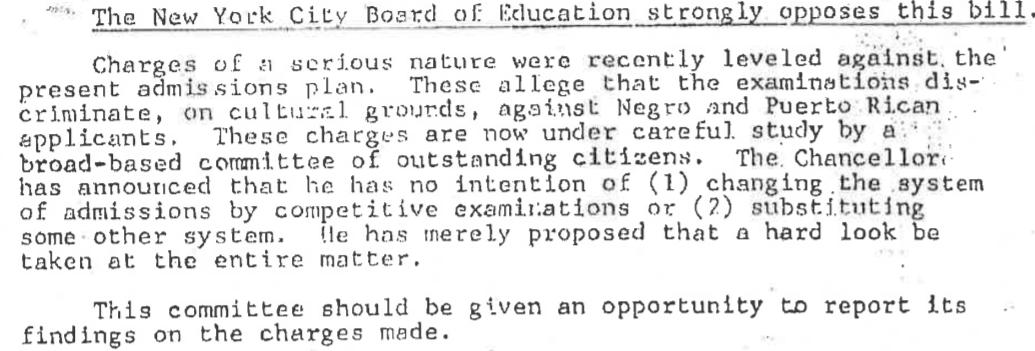
Source: Statement of the New York City Board of Education, in the Governor’s bill jacket.
Teens Take Charge: 1970 edition…
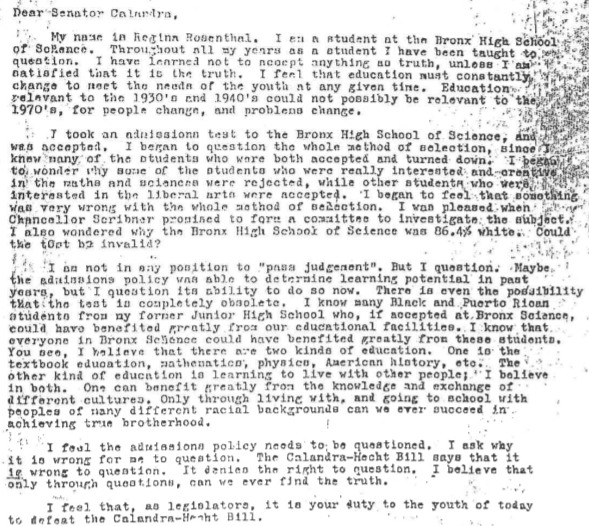
Source: Letter from Regina Rosenthal, a Bronx Science student, to Senator Calandra, in the Governor’s bill jacket.
Arguments against Hecht-Calandra from 1970 seem like they were written today…
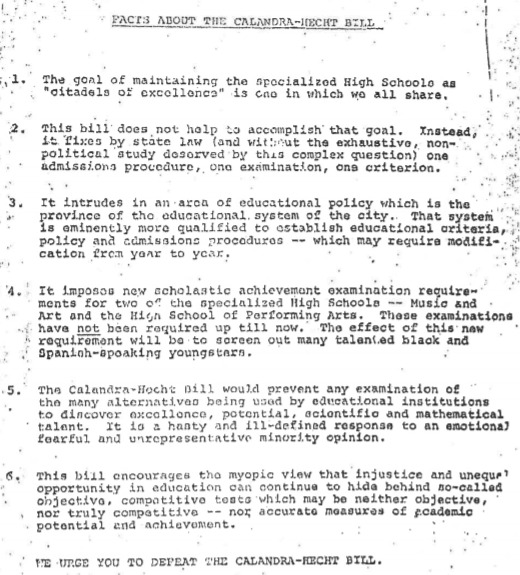
Source: The leaflet “Facts About the Calandra-Hecht Bill,” in the Governor’s bill jacket.
In ’69 Stuyvesant had 15% discovery offers, last year it had 0%. But SHSAT supporter like Jumaane Williams will keep asking you “what has changed?”, implying its the students.
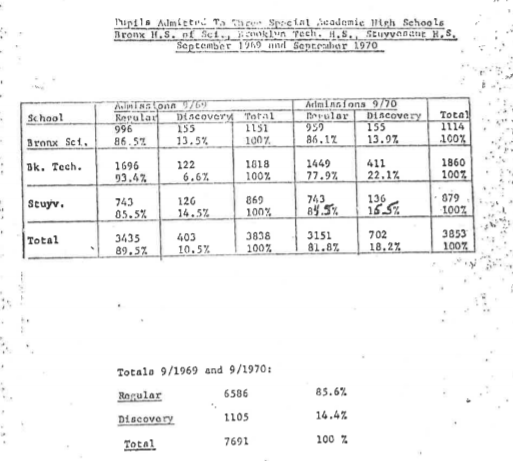
Source: Pupils admitted to Bronx Science, Brooklyn Tech and Stuyvesant, 1969 and 1970, in the Governor’s bill jacket.
The Bronx Science administration and faculty OPPOSED Hecht-Calandra and called for its defeat.
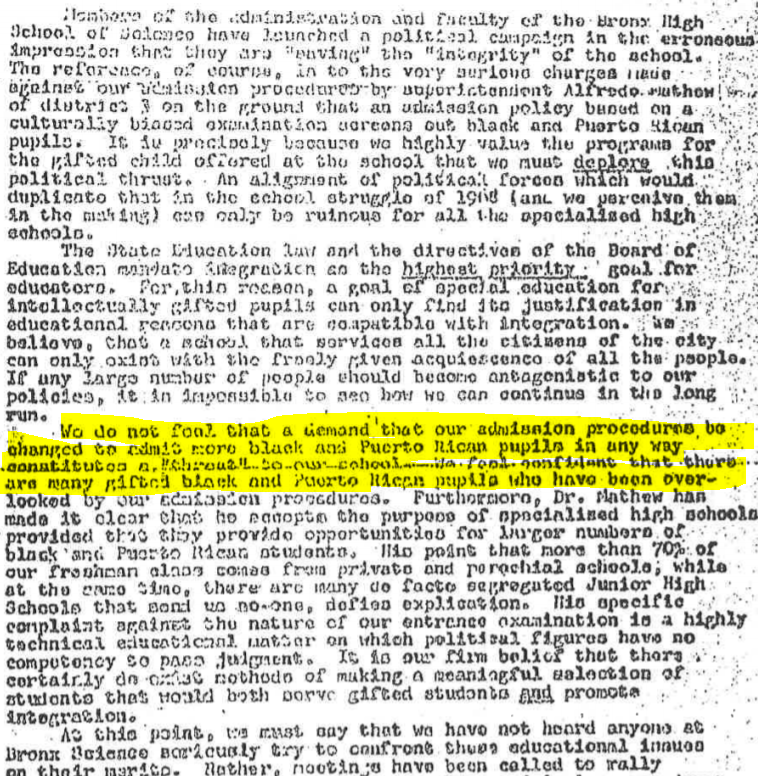
Source: Statement by members of the Bronx Science administration and faculty, in the Governor’s bill jacket.
The City Bar Association opposed Hecht-Calandra even back then…
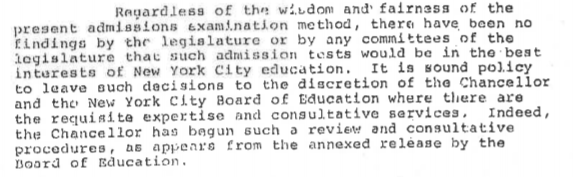
Source: City Bar Association memorandum, in the Governor’s bill jacket.
Though the Bronx Science principal approved…
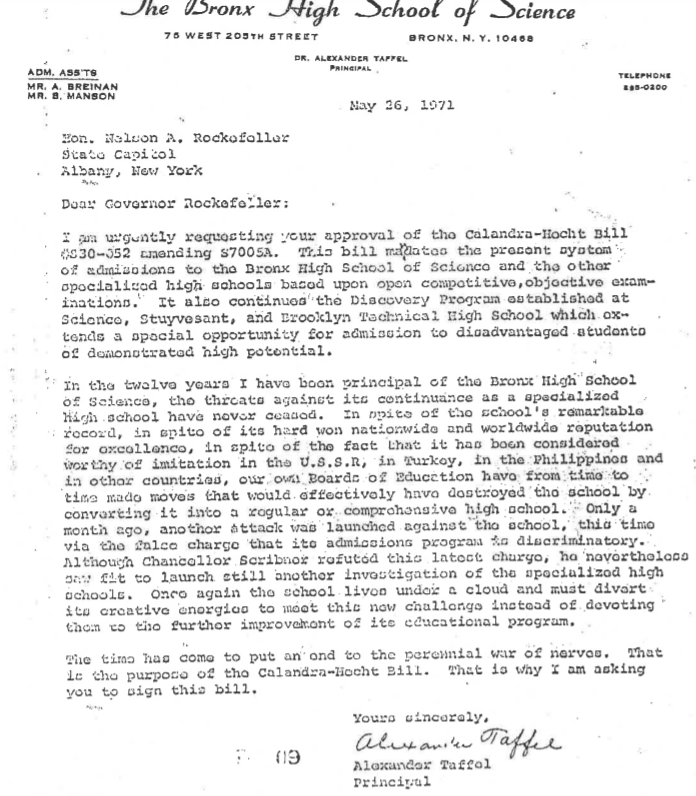
Source: Letter from Bronx Science principal Alexander Taffel to Governor Rockefeller, May 26, 1971, in the Governor’s bill jacket.
In Democratic assemblymember Hecht’s own words…
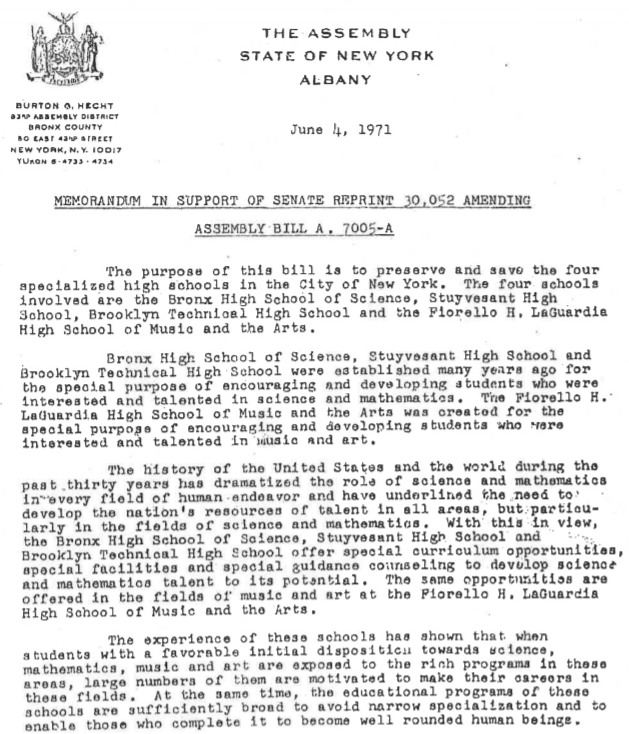
Source: Assemblyman Burton G. Hecht’s memorandum in support of the bill, June 4, 1971, in the Governor’s bill jacket.
1973
NYC’s elementary G&T program was started with the Astor grant in 1973.
This was followed by national funding and attention paid to the “plight” of gifted students through the early 80s.
By ’88, 20% of NYC’s students were G&T.19
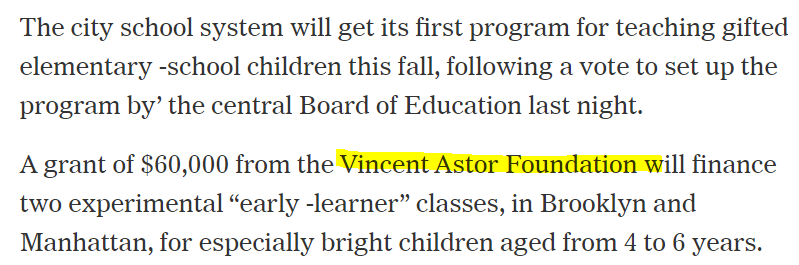
Source: “Gifted Grade Schoolers To Get Special Instruction,” The New York Times, August 16, 1973.
1974
50 years later that is still true.
Though almost 70 years of K12 integration, the north has stubbornly held its title. While hypocritically mocking the south.20
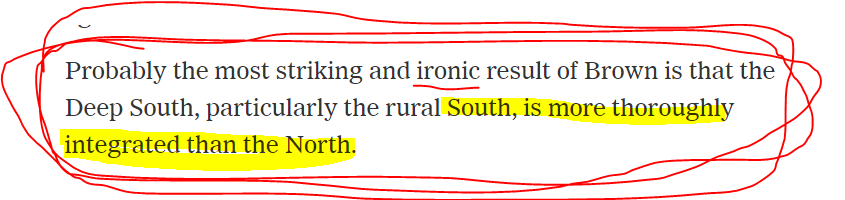
Source: “School Integration Order of ’54 Did Much, but Much Is Undone,” The New York Times, May 12, 1974.
This article from 1974 pretty much sums up what happened to “Special Progress” classes. It also, in my mind, hints as to why the SP classes would not have been the solution to desegregating our Specialized HSs21
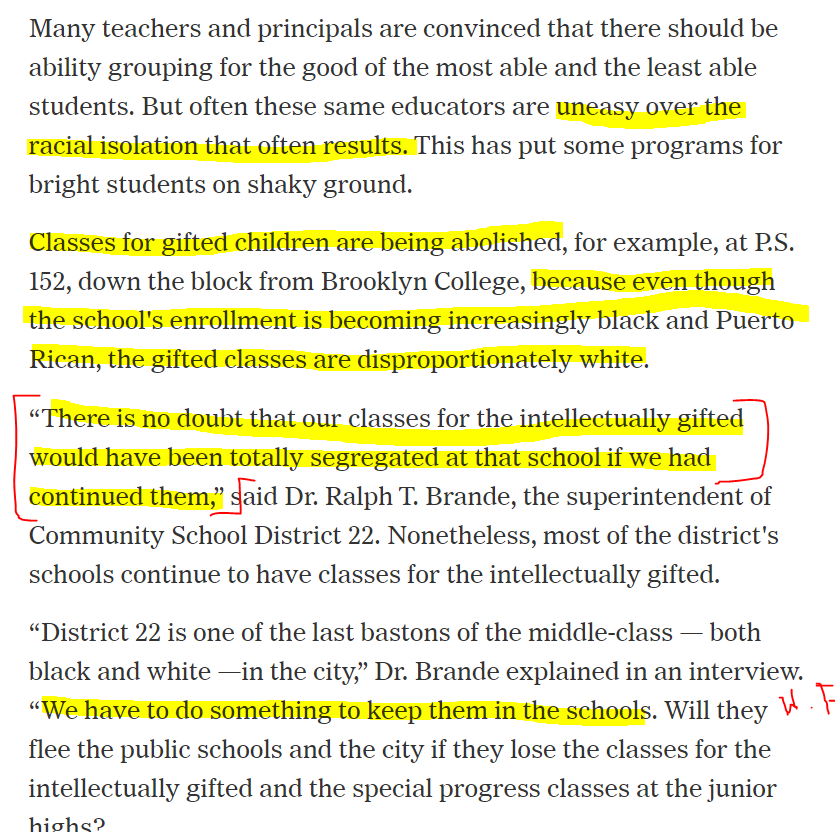
Source: “2 Ideals at Issue,” The New York Times, May 22, 1974.
1975
In 2 years, the G&T pilot program had not been expanded from the original 2 classes but was generating a lot of buzz.22
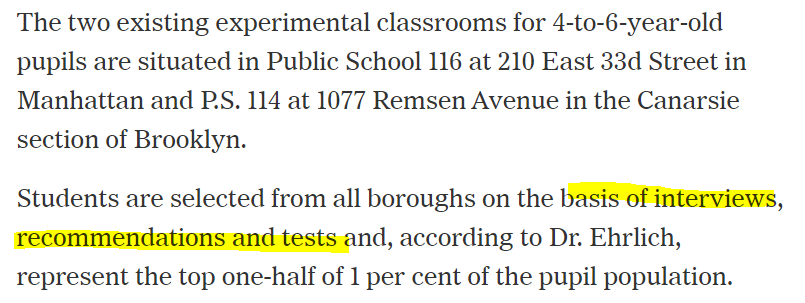
Source: “Pilot Project Aids Gifted Children in City Schools,” The New York Times, May 11, 1975.
1976
The “tracking” system was abolished in 1973, the same year G&T was created. Coincidence?23
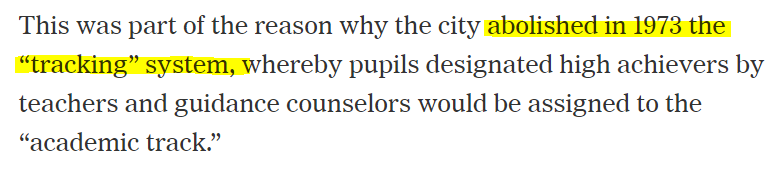
Source: “Minorities and Hidden Gifts,” The New York Times, April 25, 1976.
1977
SP classes were dogged with segregation issues throughout its life, but this came to head in the late 60s and 70s through the civil rights movement then.
In a sense, SP was seen as an alternative to “White flight”, referenced in this article24
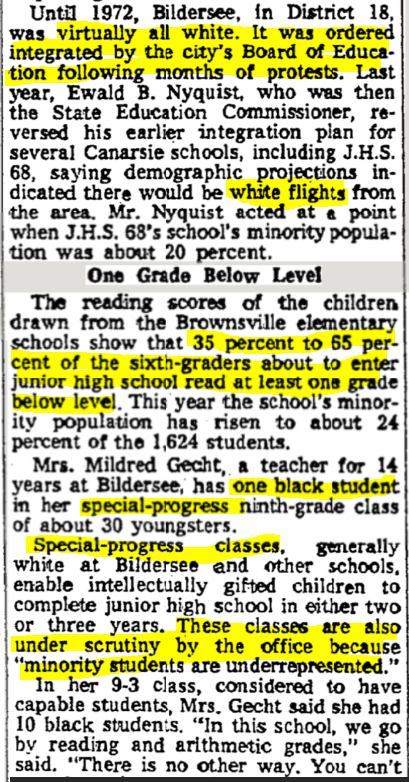
Source: “Board Says Segregated Classes Resulted From Federal Programs,” The New York Times, November 13, 1977.
By year 4, 1977, G&T was already being used as a segregation tool25
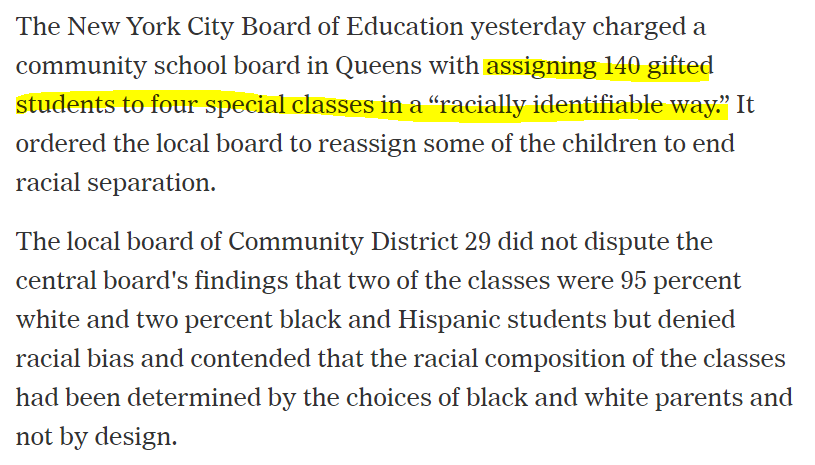
Source: “Queens School Board Told to Shift Racially Separated Gifted Students,” The New York Times, December 14, 1977.
1978
SP programs heavily screened students. E.g. Mark Twain admissions requirements below.26
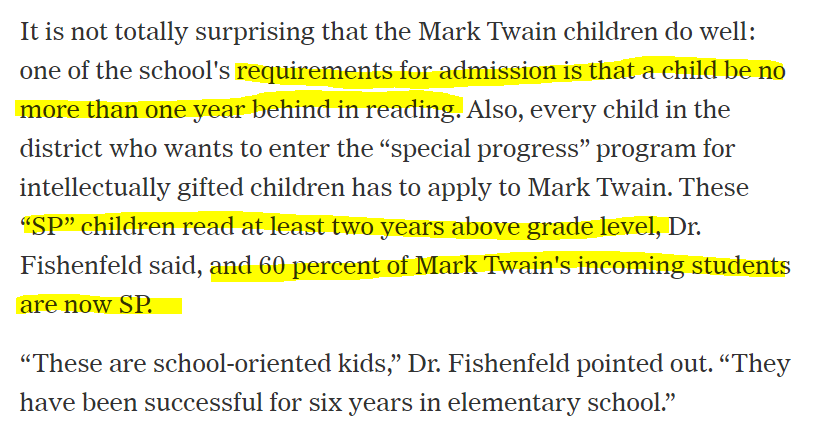
Source: “New York’s Best Public Schools Defy Racial Stereotyping,” The New York Times, January 23, 1978.
After Mark Twain was ruled unconstitutionally segregated, it was ordered to be a “Special Progress” magnet
The result was that the 80 Black/PR school became 70% White.
Today it’s 13% B/L, 52% White, and 28% Asian students.
“Special Progress”, like all other G&T segregates!
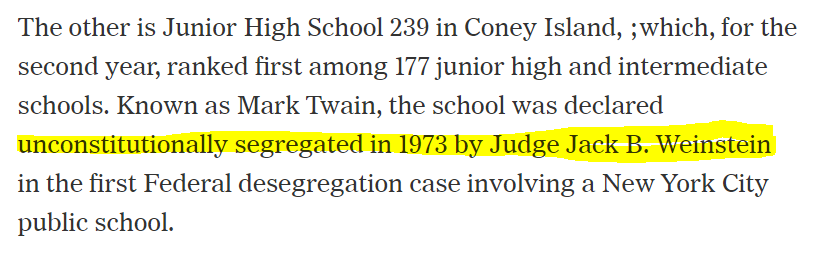
Source: “New York’s Best Public Schools Defy Racial Stereotyping,” The New York Times, January 23, 1978.
That tracking decision was later reversed when the OCR complaint against the SHSAT failed.
Not sure if the “quota” framing is correct ( certainly doesn’t apply today ). But may show why the 2 existing OCR complaints probably won’t succeed.27
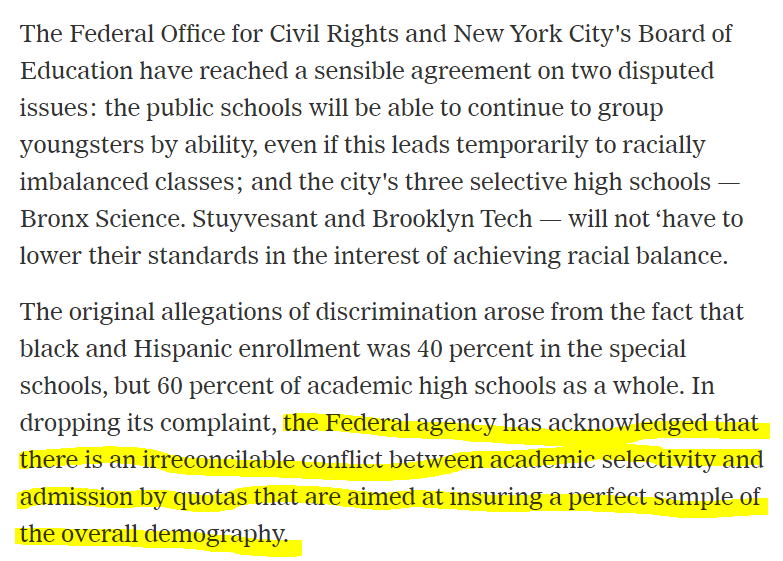
Source: “On the Right Track,” The New York Times, June 17, 1978.
A bit more on the OCR complaint.28
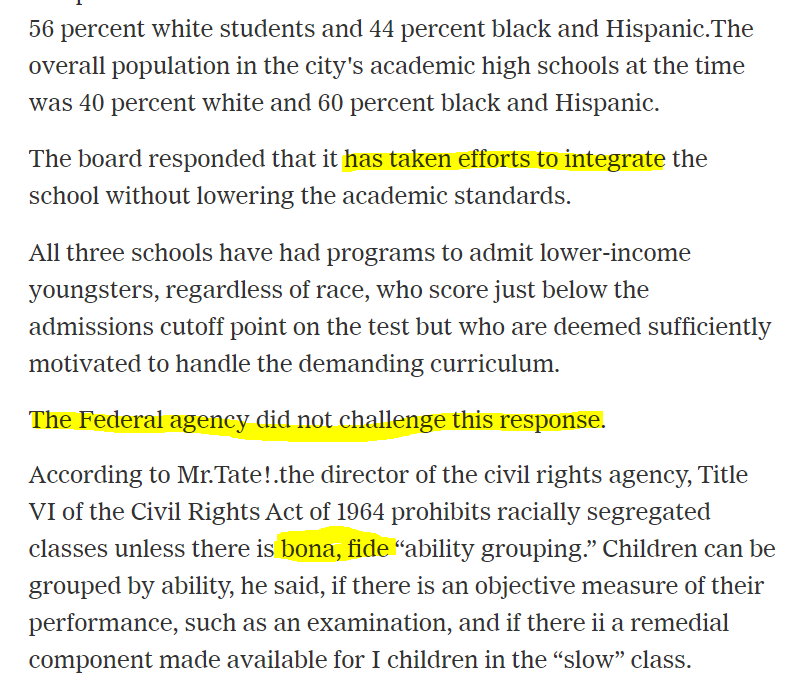
Source: “Grouping by Ability Of Students Upheld For New York City,” The New York Times, June 16, 1978.
SHSAT History: NY Times article on the then “Special Progress” program, providing in-school SHSAT test prep in the Bronx. Dec 12th 197829
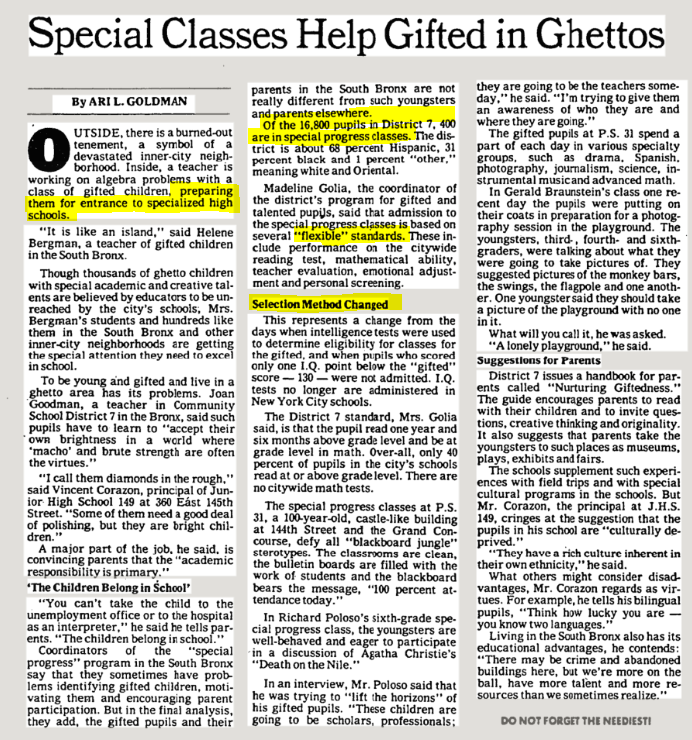
Source: “Special Classes Help Gifted in Ghettos,” The New York Times, December 12, 1978.
1979
in 1979
1. Koch prioritized building out an already expanded G&T that was in all 32 districts.
2. Didn’t mind large class sizes
3. Argued G&T was supposed to stem “White Flight” (a reoccurring theme)
4. Only 8 districts had G&T below 4th grade30
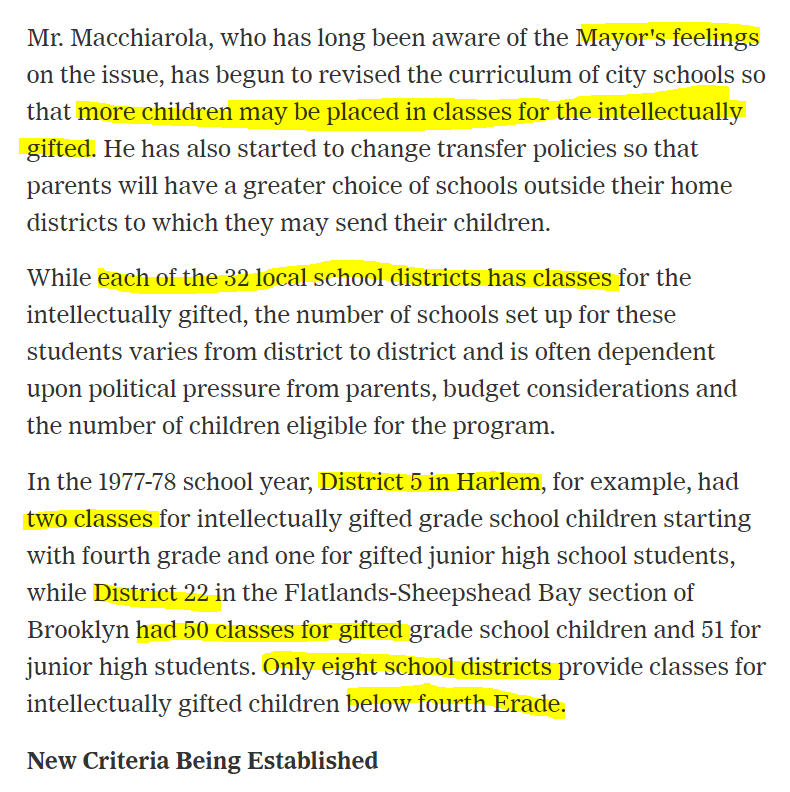
Source: “City’s Schools Seek to Attract Middle Class,” The New York Times, October 29, 1979.
So now we know how we got to 20% of students G&T by the mid-eighties
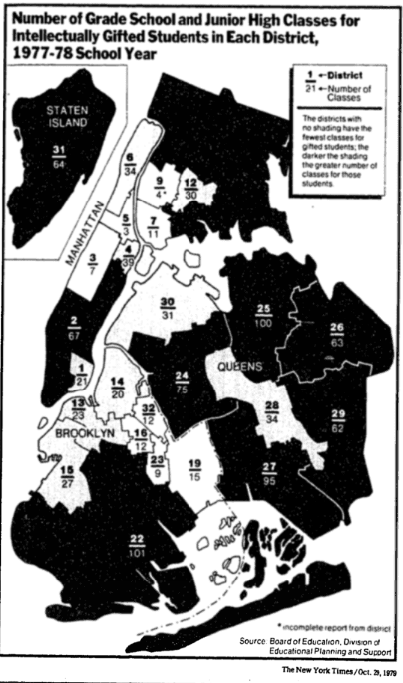
Source: a map printed with “City’s Schools Seek to Attract Middle Class,” The New York Times, October 29, 1979.
1980
One overlooked aspect of G&T’s decline is the decline of federal funds for G&T. Local boards were increasingly on the hook for the popular programs.
“Program for Gifted Pupils Stirs Dispute in Brooklyn” NYTimes, November 24, 1980
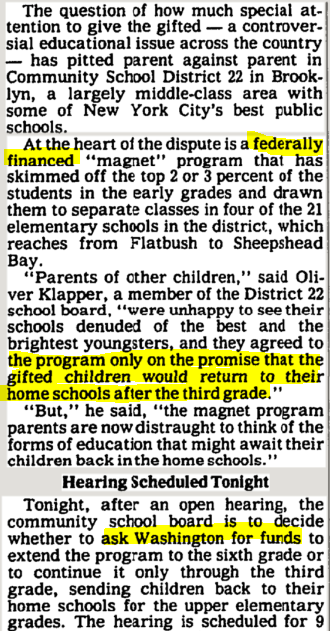
Source: “Program for Gifted Pupils Stirs Dispute in Brooklyn,” The New York Times, November 24, 1980.31
1981
In ’81 they knew that the G&T admissions tests were undercounting promising students.
40 years later, we’re even worse of.32

Source: “Tests Faulted for Inability to Measure Creativity,” The New York Times, July 28, 1981.
1987
This 1987 article gives us a little more insight into an SP school. It’s really not that impressive if you understand what’s happening.
The school is now a magnet drawing 120 bussed-in students into a 200 sts program.
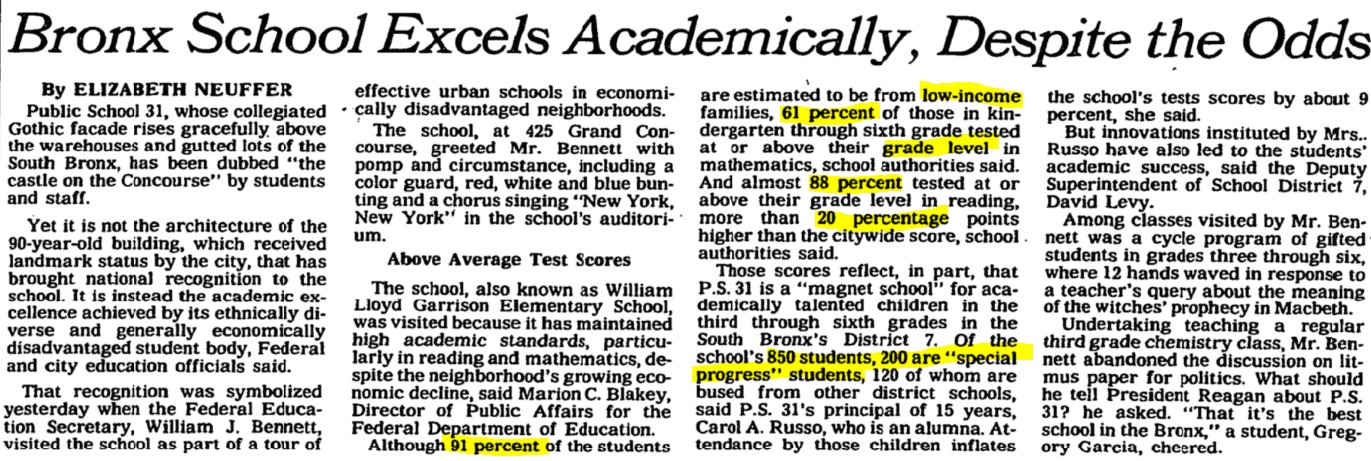
Source: “Bronx School Excels Academically, Despite the Odds,” The New York Times, January 14, 1987.33
It’s clear that by 1987 the promising little “Special Progress” program we saw in 1978 has been a “program” version of today’s “Bronx Science”.
Students visit the Bronx to attend school then get the heck out.
Not going to go into the budget too much. But there’s a general question of “Why sharp cuts when Koch was so pro-G&T?”
From G&T having 20% total NYC students to ~5% on his watch?
Also, why fed pullback?
One possibility is “Black Monday” Oct 19, 198734
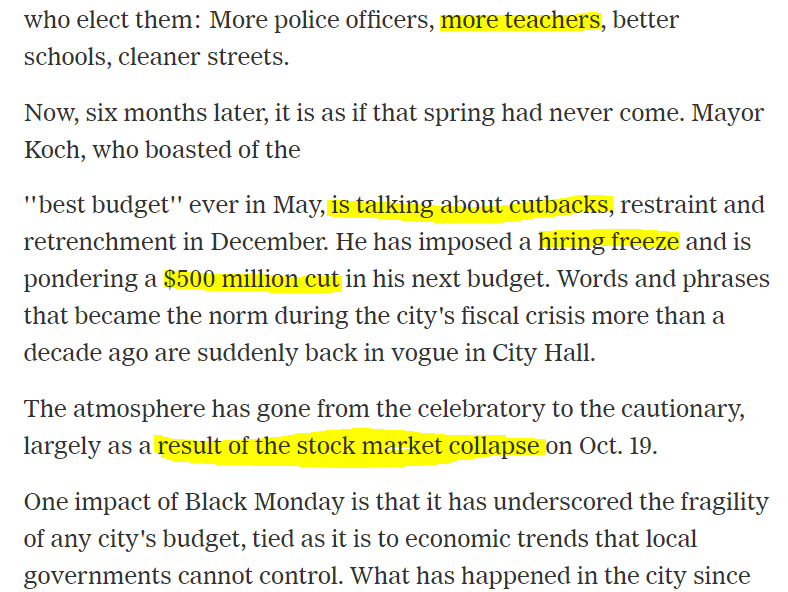
Source: “City’s Mood Dips From the Celebratory to the Cautionary,” The New York Times, December 13, 1987.
1988
In 1988, 20% of NYC’s 936K students were in G&T.
PS. These schools were heavily protested by Black parents35
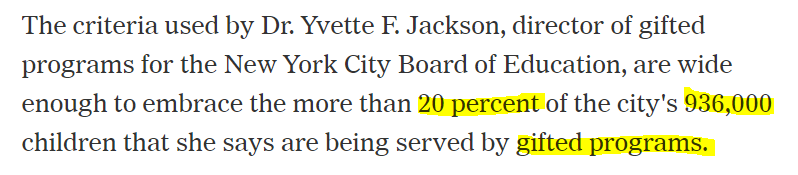
Source: “Teachers of the Gifted Fight Accusations of Elitism,” The New York Times, March 16, 1988.
Almost 1/3 of some schools were G&T.

Source: “Teachers of the Gifted Fight Accusations of Elitism,” The New York Times, March 16, 1988.
1992
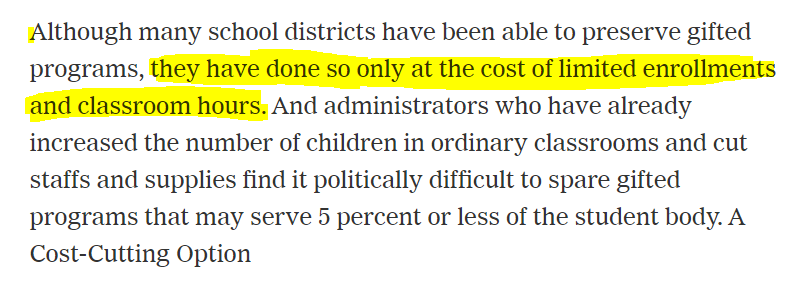
1992 G&T Est. <5%
Ultimately, G&T’s sharp reduction from the ’80-’90s was almost certainly due to budget cuts and nothing else.
The feds stopped pumping money into G&T, and local expenses grew for regular classes. G&T was squeezed out of the budget.36
Source: “Education for the Gifted, Seen As a Luxury, Faces Cutbacks,” The New York Times, November 29, 1992.
1996
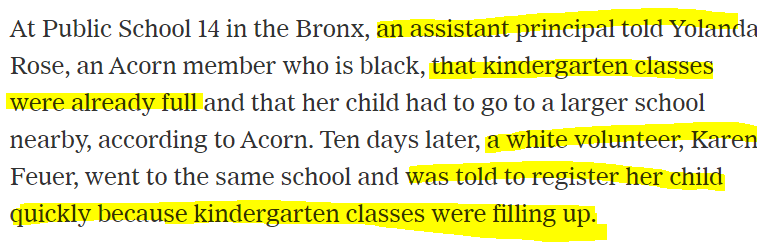
More on the ACORN sting.
It’s clear B/L students were being kept out of G&T programs (already only 4.5% in total), so how could they be responsible for B/L Specialized HS success at the same time?
1996 represented the last year BKTech was 50% B/L.37
Source: “School Disparities Cited in Gifted Programs,” The New York Times, April 16, 1996.
1997
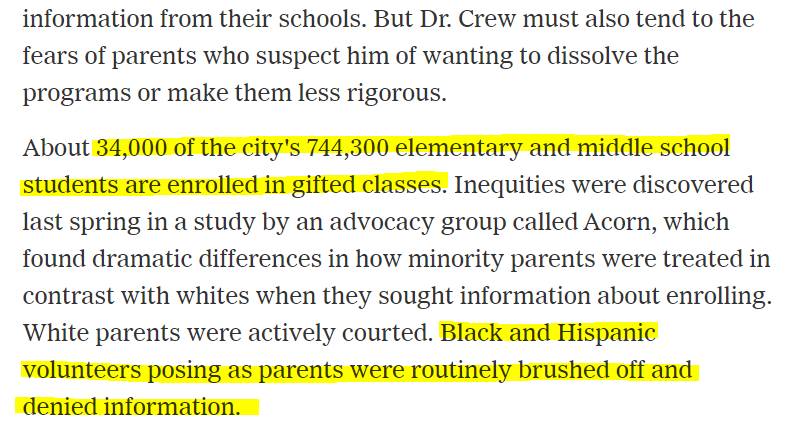
It’s 1997
➡️G&T participation is 4.5%
➡️Chancellor Crew pushes local-norming in response to racism found in undercover testing (Klein reversed this under Bloomberg claiming we wanted to INCREASE diversity)38
Source: “The Battle Over Gifted Programs,” The New York Times, March 5, 1997.
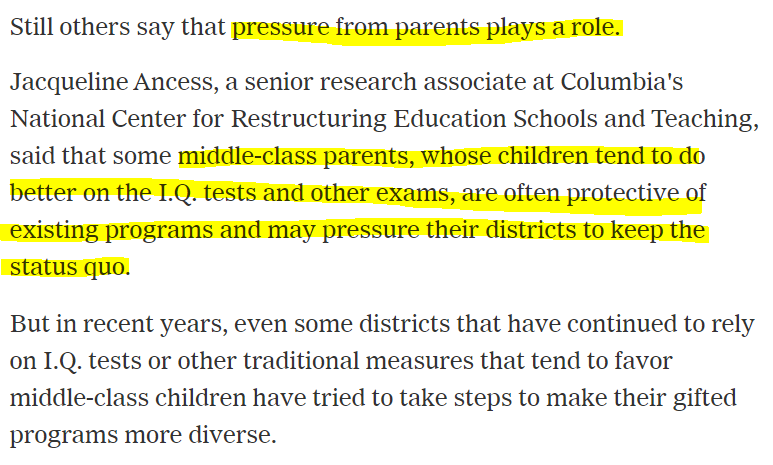
Here’s more evidence Chancellor Klein is full of it. Even that year another article noted that multiple-measures were standard in urban systems and also discussed issues with IQ tests.
Just a few years before Klein when in that direction.39
Source: “Gifted Programs’ Criteria Vary Widely,” The New York Times, February 28, 1997.
Chancellor Crew spent a lot of political capital reforming G&T admissions. He insisted that we stopped using a single normative exam.
Again, compare to Klein who mandated the exact opposite a few years later.40
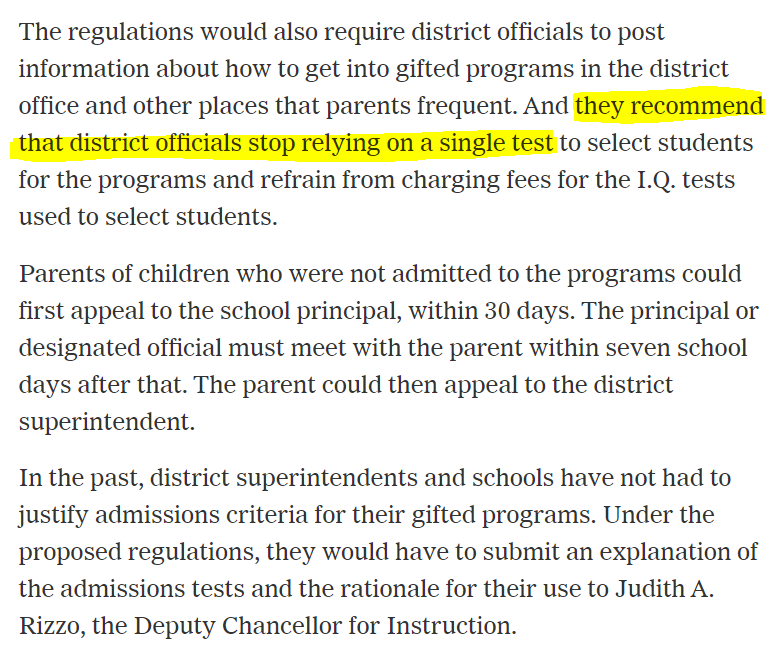
Source: “Crew Proposes New Oversight On Programs For the Gifted,” The New York Times, April 4, 1997.
2008
In 2008, after the Klein/Bloomberg switch to nationally-normed G&T admissions/identification, elementary G&T was at 3.5% participation. Down from about 20% in the mid-80s41

Source: “Fewer Children Entering Gifted Programs,” The New York Times, October 30, 2008.
2018
Today. G&T isn’t much or even any better integrated than in the 70s.
The Black and Latinx student population is now ~70% of the total, but 27% of G&T.42

Source: “New York City gifted programs show progress towards modest student diversity goals,” Chalkbeat New York, June 1, 2018.
2019
The continued search for “What happened to SP” evidence turns up Peter Goodman’s blog, Ed in the Apple, with a nice summary. Also sources Diane Ravitch’s “The Great School Wars: New York City, 1805-1973“43
📰 References
The articles, blog posts and documents cited above, for the text and the clippings, numbered in the order they appear. Each number links here, and ↩︎ goes back.
- “Wade Gives School Plan: ‘Special Progress’ Classes Will Be Set Up in September,” The New York Times, March 13, 1947. ↩︎
- “March Tests for Special Schools,” Daily News, February 12, 1950. ↩︎
- “Is ‘Gifted Education’ an excuse for ‘Segregated Education?’” Ed in the Apple (Peter Goodman’s blog), June 3, 2018. ↩︎
- “‘Gifted’ Children Need Help, Too,” The New York Times, May 10, 1953. ↩︎
- “New Challenge to Schools Due: Suit Will Assert Integration Plan Hurts Education,” The New York Times, September 6, 1964. ↩︎
- “Operation Second Chance: Culturally Deprived Youths Studying in Special Schools,” New York Amsterdam News, October 9, 1965. ↩︎
- Report on school attendance during the transit strike, Daily News, January 5, 1966. ↩︎
- “30 Seniors Criticize Brooklyn Tech,” The New York Times, June 16, 1966. ↩︎
- Boro Tutoring, Inc. advertisement, Daily News, November 13, 1967. ↩︎
- “Bronx Science School Undaunted by Radicals’ Moves,” The New York Times, April 29, 1969. ↩︎
- Robert Walsh, “60 Blacks Suspended for Protest at School,” Daily News, May 29, 1969. ↩︎
- “Pupil Takes Admission Fight to Top,” Daily News, July 3, 1970. ↩︎
- “Class 4-4: Educational Theories Meet Reality,” The New York Times, October 9, 1970. ↩︎
- Bert Shanas, first of two articles on Chancellor Harvey Scribner, Daily News, December 3, 1970. ↩︎
- Article on the Hecht-Calandra bill quoting Assemblyman Hecht and Senator Calandra, Daily News, April 4, 1971. ↩︎
- “Assembly Votes High School Curb,” The New York Times, May 20, 1971. ↩︎
- “Keep Those Standards High,” editorial, Daily News, May 24, 1971, in the Governor’s bill jacket. ↩︎
- Governor’s bill jacket for the Hecht-Calandra Act (Chapter 1212 of the Laws of 1971), on this site. ↩︎
- “Gifted Grade Schoolers To Get Special Instruction,” The New York Times, August 16, 1973. ↩︎
- “School Integration Order of ’54 Did Much, but Much Is Undone,” The New York Times, May 12, 1974. ↩︎
- “2 Ideals at Issue,” The New York Times, May 22, 1974. ↩︎
- “Pilot Project Aids Gifted Children in City Schools,” The New York Times, May 11, 1975. ↩︎
- “Minorities and Hidden Gifts,” The New York Times, April 25, 1976. ↩︎
- “Board Says Segregated Classes Resulted From Federal Programs,” The New York Times, November 13, 1977. ↩︎
- “Queens School Board Told to Shift Racially Separated Gifted Students,” The New York Times, December 14, 1977. ↩︎
- “New York’s Best Public Schools Defy Racial Stereotyping,” The New York Times, January 23, 1978. ↩︎
- “On the Right Track,” The New York Times, June 17, 1978. ↩︎
- “Grouping by Ability Of Students Upheld For New York City,” The New York Times, June 16, 1978. ↩︎
- “Special Classes Help Gifted in Ghettos,” The New York Times, December 12, 1978. ↩︎
- “City’s Schools Seek to Attract Middle Class,” The New York Times, October 29, 1979. ↩︎
- “Program for Gifted Pupils Stirs Dispute in Brooklyn,” The New York Times, November 24, 1980. ↩︎
- “Tests Faulted for Inability to Measure Creativity,” The New York Times, July 28, 1981. ↩︎
- “Bronx School Excels Academically, Despite the Odds,” The New York Times, January 14, 1987. ↩︎
- “City’s Mood Dips From the Celebratory to the Cautionary,” The New York Times, December 13, 1987. ↩︎
- “Teachers of the Gifted Fight Accusations of Elitism,” The New York Times, March 16, 1988. ↩︎
- “Education for the Gifted, Seen As a Luxury, Faces Cutbacks,” The New York Times, November 29, 1992. ↩︎
- “School Disparities Cited in Gifted Programs,” The New York Times, April 16, 1996. ↩︎
- “The Battle Over Gifted Programs,” The New York Times, March 5, 1997. ↩︎
- “Gifted Programs’ Criteria Vary Widely,” The New York Times, February 28, 1997. ↩︎
- “Crew Proposes New Oversight On Programs For the Gifted,” The New York Times, April 4, 1997. ↩︎
- “Fewer Children Entering Gifted Programs,” The New York Times, October 30, 2008. ↩︎
- “New York City gifted programs show progress towards modest student diversity goals,” Chalkbeat New York, June 1, 2018. ↩︎
- “Are ‘Gifted and Talented’ Classes Responding to Political Needs of Parents and Politicians? Should We Be ‘Segregating’ Gifted Students?” Ed in the Apple (Peter Goodman’s blog), August 24, 2019. ↩︎