Question
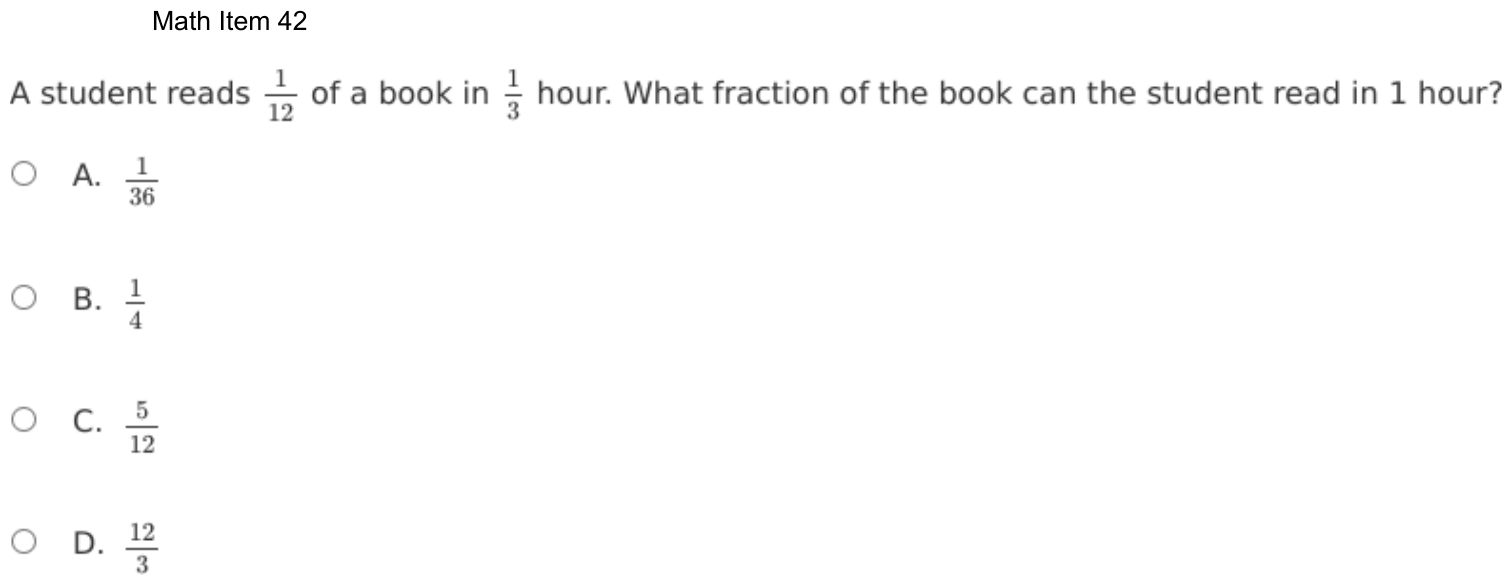
A student reads of a book in hour. What fraction of the book can the student read in 1 hour?
- A
- B
- C
- D
Show the answer
Correct answer: B
To find the fraction of the book the student can read in 1 hour, find the unit rate per hour. First, set up the ratio.
Then use division to find the unit rate.
Another way to solve the problem is to set up the ratio and then multiply both the numerator and denominator by 3, since hour times 3 equals 1 hour.
Question analysis
A student reads 1/12 of a book in 1/3 of an hour, and this rate question asks what fraction of the book the student can read in a whole hour. It tests finding a unit rate when both amounts are fractions. Deciding whether to multiply or divide, and which fraction goes on top, decides the result.
- Grade level
- Grade 7 content, by NYS standard
- Compared with grade 7
- At grade 7 Computing a unit rate from a ratio of fractions is the grade 7 standard itself. This is a short example with unit fractions, where scaling the time up to a whole hour is as quick as dividing.
- Estimated difficulty
- Straightforward: two steps or one careful reading.
- Thinking it demands
- Depth of knowledge 2, skills and concepts · mainly apply
- What makes it hard
- Error-prone arithmetic minor
- Turning words into math minor
- Solution
- 2 steps
- Reading level
- Question and choices: about grade 5, 25 words.
- Students, last 30 days
- Not enough answers yet to show (it takes 10).
Why it is hard, traps and wrong answers (shows the answer)
Why it is hard
Thinking in thirds of an hour makes this quick: an hour holds three of them, so the student reads three twelfths of the book. Students who reach for a fraction rule instead must choose between multiplying and dividing, and between two orders of division. A sense check rules out two wrong choices at once: a whole hour must cover more than 1/12 of the book, and no more than the whole book.
Error-prone arithmetic minor Working it out
Both amounts are unit fractions, and 1/12 ÷ 1/3 means multiplying by 3, which gives 3/12 that still has to be simplified to match a choice. (Brown & Burton, 1978; Junker & Sijtsma, 2001)
Turning words into math minor Understanding the question
The phrase “fraction of the book … in 1 hour” asks for book per hour, so the fraction of the book is divided by the time, not the other way round. (Hegarty, Mayer & Monk, 1995; Koedinger & Nathan, 2004)
Strategy: Ask how many thirds of an hour make 1 hour, then scale the fraction of the book by the same factor; or divide the fraction of the book by the time.
Traps
- Wrong operation: Adds instead of multiplying, divides the wrong way round, turns a ratio or rate upside down, or undoes a step in the wrong direction (subtracts what should be added back).
- Numbers taken from the question: Combines the numbers in the question without a model of the situation, or is simply a number that appears in the question.
The wrong answers, classified
A Wrong operation (Hegarty, Mayer & Monk, 1995; King et al., 2004)
Multiplies 1/12 by 1/3 instead of dividing, getting 1/36, which would mean reading less of the book in an hour than in a third of one.
C Numbers taken from the question (Hegarty, Mayer & Monk, 1995)
Adds the two fractions, 1/12 + 4/12 = 5/12, combining an amount of the book with an amount of time as if they were alike.
D Wrong operation (Hegarty, Mayer & Monk, 1995; King et al., 2004)
Divides the time by the amount read, 1/3 ÷ 1/12 = 12/3, which is hours per book, the rate turned upside down.
Worked solution, step by step
Formulas used
- Unit rate
- A unit rate tells how much happens in 1 unit, here 1 hour. Put the part of the book on top and the time on the bottom. Dividing finds the part of the book for one whole hour.
- Dividing fractions
- a, b, c and d are numbers that are not zero. To divide by a fraction, multiply by its reciprocal, the fraction flipped upside down. Flip only the fraction you divide by.
Sort out the question
The student reads of a book in of an hour. You need the part of the book read in 1 whole hour. That is a unit rate.
Scale up to one hour
One hour holds three thirds of an hour. So in 1 hour the student reads 3 times as much:
To simplify 3/12, divide the top and bottom by 3. The student reads 1/4 of the book in 1 hour.
Check with the unit rate
Divide the part of the book by the time. Multiply by the reciprocal of 1/3, which is 3/1:
Both ways give 1/4.
Avoid the wrong operations
Watch out: multiplying gives , choice A. That is less than 1/12. But in a full hour, the student must read more than in a third of an hour. Dividing the time by the book gives 12/3, choice D. That is 4 whole books.
So the answer is B, .
Check your answer
If the student reads 1/4 of the book each hour, the whole book takes 4 hours. In 1/3 of an hour, the student reads of the book. That matches the question.
More questions like this
The original DOE question