Question
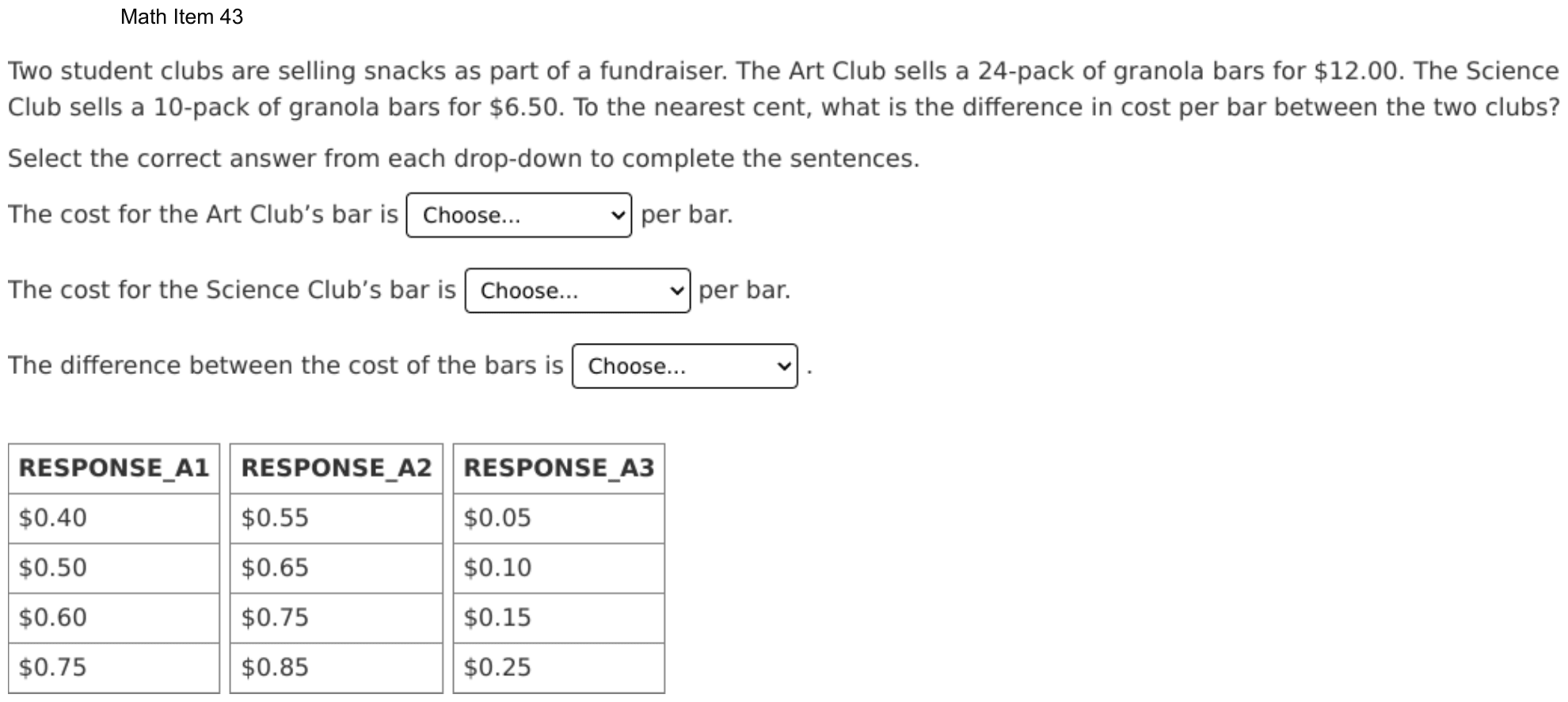
Two student clubs are selling snacks as part of a fundraiser. The Art Club sells a 24-pack of granola bars for $12.00. The Science Club sells a 10-pack of granola bars for $6.50. To the nearest cent, what is the difference in cost per bar between the two clubs?
Select the correct answer from each drop-down to complete the sentences.
The cost for the Art Club’s bar is per bar.
The cost for the Science Club’s bar is per bar.
The difference between the cost of the bars is .
Choose an answer from each menu, then check. The DOE has not published how answers with several parts are scored; this site counts one right only when every part is right.
Show the answer
Correct answer: blank 1: $0.50; blank 2: $0.65; blank 3: $0.15
To determine the cost per bar from the Art Club, divide the total cost by the total number of bars:
To determine the cost per bar from the Science Club, divide the total cost by the total number of bars:
To find the difference in price per bar, subtract the cost per bar for the Art Club from the cost per bar for the Science Club:
Question analysis
Two clubs sell granola bars for a fundraiser: the Art Club a 24-pack for $12.00 and the Science Club a 10-pack for $6.50. Students complete three sentences with drop-down menus, giving each club's cost per bar and the difference between them. It tests unit prices with money, and all three menus must be right.
- Grade level
- Grade 6 content, by NYS standard
- Compared with grade 7
- Below grade 7 Comparing unit prices is grade 6 rate work. The menus split it into three short steps, two divisions of money amounts and one subtraction, which is lighter than typical grade 7 work.
- Estimated difficulty
- Routine: one familiar step, little to misread.
- Thinking it demands
- Depth of knowledge 1, recall and reproduction · mainly apply
- What makes it hard
- Many steps minor
- Error-prone arithmetic minor
- Solution
- 3 steps
- Reading level
- Question and choices: about grade 3, 87 words.
- Corrected from the DOE handbook
- The order of the answers in the DOE’s key was corrected.
- Students, last 30 days
- Not enough answers yet to show (it takes 10).
Why it is hard, traps and wrong answers (shows the answer)
Why it is hard
The menus guide the work, one sentence per step, and every option is a reasonable price, so the question rewards accurate division more than planning. No common misconception leads to the wrong options; they catch slips, such as misreading a pack size or subtracting carelessly. Checking that 24 bars at the first price cost $12.00 and 10 bars at the second cost $6.50 confirms both menus before the subtraction.
Many steps minor Working it out
Three menus must all be right to score: two divisions for the costs per bar, then a subtraction that uses both, so a slip in either division spoils the third menu. (Daniel & Embretson, 2010; Enright, Morley & Sheehan, 2002)
Error-prone arithmetic minor Working it out
Each division is with money, $12.00 ÷ 24 and $6.50 ÷ 10, so the decimal point must be placed carefully, though the menus offer only sensible amounts. (Brown & Burton, 1978; Junker & Sijtsma, 2001)
Strategy: Divide each pack's price by the number of bars in it, then subtract the smaller cost per bar from the larger; checking that 24 bars at your first price make $12.00 catches slips.
Traps
- Misreads the question: Misses or misreads a condition or a word in the question: "at least", "each", "remaining", "not".
- An arithmetic slip: The right method with a plausible arithmetic error: a digit, a place value or a times-table fact.
The wrong answers, classified
CBA Misreads the question (Hegarty, Mayer & Monk, 1995)
Divides $12.00 by 20 instead of 24, misreading the size of the Art Club’s pack, so $0.60 a bar leaves a gap of only $0.05.
BBB An arithmetic slip (Junker & Sijtsma, 2001)
Finds both costs per bar correctly, then slips in the subtraction, taking $0.65 − $0.50 as $0.10, the option beside the right one.
What was corrected from the DOE handbook, and why
- Answer key: The DOE’s explanation opens with the key “($0.65; $0.50; $0.15)”, which puts $0.65 in the first drop-down and $0.50 in the second. Neither is possible: the first menu (the Art Club’s cost per bar) offers $0.40, $0.50, $0.60 and $0.75, and the second (the Science Club’s) offers $0.55, $0.65, $0.75 and $0.85. The explanation’s own working gives the Art Club $12.00 ÷ 24 = $0.50 and the Science Club $6.50 ÷ 10 = $0.65, so the key is $0.50, $0.65, $0.15. The site’s key was already in that order; the DOE’s key line is not shown on the site.
Worked solution, step by step
Formulas used
- Cost of one item
- The price of the pack is what you pay for all the bars together. Dividing shares that price equally among the bars. The result is the price of one bar, called the unit price.
Sort out the question
You know:
- The Art Club sells 24 bars for $12.00.
- The Science Club sells 10 bars for $6.50.
There are three menus. The first is the Art Club’s cost per bar. The second is the Science Club’s. The third is the difference, how much more one bar costs than the other.
Find the Art Club’s cost
Share $12.00 among 24 bars:
Each bar costs $0.50. That makes sense: 24 half-dollars make $12. Pick $0.50 in the first menu.
Watch out: dividing by 20 instead of 24 gives $0.60, which is also in the menu.
Find the Science Club’s cost
Share $6.50 among 10 bars. Dividing by 10 moves the decimal point one place to the left:
Each bar costs $0.65. Pick $0.65 in the second menu.
Find the difference
Subtract the smaller cost from the larger one:
The bars differ by $0.15. Pick $0.15 in the third menu.
Watch out: $0.10 sits right next to $0.15 in the menu. A slip in the subtraction lands there.
Fill in the three menus
On the test and on this site, you choose each answer from a drop-down menu.
So the menus read $0.50, $0.65 and $0.15.
Check your answer
Multiply back. and , so both costs per bar match the pack prices. And , so the difference fits too.
More questions like this
The original DOE question