Question
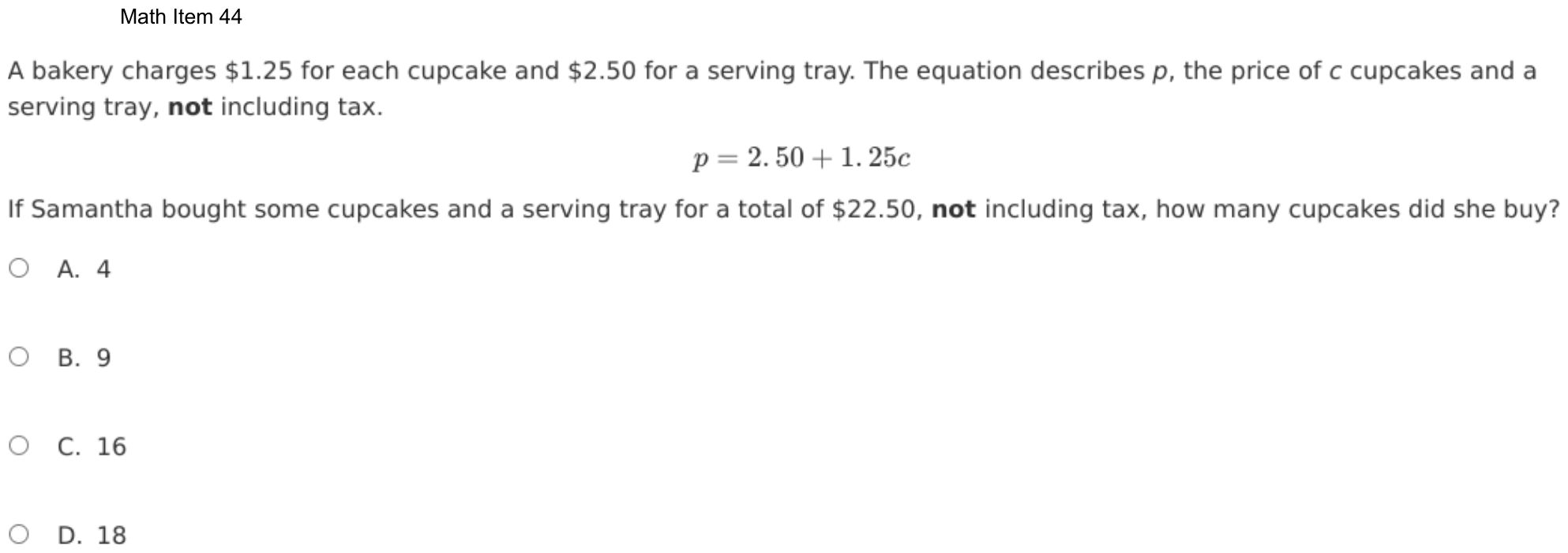
A bakery charges $1.25 for each cupcake and $2.50 for a serving tray. The equation describes p, the price of c cupcakes and a serving tray, not including tax.
If Samantha bought some cupcakes and a serving tray for a total of $22.50, not including tax, how many cupcakes did she buy?
- A4
- B9
- C16
- D18
Show the answer
Correct answer: C
Using the specified equation , determine the number of cupcakes Samantha bought by substituting the total paid ($22.50) for p, and solve the equation for the value of c, the number of cupcakes bought.
Question analysis
A bakery's price for c cupcakes and a serving tray is given by the equation p = 2.50 + 1.25c, and Samantha paid $22.50 before tax. This equation question asks how many cupcakes she bought. Students substitute the total and solve a two-step equation with decimal money amounts, undoing the steps in the right order.
- Grade level
- Grade 7 content, by NYS standard
- Compared with grade 7
- At grade 7 Solving a two-step equation of the form px + q = r in a money context is core grade 7 algebra. The equation is given, so the work is substituting the total and dividing by a decimal, a routine example.
- Estimated difficulty
- Straightforward: two steps or one careful reading.
- Thinking it demands
- Depth of knowledge 1, recall and reproduction · mainly apply
- What makes it hard
- Error-prone arithmetic minor
- Solution
- 2 steps
- Reading level
- Question and choices: about grade 6, 50 words.
- Students, last 30 days
- Not enough answers yet to show (it takes 10).
Why it is hard, traps and wrong answers (shows the answer)
Why it is hard
The equation is supplied, so the question is a two-step solve with money. The tray’s $2.50 has to come off the total before dividing, and students who divide the whole $22.50 by $1.25 get a whole number that matches a choice, so nothing warns them. Substituting the chosen number back into p = 2.50 + 1.25c is a quick, decisive check.
Error-prone arithmetic minor Working it out
After subtracting the tray, $20 must be divided by $1.25, a decimal divisor that is easiest handled as 2,000 ÷ 125 or by noting that 4 cupcakes cost $5. (Brown & Burton, 1978; Junker & Sijtsma, 2001)
Strategy: Substitute the total for p, subtract the tray's cost from both sides, then divide by the price of one cupcake; check by putting your number back into the equation.
Traps
- Misreads the question: Misses or misreads a condition or a word in the question: "at least", "each", "remaining", "not".
- Numbers taken from the question: Combines the numbers in the question without a model of the situation, or is simply a number that appears in the question.
The wrong answers, classified
A Stops one step early (King et al., 2004; Gierl et al., 2017)
Notes that 4 cupcakes cost $5.00 and that the $20 left after the tray holds four such amounts, then gives the 4 groups instead of 16 cupcakes.
B Numbers taken from the question (Hegarty, Mayer & Monk, 1995)
Divides the $22.50 total by the $2.50 tray price, combining two numbers from the question without using the equation.
D Misreads the question (Hegarty, Mayer & Monk, 1995)
Divides the whole $22.50 by $1.25 a cupcake, forgetting that $2.50 of the total paid for the serving tray.
Worked solution, step by step
Formulas used
- Doing the same to both sides
- a and b are the two sides of an equation, and n is any number (not zero when you divide). An equation is like a balanced scale. Doing the same thing to both sides keeps it level. That is how you get c, the number of cupcakes, by itself.
Sort out the question
The equation gives the price. p is the price in dollars, and c is the number of cupcakes. The 2.50 is the tray, and 1.25 is the price of one cupcake. Samantha paid $22.50. You need c.
Put in the total
Samantha paid $22.50 in all, so put 22.50 in place of p. Now the equation has only one unknown, c:
Subtract the tray
Take 2.50 away from both sides. That removes the cost of the tray:
So $20.00 went to cupcakes alone.
Watch out: dividing all of $22.50 by $1.25 gives 18, choice D. That forgets the tray.
Divide by the price of one cupcake
Divide both sides by 1.25:
An easy way: 4 cupcakes cost dollars. $20 is 4 groups of $5. So Samantha bought cupcakes.
Watch out: 4 is the number of $5 groups, not cupcakes. That is choice A.
So the answer is C, 16.
Check your answer
Put 16 back into the equation. , and . That is what Samantha paid, so 16 is right.
More questions like this
The original DOE question