Question
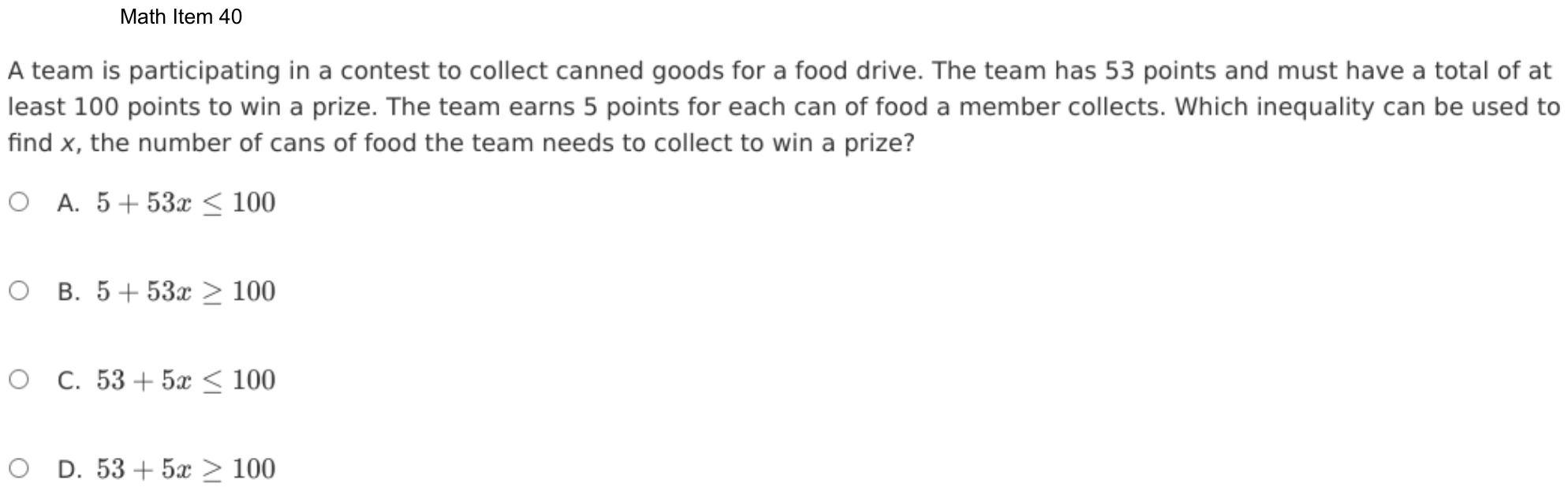
A team is participating in a contest to collect canned goods for a food drive. The team has 53 points and must have a total of at least 100 points to win a prize. The team earns 5 points for each can of food a member collects. Which inequality can be used to find x, the number of cans of food the team needs to collect to win a prize?
- A
- B
- C
- D
Show the answer
Correct answer: D
Since each can is worth 5 points, the total number of points earned from all the cans, x, is 5x. The team started with 53 points. That is a constant value and doesn’t change. So the total number of points the team will earn is . The team wants to earn at least (≥) 100 points, so they need total points.
Question analysis
A team has 53 points in a canned-food drive, earns 5 points for each can, and needs at least 100 points to win a prize. Students choose the inequality for x, the number of cans the team must collect. It tests writing an inequality from words, where the starting points and the points per can must each take the right place.
- Grade level
- Grade 7 content, by NYS standard
- Compared with grade 7
- At grade 7 Writing an inequality for a word problem with a starting amount and a rate is grade 7 work. The four choices pair two expressions with two symbols, so students make one decision about the terms and one about the phrase "at least".
- Estimated difficulty
- Straightforward: two steps or one careful reading.
- Thinking it demands
- Depth of knowledge 2, skills and concepts · mainly apply
- What makes it hard
- Turning words into math moderate
- A very close wrong answer minor
- Solution
- 2 steps
- Reading level
- Question and choices: about grade 4, 71 words.
- Students, last 30 days
- Not enough answers yet to show (it takes 10).
Why it is hard, traps and wrong answers (shows the answer)
Why it is hard
The choices form a two-by-two grid: which number goes with x, and which way the symbol points. Each decision can be made separately, so a student who settles both gets the item, while one mistake lands on a listed choice. Testing two numbers of cans, 5, which leaves the team at 78 points, and 10, which lifts it to 103, rules out every wrong inequality.
Turning words into math moderate Understanding the question
The 53 points the team “has” are a fixed start, the “5 points for each can” go with x, and “at least 100” calls for ≥, though “least” can sound like less. (Hegarty, Mayer & Monk, 1995; Koedinger & Nathan, 2004)
A very close wrong answer minor Choosing the answer
The four choices are two expressions, 5 + 53x and 53 + 5x, each with ≤ and with ≥, so the right one and the strongest wrong one differ only in the symbol. (Embretson & Wetzel, 1987; Gorin & Embretson, 2006; Ascalon et al., 2007)
Strategy: Work out the team's total points after 2 cans and then after x cans, translate "at least 100" into a symbol, and compare the result with each choice.
Traps
- Misreads the question: Misses or misreads a condition or a word in the question: "at least", "each", "remaining", "not".
- Misunderstands the concept: A wrong belief about a concept: that percents can be added, that area grows like length, that averages can be averaged, that a bigger denominator means a bigger fraction.
The wrong answers, classified
A Misunderstands the concept (Smith, diSessa & Roschelle, 1993; De Bock et al., 1998; Ni & Zhou, 2005)
Attaches x to the 53 points the team already has and also reverses “at least”, combining the mistakes behind the other two wrong choices.
B Misunderstands the concept (Smith, diSessa & Roschelle, 1993; De Bock et al., 1998; Ni & Zhou, 2005)
Keeps the right symbol but multiplies the number of cans by 53 and adds 5, putting the starting points where the points per can belong.
C Misreads the question (Hegarty, Mayer & Monk, 1995)
Writes the points correctly as 53 + 5x but reads “at least 100” as at most 100, reversing the inequality.
Worked solution, step by step
Formulas used
- Total with a start and a rate
- The start is the amount you have now, here 53 points. The rate is what each item adds, here 5 points for each can. x is the number of items. The start is added once, and the rate is multiplied by x.
- At least
- The sign ≥ means is greater than or equal to. At least 100 means 100 or more. So the total must be greater than or equal to 100.
Sort out the question
You know:
- The team already has 53 points.
- It earns 5 points for each can.
- It needs at least 100 points to win.
x is the number of cans. You need the inequality that shows this.
Write the total points
Try 2 cans first. The team gets 5 points for each, so points. For x cans, the total is:
Watch out: the 53 points do not repeat for each can. gives 53 points for each can, as in choices A and B.
Choose the sign
At least 100 means 100 or more, so use ≥:
Watch out: “least” sounds like “less,” but at least means the total can be 100 or higher. Using ≤ gives choice C.
So the answer is D, .
Check your answer
Test two numbers of cans. With 10 cans, , and 103 ≥ 100 is true. The team wins. With 9 cans, , and 98 ≥ 100 is false. The team is short. Choice D gets both right.
More questions like this
The original DOE question