Question
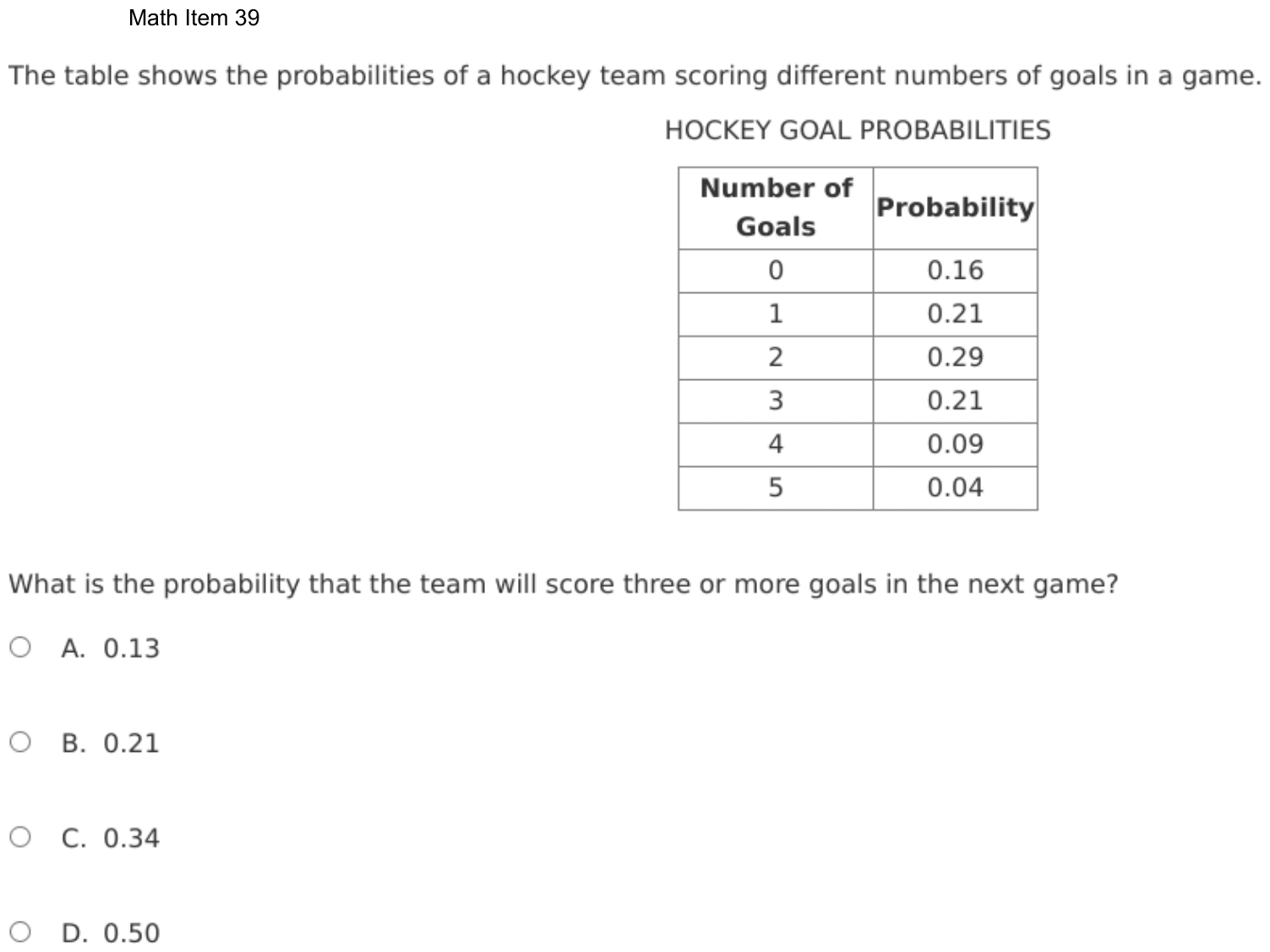
The table shows the probabilities of a hockey team scoring different numbers of goals in a game.
HOCKEY GOAL PROBABILITIES
| Number of Goals | Probability |
|---|---|
| 0 | 0.16 |
| 1 | 0.21 |
| 2 | 0.29 |
| 3 | 0.21 |
| 4 | 0.09 |
| 5 | 0.04 |
What is the probability that the team will score three or more goals in the next game?
- A0.13
- B0.21
- C0.34
- D0.50
Show the answer
Correct answer: C
To find the probability that any one of several mutually exclusive events occurs, use the addition rule, and add the probabilities of each event:
Using the data in the table, the probability that the team will score 3 or more goals in the next game is represented by
Question analysis
A table gives the probabilities of a hockey team scoring 0 to 5 goals in a game, and students find the chance that it scores three or more goals in the next one. This probability question tests adding the probabilities of separate outcomes. Reading exactly which rows the phrase covers is the main point of care.
- Grade level
- Grade 6 content, by NYS standard
- Compared with grade 7
- Below grade 7 Finding the probability of an event from a given probability model is grade 6 work in New York. Here the model is a table, and the task is choosing the right rows and adding decimals, shorter than typical grade 7 work.
- Estimated difficulty
- Routine: one familiar step, little to misread.
- Thinking it demands
- Depth of knowledge 1, recall and reproduction · mainly apply
- What makes it hard
- Solution
- 2 steps
- Reading level
- Question and choices: about grade 8, 40 words.
- Students, last 30 days
- Not enough answers yet to show (it takes 10).
Why it is hard, traps and wrong answers (shows the answer)
Why it is hard
Adding three decimals is easy, so the question turns on which rows the words cover. Including the 3-goal row, and not stopping at it, are the two decisions, and each misreading gives a listed choice. Checking the complement, 1 − (0.16 + 0.21 + 0.29), confirms both the sum and the choice of rows.
Turning words into math minor Understanding the question
The phrase “three or more goals” has to become the three rows for 3, 4 and 5 goals, starting at the 3-goal row itself. (Hegarty, Mayer & Monk, 1995; Koedinger & Nathan, 2004)
Reading a figure, table or graph minor Understanding the question
The table lists six probabilities, two of them both 0.21, so the rows for 3, 4 and 5 goals must be picked out by their goal counts, not by their values. (Lesh, Post & Behr, 1987; Kirsch & Mosenthal, 1990)
Strategy: Decide which rows the words "three or more" cover, add their probabilities, and check by subtracting the total of the other rows from 1.
Traps
- Counting the ends: Inclusive or exclusive ends, fence posts, consecutive numbers: an answer that is one too many or too few, or an endpoint drawn open where it belongs closed (or the reverse).
- Misreads the question: Misses or misreads a condition or a word in the question: "at least", "each", "remaining", "not".
- Misunderstands the concept: A wrong belief about a concept: that percents can be added, that area grows like length, that averages can be averaged, that a bigger denominator means a bigger fraction.
The wrong answers, classified
A Counting the ends (Brown & Burton, 1978)
Adds only the rows for 4 and 5 goals, 0.09 + 0.04 = 0.13, reading three or more as more than three and leaving out the end row.
B Misreads the question (Hegarty, Mayer & Monk, 1995)
Reads only the row for exactly 3 goals, 0.21, overlooking the words “or more” and the two rows below it.
D Misunderstands the concept (Smith, diSessa & Roschelle, 1993; De Bock et al., 1998; Ni & Zhou, 2005)
Counts 3 of the 6 rows, for 3, 4 and 5 goals, as half the outcomes, ignoring that the table gives them different probabilities.
Worked solution, step by step
Formulas used
- Adding probabilities
- A and B are two events that cannot both happen at once, like scoring exactly 3 goals and exactly 4 goals. The chance that one or the other happens is the sum of their chances.
- The chance it does not happen
- The chances of all possible outcomes add up to 1. So the chance an event does not happen is 1 minus the chance it does. Use it to check an answer from the other side.
Sort out the question
The table gives the chance of each number of goals, from 0 to 5. You need the chance the team scores three or more goals in the next game.
Pick the right rows
Three or more means 3 goals, 4 goals or 5 goals. The row for 3 counts too. Read those three rows:
- 3 goals: 0.21
- 4 goals: 0.09
- 5 goals: 0.04
Watch out: leaving out the 3-goal row gives 0.09 + 0.04 = 0.13, choice A. Using only the 3-goal row gives 0.21, choice B.
Add the chances
A game can end with only one number of goals. So add the three chances:
Watch out: three of the six rows is half the rows, but that does not make the chance 0.50, choice D. The rows have different chances.
So the answer is C, 0.34.
Check your answer
Find the chance of fewer than 3 goals, the other rows: . Then the chance of 3 or more is . Both ways give 0.34.
More questions like this
The original DOE question