Question
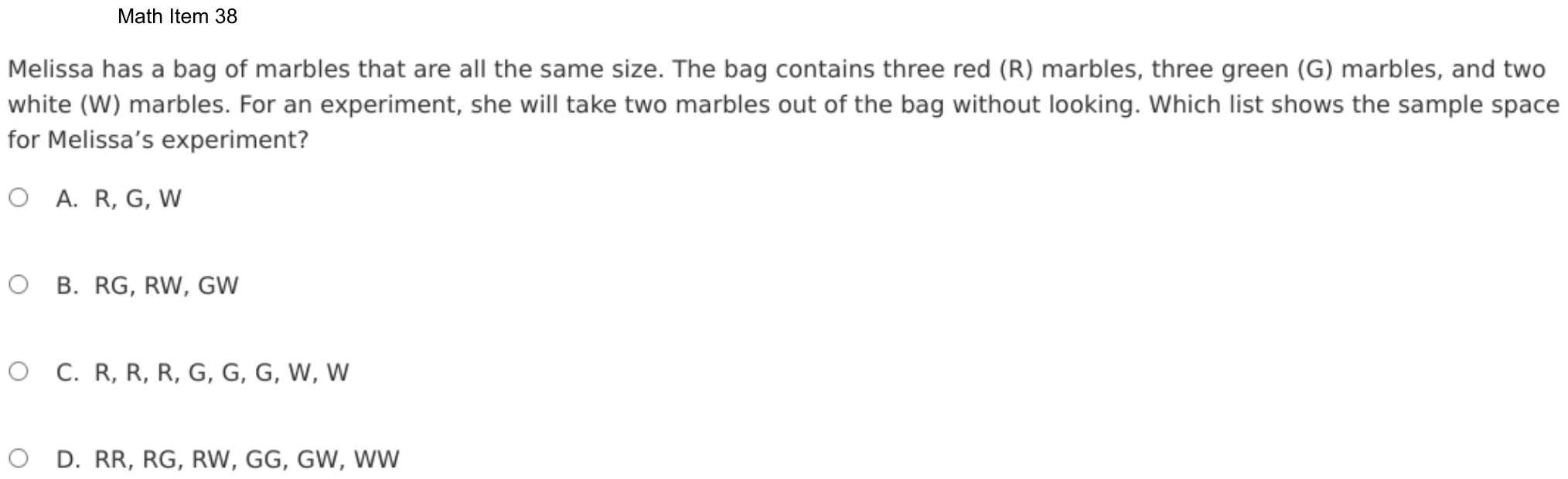
Melissa has a bag of marbles that are all the same size. The bag contains three red (R) marbles, three green (G) marbles, and two white (W) marbles. For an experiment, she will take two marbles out of the bag without looking. Which list shows the sample space for Melissa’s experiment?
- AR, G, W
- BRG, RW, GW
- CR, R, R, G, G, G, W, W
- DRR, RG, RW, GG, GW, WW
Show the answer
Correct answer: D
The sample space of a random experiment is the collection of all possible outcomes. For this experiment, R represents a red marble, G represents a green marble, and W represents a white marble.
Since two marbles are being drawn, the possible outcomes for the first marble drawn are R, G, W.
List the possible results for each initial outcome combined with the second choice of marble. For example, if the first marble and second marble are both red, the sample space will include RR (red, red).
RR, RG, RW
GR, GG, GW
WR, WG, WW
Since order does not matter in this selection, remove any pairing that presents a duplicate choice, such as RG and GR—only one of the two pairings will be included in the sample space. Those are removed and leave a sample space of:
RR, RG, RW, GG, GW, WW
Question analysis
A bag holds three red, three green and two white marbles, and Melissa will take out two without looking. This probability question asks which list shows the sample space for her experiment. Students must know what a sample space is and what one outcome of drawing two marbles looks like, then decide which color pairs are possible.
- NYS standards
- 7.SP.8b sample spaces for compound events
- Grade level
- Grade 7 content, by NYS standard
- Compared with grade 7
- At grade 7 Representing the sample space of a compound event is a named grade 7 skill. Nothing is computed here; the demand is knowing what one outcome of drawing two marbles looks like and which pairs the bag allows, much as in grade 7 classwork.
- Estimated difficulty
- Moderate: several steps, or a close reading with one strong distractor.
- Thinking it demands
- Depth of knowledge 2, skills and concepts · mainly understand
- What makes it hard
- Something you must already know moderate
- A very close wrong answer moderate
- Solution
- 2 steps
- Reading level
- Question and choices: about grade 3, 71 words.
- Students, last 30 days
- Not enough answers yet to show (it takes 10).
Why it is hard, traps and wrong answers (shows the answer)
Why it is hard
The question tests a definition more than a skill, and three choices describe something real: the colors of one marble, the contents of the bag, and the pairs of different colors. The strongest pull comes from treating the colors as three single objects, which leaves out the pairs of one color although the bag holds three reds, three greens and two whites. Asking what Melissa could be holding after the draw settles it.
Something you must already know moderate Working it out
The term sample space is not defined in the question: students must know it means every possible result of the whole experiment, here a pair of colors drawn together. (Anderson & Krathwohl, 2001)
A very close wrong answer moderate Choosing the answer
The three mixed pairs, RG, RW and GW, form a complete-looking list that is the right list minus RR, GG and WW, so only asking whether two marbles of one color can come out together separates them. (Embretson & Wetzel, 1987; Gorin & Embretson, 2006; Ascalon et al., 2007)
Strategy: Describe one possible result of taking out two marbles, then build the list systematically, starting from each color and pairing it with every color that could come out with it.
Traps
- Misunderstands the concept: A wrong belief about a concept: that percents can be added, that area grows like length, that averages can be averaged, that a bigger denominator means a bigger fraction.
- Without replacement: In a second pick there is one fewer item, which changes the probability.
- Answers a different question: A choice is right for another quantity: the other unknown, the rest instead of the part, the part instead of the whole.
The wrong answers, classified
A Answers a different question (King et al., 2004; Hegarty, Mayer & Monk, 1995)
Lists the colors a single marble can be, the sample space for drawing one marble, though Melissa takes out two.
B Without replacement (Fischbein & Schnarch, 1997)
Leaves out pairs of one color, as if drawing a red marble left no red behind, though the bag holds three reds, three greens and two whites.
C Misunderstands the concept (Smith, diSessa & Roschelle, 1993; De Bock et al., 1998; Ni & Zhou, 2005)
Lists the eight marbles in the bag, describing what the bag holds rather than the possible results of taking two out.
Worked solution, step by step
Formulas used
- Sample space
- An outcome is one possible result of an experiment. The sample space lists every outcome once. For this experiment, one outcome is the pair of colors Melissa holds after she takes out two marbles.
Sort out the question
The bag holds 3 red (R), 3 green (G) and 2 white (W) marbles. Melissa takes out 2 marbles without looking.
You need the sample space: every possible result of taking out 2 marbles. So each outcome must name two colors, like RG for one red and one green.
List pairs by the first color
Start with each color the first marble could be. Then pair it with each color the second could be:
- First red: RR, RG, RW
- First green: GR, GG, GW
- First white: WR, WG, WW
That gives 9 pairs.
Remove pairs that repeat
Melissa ends up holding two marbles. One red and one green is the same result whichever came out first. So GR is the same as RG. Cross out GR, WR and WG. Six pairs are left:
RR, RG, RW, GG, GW, WW
Check the same-color pairs
Can both marbles be the same color? Yes. The bag has 3 reds, 3 greens and 2 whites, so RR, GG and WW can all happen.
Watch out: choice B leaves out RR, GG and WW. That would only be right if the bag had one marble of each color. Choice A is the colors of one marble. Choice C lists the marbles in the bag, not results.
So the answer is D, RR, RG, RW, GG, GW, WW.
Check your answer
Ask what Melissa could be holding. Two reds? Yes, there are 3. Two whites? Yes, there are exactly 2. A green and a white? Yes. Every pair in D can happen, and no possible pair is missing. Choice B misses three pairs that can happen.
More questions like this
The original DOE question