Question
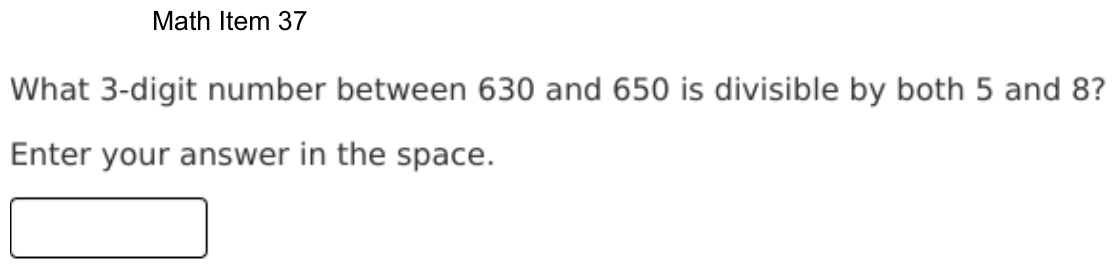
What 3-digit number between 630 and 650 is divisible by both 5 and 8?
Enter your answer in the space.
Fill-in question: work out the answer and type it as a number.
Show the answer
Correct answer: 640
The final digit of the three-digit number is 0. Each of the digits 0 through 9, inclusive, must be considered.
To narrow the choices, first consider that the number between 630 and 650 must be divisible by both 5 and 8.
A number divisible by 5 must end in 0 or 5. Therefore, the only possibilities are 0 and 5.
-
If the number ended in 0, the whole number 640 must also be divisible by 8:
Both result in a remainder of 0.
-
If the number ended in 5, the whole numbers 635 and 645 must also be divisible by 8:
Dividing 635 by 5 results in a remainder of 0, but dividing 635 by 8 results in a remainder of 3.
Dividing 645 by 5 results in a remainder of 0, but dividing 645 by 8 results in a remainder of 5.
Therefore, 640 is the only whole number between 630 and 650 that is divisible by both 5 and 8.
Question analysis
This number question asks for the 3-digit number between 630 and 650 that is divisible by both 5 and 8, typed into a box. Students use divisibility rules or common multiples to find it. The work is short, but the number has to pass both tests, so checking only one divisor is the easy slip.
- NYS standards
- 6.NS.4 common factors and multiples
- Grade level
- Grade 6 content, by NYS standard
- Compared with grade 7
- Below grade 7 Common multiples are grade 6 content. Divisibility by 5 limits the last digit, and only a few numbers lie between 630 and 650, so this is a quick check, shorter than typical grade 7 work.
- Estimated difficulty
- Routine: one familiar step, little to misread.
- Thinking it demands
- Depth of knowledge 1, recall and reproduction · mainly apply
- What makes it hard
- Solution
- 2 steps
- Reading level
- Question and choices: about grade 5, 16 words.
- Students, last 30 days
- Not enough answers yet to show (it takes 10).
Why it is hard, traps and wrong answers (shows the answer)
Why it is hard
Few numbers need checking, so most students succeed; the risk is testing only one divisor. Students who start from multiples of 8 meet 632 first, and those who start from multiples of 5 can slip on 645 ÷ 8. Using the least common multiple, 40, shows at once that the number must be a multiple of 40, which leaves one candidate in the range.
Much to keep track of minor Working it out
Each candidate must pass two tests, divisible by 5 and by 8, and both ends of the range, 630 and 650, pass the first test but fail the second. (Sweller, 1988; Carpenter, Just & Shell, 1990)
Something you must already know minor Working it out
The shortcut that a multiple of 5 ends in 0 or 5 is assumed, and it cuts the search to 635, 640 and 645 before any division by 8. (Anderson & Krathwohl, 2001)
Strategy: Use divisibility by 5 to limit the last digit, then check only those few numbers in the range for divisibility by 8.
Traps
- Misreads the question: Misses or misreads a condition or a word in the question: "at least", "each", "remaining", "not".
- Stops one step early: A choice is a number from partway through the solution.
The wrong answers, classified
632 Misreads the question (Hegarty, Mayer & Monk, 1995)
Takes the first multiple of 8 after 630, 8 × 79 = 632, and stops without checking divisibility by 5, which a number ending in 2 fails.
645 An arithmetic slip (Junker & Sijtsma, 2001)
Picks a number ending in 5 so that 5 divides it, then slips on the check for 8, which leaves a remainder of 5.
40 Stops one step early (King et al., 2004; Gierl et al., 2017)
Finds the least common multiple of 5 and 8, 40, and enters it, one step before finding its multiple between 630 and 650.
Worked solution, step by step
Formulas used
- Divisible by 5
- Divisible means it divides evenly, with no remainder. A whole number is divisible by 5 only when its last digit is 0 or 5. That is because counting by 5s always lands on a number ending in 0 or 5.
- Least common multiple
- The least common multiple, or LCM, is the smallest number that both 5 and 8 divide evenly. 5 and 8 share no factor except 1, so their LCM is their product. Any number divisible by both is a multiple of 40.
Sort out the question
You need a 3-digit number between 630 and 650. It must be divisible by 5 and also by 8. Between means 630 and 650 themselves do not count.
Use the rule for 5
A number divisible by 5 ends in 0 or 5. Between 630 and 650, only three numbers do:
Only these need checking for 8.
Test each number for 8
Divide each one by 8 and look at the remainder, the amount left over:
- 635 ÷ 8 = 79, with 3 left over.
- 640 ÷ 8 = 80, with nothing left over.
- 645 ÷ 8 = 80, with 5 left over.
Only 640 divides evenly by 8.
Watch out: 645 passes the test for 5 but fails for 8. And 632, which is , passes for 8 but ends in 2, so it fails for 5.
Enter the number
640 passes both tests. Type the whole number in the box.
Watch out: 40 is the smallest number divisible by 5 and 8, but it is not between 630 and 650.
So you would enter 640.
Check your answer
Use the LCM. A number divisible by both 5 and 8 must be a multiple of 40. . The multiples next to it are 600 and 680, which are outside the range. So 640 is the only one.
More questions like this
The original DOE question