Passage Looking for the Smallest Spark of Everything
Looking for the Smallest Spark of Everything
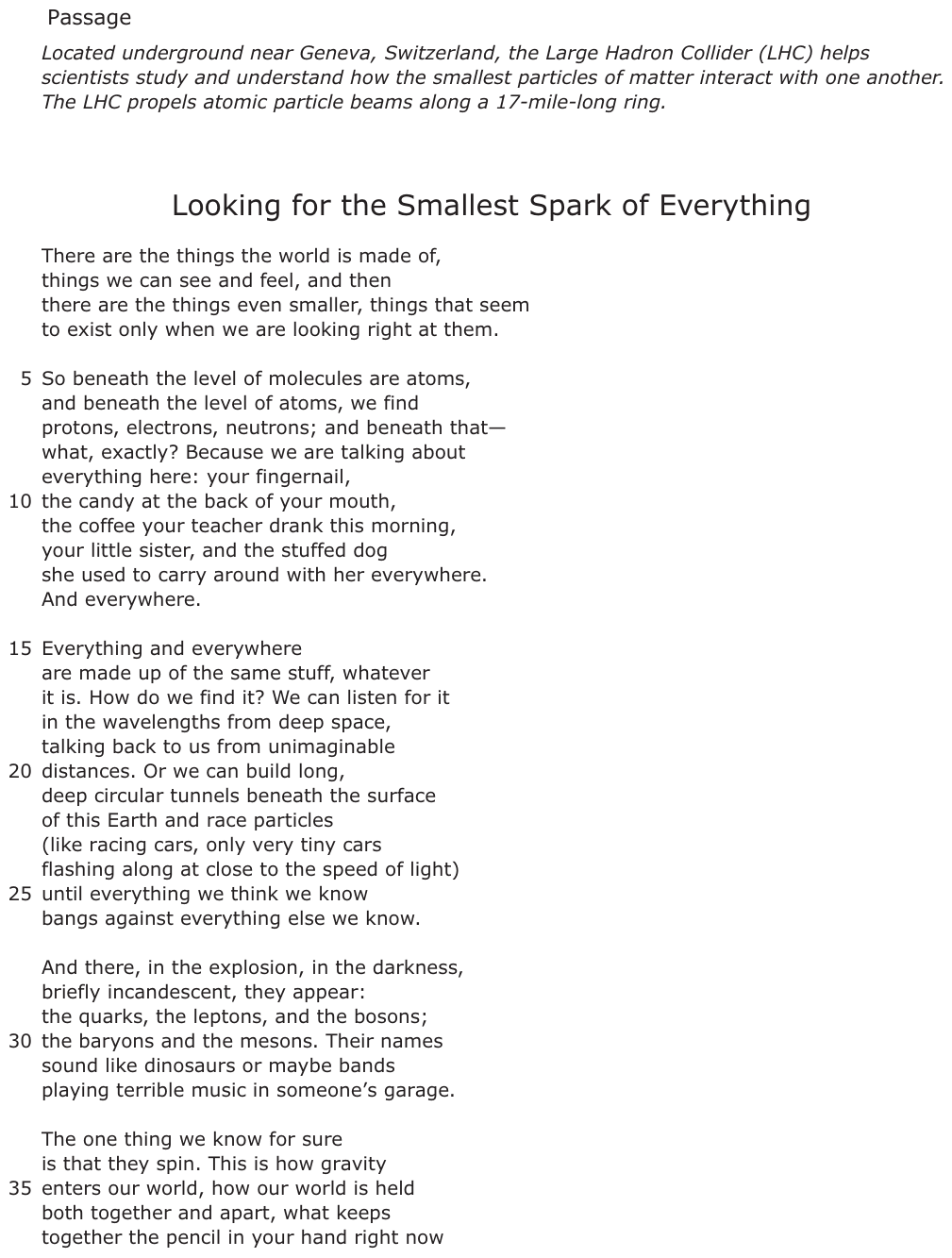
Located underground near Geneva, Switzerland, the Large Hadron Collider (LHC) helps scientists study and understand how the smallest particles of matter interact with one another. The LHC propels atomic particle beams along a 17-mile-long ring.
There are the things the world is made of,
things we can see and feel, and then
there are the things even smaller, things that seem
to exist only when we are looking right at them.
So beneath the level of molecules are atoms,
and beneath the level of atoms, we find
protons, electrons, neutrons; and beneath that—
what, exactly? Because we are talking about
everything here: your fingernail,
the candy at the back of your mouth,
the coffee your teacher drank this morning,
your little sister, and the stuffed dog
she used to carry around with her everywhere.
And everywhere.
Everything and everywhere
are made up of the same stuff, whatever
it is. How do we find it? We can listen for it
in the wavelengths from deep space,
talking back to us from unimaginable
distances. Or we can build long,
deep circular tunnels beneath the surface
of this Earth and race particles
(like racing cars, only very tiny cars
flashing along at close to the speed of light)
until everything we think we know
bangs against everything else we know.
And there, in the explosion, in the darkness,
briefly incandescent, they appear:
the quarks, the leptons, and the bosons;
the baryons and the mesons. Their names
sound like dinosaurs or maybe bands
playing terrible music in someone’s garage.
The one thing we know for sure
is that they spin. This is how gravity
enters our world, how our world is held
both together and apart, what keeps
together the pencil in your hand right now
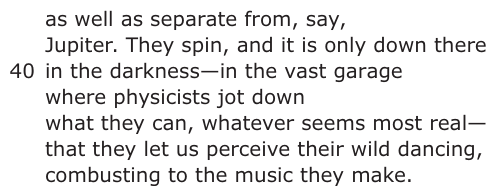
as well as separate from, say,
Jupiter. They spin, and it is only down there
in the darkness—in the vast garage
where physicists jot down
what they can, whatever seems most real—
that they let us perceive their wild dancing,
combusting to the music they make.
Question
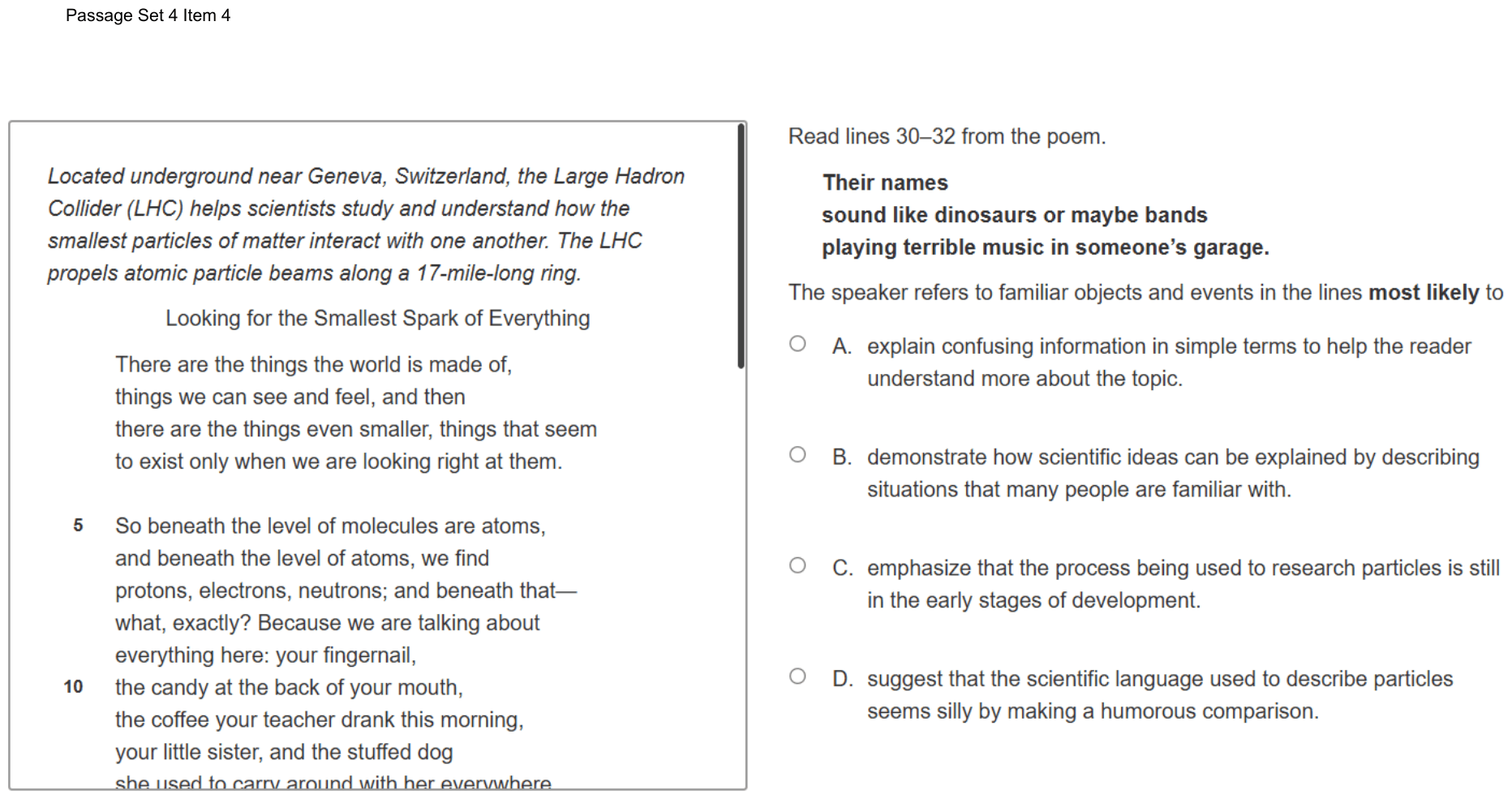
Read lines 30–32 from the poem.
Their names
sound like dinosaurs or maybe bands
playing terrible music in someone’s garage.
The speaker refers to familiar objects and events in the lines most likely to
- Aexplain confusing information in simple terms to help the reader understand more about the topic.
- Bdemonstrate how scientific ideas can be explained by describing situations that many people are familiar with.
- Cemphasize that the process being used to research particles is still in the early stages of development.
- Dsuggest that the scientific language used to describe particles seems silly by making a humorous comparison.
Show the answer
Correct answer: D
The question asks why the speaker refers to familiar objects and events in lines 30–32.
A. Incorrect. In lines 30–32, the speaker only gives an opinion about what the names sound like and does not simplify confusing information about how these newly discovered particles function or exist.
B. Incorrect. In lines 30–32, the speaker is only describing what the names of the particles sound like: “dinosaurs or maybe bands” (line 31). These descriptions illustrate the speaker’s opinion but do not explain specific scientific ideas.
C. Incorrect. In lines 30–32, the mention of the names of the particles sounding like “dinosaurs or maybe bands” (line 31) reveals the speaker’s opinion about the names but does not explain the process of researching the particles.
D. CORRECT. The phrase “their names” (line 30) refers to the scientific names of the particles: “the quarks, the leptons, and the bosons; / the baryons and the mesons” (lines 29–30). In lines 30–32, the speaker expresses the opinion that these scientific terms sound nonsensical, much like the strange scientific names of dinosaurs or silly band names.
Question analysis
In “Looking for the Smallest Spark of Everything,” the speaker says the names of particles sound like dinosaurs or bands playing in someone’s garage. This question asks why the speaker refers to such familiar things in lines 30–32. Students must read the comparison’s tone and purpose, and the choices offer several reasons poets compare science with everyday life.
- Grade level
- Grade 7 reading and task
- Compared with grade 7
- At grade 7 Explaining why a speaker includes a comparison is typical grade 7 work on word choice and tone. The three lines are quoted and their images are everyday ones, but the choices state purposes that differ in subtle ways.
- Estimated difficulty
- Moderate: several steps, or a close reading with one strong distractor.
- Thinking it demands
- Depth of knowledge 2, skills and concepts · mainly analyze
- What makes it hard
- How, not what moderate
- Figurative or literary language moderate
- Reading between the lines minor
- Evidence
- Answered from one paragraph or stanza
- Reading level
- Passage: 346 words (a poem; reading level not measured); question and choices: about grade 10, 97 words.
- Students, last 30 days
- Not enough answers yet to show (it takes 10).
Why it is hard, traps and wrong answers (shows the answer)
Why it is hard
Two choices give the textbook reason for an everyday comparison, to make hard science easier, and they draw students who answer from what comparisons usually do. These lines explain nothing; they say how the particles’ names sound, and “terrible music in someone’s garage” is a joke at the expense of the jargon. Students who trace “Their names” back to the list before it and hear the teasing tone reach the right purpose.
How, not what moderate Working it out
The question asks why the speaker makes the comparison, and two choices offer the usual reason for likening science to everyday things, making it easier to grasp, which these lines do not do. (Anderson & Krathwohl, 2001)
Figurative or literary language moderate Understanding the question
The humor has to be heard: names that sound like dinosaurs or like bands “playing terrible music in someone’s garage” are being teased, which signals a joke, not an explanation. (Graesser, Singer & Trabasso, 1994; Kintsch, 1998)
Reading between the lines minor Working it out
“Their names” points back to the list in lines 29–30, quarks, leptons, bosons, baryons and mesons, and students must see that the lines judge those words, not the particles. (Graesser, Singer & Trabasso, 1994; Kintsch, 1998)
Strategy: Find what “Their names” refers to in the lines just before, then ask what the comparison says about those names and in what tone, and match the purpose to both.
Traps
- Wrong purpose or structure: Names a purpose, structure or effect that the part does not serve, or describes what a part says when the question asks what it does.
- Too broad or too strong: A choice overstates, generalizes, or uses absolute words the text does not support.
- Reads too much in: A reasonable-sounding conclusion that goes further than the text allows.
The wrong answers, classified
A Wrong purpose or structure (Anderson & Krathwohl, 2001)
Assumes that comparing science with familiar things is meant to simplify it, but these lines explain nothing about particles; they only say what the names sound like.
B Too broad or too strong (King et al., 2004)
Turns three lines into a general claim about teaching science through familiar situations, though no scientific idea is described here, only the sound of some names.
C Reads too much in (Graesser, Singer & Trabasso, 1994)
Hears “someone’s garage” as an amateur workshop and concludes that particle research is just beginning, a meaning the lines, which tease the names, never suggest.
Working it out, step by step
Figure out what the question asks
This asks why the speaker compares the particles’ names to familiar things. Familiar means well known from everyday life. First find what “Their names” points to. Then decide what the comparison says about those names, and in what tone.
Find what their names means
Lines 29–30 list the particles: “the quarks, the leptons, and the bosons; / the baryons and the mesons.” Then the speaker says “Their names / sound like dinosaurs or maybe bands / playing terrible music in someone’s garage.” So “their names” means these science words.
Hear the joke
Dinosaurs have long, strange names. A garage band is a group of beginners who practice in a garage. Their music is often loud and bad. The speaker is teasing the science words. They sound odd and a little silly. This is a humorous, or funny, comparison.
Check each choice
- A does not fit. The lines explain nothing about particles. They only say how the names sound.
- B does not fit. No science idea is explained here.
- C does not fit. “Garage” is part of the band joke. It does not say the research is new.
- D fits. The joke makes the science names sound silly.
Watch out: A is tempting because comparisons to everyday things often make science easier. But these lines make fun of names. They do not explain anything.
Choose the answer
The speaker compares the particle names to dinosaurs and bad garage bands to poke fun at them. So the answer is D, “suggest that the scientific language used to describe particles seems silly by making a humorous comparison.”
Why this answer and not the closest wrong one
A is the closest wrong choice. Writers often compare science to everyday things to make it simpler. But ask what these lines explain. Nothing about how particles work is made clearer. The lines only say the names sound like “bands / playing terrible music.” That is a joke about the words, so D fits.
More questions like this
The original DOE question
The passage “Looking for the Smallest Spark of Everything” as printed (pages 32–33)