Passage Looking for the Smallest Spark of Everything
Looking for the Smallest Spark of Everything
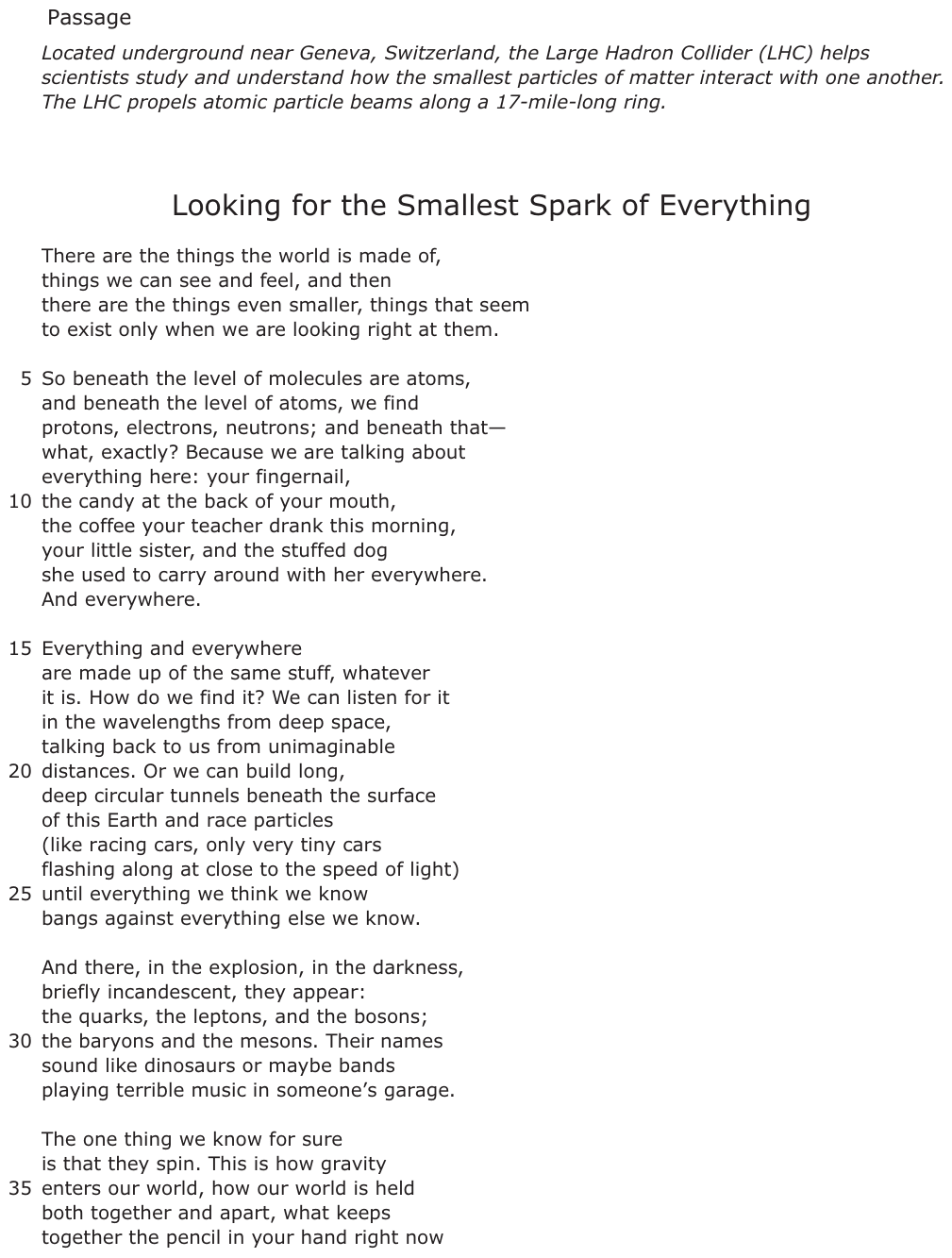
Located underground near Geneva, Switzerland, the Large Hadron Collider (LHC) helps scientists study and understand how the smallest particles of matter interact with one another. The LHC propels atomic particle beams along a 17-mile-long ring.
There are the things the world is made of,
things we can see and feel, and then
there are the things even smaller, things that seem
to exist only when we are looking right at them.
So beneath the level of molecules are atoms,
and beneath the level of atoms, we find
protons, electrons, neutrons; and beneath that—
what, exactly? Because we are talking about
everything here: your fingernail,
the candy at the back of your mouth,
the coffee your teacher drank this morning,
your little sister, and the stuffed dog
she used to carry around with her everywhere.
And everywhere.
Everything and everywhere
are made up of the same stuff, whatever
it is. How do we find it? We can listen for it
in the wavelengths from deep space,
talking back to us from unimaginable
distances. Or we can build long,
deep circular tunnels beneath the surface
of this Earth and race particles
(like racing cars, only very tiny cars
flashing along at close to the speed of light)
until everything we think we know
bangs against everything else we know.
And there, in the explosion, in the darkness,
briefly incandescent, they appear:
the quarks, the leptons, and the bosons;
the baryons and the mesons. Their names
sound like dinosaurs or maybe bands
playing terrible music in someone’s garage.
The one thing we know for sure
is that they spin. This is how gravity
enters our world, how our world is held
both together and apart, what keeps
together the pencil in your hand right now
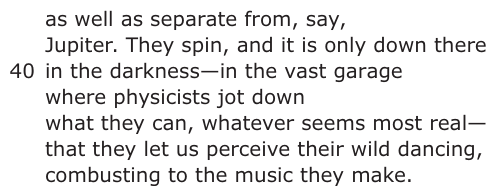
as well as separate from, say,
Jupiter. They spin, and it is only down there
in the darkness—in the vast garage
where physicists jot down
what they can, whatever seems most real—
that they let us perceive their wild dancing,
combusting to the music they make.
Question
Read lines 36–39 from the poem.
both together and apart, what keeps
together the pencil in your hand right now
as well as separate from, say,
Jupiter.
The poet includes these lines most likely to emphasize that
- Ait is important for physicists to continue their research about particles.
- Bthese particles have a powerful effect on everything.
- Cthe discoveries about particles provide little information.
- Dthe study of particles and the study of objects in space are similar.
Show the answer
Correct answer: B
The question asks for the most likely reason the poet includes lines 36–39 in the poem.
A. Incorrect. While the poem implies that the research is important, lines 36–39 do not point to a need for more research. Instead, the lines explain the power of the particles in the universe.
B. CORRECT. The particles that are “Everything and everywhere” (line 15) make up the objects mentioned in lines 36–39: a “pencil in your hand” and the planet “Jupiter.” Even though these objects are different from each other and extremely far apart in the universe, they are made up of and affected by these particles. The “powerful effect” is that the particles keep the objects “both together and apart” (line 36).
C. Incorrect. While the physicists can only “jot down / what they can, whatever seems most real” (lines 41–42), the discoveries about particles are ongoing and informative. The speaker shares that the particles are “everything and everywhere” (line 15) and that they “spin” (line 34), and that “this is how gravity / enters our world” (lines 34–35).
D. Incorrect. The speaker states that particles keep together objects in space, such as Jupiter, as well as objects on Earth, such as “the pencil in your hand right now” (line 37). However, in lines 36–39, the speaker is not comparing the study of subatomic particles with the study of objects in space (astronomy); the speaker is implying that because particles are “everything and everywhere” (line 15), the study of particles affects our understanding of everything in the universe, regardless of location.
Question analysis
This question asks why the poet of “Looking for the Smallest Spark of Everything” includes lines 36–39, about what keeps a pencil in your hand together and separate from the planet Jupiter. The quoted lines begin partway through a sentence, so students must read the lines before them to see what the sentence is about before judging the poet’s purpose.
- Grade level
- Grade 7 reading and task
- Compared with grade 7
- At grade 7 Explaining why a poet includes certain lines is typical grade 7 work. The quoted lines start partway through a sentence, so students must read lines 33–35 to see what the sentence is about, an extra step but not an unusual one.
- Estimated difficulty
- Moderate: several steps, or a close reading with one strong distractor.
- Thinking it demands
- Depth of knowledge 2, skills and concepts · mainly analyze
- What makes it hard
- Complex sentences moderate
- Reading between the lines minor
- Evidence
- Answered from one paragraph or stanza
- Reading level
- Passage: 346 words (a poem; reading level not measured); question and choices: about grade 8, 75 words.
- Corrected from the DOE handbook
- The explanation of C reversed cause and effect in the poem; one word was changed.
- Students, last 30 days
- Not enough answers yet to show (it takes 10).
Why it is hard, traps and wrong answers (shows the answer)
Why it is hard
The quoted lines are the tail of a sentence, and without its start they read like a list of objects. Students who go back to lines 33–35 see that the spin of the particles is what holds things “together and apart,” and the pencil and Jupiter show how far that reaches. Those who read the fragment alone fasten on Jupiter and think of astronomy, while those who read on to the physicists who “jot down / what they can” may decide that little is known.
Complex sentences moderate Understanding the question
The quoted lines begin mid-sentence with “both together and apart, what keeps,” so students must read back to lines 33–35 to learn that the subject is the particles’ spin, “how gravity / enters our world.” (Abedi & Lord, 2001; Freedle & Kostin, 1993; Messick, 1989)
Reading between the lines minor Working it out
The lines never say “everything”; students must see that a pencil in your hand and a distant planet stand for things near and small and things far and huge, so the effect reaches all matter. (Graesser, Singer & Trabasso, 1994; Kintsch, 1998)
Strategy: Read lines 33–39 as one sentence, work out what the subject of “what keeps” is, and then ask what point the two examples in lines 37–39 are meant to make.
Traps
- Twists what the text says: Uses the text's topic and ideas but changes what it says: who did it, how much, when, or why.
- Wrong part of the text: A choice is true of another paragraph, stanza or speaker than the one asked about.
- Reads too much in: A reasonable-sounding conclusion that goes further than the text allows.
The wrong answers, classified
A Reads too much in (Graesser, Singer & Trabasso, 1994)
Assumes the lines push for more research, a common message in writing about science, but they state what the particles do, not what physicists should go on doing.
C Wrong part of the text (Kirsch & Mosenthal, 1990)
Draws on “The one thing we know for sure” in line 33 and the physicists who “jot down / what they can” in lines 41–42, but lines 36–39 state confidently what the particles do.
D Twists what the text says (King et al., 2004)
Sees a planet next to a pencil and builds a comparison between particle physics and astronomy, though the lines show one force acting on both objects, not two fields of study.
What was corrected from the DOE handbook, and why
- Explanation: Rejecting C, the handbook's explanation says the particles “spin” “because ‘this is how gravity / enters our world’”. The poem says it the other way round: “The one thing we know for sure / is that they spin. This is how gravity / enters our world”, so the spinning is how gravity enters. It now says the particles “spin”, and that “this is how gravity / enters our world”. The answer, B, is unchanged.
Working it out, step by step
Figure out what the question asks
This asks why the poet includes lines 36–39. The lines start in the middle of a sentence. So read the whole sentence, from line 33, to see what it is about.
Read lines 33–39 as one sentence
Lines 33–34 say “The one thing we know for sure / is that they spin.” “They” means the tiny particles. Then the poem goes on: “This is how gravity / enters our world, how our world is held / both together and apart, what keeps / together the pencil in your hand right now / as well as separate from, say, / Jupiter.”
Work out what it means
“This” points back to the spinning. The spinning is how gravity comes into our world. Gravity is the pull that draws things toward each other. So the particles’ spin holds a pencil together and keeps it apart from Jupiter. A pencil is small and close. Jupiter is a huge planet, far away. Together they stand for everything.
Check each choice
- A does not fit. The lines say what particles do. They do not say physicists must keep working.
- B fits. The particles affect everything, from a pencil to a planet.
- C does not fit. These lines state facts with confidence. The physicists who “jot down / what they can” come later, in lines 41–42.
- D does not fit. The pencil and Jupiter are things the particles affect. They are not two subjects of study being compared.
Watch out: D is tempting because Jupiter is in space. But the lines show one force acting on both objects, not two kinds of science.
Choose the answer
A small pencil and a giant planet show that the particles’ effect reaches everything. So the answer is B, “these particles have a powerful effect on everything.”
Why this answer and not the closest wrong one
D is the closest wrong choice, since it also notices Jupiter. But D is about studying particles and studying space. The lines are not about study. They say the spin is “what keeps / together the pencil in your hand” and keeps it apart from Jupiter. Small and near, huge and far: that means everything, so B fits.
More questions like this
The original DOE question
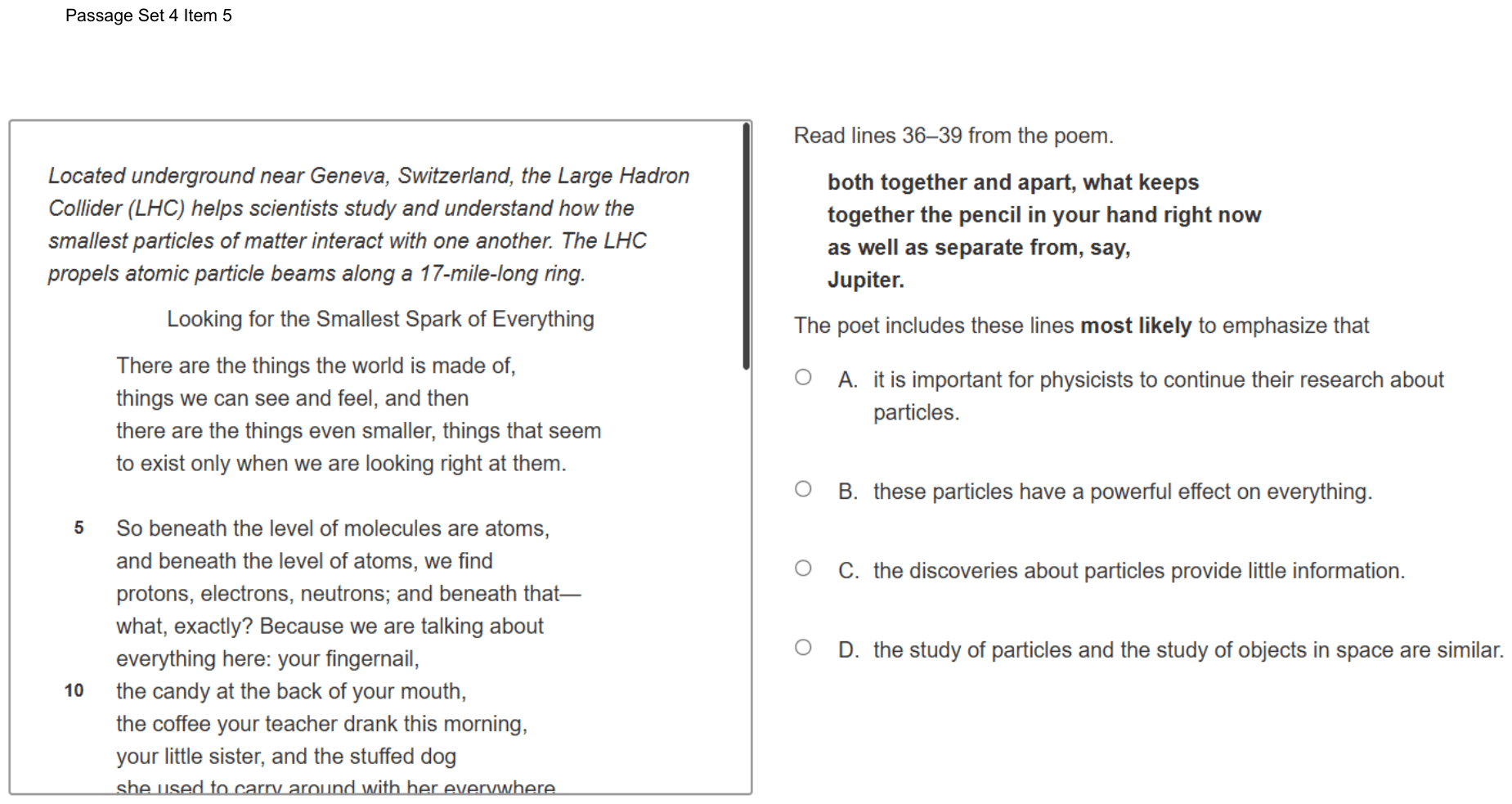
The passage “Looking for the Smallest Spark of Everything” as printed (pages 32–33)