Question
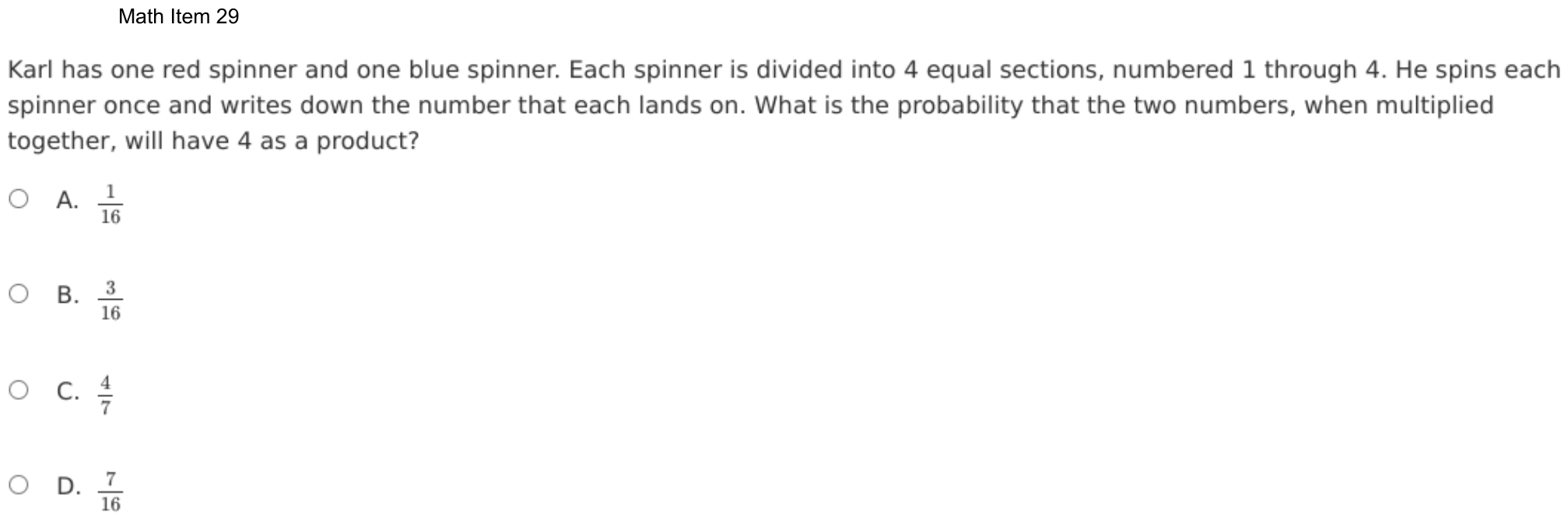
Karl has one red spinner and one blue spinner. Each spinner is divided into 4 equal sections, numbered 1 through 4. He spins each spinner once and writes down the number that each lands on. What is the probability that the two numbers, when multiplied together, will have 4 as a product?
- A
- B
- C
- D
Show the answer
Correct answer: B
There are four possible outcomes for each spin of the spinner:
1, 2, 3, 4
The possible outcomes of two spins are:
Of the 16 possible outcomes, only 3 pairings have a product of 4: 14, 22, and 41.
Therefore, the probability that the two numbers resulting from two consecutive spins have a product of 4 is .
Question analysis
Karl spins a red spinner and a blue spinner, each with four equal sections numbered 1 to 4, and multiplies the two results. This compound probability question asks for the chance that the product is 4. Students build the sample space of outcomes, and listing every pair rather than the ones that come to mind is the safe route.
- NYS standards
- Grade level
- Grade 7 content, by NYS standard
- Compared with grade 7
- At grade 7 Finding a compound probability from a list or table of equally likely outcomes is standard grade 7 work. Two four-section spinners give a small sample space that is quick to write out, and the event needs one careful scan of the products.
- Estimated difficulty
- Moderate: several steps, or a close reading with one strong distractor.
- Thinking it demands
- Depth of knowledge 2, skills and concepts · mainly apply
- What makes it hard
- Something you must already know moderate
- Much to keep track of minor
- Solution
- 3 steps
- Reading level
- Question and choices: about grade 5, 52 words.
- Students, last 30 days
- Not enough answers yet to show (it takes 10).
Why it is hard, traps and wrong answers (shows the answer)
Why it is hard
The question is decided by the count of favorable outcomes, not by any calculation. Students who think of 4 only as 2 × 2 find one outcome, and those who think in factor pairs find two, which is not a listed choice and should send them back to the table. A 4-by-4 grid of products, red down the side and blue across, shows all three cells at once.
Something you must already know moderate Working it out
Nothing in the stem says that red 1 with blue 4 and red 4 with blue 1 are separate outcomes, or that two four-part spinners give 16 equally likely pairs. (Anderson & Krathwohl, 2001)
Much to keep track of minor Working it out
All 16 pairs must be scanned for a product of 4, and the two pairs that use 1 and 4 are easy to miss beside the obvious 2 times 2. (Sweller, 1988; Carpenter, Just & Shell, 1990)
Strategy: Make a 4-by-4 table with the red spinner's numbers down the side and the blue spinner's across the top, write each product in its cell, and count the cells that match.
Traps
- Misreads the question: Misses or misreads a condition or a word in the question: "at least", "each", "remaining", "not".
- Stops one step early: A choice is a number from partway through the solution.
The wrong answers, classified
A Stops one step early (King et al., 2004; Gierl et al., 2017)
Finds only the double, 2 and 2, and stops, missing the two outcomes in which a 1 on one spinner meets a 4 on the other.
C Little reason to choose it (Haladyna & Downing, 1993; Rodriguez, 2005)
No count of the 16 outcomes gives a denominator of 7, so 4/7 has no working behind it and mostly attracts guesses.
D Misreads the question (Hegarty, Mayer & Monk, 1995)
Counts the 7 outcomes in which either spinner shows a 4, reading “4 as a product” as a pair that simply contains a 4.
Worked solution, step by step
Formulas used
- Probability of an event
- P is the probability, the chance that something happens. An outcome is one possible result. This works when every outcome is equally likely, like landing on equal sections of a spinner.
- Counting outcomes of two actions
- a is the number of results for the first action, and b is the number for the second. Each result of the first can go with each result of the second, so you multiply.
Sort out the question
Karl spins two spinners, one red and one blue. Each has 4 equal sections, numbered 1 to 4. He multiplies the two numbers. You need the probability that the product, the answer to a multiplication, is 4.
Count all the outcomes
The red spinner has 4 results, and so does the blue one. Each red result can go with each blue result:
So there are 16 outcomes, all equally likely. Red 1 with blue 4 is not the same as red 4 with blue 1. They come from different spinners.
Make a table of products
Write each product in a table. Red goes down the side and blue goes across the top.
Red × Blue 1 2 3 4 1 1 2 3 4 2 2 4 6 8 3 3 6 9 12 4 4 8 12 16 Three cells show 4: red 1 with blue 4, red 2 with blue 2, and red 4 with blue 1.
Watch out: thinking of 4 only as 2 × 2 finds one outcome. That gives 1/16, choice A.
Find the probability
Use the probability rule. Three outcomes give 4, out of 16 in all:
Watch out: 7 outcomes have a 4 on at least one spinner. But that counts pairs that show a 4, not pairs whose product is 4. That mistake gives 7/16, choice D.
So the answer is B, .
Check your answer
List the ways to multiply two numbers from 1 to 4 and get 4: , and . That is 3 ways. The table has 16 cells, and 13 of them are not 4. So a small chance like 3/16 makes sense.
More questions like this
The original DOE question