Question
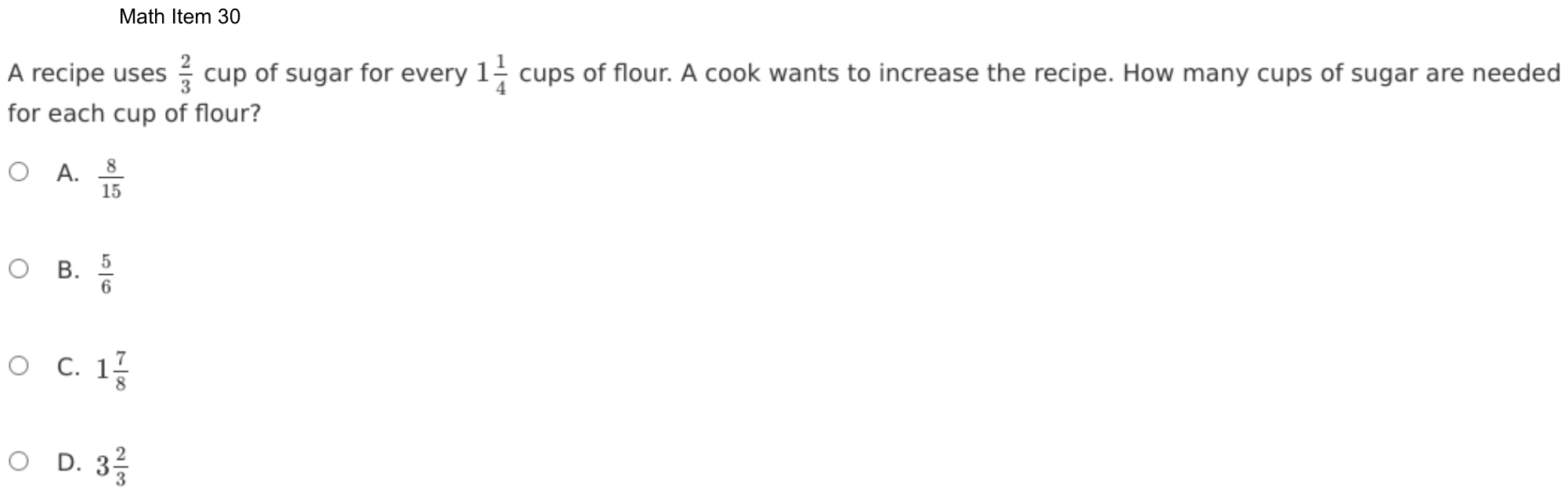
A recipe uses cup of sugar for every cups of flour. A cook wants to increase the recipe. How many cups of sugar are needed for each cup of flour?
- A
- B
- C
- D
Show the answer
Correct answer: A
To find the cups of sugar for each cup of flour, find the unit rate using this ratio:
Then, convert the denominator to an improper fraction and divide to find the cups of sugar per cup of flour.
Question analysis
A recipe uses 2/3 cup of sugar for every 1 1/4 cups of flour, and this unit rate question asks how many cups of sugar go with each cup of flour. Students divide one fraction by a mixed number. Deciding which amount to divide by which, and converting the mixed number first, are where mistakes creep in.
- Grade level
- Grade 7 content, by NYS standard
- Compared with grade 7
- At grade 7 Computing a unit rate from a ratio of fractions is exactly the grade 7 standard. This one divides by a mixed number, and the cook's plan to enlarge the recipe adds wording without adding any numbers to use.
- Estimated difficulty
- Moderate: several steps, or a close reading with one strong distractor.
- Thinking it demands
- Depth of knowledge 2, skills and concepts · mainly apply
- What makes it hard
- Error-prone arithmetic moderate
- Turning words into math minor
- Solution
- 2 steps
- Reading level
- Question and choices: about grade 5, 36 words.
- Students, last 30 days
- Not enough answers yet to show (it takes 10).
Why it is hard, traps and wrong answers (shows the answer)
Why it is hard
The work is a single fraction division, but it involves a mixed number and an awkward result. Students unsure of the rule multiply the two amounts or divide them the other way round, and each gives a tidy listed fraction. A size check settles it: 1 1/4 cups of flour take only 2/3 cup of sugar, so one cup of flour needs less than 2/3 cup, which leaves a single choice.
Error-prone arithmetic moderate Working it out
The divisor is the mixed number 1 1/4, which must become 5/4 before dividing; then 2/3 × 4/5 gives 8/15, a fraction that does not simplify and looks unfinished. (Brown & Burton, 1978; Junker & Sijtsma, 2001)
Turning words into math minor Understanding the question
The phrase “for each cup of flour” puts flour in the denominator, sugar ÷ flour, and the sentence about increasing the recipe adds nothing to the calculation. (Hegarty, Mayer & Monk, 1995; Koedinger & Nathan, 2004)
Strategy: Write the sugar over the flour, change 1 1/4 to an improper fraction, and divide by multiplying by its reciprocal, keeping sugar on top because the question asks for sugar per cup of flour.
Traps
- Wrong operation: Adds instead of multiplying, divides the wrong way round, turns a ratio or rate upside down, or undoes a step in the wrong direction (subtracts what should be added back).
- A faulty procedure: A systematic but wrong procedure: adding fractions straight across, applying an exponent to each term of a sum, dropping a sign when moving a term.
The wrong answers, classified
B Wrong operation (Hegarty, Mayer & Monk, 1995; King et al., 2004)
Multiplies 2/3 by 5/4 instead of dividing, getting 10/12 = 5/6, more sugar for one cup of flour than the recipe uses for 1 1/4 cups.
C Wrong operation (Hegarty, Mayer & Monk, 1995; King et al., 2004)
Divides the flour by the sugar, 5/4 ÷ 2/3 = 15/8 = 1 7/8, which is cups of flour for each cup of sugar, the rate upside down.
D A faulty procedure (Brown & Burton, 1978; Tatsuoka, 1983)
Splits the mixed number apart, dividing 2/3 by only the 1/4 to get 2 2/3, then adding the whole 1 to make 3 2/3.
Worked solution, step by step
Formulas used
- Unit rate
- A unit rate tells how much of one thing goes with 1 of another. Here it is the cups of sugar for 1 cup of flour. The amount you want goes on top. The amount you want to make 1 goes on the bottom.
- Mixed number to fraction
- w is the whole number, and n/d is the fraction part. Multiply the whole number by the bottom, add the top, and keep the bottom. It works because each whole holds d pieces of size 1/d.
- Dividing fractions
- a, b, c and d are numbers that are not zero. To divide by a fraction, multiply by its reciprocal, the fraction flipped upside down. Flip only the fraction you divide by.
Sort out the question
The recipe uses cup of sugar for every cups of flour. You need the cups of sugar for each 1 cup of flour. The part about making more of the recipe gives no numbers, so you can set it aside.
Set up the unit rate
You want sugar for each cup of flour. So sugar goes on top and flour goes on the bottom:
Watch out: dividing the other way, flour by sugar, gives . That is cups of flour for each cup of sugar, choice C.
Change the mixed number
You cannot divide by a mixed number directly. Change it to a fraction first. Each whole has 4 fourths:
Divide the fractions
Multiply by the reciprocal of 5/4, which is 4/5. Multiply the tops and multiply the bottoms:
The fraction 8/15 cannot be simplified, since 8 and 15 share no factor but 1.
Watch out: multiplying without flipping gives , choice B.
So the answer is A, .
Check your answer
More than 1 cup of flour takes only 2/3 cup of sugar. So 1 cup of flour needs a bit less than 2/3. Since , the answer 8/15 is a bit less. Also, , which brings back the recipe.
More questions like this
The original DOE question