Question
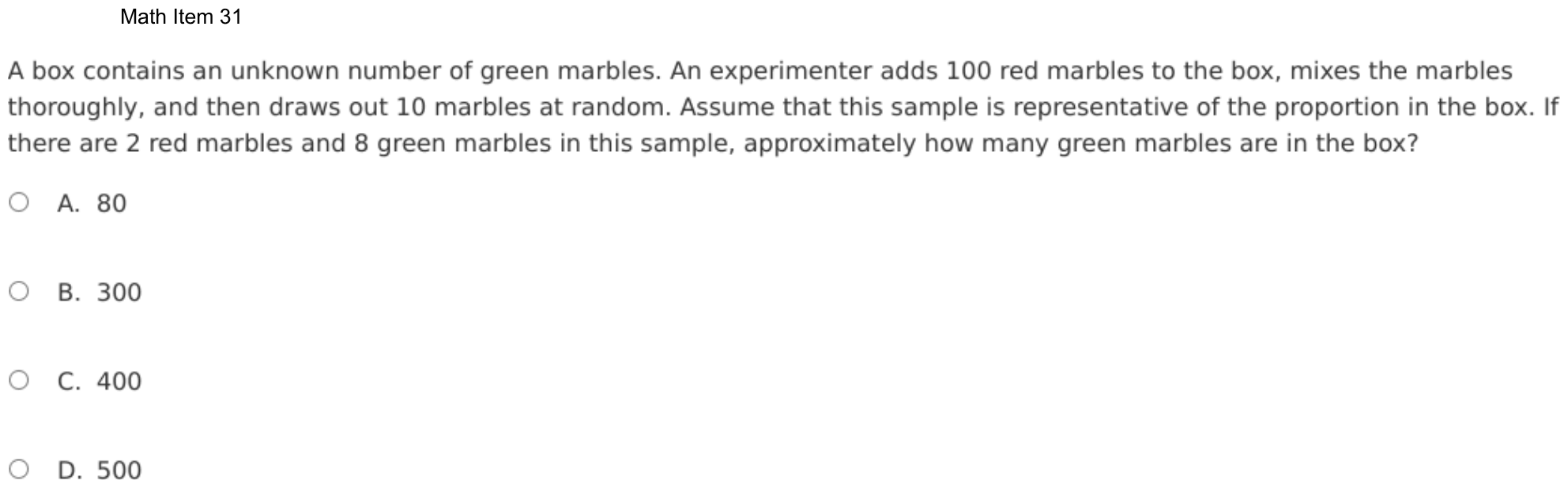
A box contains an unknown number of green marbles. An experimenter adds 100 red marbles to the box, mixes the marbles thoroughly, and then draws out 10 marbles at random. Assume that this sample is representative of the proportion in the box. If there are 2 red marbles and 8 green marbles in this sample, approximately how many green marbles are in the box?
- A80
- B300
- C400
- D500
Show the answer
Correct answer: C
In this context, the phrase “this sample is representative” means that the ratio of 2 red marbles to 8 green marbles is the same as the ratio of red to green marbles in the entire box. Use this ratio of 2 to 8 to set up a proportion and solve, where x represents the number of green marbles in the box.
Question analysis
An experimenter adds 100 red marbles to a box of green marbles, mixes them, and draws a sample of 10 with 2 red and 8 green. This sampling question asks students to estimate how many green marbles the box holds. It applies a ratio from a representative sample, worked from a count known for the box rather than for the sample.
- Grade level
- Grade 6 content, by NYS standard
- Compared with grade 7
- At grade 7 Using a representative sample to reason about a population is grade 6 and 7 work. The twist is that the known count, the 100 red marbles added, belongs to the box rather than the sample, so the usual scaling runs in an unfamiliar direction.
- Estimated difficulty
- Moderate: several steps, or a close reading with one strong distractor.
- Thinking it demands
- Depth of knowledge 2, skills and concepts · mainly apply
- What makes it hard
- Turning words into math moderate
- Much to keep track of minor
- Solution
- 2 steps
- Reading level
- Question and choices: about grade 8, 60 words.
- Students, last 30 days
- Not enough answers yet to show (it takes 10).
Why it is hard, traps and wrong answers (shows the answer)
Why it is hard
This is the logic of estimating a population by tagging, and the twist is that the known count belongs to the marbles that were added, not to the ones being estimated. Scaling the sample up by 50, so that its 2 red become the box’s 100, turns its 8 green into the estimate in one step. Students who scale by way of the whole box often stop at the box’s total, and those who treat 100 as the whole box scale the wrong amount.
Turning words into math moderate Understanding the question
The 100 red marbles are counted in the box, while the 2 red and 8 green are counted in a sample of 10, so “representative of the proportion” must become 2 : 8 = 100 : x. (Hegarty, Mayer & Monk, 1995; Koedinger & Nathan, 2004)
Much to keep track of minor Working it out
Three ratios can be read from the sample, red to green, red to all and green to all, and only the first two connect to the known 100 red marbles. (Sweller, 1988; Carpenter, Just & Shell, 1990)
Strategy: Use the sample's ratio of red to green marbles, then scale it up until the red part matches the 100 red marbles known to be in the box.
Traps
- Answers a different question: A choice is right for another quantity: the other unknown, the rest instead of the part, the part instead of the whole.
- Misunderstands the concept: A wrong belief about a concept: that percents can be added, that area grows like length, that averages can be averaged, that a bigger denominator means a bigger fraction.
The wrong answers, classified
A Misreads the question (Hegarty, Mayer & Monk, 1995)
Scales the sample’s 8 green in 10 up to 100 marbles, getting 80, as if the 100 red marbles added were every marble in the box.
B Misunderstands the concept (Smith, diSessa & Roschelle, 1993; De Bock et al., 1998; Ni & Zhou, 2005)
Reads the sample’s 2 to 8 as red to all marbles, so 2/8 = 100/400 makes 400 marbles in the box, then subtracts the 100 red ones.
D Answers a different question (King et al., 2004; Hegarty, Mayer & Monk, 1995)
Uses 2 red in 10 marbles to find 500 marbles in the whole box, then stops without taking away the 100 red ones to leave the green.
Worked solution, step by step
Formulas used
- Equal ratios (a proportion)
- A ratio compares two amounts. A proportion says two ratios are equal. A sample that is representative has the same mix as the whole box. So the box is the sample scaled up.
Sort out the question
You know:
- The box has an unknown number of green marbles.
- 100 red marbles are added to the box.
- A sample of 10 marbles has 2 red and 8 green.
Representative means the sample has the same mix as the box. You need the number of green marbles in the box. Notice that the 100 red marbles are counted in the box, not in the sample.
Set up the proportion
In the sample, red to green is 2 to 8. In the box, red to green is 100 to x, where x is the number of green marbles. The two ratios are equal:
Scale up the sample
How do you get from 2 red to 100 red? Multiply by 50, since . The green marbles grow by the same factor:
So the box has about 400 green marbles.
Avoid the tempting wrong totals
Watch out: there is another way that can trip you up. In the sample, 2 of 10 marbles are red. So the 100 red marbles are 2/10 of the box, and the box holds 500 marbles in all. But 100 of those are red. Stopping at 500 gives choice D.
Taking away the red ones gives green marbles, the same answer. Treating 100 as the whole box gives 80 green, choice A. Reading 2 to 8 as red to all marbles gives 300, choice B.
So the answer is C, 400.
Check your answer
Picture the finished box: 400 green and 100 red, so 500 marbles. The red part is . The sample had red too. The mix matches, so 400 makes sense.
More questions like this
The original DOE question