Question
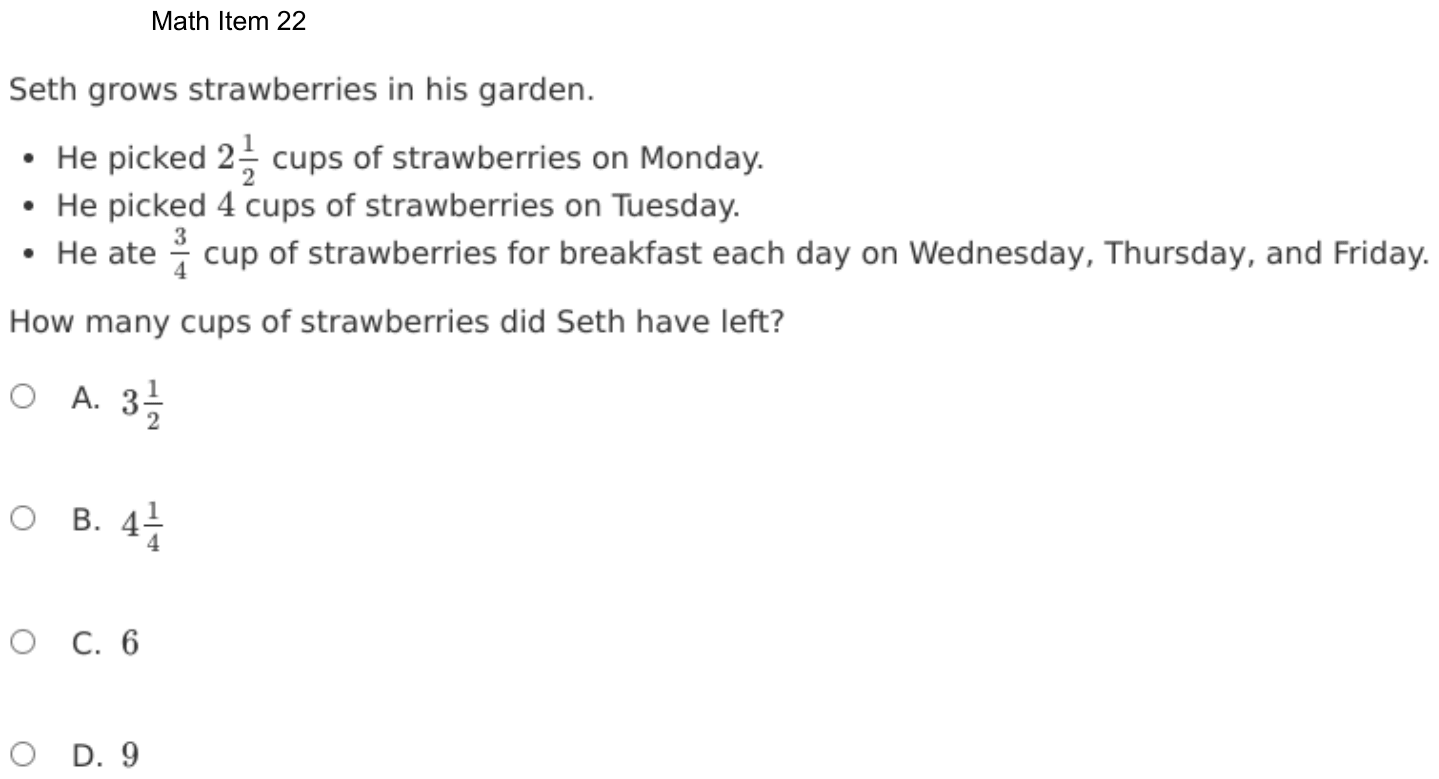
Seth grows strawberries in his garden.
- He picked cups of strawberries on Monday.
- He picked 4 cups of strawberries on Tuesday.
- He ate cup of strawberries for breakfast each day on Wednesday, Thursday, and Friday.
How many cups of strawberries did Seth have left?
- A
- B
- C6
- D9
Show the answer
Correct answer: B
When Seth picks strawberries, the value represents a positive number, and when he eats the strawberries, the value represents a negative number. Write an expression and then evaluate the expression, where the negative value is multiplied by 3 because he ate the same amount on 3 different days.
If the multiplication is confusing, evaluate the expression below which represents the sum for the 5 days with each day listed separately.
Question analysis
Seth picked strawberries on Monday and Tuesday, in amounts given as a mixed number and a whole number, then ate the same fraction of a cup at breakfast on three days. Students find how many cups he has left. It tests adding, multiplying and subtracting fractions in a short word problem, and the eaten amount repeats each day.
- Grade level
- Grade 7 content, by NYS standard
- Compared with grade 7
- Below grade 7 Adding mixed numbers and multiplying a fraction by a whole number are skills from before grade 7. The three steps are short and the numbers friendly, so the demand is below typical grade 7 work with signed rational numbers.
- Estimated difficulty
- Straightforward: two steps or one careful reading.
- Thinking it demands
- Depth of knowledge 2, skills and concepts · mainly apply
- What makes it hard
- Error-prone arithmetic moderate
- Turning words into math minor
- Solution
- 3 steps
- Reading level
- Question and choices: about grade 6, 47 words.
- Students, last 30 days
- Not enough answers yet to show (it takes 10).
Why it is hard, traps and wrong answers (shows the answer)
Why it is hard
The bulleted list lays out the story day by day, so setting up the problem is easy; the points are lost in the fractions. The number of breakfast days, 3, sits right beside the 3/4 cup, and subtracting 3 cups instead of three quarters of a cup each day is the tempting shortcut. Writing every amount in fourths, 26/4 picked and 9/4 eaten, makes the last step a whole-number subtraction.
Error-prone arithmetic moderate Working it out
Three breakfasts of 3/4 cup make 9/4 = 2 1/4 cups, and taking that from 6 1/2 means renaming the half as 2/4, two fraction steps where a slip is easy. (Brown & Burton, 1978; Junker & Sijtsma, 2001)
Turning words into math minor Understanding the question
Picking adds and eating subtracts, and “each day on Wednesday, Thursday, and Friday” means the 3/4 cup counts three times, not once. (Hegarty, Mayer & Monk, 1995; Koedinger & Nathan, 2004)
Strategy: Add the two amounts picked, multiply the breakfast amount by the number of days, and subtract that from the total; writing every amount in fourths keeps the arithmetic simple.
Traps
- Numbers taken from the question: Combines the numbers in the question without a model of the situation, or is simply a number that appears in the question.
- Wrong operation: Adds instead of multiplying, divides the wrong way round, turns a ratio or rate upside down, or undoes a step in the wrong direction (subtracts what should be added back).
The wrong answers, classified
A Numbers taken from the question (Hegarty, Mayer & Monk, 1995)
Subtracts 3 cups, the number of breakfast days, instead of 3 × 3/4 = 2 1/4 cups, so 6 1/2 − 3 = 3 1/2.
C Little reason to choose it (Haladyna & Downing, 1993; Rodriguez, 2005)
No common working gives exactly 6; it is near the 6 1/2 cups picked and mostly catches students who drop the fractions or guess.
D Wrong operation (Hegarty, Mayer & Monk, 1995; King et al., 2004)
Adds the 2 1/4 cups eaten to the 6 1/2 cups picked instead of subtracting, 8 3/4 cups, and takes the nearest choice, 9.
Worked solution, step by step
Formulas used
- Total of a repeated amount
- Use it when the same amount happens again and again. Here Seth eats 3/4 cup on each of 3 days, so the number of times is 3 and the amount each time is 3/4 cup.
- A whole number times a fraction
- n is a whole number, and a/b is a fraction. Multiply the whole number by the top only, and keep the bottom. It works because n groups of a pieces make n × a pieces, and each piece is still size 1/b.
Sort out the question
Seth picked 2 1/2 cups on Monday and 4 cups on Tuesday. Then he ate 3/4 cup each day on Wednesday, Thursday and Friday. That is 3 days of eating. Picking adds strawberries, and eating takes them away. You need the number of cups he has left.
Add what he picked
Add the two days of picking:
He picked 6 1/2 cups in all, before he ate any.
Find how much he ate
He ate 3/4 cup on each of 3 days. Multiply:
To change 9/4 to a mixed number, note that 4 fits into 9 twice, with 1 left over. He ate 2 1/4 cups.
Watch out: he ate 3/4 cup three times, not 3 cups. Subtracting 3 gives 3 1/2, choice A.
Take away what he ate
Write the half as fourths, so both fractions have the same bottom: 1/2 = 2/4. Then subtract the wholes and the fourths:
Watch out: eating takes away. Adding the 2 1/4 cups gives 8 3/4, and the nearest choice is 9, choice D.
So the answer is B, cups.
Check your answer
Use decimals. 2.5 + 4 = 6.5 cups picked. 3 × 0.75 = 2.25 cups eaten. Then 6.5 − 2.25 = 4.25 cups, which is 4 1/4.
More questions like this
The original DOE question