Question
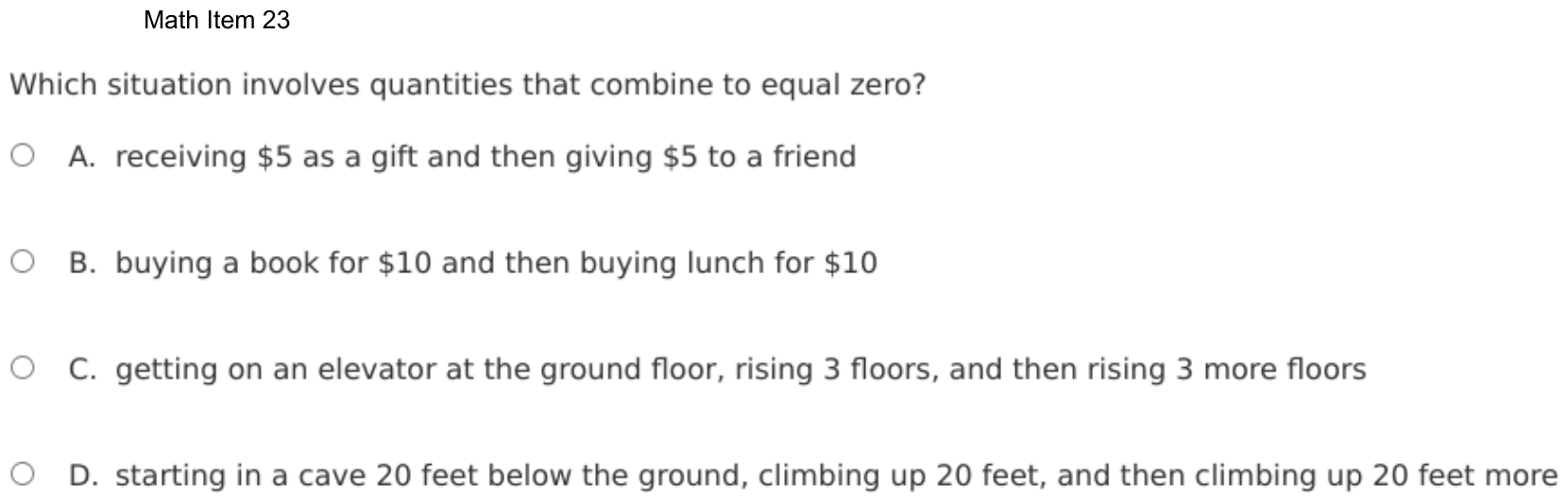
Which situation involves quantities that combine to equal zero?
- Areceiving $5 as a gift and then giving $5 to a friend
- Bbuying a book for $10 and then buying lunch for $10
- Cgetting on an elevator at the ground floor, rising 3 floors, and then rising 3 more floors
- Dstarting in a cave 20 feet below the ground, climbing up 20 feet, and then climbing up 20 feet more
Show the answer
Correct answer: A
When looking for a situation where quantities combine to make zero, find two values with the same absolute value where one value is positive and one value is negative.
In the situation in option A, receiving a gift of $5 is represented by , and giving a friend $5 is represented by . These values combine to equal zero because .
Question analysis
This question gives four everyday situations involving money, an elevator and a cave, and asks which one involves quantities that combine to make zero. It tests representing gains and losses, or ups and downs, with positive and negative numbers. Equal numbers alone do not make zero, so the direction of each amount must be read carefully.
- Grade level
- Grade 7 content, by NYS standard
- Compared with grade 7
- Below grade 7 Describing situations where opposite quantities make zero is named in the grade 7 standards, and this is its most direct form: one reading of four everyday situations, easier than typical grade 7 work with signed numbers.
- Estimated difficulty
- Routine: one familiar step, little to misread.
- Thinking it demands
- Depth of knowledge 1, recall and reproduction · mainly understand
- What makes it hard
- Solution
- 1 step
- Reading level
- Question and choices: about grade 5, 60 words.
- Students, last 30 days
- Not enough answers yet to show (it takes 10).
Why it is hard, traps and wrong answers (shows the answer)
Why it is hard
The idea that a quantity and its opposite add to zero is familiar, and the right situation states it plainly. The wrong choices are built from equal amounts: two of them repeat a number but move in one direction, and the cave climb reaches zero partway before going 20 feet past it. Writing each situation as a sum of signed numbers takes a few seconds and settles it.
Turning words into math minor Understanding the question
Each situation must be turned into signed numbers, receiving or rising as plus and giving or buying as minus, before its total can be judged. (Hegarty, Mayer & Monk, 1995; Koedinger & Nathan, 2004)
Every choice must be checked minor Choosing the answer
Every choice repeats one amount, $5, $10, 3 floors or 20 feet, so equal numbers alone do not identify the answer; the direction of each move has to be checked. (Embretson & Wetzel, 1987)
Strategy: Write each situation as signed numbers, using + for gains or upward moves and − for losses or downward moves, add them, and see which total is zero.
Traps
- Stops one step early: A choice is a number from partway through the solution.
- Misunderstands the concept: A wrong belief about a concept: that percents can be added, that area grows like length, that averages can be averaged, that a bigger denominator means a bigger fraction.
The wrong answers, classified
B Misunderstands the concept (Smith, diSessa & Roschelle, 1993; De Bock et al., 1998; Ni & Zhou, 2005)
Treats the two equal $10 amounts as opposites that cancel, though buying a book and buying lunch both take money away, for a total of −$20.
C Misunderstands the concept (Smith, diSessa & Roschelle, 1993; De Bock et al., 1998; Ni & Zhou, 2005)
Pairs the two 3s as amounts that cancel, missing that rising and then rising again both go up, ending 6 floors above the ground floor.
D Stops one step early (King et al., 2004; Gierl et al., 2017)
Sees that starting 20 feet below ground and climbing 20 feet reaches zero, then overlooks the last 20 feet climbed, which ends 20 feet above ground.
Worked solution, step by step
Formulas used
- Opposites add to zero
- a is any number, and −a is its opposite: the same size, but the other sign. A number and its opposite always add to 0. On a number line, they sit the same distance from 0 on opposite sides. Equal moves in opposite directions cancel out.
Sort out the question
You need the situation whose amounts add up to zero. Give each amount a sign. Use + for getting money or going up. Use − for spending money or going down. Then add the amounts in each choice. The direction matters, not just the numbers.
Write each choice with signs
Turn each situation into signed numbers and add them up:
Choice Amounts Total A +5, then −5 0 B −10, then −10 −20 C +3, then +3 +6 D start at −20, then +20, then +20 +20 Look at the tricky choices
In B, buying a book and buying lunch both take money away. Equal amounts cancel only when they go in opposite directions. In C, rising and rising again both go up, so you end 6 floors up.
Watch out: in D, starting at −20 and climbing 20 feet does reach 0, ground level. But then you climb 20 feet more. You end at +20, 20 feet above the ground, so D is wrong.
Choose the zero total
Only choice A has two opposite amounts of the same size. Getting $5 is +5, and giving $5 away is −5:
So the answer is A: receiving $5 as a gift and then giving $5 to a friend.
Check your answer
Think about where you end up. In A, you end with exactly the money you started with, so the total change is zero. In every other choice, you end with less money, higher up, or above the ground.
More questions like this
The original DOE question