Question
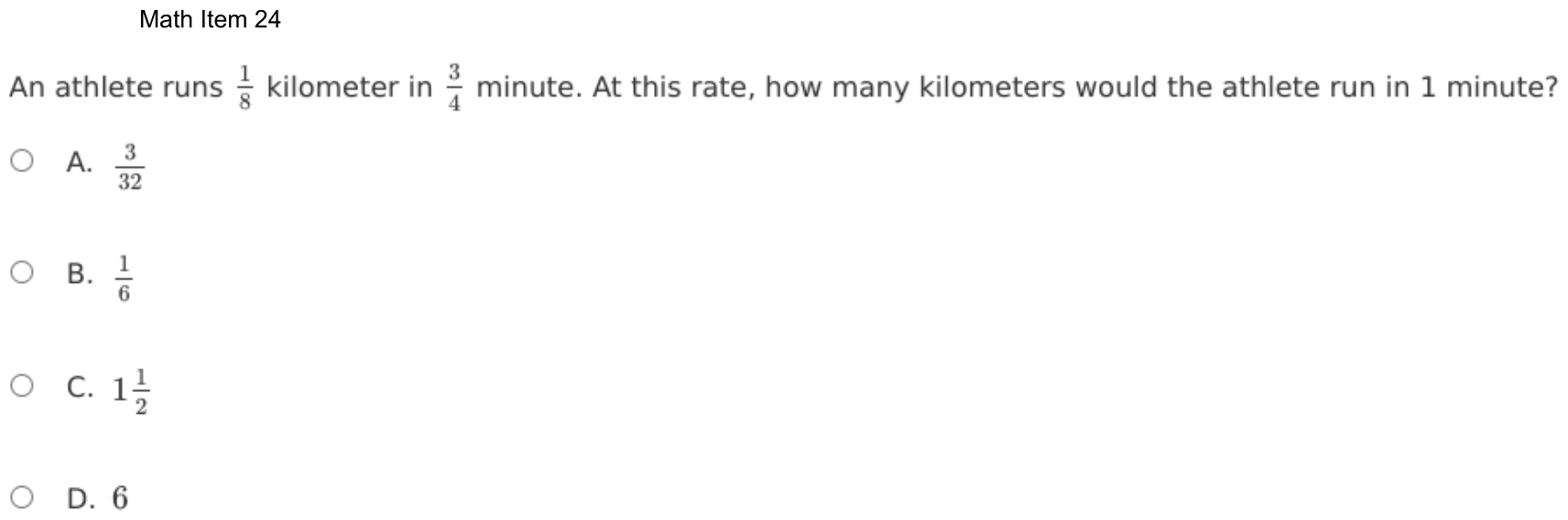
An athlete runs kilometer in minute. At this rate, how many kilometers would the athlete run in 1 minute?
- A
- B
- C
- D6
Show the answer
Correct answer: B
To determine the number of kilometers in 1 minute, find the unit rate in kilometers per minute: .
To evaluate the fraction, use the reciprocal when dividing to get kilometer per 1 minute.
Question analysis
An athlete runs 1/8 kilometer in 3/4 minute, and students find how many kilometers the athlete would run in 1 minute at the same rate. It tests unit rates with fractions. Both the distance and the time are fractions, so deciding which one to divide by which is the main challenge.
- Grade level
- Grade 7 content, by NYS standard
- Compared with grade 7
- At grade 7 Computing a unit rate from a ratio of fractions is the grade 7 standard itself, and this is a standard example: one fraction divided by another in two short steps, with the order of division the only real decision.
- Estimated difficulty
- Straightforward: two steps or one careful reading.
- Thinking it demands
- Depth of knowledge 2, skills and concepts · mainly apply
- What makes it hard
- Error-prone arithmetic moderate
- Turning words into math minor
- Solution
- 2 steps
- Reading level
- Question and choices: about grade 9, 23 words.
- Students, last 30 days
- Not enough answers yet to show (it takes 10).
Why it is hard, traps and wrong answers (shows the answer)
Why it is hard
The question is a unit rate with fractions, and its wrong choices are the other ways to combine 1/8 and 3/4. Since 1 minute is only a third longer than 3/4 minute, the distance must be only a third more than 1/8 kilometer, which rules out the product and both large choices at once. Dividing with the units written in, kilometers over minutes, keeps the order right.
Error-prone arithmetic moderate Working it out
The rate is a fraction divided by a fraction, 1/8 ÷ 3/4, and only the 3/4 may be flipped; multiplying straight across or dividing the other way round both give listed choices. (Brown & Burton, 1978; Junker & Sijtsma, 2001)
Turning words into math minor Understanding the question
Kilometers in 1 minute means kilometers per minute, so the 1/8 goes on top even though the time, 3/4, is the larger number. (Hegarty, Mayer & Monk, 1995; Koedinger & Nathan, 2004)
Strategy: Divide the distance by the time, kilometers over minutes, by multiplying 1/8 by the reciprocal of 3/4, and check that the units of the result are kilometers per minute.
Traps
- Wrong operation: Adds instead of multiplying, divides the wrong way round, turns a ratio or rate upside down, or undoes a step in the wrong direction (subtracts what should be added back).
The wrong answers, classified
A Wrong operation (Hegarty, Mayer & Monk, 1995; King et al., 2004)
Multiplies 1/8 by 3/4 instead of dividing, getting 3/32, which is less than the 1/8 kilometer already run in under a minute.
C Wrong operation (Hegarty, Mayer & Monk, 1995; King et al., 2004)
Splits the 3/4 minute into quarters but multiplies 1/8 by 3 instead of dividing, then multiplies by 4 for a full minute, giving 12/8 = 1 1/2.
D Wrong operation (Hegarty, Mayer & Monk, 1995; King et al., 2004)
Divides 3/4 by 1/8, minutes by kilometers, which gives 6 minutes per kilometer, the rate turned upside down.
Worked solution, step by step
Formulas used
- Unit rate
- A unit rate tells how much happens in 1 unit of time. Here the distance is in kilometers and the time is in minutes, so the rate is kilometers per minute. You divide because you are sharing the distance equally over the minutes.
- Dividing fractions
- a, b, c and d are numbers that are not zero. To divide by a fraction, multiply by its reciprocal (the fraction flipped upside down). Flip only the second fraction, the one you divide by.
Sort out the question
The athlete runs 1/8 kilometer in 3/4 minute, which is less than a full minute. You need how far the athlete runs in 1 whole minute at the same speed. That is the unit rate, in kilometers per minute.
Set up the division
Kilometers per minute means kilometers divided by minutes. So the distance comes first and the time second:
Watch out: dividing the other way, 3/4 ÷ 1/8, gives 6. That is minutes per kilometer, the rate turned upside down, choice D.
Divide the fractions
Flip 3/4 to get 4/3, then multiply. Multiply the tops and multiply the bottoms:
Simplify by dividing the top and bottom by 4:
Watch out: multiplying 1/8 × 3/4 without flipping gives 3/32, choice A.
Make sense of the answer
In 1 minute, the athlete runs 1/6 kilometer. That is a bit more than 1/8 kilometer, which makes sense. A full minute is a bit longer than 3/4 minute, so the athlete goes a bit farther. Choice C, 1 1/2 kilometers, would be 12 times as far in barely more time.
So the answer is B, kilometer.
Check your answer
Work in quarter minutes. In 3 quarter minutes, the athlete runs 1/8 km. So in 1 quarter minute, the athlete runs 1/8 ÷ 3 = 1/24 km. A full minute has 4 quarters: 4 × 1/24 = 4/24 = 1/6 km.
More questions like this
The original DOE question