Question
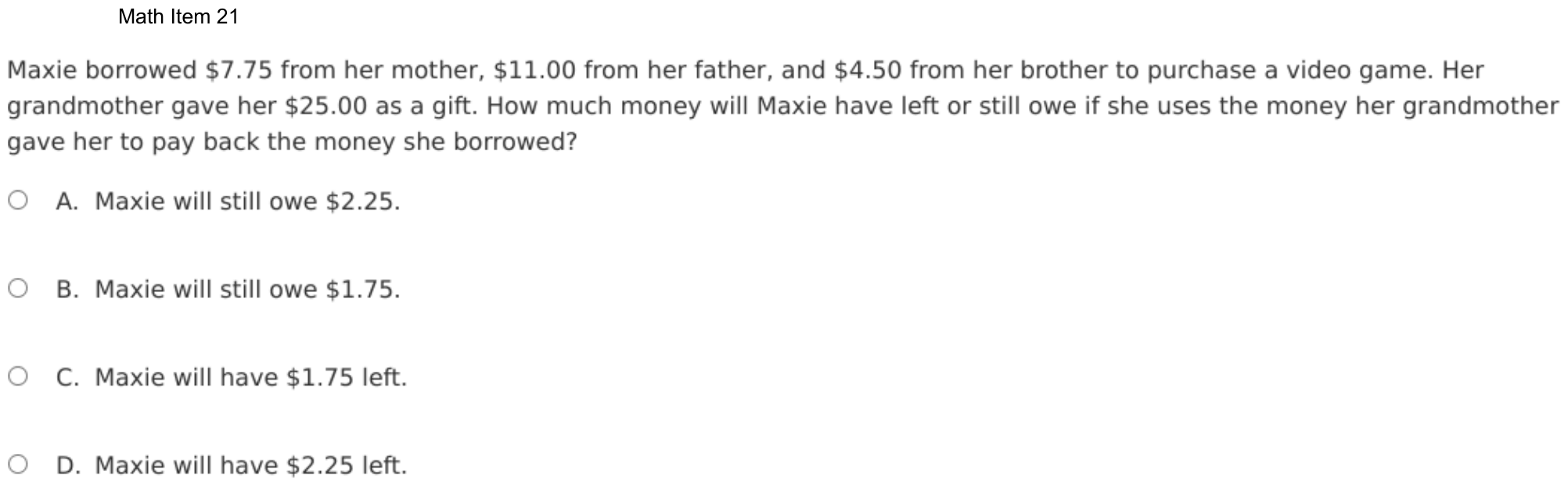
Maxie borrowed $7.75 from her mother, $11.00 from her father, and $4.50 from her brother to purchase a video game. Her grandmother gave her $25.00 as a gift. How much money will Maxie have left or still owe if she uses the money her grandmother gave her to pay back the money she borrowed?
- AMaxie will still owe $2.25.
- BMaxie will still owe $1.75.
- CMaxie will have $1.75 left.
- DMaxie will have $2.25 left.
Show the answer
Correct answer: C
First, determine the total amount Maxie borrowed, in dollars:
Then use subtraction to determine the difference between the amount her grandmother gave her and the amount she borrowed:
The difference is positive, which means that Maxie will still have $1.75 left from the amount her grandmother gave her.
Question analysis
Maxie borrowed money from her mother, father and brother to buy a video game, then received $25.00 from her grandmother to pay them back. Students decide how much money she will have left over or still owe. It tests adding and subtracting decimals with money, and the choices also test which way the difference goes.
- Grade level
- Grade 6 content, by NYS standard
- Compared with grade 7
- Below grade 7 Adding and subtracting money amounts is grade 6 decimal work. Here it takes one sum and one difference, and the only further demand is deciding whether the result is money left or money owed, well below typical grade 7 tasks.
- Estimated difficulty
- Routine: one familiar step, little to misread.
- Thinking it demands
- Depth of knowledge 2, skills and concepts · mainly apply
- What makes it hard
- Error-prone arithmetic minor
- Turning words into math minor
- Solution
- 2 steps
- Reading level
- Question and choices: about grade 4, 66 words.
- Students, last 30 days
- Not enough answers yet to show (it takes 10).
Why it is hard, traps and wrong answers (shows the answer)
Why it is hard
Few students miss this one, since it needs only one addition and one subtraction with money. The choices come in pairs, so the right amount must also be matched with the right outcome. Lining up the decimal points, and asking whether $25.00 is more or less than the $23.25 borrowed, settles both the amount and whether Maxie owes or keeps money.
Error-prone arithmetic minor Working it out
The loans add to $23.25, and subtracting that from $25.00 means borrowing across two zeros, a classic place for a digit to go wrong. (Brown & Burton, 1978; Junker & Sijtsma, 2001)
Turning words into math minor Understanding the question
Each amount appears twice among the choices, once as money left and once as money owed, so the result must also be read for direction by asking which is larger, the gift or the loans. (Hegarty, Mayer & Monk, 1995; Koedinger & Nathan, 2004)
Strategy: Add the three amounts borrowed, compare the total with the $25.00 gift, and decide from which is larger whether Maxie ends up with money left or still owes some.
Traps
- Negatives and direction: Arithmetic with negative numbers, the order of a subtraction, or direction on a number line. (Moving a term across the equals sign without changing its sign is a faulty procedure.)
- A faulty procedure: A systematic but wrong procedure: adding fractions straight across, applying an exponent to each term of a sum, dropping a sign when moving a term.
The wrong answers, classified
A Little reason to choose it (Haladyna & Downing, 1993; Rodriguez, 2005)
Needs two errors at once, a wrong difference such as $2.25 and the reversed outcome, so no single line of working reaches it and it mostly draws guesses.
B Negatives and direction (Brown & Burton, 1978)
Finds the $1.75 difference correctly but reverses its meaning, as if the $25.00 gift fell short of the $23.25 borrowed instead of covering it.
D A faulty procedure (Brown & Burton, 1978; Tatsuoka, 1983)
Subtracts $23.25 from $25.00 column by column, taking the smaller digit from the larger instead of borrowing, so 5 − 0 and 2 − 0 give $2.25.
Worked solution, step by step
Formulas used
- Money left over
- Money she has is the $25.00 gift. Money she owes is the total she borrowed. If the result is positive, she has that much left. If it were negative, she would still owe that much. Comparing the two amounts first tells you which.
Sort out the question
Maxie borrowed from three people: $7.75, $11.00 and $4.50. Her grandmother gave her $25.00. She uses the $25.00 to pay everyone back. You need to know if money is left over or if she still owes some, and how much.
Add up what she borrowed
Line up the decimal points and add:
She owes $23.25 in all. That is the amount she must pay back.
Compare the gift with the debt
The gift, $25.00, is more than the $23.25 she owes. So she can pay everyone back and still have money left. She will not owe anything.
Watch out: once you find $1.75, keep its meaning straight. Saying she still owes $1.75, choice B, gets the direction backwards.
Subtract to find what is left
Take the debt away from the gift:
You need to regroup (borrow) across the zeros. Think of $25.00 as 24 dollars and 100 cents. Then 100 − 25 = 75 cents, and 24 − 23 = 1 dollar.
Watch out: taking the smaller digit from the larger one in each column gives $2.25, choice D.
So the answer is C: Maxie will have $1.75 left.
Check your answer
Add back. The $23.25 she pays plus the $1.75 she keeps is 23.25 + 1.75 = 25.00. That is the whole gift, so the subtraction is right.
More questions like this
The original DOE question