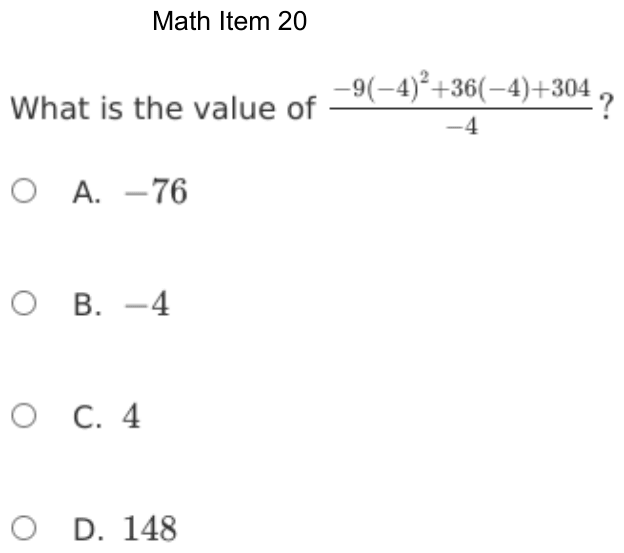
Question
What is the value of ?
- A−76
- B−4
- C4
- D148
Show the answer
Correct answer: B
Use the order of operations to evaluate the expression. It is important to recognize that the fraction bar is a grouping symbol and so the entire numerator should be evaluated first. Exponents are evaluated first.
Then multiplication, recognizing that the product of a negative factor and a positive factor is negative.
Then addition and subtraction in order from left to right, recognizing the rules for adding and subtracting signed numbers.
And finally the fraction can be evaluated by division, recognizing that the quotient of a positive and a negative number is negative.
Question analysis
This arithmetic question asks for the value of a fraction whose numerator, −9(−4)² + 36(−4) + 304, is divided by −4. Students follow the order of operations with negative numbers: a square, two products, a sum and a division. Every step carries a sign, and one dropped negative changes the result completely.
- NYS standards
- Grade level
- Grade 7 content, by NYS standard
- Compared with grade 7
- At grade 7 Order of operations with negative numbers is standard grade 7 practice. This expression stacks a squared negative, two products and a division by a negative into one fraction, so it takes more steps than usual, each with a sign to track.
- Estimated difficulty
- Moderate: several steps, or a close reading with one strong distractor.
- Thinking it demands
- Depth of knowledge 1, recall and reproduction · mainly apply
- What makes it hard
- Error-prone arithmetic moderate
- Many steps minor
- A very close wrong answer minor
- Solution
- 4 steps
- Reading level
- Question and choices: about grade 5, 6 words.
- Students, last 30 days
- Not enough answers yet to show (it takes 10).
Why it is hard, traps and wrong answers (shows the answer)
Why it is hard
Nothing here is conceptually new; the question measures care with signs under the order of operations. The parentheses in (−4)² decide whether −9 multiplies 16 or −16, and the two products of −144 then nearly cancel the 304, leaving a small numerator whose sign is easy to lose. Writing each intermediate value with its sign, line by line, prevents most errors.
Error-prone arithmetic moderate Working it out
Five sign decisions sit in one expression: squaring −4, two products with a negative factor, a sum that climbs from −288 past zero, and a division by −4. (Brown & Burton, 1978; Junker & Sijtsma, 2001)
Many steps minor Working it out
The numerator alone takes an exponent, two multiplications and two additions before the single division, and all of it must be finished before dividing. (Daniel & Embretson, 2010; Enright, Morley & Sheehan, 2002)
A very close wrong answer minor Choosing the answer
The right value and the choice 4 differ only in sign, so a student with the right size must still check the sign of a positive numerator over −4. (Embretson & Wetzel, 1987; Gorin & Embretson, 2006; Ascalon et al., 2007)
Strategy: Treat the fraction bar as grouping: square −4 first, do the two multiplications, combine the numerator from left to right, and only then divide by −4, writing each sign as you go.
Traps
- Negatives and direction: Arithmetic with negative numbers, the order of a subtraction, or direction on a number line. (Moving a term across the equals sign without changing its sign is a faulty procedure.)
- Order of operations: Working left to right, or distributing a minus sign wrongly, gives a choice.
The wrong answers, classified
A Order of operations (Brown & Burton, 1978)
Squares as if the minus sat outside the parentheses, taking (−4)² as −16, so −9 × (−16) = 144, the numerator becomes 304, and 304 ÷ (−4) = −76.
C Negatives and direction (Brown & Burton, 1978)
Works the numerator out correctly as 16 but divides by −4 as if the signs did not matter, giving a positive quotient.
D Negatives and direction (Brown & Burton, 1978)
Drops every negative sign, adding 144 + 144 + 304 = 592 and dividing by 4, so 148 keeps none of the signs in the problem.
Worked solution, step by step
Formulas used
- Order of operations
- This is the order for working out an expression. Grouping means parentheses and the fraction bar. Exponents are small raised numbers, like the 2 in (−4)². Next, multiply and divide from left to right. Last, add and subtract from left to right.
- Squaring a negative number
- a is a positive number, so −a is negative. Squaring means multiplying a number by itself. A negative times a negative is positive, so a negative number squared is positive. For example, (−4)² = 16.
- Signs when you multiply or divide
- When two numbers have different signs, their product or quotient is negative. When they have the same sign, it is positive. A quotient is the answer to a division.
Sort out the question
You need the value of one big fraction. The fraction bar is a grouping symbol, so finish the whole top first. Then divide by −4. Follow the order of operations, and track every minus sign.
Do the exponent first
The only exponent is (−4)². Squaring means multiplying a number by itself:
Watch out: (−4)² is 16, not −16. Using −16 makes the top 304, which gives −76, choice A.
Do the multiplication
Now multiply. A negative times a positive is negative:
So the top becomes:
Add from left to right
Add the two negatives first:
Then add 304. Since 304 is more than 288, the result is positive:
The whole top is 16.
Divide by −4
Now divide the top by the bottom. A positive divided by a negative is negative:
Watch out: positive 4, choice C, ignores the negative bottom. Dropping every minus sign gives 592 ÷ 4 = 148, choice D.
So the answer is B, −4.
Check your answer
Multiply back. If the answer is −4, then −4 times the bottom, −4, should give the top. It does: (−4) × (−4) = 16. Also, the top is positive and the bottom is negative, so the answer must be negative.
More questions like this
The original DOE question