Passage Bird Talk
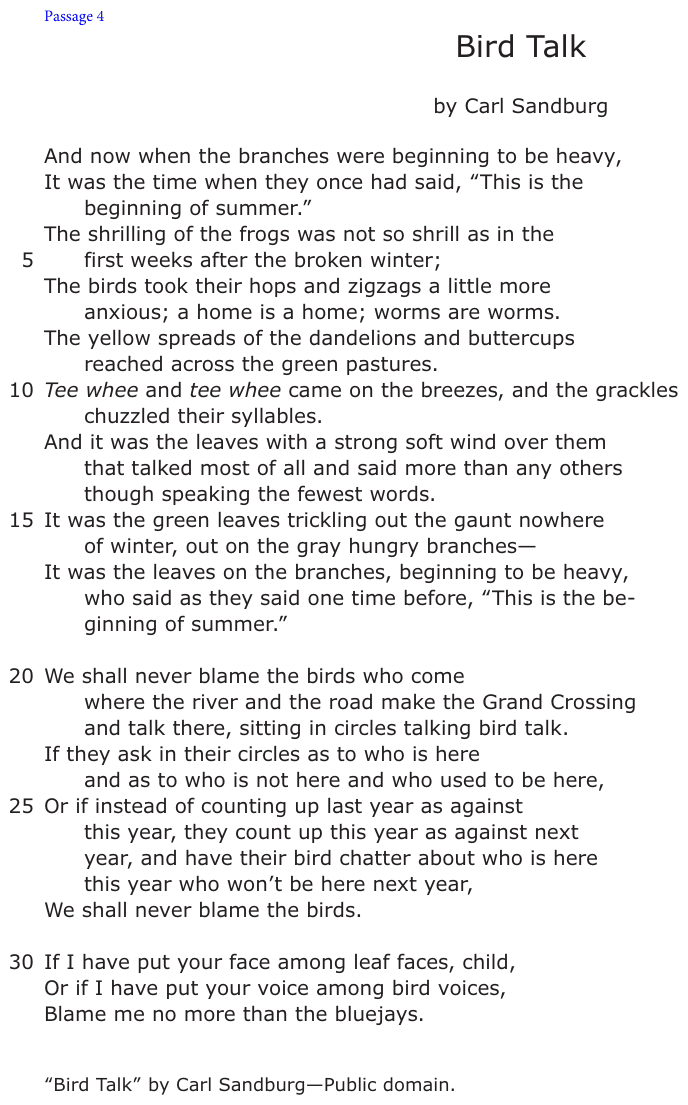
Bird Talk
by Carl Sandburg
And now when the branches were beginning to be heavy,
It was the time when they once had said, “This is the
beginning of summer.”
The shrilling of the frogs was not so shrill as in the
first weeks after the broken winter;
The birds took their hops and zigzags a little more
anxious; a home is a home; worms are worms.
The yellow spreads of the dandelions and buttercups
reached across the green pastures.
Tee whee and tee whee came on the breezes, and the grackles
chuzzled their syllables.
And it was the leaves with a strong soft wind over them
that talked most of all and said more than any others
though speaking the fewest words.
It was the green leaves trickling out the gaunt nowhere
of winter, out on the gray hungry branches—
It was the leaves on the branches, beginning to be heavy,
who said as they said one time before, “This is the be-
ginning of summer.”
We shall never blame the birds who come
where the river and the road make the Grand Crossing
and talk there, sitting in circles talking bird talk.
If they ask in their circles as to who is here
and as to who is not here and who used to be here,
Or if instead of counting up last year as against
this year, they count up this year as against next
year, and have their bird chatter about who is here
this year who won’t be here next year,
We shall never blame the birds.
If I have put your face among leaf faces, child,
Or if I have put your voice among bird voices,
Blame me no more than the bluejays.
“Bird Talk” by Carl Sandburg—Public domain.
Question
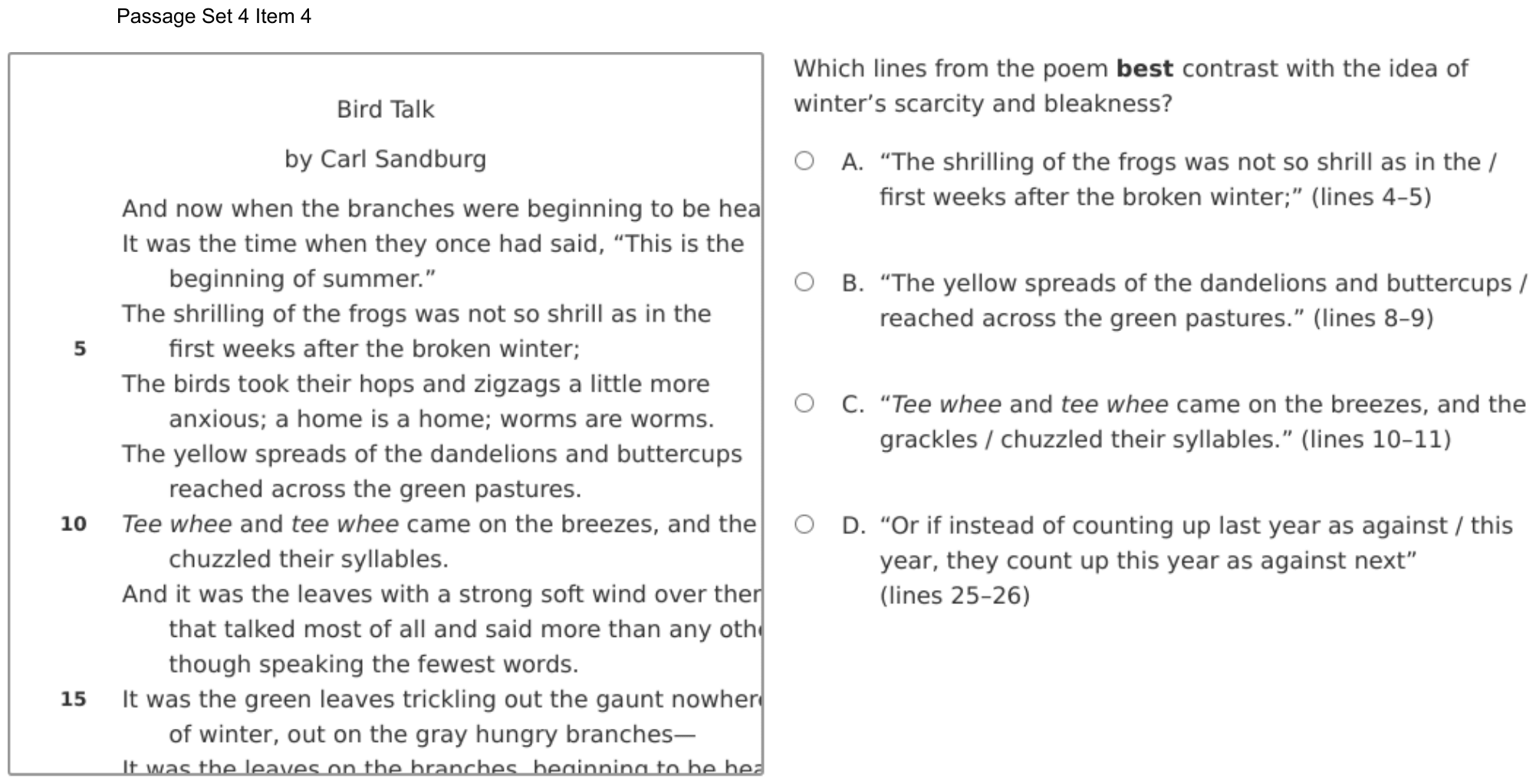
Which lines from the poem best contrast with the idea of winter’s scarcity and bleakness?
- A“The shrilling of the frogs was not so shrill as in the / first weeks after the broken winter;” (lines 4–5)
- B“The yellow spreads of the dandelions and buttercups / reached across the green pastures.” (lines 8–9)
- C“Tee whee and tee whee came on the breezes, and the grackles / chuzzled their syllables.” (lines 10–11)
- D“Or if instead of counting up last year as against / this year, they count up this year as against next” (lines 25–26)
Show the answer
Correct answer: B
The question asks for the identification of a description that contrasts with the scarcity and bleakness of winter.
A. Incorrect. These lines indicate that the frogs are first very excited about the shift from winter to spring, which causes them to make a loud “shrilling,” yet their sounds lessen after a time and grow weaker. As such, these lines contrast two periods of spring (early vs. later) and the response of the frogs to these two periods; the lines do not contrast the bleakness of winter with the abundance of spring or summer.
B. CORRECT. During winter, there is scarcity of plant life and a bleak landscape: trees lose their leaves, snow covers the ground, and nature appears dark and shuttered. In contrast, these lines reveal the bright “yellow spreads” of flowers and the verdant “green pastures” that are signs that winter has abated.
C. Incorrect. This description contrasts the sounds of “the breezes” of warmer air and the sounds made by grackles—a type of bird—rather than the bleakness and scarcity of winter and the abundance of the “ ‘beginning of summer’ ” (line 3).
D. Incorrect. These lines show the contrast between the two ways of looking at things in terms of past vs. present or present vs. future; in this instance, the lines reveal the way birds naturally expect and adapt to the passing of time and the change of seasons. The lines do not present a contrast between winter and spring.
Question analysis
This textual evidence question on Carl Sandburg’s poem “Bird Talk” asks which lines best contrast with the idea of winter’s scarcity and bleakness. Students compare four quotations about frogs, flowers, birdsong and the birds’ yearly counting, and the challenge is finding the one whose images most fully show the opposite of a bare, bleak season.
- Grade level
- Grade 7 reading and task
- Compared with grade 7
- At grade 7 Choosing lines that fit an idea is routine grade 7 evidence work. The twist is that students look for the opposite of an idea, winter’s scarcity and bleakness, rather than support for it, though the quoted images are concrete.
- Estimated difficulty
- Straightforward: two steps or one careful reading.
- Thinking it demands
- Depth of knowledge 2, skills and concepts · mainly evaluate
- What makes it hard
- Every choice must be checked minor
- Hard words minor
- Evidence
- Answered from one sentence or line
- Reading level
- Passage: 296 words (a poem; reading level not measured); question and choices: about grade 6, 85 words.
- Students, last 30 days
- Not enough answers yet to show (it takes 10).
Why it is hard, traps and wrong answers (shows the answer)
Why it is hard
The question turns the usual evidence task around: students picture a scarce, bleak winter and then look for its opposite. The line that names winter outright is a trap, since it only compares the frogs’ noise in two stretches of spring, and the grackles’ calls show life without plenty. The flowers spreading “across the green pastures” are the one image of abundance and color.
Every choice must be checked minor Choosing the answer
Every quotation carries some sign of the season, frogs, flowers, birdsong and the birds’ yearly count, so each must be tested for images of plenty and color set against a bare winter. (Embretson & Wetzel, 1987)
Hard words minor Understanding the question
The stem’s “scarcity” and “bleakness” define what to look for; a student unsure of them cannot tell that yellow and green spreading across pastures is their opposite. (Perfetti, 2007; Freedle & Kostin, 1993)
Strategy: First picture what a scarce, bleak winter looks like, then read each quotation for images that show the plain opposite of that picture.
Traps
- Word match: Repeats striking words or phrases from the text, so it looks supported, but its meaning does not fit the question.
- Supports only part of the claim: In a question about evidence: a line that backs one half of the claim but not the other, or a related point rather than the claim itself.
The wrong answers, classified
A Word match (Freedle & Kostin, 1993)
Is drawn by “the broken winter,” the only mention of winter among the choices, but the lines compare the frogs’ shrilling early and later in spring, not winter’s bareness with plenty.
C Supports only part of the claim (King et al., 2004; Thissen, Steinberg & Fitzpatrick, 1989)
Picks the birdsong, which does show life returning after a silent season, but the calls say nothing about scarcity giving way to plenty, as the spreading flowers in lines 8–9 do.
D Word match (Freedle & Kostin, 1993)
Takes “as against” for the contrast the question asks about, though these lines set one year against another in the birds’ talk and hold no image of winter or of growth.
Working it out, step by step
Figure out what the question asks
This asks you to find lines that show the opposite of winter. Scarcity means not having enough of something. Bleakness means looking bare, cold and gloomy. So picture winter: bare branches, no flowers, gray and brown fields. Then look for the lines that show plenty and bright color instead.
Read lines 8–9
Lines 8–9 say “The yellow spreads of the dandelions and buttercups / reached across the green pastures.” Dandelions and buttercups are small yellow flowers. Pastures are grassy fields. A spread is a wide area covered with something. Here, yellow flowers stretch across green fields. That is a picture of color everywhere and plenty of growth. It is the exact opposite of a bare, gray winter.
Check each choice
- A does not fit. It mentions “the broken winter,” but it only compares how shrill, or sharp and high, the frogs sounded at two times. Nothing in it shows plenty.
- B fits. Yellow flowers spread over green fields, full of color and life.
- C does not fit. The birdsong shows that life is back. But it gives no picture of plenty or color to set against a bare winter.
- D does not fit. These lines compare one year with another in the birds’ talk. There is no winter and no growth in them.
Watch out: A is the only choice that names winter, so it can seem to fit. But mentioning winter is not the same as contrasting with it.
Choose the answer
Only lines 8–9 show plenty and bright color, the opposite of a scarce, bleak winter. So the answer is B, lines 8–9: “The yellow spreads of the dandelions and buttercups / reached across the green pastures.”
Why this answer and not the closest wrong one
C is a close wrong choice, since birdsong is a sign that life is back. But the question asks for a contrast with scarcity, or not having enough. Sounds alone do not show plenty. Lines 8–9 show flowers spreading wide across green fields. That picture of color and plenty is the clearest opposite of a bare, gray winter.
More questions like this
The original DOE question
The passage “Bird Talk” as printed (page 32)