Passage Bird Talk
Bird Talk
by Carl Sandburg
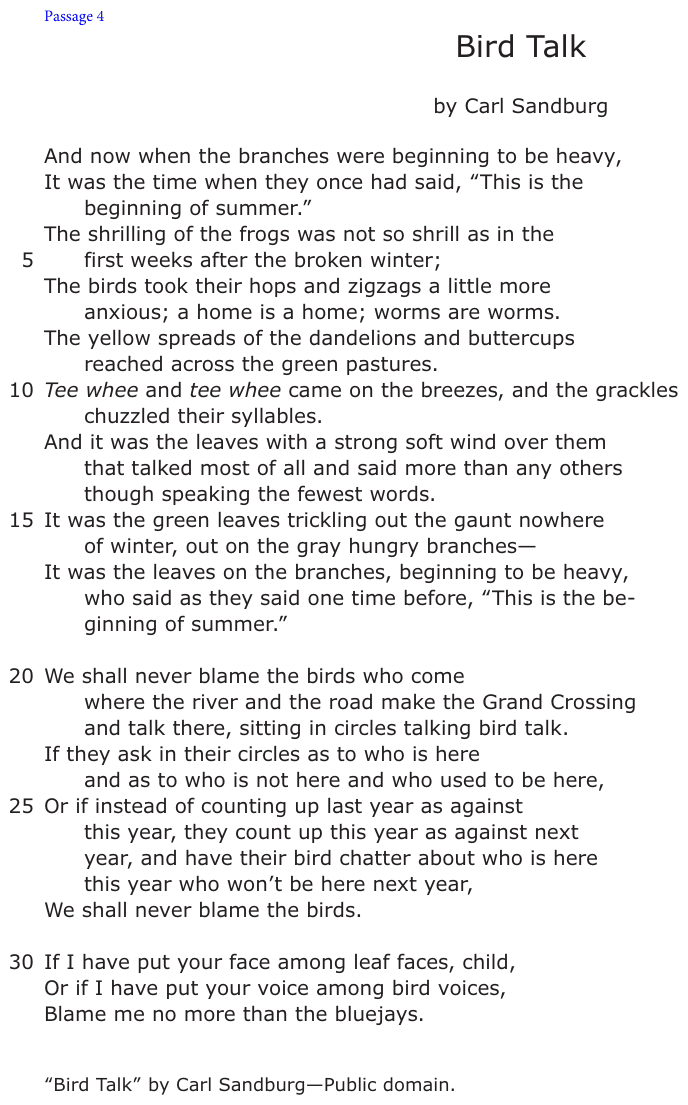
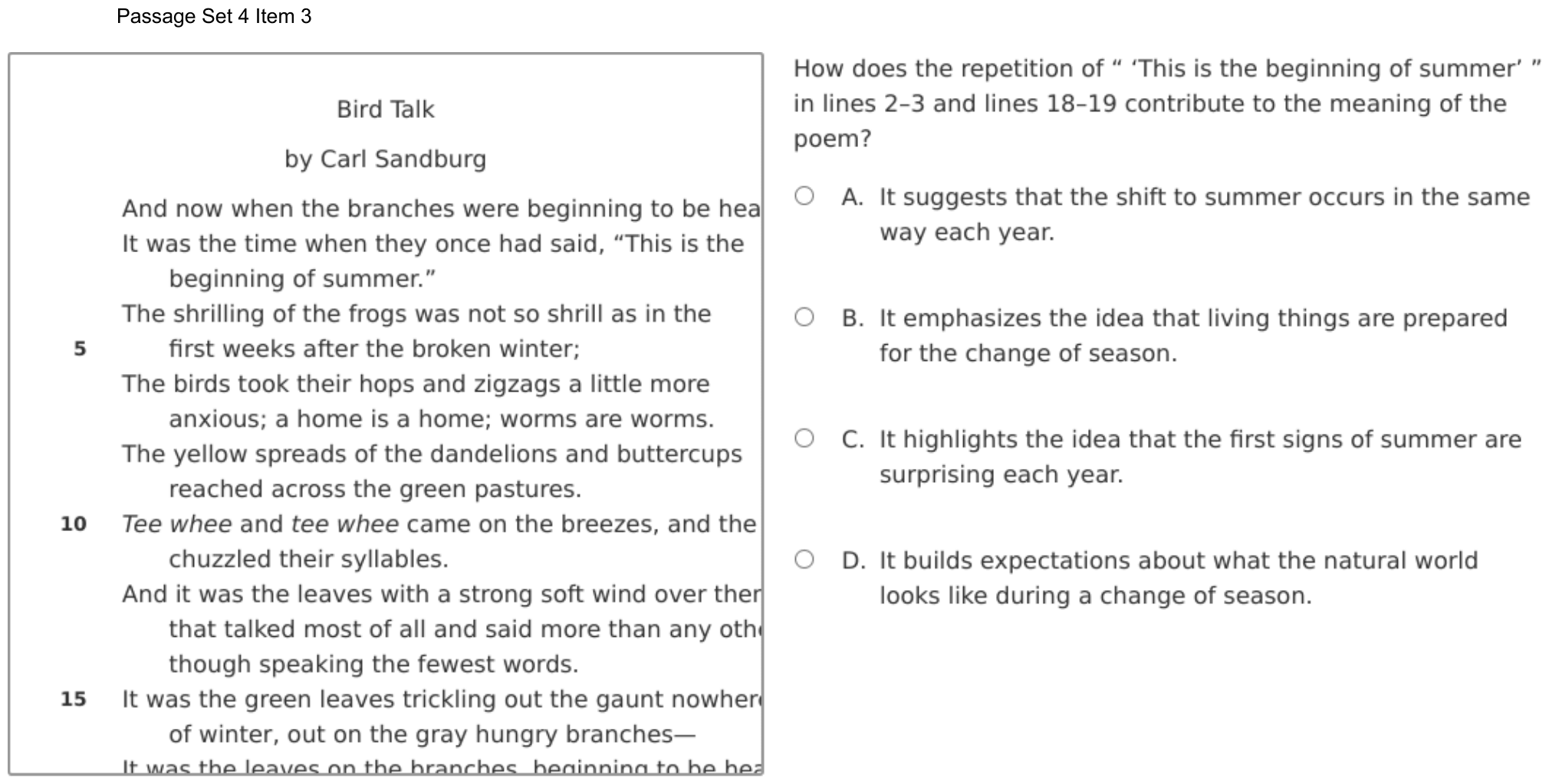
And now when the branches were beginning to be heavy,
It was the time when they once had said, “This is the
beginning of summer.”
The shrilling of the frogs was not so shrill as in the
first weeks after the broken winter;
The birds took their hops and zigzags a little more
anxious; a home is a home; worms are worms.
The yellow spreads of the dandelions and buttercups
reached across the green pastures.
Tee whee and tee whee came on the breezes, and the grackles
chuzzled their syllables.
And it was the leaves with a strong soft wind over them
that talked most of all and said more than any others
though speaking the fewest words.
It was the green leaves trickling out the gaunt nowhere
of winter, out on the gray hungry branches—
It was the leaves on the branches, beginning to be heavy,
who said as they said one time before, “This is the be-
ginning of summer.”
We shall never blame the birds who come
where the river and the road make the Grand Crossing
and talk there, sitting in circles talking bird talk.
If they ask in their circles as to who is here
and as to who is not here and who used to be here,
Or if instead of counting up last year as against
this year, they count up this year as against next
year, and have their bird chatter about who is here
this year who won’t be here next year,
We shall never blame the birds.
If I have put your face among leaf faces, child,
Or if I have put your voice among bird voices,
Blame me no more than the bluejays.
“Bird Talk” by Carl Sandburg—Public domain.
Question
How does the repetition of “ ‘This is the beginning of summer’ ” in lines 2–3 and lines 18–19 contribute to the meaning of the poem?
- AIt suggests that the shift to summer occurs in the same way each year.
- BIt emphasizes the idea that living things are prepared for the change of season.
- CIt highlights the idea that the first signs of summer are surprising each year.
- DIt builds expectations about what the natural world looks like during a change of season.
Show the answer
Correct answer: A
The question asks how the repetition of a phrase contributes to the meaning of the poem in terms of conveying information about a cyclical event.
A. CORRECT. This phrase is used twice verbatim, in both cases to show the figurative words spoken by the branches (lines 2–3) and the leaves on the branches (lines 18–19). Repetition of this phrase conveys the idea that the transition to summer occurs in the same manner each subsequent year and thus evokes the same response from nature.
B. Incorrect. While living things—branches and leaves—both make identical figurative utterances, they do so not because they have prepared for such an event. Rather, these living things take the change in stride because of the sameness and expectedness of the seasonal shifts, which occur in the same way each time.
C. Incorrect. Even though the branches and leaves have been imbued by the speaker with some degree of consciousness in their figurative ability to speak, they are not surprised by the change in seasons. They say the same thing each year because the same thing occurs each year in the same way.
D. Incorrect. Certain lines of the poem do describe the natural world during the change of seasons, such as lines 8–9: “The yellow spreads of the dandelions and buttercups / reached across the green pastures.” However, this repeated phrase serves to evoke a sense of sameness and inevitability; it is not a phrase related to the physical appearance of the natural world, only the way the natural world responds to the seasonal change with simple acceptance for its sameness. The repeated lines do not hold any sort of expectation or anticipation for the coming of summer; they help relay observations made about the state of the season.
Question analysis
This poetry question asks how the repetition of “This is the beginning of summer,” said by the branches in lines 2–3 and by the leaves in lines 18–19 of Sandburg’s “Bird Talk,” contributes to the poem’s meaning. Students must judge what the repetition does, not only what the words say, and the four choices read the repeated line in quite different ways.
- Grade level
- Grade 7 reading and task
- Compared with grade 7
- At grade 7 Explaining what a repeated phrase adds to a poem is familiar grade 7 work. Both passages are pointed out by line number, so the task is to judge the effect of the repetition rather than to find it.
- Estimated difficulty
- Straightforward: two steps or one careful reading.
- Thinking it demands
- Depth of knowledge 2, skills and concepts · mainly analyze
- What makes it hard
- How, not what moderate
- Reading between the lines minor
- Evidence
- Answered from one paragraph or stanza
- Reading level
- Passage: 296 words (a poem; reading level not measured); question and choices: about grade 7, 79 words.
- Students, last 30 days
- Not enough answers yet to show (it takes 10).
Why it is hard, traps and wrong answers (shows the answer)
Why it is hard
Both quotations are pointed out, so the work is deciding what the echo adds. Students who know that repetition emphasizes may grab a choice that begins “emphasizes,” and those who hear the quoted words as a cry of discovery may pick surprise, even though that choice shares the key’s “each year.” Reading the lead-ins, “once had said” and “one time before,” settles it: the line is an old, expected announcement.
How, not what moderate Working it out
The question asks what repeating the line does for the poem, not what the line says, so students must judge an effect of structure: the same words open the first stanza and close it. (Anderson & Krathwohl, 2001)
Reading between the lines minor Working it out
The clue is in the lead-ins, “they once had said” in line 2 and “as they said one time before” in line 18, which present the announcement as words said at this point in earlier years. (Graesser, Singer & Trabasso, 1994; Kintsch, 1998)
Strategy: Reread each quoted passage together with the line that leads into it, then decide what the poet gains by having the branches and the leaves say the same words.
Traps
- Reads too much in: A reasonable-sounding conclusion that goes further than the text allows.
- Wrong tone or attitude: Misjudges the tone, attitude or point of view, such as reading admiration as criticism, or taking a character's or subject's feelings for the author's.
- Wrong purpose or structure: Names a purpose, structure or effect that the part does not serve, or describes what a part says when the question asks what it does.
The wrong answers, classified
B Reads too much in (Graesser, Singer & Trabasso, 1994)
Moves from the calm, repeated announcement to the claim that branches and leaves were ready for summer, but saying the same words again shows recurrence, not preparation.
C Wrong tone or attitude (Graesser, Singer & Trabasso, 1994)
Keeps the idea of “each year” but hears the quoted words as a cry of surprise, though “once had said” and “one time before” make them a familiar, expected announcement.
D Wrong purpose or structure (Anderson & Krathwohl, 2001)
Gives the repeated line the job of the stanza’s pictures, the dandelions and green pastures, though it names when summer begins and says nothing about how the land looks.
Working it out, step by step
Figure out what the question asks
This asks about repetition, which means using the same words more than once. The words “This is the beginning of summer” appear in lines 2–3. They come back in lines 18–19. You need to work out what saying them twice adds to the poem’s meaning.
Read the words that lead in
Look at the words just before each quotation. Line 2 says “It was the time when they once had said.” Line 18 says the leaves “said as they said one time before.” Both lead-ins point to the past. The branches and leaves have said these words before, at this same time in other years.
Work out what the repetition shows
The same words come back, just as summer itself comes back. Each year the branches get heavy, the leaves come out, and it is summer again. The change happens the same way every time. So the repeated line works like a yearly announcement that nobody finds strange. It shows that the shift to summer follows a familiar pattern.
Check each choice
- A fits. The repeated words show summer arriving the same way each year.
- B does not fit. Saying the words again shows that summer returns. It does not show that living things got ready for it.
- C does not fit. Something said “one time before” is familiar, not surprising.
- D does not fit. The line only names a time. Pictures like the yellow dandelions show how the land looks.
Watch out: C also says “each year,” so it can look right. But the quoted words are calm, like an old saying, not a cry of surprise.
Choose the answer
The repeated line is an old announcement, made again because summer comes again. So the answer is A, “It suggests that the shift to summer occurs in the same way each year.”
Why this answer and not the closest wrong one
C is the closest wrong choice, because it also points to something that happens each year. But C says the first signs of summer are a surprise. The lead-ins say the opposite. The branches “once had said” these words, and the leaves said them “one time before.” Words said many times before are expected. They show a pattern, not a surprise.
More questions like this
The original DOE question
The passage “Bird Talk” as printed (page 32)