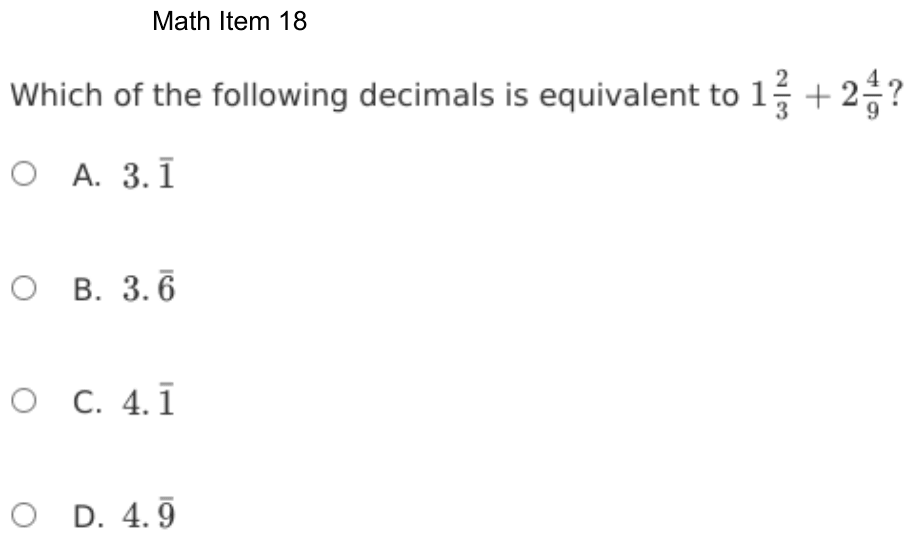
Question
Which of the following decimals is equivalent to ?
- A
- B
- C
- D
Show the answer
Correct answer: C
First, add the mixed numbers. Then, convert the fraction to a decimal.
Question analysis
This question asks which repeating decimal equals the sum of the mixed numbers 1 2/3 and 2 4/9. Students rename the fractions with a common denominator, add, and convert the fraction part to a decimal with a bar over its repeating digit. The choices differ in both the whole number and the repeating digit, so each step has to be right.
- NYS standards
- Grade level
- Grade 7 content, by NYS standard
- Compared with grade 7
- At grade 7 Adding mixed numbers and writing a fraction as a repeating decimal are standard grade 7 skills. This combines them in three short steps; renaming a fraction and reading the bar notation are the only places that need care.
- Estimated difficulty
- Straightforward: two steps or one careful reading.
- Thinking it demands
- Depth of knowledge 1, recall and reproduction · mainly apply
- What makes it hard
- Error-prone arithmetic moderate
- An answer in an unexpected form minor
- Solution
- 3 steps
- Reading level
- Question and choices: about grade 13, 13 words.
- Students, last 30 days
- Not enough answers yet to show (it takes 10).
Why it is hard, traps and wrong answers (shows the answer)
Why it is hard
Two fraction moves and one conversion stand between the sum and the choices. The carry is the main hazard: 10/9 has to become 1 1/9, and students who keep only the 1/9 land on a choice with the wrong whole number. Estimating first, about 1.7 + 2.4 = 4.1, rules out both choices that begin with 3 and the one that equals 5.
Error-prone arithmetic moderate Working it out
Adding 2/3 and 4/9 needs 2/3 renamed as 6/9, and the sum 10/9 is more than 1, so a whole must be carried into the 3 before converting. (Brown & Burton, 1978; Junker & Sijtsma, 2001)
An answer in an unexpected form minor Choosing the answer
The choices are repeating decimals with bars, so a mixed number in ninths has to be recognized as a digit repeating forever; knowing that ninths repeat their numerator makes the match quick. (Enright, Morley & Sheehan, 2002)
Strategy: Rename 2/3 as ninths, add the whole numbers and the fractions separately, regroup any fraction of 9/9 or more as a whole, then divide the leftover numerator by 9.
Traps
- A faulty procedure: A systematic but wrong procedure: adding fractions straight across, applying an exponent to each term of a sum, dropping a sign when moving a term.
- Answer in another form: The right answer is written differently from the way you worked it out.
The wrong answers, classified
A An arithmetic slip (Junker & Sijtsma, 2001)
Adds the fractions to 10/9 but keeps only the 1/9 left over, forgetting to carry the whole 1 into the 3, so the sum becomes 3 1/9.
B A faulty procedure (Brown & Burton, 1978; Tatsuoka, 1983)
Adds the numerators 2 and 4 over 9 without renaming 2/3 as 6/9, so gets 3 6/9, which is 3.666…
D A faulty procedure (Brown & Burton, 1978; Tatsuoka, 1983)
Reaches 4 1/9 but repeats the denominator's 9 instead of the numerator's 1, as if one ninth were 0.999… rather than 0.111…
Worked solution, step by step
Formulas used
- Equivalent fractions
- a/b is a fraction, and n is any number except 0. Multiplying the top and the bottom by the same n gives an equal fraction, because n/n is 1. Use it to give two fractions the same bottom before you add them.
- Ninths as repeating decimals
- 1 divided by 9 is 0.111…, with 1s that go on forever. The bar over a digit means that digit repeats forever. Ninths from 1/9 to 8/9 repeat their top digit, so 4/9 is 0.444… and 2/9 is 0.222…
Sort out the question
You need to add two mixed numbers, 1 2/3 and 2 4/9. A mixed number is a whole number plus a fraction. Then write the sum as a decimal. The choices are repeating decimals, where the bar over a digit means it repeats forever.
Rename two thirds as ninths
The fractions 2/3 and 4/9 have different bottoms. Since 3 × 3 = 9, multiply the top and bottom of 2/3 by 3:
So 1 2/3 is the same as 1 6/9.
Watch out: adding the tops 2 and 4 over 9 without renaming gives 3 6/9, choice B.
Add the mixed numbers
Add the whole numbers, then add the fractions:
10/9 is more than 1. It is 9/9 plus 1/9, or 1 1/9. Carry the 1 into the whole number:
Watch out: forgetting to carry the 1 gives 3 1/9, choice A.
Change it to a decimal
One ninth is 0.111…, with the 1 repeating forever. So:
Watch out: ninths repeat the top digit, not the 9. Choice D, 4.999…, does not match 4 1/9.
So the answer is C, .
Check your answer
Use rough decimals. 1 2/3 is about 1.667, and 2 4/9 is about 2.444. Their sum is about 4.111. That matches 4.111… and rules out both choices that start with 3. And 4.999… is almost 5, which is too big.
More questions like this
The original DOE question