Question
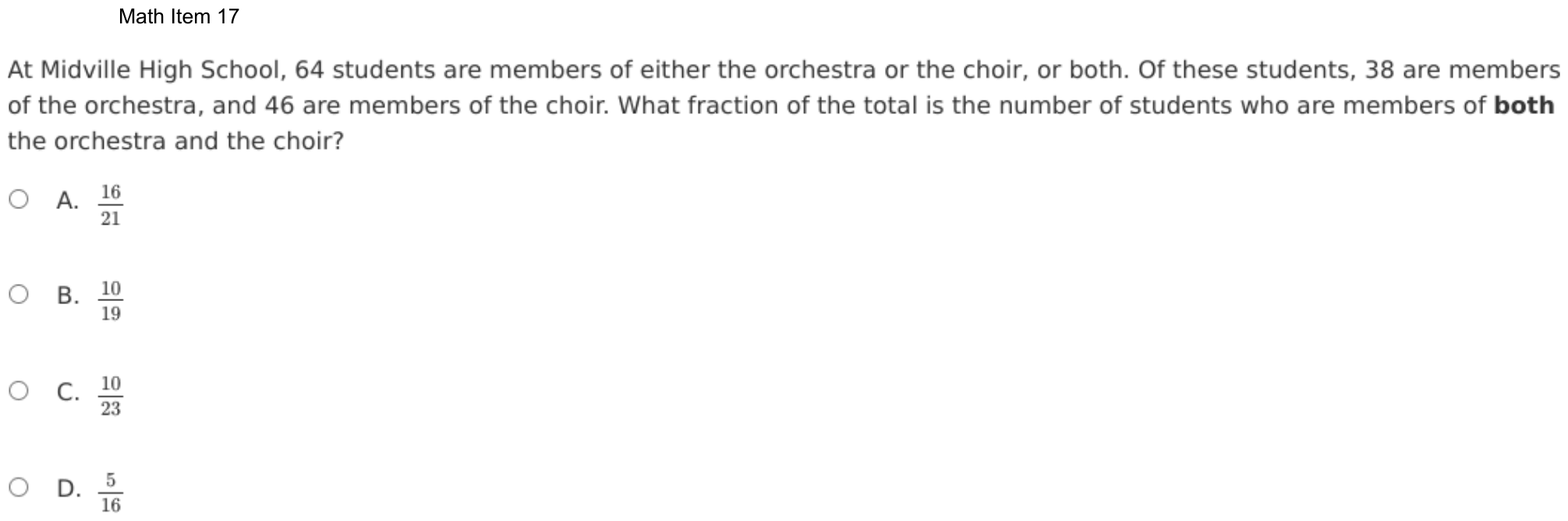
At Midville High School, 64 students are members of either the orchestra or the choir, or both. Of these students, 38 are members of the orchestra, and 46 are members of the choir. What fraction of the total is the number of students who are members of both the orchestra and the choir?
- A
- B
- C
- D
Show the answer
Correct answer: D
First, add the number of students that are members of the orchestra and the number of students that are members of the choir.
Then, subtract to find the number of students that are members of both orchestra and choir.
Then, find the fraction of the 64 students that are members of both orchestra and choir.
Question analysis
At Midville High School, 64 students belong to the orchestra, the choir or both; 38 are in the orchestra and 46 in the choir. Students find what fraction of the 64 belong to both groups. It is a Venn diagram counting question with a fraction, and the students in both groups are included in each membership number.
- Grade level
- Grade 7 content, by NYS standard
- Compared with grade 7
- At grade 7 Overlapping groups are seldom taught directly in grade 7, though the arithmetic is whole-number addition and subtraction. Students must first find the overlap and then choose the right whole for the fraction, two decisions where errors are common.
- Estimated difficulty
- Moderate: several steps, or a close reading with one strong distractor.
- Thinking it demands
- Depth of knowledge 2, skills and concepts · mainly apply
- What makes it hard
- Turning words into math moderate
- No obvious method minor
- An answer in an unexpected form minor
- Solution
- 3 steps
- Reading level
- Question and choices: about grade 5, 54 words.
- Corrected from the DOE handbook
- A misstatement in the explanation’s first step was corrected.
- Students, last 30 days
- Not enough answers yet to show (it takes 10).
Why it is hard, traps and wrong answers (shows the answer)
Why it is hard
The question hides its key number: the students in both groups appear only as the amount by which 38 + 46 overshoots 64. A sketch of two overlapping circles, with 20 in the middle, 18 in orchestra only and 26 in choir only, shows the whole group at once. After that, the remaining risk is the denominator, since the question asks for a fraction of all 64 students, not of one group.
Turning words into math moderate Understanding the question
“Either the orchestra or the choir, or both” means the 64 counts each student once, while 38 + 46 counts the students in both groups twice; the overlap itself is never stated. (Hegarty, Mayer & Monk, 1995; Koedinger & Nathan, 2004)
No obvious method minor Working it out
Nothing names the step that finds the overlap: the excess of 38 + 46 = 84 over 64 is the number in both groups, an idea students must bring themselves. (Schoenfeld, 1985)
An answer in an unexpected form minor Choosing the answer
The fraction 20/64 appears only in lowest terms, so it must be simplified by 4 before it can be matched with a choice. (Enright, Morley & Sheehan, 2002)
Strategy: Add the orchestra and choir counts, subtract the 64 students to find how many were counted twice, then put that number over the total and simplify.
Traps
- Answers a different question: A choice is right for another quantity: the other unknown, the rest instead of the part, the part instead of the whole.
- Overlapping groups: Things in two groups at once are counted twice, or not subtracted.
The wrong answers, classified
A Overlapping groups (King et al., 2004)
Takes 38 + 46 = 84 as the number of students, counting those in both groups twice, and puts the stated 64 over it to get 16/21.
B Answers a different question (King et al., 2004; Hegarty, Mayer & Monk, 1995)
Finds the 20 students in both groups but compares them with the 38 orchestra members instead of all 64 students, so 20/38 = 10/19.
C Answers a different question (King et al., 2004; Hegarty, Mayer & Monk, 1995)
Finds the 20 students in both groups but divides by the 46 choir members, using one group as the whole instead of all 64, so 20/46 = 10/23.
What was corrected from the DOE handbook, and why
- Explanation: The DOE’s explanation begins “First, add the number of students that are members of both orchestra and choir. 38 + 46 = 84.” But 38 is the number of orchestra members and 46 the number of choir members; the number of students in both is what the next step finds (84 − 64 = 20). The site now says “First, add the number of students that are members of the orchestra and the number of students that are members of the choir.”
Worked solution, step by step
Formulas used
- Counting two groups that overlap
- O is the number in the orchestra, and C is the number in the choir. Students in both groups are counted in O and again in C. Subtracting them once makes each student count one time. Here every student is in at least one group, so this gives everyone.
- Fraction of a total
- The part is the group you are asked about. The whole is the full group it comes from. Here the part is the students in both groups, and the whole is all 64 students. Simplify by dividing the top and bottom by the same number.
Sort out the question
There are 64 students in all. Each one is in the orchestra, the choir or both. 38 are in the orchestra, and 46 are in the choir. Some students are in both, but the question does not say how many. You need that number as a fraction of all 64 students.
Add the two groups
Add the number in the orchestra and the number in the choir:
That is more than the 64 students there are. Why? A student in both groups is counted once with the orchestra and once more with the choir.
Find the students in both
The extra amount over 64 is the students who were counted twice:
So 20 students are in both groups. This is the overlap rule turned around: both = O + C − total.
Watch out: 84 is not the number of students. Putting 64 over 84 gives 16/21, choice A.
Write the fraction and simplify
The part is 20 students, and the whole is all 64 students. Both numbers divide by 4:
Watch out: the whole is all 64 students, not one group. Using 38 gives 10/19, choice B. Using 46 gives 10/23, choice C.
So the answer is D, .
Check your answer
Split the 64 students into three groups that do not overlap. Only orchestra: 38 − 20 = 18. Only choir: 46 − 20 = 26. Both: 20. Add them: 18 + 26 + 20 = 64. That matches the total, so 20 is right.
More questions like this
The original DOE question