Question
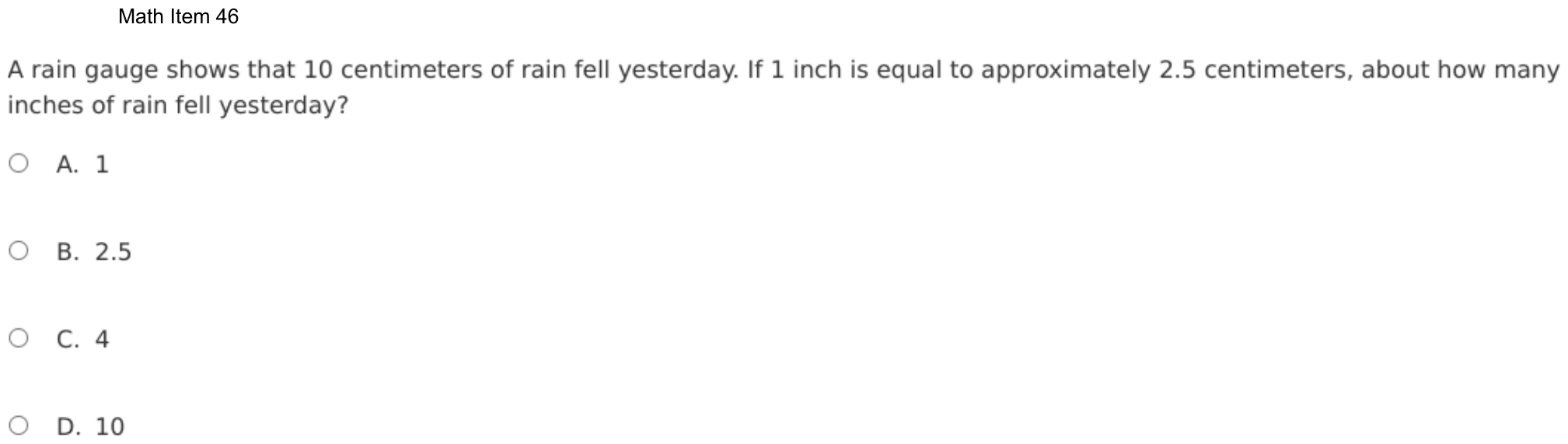
A rain gauge shows that 10 centimeters of rain fell yesterday. If 1 inch is equal to approximately 2.5 centimeters, about how many inches of rain fell yesterday?
- A1
- B2.5
- C4
- D10
Show the answer
Correct answer: C
Set up a proportion to solve:
10 centimeters is approximately 4 inches.
Question analysis
A rain gauge shows that 10 centimeters of rain fell, and 1 inch is about 2.5 centimeters. Students find about how many inches of rain fell. It tests converting between metric and customary units with a given conversion fact, and the main risk is converting in the wrong direction or reusing a number from the question.
- NYS standards
- 6.RP.3d converting measurement units
- Grade level
- Grade 6 content, by NYS standard
- Compared with grade 7
- Below grade 7 Converting units with a given conversion fact is grade 6 content, and this needs a single division with friendly numbers, lighter than grade 7 work with rates and percents.
- Estimated difficulty
- Routine: one familiar step, little to misread.
- Thinking it demands
- Depth of knowledge 1, recall and reproduction · mainly apply
- What makes it hard
- Turning words into math minor
- Solution
- 1 step
- Reading level
- Question and choices: about grade 10, 25 words.
- Students, last 30 days
- Not enough answers yet to show (it takes 10).
Why it is hard, traps and wrong answers (shows the answer)
Why it is hard
A single division answers the question, and its numbers are friendly: four lengths of 2.5 centimeters make 10. Every wrong choice is simply a number from the stem, so the only real risk is reaching for a given value instead of converting. Inches are longer than centimeters, so the rainfall in inches has to be less than 10 but more than the 1 inch that 2.5 centimeters make.
Turning words into math minor Understanding the question
The fact “1 inch is equal to approximately 2.5 centimeters” has to be turned into a division, how many 2.5-centimeter lengths fit into 10, rather than a multiplication. (Hegarty, Mayer & Monk, 1995; Koedinger & Nathan, 2004)
Strategy: Ask how many groups of 2.5 centimeters fit into the 10 centimeters of rain, since each group of 2.5 centimeters makes one inch.
Traps
- Numbers taken from the question: Combines the numbers in the question without a model of the situation, or is simply a number that appears in the question.
- Units or scale: The answer is wanted in other units, or a rate or scale must be converted first.
The wrong answers, classified
A Numbers taken from the question (Hegarty, Mayer & Monk, 1995)
Picks the 1 from the conversion fact, 1 inch for 2.5 centimeters, reading the given fact as the answer instead of applying it to 10 centimeters.
B Numbers taken from the question (Hegarty, Mayer & Monk, 1995)
Picks 2.5, the number of centimeters in one inch, straight from the conversion fact rather than finding how many inches 10 centimeters make.
D Units or scale (King et al., 2004)
Keeps the 10 from the rain gauge, as if centimeters and inches were the same size, so no conversion is done at all.
Worked solution, step by step
Formulas used
- Converting centimeters to inches
- About 2.5 centimeters make 1 inch. So each group of 2.5 centimeters is 1 inch. Dividing the centimeters by 2.5 counts how many of those groups fit. That count is the number of inches.
Sort out the question
The rain gauge shows 10 centimeters (cm) of rain. You know that 1 inch is about 2.5 cm. You need the rain in inches.
Decide whether to multiply or divide
An inch is longer than a centimeter. So it takes fewer inches than centimeters to measure the same rain. The answer must be less than 10. That tells you to divide, not multiply.
Watch out: choice D, 10, keeps the same number, as if inches and centimeters were the same size.
Divide by 2.5
Use the conversion formula:
You can see it by adding: . Four groups of 2.5 cm fit into 10 cm. So 10 cm is about 4 inches.
Give the answer
Watch out: choices A and B, 1 and 2.5, are just the numbers in the conversion fact. They do not use the 10 cm at all.
About 4 inches of rain fell. So the answer is C, 4.
Check your answer
Change back. Each inch is 2.5 cm, so 4 inches is cm. That is what the gauge showed. Also, 4 inches is less than 10, as it should be, because inches are longer.
More questions like this
The original DOE question