Question
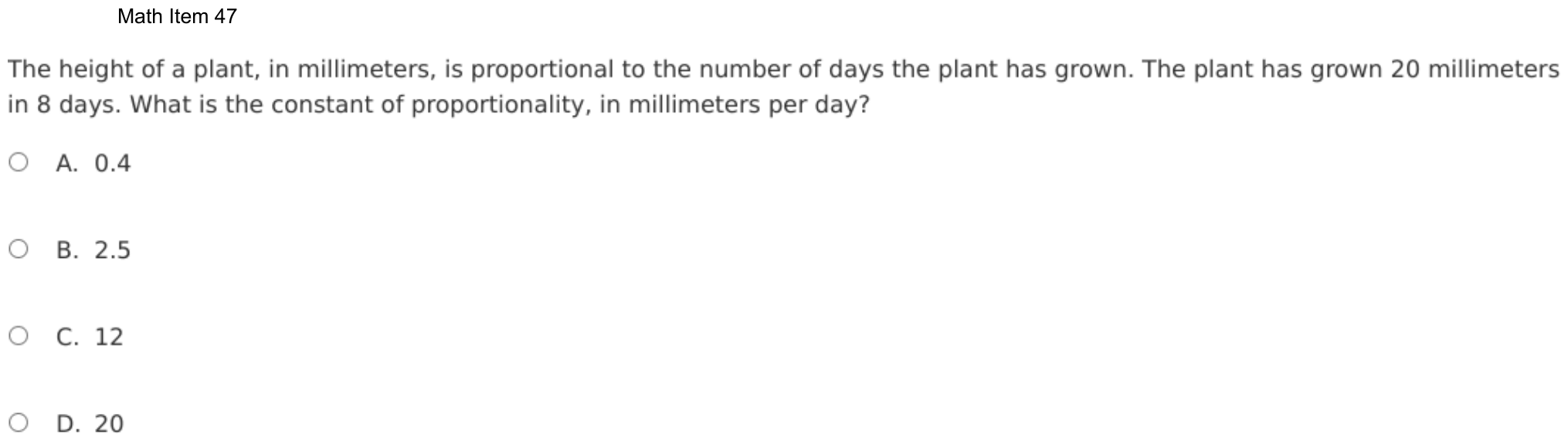
The height of a plant, in millimeters, is proportional to the number of days the plant has grown. The plant has grown 20 millimeters in 8 days. What is the constant of proportionality, in millimeters per day?
- A0.4
- B2.5
- C12
- D20
Show the answer
Correct answer: B
The constant of proportionality is determined by dividing the number of millimeters by the number of days:
Question analysis
A plant's height in millimeters is proportional to the number of days it has grown, and it grew 20 millimeters in 8 days. Students find the constant of proportionality in millimeters per day. It tests finding a unit rate, and the order of the division decides whether the rate comes out in the units asked for.
- Grade level
- Grade 7 content, by NYS standard
- Compared with grade 7
- Below grade 7 Finding a constant of proportionality from one pair of values is a basic grade 7 skill. With one division and the units named in the question, it asks less than most grade 7 problems.
- Estimated difficulty
- Routine: one familiar step, little to misread.
- Thinking it demands
- Depth of knowledge 1, recall and reproduction · mainly apply
- What makes it hard
- Solution
- 1 step
- Reading level
- Question and choices: about grade 7, 35 words.
- Students, last 30 days
- Not enough answers yet to show (it takes 10).
Why it is hard, traps and wrong answers (shows the answer)
Why it is hard
One division gives the constant, and the question itself names the order by asking for millimeters per day. The tempting slip is dividing the smaller number by the larger, 8 by 20, out of habit, which gives a rate in days per millimeter. A plant that grows 20 millimeters in 8 days grows more than 2 millimeters a day, a quick sense check on any result.
Something you must already know minor Working it out
Students must know that the constant is the height divided by the days; the units in the question, millimeters per day, name the order of the division. (Anderson & Krathwohl, 2001)
Strategy: Use the units in the question, millimeters per day, as the instruction: divide the millimeters grown by the number of days.
Traps
- Wrong operation: Adds instead of multiplying, divides the wrong way round, turns a ratio or rate upside down, or undoes a step in the wrong direction (subtracts what should be added back).
- Numbers taken from the question: Combines the numbers in the question without a model of the situation, or is simply a number that appears in the question.
The wrong answers, classified
A Wrong operation (Hegarty, Mayer & Monk, 1995; King et al., 2004)
Divides the days by the millimeters, 8 ÷ 20 = 0.4, which gives days per millimeter, the rate turned upside down.
C Numbers taken from the question (Hegarty, Mayer & Monk, 1995)
Subtracts the days from the millimeters, 20 − 8 = 12, combining the two numbers without thinking about a rate.
D Numbers taken from the question (Hegarty, Mayer & Monk, 1995)
Gives the 20 millimeters the plant grew over all 8 days, the total growth, rather than the growth for each single day.
Worked solution, step by step
Formulas used
- Constant of proportionality
- Here y is the height in millimeters, and x is the number of days. k is the growth in one day, in millimeters per day. In a proportional relationship, y = kx, so dividing y by x gives k.
Sort out the question
The plant’s height is proportional to the number of days it grows. It grew 20 millimeters (mm) in 8 days.
You need the constant of proportionality in millimeters per day. Per day means for each day. So you need how much the plant grows in one day.
Divide millimeters by days
The units tell you the order: millimeters per day means millimeters divided by days. Use the formula:
So the plant grows 2.5 mm each day.
Avoid the tempting slips
Watch out: , choice A, is days per millimeter. That is the rate upside down.
Choice C, 12, comes from . Subtracting does not make a rate. Choice D, 20, is the growth over all 8 days, not one day.
Give the answer
The constant of proportionality is 2.5 mm per day.
So the answer is B, 2.5.
Check your answer
Multiply back. At 2.5 mm a day for 8 days, the plant grows mm. That matches. Also, 2 mm a day would give only 16 mm, and 3 mm a day would give 24 mm. So the rate must be between 2 and 3.
More questions like this
The original DOE question