Question
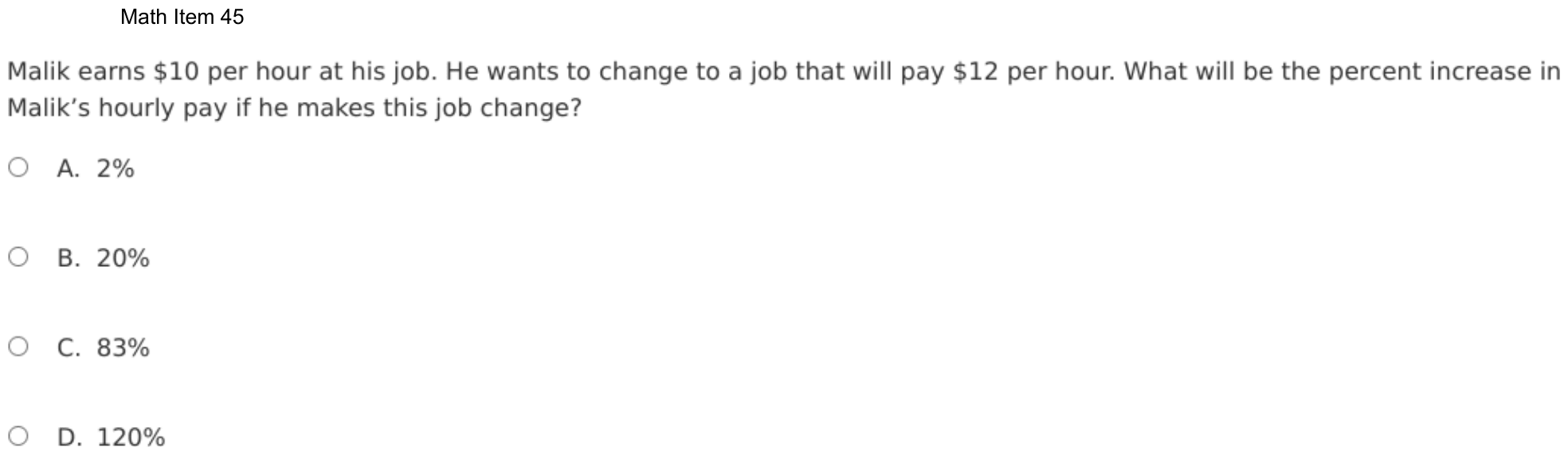
Malik earns $10 per hour at his job. He wants to change to a job that will pay $12 per hour. What will be the percent increase in Malik’s hourly pay if he makes this job change?
- A2%
- B20%
- C83%
- D120%
Show the answer
Correct answer: B
Subtract to determine the amount of increase in Malik’s hourly pay if he changes jobs.
Divide the increase amount by the original hourly pay rate.
Multiply the quotient by 100 to express the decimal amount as a percentage.
Question analysis
Malik earns $10 an hour and wants to switch to a job that pays $12 an hour. Students find the percent increase in his hourly pay. It tests finding a percent change. The numbers are easy, so the challenge is knowing which amounts to compare and how to turn that comparison into a percent.
- NYS standards
- 7.RP.3 multistep ratio and percent problems
- Grade level
- Grade 7 content, by NYS standard
- Compared with grade 7
- At grade 7 Percent increase is grade 7 content, and this case uses whole-dollar wages that make the arithmetic easy. The demand is comparing the change with the right amount rather than reporting the change itself or a ratio of the wages.
- Estimated difficulty
- Straightforward: two steps or one careful reading.
- Thinking it demands
- Depth of knowledge 2, skills and concepts · mainly apply
- What makes it hard
- Solution
- 2 steps
- Reading level
- Question and choices: about grade 2, 35 words.
- Students, last 30 days
- Not enough answers yet to show (it takes 10).
Why it is hard, traps and wrong answers (shows the answer)
Why it is hard
The numbers could hardly be friendlier, a $2 raise on $10, so the question checks what to divide by what. Dividing $12 by $10 gives 1.2, the new pay as a percent of the old, and stopping there is tempting because the division feels like the whole job. Reading the $2 itself as 2% is the other quick error, since dollars of change are not percent of change.
Something you must already know minor Working it out
The rule for percent change, the change divided by the starting amount, is not given, and each wrong choice comes from a different comparison of the $10 and the $12. (Anderson & Krathwohl, 2001)
Turning words into math minor Understanding the question
“Percent increase in Malik’s hourly pay” has to be read as the $2 rise measured against the $10 he earns now, not as the new wage compared with the old. (Hegarty, Mayer & Monk, 1995; Koedinger & Nathan, 2004)
Strategy: Find how many dollars the hourly pay goes up, then divide that change by the pay Malik earns now and write the result as a percent.
Traps
- Answers a different question: A choice is right for another quantity: the other unknown, the rest instead of the part, the part instead of the whole.
- Misunderstands the concept: A wrong belief about a concept: that percents can be added, that area grows like length, that averages can be averaged, that a bigger denominator means a bigger fraction.
- Wrong operation: Adds instead of multiplying, divides the wrong way round, turns a ratio or rate upside down, or undoes a step in the wrong direction (subtracts what should be added back).
The wrong answers, classified
A Misunderstands the concept (Smith, diSessa & Roschelle, 1993; De Bock et al., 1998; Ni & Zhou, 2005)
Finds the $2 increase and reads it as 2%, as if a change in dollars were a percent, without dividing it by the original $10.
C Wrong operation (Hegarty, Mayer & Monk, 1995; King et al., 2004)
Divides the old pay by the new, 10 ÷ 12 ≈ 0.83, turning the ratio of the wages upside down and reporting 83%.
D Answers a different question (King et al., 2004; Hegarty, Mayer & Monk, 1995)
Divides the new pay by the old, 12 ÷ 10 = 1.2, which gives the new wage as a percent of the old, not the increase.
Worked solution, step by step
Formulas used
- Percent increase
- The original is the amount before the change. The new amount is the amount after it. The top is how much it went up. Dividing by the original compares the change with where you started. Multiplying by 100 makes it a percent.
Sort out the question
Malik earns $10 an hour now. The new job pays $12 an hour. You need the percent increase.
That means: how much does his pay go up, compared with what he earns now? So $10 is the original amount, and $12 is the new amount.
Find the increase in dollars
Subtract the old pay from the new pay:
His pay goes up by $2 an hour.
Watch out: $2 is an amount of money, not a percent. Calling it 2% gives choice A.
Compare the increase with the original
Use the percent increase formula. Divide the $2 by the original $10, then multiply by 100:
So the pay goes up by 20%.
Watch out: is 120%, choice D. That is the new pay as a percent of the old, not the increase. And is about 83%, choice C, which is upside down.
Give the answer
The $2 raise is 20% of Malik’s current pay.
So the answer is B, 20%.
Check your answer
Work forward. 20% of $10 is dollars. Add that to $10, and you get $12, the new pay. It works. Note that 120% is the new pay compared with the old pay, which is the same as a 20% increase.
More questions like this
The original DOE question