Question
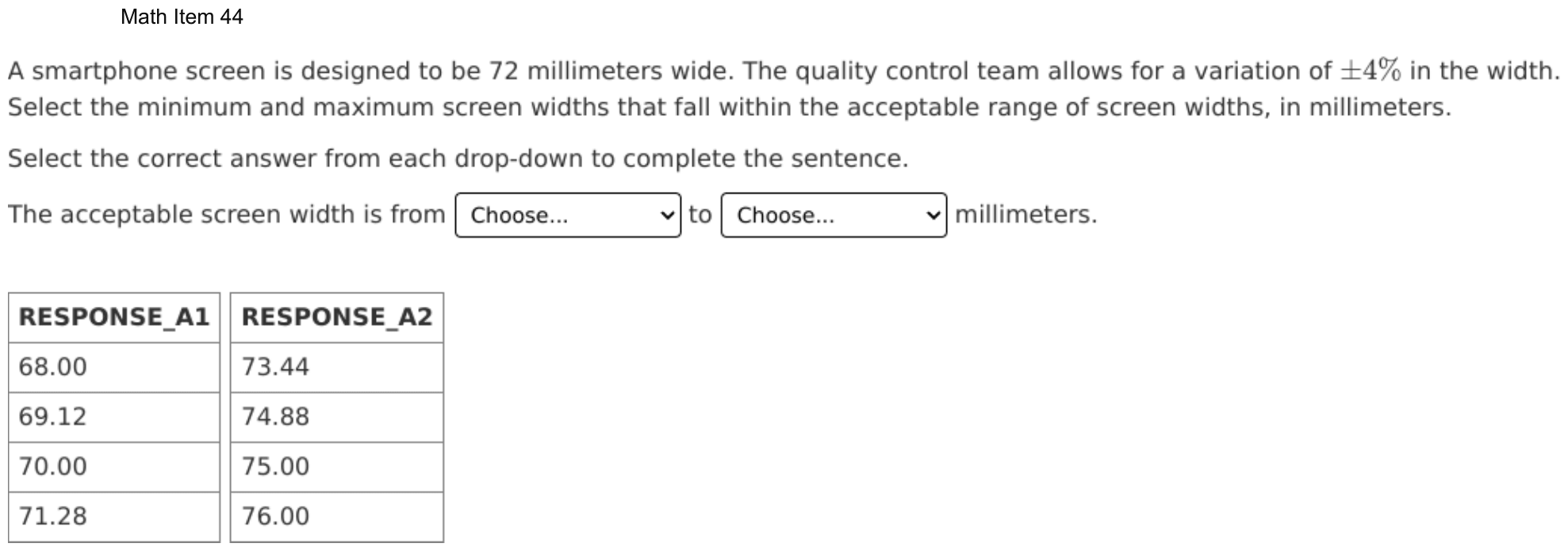
A smartphone screen is designed to be 72 millimeters wide. The quality control team allows for a variation of in the width. Select the minimum and maximum screen widths that fall within the acceptable range of screen widths, in millimeters.
Select the correct answer from each drop-down to complete the sentence.
The acceptable screen width is from to millimeters.
Choose an answer from each menu, then check. The DOE has not published how answers with several parts are scored; this site counts one right only when every part is right.
Show the answer
Correct answer: blank 1: 69.12; blank 2: 74.88
A variation of in the width means that the width of the smartphone can be from 4% less than the standard of 72 mm to 4% greater than 72 mm.
The least allowed measure is
The greatest allowed measure is
Therefore, the allowable range is from 69.12 mm to 74.88 mm in width.
Question analysis
A smartphone screen is designed to be 72 millimeters wide, and quality control allows a variation of plus or minus 4%. Students choose the minimum and maximum acceptable widths from two drop-down menus. It tests finding a percent of a quantity, and the 4% has to be turned into millimeters before it is added or subtracted.
- Grade level
- Grade 7 content, by NYS standard
- Compared with grade 7
- At grade 7 Finding a percent of a number and adding or subtracting it is grade 7 percent work. The ± sign, the decimal result and two linked menus, which must both be right, add a little to the usual demand.
- Estimated difficulty
- Moderate: several steps, or a close reading with one strong distractor.
- Thinking it demands
- Depth of knowledge 2, skills and concepts · mainly apply
- What makes it hard
- Error-prone arithmetic moderate
- Turning words into math minor
- A very close wrong answer minor
- Many steps minor
- Solution
- 3 steps
- Reading level
- Question and choices: about grade 8, 59 words.
- Students, last 30 days
- Not enough answers yet to show (it takes 10).
Why it is hard, traps and wrong answers (shows the answer)
Why it is hard
The question rewards turning the percent into millimeters before doing anything else. Students who treat ±4% as ±4 millimeters find the two whole-number options at either end of the menus, 68.00 and 76.00, which look like a natural pair. Those who compute 2.88 correctly can still lose the item on the maximum by rounding to 3 and picking 75.00. Multiplying 72 by 0.96 and by 1.04 is a quick double-check.
Error-prone arithmetic moderate Working it out
Four percent of 72 is 0.04 × 72 = 2.88, a decimal product, and taking it from 72 means borrowing across the decimal point to reach 69.12. (Brown & Burton, 1978; Junker & Sijtsma, 2001)
Turning words into math minor Understanding the question
The phrase “a variation of ±4% in the width” has to become 4% of 72 millimeters, a length of 2.88 mm, before anything is added or subtracted. (Hegarty, Mayer & Monk, 1995; Koedinger & Nathan, 2004)
A very close wrong answer minor Choosing the answer
The second menu lists 75.00 just 0.12 above 74.88, so a rounded estimate of 72 + 3 lands on the wrong option, and estimating cannot separate the two. (Embretson & Wetzel, 1987; Gorin & Embretson, 2006; Ascalon et al., 2007)
Many steps minor Working it out
Both menus must be right to score, so the minimum and the maximum each need their own subtraction or addition after the shared percent is found. (Daniel & Embretson, 2010; Enright, Morley & Sheehan, 2002)
Strategy: Find 4% of the 72-millimeter design width first, then subtract that amount for the minimum and add it for the maximum, before looking at the menus.
Traps
- Misunderstands the concept: A wrong belief about a concept: that percents can be added, that area grows like length, that averages can be averaged, that a bigger denominator means a bigger fraction.
- Rounds too early: Rounds a value partway through, or rounds the wrong way, so the final answer drifts from the exact one.
The wrong answers, classified
AD Misunderstands the concept (Smith, diSessa & Roschelle, 1993; De Bock et al., 1998; Ni & Zhou, 2005)
Reads ±4% as ±4 millimeters, so the widths run from 72 − 4 = 68.00 to 72 + 4 = 76.00.
BC Rounds too early (King et al., 2004)
Finds the 69.12 minimum, then estimates the maximum by rounding the 2.88 change up to 3, so 72 + 3 = 75.00 is picked over 74.88.
Worked solution, step by step
Formulas used
- Percent of a number
- The percent is how many out of 100. Dividing it by 100 turns it into a decimal, so 4% becomes 0.04. The whole is the amount you take the percent of. The part is the amount that the percent stands for.
Sort out the question
The screen is designed to be 72 millimeters (mm) wide. The sign ±4% means plus or minus 4%. So a screen may be up to 4% narrower or up to 4% wider than 72 mm.
You need the minimum, the smallest allowed width, and the maximum, the largest. You pick each one from a drop-down menu.
Find 4% of 72 mm
Use the percent formula. 4% is :
So the width may change by up to 2.88 mm either way.
Watch out: 4% is not 4 mm. Taking 4 away and adding 4 gives 68.00 and 76.00. Both are in the menus, and both are wrong.
Find the minimum width
Take the change away from the design width:
The narrowest allowed screen is 69.12 mm wide.
Find the maximum width
Add the change to the design width:
The widest allowed screen is 74.88 mm wide.
Watch out: rounding 2.88 up to 3 gives 75.00. That is in the second menu too, but it is too wide.
Choose from each menu
Open the first drop-down menu and choose 69.12. Open the second one and choose 74.88.
So the sentence reads: the acceptable screen width is from 69.12 to 74.88 millimeters.
Check your answer
Use multipliers. A screen 4% narrower keeps 96% of the width: . A screen 4% wider is 104% of it: . Both match. Also, both ends are the same 2.88 mm away from 72.
More questions like this
The original DOE question