Question
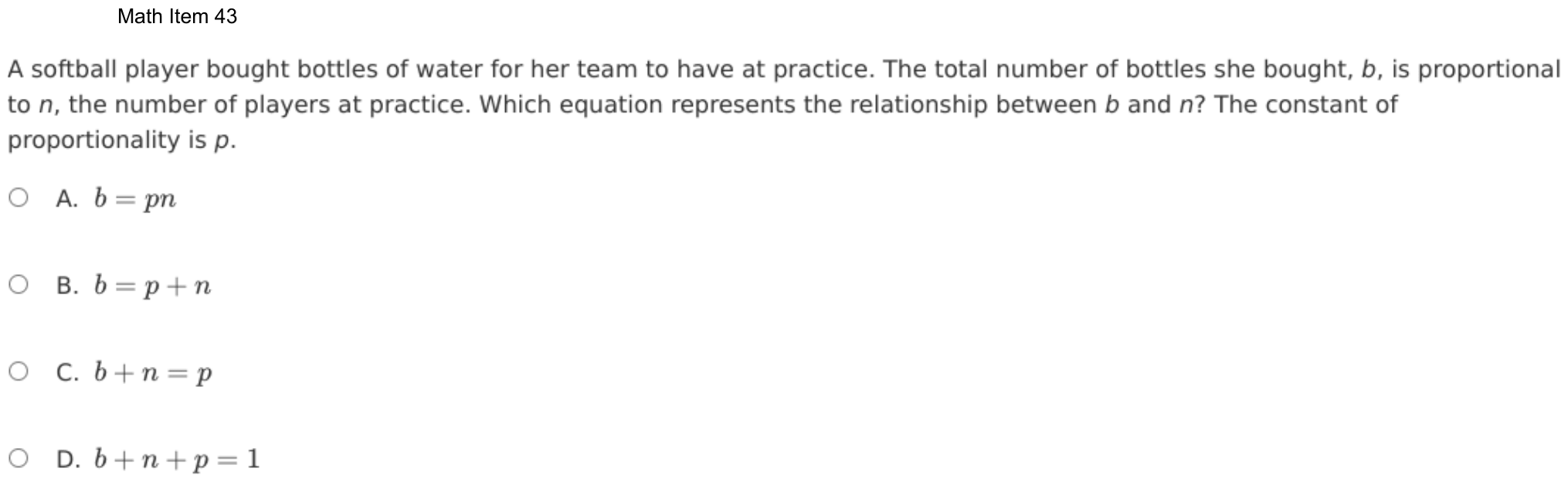
A softball player bought bottles of water for her team to have at practice. The total number of bottles she bought, b, is proportional to n, the number of players at practice. Which equation represents the relationship between b and n? The constant of proportionality is p.
- A
- B
- C
- D
Show the answer
Correct answer: A
In this context, the constant of proportionality, p, represents the relationship between b, the number of bottles of water, and n, the number of players on the team.
The number of bottles of water is the product of the constant of proportionality and the number of players.
The equation that represents this relationship is .
Question analysis
A softball player buys bottles of water for practice, and the number of bottles, b, is proportional to the number of players, n, with constant of proportionality p. Students choose the equation that represents the relationship. It tests writing an equation for a proportional relationship using letters only, so the meaning of proportional has to be clear.
- NYS standards
- 7.RP.2c proportional relationship equations
- Grade level
- Grade 7 content, by NYS standard
- Compared with grade 7
- Below grade 7 Grade 7 students write equations for proportional relationships from tables, graphs and descriptions, usually with a number to find. Here the constant is already given as a letter, so only the general form must be recalled, a short task.
- Estimated difficulty
- Routine: one familiar step, little to misread.
- Thinking it demands
- Depth of knowledge 1, recall and reproduction · mainly remember
- What makes it hard
- Solution
- 1 step
- Reading level
- Question and choices: about grade 7, 51 words.
- Students, last 30 days
- Not enough answers yet to show (it takes 10).
Why it is hard, traps and wrong answers (shows the answer)
Why it is hard
This is a recall question dressed in a short story: the softball team adds nothing but names for the letters. The one idea needed is that proportional means multiplied by a constant, so doubling the players doubles the bottles. Students who think of a constant as something added, or as a fixed total, are drawn to the two sums that use the same letters.
Something you must already know minor Working it out
The general form of a proportional relationship, one amount equal to the constant times the other, has to be recalled; the stem names p but never says it multiplies. (Anderson & Krathwohl, 2001)
Variables instead of numbers minor Understanding the question
No numbers are given, only b, n and p, so a choice cannot be checked by computing unless students make up a case, such as 2 bottles per player for 10 players. (Koedinger & Nathan, 2004; Enright, Morley & Sheehan, 2002)
Strategy: Recall how two proportional quantities are linked through the constant of proportionality, then test each choice with sample numbers: if the players double, the bottles should double too.
Traps
- Misunderstands the concept: A wrong belief about a concept: that percents can be added, that area grows like length, that averages can be averaged, that a bigger denominator means a bigger fraction.
The wrong answers, classified
B Misunderstands the concept (Smith, diSessa & Roschelle, 1993; De Bock et al., 1998; Ni & Zhou, 2005)
Treats proportional as adding a fixed amount, so the bottles would be the players plus p, rather than the players multiplied by a constant.
C Misunderstands the concept (Smith, diSessa & Roschelle, 1993; De Bock et al., 1998; Ni & Zhou, 2005)
Takes the constant of proportionality as the total of bottles and players, confusing a constant sum with a constant ratio.
D Little reason to choose it (Haladyna & Downing, 1993; Rodriguez, 2005)
Puts all three letters into one sum equal to 1, an equation that uses the right letters but matches no idea of proportion, so it mostly draws guesses.
Worked solution, step by step
Formulas used
- Proportional relationship
- y and x are two amounts that change together. k is the constant of proportionality, the number you always multiply x by to get y. Because it is a multiplication, doubling x doubles y.
Sort out the question
The letter b is the number of bottles, and n is the number of players. The bottles are proportional to the players. The constant of proportionality is p.
You need the equation that links b and n. There are no numbers, only letters.
Recall what proportional means
Proportional means one amount is always a fixed number times the other. For example, say there are 2 bottles for each player. Then 10 players need 20 bottles, and 20 players need 40 bottles. Doubling the players doubles the bottles.
The fixed number, here 2, is the constant of proportionality.
Write it with these letters
Start with the rule . The bottles take the place of y, the players take the place of x, and p is the constant:
Here pn means p times n.
Check the other choices
Watch out: choice B, , adds instead of multiplying. With p = 2, 10 players give 12 bottles. Then 20 players give 22, which is not double.
Choice C makes p a total of bottles and players, not a multiplier. Choice D makes all three letters add up to 1, which does not fit at all.
Give the answer
Only multiplies the players by a constant. So it is the only choice where doubling the players doubles the bottles.
So the answer is A, .
Check your answer
Try p = 3 bottles per player. With 5 players, . With 10 players, . Twice the players, twice the bottles. Also, , so b ÷ n gives back the constant.
More questions like this
The original DOE question