Question
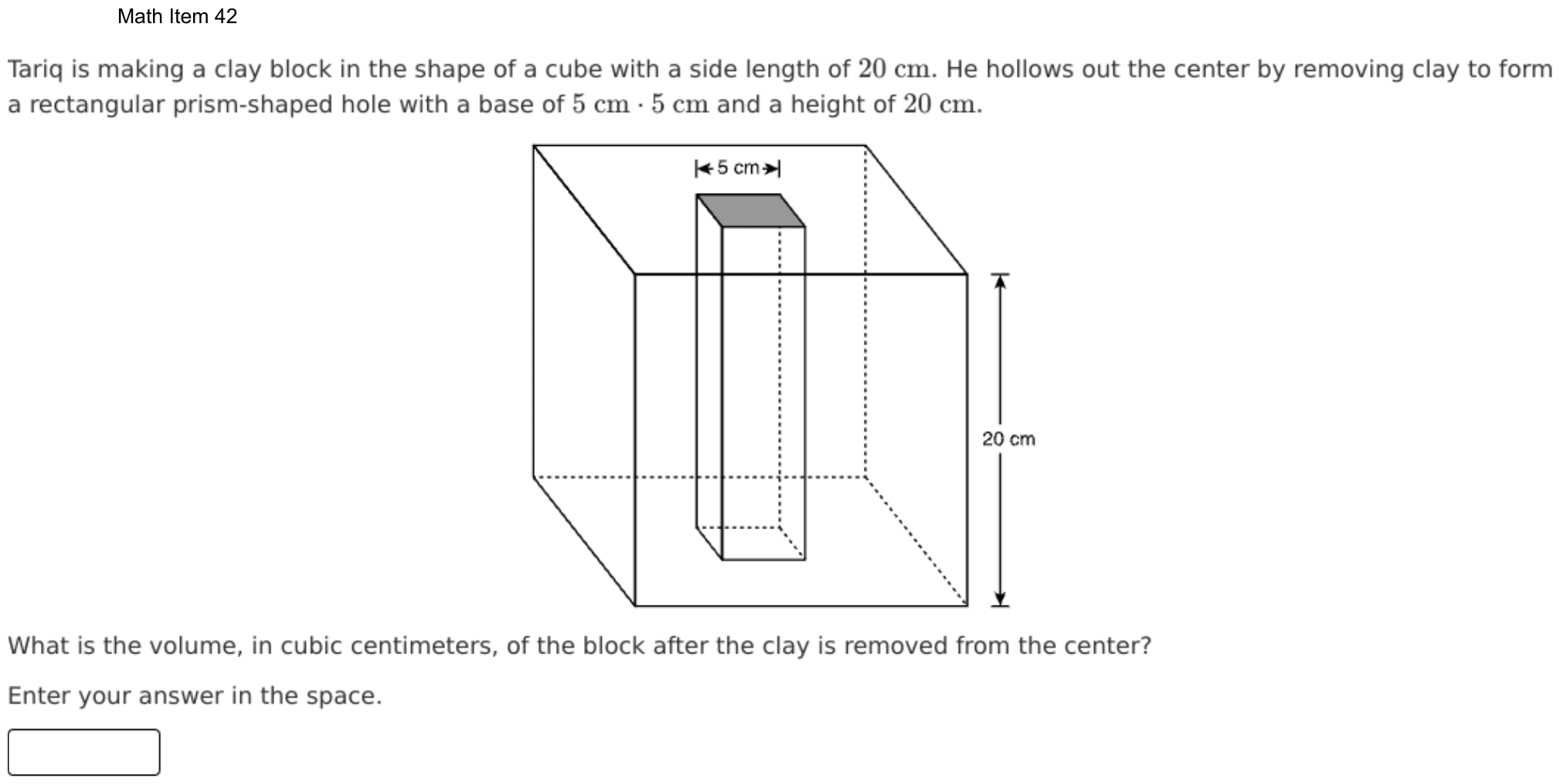
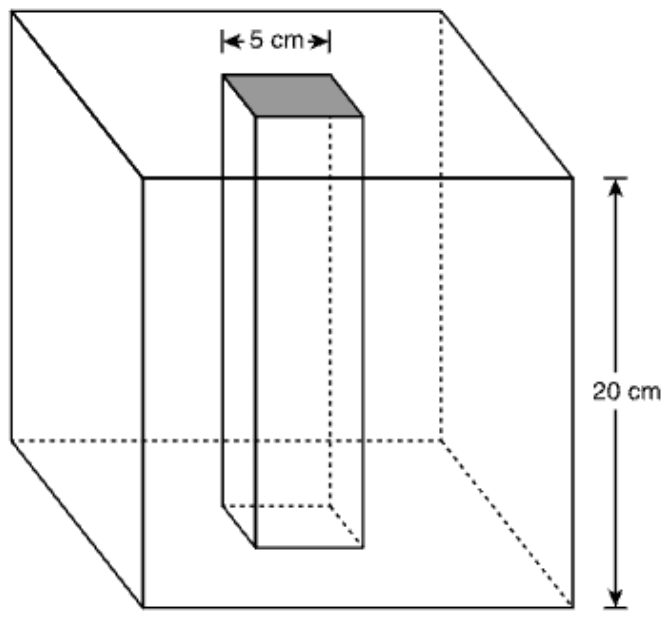
Tariq is making a clay block in the shape of a cube with a side length of . He hollows out the center by removing clay to form a rectangular prism-shaped hole with a base of and a height of .
What is the volume, in cubic centimeters, of the block after the clay is removed from the center?
Enter your answer in the space.
Fill-in question: work out the answer and type it as a number.
Show the answer
Correct answer: 7,500
First, find the volume of the cube using the formula .
The length, width, and height of the cube are each equal to 20 cm.
Next, find the volume of the cut-out square prism, with equal length and width of 5 cm and height of 20 cm.
Finally, subtract the volume of the prism from the volume of the cube.
Question analysis
Tariq makes a clay cube 20 centimeters on each side and removes a rectangular prism from its center, with a 5 cm by 5 cm base and a height of 20 cm. Students type the volume of the block that is left, in cubic centimeters. It tests the volume of rectangular prisms, and the hole's size must be read carefully from the words and figure.
- Grade level
- Grade 7 content, by NYS standard
- Compared with grade 7
- At grade 7 Finding the volume of a solid made from rectangular prisms, here by taking one away, is named in the grade 7 standards. This is a direct case with whole numbers, two volumes and one subtraction.
- Estimated difficulty
- Straightforward: two steps or one careful reading.
- Thinking it demands
- Depth of knowledge 1, recall and reproduction · mainly apply
- What makes it hard
- Solution
- 3 steps
- Reading level
- Question and choices: about grade 8, 66 words.
- Students, last 30 days
- Not enough answers yet to show (it takes 10).
Why it is hard, traps and wrong answers (shows the answer)
Why it is hard
This is a direct composite-volume problem with whole numbers: one cube, one hole, one subtraction. What it checks is that both volumes are real volumes, the hole as tall as the cube, and that the subtraction is done at the end. Students who stop at the hole’s volume, or who subtract only the square face, give amounts that are easy to type and hard to doubt without choices.
Something you must already know minor Working it out
The volume of a rectangular prism, length times width times height, is not given, and it is needed twice, once for the 20 cm cube and once for the hole. (Anderson & Krathwohl, 2001)
Reading a figure, table or graph minor Understanding the question
The figure labels only the 5 cm opening and the cube’s 20 cm edge; the hole’s 20 cm height comes from the words, while the drawing shows it reaching from top to bottom. (Lesh, Post & Behr, 1987; Kirsch & Mosenthal, 1990)
An answer in an unexpected form minor Choosing the answer
The volume is typed with no choices to compare, so the hole’s 500 cubic centimeters or the cube’s 8,000 can be entered without any warning. (Enright, Morley & Sheehan, 2002)
Strategy: Find the volume of the full cube, then the volume of the square hole that runs from the top face to the bottom, and subtract the hole from the cube.
Traps
- Answers a different question: A choice is right for another quantity: the other unknown, the rest instead of the part, the part instead of the whole.
- Misreads the figure: Reads a value, label or tick spacing in a figure, table or graph wrongly.
- Wrong formula: Uses a related but wrong formula: perimeter for area, diameter for radius, area for volume, or a misremembered one.
The wrong answers, classified
500 Answers a different question (King et al., 2004; Hegarty, Mayer & Monk, 1995)
Finds the volume of the hole, 5 × 5 × 20 = 500 cubic centimeters, and gives the clay removed instead of the clay that is left.
7,875 Misreads the figure (Lesh, Post & Behr, 1987; Kirsch & Mosenthal, 1990)
Treats the hole as a 5 cm cube, 5 × 5 × 5 = 125, though it runs the full 20 cm height, so 8,000 − 125 = 7,875.
7,975 Wrong formula (King et al., 2004)
Subtracts only the area of the square opening, 5 × 5 = 25, from the cube’s 8,000, mixing a face’s area with the hole’s volume.
Worked solution, step by step
Formulas used
- Volume of a rectangular prism
- V is the volume, the space inside a solid. l is the length, w is the width and h is the height. A cube is a prism with all three the same. Volume is measured in cubic centimeters, tiny cubes 1 cm on each side.
Sort out the question
Tariq’s block starts as a cube 20 cm on each side. He removes a hole shaped like a rectangular prism, a box shape with flat rectangle sides. Its base is 5 cm by 5 cm, and its height is 20 cm. The figure shows it running from the top face to the bottom face.
You need the volume of the clay that is left, in cubic centimeters.
Find the volume of the cube
Use the volume formula. The length, width and height are all 20 cm:
The full cube holds 8,000 cubic cm of clay.
Find the volume of the hole
The hole is a prism too. Its length and width are 5 cm, and its height is 20 cm:
So 500 cubic cm of clay are removed.
Watch out: the hole is 20 cm tall, not 5 cm. Treating it as a small 5 cm cube gives 125 and the wrong answer 7,875. And 5 × 5 = 25 is only the area of the opening, not a volume. Subtracting it gives 7,975, also wrong.
Subtract the hole from the cube
The clay left is the cube minus the hole:
The block has 7,500 cubic cm of clay left.
Watch out: 500 is the clay taken out, not the clay that is left.
Enter the number
Type only the number, with no units. You can type 7500 or 7,500.
So you would enter 7,500.
Check your answer
Think of the cube as 20 flat layers, each 1 cm thick. Each layer is a 20 by 20 square, 400 square cm, with a 5 by 5 hole, 25 square cm. So each layer holds cubic cm of clay. Then . It matches.
More questions like this
The original DOE question