Question
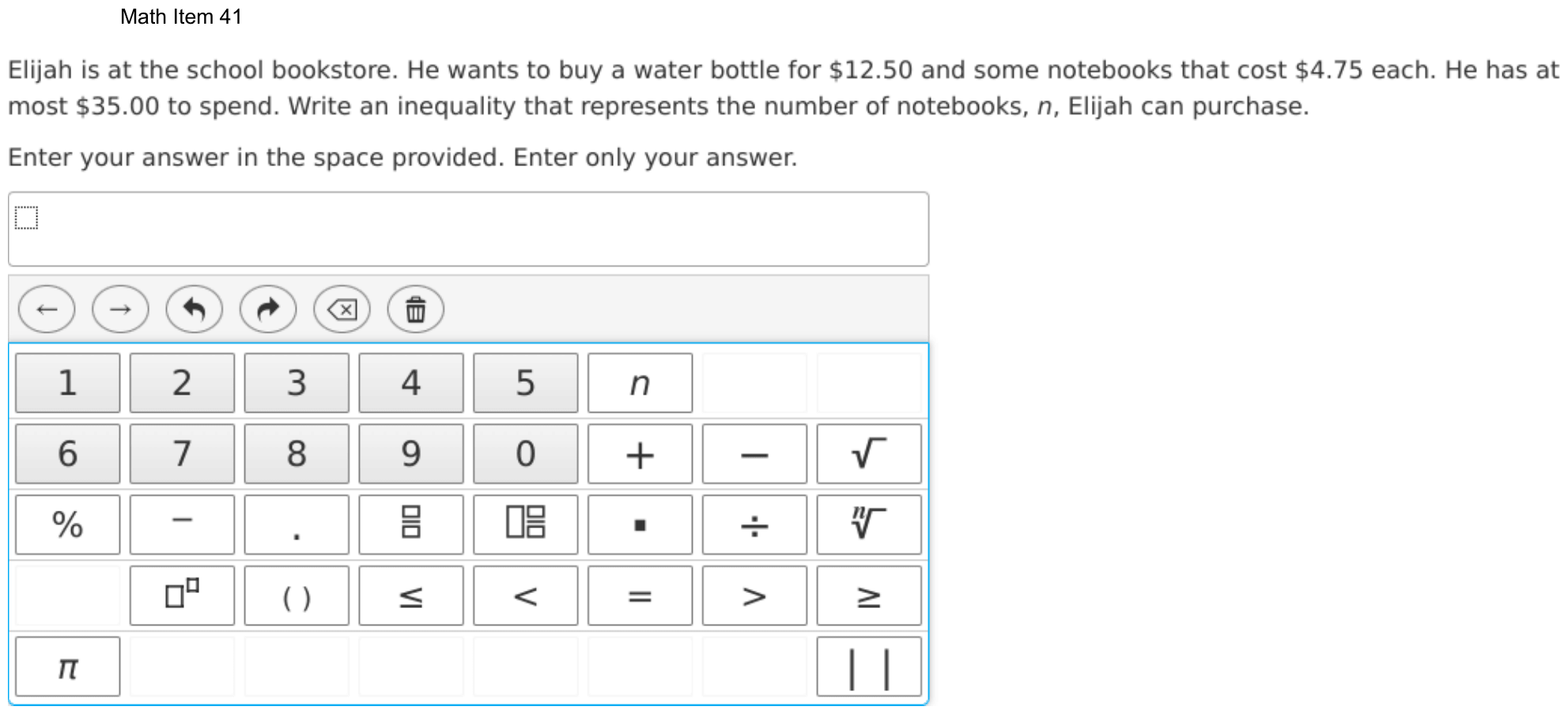
Elijah is at the school bookstore. He wants to buy a water bottle for $12.50 and some notebooks that cost $4.75 each. He has at most $35.00 to spend. Write an inequality that represents the number of notebooks, n, Elijah can purchase.
Enter your answer in the space provided. Enter only your answer.
On the test you build the answer on an on-screen keypad; here, type it. Use ^ for a power, sqrt( ) or √ for a root, pi for π, and <= or >= for ≤ and ≥.
Show the answer
Correct answer: 12.50 + 4.75n ≤ 35.00
The question uses the phrase “at most,” which means “less than or equal to” (≤).
Since notebooks cost $4.75 each and Elijah will buy n notebooks, the total cost just for the notebooks is found by multiplying $4.75 by n, or .
Combining the cost of a water bottle ($12.50) with the cost of n notebooks, the inequality is .
This may also be written as .
Question analysis
Elijah has at most $35.00 to buy one water bottle and some notebooks at the school bookstore, with a price given for each. Students type an inequality for the number of notebooks, n, he can buy. It tests writing an inequality from a word problem. The two prices play different roles, and the phrase "at most" decides the inequality symbol.
- Grade level
- Grade 7 content, by NYS standard
- Compared with grade 7
- At grade 7 Writing an inequality for a budget with a one-time cost and a cost per item is typical grade 7 work. The answer is typed, so both the symbol for "at most" and the role of each price must be right.
- Estimated difficulty
- Straightforward: two steps or one careful reading.
- Thinking it demands
- Depth of knowledge 2, skills and concepts · mainly apply
- What makes it hard
- Turning words into math moderate
- An answer in an unexpected form minor
- Solution
- 2 steps
- Reading level
- Question and choices: about grade 5, 50 words.
- Students, last 30 days
- Not enough answers yet to show (it takes 10).
Why it is hard, traps and wrong answers (shows the answer)
Why it is hard
The prices are given in the order they are used, so the expression for the total is the easier half. The points are lost on the symbol: “at most” has to be heard as no more than, with equality allowed, and the keypad offers all four inequality signs side by side. Pricing one and two notebooks with the bottle, $17.25 and $22.00, shows which amount repeats and confirms the total.
Turning words into math moderate Understanding the question
The $12.50 bottle is bought once and the $4.75 is paid for each of n notebooks, and “at most $35.00” has to become ≤, which allows a total of exactly $35.00. (Hegarty, Mayer & Monk, 1995; Koedinger & Nathan, 2004)
An answer in an unexpected form minor Choosing the answer
The whole inequality, with n, its symbol and both prices, is built on a keypad offering ≤, <, ≥ and >, so a wrong symbol looks as complete as the right one. (Enright, Morley & Sheehan, 2002)
Strategy: Price a few cases by hand, such as 1 and 2 notebooks with the water bottle, to see which amount repeats, then decide whether a total of exactly $35.00 is allowed.
Traps
- Misreads the question: Misses or misreads a condition or a word in the question: "at least", "each", "remaining", "not".
- Counting the ends: Inclusive or exclusive ends, fence posts, consecutive numbers: an answer that is one too many or too few, or an endpoint drawn open where it belongs closed (or the reverse).
- Numbers taken from the question: Combines the numbers in the question without a model of the situation, or is simply a number that appears in the question.
The wrong answers, classified
12.50 + 4.75n ≥ 35.00 Misreads the question (Hegarty, Mayer & Monk, 1995)
Builds the total correctly but reads “at most” as at least, writing ≥, which would mean Elijah must spend $35.00 or more.
12.50 + 4.75n < 35.00 Counting the ends (Brown & Burton, 1978)
Builds the total correctly but uses a strict less-than sign, leaving out a total of exactly $35.00, which “at most” allows.
17.25n ≤ 35.00 Numbers taken from the question (Hegarty, Mayer & Monk, 1995)
Adds the bottle’s price to each notebook’s, $12.50 + $4.75 = $17.25, and multiplies by n, as if a bottle came with every notebook.
Worked solution, step by step
Formulas used
- Total cost with a one-time cost
- The one-time cost is paid once, no matter what. The price each is paid once for every item. n is the number of items. You multiply the price each by n because you pay it n times.
- At most
- The sign ≤ means less than or equal to. The total can be under the limit or exactly equal to it, but never over it. Use it for words like at most and no more than.
Sort out the question
Elijah buys one water bottle for $12.50. He also buys n notebooks at $4.75 each. He can spend at most $35.00.
You need an inequality for n. An inequality compares two amounts with a sign such as ≤ instead of =.
Price a few cases
Work out the cost for a few numbers of notebooks:
Notebooks Total ($) 1 2 3 The $12.50 shows up once. The $4.75 shows up once for each notebook.
Write the total cost
Use the total cost formula. The bottle is the one-time cost, and each notebook costs $4.75:
Here 4.75n means 4.75 times n.
Watch out: do not add the two prices first. charges for a new bottle with every notebook.
Choose the sign
At most $35.00 means the total can be less than $35.00 or exactly $35.00. It cannot be more. So use ≤:
Watch out: ≥ means at least, the opposite. And < leaves out a total of exactly $35.00, which Elijah is allowed to spend.
Enter it on the keypad
Type the whole inequality. Nothing is printed before the box. On the test, press 1, 2, ., 5, 0, +, 4, ., 7, 5, the n key, the ≤ key, then 3, 5, ., 0, 0. The ≤ key is in the fourth row. Skip the dollar signs. On this site, type <= for ≤.
So you would enter 12.50 + 4.75n ≤ 35.00. An equal form, such as 4.75n + 12.50 ≤ 35.00, counts too.
Check your answer
Test some numbers. For 4 notebooks, , which is not over 35.00. For 5 notebooks, , which is too much. So Elijah can buy up to 4 notebooks. That makes sense for a budget of $35.00.
More questions like this
The original DOE question