Question
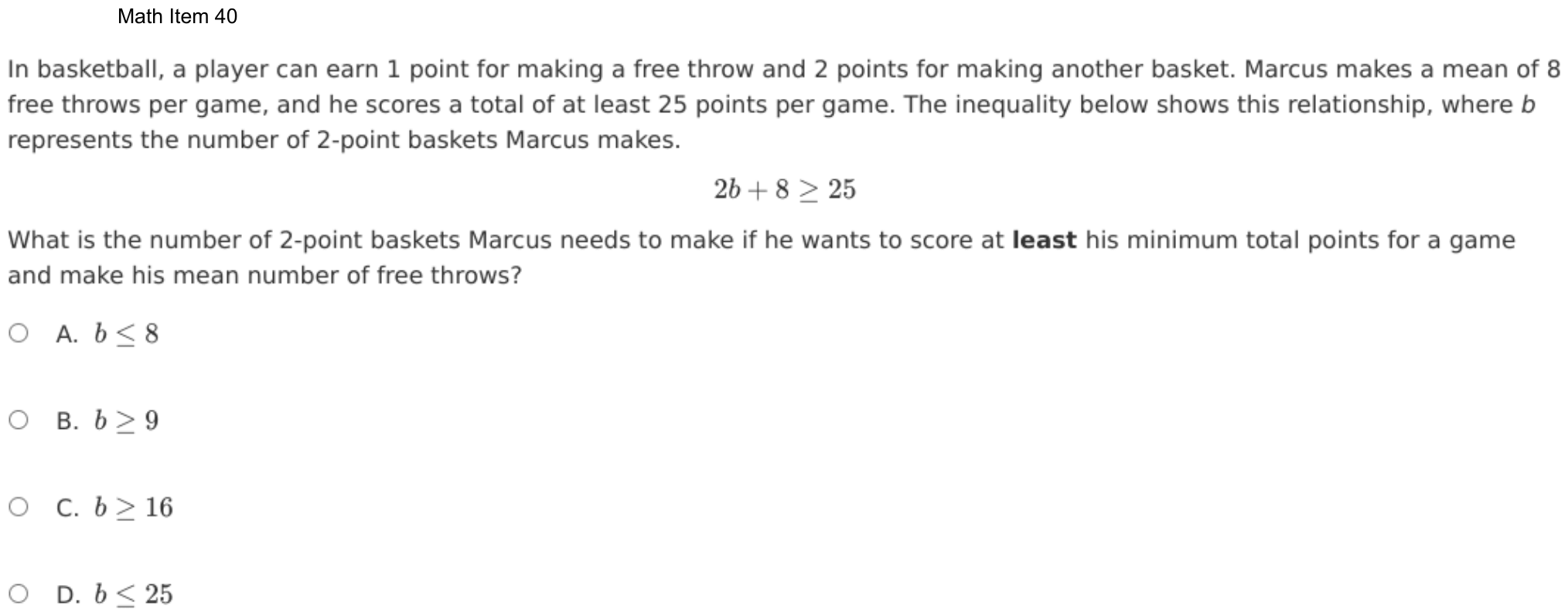
In basketball, a player can earn 1 point for making a free throw and 2 points for making another basket. Marcus makes a mean of 8 free throws per game, and he scores a total of at least 25 points per game. The inequality below shows this relationship, where b represents the number of 2-point baskets Marcus makes.
What is the number of 2-point baskets Marcus needs to make if he wants to score at least his minimum total points for a game and make his mean number of free throws?
- A
- B
- C
- D
Show the answer
Correct answer: B
Solve the inequality .
Since the number of baskets made must be a whole number, the fewest 2-point baskets, b, he must make is 9.
Question analysis
In basketball, Marcus makes a mean of 8 one-point free throws a game and wants at least 25 points, shown by the inequality 2b + 8 ≥ 25. Students find how many 2-point baskets he needs. It tests solving a two-step inequality and interpreting the solution in context, since a player cannot make part of a basket.
- NYS standards
- 7.EE.4b two-step inequalities
- Grade level
- Grade 7 content, by NYS standard
- Compared with grade 7
- At grade 7 Solving a two-step inequality from a word problem is a grade 7 standard. Here the inequality is already written, so the extra demand is interpreting its solution as a count of baskets, typical of grade 7 tasks.
- Estimated difficulty
- Straightforward: two steps or one careful reading.
- Thinking it demands
- Depth of knowledge 2, skills and concepts · mainly apply
- What makes it hard
- An answer in an unexpected form minor
- Complex sentences minor
- Solution
- 3 steps
- Reading level
- Question and choices: about grade 5, 92 words.
- Students, last 30 days
- Not enough answers yet to show (it takes 10).
Why it is hard, traps and wrong answers (shows the answer)
Why it is hard
The inequality is handed over, so the solving is two routine moves; the judgment comes after. Dividing 17 by 2 leaves a half, and since a basket cannot be split, the boundary has to move up to 9: eight baskets give 2(8) + 8 = 24 points, one short of 25. Students who flip the symbol while dividing, or who move the 8 without changing its sign, still find a choice to match.
An answer in an unexpected form minor Choosing the answer
Solving gives b ≥ 8.5, which no choice shows; it has to be recognized as b ≥ 9, because Marcus cannot make half a basket. (Enright, Morley & Sheehan, 2002)
Complex sentences minor Understanding the question
The 33-word question restates the given inequality as “at least his minimum total points” and “make his mean number of free throws”, wording harder than the math it describes. (Abedi & Lord, 2001; Freedle & Kostin, 1993; Messick, 1989)
Strategy: Undo the added 8 and then the 2 to solve for b, then ask which whole numbers of baskets actually reach 25 points, testing the boundary value in the original inequality.
Traps
- Negatives and direction: Arithmetic with negative numbers, the order of a subtraction, or direction on a number line. (Moving a term across the equals sign without changing its sign is a faulty procedure.)
- A faulty procedure: A systematic but wrong procedure: adding fractions straight across, applying an exponent to each term of a sum, dropping a sign when moving a term.
- Numbers taken from the question: Combines the numbers in the question without a model of the situation, or is simply a number that appears in the question.
The wrong answers, classified
A Negatives and direction (Brown & Burton, 1978)
Reverses the inequality when dividing by 2, as if dividing always flipped it, so b ≤ 8.5, and whole baskets give b ≤ 8.
C A faulty procedure (Brown & Burton, 1978; Tatsuoka, 1983)
Moves the 8 to the right without changing its sign, so 2b ≥ 33 and b ≥ 16.5, then drops the half to match b ≥ 16.
D Numbers taken from the question (Hegarty, Mayer & Monk, 1995)
Takes the 25-point total from the inequality as a limit on baskets and writes at most, a number copied from the question rather than solved for.
Worked solution, step by step
Formulas used
- Solving an inequality
- A and B are the two sides. The sign ≥ means greater than or equal to. Taking the same amount C from both sides keeps the sign the same. Dividing both sides by a positive number, like 2, also keeps it the same. Only a negative number flips it.
Sort out the question
A free throw is worth 1 point, and each other basket is worth 2 points. Marcus makes 8 free throws, which give 8 points. The letter b is the number of 2-point baskets, so they give 2b points.
He wants at least 25 points in all. That is the inequality . An inequality compares two amounts. The sign ≥ means greater than or equal to. You need the values of b that work.
Subtract 8 from both sides
Undo the added 8 first:
Watch out: adding 8 instead gives . That leads to choice C, which is wrong.
Divide both sides by 2
2b means 2 times b. Divide both sides by 2. Since 2 is positive, the sign stays the same:
Watch out: do not flip the sign here. Flipping it gives , which leads to choice A.
Think about whole baskets
Marcus cannot make half a basket. So test the whole numbers near 8.5:
Eight baskets give 24 points, one short of 25. Nine baskets give 26 points, which is enough. So he needs 9 or more baskets.
Give the answer
The number of baskets is 9 or more, written . Choice D, , just copies the 25 from the points.
So the answer is B, .
Check your answer
Try a bigger number, such as b = 12. Then points, which is at least 25. Any number of baskets above 9 also works, and that is what ≥ says. Below 9, the total stays at 24 points or fewer.
More questions like this
The original DOE question