Question
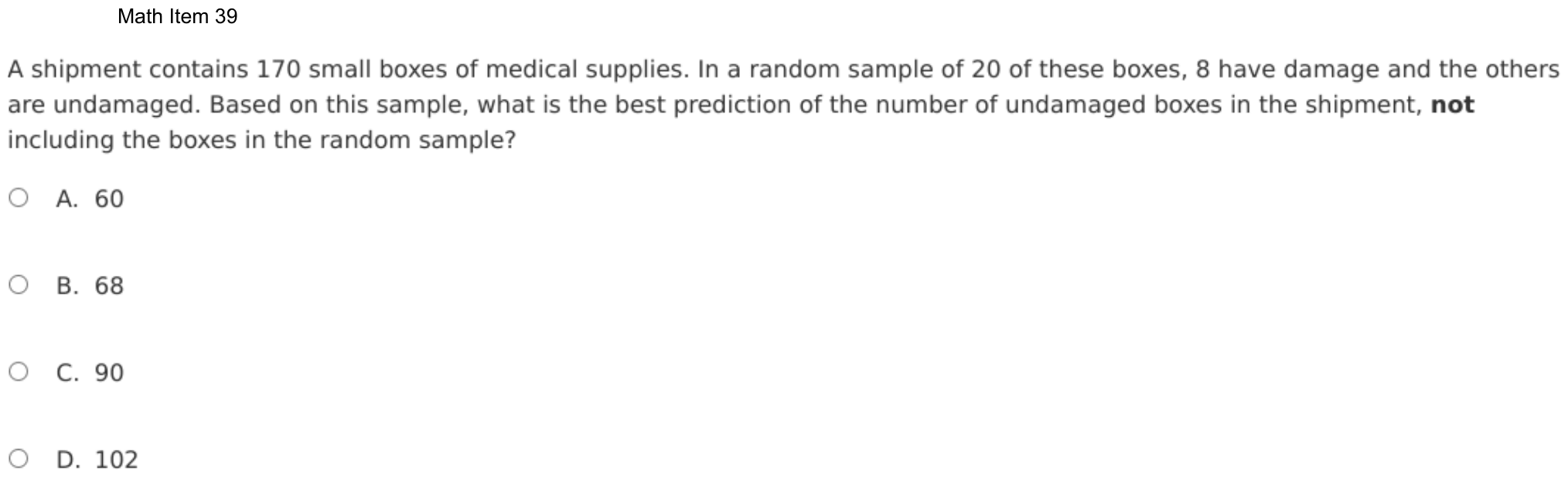
A shipment contains 170 small boxes of medical supplies. In a random sample of 20 of these boxes, 8 have damage and the others are undamaged. Based on this sample, what is the best prediction of the number of undamaged boxes in the shipment, not including the boxes in the random sample?
- A60
- B68
- C90
- D102
Show the answer
Correct answer: C
Determine the fraction of undamaged boxes in the sample, given 8 of the 20 boxes are damaged.
Subtract the number of boxes in the sample from 170.
Basing the prediction of undamaged boxes on the sample, multiply the number of boxes not in the sample by the fraction of undamaged boxes in the sample.
Question analysis
A shipment holds 170 boxes of medical supplies, and in a random sample of 20, 8 are damaged. Students predict how many undamaged boxes are in the shipment, leaving out the boxes in the sample. It tests using a sample to make a prediction, and the question's two conditions each lead to a different tempting wrong choice.
- Grade level
- Grade 7 content, by NYS standard
- Compared with grade 7
- At grade 7 Predicting from a random sample is grade 7 proportional reasoning. This version adds two conditions, undamaged rather than damaged and the shipment without the sample, so it takes three steps and a close reading.
- Estimated difficulty
- Moderate: several steps, or a close reading with one strong distractor.
- Thinking it demands
- Depth of knowledge 2, skills and concepts · mainly apply
- What makes it hard
- Much to keep track of moderate
- Many steps minor
- Solution
- 3 steps
- Reading level
- Question and choices: about grade 8, 49 words.
- Students, last 30 days
- Not enough answers yet to show (it takes 10).
Why it is hard, traps and wrong answers (shows the answer)
Why it is hard
The proportion itself is routine; the question is built around two conditions that each change the numbers. The stem reports the damaged boxes, but the question asks about undamaged ones, and its bold not removes the 20 sampled boxes from the shipment. Each wrong choice matches one way of mishandling the two conditions, so checking the result against both words, undamaged and not, is what the question rewards.
Much to keep track of moderate Working it out
Two conditions point away from the obvious numbers: the question wants undamaged boxes while the stem counts the 8 damaged, and it leaves out the 20 sampled, so 150 boxes, not 170. (Sweller, 1988; Carpenter, Just & Shell, 1990)
Many steps minor Working it out
Three steps follow in order, the undamaged share 12/20, the 150 boxes outside the sample, and their product, and each wrong turn lands on a listed choice. (Daniel & Embretson, 2010; Enright, Morley & Sheehan, 2002)
Strategy: Find the fraction of the sample that is undamaged, count the boxes that were not sampled, and multiply; then check that the answer describes the group of boxes asked about.
Traps
- Misreads the question: Misses or misreads a condition or a word in the question: "at least", "each", "remaining", "not".
- Answers a different question: A choice is right for another quantity: the other unknown, the rest instead of the part, the part instead of the whole.
The wrong answers, classified
A Answers a different question (King et al., 2004; Hegarty, Mayer & Monk, 1995)
Uses the damaged share, 8 of 20 or 0.4, instead of the undamaged share, taking it of the 150 unsampled boxes: 0.4 × 150 = 60.
B Answers a different question (King et al., 2004; Hegarty, Mayer & Monk, 1995)
Takes the damaged share of the whole shipment, 0.4 × 170 = 68, answering for damaged boxes and keeping the 20 sampled ones as well.
D Misreads the question (Hegarty, Mayer & Monk, 1995)
Finds the undamaged share, 0.6, but takes it of all 170 boxes, missing the bold not that leaves the 20 sampled boxes out: 0.6 × 170 = 102.
Worked solution, step by step
Formulas used
- Predicting from a sample
- A sample is a small group chosen at random from a bigger group. The fraction is the share of the sample with some feature. A random sample is likely to look like the bigger group. So use the same share of the group you are predicting for.
Sort out the question
The shipment has 170 boxes. A random sample of 20 boxes was checked, and 8 of them were damaged.
You need to predict the undamaged boxes in the shipment, not counting the 20 in the sample. Two words matter: undamaged and not.
Find the undamaged share
The sample has undamaged boxes. Write that as a share of the sample, and simplify:
So 0.6, or 60%, of the sample is undamaged.
Watch out: is the damaged share. Using it leads to choice A or B.
Count the boxes outside the sample
The question leaves out the 20 boxes in the sample. Take them away from the shipment:
So the prediction is about 150 boxes.
Make the prediction
Use the same undamaged share for the 150 boxes:
About 90 of those boxes should be undamaged.
Watch out: , choice D, forgets the bold not. It counts the sample boxes again.
Give the answer
The best prediction is 90 undamaged boxes outside the sample.
So the answer is C, 90.
Check your answer
Predict the damaged boxes outside the sample too: . Then , every box outside the sample. Also, 12 out of 20 is a bit more than half. And 90 is a bit more than half of 150.
More questions like this
The original DOE question