Question
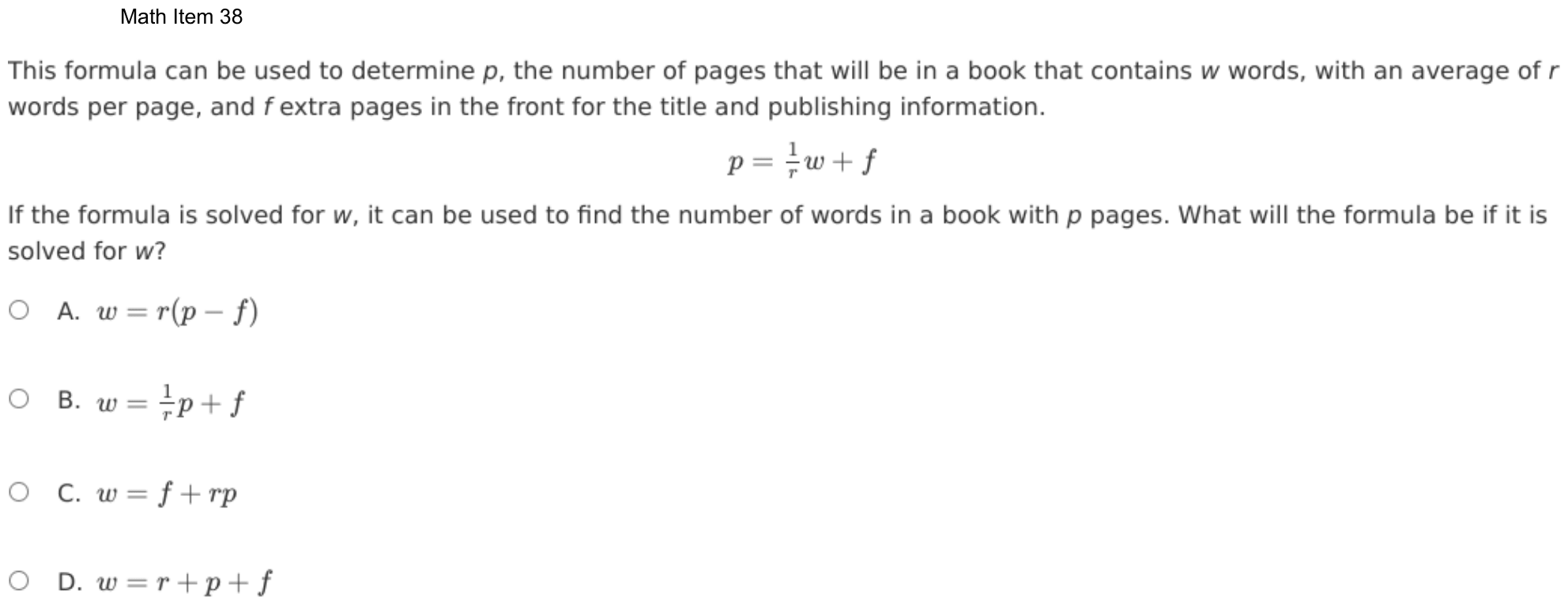
This formula can be used to determine p, the number of pages that will be in a book that contains w words, with an average of r words per page, and f extra pages in the front for the title and publishing information.
If the formula is solved for w, it can be used to find the number of words in a book with p pages. What will the formula be if it is solved for w?
- A
- B
- C
- D
Show the answer
Correct answer: A
Apply the properties of equality to solve for w.
Subtract f from both sides of the equation.
Multiply both sides by r.
Question analysis
A formula gives the number of pages p in a book from its number of words w, the average words per page r, and the extra front pages f. Students choose the formula solved for w. It tests rearranging a formula with inverse operations, and with only letters there are no numbers to check, so the order of the steps matters.
- Grade level
- Grade 8 content, by NYS standard
- Compared with grade 7
- Above grade 7 Grade 7 students solve two-step equations such as 5 = x/4 + 2 with numbers. Rearranging a formula with four letters to solve for a different one is grade 8 work, with no numbers to check against.
- Estimated difficulty
- Moderate: several steps, or a close reading with one strong distractor.
- Thinking it demands
- Depth of knowledge 1, recall and reproduction · mainly apply
- What makes it hard
- Variables instead of numbers moderate
- Many steps minor
- Solution
- 2 steps
- Reading level
- Question and choices: about grade 5, 82 words.
- Students, last 30 days
- Not enough answers yet to show (it takes 10).
Why it is hard, traps and wrong answers (shows the answer)
Why it is hard
The formula is short, but solving it for w means undoing two operations in reverse order, with letters only. The tempting shortcut multiplies p by r and leaves the f untouched, which yields a formula that looks as finished as the right one. Swapping p and w without undoing anything is the other quick trap. Substituting a small book, 5,000 words at 250 a page with 4 front pages, shows which formula gives back 5,000.
Variables instead of numbers moderate Understanding the question
Four letters and no numbers mean each choice has to be judged by its structure, unless students pick values such as r = 250, w = 5,000 and f = 4 to test it. (Koedinger & Nathan, 2004; Enright, Morley & Sheehan, 2002)
Many steps minor Working it out
Two inverse operations must come in order, subtracting f before multiplying by r; multiplying first means the f would have to be multiplied by r as well. (Daniel & Embretson, 2010; Enright, Morley & Sheehan, 2002)
Strategy: Treat it like a two-step equation with numbers: undo what was done to w last, then the step before, applying each operation to the whole of the other side.
Traps
- A faulty procedure: A systematic but wrong procedure: adding fractions straight across, applying an exponent to each term of a sum, dropping a sign when moving a term.
- Misunderstands the concept: A wrong belief about a concept: that percents can be added, that area grows like length, that averages can be averaged, that a bigger denominator means a bigger fraction.
- Numbers taken from the question: Combines the numbers in the question without a model of the situation, or is simply a number that appears in the question.
The wrong answers, classified
B Misunderstands the concept (Smith, diSessa & Roschelle, 1993; De Bock et al., 1998; Ni & Zhou, 2005)
Treats solving for w as trading the places of p and w, keeping the 1/r and the + f exactly where they were.
C A faulty procedure (Brown & Burton, 1978; Tatsuoka, 1983)
Multiplies p by r to undo the 1/r but leaves the + f alone, neither subtracting it first nor multiplying it by r too.
D Numbers taken from the question (Hegarty, Mayer & Monk, 1995)
Adds the other three letters, r + p + f, keeping the formula’s letters but none of its multiplication or division.
Worked solution, step by step
Formulas used
- Multiplying by the reciprocal
- r is any number except 0. The reciprocal of r is 1/r, the number flipped upside down. A number times its reciprocal is always 1. So multiplying by r undoes the 1/r in front of w and leaves w by itself.
Sort out the question
The formula is . Here p is the number of pages, w the number of words, r the words on each page, and f the extra front pages.
You need the formula solved for w. That means w alone on one side of the equal sign.
See what happens to w
Read the formula like a recipe. Start with w. First it is multiplied by , which is the same as dividing by r. Then f is added.
To get w back, undo the steps in reverse order. Take away f first. Then undo the .
Subtract f from both sides
Taking f from both sides keeps them equal:
Now the only thing left to undo is the .
Multiply both sides by r
Use the reciprocal rule. Multiply both whole sides by r:
So .
Watch out: , choice C, multiplies only p by r. The f must be taken away before you multiply. Or, if you multiply first, every term gets multiplied by r.
Give the answer
Choice B only trades the places of p and w, and it undoes nothing. Choice D just adds the letters.
So the answer is A, .
Check your answer
Try a book with 5,000 words, 250 words a page and 4 front pages. The first formula gives pages. Choice A gives back the words: . Choice C gives , which is wrong.
More questions like this
The original DOE question