Question
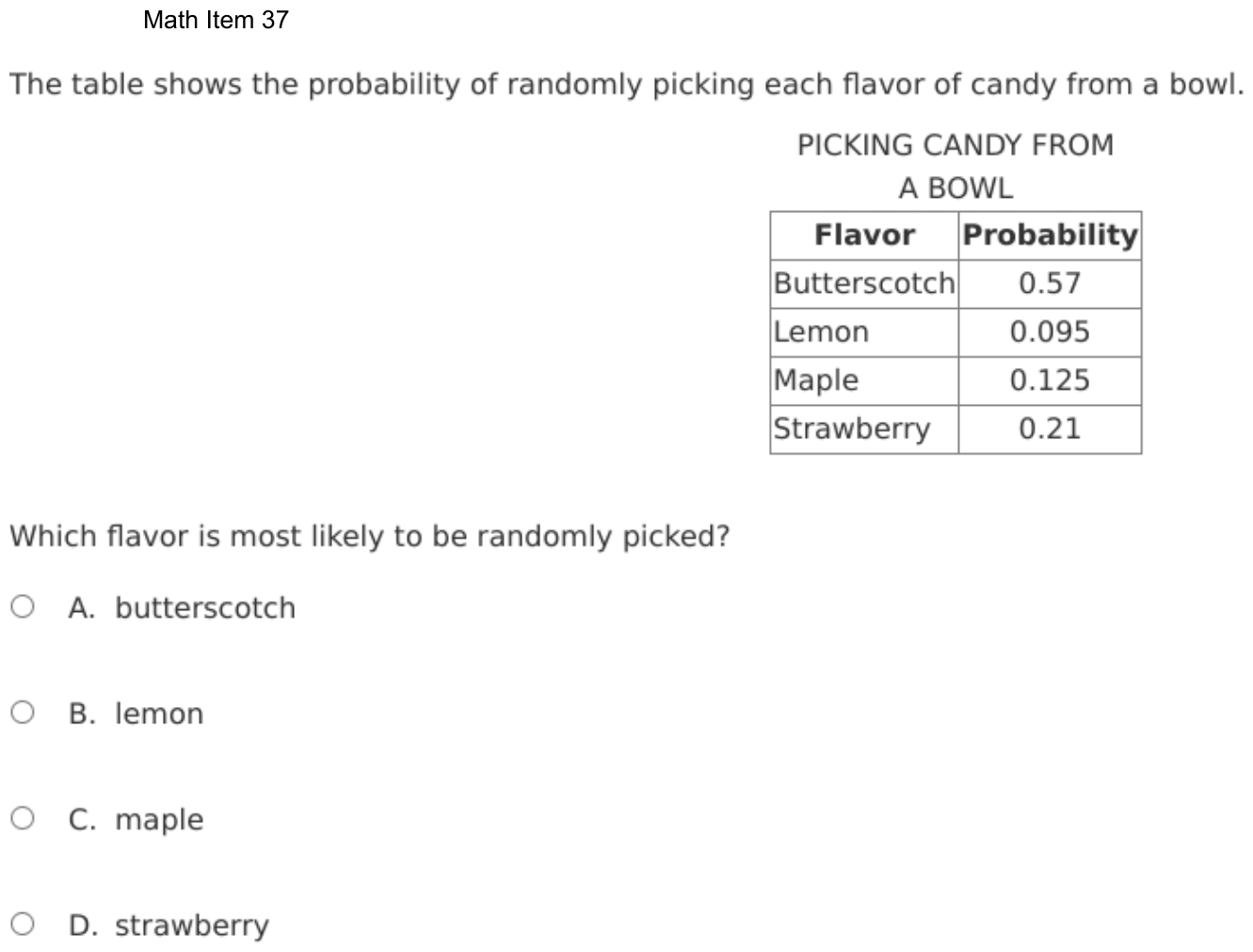
The table shows the probability of randomly picking each flavor of candy from a bowl.
PICKING CANDY FROM
A BOWL
| Flavor | Probability |
|---|---|
| Butterscotch | 0.57 |
| Lemon | 0.095 |
| Maple | 0.125 |
| Strawberry | 0.21 |
Which flavor is most likely to be randomly picked?
- Abutterscotch
- Blemon
- Cmaple
- Dstrawberry
Show the answer
Correct answer: A
The flavor most likely to be picked at random is butterscotch, because its probability is the greatest of the probabilities in the list. More than half the candies in the bowl are butterscotch.
Question analysis
A table lists the probability of picking butterscotch, lemon, maple or strawberry candy at random from a bowl, each as a decimal. Students decide which flavor is most likely to be picked. It tests the meaning of probability and comparing decimals, which have different numbers of digits here and must be compared by place value.
- Grade level
- Grade 6 content, by NYS standard
- Compared with grade 7
- Below grade 7 Reading probabilities as likelihoods is grade 6 content, and this needs only a comparison of four decimals. The one demand is comparing decimals with different numbers of digits, a skill from earlier grades.
- Estimated difficulty
- Routine: one familiar step, little to misread.
- Thinking it demands
- Depth of knowledge 1, recall and reproduction · mainly understand
- What makes it hard
- Error-prone arithmetic minor
- Solution
- 1 step
- Reading level
- Question and choices: about grade 9, 37 words.
- Students, last 30 days
- Not enough answers yet to show (it takes 10).
Why it is hard, traps and wrong answers (shows the answer)
Why it is hard
One idea answers the question: the most likely flavor has the greatest probability. The only obstacle is comparing decimals of different lengths, where 0.125 and 0.095 look bigger than 0.57 to students who count digits. Writing each as thousandths, 570, 95, 125 and 210, or noticing that 0.57 alone is more than one half, makes the order plain.
Error-prone arithmetic minor Working it out
The probabilities have two and three decimal places, 0.57 beside 0.095 and 0.125, so comparing them by length, or by their digits as whole numbers, ranks them wrongly. (Brown & Burton, 1978; Junker & Sijtsma, 2001)
Strategy: Line the four decimals up by place value, adding zeros so each has three decimal places, and compare them digit by digit starting from the tenths place.
Traps
- Misunderstands the concept: A wrong belief about a concept: that percents can be added, that area grows like length, that averages can be averaged, that a bigger denominator means a bigger fraction.
The wrong answers, classified
B Misreads the figure (Lesh, Post & Behr, 1987; Kirsch & Mosenthal, 1990)
Reads lemon’s 0.095 as 0.95, overlooking the 0 in the tenths place, so it looks almost certain and larger than 0.57.
C Misunderstands the concept (Smith, diSessa & Roschelle, 1993; De Bock et al., 1998; Ni & Zhou, 2005)
Treats the decimal with more digits as the larger, or compares 125 with 57 as whole numbers, so 0.125 seems bigger than 0.57.
D Little reason to choose it (Haladyna & Downing, 1993; Rodriguez, 2005)
No common misreading makes 0.21 the largest, since it is neither the longest decimal nor the one with the biggest digits, so it mostly draws guesses.
Worked solution, step by step
Formulas used
- Probability
- P is the probability of picking a flavor. It is a number from 0 to 1. The more candies of a flavor there are, the bigger its probability. So the flavor with the greatest probability is the most likely to be picked.
Sort out the question
The table gives the probability of picking each of four flavors. You need the flavor that is most likely to be picked.
The greater the probability, the more likely the pick. So you need the greatest of the four decimals.
Line up the decimals
The decimals have different numbers of digits. Add zeros at the end so each has three decimal places. This does not change their values:
Flavor Probability Butterscotch 0.570 Lemon 0.095 Maple 0.125 Strawberry 0.210 Compare the tenths digits
Start with the first digit after the decimal point, the tenths place. The tenths digits are 5, 0, 1 and 2. The biggest is 5, so 0.570 is the greatest.
Watch out: 0.125 has more digits than 0.57, but it is smaller. Compare place by place, not by length. That mistake leads to choice C. Also, lemon is 0.095, not 0.95, so choice B is out.
Give the answer
Butterscotch has the greatest probability, 0.57. So it is the flavor most likely to be picked.
So the answer is A, butterscotch.
Check your answer
0.57 is more than 0.5, which is one half. So more than half the candies are butterscotch. The other three flavors add up to , less than half. So butterscotch must be the most likely.
More questions like this
The original DOE question