Question
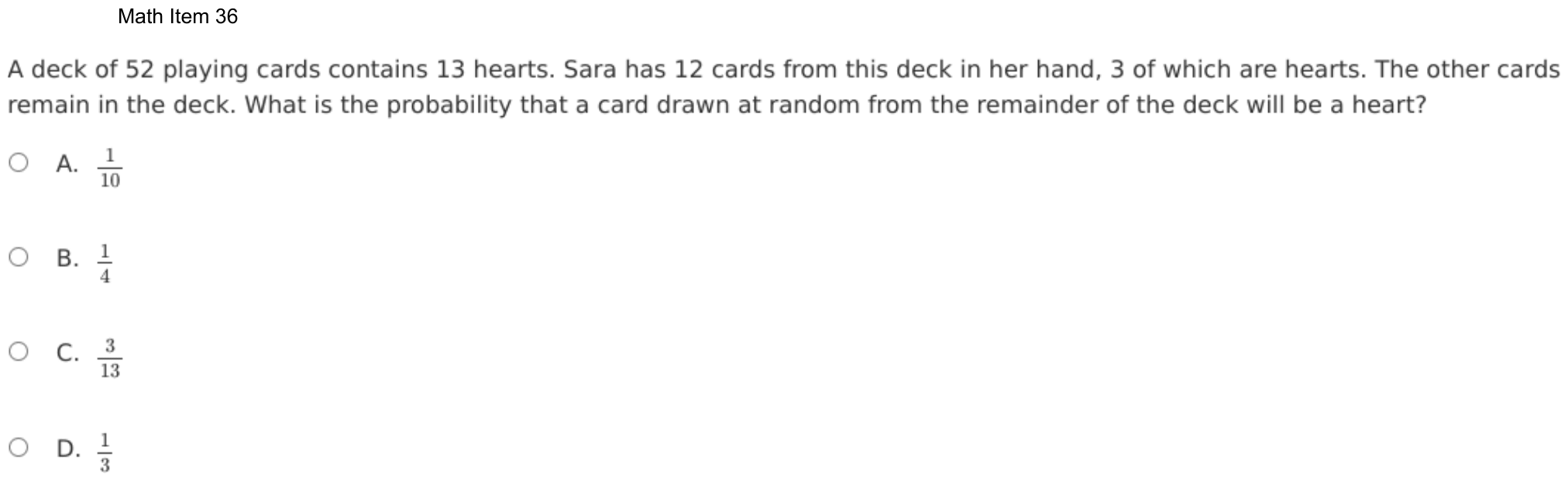
A deck of 52 playing cards contains 13 hearts. Sara has 12 cards from this deck in her hand, 3 of which are hearts. The other cards remain in the deck. What is the probability that a card drawn at random from the remainder of the deck will be a heart?
- A
- B
- C
- D
Show the answer
Correct answer: B
First, determine the number of cards in the remaining deck:
Next, determine the number of hearts left in the remaining deck:
Last, determine the probability of drawing a heart from the remaining deck:
Question analysis
A standard deck of 52 playing cards has 13 hearts, and Sara holds 12 cards, 3 of them hearts. Students find the probability that a card drawn at random from the rest of the deck is a heart. Her hand changes both the number of hearts and the number of cards left, so both counts must be updated.
- NYS standards
- 6.SP.8a uniform probability models
- Grade level
- Grade 6 content, by NYS standard
- Compared with grade 7
- At grade 7 Finding a simple probability is grade 6 content. This one adds a step many grade 7 problems skip: the cards in Sara's hand must be taken out of both the hearts and the whole deck first.
- Estimated difficulty
- Straightforward: two steps or one careful reading.
- Thinking it demands
- Depth of knowledge 2, skills and concepts · mainly apply
- What makes it hard
- Much to keep track of minor
- Turning words into math minor
- Solution
- 3 steps
- Reading level
- Question and choices: about grade 3, 51 words.
- Students, last 30 days
- Not enough answers yet to show (it takes 10).
Why it is hard, traps and wrong answers (shows the answer)
Why it is hard
The careful route takes two subtractions and a fraction: 10 hearts among 40 cards. The numbers are kind, because Sara’s hand is a quarter hearts, just like the full deck, so a student who ignores her hand and divides 13 by 52 also reaches 1/4. The wrong choices come from describing her hand instead of the deck, or from comparing hearts with the cards that are not hearts.
Much to keep track of minor Working it out
Four counts are in play, 52 cards, 13 hearts, Sara’s 12 cards and her 3 hearts, and both the hearts and the total must be reduced before the fraction is formed. (Sweller, 1988; Carpenter, Just & Shell, 1990)
Turning words into math minor Understanding the question
“The other cards remain in the deck” and “the remainder of the deck” point to the 40 cards Sara is not holding, not to the full 52 or to her hand. (Hegarty, Mayer & Monk, 1995; Koedinger & Nathan, 2004)
Strategy: Work out how many cards are left in the deck and how many of them are hearts, then write the hearts left over the cards left and simplify.
Traps
- Answers a different question: A choice is right for another quantity: the other unknown, the rest instead of the part, the part instead of the whole.
- Misunderstands the concept: A wrong belief about a concept: that percents can be added, that area grows like length, that averages can be averaged, that a bigger denominator means a bigger fraction.
- Numbers taken from the question: Combines the numbers in the question without a model of the situation, or is simply a number that appears in the question.
The wrong answers, classified
A Numbers taken from the question (Hegarty, Mayer & Monk, 1995)
Matches the 10 hearts left in the deck to the 10 in 1/10, never dividing them by the 40 cards that remain.
C Answers a different question (King et al., 2004; Hegarty, Mayer & Monk, 1995)
Puts Sara’s 3 hearts over the deck’s 13, or her 12 cards over 52, both 3/13, which describes her hand rather than the cards left.
D Misunderstands the concept (Smith, diSessa & Roschelle, 1993; De Bock et al., 1998; Ni & Zhou, 2005)
Compares the 10 hearts left with the 30 other cards left, a part-to-part ratio of 1 to 3, instead of with all 40 cards.
Worked solution, step by step
Formulas used
- Probability
- P is the probability, the chance something happens. The top counts the cards that are hearts. The bottom counts every card you could draw. Each card is equally likely to be drawn, so the fraction gives the chance.
Sort out the question
A full deck has 52 cards, and 13 of them are hearts. Sara holds 12 cards, and 3 of those are hearts. The rest of the cards stay in the deck.
You need the chance that a card drawn from the rest of the deck is a heart. Her hand changes both counts.
Count the cards left
Take Sara’s 12 cards out of the deck:
So 40 cards are left in the deck.
Count the hearts left
Sara holds 3 of the 13 hearts. Take those out:
So 10 hearts are left in the deck.
Find the probability
Use the probability formula. Put the hearts left over all the cards left, then simplify:
Watch out: comparing the 10 hearts with the 30 cards that are not hearts gives , choice D. The bottom must be all 40 cards. Choice C, , describes Sara’s hand, not the deck. Choice A, , uses the 10 hearts but forgets the 40 cards.
Give the answer
The chance of drawing a heart from the rest of the deck is 1 in 4.
So the answer is B, .
Check your answer
10 is one quarter of 40, because . Here is another check. Sara’s hand is 3 hearts out of 12, which is also one quarter. Taking a hand that is one quarter hearts out of a deck that is one quarter hearts leaves one quarter hearts.
More questions like this
The original DOE question