Question
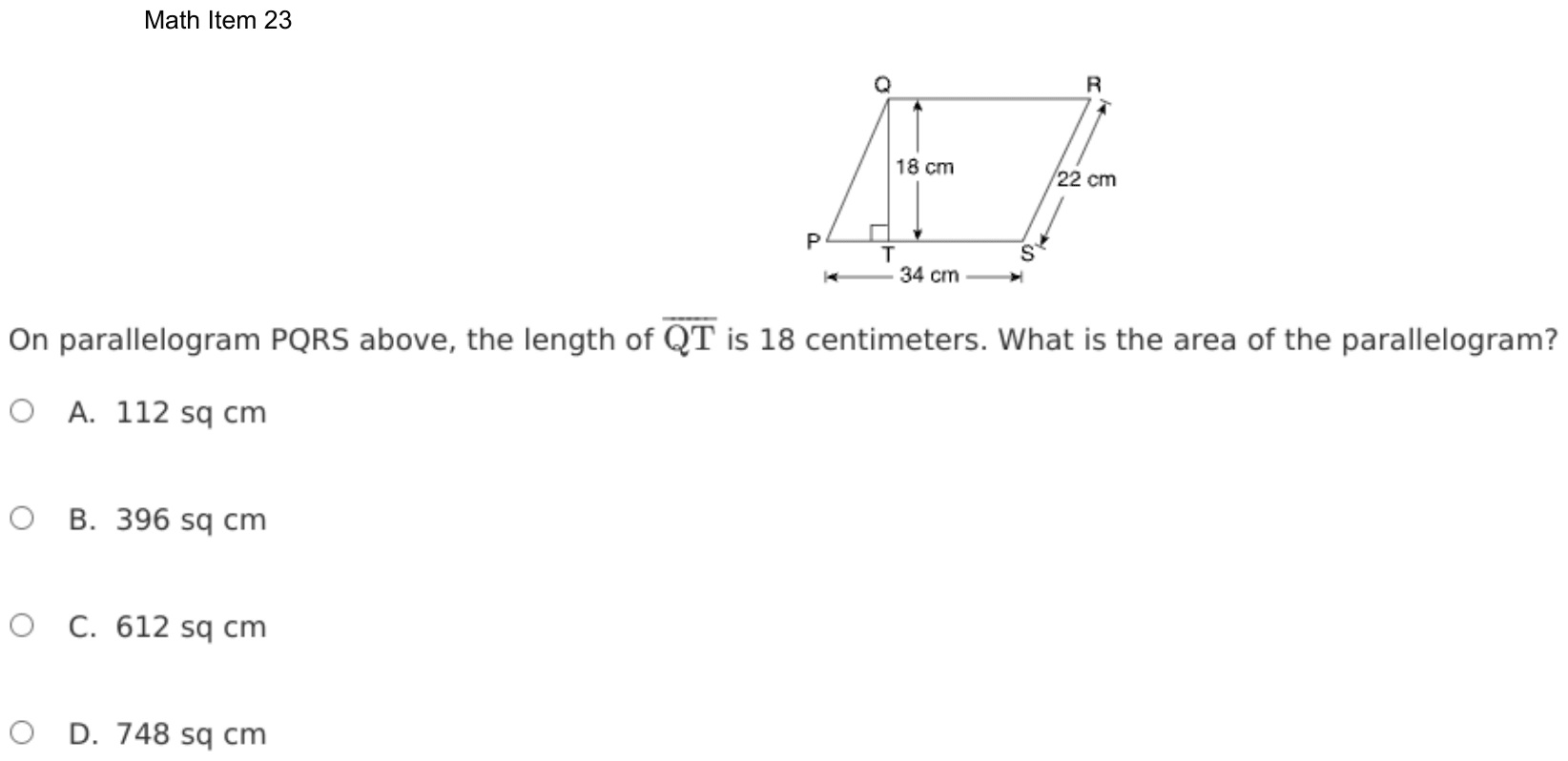
On parallelogram PQRS above, the length of is 18 centimeters. What is the area of the parallelogram?
- A112 sq cm
- B396 sq cm
- C612 sq cm
- D748 sq cm
Show the answer
Correct answer: C
PQRS is a parallelogram in which PS is a base and QT is an altitude. The base is 34 cm in length, and the height is the length of the altitude, so the height is 18 cm.
To determine the area of a parallelogram, multiply the base × the height:
Question analysis
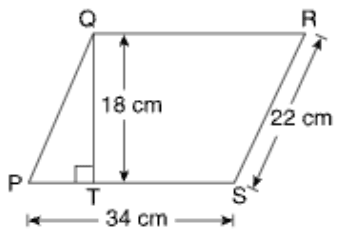
Parallelogram PQRS is drawn with a 34 cm base PS, a 22 cm slanted side and an 18 cm segment QT at a right angle to the base, and students find its area. It tests the area formula for a parallelogram. One labeled length is not needed, so the base and height that go together have to be chosen.
- NYS standards
- 6.G.1 area of polygons
- Grade level
- Grade 6 content, by NYS standard
- Compared with grade 7
- Below grade 7 The area of a parallelogram is grade 6 content, used here once with the height already drawn and labeled. Grade 7 area tasks usually involve circles, composite shapes or scale drawings, so this is easier.
- Estimated difficulty
- Routine: one familiar step, little to misread.
- Thinking it demands
- Depth of knowledge 1, recall and reproduction · mainly apply
- What makes it hard
- Solution
- 1 step
- Reading level
- Question and choices: about grade 5, 25 words.
- Students, last 30 days
- Not enough answers yet to show (it takes 10).
Why it is hard, traps and wrong answers (shows the answer)
Why it is hard
One multiplication answers the question once the right pair of lengths is chosen. Each wrong choice pairs or combines the labeled lengths in another way: the two sides as for a rectangle, the height with the slanted side, or all four sides as a perimeter. Following the right-angle mark at T from QT down to PS identifies the base and height that belong together.
Reading a figure, table or graph minor Understanding the question
Three lengths are labeled, 34 cm, 18 cm and 22 cm, but only the base PS and the height QT meet at the right-angle mark; the slanted side RS is not needed. (Lesh, Post & Behr, 1987; Kirsch & Mosenthal, 1990)
Something you must already know minor Working it out
The formula, base times height, is not given, and the height must be the perpendicular distance between two sides, not the length of a slanted side. (Anderson & Krathwohl, 2001)
Strategy: Multiply the base by the height measured at a right angle to it, and check that the length you use as the height meets that base at a right-angle mark.
Traps
- Wrong formula: Uses a related but wrong formula: perimeter for area, diameter for radius, area for volume, or a misremembered one.
- Information you don't need: The question gives numbers or facts that play no part in the answer.
The wrong answers, classified
A Wrong formula (King et al., 2004)
Adds all four sides, 2 × (34 + 22) = 112, finding the perimeter of the parallelogram instead of its area.
B Misreads the figure (Lesh, Post & Behr, 1987; Kirsch & Mosenthal, 1990)
Multiplies the 18 cm height by the 22 cm slanted side, a pair that does not meet at a right angle, getting 396.
D Wrong formula (King et al., 2004)
Multiplies the two side lengths, 34 × 22 = 748, as if a parallelogram's area were side times side like a rectangle's.
Worked solution, step by step
Formulas used
- Area of a parallelogram
- A is the area. b is the base, the side the shape sits on. h is the height, the straight-up distance from the base to the opposite side, at a right angle to the base. It works because you can cut a triangle off one end, move it to the other end, and make a rectangle.
Sort out the question
PQRS is a parallelogram, a four-sided shape whose opposite sides are parallel. The figure shows three lengths. Side PS, the bottom, is 34 cm. Segment QT goes straight down from Q to PS and is 18 cm. Side RS is slanted and is 22 cm. You need the area, in square centimeters.
Pick the base and the height
The base is PS, 34 cm. The height must meet the base at a right angle. The small square at T shows that QT does. So the height is QT, 18 cm.
Watch out: the 22 cm side is slanted, so it is not the height. Multiplying 22 × 18 gives 396, choice B.
Multiply the base by the height
Use the area formula:
Break it up to multiply:
The area is 612 square centimeters.
Choose the answer
Watch out: 34 × 22 = 748, choice D, treats the shape like a rectangle. Adding all four sides gives 112, choice A. That is the perimeter, the distance around.
So the answer is C, 612 sq cm.
Check your answer
Estimate: 34 is about 30 and 18 is about 20, and . 612 is close. Also, the area must be less than , because the height is shorter than the slanted side.
More questions like this
The original DOE question