Question
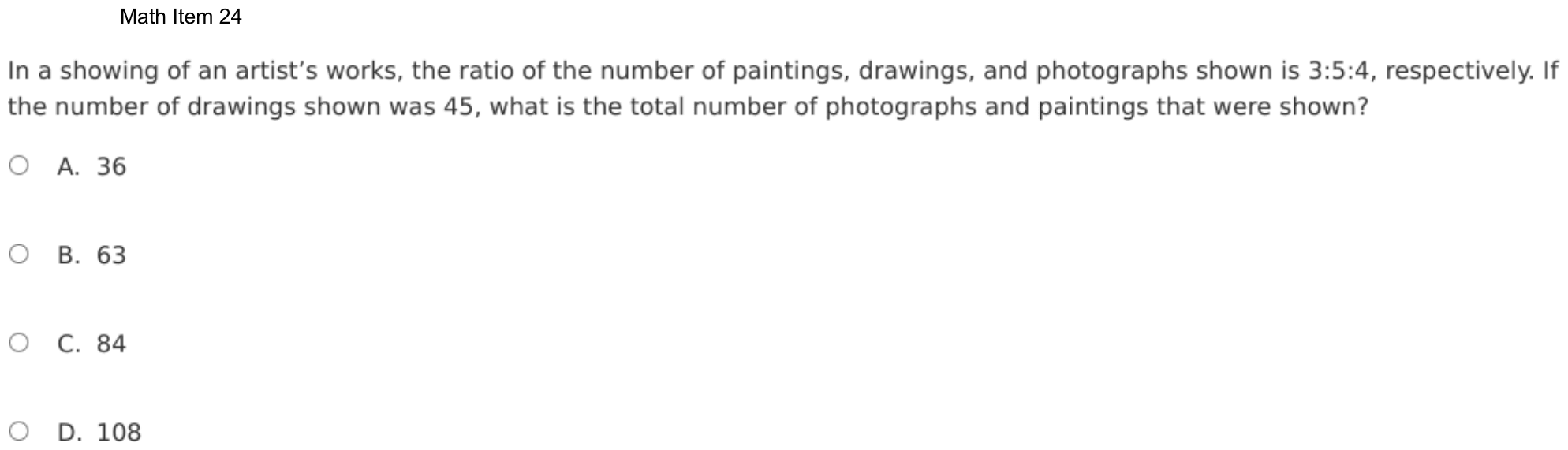
In a showing of an artist’s works, the ratio of the number of paintings, drawings, and photographs shown is 3:5:4, respectively. If the number of drawings shown was 45, what is the total number of photographs and paintings that were shown?
- A36
- B63
- C84
- D108
Show the answer
Correct answer: B
The ratio of paintings to drawings to photographs is .
First, determine the number of actual paintings and photographs.
Since the number of actual drawings is 45, each ratio is multiplied by 9, since .
| Type | Ratio | Actual Number |
|---|---|---|
| Paintings | 3 | 27 |
| Drawings | 5 | 45 |
| Photographs | 4 | 36 |
Then, add the actual number of paintings and photographs.
Question analysis
An art showing has paintings, drawings and photographs in the ratio 3:5:4, and 45 drawings were shown. Students find the total number of photographs and paintings. It tests using a three-part ratio to find actual amounts, and the question asks for two of the three groups together, not any single group or the whole show.
- Grade level
- Grade 7 content, by NYS standard
- Compared with grade 7
- At grade 7 Scaling a ratio from one known part is grade 6 and 7 work. A three-part ratio, and a question about two of the three groups combined, make it a three-step task typical of grade 7 ratio problems.
- Estimated difficulty
- Moderate: several steps, or a close reading with one strong distractor.
- Thinking it demands
- Depth of knowledge 2, skills and concepts · mainly apply
- What makes it hard
- Much to keep track of moderate
- Turning words into math minor
- Solution
- 3 steps
- Reading level
- Question and choices: about grade 10, 39 words.
- Students, last 30 days
- Not enough answers yet to show (it takes 10).
Why it is hard, traps and wrong answers (shows the answer)
Why it is hard
The scale factor comes from one division, 45 ÷ 5 = 9, so the risk lies in what to do with it. Two tempting results are listed: the photographs alone, and the whole show with the drawings added in. Multiplying the 3 + 4 = 7 parts for paintings and photographs by 9 gives the total in one step and avoids both.
Much to keep track of moderate Working it out
The ratio has three parts, the known count belongs to the middle part, drawings, and the question wants the first and third parts combined, so three roles must be tracked. (Sweller, 1988; Carpenter, Just & Shell, 1990)
Turning words into math minor Understanding the question
The word respectively assigns 3, 5 and 4 to paintings, drawings and photographs in that order, and the question then names two of them in the other order. (Hegarty, Mayer & Monk, 1995; Koedinger & Nathan, 2004)
Strategy: Find how many works each ratio part stands for from the drawings, multiply it by the parts for paintings and for photographs, and add only those two.
Traps
- Stops one step early: A choice is a number from partway through the solution.
- Answers a different question: A choice is right for another quantity: the other unknown, the rest instead of the part, the part instead of the whole.
The wrong answers, classified
A Stops one step early (King et al., 2004; Gierl et al., 2017)
Finds the photographs, 4 × 9 = 36, and stops before adding the 27 paintings that the question also asks about.
C Numbers taken from the question (Hegarty, Mayer & Monk, 1995)
Multiplies the 7 parts for paintings and photographs by 12, the total of the ratio's parts, instead of by 9.
D Answers a different question (King et al., 2004; Hegarty, Mayer & Monk, 1995)
Finds every group correctly but adds the 45 drawings too, giving the whole show, 108, rather than the paintings and photographs.
Worked solution, step by step
Formulas used
- Using the parts of a ratio
- The ratio 3:5:4 splits the show into equal parts. Parts is how many parts a group has. Each part stands for the same number of works. Find that number from the group you know, then multiply each group’s parts by it.
Sort out the question
The ratio of paintings to drawings to photographs is 3:5:4. Respectively means in that order: 3 for paintings, 5 for drawings and 4 for photographs. There were 45 drawings. You need the number of photographs and paintings together.
Find the value of one part
Drawings are 5 parts, and there were 45 drawings:
So each part of the ratio stands for 9 works.
Find each group
Multiply each group’s parts by 9:
Type Parts Actual number Paintings 3 Drawings 5 Photographs 4 The drawings row gives 45, which matches the question.
Add only the two groups asked for
Add the paintings and the photographs:
Watch out: 36 alone, choice A, leaves out the paintings. Adding the 45 drawings too gives 108, choice D, the whole show.
So the answer is B, 63.
Check your answer
Paintings and photographs are parts. Each part is 9 works, so . That matches. Also, 63 to 45 is the same as 7 to 5, just as the ratio says.
More questions like this
The original DOE question