Passage Excerpt from “Scribe Like an Egyptian”
Excerpt from “Scribe Like an Egyptian”
by Hilary Wilson
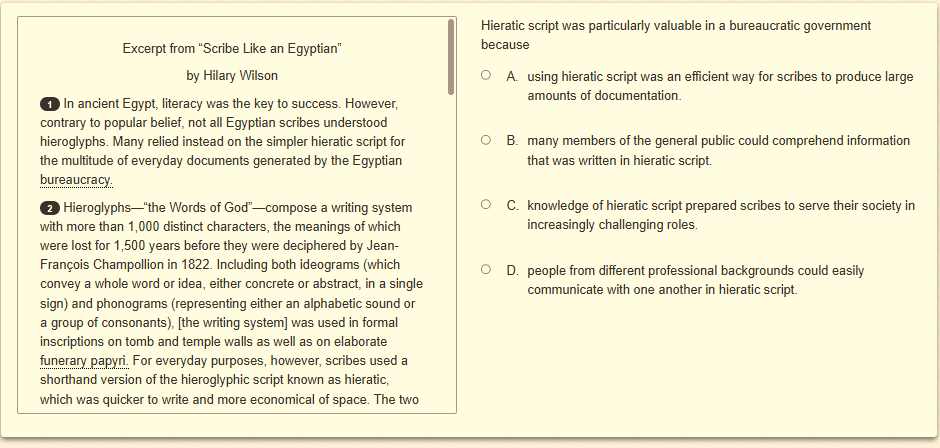
In ancient Egypt, literacy was the key to success. However, contrary to popular belief, not all Egyptian scribes understood hieroglyphs. Many relied instead on the simpler hieratic script for the multitude of everyday documents generated by the Egyptian bureaucracy.
Hieroglyphs—“the Words of God”—compose a writing system with more than 1,000 distinct characters, the meanings of which were lost for 1,500 years before they were deciphered by Jean-François Champollion in 1822. Including both ideograms (which convey a whole word or idea, either concrete or abstract, in a single sign) and phonograms (representing either an alphabetic sound or a group of consonants), [the writing system] was used in formal inscriptions on tomb and temple walls as well as on elaborate funerary papyri. For everyday purposes, however, scribes used a shorthand version of the hieroglyphic script known as hieratic, which was quicker to write and more economical of space. The two writings existed side by side for at least 2,500 years.
Scraps of ancient hieratic writing, mostly penned by student scribes on limestone flakes called ostraca, suggest that no matter how humble his origins, an educated Egyptian could achieve almost anything. Horemheb (d.1292 B.C.) is a good example. Born of middle-ranking parents, his scribal training led to an army career. From Scribe of Recruits, during the reign of Akhenaten (1353–1336 B.C.), Horemheb rose through the military ranks and, by the rule of Tutankhamun (1332–1323 B.C.), he was commander in chief of the Egyptian forces. As a close adviser of the young Pharaoh, Horemheb was appointed “Deputy of the King throughout the Two Lands,” and might have expected to succeed to the throne should the king die childless. He had to wait a few years, but eventually Horemheb achieved the pinnacle of his career by becoming the last king of the 18th Dynasty, making his mark by instituting dramatic reforms to the organisation of the army, the judiciary and administration in general. The lasting success of these changes owed much to his scribal background. . . .
But education was not available to all. Government departments and major temples supported schools, where boys commenced their training at six or seven, sometimes earlier. To these boarding establishments . . . family or household servants delivered the students’ food and drink rations daily for several years, during which time the student was not contributing to the family’s income. Boys from poorer families could only hope to be educated with support from a wealthier relative or patron, or through apprenticeship to an older scribe, perhaps the local clerk or land agent, who would teach them the basics of the scribe’s craft. This limited the scope for employment but such “on the job” training allowed apprentices to help out at home while learning. . . .
Scribal education began with the elementary principles of the hieratic script. The lowliest scribes, who trained for just five or six years, probably learned only the rudiments of the hieroglyphic script. Students were set exemplar documents and extracts from popular texts to copy, to practice their hieratic handwriting on basic-format letters, reports and contracts, while absorbing the good advice contained in the texts. Surviving examples of copy-work sometimes include tutors’ corrections added in red. Some significant Egyptian literary works survive almost exclusively from student copies.
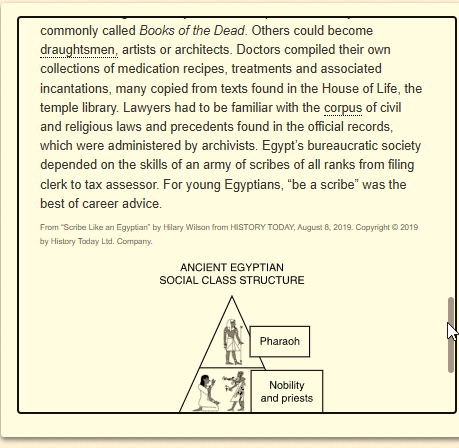
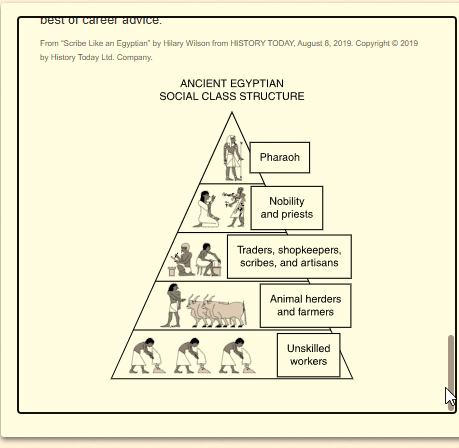
A schoolboy “dictionary” of hieroglyphs with their hieratic equivalents shows that a knowledge of more than 450 signs was required for everyday writing purposes. Lessons in record-keeping and filing and labelling enabled any half-competent scribe to perform that most essential of all scribal functions: the making and updating of lists. For professions such as those of government official, priest or lawyer, a scribe would train for several more years, increasing his vocabulary to perhaps a thousand or more signs. Those with the best handwriting or drawing skills might follow the craft of creating beautifully illustrated copies of funerary texts, commonly called Books of the Dead. Others could become draughtsmen, artists or architects. Doctors compiled their own collections of medication recipes, treatments and associated incantations, many copied from texts found in the House of Life, the temple library. Lawyers had to be familiar with the corpus of civil and religious laws and precedents found in the official records, which were administered by archivists. Egypt’s bureaucratic society depended on the skills of an army of scribes of all ranks from filing clerk to tax assessor. For young Egyptians, “be a scribe” was the best of career advice.
From “Scribe Like an Egyptian” by Hilary Wilson from HISTORY TODAY, August 8, 2019. Copyright © 2019 by History Today Ltd. Company.
Question
Hieratic script was particularly valuable in a bureaucratic government because
- Ausing hieratic script was an efficient way for scribes to produce large amounts of documentation.
- Bmany members of the general public could comprehend information that was written in hieratic script.
- Cknowledge of hieratic script prepared scribes to serve their society in increasingly challenging roles.
- Dpeople from different professional backgrounds could easily communicate with one another in hieratic script.
Show the answer
Correct answer: A
The question asks why hieratic script was especially valuable in a bureaucratic government.
A. CORRECT. Hieratic script is described in paragraph 1 as being simpler for the “multitude of everyday documents” generated by the government and as “quicker to write and more economical of space” in paragraph 2. The logical conclusion based on these details is that hieratic script was more efficient for the large amounts of documentation produced by the government.
B. Incorrect. In paragraph 4, the author explains that “education was not available to all,” suggesting that only people who were educated could read and write. The excerpt as a whole does not provide sufficient information to indicate what portion of the general public would be able to comprehend material written in hieratic script.
C. Incorrect. The idea that becoming a scribe could lead to taking different positions in society is addressed in paragraphs 3, 4, and 6. However, the use of hieratic script in the fields of medicine, law, or religion does not necessarily explain the value of the script for the bureaucratic government referenced in the question.
D. Incorrect. Although different professions such as doctors and lawyers used hieratic script, the author uses these professions as examples of different job opportunities for scribes in paragraph 6. There is no discussion in the excerpt about different professions communicating with each other, and these professions were not necessarily part of the bureaucratic government.
Question analysis
This inference question on “Scribe Like an Egyptian” asks why hieratic, one of the two scripts of ancient Egypt, was especially valuable to a bureaucratic government. The article never gives the reason in a single sentence, so students must connect what it says about Egypt’s bureaucracy with what it says about the script itself. Each choice offers a reasonable-sounding benefit.
- Grade level
- Grade 7 reading and task
- Compared with grade 7
- At grade 7 Drawing a conclusion from two neighboring paragraphs is typical grade 7 inference work. The word “bureaucratic” and the article’s formal style add some load, but the details needed are close together and plainly stated.
- Estimated difficulty
- Straightforward: two steps or one careful reading.
- Thinking it demands
- Depth of knowledge 2, skills and concepts · mainly understand
- What makes it hard
- Evidence in several places minor
- Hard words minor
- Reading between the lines minor
- Evidence
- Answered from several paragraphs or stanzas
- Reading level
- Passage: about grade 12, 755 words; question and choices: about grade 13, 68 words.
- Students, last 30 days
- Not enough answers yet to show (it takes 10).
Why it is hard, traps and wrong answers (shows the answer)
Why it is hard
The two facts that answer the question sit a few lines apart in the first two paragraphs, so the work is mostly connecting them. The wrong reasons all sound like advantages a simpler script might bring, public readability, career preparation, communication across professions, and each rests on a guess or on the excerpt’s talk of scribal careers rather than on what it says hieratic was used for. Students who return to the description of hieratic itself avoid them.
Evidence in several places minor Working it out
The reason is split between paragraph 1, where hieratic serves the “multitude of everyday documents,” and paragraph 2, where it is “quicker to write and more economical of space.” (Kirsch & Mosenthal, 1990; Gorin & Embretson, 2006)
Hard words minor Understanding the question
The stem turns on “bureaucratic,” a word students must connect to a government that runs on paperwork; without it, the link to large amounts of documentation is hard to see. (Perfetti, 2007; Freedle & Kostin, 1993)
Reading between the lines minor Working it out
No sentence says why hieratic helped the government; students must combine speed and compactness with the sheer volume of records to reach efficiency. (Graesser, Singer & Trabasso, 1994; Kintsch, 1998)
Strategy: Find the sentences that describe hieratic script and what it was used for, then pick the choice those sentences support rather than one that only sounds like an advantage.
Traps
- Reads too much in: A reasonable-sounding conclusion that goes further than the text allows.
- True but not the answer: A choice says something accurate about the text that does not answer this question.
- Outside knowledge: A choice is plausible in the real world but not supported by this text.
The wrong answers, classified
B Reads too much in (Graesser, Singer & Trabasso, 1994)
Reasons that a simpler script must have been readable by ordinary people, though paragraph 4 says “education was not available to all” and the excerpt never says the public read hieratic.
C True but not the answer (King et al., 2004; Embretson & Wetzel, 1987)
Recalls the careers in paragraphs 3 and 6 that schooling opened to scribes, which is true of the excerpt but explains a scribe’s prospects, not why the government valued hieratic.
D Outside knowledge (King et al., 2004; Recht & Leslie, 1988)
Imagines hieratic as a shared language linking doctors, lawyers and officials, a sensible-sounding benefit the excerpt never raises; paragraph 6 names those professions only as careers for scribes.
Working it out, step by step
Figure out what the question asks
This asks why hieratic script was so useful to a bureaucratic government. A bureaucracy is a government run by many officials, with lots of paperwork. Hieratic is the quick, simple form of Egyptian writing. Look for what the article says about hieratic and what it was used for.
Find the evidence in paragraphs 1 and 2
Paragraph 1 says many scribes used hieratic for the “multitude of everyday documents” that the government produced. Multitude means a huge number. Paragraph 2 says hieratic was “quicker to write and more economical of space.” Economical of space means it took up less room on the page.
Connect the two facts
Put the facts together. The government made a huge number of papers. Hieratic was fast to write and used less space. So scribes could turn out lots of papers quickly. Getting a lot done with little time and effort is called being efficient.
Check each choice
- A fits. Hieratic let scribes make large amounts of paperwork quickly.
- B does not fit. Paragraph 4 says “education was not available to all.” The article never says ordinary people could read hieratic.
- C does not fit. Training did lead to careers, but that explains a scribe’s chances, not why the government valued the script.
- D does not fit. Paragraph 6 lists jobs like doctor and lawyer as careers for scribes. It never says those workers wrote to each other in hieratic.
Watch out: B sounds sensible, since a simpler script seems easier for anyone to read. But that is a guess, not something the article says.
Choose the answer
Hieratic was fast and compact, and the government needed a huge number of documents. So the answer is A.
Why this answer and not the closest wrong one
B is the closest wrong choice, because a simpler script does sound easier to read. But the article says only some Egyptians got an education. It never says the public could read hieratic. A rests on two facts the article states: the government made a “multitude of everyday documents,” and hieratic was quicker to write.
More questions like this
The original DOE question
The passage “Excerpt from “Scribe Like an Egyptian”” as shown on the test