Question
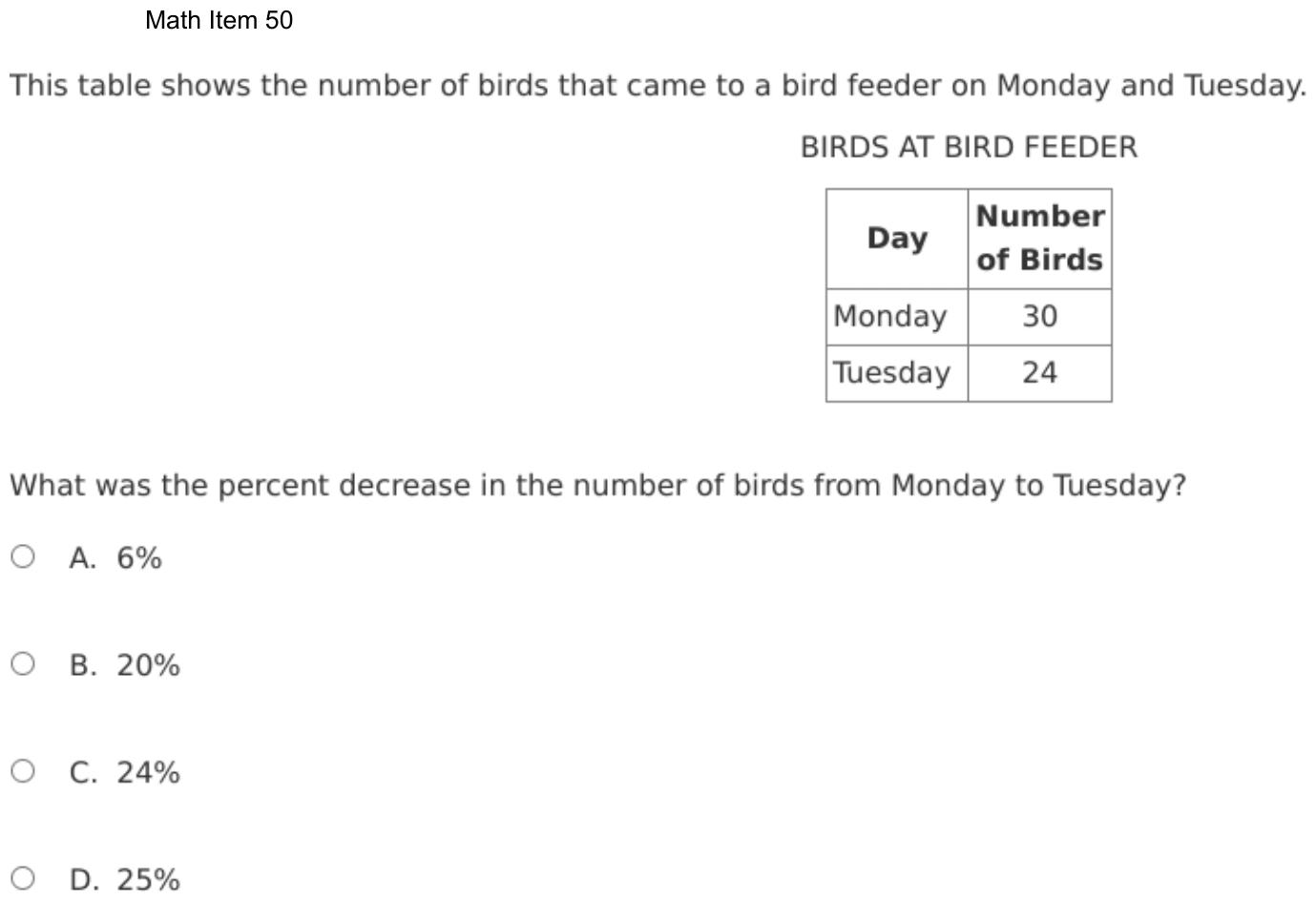
This table shows the number of birds that came to a bird feeder on Monday and Tuesday.
BIRDS AT BIRD FEEDER
| Day | Number of Birds |
|---|---|
| Monday | 30 |
| Tuesday | 24 |
What was the percent decrease in the number of birds from Monday to Tuesday?
- A6%
- B20%
- C24%
- D25%
Show the answer
Correct answer: B
To determine the percent decrease from Monday to Tuesday, first calculate the decrease in the number of birds at the feeder.
The difference in the number of birds at the feeder divided by the number of birds on Monday will yield the percent decrease from Monday to Tuesday.
0.20 represents 20%.
There was a 20% decrease from Monday to Tuesday.
Question analysis
A table shows that 30 birds came to a bird feeder on Monday and 24 on Tuesday. This percent change question asks for the percent decrease from Monday to Tuesday. Students find the change and compare it with one day's count, and choosing the right day as the base decides the result.
- NYS standards
- 7.RP.3 multistep ratio and percent problems
- Grade level
- Grade 7 content, by NYS standard
- Compared with grade 7
- At grade 7 Percent decrease is core grade 7 work, and this is a plain example: one subtraction and one division with friendly numbers. The only real demand is measuring the change against the right day's count.
- Estimated difficulty
- Straightforward: two steps or one careful reading.
- Thinking it demands
- Depth of knowledge 2, skills and concepts · mainly apply
- What makes it hard
- Solution
- 2 steps
- Reading level
- Question and choices: about grade 3, 40 words.
- Students, last 30 days
- Not enough answers yet to show (it takes 10).
Why it is hard, traps and wrong answers (shows the answer)
Why it is hard
The subtraction is trivial, so the question is about the base. Both counts sit in the table, and dividing by the later one gives an equally neat percent that is easy to accept. Saying “a decrease from Monday” and putting Monday’s 30 under the change avoids it, and checking that 20% of 30 is 6 confirms the result.
A very close wrong answer minor Choosing the answer
Dividing the drop of 6 by Monday’s 30 gives 20% and by Tuesday’s 24 gives 25%, two round, listed percents only 5 points apart, so only the choice of base separates them. (Embretson & Wetzel, 1987; Gorin & Embretson, 2006; Ascalon et al., 2007)
Something you must already know minor Working it out
Students must know that a percent decrease is the change divided by the starting amount, here Monday’s count, a rule the question does not state. (Anderson & Krathwohl, 2001)
Strategy: Subtract to find how many fewer birds came on Tuesday, divide by Monday's count, the starting amount, and change the fraction to a percent.
Traps
- Percent of the wrong amount: Finding the whole from a part, or a percent change measured from the wrong starting amount.
- Misunderstands the concept: A wrong belief about a concept: that percents can be added, that area grows like length, that averages can be averaged, that a bigger denominator means a bigger fraction.
- Numbers taken from the question: Combines the numbers in the question without a model of the situation, or is simply a number that appears in the question.
The wrong answers, classified
A Misunderstands the concept (Smith, diSessa & Roschelle, 1993; De Bock et al., 1998; Ni & Zhou, 2005)
Finds the decrease of 6 birds and reads it as 6 percent, as if the count had dropped from 100 rather than from 30.
C Numbers taken from the question (Hegarty, Mayer & Monk, 1995)
Reads Tuesday’s 24 birds as a percent, taking a number straight from the table without working out the change at all.
D Percent of the wrong amount (Parker & Leinhardt, 1995)
Divides the decrease of 6 by Tuesday’s 24 birds instead of Monday’s 30, measuring the change from the later day: 6/24 = 25%.
Worked solution, step by step
Formulas used
- Percent decrease
- Old is the starting amount, here Monday’s count. New is the later amount, Tuesday’s count. The top is how much it dropped. You divide by the starting amount because a change is measured from where you started.
Sort out the question
The table shows 30 birds on Monday and 24 birds on Tuesday. You need the percent decrease from Monday to Tuesday. From Monday means Monday is the starting amount.
Find the drop
Subtract Tuesday’s count from Monday’s:
There were 6 fewer birds.
Watch out: 6 is a number of birds, not a percent. Calling it 6% leads to choice A.
Compare the drop with Monday
Use the formula. Divide the drop by Monday’s count, then multiply by 100:
The number of birds went down by 20%.
Watch out: dividing by Tuesday’s 24 gives , or 25%, choice D. Measure the change from the starting day. Choice C, 24%, just copies a number from the table.
So the answer is B, 20%.
Check your answer
Take 20% of Monday’s count: . Then , which is Tuesday’s count. The answer checks out.
More questions like this
The original DOE question