Question
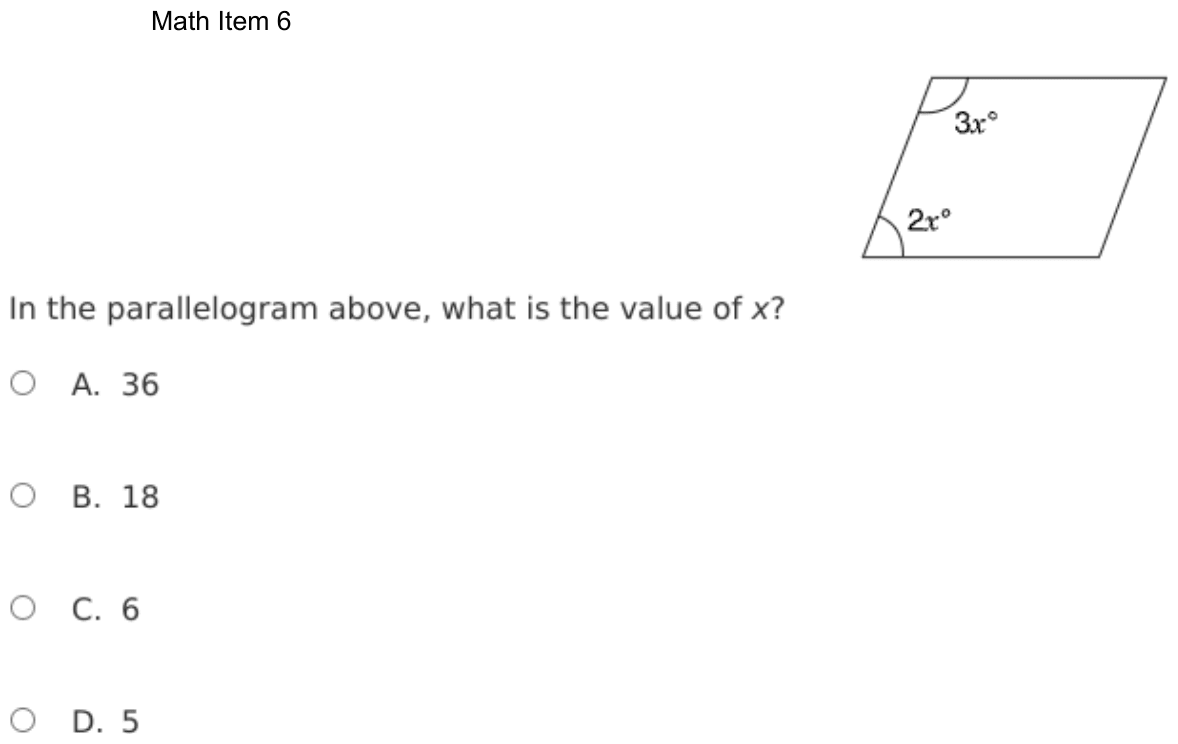
In the parallelogram above, what is the value of x?
- A36
- B18
- C6
- D5
Show the answer
Correct answer: A
In a parallelogram, any two adjacent angles are supplementary, so the sum of the two given angles is equal to 180°.
Write an equation showing that the sum of and is equal to 180°:
Solve for x:
Question analysis
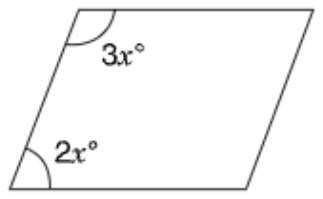
A parallelogram is drawn with the two angles at the ends of its left side labeled 3x° and 2x°, and students find the value of x. It tests the angle facts of a parallelogram and solving a simple equation. Knowing what the two angles must add up to is the key fact, since the figure gives no other number.
- NYS standards
- Grade level
- Grade 8 content, by NYS standard
- Compared with grade 7
- At grade 7 The angle fact needed, about consecutive angles of a parallelogram, rests on grade 8 parallel-line reasoning. Once it is known, the work is one short equation, like a typical grade 7 problem about angle sums.
- Estimated difficulty
- Straightforward: two steps or one careful reading.
- Thinking it demands
- Depth of knowledge 2, skills and concepts · mainly apply
- What makes it hard
- Solution
- 2 steps
- Reading level
- Question and choices: about grade 7, 10 words.
- Students, last 30 days
- Not enough answers yet to show (it takes 10).
Why it is hard, traps and wrong answers (shows the answer)
Why it is hard
Once the angle fact is in place, 5x = 180 is a one-line equation, so the question tests recall more than computation. Students who use 90° for the pair land on half the right value, and the two smallest choices come only from combining the labels' 3 and 2. A sense check helps: x = 36 makes the angles 108° and 72°, one obtuse and one acute, just as the drawing shows.
Something you must already know moderate Working it out
The figure gives no number of degrees, only 3x° and 2x°, so everything rests on recalling that the two angles at the ends of one side of a parallelogram add to 180°. (Anderson & Krathwohl, 2001)
Reading a figure, table or graph minor Understanding the question
The marked angles sit at the upper and lower ends of the left side, consecutive rather than opposite, which is what makes them supplementary instead of equal. (Lesh, Post & Behr, 1987; Kirsch & Mosenthal, 1990)
Strategy: Decide what two angles that share a side of a parallelogram add up to, set 3x + 2x equal to that total, solve for x, and check that the two angles fit the figure.
Traps
- Wrong formula: Uses a related but wrong formula: perimeter for area, diameter for radius, area for volume, or a misremembered one.
- Stops one step early: A choice is a number from partway through the solution.
- Numbers taken from the question: Combines the numbers in the question without a model of the situation, or is simply a number that appears in the question.
The wrong answers, classified
B Wrong formula (King et al., 2004)
Uses 90° as the total of the two angles, the complementary total, so 5x = 90 gives 18, though consecutive angles of a parallelogram add to 180°.
C Numbers taken from the question (Hegarty, Mayer & Monk, 1995)
Multiplies the two coefficients from the labels, 3 × 2 = 6, without using any angle fact or writing an equation.
D Stops one step early (King et al., 2004; Gierl et al., 2017)
Combines 3x + 2x into 5x and gives the coefficient 5, stopping before dividing the 180° total by it.
Worked solution, step by step
Formulas used
- Neighboring angles of a parallelogram
- a and b are two angles of a parallelogram that share a side, like the top left and bottom left angles. They always add to 180°. Here is why. The four angles add to 360°, and opposite angles are equal. So each pair of neighbors is half of 360°.
Sort out the question
The figure is a parallelogram. That is a four-sided shape whose opposite sides are parallel, so they never meet. Two angles are marked: 3x° at the upper left and 2x° at the lower left. You need the value of x.
Write an equation for the angles
The two marked angles are at the two ends of the left side. So they are neighbors, not opposite angles. Use the rule that neighbors add to 180°:
Watch out: the total is 180°, not 90°. Using 90 gives 5x = 90 and x = 18, choice B.
Solve for x
Three x’s plus two x’s make five x’s:
Divide both sides by 5 to get x alone:
Watch out: stopping at 5, the number in front of x, gives choice D. Multiplying 3 × 2 = 6 gives choice C, but that uses no angle fact.
Choose the answer
The value of x is 36. It is a number, not the size of an angle. The angles themselves are 3 × 36 and 2 × 36 degrees.
So the answer is A, 36.
Check your answer
Find the two angles. The top one is degrees. The bottom one is degrees. They add to 180°. In the figure, the top angle is wide, more than 90°. The bottom one is narrow, less than 90°. That matches.
More questions like this
The original DOE question