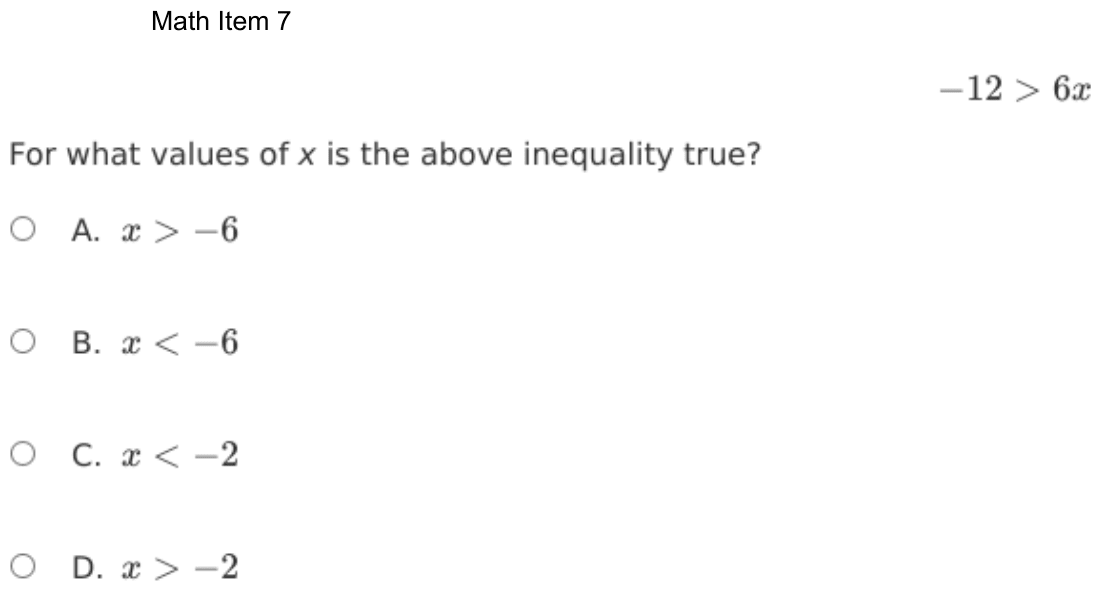
Question
For what values of x is the above inequality true?
- A
- B
- C
- D
Show the answer
Correct answer: C
Divide to solve for x:
Rewriting with the x term first requires reversing the inequality symbol in order to keep the meaning “x is less than ”.
Question analysis
This inequality question asks which values of x make −12 > 6x true. Students solve a one-step inequality by dividing and then state the solution with x written first. A negative number on one side and the variable on the other make the direction of the symbol the main thing to get right.
- Grade level
- Grade 7 content, by NYS standard
- Compared with grade 7
- Below grade 7 Grade 7 inequalities usually take two steps, such as 3x + 4 > 19. This one needs a single division, and the care goes into reading the result correctly when the variable ends up on the right of the symbol.
- Estimated difficulty
- Straightforward: two steps or one careful reading.
- Thinking it demands
- Depth of knowledge 1, recall and reproduction · mainly apply
- What makes it hard
- A very close wrong answer moderate
- Something you must already know minor
- Solution
- 2 steps
- Reading level
- Question and choices: about grade 10, 15 words.
- Students, last 30 days
- Not enough answers yet to show (it takes 10).
Why it is hard, traps and wrong answers (shows the answer)
Why it is hard
One division finds the boundary, so the question is really about direction. Two things pull students the wrong way: the −12 on the left makes the inequality look like one that must be flipped, and the result −2 > x has x on the right, where it is easy to read backward. Testing x = −3, which gives −12 > −18, shows that values below −2 work.
A very close wrong answer moderate Choosing the answer
x < −2 and x > −2 share the boundary −2 and differ only in direction, so finding the right number settles nothing until the direction is read correctly. (Embretson & Wetzel, 1987; Gorin & Embretson, 2006; Ascalon et al., 2007)
Something you must already know minor Working it out
Students must know that the symbol flips only when both sides are multiplied or divided by a negative number, and that −2 > x says the same as x < −2. (Anderson & Krathwohl, 2001)
Strategy: Divide both sides by 6, asking whether you divided by a negative number, then rewrite the result with x on the left so that the symbol still opens toward the larger side.
Traps
- Negatives and direction: Arithmetic with negative numbers, the order of a subtraction, or direction on a number line. (Moving a term across the equals sign without changing its sign is a faulty procedure.)
- Wrong operation: Adds instead of multiplying, divides the wrong way round, turns a ratio or rate upside down, or undoes a step in the wrong direction (subtracts what should be added back).
The wrong answers, classified
A Wrong operation (Hegarty, Mayer & Monk, 1995; King et al., 2004)
Adds 6 to −12 instead of dividing by 6, getting −6, and also reverses the direction, so both the boundary and the symbol are wrong.
B Wrong operation (Hegarty, Mayer & Monk, 1995; King et al., 2004)
Undoes the 6 by adding it to −12 rather than dividing, as if 6x meant x − 6, getting −6 > x and so x < −6.
D Negatives and direction (Brown & Burton, 1978)
Finds −2 > x but flips the symbol because −12 is negative, or reads −2 > x as x > −2, though dividing by a positive 6 keeps the direction.
Worked solution, step by step
Formulas used
- Dividing both sides of an inequality
- a and b are the two sides of an inequality, and c is the number you divide by. If c is positive, the symbol stays the same. It flips only when you multiply or divide both sides by a negative number. Here c is 6, which is positive.
- Reading an inequality the other way
- a and b are any two numbers. Saying a is greater than b is the same as saying b is less than a. When you swap the two sides, turn the symbol around. Its point still aims at the smaller number.
Sort out the question
The inequality is . The symbol > means is greater than. So it says −12 is greater than 6 times x. You need every value of x that makes this true.
Divide both sides by 6
To get x alone, divide both sides by 6:
You divided by 6, which is positive. So the symbol does not flip.
Watch out: −12 is negative, but that does not matter. Only dividing by a negative number flips the symbol.
Put x first
says −2 is greater than x. That means x is less than −2. Swap the sides and turn the symbol around:
Watch out: keeping > when you swap the sides gives choice D, . That is the opposite meaning.
Choose the answer
Choices A and B use −6. That comes from adding 6 to −12 instead of dividing by 6. The right boundary is −2, and x is below it.
So the answer is C, .
Check your answer
Test a number below −2, such as −3. Then , and is true. Now test 0, which is above −2. Then , and is false. So only numbers below −2 work.
More questions like this
The original DOE question