Question
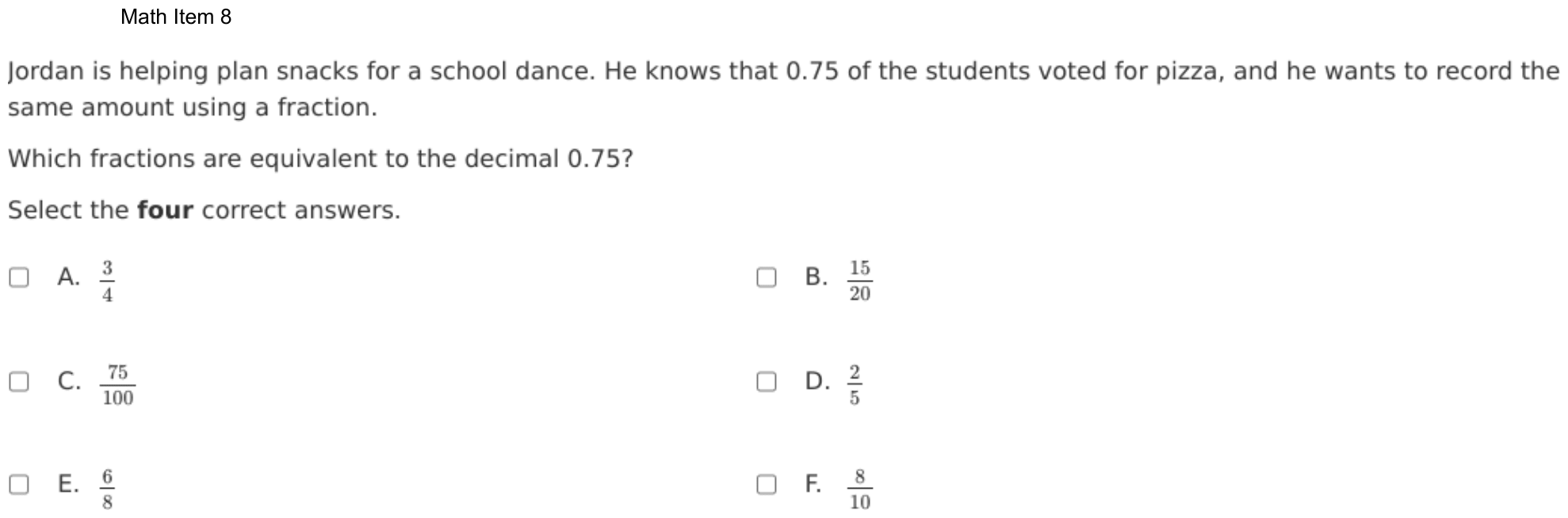
Jordan is helping plan snacks for a school dance. He knows that 0.75 of the students voted for pizza, and he wants to record the same amount using a fraction.
Which fractions are equivalent to the decimal 0.75?
Select the four correct answers.
Choose every answer that is correct, then check. The DOE has not published how answers with several parts are scored; this site counts one right only when every part is right.
- A
- B
- C
- D
- E
- F
Show the answer
Correct answer: A, B, C, and E
Check each fraction to determine whether it is equal to 0.75 when simplified or converted to a decimal.
This is the most common fraction equal to 0.75.
Simplifies to 3/4, because 15 and 20 can both be divided by 5.
This is a direct match to 0.75 when written as a decimal.
, which is less than 0.75.
Simplifies to because both 6 and 8 can be divided by 2.
, which is more than 0.75.
Question analysis
Jordan wants to record 0.75 of the students' pizza votes as a fraction, and students select the four fractions, out of six, that equal 0.75. It tests converting between decimals and fractions and recognizing equivalent fractions. Each choice has to be checked by its value, not by how its numbers look.
- NYS standards
- 7.NS.2d fractions to decimals by long division
- Grade level
- Grade 7 content, by NYS standard
- Compared with grade 7
- Below grade 7 Matching fractions to a decimal such as 0.75 builds on grade 4 to 6 work, and the denominators here divide easily. The added demand is the format: four of the six must be chosen, and one wrong or missing pick loses the item.
- Estimated difficulty
- Straightforward: two steps or one careful reading.
- Thinking it demands
- Depth of knowledge 1, recall and reproduction · mainly apply
- What makes it hard
- Every choice must be checked moderate
- A very close wrong answer minor
- Much to keep track of minor
- Solution
- 2 steps
- Reading level
- Question and choices: about grade 5, 47 words.
- Students, last 30 days
- Not enough answers yet to show (it takes 10).
Why it is hard, traps and wrong answers (shows the answer)
Why it is hard
Three of the four right fractions, 3/4, 75/100 and 6/8, are familiar forms of 0.75, so the item comes down to the fourth. Students who stop after the familiar ones must decide between 15/20, which needs dividing by 5 to recognize, and 8/10, which sits close to 0.75 on a number line. Dividing each numerator by its denominator, or scaling 3/4 up by 5, settles it.
Every choice must be checked moderate Choosing the answer
Six fractions with six different denominators have to be tested one by one, by dividing or by simplifying, since 15/20 and 8/10 cannot be judged by how they look. (Embretson & Wetzel, 1987)
A very close wrong answer minor Choosing the answer
8/10 is 0.8, only 0.05 above 0.75, and it follows 6/8 by adding 2 to the top and the bottom, so it looks like one more member of the family. (Embretson & Wetzel, 1987; Gorin & Embretson, 2006; Ascalon et al., 2007)
Much to keep track of minor Working it out
Four of the six must be chosen and all four must be right for the item to count, so each verdict has to be kept while the remaining fractions are tested. (Sweller, 1988; Carpenter, Just & Shell, 1990)
Strategy: Turn each choice into a decimal by dividing its numerator by its denominator, or reduce it to lowest terms, and keep only the ones whose value is exactly the decimal given.
Traps
- Misunderstands the concept: A wrong belief about a concept: that percents can be added, that area grows like length, that averages can be averaged, that a bigger denominator means a bigger fraction.
The wrong answers, classified
D Little reason to choose it (Haladyna & Downing, 1993; Rodriguez, 2005)
No usual working links 2/5 to 0.75, since 2 ÷ 5 = 0.4, so it mostly catches students filling the fourth slot by guessing.
F Misunderstands the concept (Smith, diSessa & Roschelle, 1993; De Bock et al., 1998; Ni & Zhou, 2005)
Builds 8/10 from 6/8 by adding 2 to the top and the bottom, as if equal additions kept a fraction's value, or accepts 0.8 as close enough.
Worked solution, step by step
Formulas used
- Changing a fraction to a decimal
- a is the numerator, the top. b is the denominator, the bottom. A fraction bar means divide. So dividing the top by the bottom gives the fraction’s value as a decimal.
- Equivalent fractions
- a is the top and b is the bottom. n is a number that goes evenly into both. Dividing the top and the bottom by the same number gives an equal fraction. Equivalent fractions name the same amount in different ways.
Sort out the question
Six fractions are given, A to F. You need the four that equal the decimal 0.75. Equivalent means equal in value. Test every choice, because some fractions look alike but are not equal.
Write 0.75 as a fraction
0.75 means 75 hundredths:
So choice C works. Now simplify it. 25 goes into both 75 and 100:
So choice A, 3/4, works too.
Test choices B and E
Simplify each one to see if it becomes 3/4:
- B: 5 goes into 15 and 20. . It works.
- E: 2 goes into 6 and 8. . It works.
Test choices D and F
Divide the top by the bottom:
- D: . That is less than 0.75.
- F: . That is more than 0.75.
Watch out: F looks like 6/8 with 2 added to the top and the bottom. Adding the same number to both changes the value. Only multiplying or dividing both keeps it.
Name the four answers
A, B, C and E all equal 0.75. On the test, you check the box beside each of them. On this site, you choose all four, then check your answer.
So the answers are A, B, C and E.
Check your answer
Turn each answer into a decimal. , , and all give 0.75. Exactly four choices passed, and the question asks for four. So none were missed.
More questions like this
The original DOE question