Question
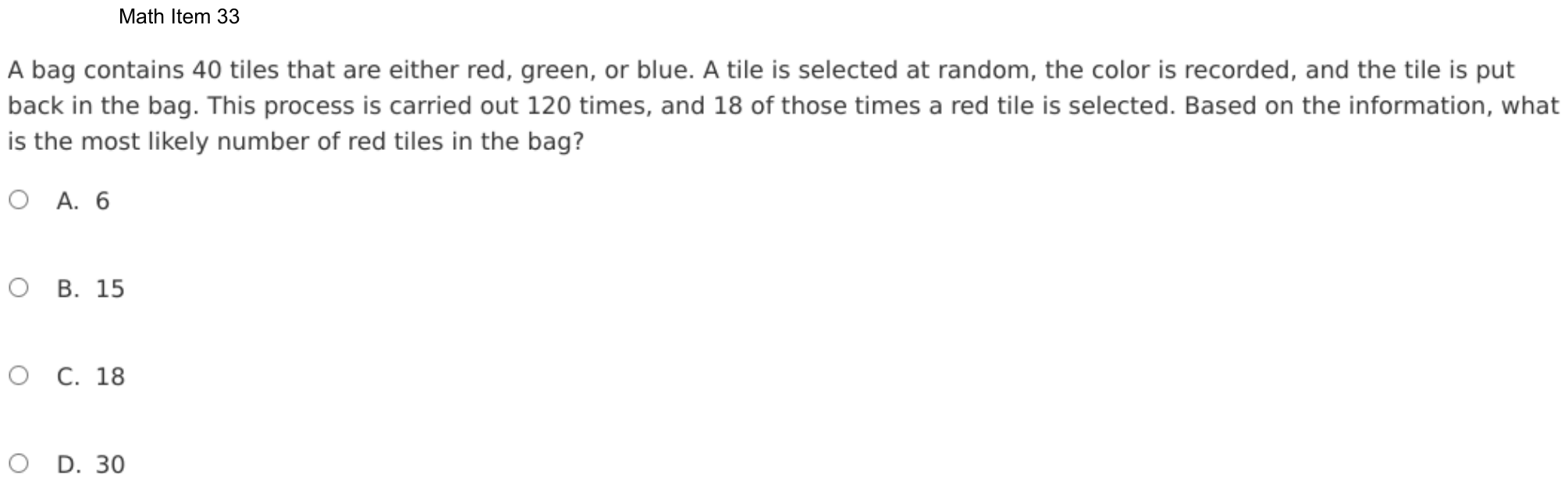
A bag contains 40 tiles that are either red, green, or blue. A tile is selected at random, the color is recorded, and the tile is put back in the bag. This process is carried out 120 times, and 18 of those times a red tile is selected. Based on the information, what is the most likely number of red tiles in the bag?
- A6
- B15
- C18
- D30
Show the answer
Correct answer: A
First, determine what fraction of the sample were red tiles, given 18 of the 120 tiles drawn were red.
To predict how many of the actual 40 tiles in the bag are red, multiply 40 by the fraction of red tiles in the sample.
Question analysis
A bag holds 40 red, green and blue tiles, and a tile is drawn and put back 120 times, with red coming up 18 times. Students predict the most likely number of red tiles in the bag. It tests using experimental results to estimate what is in the bag, and the draws outnumber the tiles, which can confuse the scaling.
- Grade level
- Grade 6 content, by NYS standard
- Compared with grade 7
- At grade 7 Predicting from repeated trials is grade 6 probability, and grade 7 students make similar estimates from samples. The twist is scaling down, from 120 draws to a bag of 40 tiles, rather than up to a larger group.
- Estimated difficulty
- Straightforward: two steps or one careful reading.
- Thinking it demands
- Depth of knowledge 2, skills and concepts · mainly apply
- What makes it hard
- Solution
- 2 steps
- Reading level
- Question and choices: about grade 6, 61 words.
- Students, last 30 days
- Not enough answers yet to show (it takes 10).
Why it is hard, traps and wrong answers (shows the answer)
Why it is hard
There are more draws than tiles, which is what makes this unusual: the 120 draws must be scaled down to a bag of 40, not up to a bigger group. Red came up 18 times because each tile went back in the bag, so 18 is not a count of red tiles. Since there are three draws for every tile, dividing the 18 red draws by 3 gives the same estimate as taking 3/20 of 40.
Turning words into math minor Understanding the question
The 18 red draws come from 120 draws with the tile put back each time, so they give a share, 3/20, to take of the 40 tiles, not a count of red tiles. (Hegarty, Mayer & Monk, 1995; Koedinger & Nathan, 2004)
Something you must already know minor Working it out
Students must know that the share of red in repeated draws estimates the share of red tiles in the bag; the stem never says to multiply 40 by that share. (Anderson & Krathwohl, 2001)
Strategy: Write the red draws as a fraction of all 120 draws, simplify it, and take that same fraction of the 40 tiles in the bag.
Traps
- Stops one step early: A choice is a number from partway through the solution.
- Numbers taken from the question: Combines the numbers in the question without a model of the situation, or is simply a number that appears in the question.
The wrong answers, classified
B Stops one step early (King et al., 2004; Gierl et al., 2017)
Finds that red came up in 18 of 120 draws, or 15%, and gives 15 as the count, stopping before taking that share of the 40 tiles.
C Numbers taken from the question (Hegarty, Mayer & Monk, 1995)
Gives 18, the number of times red was drawn, as the number of red tiles, though each tile went back and could be drawn many times.
D Little reason to choose it (Haladyna & Downing, 1993; Rodriguez, 2005)
No working from 18 red draws in 120 gives 30 red tiles, three quarters of the bag, when red came up in fewer than one draw in six.
Worked solution, step by step
Formulas used
- Predicting from repeated draws
- The fraction is the share of draws that came up red. That share is your best guess for the share of tiles that are red. Multiply it by the number of tiles in the bag to predict the red tiles. The sign ≈ means about equal.
Sort out the question
The bag has 40 tiles, each red, green or blue. A tile is drawn, its color is written down, and it goes back in the bag. This happens 120 times, and red comes up 18 times.
You need the most likely number of red tiles in the bag.
See why 18 is not the answer
Each tile goes back in the bag after it is drawn. So the same red tile can be drawn again and again. That means 18 counts draws, not tiles.
Watch out: choice C, 18, mixes up the number of red draws with the number of red tiles.
Find the share of red draws
Red came up 18 times out of 120. Simplify by dividing the top and bottom by 6:
As a decimal, that is 0.15, or 15%.
Watch out: 15 is a percent here, not a number of tiles. Stopping now gives choice B.
Take that share of the bag
Use the same share of the 40 tiles in the bag:
So about 6 of the 40 tiles are red.
Give the answer
The best prediction is 6 red tiles. The other 34 tiles are probably green or blue.
So the answer is A, 6.
Check your answer
There were 120 draws for 40 tiles. That is 3 draws for every tile. So divide the red draws by 3: . Same answer. Choice D, 30 red tiles, would be three quarters of the bag. Then red would come up far more than 18 times.
More questions like this
The original DOE question