Question
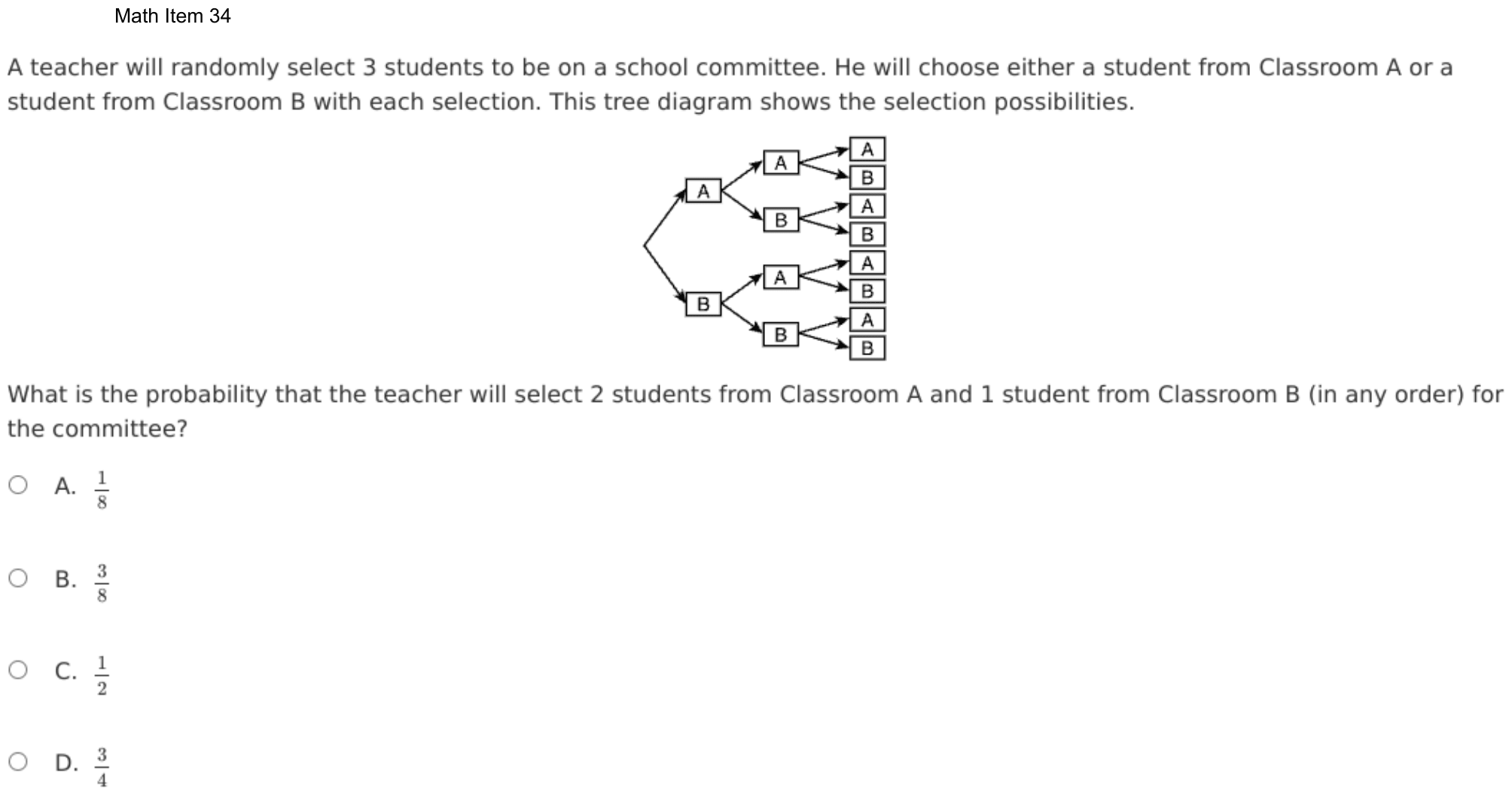
A teacher will randomly select 3 students to be on a school committee. He will choose either a student from Classroom A or a student from Classroom B with each selection. This tree diagram shows the selection possibilities.
What is the probability that the teacher will select 2 students from Classroom A and 1 student from Classroom B (in any order) for the committee?
- A
- B
- C
- D
Show the answer
Correct answer: B
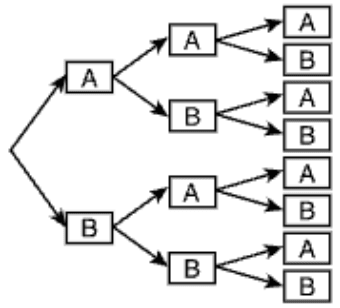
The tree diagram shows that each of the 3 randomly selected students is from Classroom A or Classroom B. So the first chosen is either A or B, represented by the left column of the diagram.
The second student is either A or B, so if the first is A, the first two chosen will be either AA or AB. If the first is B, then the first two chosen will be either BA or BB, represented by the middle column.
The third student is either A or B, so if the first 2 were AA, the group of 3 would be either AAA or AAB. These outcomes are represented by the top two boxes of the right column. This pattern is followed so that 8 distinct outcomes can be visualized in order:
AAA, AAB, ABA, ABB, BAA, BAB, BBA, BBB
Since the order does not matter, there are 3 groups made up of 2 students from Classroom A and 1 student from Classroom B: AAB, ABA, and BAA.
Out of 8 possible outcomes, 3 outcomes have 2 students from Classroom A and 1 student from Classroom B. Therefore, the probability is 3 out of 8, or .
Question analysis
A teacher picks 3 students for a committee, each from Classroom A or Classroom B, and a tree diagram shows every possible sequence of picks. Students find the probability of getting 2 students from A and 1 from B in any order. Reading the tree as a list of outcomes, and counting each order, is the key.
- NYS standards
- Grade level
- Grade 7 content, by NYS standard
- Compared with grade 7
- At grade 7 Finding a compound probability from a tree diagram is a grade 7 standard, and here the tree is already drawn. Listing its paths and counting the ones that fit the event, in any order, is typical grade 7 classwork.
- Estimated difficulty
- Straightforward: two steps or one careful reading.
- Thinking it demands
- Depth of knowledge 2, skills and concepts · mainly apply
- What makes it hard
- Reading a figure, table or graph moderate
- Much to keep track of minor
- Solution
- 3 steps
- Reading level
- Question and choices: about grade 7, 65 words.
- Students, last 30 days
- Not enough answers yet to show (it takes 10).
Why it is hard, traps and wrong answers (shows the answer)
Why it is hard
The tree does the hard part of the setup, but it shows each outcome only as a path through three columns, not as a list. The parenthesis “in any order” is the key phrase: missing it leaves a single path, while reading the event loosely, as at least two from Classroom A, adds A, A, A. Writing out all eight paths and marking those with exactly two A’s settles the count.
Reading a figure, table or graph moderate Understanding the question
The tree prints only A or B in each box, so the eight three-pick outcomes, such as A, B, A, have to be read by tracing each path across all three columns. (Lesh, Post & Behr, 1987; Kirsch & Mosenthal, 1990)
Much to keep track of minor Working it out
All eight paths must be tracked while counting those with exactly two A’s and one B, and “in any order” means three of them count, not just A, A, B. (Sweller, 1988; Carpenter, Just & Shell, 1990)
Strategy: Follow each path through the tree to write out every three-letter outcome, mark the ones with exactly two A's and one B, and divide by the total number of outcomes.
Traps
- Misreads the question: Misses or misreads a condition or a word in the question: "at least", "each", "remaining", "not".
- Answers a different question: A choice is right for another quantity: the other unknown, the rest instead of the part, the part instead of the whole.
The wrong answers, classified
A Misreads the question (Hegarty, Mayer & Monk, 1995)
Counts only the path A, A, B, missing the stem’s “in any order”, so it finds 1 of the 8 outcomes instead of 3.
C Answers a different question (King et al., 2004; Hegarty, Mayer & Monk, 1995)
Counts every outcome with at least two picks from Classroom A, adding A, A, A to the three right paths, so 4 of 8, or 1/2.
D Answers a different question (King et al., 2004; Hegarty, Mayer & Monk, 1995)
Counts every outcome that mixes the two classrooms, including those with two from B, so 6 of the 8 outcomes, or 3/4.
Worked solution, step by step
Formulas used
- Probability
- P is the probability, the chance something happens. The top counts the outcomes that fit the event. The bottom counts every outcome that can happen. This works when every outcome is equally likely, like each path through this tree.
Sort out the question
The teacher picks 3 students, one at a time. Each pick is from Classroom A or Classroom B.
You need the chance of getting 2 students from A and 1 from B. The words “in any order” matter. They mean the B can be the first, second or third pick.
List every path in the tree
Each path from left to right is one outcome, or possible result. The top path is A, then A, then A. Read all of them:
AAA, AAB, ABA, ABB, BAA, BAB, BBA, BBB
Each pick has 2 choices, so there are outcomes in all.
Mark the ones that fit
Look for exactly two A’s and one B. Three outcomes fit: AAB, ABA and BAA.
Watch out: counting only AAB misses “in any order” and gives , choice A. AAA has three A’s, not two. Counting it too gives , choice C. Counting every mixed outcome gives , choice D, but three of those have two B’s.
Find the probability
Use the probability formula. 3 outcomes fit, out of 8:
So the answer is B, .
Check your answer
Count every outcome by type. Two A’s and one B: 3 outcomes. Two B’s and one A: 3 outcomes (ABB, BAB, BBA). All A’s: 1. All B’s: 1. , so each outcome was counted once.
More questions like this
The original DOE question