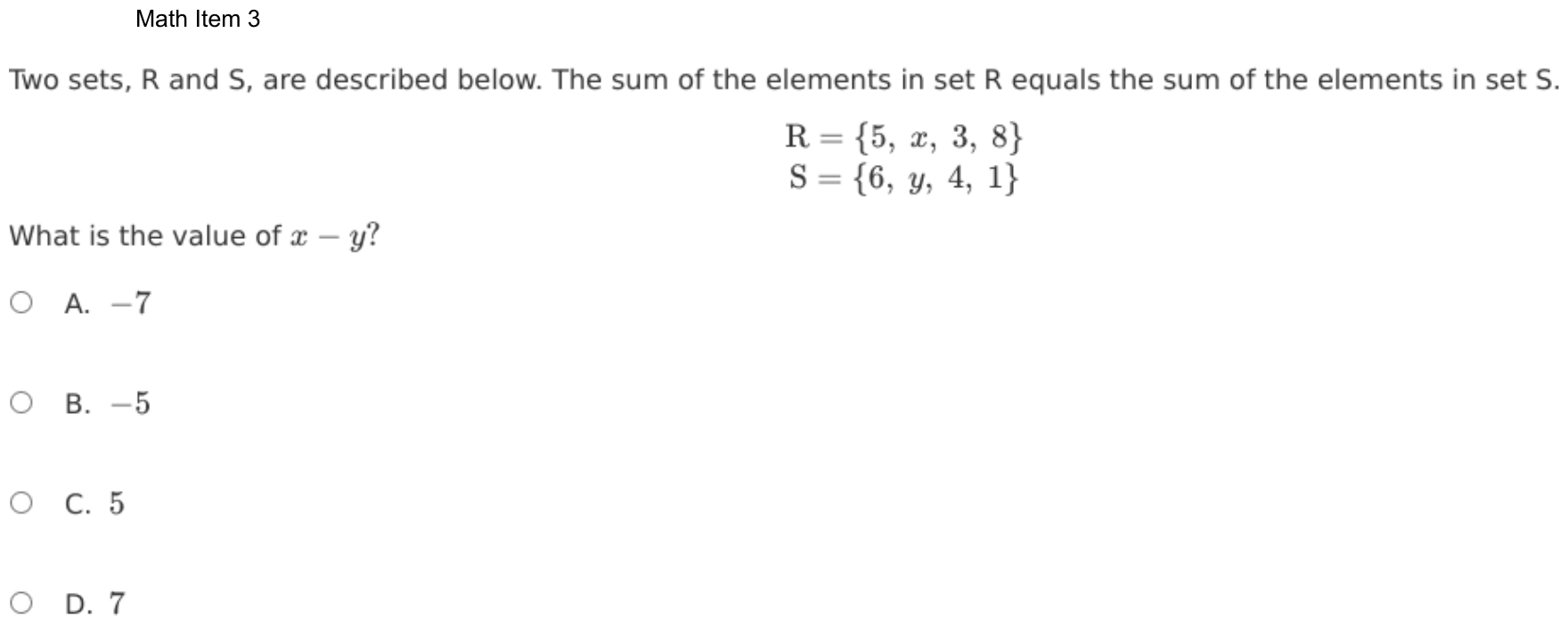
Question
Two sets, R and S, are described below. The sum of the elements in set R equals the sum of the elements in set S.
What is the value of ?
- A−7
- B−5
- C5
- D7
Show the answer
Correct answer: B
First, find the sum for each set by adding the terms in each set separately.
The sum for set R is , which is .
The sum for set S is , which is .
The question states that these two sums are equal to each other, so write the equation and then rearrange using inverse operations.
If the rearranging to obtain the target value is unclear, use the equation and find a few possible values for x and y.
For example, if , then because . If , then because . Then find the value of . No matter which values are chosen, will always be .
Question analysis
Two sets of four numbers, R and S, each contain one unknown, x and y, and the sums of the two sets are equal. Students find the value of x − y without being able to find x or y alone. It tests writing and rearranging an equation, and deciding which way round the difference goes is the tricky part.
- Grade level
- Grade 7 content, by NYS standard
- Compared with grade 7
- At grade 7 Grade 7 students write and solve equations with one unknown. This one has two unknowns that are never found separately; students must rearrange to get their difference, a less familiar goal, though the arithmetic is light.
- Estimated difficulty
- Moderate: several steps, or a close reading with one strong distractor.
- Thinking it demands
- Depth of knowledge 2, skills and concepts · mainly apply
- What makes it hard
- A very close wrong answer moderate
- Variables instead of numbers minor
- Solution
- 3 steps
- Reading level
- Question and choices: about grade 4, 33 words.
- Students, last 30 days
- Not enough answers yet to show (it takes 10).
Why it is hard, traps and wrong answers (shows the answer)
Why it is hard
The sums take seconds; the point is lost on the sign. Because set R's known numbers add to more than set S's, x has to be the smaller unknown, so x − y is negative, but subtracting the two known sums in the order they appear gives a positive 5. Choosing one pair of values that balances the sets, such as x = 1 and y = 6, settles the sign at once.
A very close wrong answer moderate Choosing the answer
The choices pair −5 with 5 and −7 with 7, so the size 5 is easy to reach and only the order of subtraction, x − y rather than y − x, separates the right choice from its opposite. (Embretson & Wetzel, 1987; Gorin & Embretson, 2006; Ascalon et al., 2007)
Variables instead of numbers minor Understanding the question
Neither x nor y can be found, only the gap between them, so students who look for a value of each letter stall; the question rewards rearranging x + 16 = y + 11. (Koedinger & Nathan, 2004; Enright, Morley & Sheehan, 2002)
Strategy: Add the known numbers in each set, set the two sums equal, then move both letters to one side so it reads x − y; testing one pair of values confirms the sign.
Traps
- Negatives and direction: Arithmetic with negative numbers, the order of a subtraction, or direction on a number line. (Moving a term across the equals sign without changing its sign is a faulty procedure.)
The wrong answers, classified
A Little reason to choose it (Haladyna & Downing, 1993; Rodriguez, 2005)
No common working gives −7; it needs a slip in a sum, such as 18 for 5 + 3 + 8, so it mostly draws guesses near −5.
C Negatives and direction (Brown & Burton, 1978)
Subtracts the known sums in the order the sets appear, 16 − 11 = 5, which is y − x, missing that R's larger known sum makes x the smaller unknown.
D Little reason to choose it (Haladyna & Downing, 1993; Rodriguez, 2005)
Needs two unrelated errors, a slip in a sum and the subtraction reversed, so no single line of working reaches 7 and it mostly catches guesses.
Worked solution, step by step
Formulas used
- Doing the same to both sides
- a and b are two equal amounts, and c is any number or letter. Taking the same thing away from both sides keeps them equal. You use it to move terms around until the equation shows what you want.
Sort out the question
Set R holds 5, x, 3 and 8. Set S holds 6, y, 4 and 1. The elements (the members) of R add up to the same total as the elements of S. You cannot find x or y alone. But you can find , the gap between them.
Add up each set
Add the known numbers in each set, and keep the letter:
The two sums are equal, so:
Rearrange to get x − y
You want on one side. Subtract y from both sides:
Then subtract 16 from both sides:
Make sense of the sign
Set R already has 16 from its numbers, but set S has only 11. So y must be 5 more than x to make the sums match. That makes negative.
Watch out: 16 − 11 = 5 is , not . Using it leads to choice C.
So the answer is B, −5.
Check your answer
Try real values. If x = 1, then R adds to 17. So y + 11 = 17, and y = 6. Then . Try x = 10: then y = 15, and 10 − 15 = −5 again.
More questions like this
The original DOE question