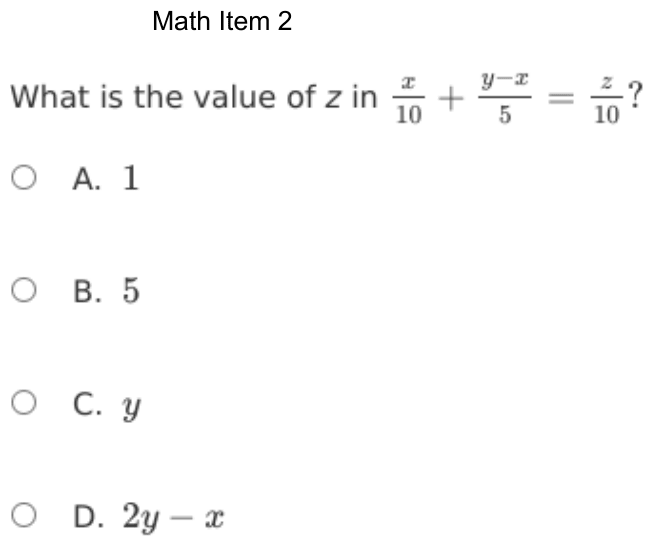
Question
What is the value of z in ?
- A1
- B5
- C
- D
Show the answer
Correct answer: D
First, multiply both sides of the equation by 10 to eliminate the fractions. In other words, multiply each term by 10.
Then, distribute and combine like terms to find the value for z.
Question analysis
This algebra question gives an equation with three letters and fractions, x over 10 plus (y − x) over 5 equals z over 10, and asks for the value of z. Students clear the denominators, distribute and combine like terms. The two fractions on the left have different denominators, which is where the usual slip happens.
- NYS standards
- Grade level
- Grade 7 content, by NYS standard
- Compared with grade 7
- At grade 7 Grade 7 students add and expand linear expressions with fraction coefficients, usually in one letter. Here three letters appear, one numerator is a difference, and the result is an expression rather than a number, which adds abstraction but no new skill.
- Estimated difficulty
- Moderate: several steps, or a close reading with one strong distractor.
- Thinking it demands
- Depth of knowledge 1, recall and reproduction · mainly apply
- What makes it hard
- Variables instead of numbers moderate
- Error-prone arithmetic moderate
- Solution
- 3 steps
- Reading level
- Question and choices: about grade 6, 10 words.
- Students, last 30 days
- Not enough answers yet to show (it takes 10).
Why it is hard, traps and wrong answers (shows the answer)
Why it is hard
The equation has three fractions and three letters, and the work is three routine moves: multiply through by 10, distribute, collect the x terms. Most errors come from the middle term, whose denominator 5 differs from the other two; treating it as tenths makes z simply y. Students who test values should avoid x = y, since that pair makes y and 2y − x agree, and x = y = 1 even makes the number 1 fit.
Variables instead of numbers moderate Understanding the question
The answer is z in terms of x and y, not a number, yet two choices are plain numbers, 1 and 5, which tempt students who expect the equation to give z a single value. (Koedinger & Nathan, 2004; Enright, Morley & Sheehan, 2002)
Error-prone arithmetic moderate Working it out
Clearing the denominators turns (y − x)/5 into 2(y − x), and the −2x from distributing must then combine with the lone x to leave −x, two places where a factor or a sign slips. (Brown & Burton, 1978; Junker & Sijtsma, 2001)
Strategy: Multiply every term on both sides by 10 so no fractions remain, distribute across the parentheses, and combine the x terms; substituting small numbers for x and y checks the result.
Traps
- A faulty procedure: A systematic but wrong procedure: adding fractions straight across, applying an exponent to each term of a sum, dropping a sign when moving a term.
- Numbers taken from the question: Combines the numbers in the question without a model of the situation, or is simply a number that appears in the question.
The wrong answers, classified
A Checks only one number (Schoenfeld, 1985)
Tests x = 1 and y = 1, gets 1/10 + 0 = z/10, so z = 1, and takes the choice that reads 1; any pair with x ≠ y rules it out.
B Numbers taken from the question (Hegarty, Mayer & Monk, 1995)
Expects z to be a number and takes the 5 from the middle denominator, a number copied from the equation rather than the result of any step.
C A faulty procedure (Brown & Burton, 1978; Tatsuoka, 1983)
Adds the numerators x and y − x over 10 as if (y − x)/5 were already in tenths, so the left side becomes y/10 and z = y.
Worked solution, step by step
Formulas used
- Doing the same to both sides
- a and b are the two sides of an equation. Multiplying both sides by the same number keeps them equal, like adding the same weight to both pans of a balance. Here 10 is a good choice, because it clears away every fraction.
- The distributive property
- a is the number outside the parentheses, and b and c are the terms inside. Multiply a by each term inside, and keep the minus sign between them. It works because a groups of (b − c) is a groups of b minus a groups of c.
Sort out the question
The equation has three letters, x, y and z. You need z written using x and y. The answer will not be one number, because x and y can be anything. The fractions make the work messy, so clear them first.
Multiply every term by 10
The bottoms are 10, 5 and 10, and each one divides into 10. So multiply every term by 10:
10 times x/10 is x. Since 10 ÷ 5 = 2, 10 times (y − x)/5 is 2(y − x). And 10 times z/10 is z.
Distribute the 2
Use the distributive property. Multiply the 2 by both y and x:
So the equation becomes:
Combine like terms
Like terms have the same letter. Here x and −2x are like terms. Since 1 − 2 = −1, they combine to −x:
That leaves:
Watch out: do not add the tops of x/10 and (y − x)/5 straight away. Their bottoms are different. Doing it anyway gives z = y, choice C. Choices A and B are plain numbers, but z changes when x and y do.
So the answer is D, .
Check your answer
Pick numbers. Let x = 2 and y = 7. The left side is 2/10 + 5/5 = 0.2 + 1 = 1.2. Choice D gives z = 2 × 7 − 2 = 12, and 12/10 = 1.2. Both sides match.
More questions like this
The original DOE question