Question
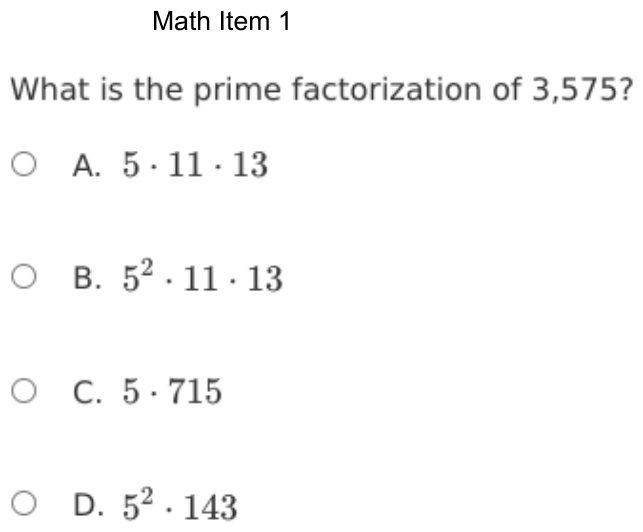
What is the prime factorization of 3,575?
- A
- B
- C
- D
Show the answer
Correct answer: B
By observation, 3,575 ends in 75; therefore, 3,575 is divisible by 25.
Test 143 for factors and eliminate 3, 5, and 7, but 11 is a factor.
; both 11 and 13 are prime numbers.
The first factor, 25, is not prime but is the product of primes, .
The prime factorization of 3,575 is .
Question analysis
This number question asks for the prime factorization of 3,575, chosen from four products of factors. Students divide by primes, using divisibility tests, until only primes remain. The four products look much alike, so the work must be carried all the way through, keeping count of every prime divided out along the way.
- Grade level
- Grade 6 content, by NYS standard
- Compared with grade 7
- Below grade 7 Breaking a number into primes is grade 6 number work that relies on divisibility tests. The number here is larger than in most class examples, but the work is still a few divisions, lighter than typical grade 7 problems.
- Estimated difficulty
- Straightforward: two steps or one careful reading.
- Thinking it demands
- Depth of knowledge 1, recall and reproduction · mainly apply
- What makes it hard
- A very close wrong answer moderate
- Something you must already know minor
- Solution
- 3 steps
- Reading level
- Question and choices: about grade 11, 10 words.
- Students, last 30 days
- Not enough answers yet to show (it takes 10).
Why it is hard, traps and wrong answers (shows the answer)
Why it is hard
Three of the four choices multiply back to 3,575, so checking a product rules out only the one that equals 715. The question turns on whether 143 is prime: it survives the quick tests for 2, 3 and 5, and the factor 11 is easy to miss. Students who keep dividing until every factor is prime, and who write a prime as often as it divides, finish in under a minute.
A very close wrong answer moderate Choosing the answer
5² · 143 matches the right factorization in its first factor and multiplies back to 3,575 just as well, so a product check cannot separate them; only splitting 143 into 11 × 13 does. (Embretson & Wetzel, 1987; Gorin & Embretson, 2006; Ascalon et al., 2007)
Something you must already know minor Working it out
Nothing on the page defines a prime factorization or gives a test for 11, and 143 passes the familiar quick tests for 2, 3 and 5, so it looks prime. (Anderson & Krathwohl, 2001)
Strategy: Divide by the smallest prime that goes in evenly, again and again, writing down every prime you use until the quotient reaches 1, then compare that list with each choice.
Traps
- Stops one step early: A choice is a number from partway through the solution.
- Misunderstands the concept: A wrong belief about a concept: that percents can be added, that area grows like length, that averages can be averaged, that a bigger denominator means a bigger fraction.
The wrong answers, classified
A Misunderstands the concept (Smith, diSessa & Roschelle, 1993; De Bock et al., 1998; Ni & Zhou, 2005)
Lists each prime that divides 3,575 only once, 5, 11 and 13, as if a factorization named which primes divide it, though their product is only 715.
C Stops one step early (King et al., 2004; Gierl et al., 2017)
Divides out one 5 and stops at 5 · 715, a true factorization but not a prime one, though 715 ends in 5 and splits further.
D Stops one step early (King et al., 2004; Gierl et al., 2017)
Divides by 25 and stops at 143, which passes the tests for 2, 3 and 5 and looks prime, though 143 = 11 × 13.
Worked solution, step by step
Formulas used
- Divisibility by 25
- A number is divisible by 25 when 25 goes into it with no remainder. You only need to look at the last two digits. If they are 00, 25, 50 or 75, the number is divisible by 25. This works because 100 is 4 × 25, so the hundreds never leave a remainder.
- Writing a repeated factor with an exponent
- a is any number. The small raised 2 is an exponent. It tells you how many times a is used as a factor, so 5² means 5 × 5 = 25. Use an exponent in a prime factorization when the same prime shows up more than once.
Sort out the question
A prime number is a whole number greater than 1 whose only factors are 1 and itself. Examples are 2, 3, 5, 7, 11 and 13. The prime factorization of 3,575 writes it as a product (the answer to a multiplication) of prime numbers only. So you must break 3,575 down until every factor is prime.
Divide by 25 first
3,575 ends in 75. So it is divisible by 25:
That means 3,575 = 25 × 143. But 25 is not prime. It is 5 × 5, which you can write as 5².
Test 143 for prime factors
Now see if 143 splits. Try the primes in order. 143 is odd, so 2 does not work. Its digits add to 1 + 4 + 3 = 8, which is not a multiple of 3, so 3 does not work. It does not end in 0 or 5, so 5 does not work. Since 7 × 20 = 140, 143 ÷ 7 leaves a remainder of 3, so 7 does not work. Now try 11:
So 143 = 11 × 13, and both 11 and 13 are prime.
Watch out: 143 looks prime, but it is not. Stopping at 5² · 143 leads to choice D.
Put all the primes together
Collect every prime you found. The 5 appears twice, then 11 and 13 once each. The dot · means times, just like ×.
Watch out: write the 5 twice, since it divides 3,575 twice. Writing it once gives 5 · 11 · 13, choice A, which equals only 715. Choice C, 5 · 715, stops too early, because 715 ends in 5 and splits further.
So the answer is B, .
Check your answer
Multiply the primes back together: 25 × 11 = 275, and 275 × 13 = 3,575. That is the number you started with. Also, 5, 11 and 13 are all prime, so nothing can be split further.
More questions like this
The original DOE question