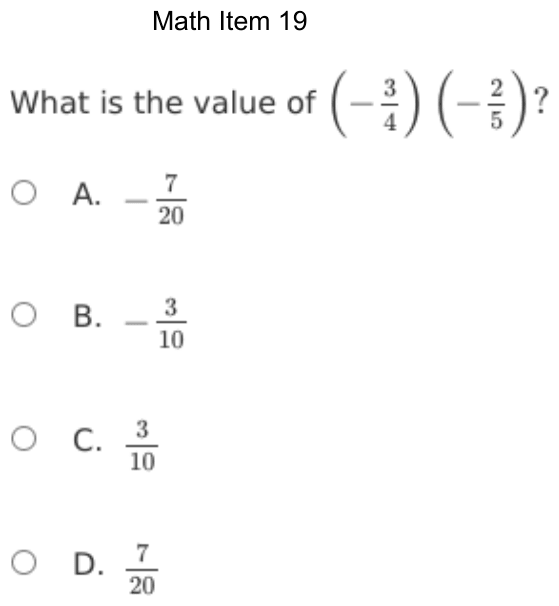
Question
What is the value of ?
- A
- B
- C
- D
Show the answer
Correct answer: C
Evaluate the expression by multiplying the terms in the numerator and the terms in the denominator. The product of two negative values is positive:
Simplify the result:
Question analysis
This question asks for the product of negative three fourths and negative two fifths. Students multiply the fractions, settle the sign of the result, and simplify. The choices mix positive and negative answers with results from other operations, so both the sign and the operation have to be right.
- Grade level
- Grade 7 content, by NYS standard
- Compared with grade 7
- At grade 7 Multiplying two negative fractions is a standard grade 7 exercise, done here in one product and one simplification. It matches typical classroom work, with the sign rule and lowest terms as the only points of care.
- Estimated difficulty
- Routine: one familiar step, little to misread.
- Thinking it demands
- Depth of knowledge 1, recall and reproduction · mainly apply
- What makes it hard
- A very close wrong answer minor
- Error-prone arithmetic minor
- Solution
- 2 steps
- Reading level
- Question and choices: about grade 10, 10 words.
- Students, last 30 days
- Not enough answers yet to show (it takes 10).
Why it is hard, traps and wrong answers (shows the answer)
Why it is hard
This is a single product of two fractions, and most students finish it quickly. The choices are built around two decisions, the sign of the product and the operation itself: two of them come from subtracting the fractions, and one keeps a minus sign that two negative factors cancel. Settling the sign first, positive, rules out half of the choices before any multiplying.
A very close wrong answer minor Choosing the answer
3/10 and −3/10 are identical except for the sign, so the size alone does not separate them; only the rule for multiplying two negatives does. (Embretson & Wetzel, 1987; Gorin & Embretson, 2006; Ascalon et al., 2007)
Error-prone arithmetic minor Working it out
Two negative fractions are multiplied, 3 × 2 over 4 × 5, and the product 6/20 has to be reduced to 3/10 before it matches a choice. (Brown & Burton, 1978; Junker & Sijtsma, 2001)
Strategy: Decide the sign of the product first, then multiply the numerators and the denominators and reduce the fraction to lowest terms.
Traps
- Negatives and direction: Arithmetic with negative numbers, the order of a subtraction, or direction on a number line. (Moving a term across the equals sign without changing its sign is a faulty procedure.)
- Wrong operation: Adds instead of multiplying, divides the wrong way round, turns a ratio or rate upside down, or undoes a step in the wrong direction (subtracts what should be added back).
The wrong answers, classified
A Wrong operation (Hegarty, Mayer & Monk, 1995; King et al., 2004)
Subtracts the fractions instead of multiplying them, −3/4 − (−2/5) = −15/20 + 8/20, which gives −7/20.
B Negatives and direction (Brown & Burton, 1978)
Multiplies the sizes correctly, 3/4 × 2/5 = 6/20 = 3/10, but keeps a minus sign, though two negative factors give a positive product.
D Wrong operation (Hegarty, Mayer & Monk, 1995; King et al., 2004)
Drops both signs and subtracts the sizes, 3/4 − 2/5 = 15/20 − 8/20 = 7/20, instead of multiplying the fractions.
Worked solution, step by step
Formulas used
- Multiplying fractions
- a and c are the tops (numerators). b and d are the bottoms (denominators). Multiply the tops together and the bottoms together. You do not need a common denominator to multiply. That is only for adding and subtracting.
- Multiplying two negatives
- a and b are positive numbers, so −a and −b are negative. A negative times a negative is positive. So when both factors are negative, the minus signs cancel.
Sort out the question
The two fractions sit side by side in parentheses, with nothing between them. That means multiply. Both fractions are negative. You need their product, the answer to the multiplication.
Decide the sign first
A negative times a negative is positive. So the answer will be positive. That rules out choices A and B.
Watch out: choice B, −3/10, has the right size but the wrong sign. The two minus signs cancel.
Multiply tops and bottoms
Now multiply the sizes. Multiply the tops, then the bottoms:
Watch out: do not find a common denominator. That is for adding and subtracting. Subtracting the fractions gives 7/20 or −7/20, choices D and A.
Simplify the fraction
2 goes into both 6 and 20. Divide the top and the bottom by 2:
The product is positive 3/10. So the answer is C, 3/10.
Check your answer
Use decimals. 3/4 is 0.75 and 2/5 is 0.4. Then , which is 3/10. Two negatives give a positive, so the product is positive 3/10.
More questions like this
The original DOE question