Question
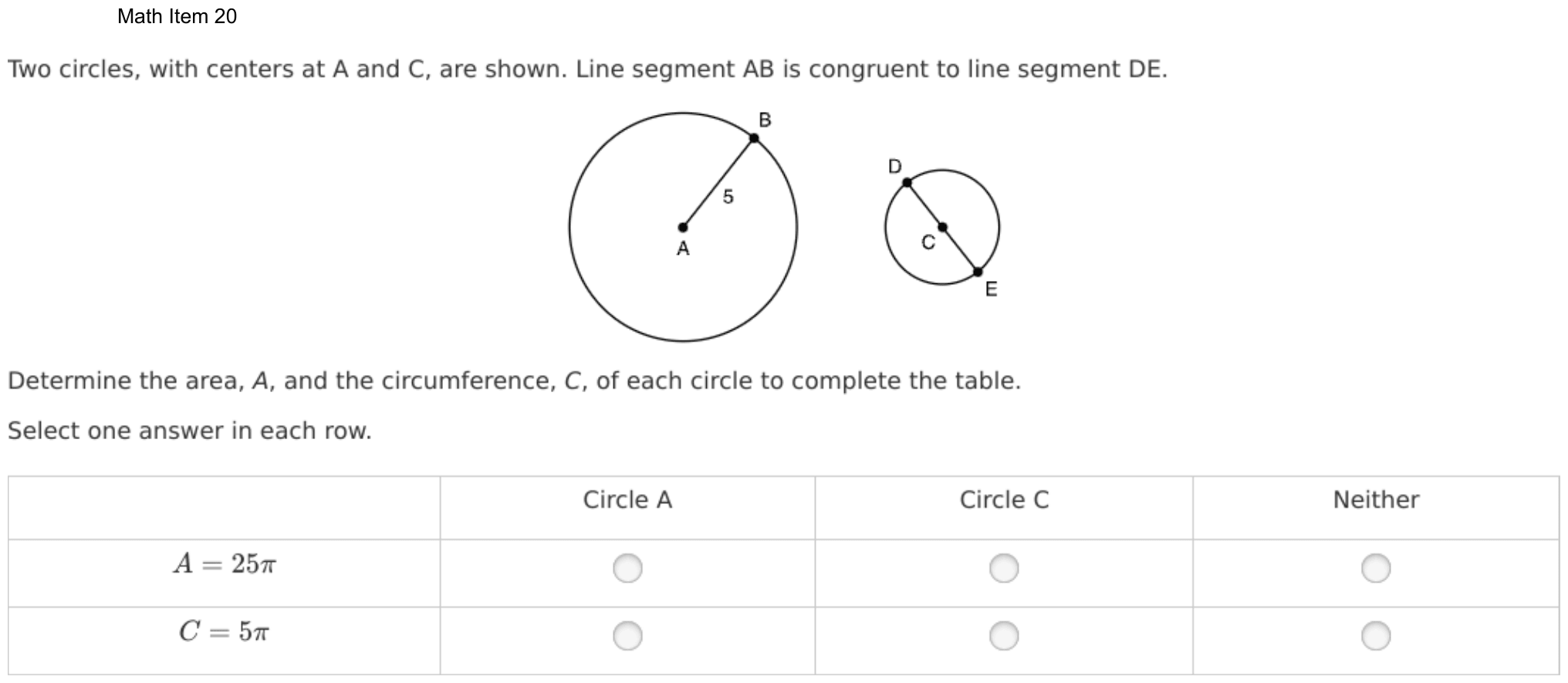
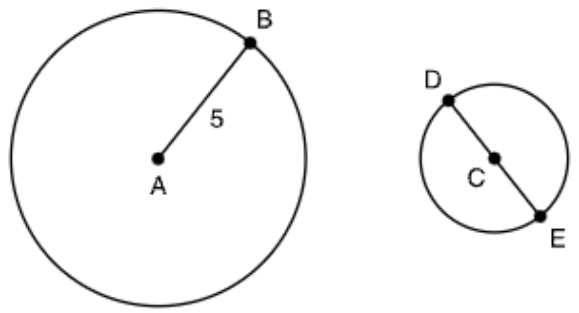
Two circles, with centers at A and C, are shown. Line segment AB is congruent to line segment DE.
Determine the area, A, and the circumference, C, of each circle to complete the table.
Select one answer in each row.
Choose one answer in each row, then check. The DOE has not published how answers with several parts are scored; this site counts one right only when every part is right.
| Circle A | Circle C | Neither | |
|---|---|---|---|
Show the answer
Correct answer: A = 25π: Circle A; C = 5π: Circle C
: Circle A
: Circle C
As shown in the illustration, AB (the radius of Circle A) is 5 units in length. Since DE (the diameter of Circle C) is congruent to AB, we know it is also 5 units in length.
Circle A:
We know the radius of Circle A is 5 so the answer to row 1 is A.
Circle C:
We have to look for the circle with a diameter of 5. That is circle C.
Question analysis
Two circles centered at A and C are shown: radius AB of Circle A is labeled 5, and segment DE, drawn through C, is congruent to AB. Students decide whether an area of 25π and a circumference of 5π each belong to Circle A, Circle C or neither. Keeping radius and diameter apart, and area and circumference, is the challenge.
- NYS standards
- 7.G.4 circle area and circumference
- Grade level
- Grade 7 content, by NYS standard
- Compared with grade 7
- At grade 7 Applying the area and circumference formulas is the grade 7 circle standard. This gives a radius for one circle and, for the other, a segment known only through congruence, and both rows of the table must be right.
- Estimated difficulty
- Moderate: several steps, or a close reading with one strong distractor.
- Thinking it demands
- Depth of knowledge 2, skills and concepts · mainly apply
- What makes it hard
- Reading a figure, table or graph moderate
- Something you must already know moderate
- Much to keep track of minor
- Solution
- 4 steps
- Reading level
- Question and choices: about grade 5, 40 words.
- Students, last 30 days
- Not enough answers yet to show (it takes 10).
Why it is hard, traps and wrong answers (shows the answer)
Why it is hard
Circle A is direct: its labeled radius of 5 gives an area of 25π. Circle C is where points are lost, since its size comes from a sentence rather than a label, and the segment through its center is a diameter, so its circumference is 5π while its area is only 6.25π. The row labels favor guessers, because the A and C in A = 25π and C = 5π match the circles' names, though they stand for area and circumference.
Reading a figure, table or graph moderate Understanding the question
Circle C's size is shown only by segment DE, drawn through center C with no label, and only the stem's sentence that DE is congruent to AB makes it a diameter of 5. (Lesh, Post & Behr, 1987; Kirsch & Mosenthal, 1990)
Something you must already know moderate Working it out
Neither A = πr² nor C = πd is given, and one circle is measured by a radius and the other by a diameter, so each formula needs the right length. (Anderson & Krathwohl, 2001)
Much to keep track of minor Working it out
Four values are in play, areas of 25π and 6.25π and circumferences of 10π and 5π, and both rows must be matched correctly for the item to count. (Sweller, 1988; Carpenter, Just & Shell, 1990)
Strategy: Write down the radius and the diameter of each circle, compute both circles' areas and circumferences in terms of π, then match each value in the table.
Traps
- Wrong formula: Uses a related but wrong formula: perimeter for area, diameter for radius, area for volume, or a misremembered one.
- Misreads the question: Misses or misreads a condition or a word in the question: "at least", "each", "remaining", "not".
- A formula you must know: Needs a formula the test does not give: area, circumference, volume, probability rules.
The wrong answers, classified
1:B Wrong formula (King et al., 2004)
Squares the diameter instead of the radius, so Circle C's area seems to be π × 5² = 25π while Circle A's becomes 100π.
1:C Wrong formula (King et al., 2004)
Uses 2πr for the area, so Circle A seems to have an area of 10π and Circle C one of 5π, and no circle seems to have 25π.
2:A Wrong formula (King et al., 2004)
Uses π times the radius for the circumference, so Circle A's radius of 5 seems to give a circumference of 5π.
2:C Misreads the question (Hegarty, Mayer & Monk, 1995)
Overlooks that DE is congruent to AB, so Circle C has no known size, and with Circle A's circumference at 10π picks Neither.
Worked solution, step by step
Formulas used
- Area of a circle
- A is the area, the space inside the circle. r is the radius, the distance from the center to the edge. π (pi) is a fixed number, a little more than 3. Square the radius, then multiply by π.
- Circumference of a circle
- C is the circumference, the distance around the circle. d is the diameter, the distance across the circle through its center. A diameter is twice as long as a radius. Multiply the diameter by π.
Sort out the question
Circle A has its center at A. Its radius, AB, is 5. Circle C has its center at C. Segment DE goes through C, so it is a diameter. Congruent means the same length, so DE is 5 too.
Careful: in the table, A means area and C means circumference. Circle A and Circle C are just names.
Find each radius and diameter
Circle A: the radius is 5, so the diameter is .
Circle C: the diameter is 5, so the radius is .
Watch out: without the sentence about DE, Circle C seems to have no size. Then you might pick Neither for the second row.
Check the area row
Use the area formula for each circle. For Circle A:
For Circle C:
Only Circle A has an area of 25π.
Watch out: squaring Circle C’s diameter instead of its radius gives 25π by mistake.
Check the circumference row
Use the circumference formula for each circle. For Circle A:
For Circle C:
Only Circle C has a circumference of 5π.
Watch out: π times the radius is not the circumference. It would give Circle A 5π.
Fill in the table
Choose one button in each row. In the row for A = 25π, choose the Circle A column. In the row for C = 5π, choose the Circle C column. Neither stays empty.
So the answers are A = 25π: Circle A and C = 5π: Circle C.
Check your answer
Compare sizes. Circle A’s radius, 5, is twice Circle C’s radius, 2.5. So the distance around Circle C should be half of Circle A’s 10π. Half of 10π is 5π, which matches. And the bigger circle has the bigger area, 25π.
More questions like this
The original DOE question